




Crossref Citations

This article has been cited by the following publications. This list is generated based on data provided by Crossref.
Harms, P. D.
Krasikova, Dina V.
and
Luthans, Fred
2018.
Not Me, But Reflects Me: Validating a Simple Implicit Measure of Psychological Capital.
Journal of Personality Assessment,
Vol. 100,
Issue. 5,
p.
551.
Teng, Yuejia
Brannick, Michael T.
and
Borman, Walter C.
2020.
Capturing Resilience in Context: Development and Validation of a Situational Judgment Test of Resilience.
Human Performance,
Vol. 33,
Issue. 2-3,
p.
74.
Weinzimmer, Laurence G.
2021.
Work Life After Failure?: How Employees Bounce Back, Learn, and Recover from Work-Related Setbacks.
p.
109.
Mhaka-Mutepfa, Magen
and
Shaibu, Sheila
2022.
Resilience: Key Factors Associated With Resilience of Older People in Botswana.
Sage Open,
Vol. 12,
Issue. 3,
Dasborough, Marie T.
Ashkanasy, Neal M.
Humphrey, Ronald H.
Harms, P.D.
Credé, Marcus
and
Wood, Dustin
2022.
Does leadership still not need emotional intelligence? Continuing “The Great EI Debate”.
The Leadership Quarterly,
Vol. 33,
Issue. 6,
p.
101539.
Fahy, Amy
McCartney, Steven
Fu, Na
and
Roche, Joseph
2024.
Investigating the indirect impact of transformational leadership on performance and work alienation: evidence from school principals navigating COVID-19.
Leadership & Organization Development Journal,
Vol. 45,
Issue. 5,
p.
877.
Singh, Shruti
and
Chakraborty, Anindita
2025.
Construing the Relationship Between Entrepreneurial Adversity and Mental Well-being of Small Business Owners During COVID-19 Outbreak: The Mediating Role of Entrepreneurial Resilience.
FIIB Business Review,
Vol. 14,
Issue. 5,
p.
645.
Sipon, Zuraidah
Majid, Muhammad
and
Sahari, Norshahniza
2025.
Next-Generation Business Models: The Role of Advanced Technologies in Defining the Future.
Vol. 1572,
Issue. ,
p.
79.
We appreciate the authors of the target article (Britt, Shen, Sinclair, Grossman, & Klieger, Reference Britt, Shen, Sinclair, Grossman and Klieger2016) shining a spotlight on the important work being done in the study of resilience and providing a historical overview of how resilience has been conceptualized and assessed in the past. To add to this review, we would briefly like to comment on current developments in the field of resilience and related fields that may have broader implications for both the study of resilience and for many other topics in the industrial–organizational literature as well.
As the target article authors explained, the concept of resilience has been notoriously hard to pin down in terms of definitions and measurement (see Meredith et al., Reference Meredith, Sherbourne, Gaillot, Hansell, Ritschard, Parker and Wrenn2011, and Vanhove, Herian, Harms, & Luthans, Reference Vanhove, Herian, Harms and Luthans2015, for reviews). Beyond the dual definition of resilience as (a) maintaining well-being and performance in the face of adversity and (b) “bouncing back” quickly in terms of well-being and performance when serious setbacks do occur, there is also the issue that resilience has been assessed as a capacity (a predictor) and as a pattern of responses to problems (an outcome). These issues are covered well in the target article, and several worthwhile suggestions are made for future research, but a number of recent developments that were also neglected in the discussion warrant attention.
Measuring Resilience as an Outcome
We would first like to address research where resilience is defined and assessed as an outcome. As the authors of the target article (Britt et al.) pointed out, this requires a time element to be included in the assessment of whether an individual is resilient or not. That said, most of the existing literature in this area is deficient because it typically only looks at single instances of crisis and then attempts to extrapolate from them. We believe that a better approach is found in the daily diary studies now being conducted by both practitioners (e.g., Welbourne, Reference Welbourne2014) and academics (e.g., Sotak, Reference Sotak2015). This research goes beyond just looking at simple three- or four-wave patterns or means and standard deviations and instead can look at the average response to a wide variety of threats and problems while at the same time accounting for daily, weekly, and monthly fluctuations in well-being and performance. In other words, it offers a precision of measurement not possible in prior resilience research and, with it, the ability to more accurately categorize and predict future behavior. Welbourne's (Reference Welbourne2014) approach is particularly interesting in that individuals are not only assessed on psychometric tools but are also asked to describe the events that led to increases or decreases in well-being and performance. This information would be particularly useful if we want to move beyond generalized models and come to a better understanding of the particular triggers that can stress an individual and which stressors an individual most quickly recovers from. This approach need not be limited to the individual level of analysis. For example, we are aware of research within the U.S. Army looking at unit- and organizational-level well-being in the same way.
Measuring Resilience as a Predictor
As noted in the target article (Britt et al.), most of the existing research on resiliency (and related constructs) looks at it as a unidimensional or multidimensional trait, and nearly all of it has utilized self-report questionnaires to assess resilience. There are some exceptions with recent research exploring the notion of whether the capacity for resilience can be assessed using neurological measurements (e.g., Quisenberry, Reference Quisenberry2015) or implicit measures (e.g., Harms & Luthans, Reference Harms and Luthans2012). Such approaches, though promising, are still largely in their infancy. More established are approaches that do not necessarily change the measurement approach but refine the theoretical understanding of what should be measured.
As the target article pointed out, constructs such as psychological capital (Luthans, Youssef-Morgan, & Avolio, Reference Luthans, Youssef-Morgan and Avolio2015) and hardiness (Bartone, Reference Bartone2006; Maddi, Reference Maddi2007) tend to assess resilience more or less retrospectively. That is, they ask individuals to reflect on past experiences and then make judgments about the likelihood of them being resilient in the future. This approach can be said to measure “efficacy for resilience” rather than resilience itself. In terms of personality, resilience assessed this way is akin to phenotypic personality traits such as the Big Five (Goldberg, Reference Goldberg1993). That is, it probably should be thought of as a summary of a pattern of behavior, cognitions, or emotions rather than the source or driver of the pattern (Hogan, Reference Hogan2005). Because of this, these approaches can be very limiting in terms of understanding why individuals experience a failure to be resilient when faced with stress or for determining the most effective interventions to enhance resilience. It is also terribly unsurprising when such measures are predictive of well-being or performance because either their item content often includes the criterion or the measure simply represents an assessment of the accuracy of one's self-understanding (Mõttus, in press; Nicholls, Licht, & Pearl, Reference Nicholls, Licht and Pearl1982). This means that associations between resiliency measures and resilient outcomes may be significant due to quite literally being measures “of the same thing” rather than actually illuminating something new as to why an individual may be resilient (Harms, Wood, & Spain, Reference Harms, Wood and Spain2016).
Modern approaches to resilience resolve this issue by assuming a functionalist approach to the assessment of resilience. That is, they put aside the classical structuralist idea that factor analysis results in source traits (i.e., the causal antecedents or drivers of the indicator items in the analysis; Cattell, Reference Cattell1946, Reference Cattell1950) and instead look at the motives, abilities, and perceptual tendencies that drive patterns of behavior. Prior research in the field of personality has utilized this approach to gain a deeper understanding of the Big Five (Wood, Gardner, & Harms, Reference Wood, Gardner and Harms2015), the Dark Triad (Harms, Spain, & Wood, Reference Harms, Spain and Wood2014), and leadership styles (Harms, Reference Harms2016). In terms of resilience, this approach assumes that there is no need to assume that there is a single, higher-order factor driving resilient behaviors. Instead, resilient behavior emerges out a number of constructs that are not necessarily correlated with one another. One of the earliest and most prominent examples of this is the U.S. Army's Global Assessment Tool (GAT; Peterson, Park, & Castro, Reference Peterson, Park and Castro2011). In this resilience measure, 15 distinct constructs are assessed, which were judged by experts as likely being factors in determining whether or not an individual would be resilient. Even though the authors of this instrument did ultimately decide to combine many of these components into four higher-order “fitness” dimensions (social, emotional, spiritual, and family), there were no attempts made to create a single, higher-order dimension of resilience. This meant that the designers of the Comprehensive Soldier Fitness program were able to more precisely design their training content to address areas where soldiers may have lacked specific skills, which may have led to them experiencing problems in a particular domain of their lives (Lester, Harms, Herian, & Sowden, Reference Lester, Harms, Herian and Sowden2015).
A more recent example of this approach is the 5×5 Resilience Scale (5×5; DeSimone, Harms, Vanhove, & Herian, in press). Unlike the GAT, the 5×5 was developed by “seeding” an analysis with items containing prototypical efficacy for resilience content (e.g., “I readily overcome setbacks”) and then looking for the motives, abilities, and perceptions that were most predictive of these items in a pool of over 2,000 items (see Wood et al., Reference Wood, Gardner and Harms2015, for a related example). Consequently, the resulting measure includes five dimensions (optimism, social support, emotional regulation, self-efficacy, and adaptability) but avoids the problem of creating measures with items explicitly dealing with self-evaluations of the capacity for resiliency. Moreover, factor analyses confirmed that a higher-order factor did not fit as well as a bifactor model (see Credé & Harms, Reference Credé and Harms2015, for a discussion). Consequently, an overall “resilience” factor is not preferable to treating each of the five dimensions as distinct antecedents of resilience. As noted above, one of the major advantages of this approach is that interventions can be designed with specific antecedents of resilience in mind. For example, issues surrounding a perceived lack of skill or efficacy could be dealt with by having the individual practice until they build confidence. Perceptions that one lacks a social support network could be addressed by making social resources more explicit, having managers engage in more relational approaches, or having the individual placed in a mentorship program.
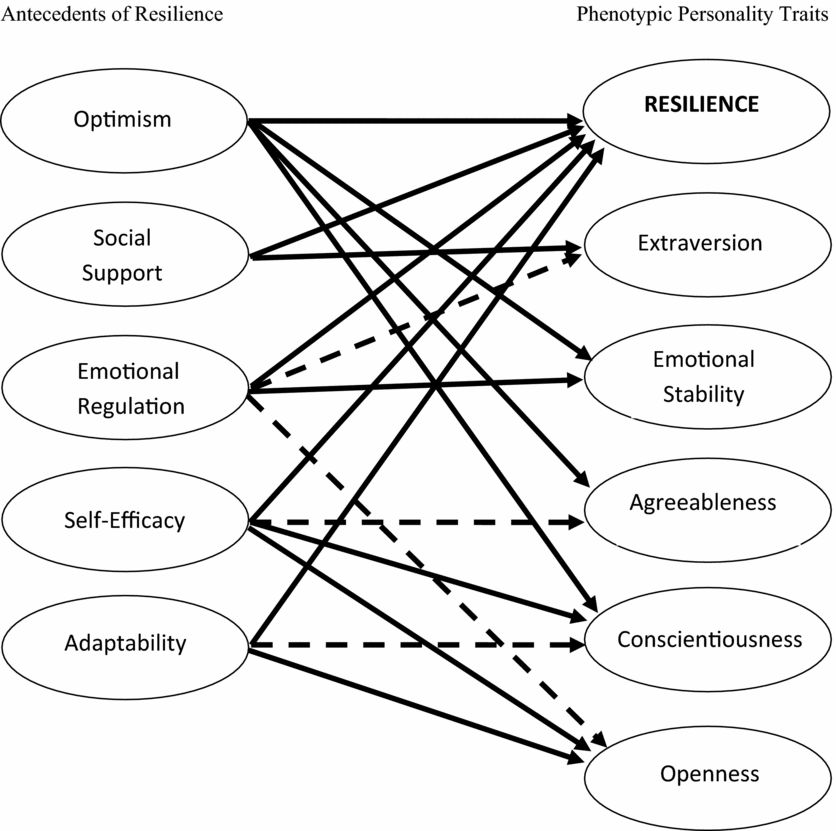
One additional benefit of this approach is that it allows researchers to understand why resilience measures tend to correlate with other personality measures such as the Big Five. As the authors of the target article (Britt et al.) noted, some researchers have attempted to show that resilience measures are largely redundant with Big Five measures and show little incremental validity above and beyond them. A functionalist approach can illustrate not only why this is the case but also why these analyses are largely meaningless. Specifically, because both “resilience” (as it is usually studied) and the Big Five traits are products of various motives, abilities, and perceptions, it is not surprising that there would be some overlap in their antecedents. We illustrate this using a subset of the Eugene–Springfield Community Sample along with the 5×5 (DeSimone et al., in press) and the Big Five Inventory (John & Srivastava, Reference John, Srivastava, Pervin and John1999). As shown in Figure 1, a major reason why emotional stability correlates with resilience is because both characteristics are facilitated by optimistic expectations (e.g., “I expect things to fail” [reversed]) and emotional regulation abilities (e.g., “I keep my emotions under control”). In contrast, most existing measures of resiliency and Big Five traits create measures on the basis of purely statistical considerations (e.g., which items maximize alpha or which items load most highly in factor analyses). By making conceptual distinctions between different types of psychological traits, a functionalist framework helps to distill the core content of a characteristic like resiliency and helps avoid measures of conceptually distinct content being associated due to sharing redundant item content.
Lines represent significant relationships between constructs. Dashed lines represent negative relationships.
Consequently, even if many “resilience” measures do not show incremental validity beyond the Big Five, such results do not diminish the theoretical and practical value of studying resilience. The value from such measures comes from being able to better understand why the individual is or isn't resilient rather than what they typically do. As we move forward, we would encourage researchers and practitioners to dig deeper into the underlying psychology that underpins resilient behavior. As we have noted, this likely will require adopting more theoretical approaches that distinguish between different types of items even when they are highly correlated with one another. We believe that doing so will enhance our ability to not only select but also train resilient individuals in the future. Prior research has demonstrated both that resilience is important and that it can be trained, but the results of training are highly variable (Vanhove, Herian, Perez, Harms, & Lester, Reference Vanhove, Herian, Perez, Harms and Lester2016). By targeting the distinct antecedents of resilience, organizations can better prepare their employees and leaders to deal with severe stressors and to be ready to bounce back in the future.