INTRODUCTION
Hans-Georg Müller, the second author, loved travelling, observing and collecting numerous plants and animals, and thus his life (which ended last year) proceeded in a very unusual way.
Already years ago he had sent his collected amphipods with remarks, tentative determinations and annotations to the first author, but only now some of them could be studied.
MATERIALS AND METHODS
Studied here is material H.-G. Müller collected during February and March 1988, on coral reef at Bora Bora, Society Islands, French Polynesia (see also Müller, Reference Müller1990, Reference Müller1993a, Reference Müllerb). Samples were taken mainly by snorkelling in shallow depths; best results were obtained by swirling the substrates by hand and collecting the organic material suspended in the water with a net of 0.5 mm mesh width. The result was fixed using 3–5% formalin, then washed in fresh water, sorted under a dissecting microscope and preserved in 70% alcohol. Slides were prepared with glycerine and closed by heated paraffin. Pencil drawings were done using various compound microscopes with camera lucida; the transfer or ‘inking’ was done by hand as well as using the program ‘Illustrator’.
All examined material is deposited at the Crustacean collection of the Museo di Storia Naturale, Verona, Italy (MVRCr).
Acronyms used in morphological descriptions: A.1, 2, antenna 1, 2; acc., accessory; art., article; Cx., coxal plate; Ep., epimeral plate; flag., flagellum; Gn.1, 2, gnathopod 1, 2; Hd, head; LL, lower lip; Md., mandible; Mx.1, 2, maxilla 1, 2; Mxp., maxilliped; P.3–7, peraeopods 3–7; Ped., peduncle; Pl., pleopod; T., telson; U.1–3, uropods 1–3; UL, upper lip.
SYSTEMATICS
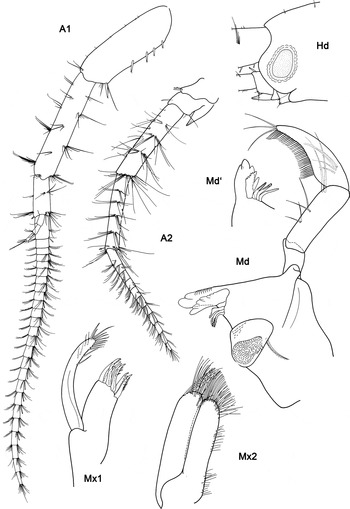
Elasmopus alalo. Hd, head, A.1, 2, antennae; Mx.1, 2, maxillae; Md., mandible.

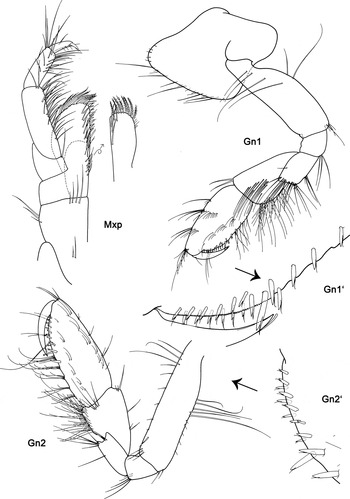
Elasmopus alalo female. Mxp., maxilliped; Gn.1, 2, gnathopod 1, 2 with enlarged parts.

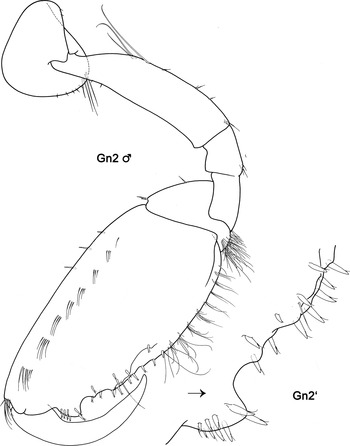
Elasmopus alalo. Gn.2 male with distal palm enlarged.

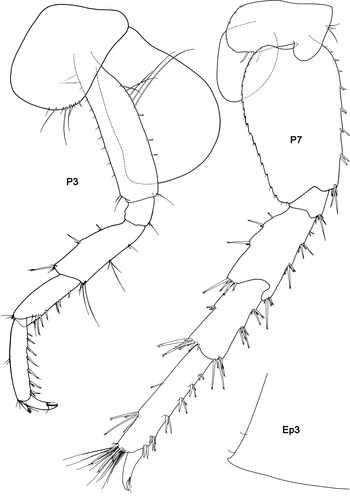
Elasmopus alalo. P.3, 7, peraeopod 3, 7; Ep.3, third epimeral plate.

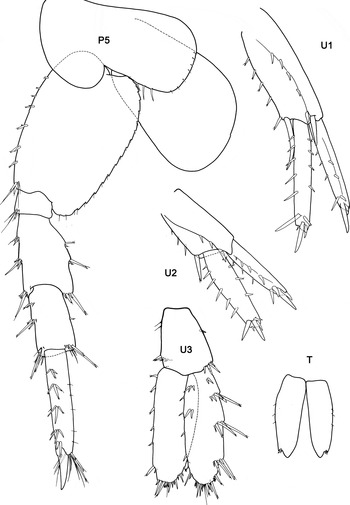
Elasmopus alalo. P.5, peraeopod 5; U.1–3, uropods 1–3; T., telson.

Elasmopus alalo Myers, Reference Myers1986: 273, figures 4, 5; 1995: 27; Lowry & Hughes, Reference Lowry, Hughes, Lowry and Myers2009: 646, figures 1, 2; Hughes & Lowry, Reference Hughes and Lowry2011: 583.
Elasmopus pseudaffinis Barnard, Reference Barnard1965: 502, figures 12, 13; Ledoyer, Reference Ledoyer1972: 219, figures 38, 39; Reference Ledoyer1978: 273, figure 20a (part.); 1982: 483, figure 182; Reference Ledoyer1984: 65, figure 30b; Berents, Reference Berents1983: 118, figures 15, 16; ?Ren, Reference Ren1998: 204, figure 6.
MATERIAL EXAMINED
Two males, 4 females 6–7 mm, 2 juveniles in alcohol. Moorea, Society Islands, Temae, the Islet Reef, Sargassum, lower intertidal; 27 March 1988.
REMARKS
As seen in the synonymy, this species was for a long time determined as E. pseudaffinis Schellenberg. Differences are the size (up to 12.5 mm for E. alalo, 6 mm for E. pseudaffinis), the shape of Cx.1 with rounded versus acute anterodistal corner and the basis of P.5–7 which is castelloserrate in E. pseudaffinis, but here crenulate. In different descriptions the posteroventral corner of Ep.3 is described as simply rounded or with a small acute tooth. In the here examined material there is a clear but quite small upturned tooth.
DISTRIBUTION
Madagascar, Mauritius, Micronesia, Polynesia, New Caledonia, Australia.
Elasmopus hawaiensis habitus male.

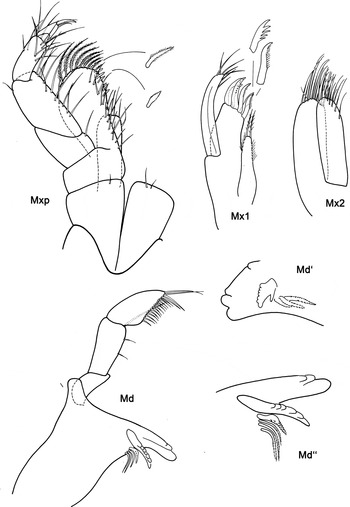
Elasmopus hawaiensis. Mxp., maxilliped; Mx.1, Mx.2, first and second maxilla; Md., mandible with parts enlarged.

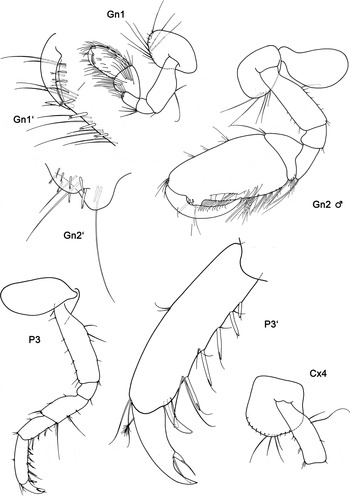
Elasmopus hawaiensis. Gn.1, gnathopod 1; Gn.2, gnathopod 2; P.3, peraeopod 3; Cx.4, coxalplate 4.

Elasmopus hawaiensis. P.5, 6, 7, peraeopods 5–7; Pl., pleopod; U.1, 2, 3, uropods 1–3; Ep.1, 2, 3, epimeral plates 1–3; T., telson.

Elasmopus ecuadoriensis hawaiensis Schellenberg, Reference Schellenberg1938: 54, figure 27; Barnard, Reference Barnard1970: 119, figure 69; Ledoyer, Reference Ledoyer1972: 213, pl. 33–34; 1982: 466, figure 175.
Elasmopus hawaiensis Barnard, Reference Barnard1979: 67.
MATERIAL EXAMINED
Afareaitu, coralligène, coral slope, fringing reef dead corals, 26 March 1988, 1–2 m; 1 specimen in alcohol, 2 slides: MVRCr 7215, 7216.
REMARKS
In this species the telson shape is illustrated by different authors: with rounded and prominent inner lobe on each of the halves (= ‘rapax-telson’), with shorter rounded inner and longer acute outer lobe, or both lobes of subequal size (all three in Barnard, Reference Barnard1970: 120, figure 69, but also Ledoyer, Reference Ledoyer1982: 467, figure 175). Quite uncommon is the shape of P.6 basis with a concave serrate posterior margin.
The difference between E. ecuadoriensis Schellenberg, 1936 and E. hawaiensis Schellenberg, Reference Schellenberg1938 is therefore not well defined. Schellenberg stresses the different spination of the telson, when erecting the ‘E. ecuadoriensis subspecies hawaiensis’ (E.e. with 3 long and 1 short spine on each telsonic half, E.h. only with one long and one short spine, see Schellenberg Reference Schellenberg1938: 54–55), but Barnard, Reference Barnard1979 illustrates a male of his ‘[?] E. ecuadoriensis Schellenberg' with three long and strong spines plus one short on the telson, but also another male with ‘abnormal spination and apical shape’ with 1–2 long spines and one short one (which is exactly the shape of E. hawaiensis, also coming from the Galapagos!).
We followed the definition of the telson spination, thus call our material ‘E. hawaiensis’, but strongly doubt about the existence of two separate species.
DISTRIBUTION
Madagascar, Polynesia, Galapagos.
Elasmopus hooheno. A1+ A1′, first antenna; A2, second antenna; Hd., head.

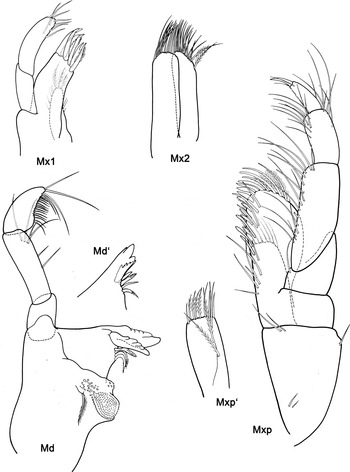
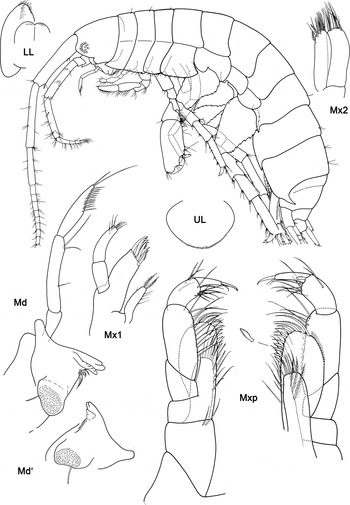
Elasmopus hooheno. Mx.1, 2, maxillae 1, 2; Md, Md′, mandible; Mxp, Mxp′, maxilliped.

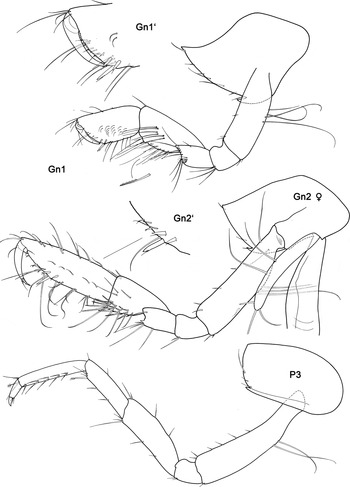
Elasmopus hooheno. Gn.1, first gnathopod; Gn.1′, palm of first gnathopod enlarged; Gn.2, second gnathopod in both sexes, Gn.2′, palm of second gnathopod enlarged.

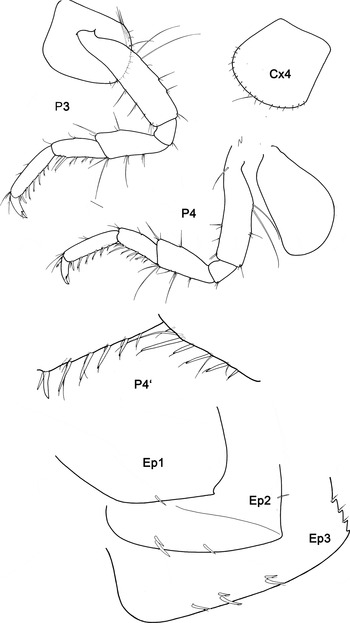
Elasmopus hooheno. P.3, 4, peraeopods 3, 4; P.4′, propodus and carpus of peraeopod 4 enlarged; Ep.1–3, epimeral plates 1–3.

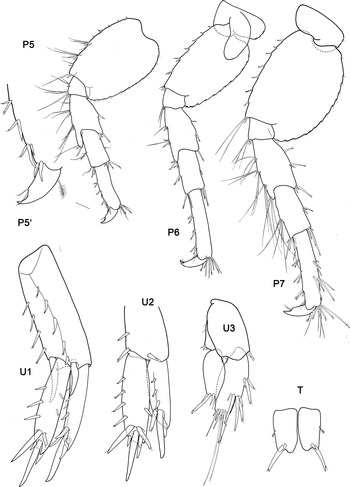
Elasmopus hooheno. P.5–7, posterior peraeopods; P5′, dactylus and propodus enlarged; U.1–3, uropods 1–3; T., telson.

Barnard, Reference Barnard1970: 121, figure 70; Ledoyer, Reference Ledoyer1972: 217, pl. 35, 36; Ledoyer, Reference Ledoyer1982: 470, figure 177; Berents, Reference Berents1983: 116, figure 3; Ren, Reference Ren1998: 197, figure 3.
MATERIAL EXAMINED
Eight males, 1 female in alcohol, Marea Afareaitu, Moorea, coral slope 1–2 m depth, March 1988; four slides male and female: MVRCr 7211–7214.
REMARKS
Although in this material the setae on the basis of P.5–7 are probably lost, this species is quite characteristic by the (minutely) serrate Ep.3, unusually short art.3 of the Md. palp, by the setose coxal plates, the two stubs sticking up along the setose palmar margin of Gn.2 male, the strikingly acute anterodistal corner of Gn.2 male basis with strong spines along the anterior margin (cf. also Ledoyer, Reference Ledoyer1972, figure 36, 1982, figure 177), the clearly unequal rami of U.3 and the very equal length of inner and outer lobe in both telsonic halves.
DISTRIBUTION
Madagascar, Mauritius, India, South China Sea, Indonesia, Polynesia, Hawaii, Australia.
Elasmopus polynesus sp. nov. Mx.1, 2, maxilla 1, 2; Md., mandible, Mxp., maxilliped, LL, lower lip; UL, upper lip.

Elasmopus polynesus sp. nov. Gn.1, gnathopod 1; Gn.2, gnathopod 2; P.3, peraeopod 3.

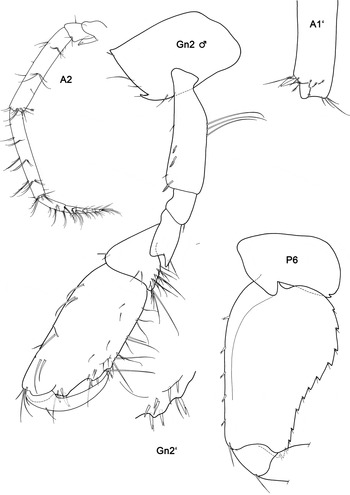
Elasmopus polynesus sp. nov. A.2, second antenna; A.1′, distal end of peduncle art.1 in first antenna; Gn.2 male, gnathopod 2; P.6, peraeopod 6.

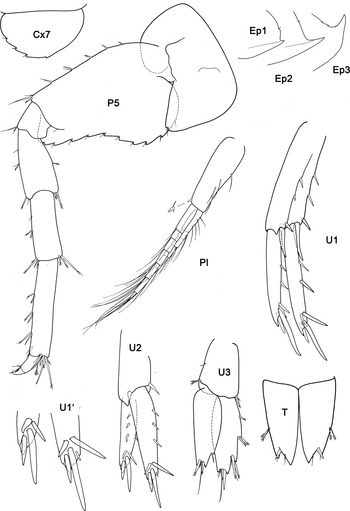
Elasmopus polynesus sp. nov. Cx.7, seventh coxa; P.5, peraeopod 5; Ep.1–3, epimeral plates 1–3; Pl., pleopod; U.1–3, uropods 1–3; T., telson.

MATERIAL EXAMINED
Holotype male 4.5 mm, Bora Bora near Vaitape, fringe of coral reef, dead corals, covered with algae and sponges, 0.5–2 m depth, 27 February–6 March 1988, coll. H.-G. Müller; MVRCr 462, 7217–7220 slides, remaining parts in alcohol.
Additional material: 31 males, 13 females in alcohol, same locality; female 4 mm, same locality, 1 slide: MVRCr 7221.
ETYMOLOGY
Polynices was one of the sons of Oedipus and brother of Antigone, he fought over the kingship of Thebes. The name should allude to the type locality of French Polynesia.
DESCRIPTION
Length: 3–5 mm.
Head: A.1 > half body length, acc. flag. with ? articles; A.2 half or more than length of A.1, on peduncle art.4, 5 few marginal setae of about the length of width of peduncle articles flagellum with 5–6 articles.
Mouthparts: Md. palp in total long and slender, art.2 > art.3, art.3 unusually narrow, l:b = 4.25. Md. art.1 distally rounded. Md. art.1 about half length of art.2.
Peraeon: Cx.1 anteroventral corner acute, with small notch on antero-ventral margin and larger sharp incision on posteroventral end. Gn.1 basis on posterior margin with long setae; carpus > propodus which is facially setose, palm well defined by corner of about 120°. Cx.2 in both sexes the same sharp incision on posteroventral corner. Gn.2 propodus female very slender, ratio l:b = >3, hind margin smooth, 1–3 spines on palmar corner stronger than those along hind margin. Gn.2 male posterior margin of basis with long setae, carpus dorsally evenly convex, ratio propodus: carpus = 2.3, propodus ratio l:b = 2, palm with wide excavation, hind margin with few long setae, dactylar hinge spine present on small hump; dactylus regularly curved, slender, reaching ≤ half length of propodus. Peraeopods: Cx.3 again the same sharp incision on posteroventral margin. Cx.5, 6 posteroventral corner with incision. Cx.7 regularly rounded, serrated. P.5–7 basis pear-shaped, anterior margin slightly excavate with few small spines, posterior margin coarsely serrate, proximally widened and regularly convex, medio-distal narrowing, thus outline nearly like a question-mark; with small serrated posterodistal lobe; hind margins of propodus and carpus without or with scarce setae.
Pleon: Ep.1–3 posterodistal corner with acute tooth, posterior margin in Ep.1 with small additional incision, in Ep.3 with two small additional incisions, in Ep.3 distoposterior tooth unusually long and with 90° angle upturned; inferior margins smooth. Urosome without bump. U.3 rami subequal and longer than peduncle. Telson cleft, l ≥ b, halves distally deeply incised, with acute inner lobes longer than acute outer ones; one strong distal spine sitting inside incision, subequal to or not reaching length of acute inner lobe; mediolaterally two plumose setae.
ECOLOGY
From fringe of coral reef, dead corals, covered with algae and sponges, 0.5–2 m depth.
DISTRIBUTION
Bora Bora (Polynesia).
REMARKS
This species has some similarity to Elasmopus sp. A LeCroy, Reference LeCroy2000: 91, figure 127 from Florida. After the sketches there are differences in Cx.1 (here the anterior margin is clearly excavate) and Gn.2 (the palm has a wide and shallow excavation here, versus a narrow and U-shaped one in Elasmopus sp. A). After the verbal description there are furthermore differences in the basis of P.5–7 (in Elasmopus sp. A only minutely serrate but with long setae, versus coarsely serrate here, lacking any long setae, and all characteristically concave on the hind margin) and the shape of Ep.2 (here with unusually lengthened and pointed tooth). The shape of Ep.3 is quite unusual within the genus, and is shared in these two species.
included species: monotypic.
DIAGNOSTIC CHARACTERS
Body smooth, urosomites free. Head rounded anteriorly and ventrally. Antennae slender, A.1 > A.2, accessory flagellum not seen. Md. normal, palp with three arts, not falciform. Mx.1 IP conical, palp with two articles. Mx.2 both plates narrow, IP without medial row of setae. Mxp. long and strong, palp with four articles. Cx.1–4 normal, growing in size, Cx.1, 2 anterodistally acutely lengthened, Cx.3, 4 anterodistal corner rounded, not lobed or excavated. Gn.1, 2 subchelate, Gn.1 < Gn.2, Gn.2 carpus posterodistally lobed. P.5, 6 similar, basis rectangular. P.7 similar but basis with rounded posterior margin. U.1, 2 normal, slightly unequal rami. U.3 biramous, inner ramus much shorter. Telson short, cleft, with distally equally rounded lobes.
ETYMOLOGY
Already a decade ago the second author sent some of his amphipods collected as by-catch in Polynesia: high time to order, separate, remove respectively tackle the accumulated projects … .
Kairos is the Greek god for the Latin aphorism by Horace of ‘carpe diem’, for ‘seize the day’: he has a big curl on his forehead, but is bald on the back of his head, symbolizing that one can cling on to him only when being in front or beside him, but not when he is already gone.
DIFFERENCE FROM CARANGOLIOPSIS
Head not anteroventrally produced (versus produced in Carangoliopsis). Md. palp art.2 only slightly shorter than art.3. Coxae not reduced, Cx.1, 2 anterodistally acutely produced (versus reduced and rounded in Carangoliopsis). P.5–7 basis relatively shorter, P.7 basis not similar to P.5, 6. Telson lobes rounded (versus acute in Carangoliopsis).
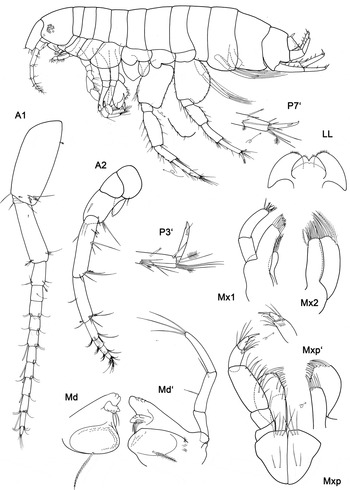
Kairos segregans gen. nov., sp. nov. habitus; A.1, 2, antennae; LL, lower lip; P.3′, P.7′ enlargement of dactylus and propodus of P3, P7; Mx.1, 2 maxillae 1,2; Md., Md′, mandible of both sides; Mxp., Mxp′, maxilliped with plates from both sides.

Kairos segregans gen. nov., sp. nov. Gn.1, 2, gnathopods 1, 2; Gn.2′, dactylus and propodus of Gn.2 enlarged; P.3, P.6, peraeopods 3, 6; Pl, pleopod; U.1–3, uropods 1–3; T., telson.

MATERIAL EXAMINED
Holotype male, 3 mm, Bora Bora, Society Islands, Matira Beach, from dead coral blocks in lagoon, 0.5–2 m depth, March 1988. One slide: MVRCr 7225, remaining parts in alcohol.
Additional material: 7 males 2.5–3 mm, 1 ovigerous female 2.8 mm, 2 juveniles in alcohol; same locality as above, one slides: MVRCr 7226, 7343–45.
ETYMOLOGY
The Latin verb ‘segregare’ means separating and should underline the fact that besides one single species, Carangoliopsis spinulosa Ledoyer, Reference Ledoyer1970, living in the Mediterranean, there is no other genus or species in this family.
DESCRIPTION OF MALE
Length: 2.5–3 mm.
Body: smooth.
Head: A.1 > A.2, not reaching half body length; ped. art.1 subequal art.2 in length, but twice as wide, art.3 < half art.2; flag. with 10 articles. A.2 gland cone reaching half art.3, art.4 > art.5, flag. with 4 articles.
Mouthparts: Md. palp slender, art.3 subequal in length to art.2, but narrower, poorly setose with only three E3-setae and one D2 and one A2-setae; molar large, lacinia mobilis and pars incisivus rounded and blunt. Mx.1 palp with 2 articles, IL slender with apical plumose setae. LL with well developed inner lobes. Mxp. palp quite robust, IL reaching about half length of outer one.
Peraeon: Gn.1 < Gn.2, basis about four times as long as wide, with four setae on posterior margin; merus and carpus densely beset with short setae, three long ones on distoposterior margin of merus and medio-distally on carpus; carpus > propodus in length but somewhat narrower in width; propodus subchelate, palmar corner well developed, about 120°, regularly rounded; dactylus reaching end of palm; 3–4 long anterodistal setae and some along palm and hindmargin. Gn.2 with three long setae on posterior, two short setae on anterior margin and one on posterodistal corner of basis which is about four times as long as wide; long setae also on distoposterior end of merus and ischium; carpus triangular, strongly lobate posteriorly, densely beset with short setae; propodus rectipalmate, along palm strong blunt spines, along hind margin acute narrow robust setae; dactylus coming across the propodus, reaching end of palm. P.3 similar P.4, dactylus with nail, basis somewhat larger than basis Gn.2 anterior margin with three short setae, posterodistal corner with one short and one long seta, ischium quadrate, about as long as wide, also one short and one long seta posterodistally, merus 2.25 times longer than wide, with about 6–8 long setae along posterior margin and some on anterodistal margin; carpus 1.5 times longer than wide, with stiff setae on posterior margin; propodus narrow, about three times longer than wide with three acute spines along posterior margin and some long ones on anterodistal corner; dactylus shorter than propodus. P.5–P.7 dactylus short, without nail but with additional spine subdistally; basis quadrate, ratio l:b = 1.5, posterodistal corner rectangularly widened, anterior margin with long, posterior one with short setae, both margins smooth; merus about twice as long as wide, on both margins with long setae; carpus half as wide as merus, about 2.5 as long as wide; propodus half as wide but longer, dactylus straight, reaching > half length of propodus. P.6 similar to P.5 but longer rectangular basis with ratio l:b = 5:3. P.7 also subequal, but basis with regularly convex rounded hind margin and not only widened but also lengthened posterodistal corner.
Pleon: Ep.1, 2 all margins smooth, posterodistal corner about rectangular, with minute tooth. Ep.3 all margins smooth, posterodistal corner with clearly developed upturned tooth. U.1 peduncle longer than slightly unequal rami, strongly spinose. U.2 < U.1, similar, rami unequal. U.3 peduncle ratio l:b = 2.3: 2, rami very unequal, the shorter less than half the longer. Telson totally cleft, each half distally regularly rounded without any incision, somewhat wider than long, medio-marginally beset with four plumose setae but no spines.
Sexual difference: no difference observed.
DISTRIBUTION
Bora Bora, Society Islands, French Polynesia.
REMARKS
Carangoliopsis spinulosa Ledoyer, Reference Ledoyer1970 has the head with acutely produced anteroventral corner, which is not the case in the present material. There is a one-articulate acc. flag. reported, which was not seen here. Mouthparts are matching very well. The coxae are here less reduced than in Carangoliopsis sp., Cx.4 is totally unlobed and not excavated. In Gn.1 propodus > carpus in Carangoliopsis sp., < carpus here, otherwise quite similar. Gn.2 carpus is here stronger lobed distoposteriorly, propodus ovoid in Carangoliopsis sp., here rectipalmate. P.7 basis is rectangular in Carangoliopsis sp., here with rounded posterior margin. U.3 ratio of rami-length in Carangoliopsis sp. is longer than in the here studied material. Telson in Carangoliopsis sp., halves triangular, here rounded.
ACKNOWLEDGEMENTS
The first author thanks Ed Bousfield for exchanges of ideas about Carangoliopsidae, and Wim Vader for fruitful collaboration on many different amphipod genera and already 25 visits in Adendorf since our very first contact in 1967.