INTRODUCTION
The jumbo flying squid, Dosidicus gigas, is widely distributed throughout the Eastern Pacific Ocean between 40°N to 45°S (Nigmatullin et al., Reference Nigmatullin, Nesis and Arkhipkin2001), and its distribution tends to be associated with the oceanic waters adjacent to upwelling zones (Nesis, Reference Nesis1970; Ehrhardt et al., Reference Ehrhardt, Jacquemin, García, González, López, Ortíz, Solís and Caddy1983). Dosidicus gigas fisheries are mainly developed in the Gulf of California (Nevárez-Martínez et al., Reference Nevárez-Martínez, Hernández-Herrera, Morales-Bojórquez, Balmori-Ramírez, Cisneros-Mata and Morales-Azpeitia2000; Morales-Bojórquez et al., Reference Morales-Bojórquez, Cisneros-Mata, Nevárez-Martínez and Hernández-Herrera2001) and the coastal or oceanic waters of Peru (Taipe et al., Reference Taipe, Yamashiro, Mariategui, Rojas and Roque2001; Waluda et al., Reference Waluda, Yamashiro, Elvidge, Hobson and Rodhouse2004; Chen & Zhao, Reference Chen and Zhao2006) and Chile (Rocha & Vega, Reference Rocha and Vega2003; Zúñiga et al., Reference Zúñiga, Cubillos and Ibáñez2008; Liu et al., Reference Liu, Chen, Lu, Chen and Qian2010). Off the Costa Rica waters, Japanese commercial jigging vessels started to target the squid during 1997 and 1999 (Ichii et al., Reference Ichii, Mahapatra, Watanabe, Yatsu, Inagake and Okada2002). Scientific surveys for the squid were made in 2009 outside the Exclusive Economic Zones (EEZ) of Costa Rica by Chinese squid jigging vessels.
Many studies have been conducted on fisheries biology of D. gigas in the Gulf of California, off the Peruvian coast (Masuda et al., Reference Masuda, Yokawa, Yatsu, Kawahara and Okutani1998; Argüelles et al., 2001; Morales-Bojórquez et al., Reference Morales-Bojórquez, Cisneros-Mata, Nevárez-Martínez and Hernández-Herrera2001; Nigmatullin et al., Reference Nigmatullin, Nesis and Arkhipkin2001), and high seas of the south-east Pacific Ocean (Ye, Reference Ye2002; Ye & Chen, Reference Ye and Chen2007; Liu et al., Reference Liu, Chen, Lu, Chen and Qian2010; Chen et al., Reference Chen, Lu, Liu and Chen2011). Three distinct groups were identified for D. gigas based on their differences in size at maturity (Nigmatullin et al., Reference Nigmatullin, Nesis and Arkhipkin2001): a small-sized group (mantle length (ML) 140–340 mm for females and 130–260 mm for males, respectively), a medium-sized group (ML 280–600 mm for females and 240–420 mm for males, respectively), and a large-sized group (ML 550–650 to 1000–1200 mm for females and >400–500 mm for males, respectively). Dosidicus gigas grow fast and do not live for more than 2 years with an average lifespan of ~1 year (Masuda et al., Reference Masuda, Yokawa, Yatsu, Kawahara and Okutani1998; Arguelles et al., 2001; Chen et al., Reference Chen, Lu, Liu and Chen2011).
Since growth increment in squid statolith was firstly reported by Clarke (Reference Clarke1966), statolith has been considered as an effective hard tissue for determining squid age compared with length–frequency data analysis because of its short lifespan, accelerated growth rates, and migratory behaviour (Jackson & Choat, Reference Jackson and Choat1992; Jackson et al., Reference Jackson, Alford and Choat2000). Since the 1980s, Ommastrephidae were aged via reading increments of statolith (Jackson, Reference Jackson1994). In the last several decades, many studies were done on the age, growth and population structure of D. gigas because of its commercial and ecological importance throughout the range, especially in the Gulf of California, coastal waters of Peru and off EEZ of Chile (Argüelles et al., Reference Argüelles, Rodhouse, Villegas and Castillo2001, Reference Argüelles, Tafur, Taipe, Piero, Keyl, Noel and Martin2008; Markaida & Sosa-Nishizaki, Reference Markaida and Sosa-Nishizaki2001; Morales-Bojórquez et al., Reference Morales-Bojórquez, Cisneros-Mata, Nevárez-Martínez and Hernández-Herrera2001; Tafur et al., Reference Tafur, Villegas, Rabí and Yamashiro2001; Chen et al., Reference Chen, Lu, Liu and Chen2011). However few studies are focused on the squid from oceanic waters off Costa Rica.
Ichii et al. (Reference Ichii, Mahapatra, Watanabe, Yatsu, Inagake and Okada2002) reported that the MLs of D. gigas off the EEZ of Costa Rica ranged between 16 and 35 cm (mostly between 17 and 28 cm) and between 15 and 39 cm (mostly between 18 and 29 cm) in October 1997 and October 1999, respectively. The females were dominant, consisting of 94% and 90% of the total catch with 5% and 15% female squids being copulated in October 1997 and 1999, respectively (Ichii et al., Reference Ichii, Mahapatra, Watanabe, Yatsu, Inagake and Okada2002). There was also a tendency that mature and larger females were more frequently distributed toward southern areas in both years (Ichii et al., Reference Ichii, Mahapatra, Watanabe, Yatsu, Inagake and Okada2002).
The objectives of this study are to determine the age and growth of D. gigas off Costa Rica Dome using statolith increment analysis and to yield a preliminary estimate of population structure, based on data collected in the scientific survey for D. gigas by the Chinese squid jigger vessels during July and August 2009 in the waters outside the EEZ of Costa Rica. Such a study can yield information important for improving our understanding of spatial and temporal variability in key life history and population parameters of D. gigas.
MATERIALS AND METHODS
Sampling and ageing
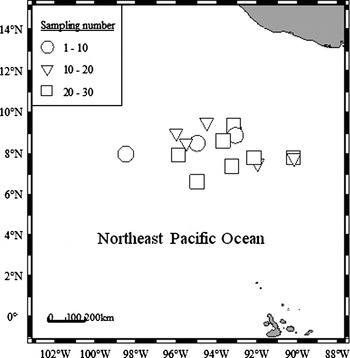
A total of 281 D. gigas, consisting of 222 females and 59 males, were sampled randomly off the Costa Rica Dome in the scientific survey from July to August in 2009 made by Chinese squid jigger vessels (Figure 1). The squid samples were frozen on the vessels and later defrosted in the laboratory. ML and body weight (BW) were recorded to the nearest 1 mm and 1 g, respectively. Sex was identified and maturation stages were determined with naked eyes following Lipinski & Underhill (Reference Lipinski and Underhill1995): stages I and II (immature); III (maturing); IV (mature); and V (spent). Statoliths were extracted, washed and stored in the centrifugal tube with 90% alcohol for further processing. The standard ageing methodology of statoliths was used in this study (Dawe & Natsukari, Reference Dawe, Natsukari, Jereb, Ragonese and Boletzky1991). The number of increments for each statolith was counted independently by two readers.
Sampling station for Dosidicus gigas off the Exclusive Economic Zones of Costa Rica Dome during July and August in 2009.

An incremental number was considered to be acceptable when the two independent counts differed by less than 10% of the mean (Yatsu et al., Reference Yatsu, Midorikawa, Shimada and Uozumi1997). Hatching dates were back-calculated from the dates of capture, assuming that growth increments were formed daily as a result of periodic deposition of increments, which were confirmed for other squids of Ommastrephidae (Hurley et al., Reference Hurley, Odense, O'Dor and Dawe1985; Nakamura & Sakurai, Reference Nakamura and Sakurai1991; Uozumi & Ohara, Reference Uozumi and Ohara1993).
Data analysis
Linear, power, exponential, logarithmic, von Bertalanffy, logistic and Gompertz growth curves were used to fit age–ML and age–BW data. For the above growth models, the Akaike information criterion (AIC) was calculated for each model, and the model with the smallest AIC value was selected as the best model (Chen et al., Reference Chen, Lu, Liu and Chen2011). Differences in growth curves between female and male D. gigas were evaluated using analysis of covariance (ANCOVA).
Instantaneous growth rate (G) and absolute daily growth rate (DGR, mm d−1 or g d−1) were estimated for each 30-day interval by sex. The G and DGR were calculated using the following models proposed by Forsythe & Van Heukelem (Reference Forsythe, Van Heukelem and Boyle1987):
 $$G=\displaystyle{{\ln \lpar S_2 \rpar - \ln \lpar S_1 \rpar } \over {t_2 - t_1 }} \times 100\percnt$$
 $$DGR=\displaystyle{{S_2 - S_1 } \over {t_2 - t_1 }}$$
where S 1 and S 2 are estimated ML or BW at the beginning (t 1) and end (t 2) of the time interval.
RESULTS
Statolith microstructure
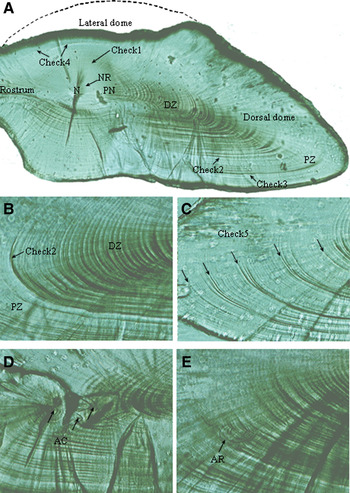
Three distinct growth zones, namely postnuclear zone (PN), dark zone (DZ) and peripheral zone (PZ), could be identified based on incremental width from the focus to the edge of the dorsal dome on statolith microstructure of all the individuals examined (Figure 2). Growth increments in the DZ were much wider than those in the PN and PZ. The first complete check was formed at time of hatching and was referred to as ‘natal ring’ (NR; Figure 2A). The second complete check usually lies in the transitional area between the PN and DZ marking the end of paralarval stage (check 1; Figure 2A). The complete check on the outer boundary of DZ (check 2; Figure 2A, B) and checks within PZ were found in some statoliths (check 3; Figure 2A). The number of increments within PN was 26.2 ± 3.7 (N = 120) and within DZ was 86.1 ± 11.5 (N = 120). Incomplete checks were occasionally observed in the lateral dome (see Figure 2A check 4). The second-order bands with fortnightly increments were observed within a few statoliths (check 5; Figure 2C). Additional centre and rings were also revealed in several statoliths (see Figure 2D, E).
Light micrograph of Dosidicus gigas statolith caught off the Exclusive Economic Zones of Costa Rica: (A) an immature female of 179 days old and 251 mm mantle length (ML); (B) a mature female of 216 days old and 310 mm ML; (C) an immature female of 165 days old and 246 mm ML; (D) a mature female of 205 days old and 331 mm ML; (E) a mature male of 197 days old and 325 mm ML. N, nuclear; NR, natal ring; PN, postnuclear zone; DZ, dark zone; PZ, peripheral zone; AC, additional centre; AR, additional rings; broken line shows the predicted normal outline of the lateral dome if the statolith does not have check 4.

Size, age and hatching time
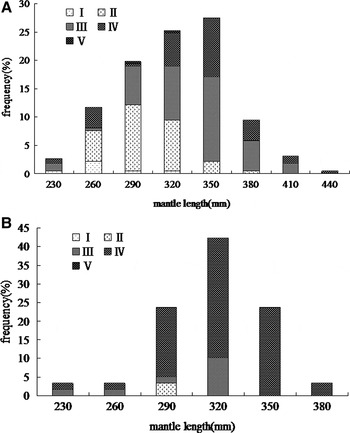
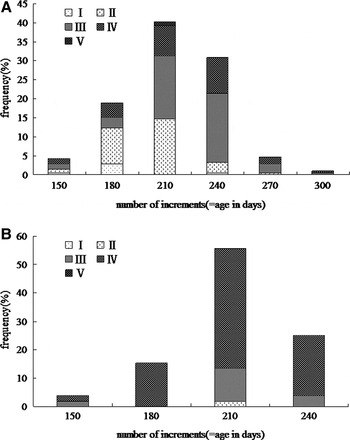
For the 281 sampled squid, ML ranged from 205 to 429 mm for females and 212 to 355 mm for males, individuals with MLs between 290 and 350 mm dominated the samples (Figure 3). Of all the samples, 263 statoliths were successfully read from 211 females and 52 males. Estimated ages ranged from 130 to 289 days with dominant ages from 180 to 240 days, consisting of more than 75% of all the samples (Figure 4). The youngest female obtained was mature at 130 days old and 218 mm ML, and the youngest male was mature at 130 days old and 212 mm ML. The oldest female was mature at 289 days and 429 mm ML, and the oldest male was mature at 240 days and 352 mm ML.
Mantle length (ML) frequency distribution by sex and maturity stage of Dosidicus gigas off the Exclusive Economic Zones of Costa Rica Dome.

Age–frequency distribution by sex and maturity stage of Dosidicus gigas off the Exclusive Economic Zones of Costa Rica Dome.

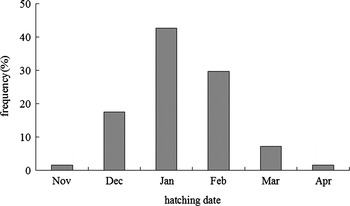
Most females became mature at 290–320 mm ML and 181–210 days old (Figures 3A & 4A), but most males already became mature at 230 mm ML and 150 days old (Figure 3B & 4B) because all the sampled males were mature except for two immature specimens with ML of 278 mm ML (unaged) and 280 mm ML (187 days). The hatching dates for squids collected during July and August in 2009 in this study ranged from November 2008 to April 2009 with a peak between January and February (winter), accounting for 72.2% of the total sample (Figure 5).
Back-calculated hatching frequency by month for Dosidicus gigas off the Exclusive Economic Zones of Costa Rica Dome.

Growth and growth rates
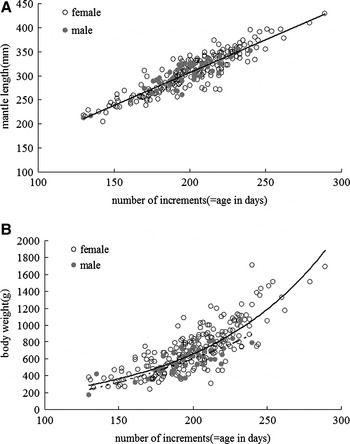
The age–ML data were best described by linear curves based on the AIC (Figure 6A) and no significant difference was found between females and males (ANCOVA, F1,260 = 0.004, P = 0.951). The age–BW data were best described by exponential curves for females, but by power curves for males based on the AIC (Figure 6B)
Relationships between age and mantle length and between age and body weight of Dosidicus gigas off the Exclusive Economic Zones of Costa Rica Dome.

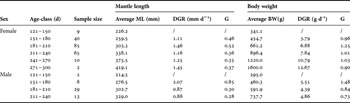
For females, the maximum DGR (1.46 mm d−1) and G (0.52) in ML occurred in 181–210 days, while the maximum values (2.07 mm d−1 for DGR and 0.85 for G) for males were reached at 151–180 days although small sample sizes in some age-classes might influence the reliability of estimated growth rates (Table 1). The DGR in BW for females increased with age and maximum G (1.25) was reached in 181–210 days, but those for males decreased with age (Table 1).
Absolute daily growth rates (DGR) and instantaneous growth rate (G) for mantle length (ML) and body weight (BW) for female and male squids off the Costa Rica Dome.

DISCUSSION
Checks and aberrant structure of statolith
Stress marks or checks are prominent growth rings developed either regularly (consisting of periodic and non-periodic) or irregularly within statolth microstructure (Arkhipkin & Murzov, Reference Arkhipkin, Murzov and Ivanov1986; Lipinski, Reference Lipinski, Okutani, O'Dor and Kubodera1993; Arkhipkin & Perez, Reference Arkhipkin, Perez, Rodhouse, Dawe and O'Dor1998). Regular periodic checks showing fortnightly and monthly incremental patterns were believed to be associated with the lunar cycle in Gonatus fabricii and Ancistrocheirus lesueurii statoliths (Kristensen, Reference Kristensen1980; Arkhipkin, Reference Arkhipkin1997). Periodic second-order bands with fortnightly increments were found in the PZ of some statoliths in this study (check 5; Figure 2C), but not observed by other authors (Arkhipkin & Murzov, Reference Arkhipkin, Murzov and Ivanov1986; Markaida et al., Reference Markaida, Quiñónez-Velázquez and Sosa-Nishizaki2004). Regular non-periodic checks often correspond to special phases of ontogenesis such as time of hatching, mating, spawning or end dates of paralarvae and juvenile (Arkhipkin et al., Reference Arkhipkin, Jereb and Ragonese1999; Arkhipkin, Reference Arkhipikin2005). These checks tend to delay or interrupt statolith growth and are always completely check located along the whole outline of the statolith because of decreasing somatic growth (Arkhipkin & Perez, Reference Arkhipkin, Perez, Rodhouse, Dawe and O'Dor1998). We found check 1 and check 2 were formed at the end of the paralarvae and juvenile phases, respectively. Estimated ages of paralarvae and juvenile were about 26 and 86 days, respectively, similar for D. gigas from Peruvian waters (PN 25–27 increments, DZ 35–55 increments) (Arkhipkin & Murzov, Reference Arkhipkin, Murzov and Ivanov1986) and considerably younger than those for Illex species (Arkhipkin & Perez, Reference Arkhipkin, Perez, Rodhouse, Dawe and O'Dor1998).
Irregular checks are assumed to reflect various stressful events suffered in the ecosystem such as starvations, storms, temperature shocks and unsuccessful attacks by predators (Arkhipkin, Reference Arkhipikin2005). Incomplete checks are only developed in some sections and occur after destruction or disturbance of statolith membranes (Arkhipkin & Perez, Reference Arkhipkin, Perez, Rodhouse, Dawe and O'Dor1998). In this study, clear abnormal shape was found in the lateral dome where irregular checks occurred because decreasing growth rates of statolith might result from successfully escaping from predator attack (check 4; Figure 2A). We were unsure of what resulted in the formation of additional centre and rings in the D. gigas statolith microstructure (Figure 2D, E). Such centre and rings were also found in Ancistrocheirus lesueurii statolith (Arkhipkin, Reference Arkhipkin1997).
Age, growth, hatching date and population structure
Squid lifespan generally varies spatially, depending on body size and environmental conditions such as temperature and food availability. In the tropical and subtropical waters, it commonly has a shorter life-span than the same species inhabiting in temperate or cold waters (Akhipkin, Reference Arkhipkin2004). Taking ommastrephid Illex coindetii as an example, tropical populations from the equatorial Atlantic Ocean live for 6 months (Akhipkin, 1996), while temperate populations from Bay of Biscay have a lifespan of one year (González et al., Reference González, Castro and Guerra1996). Maximum calculated ages of the squid off the Costa Rica Dome (289 days for mature females and 240 days for mature males) are younger than those from other temperate waters, in which D. gigas has an age of 1–1.5 years old by growth increments reading (Markaida & Sosa-Nishizaki, Reference Markaida and Sosa-Nishizaki2001; Markaida et al., Reference Markaida, Quiñónez-Velázquez and Sosa-Nishizaki2004; Mejía-Rebollo et al., Reference Mejía-Rebollo, Quiñónez-Velázquez, Salinas-Zavala and Markaida2008; Chen et al., Reference Chen, Lu, Liu and Chen2011).
Growth rates found in previous studies with values of 0.55 to 2.61 mm 30d−1 are not consistent (reviewed by Keyl, Reference Keyl2009). Significantly higher G in BW (P < 0.05) for females than males was found although other growth rates were similar (Table 1). This difference might result from a higher gonad weight in mature females compared with males. In this study, the maximum DGR and G in ML were reached in 181–210 days old for females and 151–180 days olds for males, while in the Gulf of California they occurred in 230–250 and 210–230 days old, respectively (Markaida et al., Reference Markaida, Quiñónez-Velázquez and Sosa-Nishizaki2004).
The growth of squid over their lifespan tends to follow a nonlinear model. For example, age–ML data for D. gigas in the Gulf of California, Mexico and off the western coast of the Baja Californian Peninsula were best described by a logistic model (Markaida et al., Reference Markaida, Quiñónez-Velázquez and Sosa-Nishizaki2004; Mejía-Rebollo et al., Reference Mejía-Rebollo, Quiñónez-Velázquez, Salinas-Zavala and Markaida2008). Growth in the adult phase for D. gigas could be fitted by a linear model (Arkhipkin & Murzov, Reference Arkhipkin, Murzov and Ivanov1986; Masuda et al., Reference Masuda, Yokawa, Yatsu, Kawahara and Okutani1998). In the absence of juvenile squid in the current study, age–ML data were best described by a linear function. The age–BW data of females and males were fitted with an exponential function and a power function, respectively. Small immature squid should be collected by targeting different sizes of squids using fishing gear such as purse nets and included in growth modelling to derive growth models for the whole lifespan.
Dosidicus gigas spawning takes place throughout the year but with their peaks varying in different areas. Nigmatullin et al. (Reference Nigmatullin, Nesis and Arkhipkin2001) reviewed that the prevailing spawning time was from October to January (spring and summer) in the southern hemisphere, while Mejía-Rebollo et al. (Reference Mejía-Rebollo, Quiñónez-Velázquez, Salinas-Zavala and Markaida2008) stated that hatching modes occurred between January and March of Baja California Peninsula in the northern hemisphere. In this study, hatching peaked between January and February (winter). This might not represent the exact reproductive peak because samples were only taken in two months. Longer time-series of data are needed to validate this result in the future. The sampling area of this study was likely to be the spawning ground according to the criterion proposed by Tafur et al. (Reference Tafur, Villegas, Rabí and Yamashiro2001) who suggested that sampling sites at which more than 50% females were mature (67.1%: Table 1; III, IV and V in maturity stage) should be considered as spawning grounds. This putative spawning ground is located at the countercurrent thermocline ridge to the west of the Costa Rica Dome with high primary productivity (Fiedler, Reference Fiedler2002), which can provide enough nutrients or foods to larval squids. Increased upwelling in the vicinity of the Costa Rica Dome and a well-developed countercurrent thermocline ridge are likely to be responsible for the aggregation of mature adult squids (Ichii et al., Reference Ichii, Mahapatra, Watanabe, Yatsu, Inagake and Okada2002). Indirect evidence supporting this hypothesis is that rhynchoteuthion paralarvae of D. gigas and/or Sthenoteuthis oualaniensis were identified from zooplankton samples collected in the same area during the survey (Liu et al., Reference Liu, Chen, Jia and Li2012). This observation made in other periods also suggests that spawning in this area could be greatly extended over the year (Vecchione, Reference Vecchione1999; Staaf et al., Reference Staaf, Camarillo-Coop, Haddock, Nyack, Payne, Salinas-Zavala, Seibel, Trueblood, Widmer and Gilly2008).
Previous studies classified D. gigas into three groups based on the sizes of adult females and males (Nigmatullin et al., Reference Nigmatullin, Nesis and Arkhipkin2001). The squids sampled in this study should be assigned to the small group on the basis of the size of mature squid (most mature females were at 290–320 mm ML and most mature males appeared at 230 mm ML). This pattern is also consistent with the conclusion that squids of small-sized group commonly inhabit in the near-equatorial areas (Nigmatullin et al., Reference Nigmatullin, Nesis and Arkhipkin2001).
ACKNOWLEDGEMENTS
The support of the scientific survey made by FengHui NO.16 is gratefully acknowledged. We thank the two anonymous referees and the Executive Editor for their detailed, constructive and helpful comments. This work was funded and sponsored by the Program of Shanghai Subject Chief Scientist (10XD1402000), Innovation Program of Shanghai Municipal Education Commission (10YE127), the ‘Shu Guang’ project (08GG14) from Shanghai Municipal Education Commission, and the Shanghai Leading Academic Discipline Project (Project S30702). Also this study is supported by the National Distant-water Fisheries Engineering Research Center, and Scientific Observing and Experimental Station of Oceanic Fishery Resources, Ministry of Agriculture, People's Republic of China. Y. Chen's involvement in the project was supported by the Shanghai Dongfang Scholar Program.