Introduction
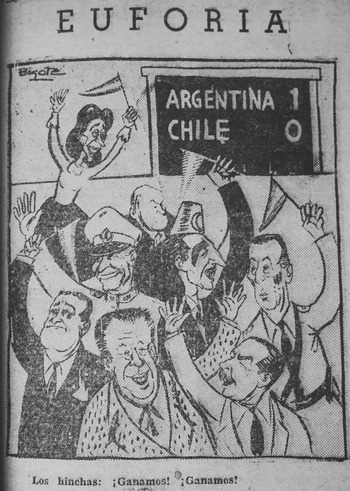
On the night of 30 March 1955, Chilean football fans lived through one of the saddest sports defeats in their history. Chile's national team reached the final match of the South American Championship held that year in Santiago. Chile faced off against Argentina, which had just returned to international football competitions after seven years of self-imposed isolation under the government of Juan Perón (1946–55). Playing on home soil, Chile's more experienced team was the clear favourite but the Argentines played an intelligent game, countering the Chilean defence with fast transitions and accurate passes. To the astonishment of 70,000 spectators, Argentina beat Chile 1-0 with a goal in the second half scored by Rodolfo Micheli. Grief over sport defeat was compounded by violence. Before the crucial game, people without tickets had broken into the stadium and caused stampedes that trampled six fans to death. The Chilean press reported on the event with a mix of bewilderment and outrage. The Radical Party newspaper El Debate took advantage of the tragedy to issue a biting political commentary against Chilean President Carlos Ibáñez (1952–8). A quarter-page cartoon entitled ‘Euphoria’ (Figure 1) suggested that Ibáñez and his followers were perfectly happy with Argentina's victory over Chile since, according to El Debate, Ibáñez's policy was itself nothing but an extension of Peronism. The satirical cartoon underscored the complex relationship between sport and politics on both the domestic and the international stage. Drawn by Alberto Reyes (nicknamed ‘Bigote’, or ‘Moustache’), the image featured several Chilean politicians and close collaborators to Ibáñez, all enthusiastically singing: ‘We won, we won!’ The treasonous cronies included María de la Cruz (senator from the Partido Femenino de Chile – Chilean Women's Party), Guillermo del Pedregal (minister of finance), Eduardo Yáñez (minister of labour), Rafael Tarud (minister of economy and trade), René Montero (secretary of the presidency), Guillermo Izquierdo (diplomat), Darío Sainte-Marie (journalist) and Conrado Ríos (Chilean ambassador to Argentina). Exaggerating physical and cultural characteristics, it depicted Ibáñez's supporters as racial others, foreign and fascist. At the image's centre, Tarud (of Palestinian descent) was drawn with an Ottoman fez and prominent nose, and Yáñez (a general in the Chilean army) appeared in full military dress. Waving Argentine flags, Ibáñez's followers were all smiles, apparently overjoyed with the Peronist defeat of Chile on the football field. The cartoon made it clear that it was not just Chilean athletes who had lost, but that Chile as a nation had been treacherously sold out on Chilean soil through the Peronist politics of Ibáñez's government. El Debate’s attack was representative of Radical Party criticism of Perón and Ibáñez on both sides of the Andes. As parallel parties with similar but not identical political agendas, the Radical Parties of Argentina and Chile were in the political opposition and their militants regularly saw Perón and Ibáñez as fascist dictators. Although Ibáñez himself was not featured in the cartoon, the allegation that Ibáñez supporters were ardent Peronists, and therefore traitors, highlights the importance of Peronism and anti-Peronism in Chilean political culture.
‘Euphoria’, cartoon by Alberto Reyes. The cartoon's original caption reads ‘The fans: We won! We won!’

As upwardly mobile military men, Perón and Ibáñez had been deeply involved in sports activities from the beginning of their careers. Ibáñez stood out as captain and instructor of the equestrian team at the Chilean Military Academy in the 1910s and Perón became the army's fencing champion in 1918, retaining the title for a decade.Footnote 1 As presidents, Perón and Ibáñez were mutual admirers and shared similar political goals for their respective nations: reduce the influence of the established party system; curtail the power of foreign capitalists in favour of government initiative; and act independently of the United States.Footnote 2 This article explores a fourth endeavour carried out by these two populist leaders: the creation of national sports projects and their representation in sports publications such as the Argentine magazines Mundo Deportivo and El Gráfico and the Chilean weekly Estadio. Reading sports publications constituted an everyday life experience for thousands of fans and potential voters in the 1950s. Perón and Ibáñez consciously courted political legitimacy through new forms of media as part of their state projects and modernising agendas, and sports magazines reached relatively large numbers of readers.
A growing body of research shows that sports figured prominently among Perón's innovative social policies, effectively expanding participation in sports activities and enhancing his popularity. While these contributions focus primarily on the national impact of Peronist politics and achievements in the international arena, none of these works studies the reception of Argentine sports programmes in the rest of Latin America.Footnote 3 Studying the impact of Peronist sport policy in the region – particularly in neighbouring countries such as Chile – might be useful for thinking about the limits of populism outside Argentina. Although an extensive literature has been published about Peronism as an iconic example of Latin American populism, there are almost no substantial studies of populism in Chile during Ibáñez's second government (1952–8) and even less about sports media's critique of Ibáñez's populism. Research focuses either on the Popular Front in the 1940s (to which Ibáñez is not seen as belonging) or the Frei–Allende era in the 1960s and early 1970s (for which Ibáñez is rarely acknowledged as a precedent). Chilean historiography generally associates ‘populism’ with the left-leaning Popular Front governments (1938–52), implying that Ibáñez's populist trappings were thin and Ibañismo a very ephemeral political phenomenon due to the strong party system. But elements of populism were incorporated successfully into the Chilean political system, albeit not without generating other tensions in the process.Footnote 4 If, as sociologist Carlos de la Torre claims, populism is a style of political mobilisation based on strong rhetorical appeals to the people and crowd action on behalf of a leader, sports might have played a key role in shaping political discourses and collective identities as Peronistas and Ibañistas.Footnote 5 What made Ibáñez a populist, even more than his appeal to a wide ideological spectrum and breadth of support, was his willingness to carry the interests of ‘the people’ to the heights of state power, challenging the leadership of traditional political parties and ties to the military.Footnote 6 Ibáñez's sports programmes borrowed but also differed from Peronist sports policies, and the former too used sports to shore up a populist project, albeit a different one. Ibáñez was not a ‘weaker’ or ‘pale’ version of Perón; he was a Chilean populist on his own terms.
By comparing Argentine and Chilean sports publications of the 1950s, this article underscores the role of the fourth estate in creating and contesting national populist projects. Here, ‘creating’ and ‘contesting’ are not mutually exclusive concepts. Indeed, sport was a tool to promote official propaganda, but in narratives found in sports media it also became a mechanism to challenge hegemonic thought. This was especially so in the discussion of women's and children's participation in sport. While acknowledging state power and success in using sports for hegemonic purposes, social historians have focused on the experiences and identities of sportspeople, as well as on the ways state projects can be challenged and resisted by immigrant and amateur sports clubs.Footnote 7 This article draws on sports media as non-traditional sources for the study of political culture, and examines sports as cultural artefacts that are produced not only ‘on the field’ during the games but also through written and visual representations aimed at much larger audiences than those sitting in the stadium.
Sports iconography (cartoons and photographs published in the press) created narrative understandings about sports that had broader political meanings. Photographers and cartoonists, often in collaboration with journalists, produced and crafted populist ideas about class collaboration, the inclusion of children in the state project and women's participation in politics. The importance of these images lies in their role of making sport a more understandable spectacle to mass audiences, many of whom were semi-literate or illiterate. This is particularly important in the case of Chile, which had lower literacy rates than Argentina.Footnote 8 As contested spaces, images published in the sporting press framed responses to the sports policies carried out by the populist administrations of Perón and Ibáñez.Footnote 9 Sports media ‘linked people with shared regional subjectivities vis-à-vis their opponents’, both locally and transnationally.Footnote 10
The article is divided into four sections. First, I provide background on Peronist sports policies and compare the Argentine sports magazines Mundo Deportivo and El Gráfico. While the latter omitted information about Peronist sport policy, the former saw sport as a vehicle for inculcating civic responsibilities in working-class children and adult women. The second section crosses the Andean border to explore Estadio’s unique place as the leading sports publication in Chile and its strong discontent toward Ibáñez's sport policy. The third section discusses some of the press responses to Perón's visit to Chile during February 1953, an occasion in which sports figured prominently among the diplomatic activities. Finally, the last section analyses how Peronism continued to shape discussions about sports in Chile even after Perón's overthrow in 1955.
Sports and Media in Peronist Argentina
Perón promoted sports within labour unions and working-class communities as a means of fostering class cooperation for the greater national good. As secretary of labour in the military dictatorship (1943–6), Perón issued decrees providing for minimum wages and maximum labour hours and built recreational centres, which ultimately increased his popularity among union leaders. With a bit more cash and free time, workers were more easily able to pay club dues, attend sports events and make use of clubhouses. While the Peronist administration organised sports activities for all sectors of society, Perón was the first Argentine president to establish strong political ties with the working classes through sports. As president, Perón inaugurated the Olimpiadas Obreras (Workers’ Olympics) in 1949 with the aim of improving the physical condition of industrial workers in Buenos Aires. More than 1,800 workers gathered to compete in football, basketball and boxing. Although Perón was not the first leader to promote sports among workers – the Soviet Union most notoriously established state-led Olympic projects to foster class-consciousness, and numerous European welfare states promoted sports through trade unions – he advocated class cooperation between workers and national industrialists. Sports programmes were meant to be vehicles for including workers within the body politic and shaping them as citizens, not mobilising them for overthrowing the bourgeoisie. In other words, Perón attempted to mobilise the workers not only as a support base but also in order to avoid class conflict, which he associated with Marxism.
Under Peronism not only were blue-collar workers required to disseminate a positive representation of Argentina but journalists too had a patriotic duty to communicate the multiple expressions of Argentine citizenship. Perón's own interest in the media became evident when he decreed the Estatuto del Periodista Profesional (Professional Journalist's Statute) in 1944, which established improvements in journalists’ working conditions such as the right to a union.Footnote 11 Perón was effective in winning the media's favour and at the same time getting rid of those newspapers that opposed him.Footnote 12 After taking control of Haynes, an Anglo-American media firm, the government promoted new magazines with its imprint in order to reach diverse audiences: Mundo Peronista, Mundo Infantil, Mundo Agrario, Mundo Radial, Mundo Atómico and Mundo Deportivo.
The sports weekly Mundo Deportivo first appeared in Buenos Aires on 21 April 1949. With a circulation of 100,000 copies, the magazine featured full-colour portraits of prominent athletes and had an average of 80 pages per issue, which at the time was higher than any other Argentine magazine. Edited by Carlos Aloé, Mundo Deportivo sought to expand its readership by appealing to Argentine youths and women, in addition to adult men. Aloé’s editorial pieces offered pedagogical instructions about Peronist values and the role sportswriters played in spreading these ideals. As he wrote in June 1954, ‘It is necessary that sports journalists become the teachers of the Argentine people.’Footnote 13 Thus, Mundo Deportivo aspired to transform journalism from an elitist institution that commented on the masses from a position of superiority to a participatory institution for and about the masses.
Mundo Deportivo aimed to become a rival to El Gráfico, Argentina's oldest and Latin America's most prestigious sports magazine. By 1950, El Gráfico was selling 200,000 copies in Buenos Aires alone; copies were also available on the newsstands of Santiago, Lima, Quito, Bogotá and Mexico City.Footnote 14 With double the circulation of its competitor, El Gráfico had higher standards of photography and published detailed reports with abundant statistics and analysis. Its tone was often moralistic, usually didactic and self-consciously cosmopolitan. A typical page in El Gráfico combined stories about Argentine football, Swedish gymnastics and US baseball. First published in 1919, El Gráfico was owned by the conservative publishing house Atlántida, which had refused to support Perón's rise to power in 1946. Thus, Mundo Deportivo represented the Peronist government's effort to displace El Gráfico and topple the oppositional press. Unlike El Gráfico’s strong focus on wealthy professional football clubs from Buenos Aires, Mundo Deportivo reported on poor clubs and different sports activities throughout the nation. In February 1950, columnist Alicia Figueroa reported on her visit to the modest Ferrocarril Oeste club in the working-class neighbourhood of Caballito, Buenos Aires. Impressed by the talent of the hundreds of children who participated in club activities, she also underscored that middle-class educators and physicians supervised the young athletes closely.Footnote 15 The story of Ferrocarril Oeste perfectly embodied the Peronist vision of working-class uplift through class collaboration and middle-class leadership, rather than class conflict.
While Mundo Deportivo projected the regime's social agenda, El Gráfico directed subtle but pointed criticism at Perón's interference in sports. Commenting on a football match between Racing and Boca Juniors in 1949, journalist Félix Fráscara lamented the intrusion of the police onto the field after fans stormed the pitch as ‘a sign of political chaos’.Footnote 16 During Perón's re-election campaign in 1951, El Gráfico described violence on and off the field as ‘symbol of the dark times in Argentina’, underscoring the editors’ objection to Perón's re-election.Footnote 17 This criticism not only stressed Perón's authoritarian style but also expressed a concern with the ways Perón's government had empowered workers and allowed football teams with modest means to displace more privileged ones. Stories about football violence became a way of illustrating how Perón had caused ‘class conflict’ as a consequence of workers’ empowerment.
Although Perón himself was not a big fan of football, the Peronist government gave substantial financial support to professional football clubs relative to other sports entities. Sports management under Peronism occurred in an economic context that favoured the use of considerable state funds for sports policy. Boca Juniors, whose fans explicitly identified as Peronists in their chants, obtained the highest government loan within the total 1950 budget destined to sports (Table 1).
Argentine Government Loans and Subsidies to Sporting Entities in 1950

Source: Servicio Internacional Publicaciones Argentinas (SIPA), Síntesis del deporte argentino (Buenos Aires: SIPA, 1952), pp. 106–7.
While 80 per cent of the government loans were directly granted to football clubs, Perón's sizeable subsidies aimed at other sports challenged the exclusive upper-class monopoly on athletic activities such as skiing, tennis and rowing. All of these sports became more affordable to the lower classes under Perón. Between 1949 and 1955, Mundo Deportivo published five front covers featuring Perón taking part in skiing, horse riding and car racing.Footnote 18 Although images of Perón playing football might have had an appeal to larger sectors of society, these front covers symbolised the aspirational inclusion of the working class in the political and cultural life of the country's elite. As historian Eduardo Elena suggests, Perón emphasised that the ‘people’ deserved inclusion within an economic order that satisfied basic wants and, if possible, allowed them to enjoy various spheres of consumption that had previously been the exclusive domain of elites.Footnote 19
If Perón was savvy about the political uses of sport, he most often linked his message of social justice to increasing opportunities for the masses to actually play sports themselves. In May 1949, Mundo Deportivo published a pamphlet supposedly written by Perón in which he distinguished two types of sports: spectator sports (deporte espectáculo) and sports as an activity (deporte actividad). For Perón, the former ‘postulates ten playing and 300,000 watching, whereas the ideal would be 300,000 playing and ten watching’.Footnote 20 Proclaimed as ‘The First Sportsman of the Nation’, Perón took full credit for expanding athletic programmes for the masses and understood this policy as central to shaping ‘citizen-athletes’ who would be loyal to his vision of the New Argentina.Footnote 21
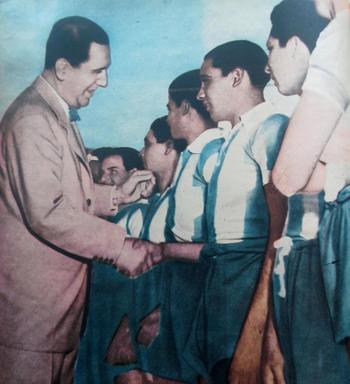
Perón wanted an entire nation of athletes and, to accomplish this task, he firmly linked childhood welfare to the Peronist project. One of his most important efforts to increase children's participation in sports nationwide was the creation of the Campeonatos Evita (Evita Championships) in 1949. Headed by Argentina's first lady, Eva Perón (Evita), the football tournaments brought together children from different provinces. Boys ranging from seven to 16 years old travelled free throughout the country to compete against teams in other cities during the summer. The best teams went to Buenos Aires for the finals in which Perón or Evita performed the kick-off. Participants were given a medical check-up, a lung X-ray and a dental examination. Those diagnosed with medical problems were referred to specialists for free treatment. In addition, the legal status of children whose births had not been properly registered was rectified when they signed up for the tournaments.Footnote 22 Competitors received sports outfits and prizes, which only added to the Peróns’ reputation as benefactors. Dozens of photographs of the Evita Championships were published by Mundo Deportivo and became central to Peronist iconography. These images evoked both obedience to paternal authority and Perón's concern with the inclusion of children in his national project. One such is reproduced as Figure 2. Taken by photographer José Olivieri, the image shows Perón greeting a group of children lined up in front of him. The young players’ status of respectful and admiring children was more important than that of athletes. Wearing the colours of the Argentine flag (light blue and white), the children are depicted receiving fatherly guidance from their national leader. Perón himself had declared children as ‘the only privileged class’, a phrase with two implications: first, the concern of the state with child welfare; and second, Perón's vision of empowering working-class subjects without class struggle. As such, Perón's intimate attention to the children in the image carried out the social contract of the state (embodied here by Perón) through which the working class (embodied here by children) received the benefits of healthcare and recreational activities directly from the president himself. Olivieri's symmetrical framing highlighted the handshaking in the centre, implying that Perón and the children had made a pact.
‘President Perón Inaugurates the Evita Championships’, photograph by José Olivieri.

While Mundo Deportivo extolled the Evita Championships, readers of El Gráfico would hardly notice that Perón was investing so many state resources in sports programmes. Images of the social work of the government were almost non-existent and articles about sports projects initiated by Perón were usually unsigned, hinting that they had been supplied by the government press service.Footnote 23 El Gráfico engaged in a systematic practice of downplaying the regime's involvement in sports. While covering the Evita Championships, the magazine referred to them as the ‘Torneos Infantiles’ (Children’s Tournaments), omitting Evita's name. This was a common strategy across the oppositional press, especially in the conservative newspaper La Prensa and the socialist La Vanguardia, which rarely mentioned the tournament or the names of Perón and Evita. With a longstanding tradition of crediting rebellious working-class children as the soul of Argentine football, El Gráfico continued celebrating acclaimed players who had emerged from the most humble backgrounds, telling stories of how young men worked their way up from underfunded sports clubs in poor areas to become national heroes.Footnote 24 As a subtle critique of Mundo Deportivo’s assessment of obedient and compliant children (and Peronist investment in childhood more broadly), El Gráfico argued that only youthfulness and rejection of paternal authority would make Argentina's football victorious again.Footnote 25 Ricardo Lorenzo, El Gráfico’s most important sportswriter at the time, suggested that rebellious spirit and unruly childishness were the true sources of football talent.Footnote 26 As such, he legitimised a discourse about national identity that contrasted with the one offered by the Peronist weekly Mundo Deportivo. By writing about children in sports, these journalists were discussing Argentine politics of the time.
Mundo Deportivo promoted the social role of the Evita Championships as important to developing the right kind of young bodies. As a consequence of the impressive numbers of female athletes from all the participating nations competing at the 1951 Pan-American Games held in Buenos Aires, girls were finally admitted to the Evita Championships in 1953, accounting for 20 per cent of the almost 216,000 participants that year.Footnote 27 Emilio Rubio, a medical columnist with Mundo Deportivo, argued that sports could liberate adolescent women from the frivolities of capitalist consumer culture and restore the moral purity of female youth.Footnote 28 Although boys and girls participated in the same sports, physicians insisted that competitions should be strictly divided by gender due to the risk to the girls of masculinisation. Eduardo Saunders, another physician writing in Mundo Deportivo, argued that women should not compete against men, so that they could ‘keep the feminine architecture [sic] of the body, avoiding any grotesque spectacle of inappropriate interaction’.Footnote 29 Contact sports like football and boxing were discouraged because such activities would presumably make it more likely for women's body parts to be inappropriately touched. Although Saunders never explicitly excluded women from football, he usually imagined women as fans or mothers who would encourage their boyfriends or sons to play.Footnote 30 Saunders advised that women who practised sports without guidance could risk nervous breakdown and excessive pallor (if they exercised indoors) and loss of body mass.Footnote 31 Suggesting moderate exercise outdoors, physicians agreed that sports activity among women could generate positive social change only when the conditions for its practice were strictly regulated.
In response to the paternalistic supervision of women's sports in Argentina, a handful of female columnists challenged the medical literature. One of the most iconic voices was María Cartasegna, a former basketball player and columnist for Mundo Deportivo, who criticised state authorities for the lack of support for sportswomen. In 1952, she suggested that the problem originated at home. ‘Only now, thanks to Eva Perón, can women find a way as human beings with dreams and political rights. If sports can be used to teach righteousness to young boys, why is the same not done with girls?’Footnote 32 Alluding to the granting of women's suffrage in 1947 (first exercised in 1951), Cartasegna lamented that the ‘housewife model’ was still placing a brake on the development of women's sport. While acknowledging Evita's role in getting women the vote, Cartasegna blamed Peronist officials for continuing to support men's sport in preference to women's. Cartasegna's criticism alluded to the contradictions of Peronism and its relationship to women. On the one hand, Peronism promoted sports within the traditional framework of preparing women for motherhood and domesticity. On the other hand, the example of Evita's public activism on behalf of women and the Peronist state's enfranchisement of women as citizen voters legitimated women's presence in activities beyond the home and suggested women's programmes should have a more equitable relationship to those of men. Cartasegna's criticism that state policies were ignoring women took its moral authority from Peronism's promise that women, too, were to be ‘citizen-athletes’.
In tune with women's new participation in politics, women athletes used the official press to advertise their own sports associations. In April 1951, Cartasegna and other sportswomen established the Ateneos Deportivos Femeninos Evita. Through the pages of Mundo Deportivo, the organisation promoted basketball, hockey and volleyball among adult women.Footnote 33 Chaired by the Olympic fencer Elsa Irigoyen, Ateneos Femeninos pushed for cheaper stadium tickets and free access to state recreational centres. In January 1953, Irigoyen complained that medical examinations overseen by the Evita Championships were not reaching girls outside Buenos Aires. She urged the creation of medical subcommittees in each province to facilitate girls’ qualification for the tournaments.Footnote 34 Using Peronist language to criticise the government's inadequate support for female athletics, Irigoyen argued: ‘With fewer than 20 [female] members per year, we cannot begin to compare [the resource of] Ateneos Femeninos with the support granted to men's football clubs. Women, too, need to educate their minds and bodies.’Footnote 35
Despite these demands, Ateneos Femeninos lost many resources after Evita's death in 1952 as state functionaries diverted money to propaganda campaigns aimed at creating worship of Evita as a Virgin Mary-like ‘Spiritual Leader of the Nation’, damaging the government's ties with the Catholic Church. Without state funds, the Ateneos Femeninos lost influence and membership dropped significantly. In 1954, the number of registered participants in all of the group's 30 clubs amounted to only 160.Footnote 36 Yet, despite these setbacks, Ateneos Femeninos had emerged as an important vehicle for advancing the female agenda when Evita was gone. Women athletes mobilised and questioned the gender hierarchies imposed by the Peronist regime advocating for their own sports organisations through the sports media. Discontent with Peronist sporting initiatives came not only from the anti-Peronist sportswriters of El Gráfico but also from female athletes who identified themselves as Peronist militants. Although Mundo Deportivo lauded the achievements of the government, its female columnists openly questioned Peronist sports management and demanded resources from the state equal to those that men received.
Sports and Media in Ibáñez's Chile
Ruling by decree as dictator during his first presidential term (1927–31), Ibáñez had initiated a period of unprecedented state modernisation, labour reforms and sports policies. Chile's first Ley de Educación Física (Law of Physical Education) in 1929 made physical education a compulsory subject for children in all educational establishments.Footnote 37 Decades before Perón, Ibáñez used his connections with sporting clubs to address crowds during football matches. But despite his rhetorical support of sports, Ibáñez's first administration could not successfully incorporate sports organisations into the state apparatus, financing sports projects only sporadically before he was deposed in 1931.Footnote 38 After years of exile in Buenos Aires and unsuccessful attempts to return to power (including two lost elections in 1938 and 1942 and two failed coups in 1939 and 1948), Ibáñez became president again in 1952, when he ran as an independent and gained the support of the electorate which, at the time, was not rigidly split between Left and Right. Even some Socialists backed Ibáñez briefly in hopes of forging a labour movement similar to Peronism.Footnote 39 Like Perón, Ibáñez sought to distance himself from his dictatorial past and saw himself as a democratic reformer. Ibáñez built power outside traditional political parties – in Chile's case, the Radical, Socialist and Communist parties of the Popular Front (1938–41), which had enjoyed hegemony. He usurped the ‘populist’ Popular Front project for a different populist project that was more authoritarian and anti-party even as it operated formally within Chilean democracy. Ibáñez criticised the presidents who had succeeded his first government, distinguishing its managerial efficiency from what he alleged was the corruption of the Radical Party-led administrations that had ruled Chile since 1938.
Sports institutions in Chile were not nearly as well developed as they were in Argentina when Ibáñez became president in 1952. Unlike the considerable budget that Perón assigned to sports, Chilean policy-makers were unwilling to grant sports large resources since the country already faced a monetary deficit for public works. Despite his efforts at creating cutting-edge sports programmes, Ibáñez ultimately could not get his reforms passed in Congress, where he did not have a majority. The budget problem, however, important though it was, served merely as an excuse for the opposition to reject Ibáñez's sports plans. Elías Ducaud, head of Chile's Departamento de Deportes del Estado (State Sports Department), proposed a card-betting system that consisted in predicting the results of professional football matches in order to bring in annual revenues of 400 million Chilean pesos, which could then be distributed among sports federations.Footnote 40 However, congressional opposition blocked the initiative on the grounds that it was immoral to encourage working-class men to gamble family wages.
In October 1953, Ibáñez created the Comisión de Educación Física y Deportes (Physical Education and Sports Commission) to which he appointed Ducaud, Alejandro Rivera (president of Chile's Olympic Committee), congressman Sergio Ojeda and sports-medicine experts Luis Bisquertt and Rosauro Salas. The latter two had been supporters of Ibáñez during his first administration, having approved the enactment of the first Law of Physical Education in 1929. Through the quarterly newsletter Revista Chilena de Educación Física, Bisquertt and Salas gradually pressured Ibáñez to consider Peronist sports policies as a model to replicate in Chile. With the Peronist example in mind, Bisquertt argued that Chileans were becoming disconnected from the goal of sports – beneficial physical activity – as capitalist mass culture industries turned people into spectators rather than athletes.Footnote 41 Bisquertt echoed Perón's distinction between spectacle sports and sports as an activity also adding, perhaps unwittingly, a Marxist analysis of alienation: he blamed capitalism for reducing sport to a commercial commodity. When Ibáñez announced the construction of two indoor stadiums in Santiago, Bisquertt labelled these projects as unproductive, suggesting that building more multi-sports courts would not solve Chile's real need for physical education for poor children.Footnote 42
After a year's consideration, the Commission drafted the Anteproyecto de Ley de Educación Física (Bill for the Physical Education Law) in October 1954; it granted 30 million Chilean pesos, collected through a tax on alcohol sales, to fund new infrastructure and medical exams in public schools. While the bill mirrored aspects of Argentina's Evita Championships in the obligatory nature of medical check-ups for children, the Commission went further by adding the pre-school and university populations. Furthermore, the bill compelled major companies and commercial entities to provide their personnel with the necessary infrastructure to practise sports. The 1954 bill also added the compulsory practice of sports in prisons as part of disciplinary procedures to prevent anti-social behaviour and to enhance the effectiveness of rehabilitation programmes during incarceration.Footnote 43 Although the government regarded this draft legislation as urgent, Congress rejected the bill in 1956. Ibáñez cut the Commission's funding and thereafter those who advocated for a national sports policy withdrew their support from Ibáñez and pinned their hopes on the political opposition.
Part of Ibáñez's failure to promote sports legislation in the 1950s was caused by adverse political and economic circumstances, particularly the high inflation rate. Following recommendations made by the private US consultancy company Klein-Saks in 1955,Footnote 44 Ibáñez restricted public spending and imposed a ceiling on wages. The measures reduced state expenditure on education, including everything related to sports and physical education projects. They also triggered the worst recession since the 1930s. The years 1956 and 1957 were particularly harsh and saw violent demonstrations. As had occurred during his first administration, the failure of his economic policies led to major discontent in the streets. The consequent erosion of Ibáñez's popularity mainly benefitted the emerging Christian Democrats and the resurgent Marxist-based parties.
Most of the Chilean media opposed Ibáñez's presidency. Journalists frequently pointed out the tense relationship he had had with the press during his first administration, particularly when he confiscated the privately owned daily La Nación in 1927, placing it under government control. In the 1950s, Ibáñez made regular use of the 1948 Ley de Defensa Permanente de la Democracia (Law for the Permanent Defence of Democracy) to crush his enemies on the Left and Right.Footnote 45 The law, passed by the Radical-led government of Gabriel González (1946–52) under pressure from the United States to outlaw the Chilean Communist Party, gave Ibáñez the authority to arrest journalists accused of being a threat to public order. Although Ibáñez's government received substantial US aid, Chile's economic problems continued and the president frequently resorted to controlling the press in order to reduce social conflict.Footnote 46
Sports publications too pitched in with support for and criticism of the Ibáñez government. Chile's largest publishing house, Zig-Zag, affiliated with the oligarchic Liberal Party, had vigorously opposed Ibáñez's return to power. In 1941, Zig-Zag launched the sports magazine Estadio under the direction of Alejandro Jaramillo. Estadio published 2,043 issues before its closure in 1982 (the longest period of publication for any sports magazine in Chile), selling 40,000 copies per week during the 1950s. Throughout the 1940s, the magazine had maintained close ties with Popular Front governments, voicing approval for the broader physical education programmes that they carried out.Footnote 47 Estadio reported on a range of athletic activities, including professional football, basketball, swimming, track and field events, school competitions and women's sports. In the 1950s, Estadio was ambivalent about Ibáñez. Immediately after his electoral triumph in September 1952, Jaramillo expressed his hope that Ibáñez's victory would be an opportunity for expanding the sports budget.Footnote 48 Two months later, Jaramillo urged him to define a clear plan for a nationwide sports infrastructure.Footnote 49
One of the unique aspects of Estadio was the quality of its sports images. Its front and back covers were full-page colour pictures of individuals or teams. Sports photography was important for a fan base that was only partially literate, especially the thousands who migrated from the countryside to Santiago in the 1950s. Despite the widespread literacy campaigns waged by Chile's Popular Front in the 1940s, resulting in substantial improvements, about one-fifth of the total population still did not have even rudimentary literacy skills in 1952.Footnote 50 Workers who were too poor to buy sports magazines acquired covers featuring football players or boxing stars and displayed them as posters on walls in garages, grocery stores and clubhouses. Estadio’s leading football photographer was Eugenio García, the son of Spanish immigrants who had moved to Santiago after the Spanish Civil War.Footnote 51 Known as ‘El mago del lente’ (‘The Magician of the Lens’), García was a talented, self-taught photographer who captured the agile movements of athletes in a single still image, using innovative sepia tones. Because of his talent, El Gráfico attempted numerous times to recruit him but García remained loyal to Estadio until he retired in 1973. His photographs ranged from dramatic shots of the game to carefully composed individual portraits, and paid testimony to a highly dynamic relationship between athletes and fans.
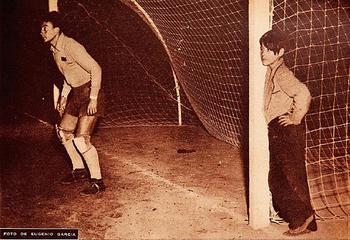
Promises of social mobility within a paternalist framework were common to the iconography of children's images in many Estadio photographs in the 1950s. García, for example, featured a shot from a match of the 1953 season of the Chilean football league (Figure 3). On the left, Club Everton's goalkeeper, Carlos Espinoza, stands on the goal line. Although he is not wearing gloves, he seems ready to react at any moment. On the right, an unidentified young boy watches the same game with similar interest but as a spectator leaning against the goal post. The bare-footed youngster seems scruffy, with a rebellious hairstyle and a laid-back attitude. García's photo lent support to the idea that improving child welfare was a responsibility of state authorities – as does perhaps its title, ‘The Hidden Treasure’. Estadio filled pages with many photographs of poor children breaking into stadiums during football matches, while columnists expressed alarm at the number of children on the streets. As Estadio’s columnist Renato González lamented on 19 August 1950, ‘It is a shame to see children begging for a few cents outside the stadium. They deserve to enter for free. Sports must promote a culture of respect for children and citizenship education.’Footnote 52 González claimed that granting Chilean children access to the stadium could help channel their energies in more positive directions. Similarly, columnist Carlos Guerrero urged club owners to provide free tickets to children under 13. Guerrero also claimed that in Argentina the state had ensured there were more opportunities and access for children.Footnote 53 Whereas Argentine children photographed in Mundo Deportivo appeared to be included in the Peronist state, Chilean children in Estadio appeared as marginalised and stateless subjects. Estadio portrayed children as lonely spectators, never as players; they were always without parents and never on the field. García's images represented the absence of a social contract between the Ibáñez government and the working class.
‘The Hidden Treasure’, photograph by Eugenio García.

Estadio shared the same paternalistic discourse as Mundo Deportivo regarding the participation of women in sports. Since most of Estadio’s content was dedicated to football, there was far less coverage of basketball or tennis, which had higher proportions of women athletes. After the professionalisation of football in 1933, which made players wage-earners and brought more spectators to the game, most of the press ignored other sports activities that remained amateur. In the 1940s, Estadio had given at least some space to reporting on physical education projects aimed at women as they related to ‘improvements in women's reproductive health’. Estadio continued to express this point of view in the 1950s, suggesting that women's sports were beneficial to motherhood, thereby relegating women to the passive roles of wives and mothers. As González wrote on 16 January 1954, in relation to basketball player Hilda Ramos, ‘[She] is a Chilean woman […] With those homely wonderful virtues of a self-sacrificing mother, now she can return to be captain of the household.’Footnote 54 González did not represent a significant departure from earlier medical views that saw women's physical activity as inextricably linked to procreation and the ‘housewife model’. Safeguarding the reproductive role of women in Chilean society, Estadio projected an ideal nuclear family in which the ‘mother-athlete’ contributed healthy offspring to the nation. In any case, Estadio’s efforts to cultivate a female fan base were never robust. Female athletes appeared considerably less often than male athletes on the front covers of the magazine, and when the women were portrayed this was an intentional strategy to attract more male readers. Photographic portraits of female athletes became raw material for the structure of gender representation in Estadio, adding to the patriarchal order established during the Ibáñez period.
The sporting event that attracted more Chilean sportswriters to debate women's sports was the 1953 Women's Basketball World Championship held in Santiago from 7 to 23 March; the teams included Chile, Argentina, Peru, Brazil, Paraguay, Cuba, Mexico, Switzerland, France and the United States, which ultimately won the tournament in the final against the hosts. An instinctive politician, Ibáñez attended the tournament's opening ceremony with his wife Graciela Letelier.Footnote 55 Always a mercurially pragmatic man though not charismatic in public, Ibáñez supported the tournament for two reasons. First, women's basketball had more chances of bringing Chile a sports victory than any other sport – indeed, the same team had achieved the gold medal at the 1950 South American Basketball Championship in Lima. Second, Ibáñez had successfully mobilised women – who were voting for the first time in presidential elections – to support his electoral success in 1952 and he wanted to retain that support. After the final match of the tournament, Ibáñez invited the female players to an evening reception in an exclusive Santiago salon to celebrate their team's victory, underscoring how important it was for the government. This event showed that Ibáñez wanted to incorporate women's sports into his message of healthy patriotism by emphasising an empowering feminist tone that embraced the ‘mother-athlete’ ideal celebrated by Estadio.
Without female columnists to comment on the basketball tournament, the male sportswriters of Estadio mostly stressed what they perceived as inherent feminine qualities. As columnist José Navasal described on 21 March 1953, ‘[It was] a different tournament, full of unexpected surprises […] Sometimes funny, sometimes dramatic […] A tournament of screams, crying and hysteria.’ While suggesting that female athletes could bring a baffling set of emotions to sports, Navasal also commented on what he labelled as the ‘sex-appeal’ of international basketball players: ‘what really mattered was their beautiful feminine figure’.Footnote 56 Navasal mirrored the patronising opinions expressed by medical experts in Mundo Deportivo but deliberately added hetero-normative guidance for male readers. Publications such as Estadio advocated what in the eyes of Ibañismo were proper gender norms, showing that the heterosexual family was the bedrock of the nation.
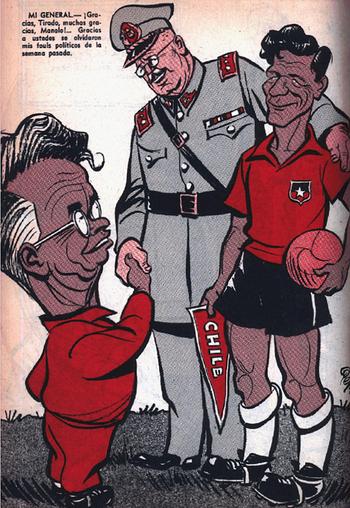
In terms of masculine social roles, cartoonists often drew parallels between Ibáñez and sportspeople, implying that the president was too old to perform the role of a paternal figure. Topaze, the satirical magazine published in Santiago by Zig-Zag between 1931 and 1970, led the attacks featuring Ibáñez as an old man. On 25 March 1955, the back cover of Topaze published a cartoon with Ibáñez dressed in military uniform in the company of Luis Tirado (Chile's national team coach), a short man in glasses, and Manuel (Manolo) Álvarez (Chile's national team captain), holding the ball (Figure 4). With sarcastic overtones, the caricature exemplified the importance of football in the discussion of national politics in the press during the Ibáñez government.Footnote 57 Drawn by the famous cartoonist René Ríos (nicknamed ‘Pepo’), the illustration also reflected the masculinised perception of sports and politics as activities carried out exclusively by ‘strong’ and ‘experienced’ men. Carefully drawn in the centre of the cartoon, leaning forward slightly as a sign of courtesy, Ibáñez has his arm around an athletic Álvarez in friendly greeting while shaking hands with Tirado. Notably exaggerating the protagonists’ physical characteristics (wrinkles, muscles, feet and head), the image encapsulates a male environment in which the three characters convey determination. Patriotic markers such as the pennant and the uniforms suggest that these men represented not only Chilean football but also the entire nation.
‘President Ibáñez with Luis Tirado and Manuel Álvarez’, cartoon by René Ríos.

In addition to the masculinised and patriotic aspect of the image, the main objective of the cartoon was to express Ibáñez's alleged satisfaction with the performance of the Chilean football team during the 1955 South American Championship held in March at Santiago's National Stadium. Chile had beaten Ecuador (7-1), Peru (5-4), Paraguay (5-0), and tied with Uruguay (2-2) before losing to Argentina in the final (0-1) – the match referred to at the beginning of this article. The image was published after the victory against Paraguay, so the Topaze illustration implied that Chile's football victories would be used by the Ibáñez regime to reduce public criticism of the mistakes made by the government. In the text in the upper left corner of the image Ibáñez exclaims: ‘Thank you, Tirado; thank you very much, Manolo! Thanks to you, my political fouls from last week have been forgotten.’ The ‘political fouls’ referred to the public disclosure of Ibáñez's plans for an internal coup within his own administration (auto-golpe) to establish a dictatorship – a scandal that shook the nation when secret meetings between Ibáñez and a group of army officers were revealed by the press. In the end, Ibáñez abandoned the plan deciding, instead, to respect the Constitution. Implying that the government's strategy was to obtain political advantage from Chile's footballing victories to distract public opinion on the eve of a coup attempt, Topaze’s cartoon offered a subtle but no less scathing critique of Ibáñez's authoritarian tactics, calling on its readers to distrust the use of sport as an instrument of social control.
Perón's Visit to Chile in 1953
In February 1953, Perón made a memorable visit to Ibáñez's Chile that grew out of the two men's aspiration to form a bloc of South American states as a counterweight to the United States in the region. Perón's insistence on obtaining political support in Chile conditioned the reaction of the local press, which regarded sport as an important arena in which diplomatic relations were shaped and re-shaped. Indeed, sport was not only an international terrain on which the virtues of Peronism could be extolled in Chile but also an opportunity to challenge Argentine intervention in Chilean domestic affairs. This section argues that Perón's visit awakened both admiration and criticism in the Chilean media.
Perón arrived by train in Santiago on 20 February 1953 accompanied by a large entourage that included Argentine ambassador to Santiago Ismael de la Cruz and his Chilean counterpart Conrado Ríos, the two ministers of foreign affairs (Jerónimo Remorino for Argentina and Arturo Olavarría for Chile), labour leaders, journalists and famous Argentine athletes such as the boxer Luis Firpo, the marathon runner Delfo Cabrera and the tennis player Mary Terán. Perón stayed in Chile for six days and regarded the encounter with Ibáñez as a unique opportunity for extending his support to the Chilean people. On 21 February 1953, the two presidents signed the Act of Santiago, an agreement that established a 120-day period in which diplomatic delegations were to negotiate a treaty to eliminate all trade restrictions between the two countries. While touring the cities of Valparaíso and Concepción, Argentine delegates distributed portraits of Evita and hundreds of footballs.
Aware of the powerful symbolism and high visibility of sports competitions, Ibáñez and Perón attended Chile's National Stadium to enjoy a friendly football match between Everton, reigning champions of Chile's professional league, and Hajduk, a Yugoslav team that was touring South America thanks to an invitation from Perón himself.Footnote 58 The next morning, Perón held a meeting with leaders of Chile's sports organisations at the Argentine Embassy in Santiago. Attendance exceeded all the expectations of the Argentine officials. Almost 400 Chilean athletes showed up at the event. Led by Rivera (president of the Chilean Olympic Committee), Chile's sports organisations hoped that Perón's visit would encourage Ibáñez to raise the living standard of Chilean athletes to the level enjoyed by their Argentine peers. Perhaps as a way to put pressure on Ibáñez, they named Perón ‘The First Sportsman of the Americas’.Footnote 59 In the meeting, Perón explained that his government was prioritising sport as a means of improving the public health and civic virtue of Argentina's national citizenry. Echoing Perón's message, Chile's government-run newspaper La Nación interviewed tennis player Terán, who explained that Argentine athletes were not only competing to break Olympic records; they were also working for the dissemination of sports. Terán also said that ‘now, thanks to Perón, we teach tennis in poor neighbourhoods with new facilities built by our government, and with free racquets for children and their mothers’.Footnote 60 To reinforce this message, La Nación interpreted Terán's words as ‘tennis with a social conscience’ and labelled the meeting between Perón and the athletes as ‘a gesture of true democracy’.
Perón's visit to Chile also aroused suspicion and criticism in the press. Chilean journalists remembered only too well Perón's work as a spy on behalf of the Argentine embassy in Santiago from 1936 to 1938, when he was caught by a counter-intelligence manoeuvre which forced him to leave Chile ignominiously in the midst of a diplomatic scandal.Footnote 61 They pointed out the importance of Chile for Perón's political career and described him as a disciple of earlier Chilean politicians, such as the twice president Arturo Alessandri (1920–5 and 1932–8), whom Perón considered a close friend. Political commentators in the magazine Topaze argued that ‘Perón lived for many years in our homeland, where he learned about our democratic traditions, labour movement and social justice. Inspired by Chile's example of labour legislation, Perón simply applied in Argentina what he had learned in our country.’Footnote 62 In the view of columnists in Topaze, Peronism owed a great deal to Chile's welfare state, which antedated that created in Argentina. Mirroring this nationalistic tone, Estadio criticised Perón for banning Argentina's participation in international football competitions.Footnote 63 Rather than proposing that Chileans could learn from Argentines how to improve sports policies, Estadio suggested that Argentina might learn a few things from the Chilean example. As Jaramillo argued in an editorial piece, ‘Hopefully, the presence of a group of athletes with Perón will usher in a new era of Argentine sports. Our neighbours have been isolated from international football competitions, ignoring their South American brothers – an inexplicable policy that has interrupted our friendship for years.’Footnote 64 While official publications such as La Nación highlighted the social aspects of Peronist sports policies and their possible application in Chile, Topaze and Estadio fostered nationalistic stories to illustrate Perón's political and sports debt to Chile.
Perón's desire to obtain political support in Chile also impacted on the way Estadio referred to Argentina. In the 1940s, Argentine athletes and coaches were seen as crucial for the modernisation of Chilean sports. Sports news from Buenos Aires appeared in Estadio on a regular basis, particularly after 1943, when Chilean goalkeeper Sergio Livingstone signed with the Argentine team Racing Club de Avellaneda. But this pattern changed on the eve of Perón's visit to Chile in 1953. Estadio stopped reporting on Argentina's football and began to celebrate how popular clubs from Santiago such as Colo-Colo formed their teams only with Chilean players. This process, known as the ‘chilenización de los clubes’ (Chileanisation of clubs), was justified by the need to ‘nationalise’ local teams and strengthen Chile's national team. Journalists in Estadio, the main advocates of this measure, focused their criticism on the large number of Argentines in Chilean clubs. As Estadio columnist Navasal explained on 14 February 1953, ‘Defensive tactics have produced more disciplined [Chilean] players in contrast to the more individualistic Argentines, who never release the ball to their teammates.’Footnote 65 In the view of Estadio journalists, Chilean teams were prepared to confront other national teams with efficient tactics rather than individual virtuosity. Fans also weighed in on the issue of Argentine footballers in Chile. In 1954, the Santiago tabloid Las Últimas Noticias published a letter from a fan complaining about a proposal by the Asociación Central de Fútbol de Chile (Chilean Football Association) that would allow Chilean clubs to increase to four the number of foreign players registered in professional teams. The fan begged for a journalistic crusade to convince club directors that Chileans were better than Argentines. The letter ended by reminding the journalists of their civic duty: ‘Do not forget that you are the Fourth Estate!’Footnote 66
Unlike Estadio’s unfavourable tone towards Argentine footballers, Mundo Deportivo praised the sportsmanship of iconic Chilean athletes, including runner Manuel Plaza, boxer Arturo Godoy and tennis player Anita Lizana.Footnote 67 With big photographs and compelling headlines, the magazine lauded the achievements of Chilean athletes on the grounds that Argentina and Chile shared a historical role in the organisation of modern sports in the region.Footnote 68 On 4 June 1953, Mundo Deportivo reported on the Evita Championships in Chile, similar to the Argentine children's tournaments.Footnote 69 Inaugurated by de la Cruz, the Argentine ambassador to Santiago, the tournaments were a pared-down version of the multi-sport competitions organised on a national level by the Peronist government in Argentina. Under a huge portrait of Evita in Chile's National Stadium, hundreds of Chilean children paraded in the presence of local authorities. But unlike the Argentine version, the tournaments did not include girls and focused exclusively on football. Children who participated mostly came from Santiago's most prominent clubs such as Colo-Colo, whose leaders had strong ties to the Ibáñez administration. Argentine government officials abroad also exported the Evita Championships to Ecuador and Bolivia, where popular admiration for Peronist policy encouraged the creation of Evita's cult abroad. In Chile, the fact that the Argentine tournaments were given such prominence, with Evita's face soaring over the heads of Chilean children, underscored just how strongly the Ibáñez government identified itself with the Peronist regime in Argentina after Perón's visit. Yet no Chilean newspaper or magazine reported on the Evita Championships, reflecting how the local press was suspicious of Perón's intentions in Chile. The re-enactment of the Evita Championships, therefore, was more the performance of an act of friendship with Perón than a direct replica of his policies. By showing Chile's admiration for the Evita Championships, Mundo Deportivo attempted to reassure Argentine readers about the Peronist presence in Chile, especially in light of Ibáñez's diplomatic visit to Buenos Aires in July 1953.
Sports and Media after the Fall of Perón
The military revolt that ousted Perón on 16 September 1955 not only had tremendous effects on Argentine politics but also brought important changes in sports and its coverage in the print media. The conservative military junta, which adopted the name ‘Revolución Libertadora’ (‘Liberating Revolution’), froze the budget for the Evita Championships and the funding of several sports associations. Athletes who had declared support for Perón received life-long suspensions, including an entire delegation of athletes who were prohibited from attending the 1956 Olympics in Melbourne, Australia.
With the imprisonment of several Peronist leaders and Perón in exile, El Gráfico praised the new military regime and celebrated the end of the Peronist government. Dante Panzeri, editor of El Gráfico, condemned the propagandistic uses of sports under Perón. As he wrote in January 1956, ‘sports had been used as decoy to divert attention from critical issues’.Footnote 70 Similarly, the new board of Mundo Deportivo, quickly appointed by the military, made a 180-degree turn to condemn Peronism. With journalist Horacio Besio as director, Mundo Deportivo began to assume the anti-Peronist tone of El Gráfico. As Besio stated in December 1955, ‘The last decade was a good demonstration of the impertinence of any regime that wants to use sport for its own benefit.’Footnote 71 Besio agreed with Panzeri saying that, for the last ten years, sports had been ‘infected and used for political gain’.Footnote 72 He also celebrated the arrival of social peace in stadiums and urged sports fans to behave in public venues.Footnote 73 Sportswriters like Besio turned their former ‘journalistic activism’ in favour of Perón toward a ‘de-Peronised’ coverage of sports. With no state funds, fewer pages, purged of Peronist ideology and in competition with El Gráfico, Mundo Deportivo sales fell and it ultimately closed in 1958.
Perón's overthrow also affected the course of the Ibáñez presidency. The theme of Peronist infiltration gained notorious force especially after Perón hinted at the possibility of seeking asylum in Santiago, which in turn triggered Chile's own congressional investigation into Peronist manoeuvres in Chile led by the Socialist congressman Florencio Galleguillos. The congressional commission issued a report on 26 June 1956, establishing that several politicians and journalists had accepted Argentine money for propagandising on behalf of the Peronist government.Footnote 74 It presented a strong case against congressman Sergio Ojeda, signalled as one of the most fervent sympathisers of Perón in Chile. Ojeda was accused of receiving payments from the Argentine Embassy as an incentive for promoting Argentina's social policies in Chile. He was removed from office in late 1956. In his memoirs, Ojeda argued that he had become the target of the paranoia over the spread of Peronism in the national press.Footnote 75 Ultimately, he attributed his expulsion from Congress to his active participation in Ibáñez's Commission of Physical Education and Sports, where he had continually used Argentina's example as a successful model of sports policy.
Still fearful of the spread of Peronism in Chile, political commentators weighed in on the dangers of football and popular mobilisation. In May 1958, the Chilean Football Association penalised the modest San Luis club from the city of Quillota for including two Argentine players who had not been registered on the team roster: the club was demoted to the second division of the national tournament. The sanction prevented the club from competing in the 1958 season of the national tournament, provoking a wave of popular outrage in its home city. On 8 May 1958, 5,000 San Luis fans travelled 120 km (75 miles) south to Santiago and marched in the streets requesting that Ibáñez himself intervene in the matter. The demonstration awoke fears of opposition politicians, who warned against the risks of ‘football fever’ and its effects on politics. As columnist Ricardo Boizard wrote in the Radical newspaper El Debate on 9 May 1958:
What began as a healthy activity that kept the masses away from alcoholism became a frenzied passion and soporific opium. Football makes people forget reality. We have in Argentina a recent example of the imbalance between sports prowess and sports madness caused by an ominous tyranny. The fact that San Luis fans organised a demonstration in the middle of a terrible economic crisis makes no sense. It may happen again that an ambitious turn toward football fever brings back despotic leaders in both Chile and Argentina.Footnote 76
Boizard expressed concern that football turned fans into irrational and alienated masses. Without mentioning Perón explicitly, but alluding to his regime in Argentina as an ‘ominous tyranny’, Boizard was criticising the demonstration by San Luis fans as a dangerous sign of popular mobilisation. For him, football was becoming an occasion for unwarranted mass protest that could lead to despotism and unleash harmful forces, and he viewed the demonstration as pernicious to democracy.
In response to the demonstration, Ibáñez's government ordered the suspension of all football matches – in effect, the first matches of the 1958 season – until the San Luis issue was resolved. Immediately after the closure of the stadiums, La Nación defended the measure stating that it was in accordance with the law.Footnote 77 But such heavy-handed action was strongly criticised by Estadio, which labelled Ibáñez's intervention as ‘unusual for a country of democratic traditions’.Footnote 78 Columnists in Estadio also argued that professional football was constitutionally protected as an autonomous activity in which players and journalists had the right to work. Facing pressure from the press, Ibáñez backed down: he rescinded the decision to suspend all matches and instead accepted San Luis's demotion.
The San Luis incident had a symbolic value for the left-wing print media, which for years had been repressed by the Ibáñez government. In contrast to Estadio, the Communist Party newspaper El Siglo celebrated the San Luis fans’ spontaneous act of protest.Footnote 79 El Siglo also criticised Ibáñez's intervention in the football conflict as a dictatorial manoeuvre.Footnote 80 The fans’ demonstration was seen as a moment of genuine popular dissent that contested the centralised management of professional sports. Three months after the San Luis episode, Ibáñez signed the law that restored the Communist Party to full legality.Footnote 81 This does not mean that Ibáñez legalised the Communist Party because of the anger of football fans, but it does provide a glimpse into Ibáñez's changing attitudes toward mass mobilisation.
Conclusion
Perón and Ibáñez believed that sports would morally and physically uplift the working and middle classes. Although both leaders promoted a variety of sports policies and sponsored the preparation of hundreds of athletes to compete domestically and internationally, Perón was considerably more successful than Ibáñez. While these governments benefitted politically from their rhetorical support for sports programmes, both regimes received more criticism than praise in the sports pages because these projects failed to materialise completely. Sports media became a central platform for political debate in which sportswriters, photographers and cartoonists deliberately challenged populism on both sides of the Andes.
In Argentina, the functioning of the press shifted from strict self-censorship to a cultural argument about Peronist values. In response to the critical discourse of El Gráfico, Mundo Deportivo showcased the achievements of the government celebrating initiatives such as the Evita Championships and the Ateneos Femeninos, arguing that they constituted an important opportunity to teach civic responsibilities to working-class children and adult women. However, the women who participated in these programmes questioned Peronist authorities for not showing full commitment to women's sports in comparison to the state support granted to men's.
Compared to the battles for the hegemony over sports coverage in Argentina, where the sporting press revolved around the opposition between Peronism and anti-Peronism, and to a larger extent over the meaning of Argentine citizenship, what we find in the Chilean sports pages during the Ibáñez period is a strong rejection of authoritarian populism. Evidence of disenchantment with Ibáñez's policies can be found in all but the official press. Despite the legislative efforts of the Commission of Physical Education and Sports, Chilean lawmakers were reluctant to approve state funds for sports since Chile was in the throes of a serious inflationary crisis. Projects such as the Evita Championships were simply out of reach of the state budget and there was no comparable version of the Ateneos Femeninos in Chile. Thus, Chilean sportswriters, photographers and cartoonists continued to criticise Ibáñez for his inability to allocate resources to sports and physical education.
Estadio’s unique place as the leading sports magazine in Chile contrasted with the rivalry between El Gráfico and Mundo Deportivo in Argentina. Most importantly, Estadio and Mundo Deportivo differed in the way their columnists reported on women's sports and working-class children. On the one hand, Estadio replicated the paternalistic discourse of Argentine medical columnists of Mundo Deportivo in regard to ‘appropriate’ women's sports as they related to the passive roles of wives and mothers. While Mundo Deportivo promoted women's sports organisations, despite Cartasegna's criticism of Peronist sports management, Estadio used women's sports as a deliberate strategy to attract male readers and to project ideals of female domesticity. On the other hand, whereas Mundo Deportivo’s images underscored the magazine's interest in children in the Peronist national project, showing them as protagonists in sports spectacles, Estadio’s images represented children as Chile's abandoned human capital lacking access to entertainment and welfare benefits: these photographs wavered between populism and social control as part of a larger process of national building on the part of the magazine.
Peronist Argentina became a major political issue in Chile's press, awakening the fears of the nation's most fervent anti-Peronist sectors, even to the point of creating a congressional commission to investigate Peronist manoeuvres in Chile. The political unrest that followed Perón's departure in 1955 meant a decline in state support for sports programmes not only in Argentina but also in Chile. Stories about football teams such as San Luis became important topics for Chilean political commentators, who saw in Peronist Argentina an example to be avoided for the sake of Chile's democratic institutions. As the Ibáñez administration weakened, Chilean opposition parties gradually showed less interest in both Perón and Ibáñez. Ibáñez came to power thanks to a ‘crisis of confidence’ in political parties; by the end of his administration, parties were stronger than ever. Thus, the fall of Perón and Ibáñez saw the increasing power of the military in Argentina and of political parties in Chile, two institutions that would also promote sports as part of their own modernising agendas using many of the authoritarian strategies previously employed by the populist regimes of the 1950s. Histories of sport could therefore enrich our understanding of Latin American populism not only by comparing Peronist Argentina to other successful populists such as Lázaro Cárdenas in Mexico (1934–40) or Getúlio Vargas in Brazil (1930–45, 1950–4), but also by paying attention to other less studied governmental policies that, like those of Ibáñez, failed to replicate Perón's success in promoting sports spectacles for political purposes.
Acknowledgements
Financial support for this article's research and writing was provided by the Andrew Mellon Foundation and the University of California – Irvine School of Humanities. The author would like to thank Heidi Tinsman, Alex Borucki, Steven Topik, Brenda Elsey and the three anonymous reviewers for their help in reading and commenting on various drafts of this article.