Introduction
Orcas (Orcinus orca) are apex predators found in all the world's oceans, currently considered as a single, cosmopolitan species (e.g., Forney and Wade, Reference Forney, Wade, Estes, Demaster, Doak, Williams and Brownell2007). However, genetic, morphological and ecological research suggests that several distinct forms of orcas exist (de Bruyn et al. Reference de Bruyn, Tosh and Terauds2013; Jefferson et al. Reference Jefferson, Webber, Pitman, Jefferson, Webber and Pitman2015). In western European waters, eastern North Atlantic orcas usually occur off the coasts of Norway, Iceland, Great Britain and in the Strait of Gibraltar (Foote et al. Reference Foote2009, Reference Foote2011, Reference Foote, Kuningas and Samarra2014; Morin et al. Reference Morin2010). Nevertheless, no orcas are resident within the southern North Sea.
Orca strandings do not occur as frequently as certain other cetacean strandings [e.g., harbour porpoises (Phocoena phocoena)] and information on their pathology and infectious diseases is sparse (Raverty et al. Reference Raverty, Gaydos and St Leger2014). Therefore, parasitological data on orcas are scarce and knowledge about their parasitic fauna, the prevalence of infections and associated pathologies is almost non-existent (Gibson et al. Reference Gibson1998). So far, only a few parasite species from the gastro-intestinal tract have been described from orcas including cestodes (six species), but also anisakid nematodes, two acanthocephalan and two trematode species (Fraija-Fernández et al. Reference Fraija-Fernández, Kovács and Nagy2016). Pseudaliid nematodes belonging to the superfamily Metastrongyloidea include multiple species of lungworms that are specific to the respiratory tract, cranial and auditory sinuses as well as the circulatory system of toothed whales (Anderson, Reference Anderson2000). The pseudaliid family has become almost extinct in terrestrial mammals, while other members of the family Parafilaroididae (Metastrongyloidea) infect the airways of pinnipeds and terrestrial carnivores (Anderson, Reference Anderson1982; Lehnert et al. Reference Lehnert2010). A severe lungworm infection can have a negative effect on cetacean health, causing general respiratory distress, bronchopneumonia and secondary bacterial infections (Measures, Reference Measures, Samuel, Pybus and Kocan2001; Siebert et al. Reference Siebert2001, Reference Siebert2007; Houde et al. Reference Houde, Measures and Huot2003; Lehnert et al. Reference Lehnert, Raga and Siebert2005). The life cycle of metastrongyloids in marine mammals is not completely elucidated. There is evidence of prey intermediate hosts (Dailey, Reference Dailey1970; Houde et al. Reference Houde, Measures and Huot2003; Lehnert et al. Reference Lehnert2010) of pinnipeds and cetaceans (Dailey, Reference Dailey1970; Houde et al. Reference Houde, Measures and Huot2003; Lehnert et al. Reference Lehnert2010), but other studies have indicated that direct infections of Halocercus species are possible in bottlenose dolphins (Tursiops truncatus) (Dailey et al. Reference Dailey1991; Fauquier et al. Reference Fauquier2009) and Australian short-beaked common dolphins (Delphinus delphis) (Tomo et al. Reference Tomo, Kemper and Lavery2010).
The aim of this study is to report the first record of lung nematode infections in two stranded neonatal orcas, indicating a vertical transmission of Halocercus sp. in this species.
Material and methods
Animals
On 8 February 2016, a deceased neonatal male orca was found on the beach of Rantum, on the German island of Sylt. The second neonatal male orca was found stranded in a small bay close to Bleik (Vesterålen) in Norway on 27 January 2017.
Both carcasses were completely necropsied approximately 10 h after collection. The German individual was examined according to the standard protocol (Siebert et al. Reference Siebert2001; Raverty et al. Reference Raverty, Gaydos and St Leger2014), while the Norwegian individual was examined under field conditions which did not allow for a complete investigation and sampling. Total length, different body measurements, girths and blubber thickness (at nine locations along the left flank: dorsal, medial and ventral behind the flipper, in front of as well as behind the dorsal fin) were recorded. Body weight was only determined for the German orca.
Pathomorphological investigation
Samples of all tissues and organs from the German individual and selected tissues and organs of the Norwegian individual were collected, fixed in 10% neutral buffered formalin and routinely embedded in paraffin wax. Tissue sections of 3–4 µm were cut and subsequently stained with haematoxylin and eosin (HE). Brain tissue from the German orca was additionally tested for morbillivirus antigen as previously described (Wohlsein et al. Reference Wohlsein2007).
Parasitology
Parasites observed in the lungs of both individuals were isolated, cleaned in tap water and subsequently stored in 70% alcohol for further analyses. The level of parasitic infection was determined macroscopically and semiquantitatively during necropsy as previously described (Siebert et al. Reference Siebert2001; Lehnert et al. Reference Lehnert, Raga and Siebert2005). Nematodes were cleared in glycerol for morphological species identification (Baylis and Daubney, Reference Baylis and Daubney1925; Delyamure, Reference Delyamure1955; Arnold and Gaskin, Reference Arnold and Gaskin1975). Voucher specimens were deposited in the Senckenberg Institute, Forschungsinstitut und Naturmuseum Frankfurt, Frankfurt, Germany (accession nos. German orca nematodes: SMF 17057, SMF 17058/Norwegian orca nematodes: SMF 17059, SMF 17060).
Genetic analysis
Skin samples, collected caudal to the dorsal fin, were sent to the Unit of Evolutionary Biology/Systematic Zoology, Institute of Biochemistry and Biology, at the University of Potsdam for genotyping of the Control Region of the mitochondrial DNA using established standard odontocete primers ProL and DLH (Tiedemann et al. Reference Tiedemann1996; Wiemann et al. Reference Wiemann2010). For the analysed part of the mtDNA, many sequences from killer whales around the world are available in genetic databases. Hence, such genetic analyses can provide an insight into the putative origin of the specimens, enabling them to be assigned to a certain population/ecotype (Foote et al. Reference Foote2009; Morin et al. Reference Morin2010).
Results
Macroscopical findings
The neonatal male German orca had a total snout to fluke notch length of 246 cm and weighed 185 kg, whereas the Norwegian male had a total length of 216 cm.
The German animal displayed sunken dorsal flanks and a depression behind the head. Three to four vertical folds were visible along the flank and the umbilicus was closed and healed. The snout, fluke edges and genital region of the Norwegian orca showed cuts and abrasions with sharp wound margins suffused with blood, and the tip of the dorsal fin was missing along a length of five cm. The subcutaneous adipose tissue revealed generalized hyperaemia and bruising on the ventral side of the body, from the snout to the tip of the pectoral fins, along the ventral tail stock and bilaterally along the fluke margins. The saddle patches caudal to the dorsal fin were not defined and the typically white-pigmented areas on adult orcas had a yellowish colouration in both individuals. The Norwegian orca's musculature was well developed but appeared lighter in colour than the usual dark blackish-red cetacean musculature.
In the upper jaw of the German orca, the tips of the teeth had broken through the mucosa, while all teeth of the lower jaw were still covered by mucosa. The teeth in the Norwegian orca had not erupted, but the periodontal pockets were already noticeable under the mucosa. The tongues of both animals showed distinctively pronounced neonatal papillae. The second stomach compartment of the German orca contained ~20 mL of a yellowish-white fluid of cream-like consistency. The aboral end of the small intestine was filled with light to dark green, foamy and liquid content. Dried residues of milk were found in the first stomach compartment of the Norwegian orca, while second and fourth compartment were mildly filled with orange-whitish liquid. The intestines revealed intermittent orange-whitish paste-like content. No meconium residues were found in either case.
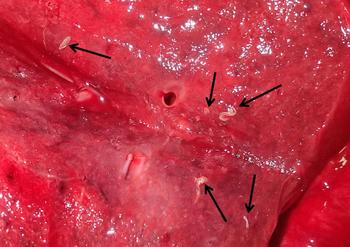
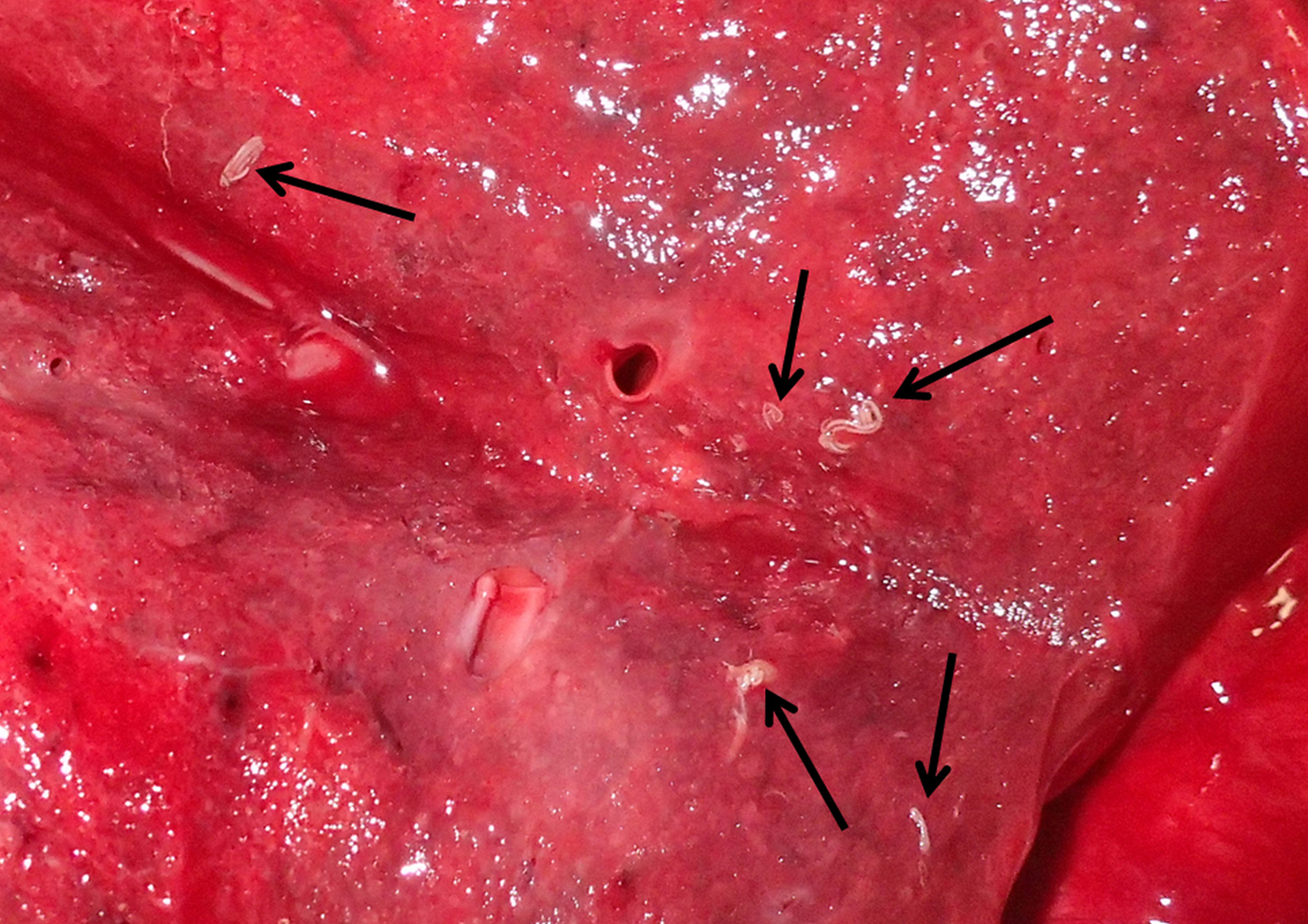
The lungs of both individuals were inflated. The German orca's lung was mildly congested, while both lungs showed a severe, acute, diffuse alveolar oedema. A mild, dispersed nematode infection was present in the bronchi of both individuals, with disseminated parasites visible at the cutting surface (Fig. 1).
Nematodes (arrows) macroscopically visible on the cutting surface of the Norwegian orca's lung.
The Norwegian orca's ductus arteriosus was still patent as a small opening with thickened rims in the wall between the pulmonary trunk and aorta. Both external umbilical cords were cleanly severed, but the Norwegian orca's still had a pinkish centre.
Parasitological findings
Several adult male and female nematodes were isolated from the lungs of both orcas. Morphological characteristics of the nematodes were similar in both orcas and indicative of Halocercus sp. (Pseudaliidae; Metastrongyloidea).
Histological findings
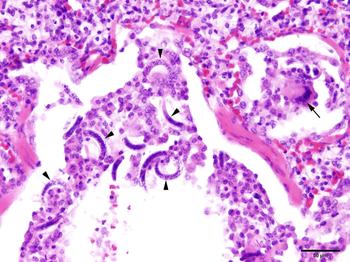
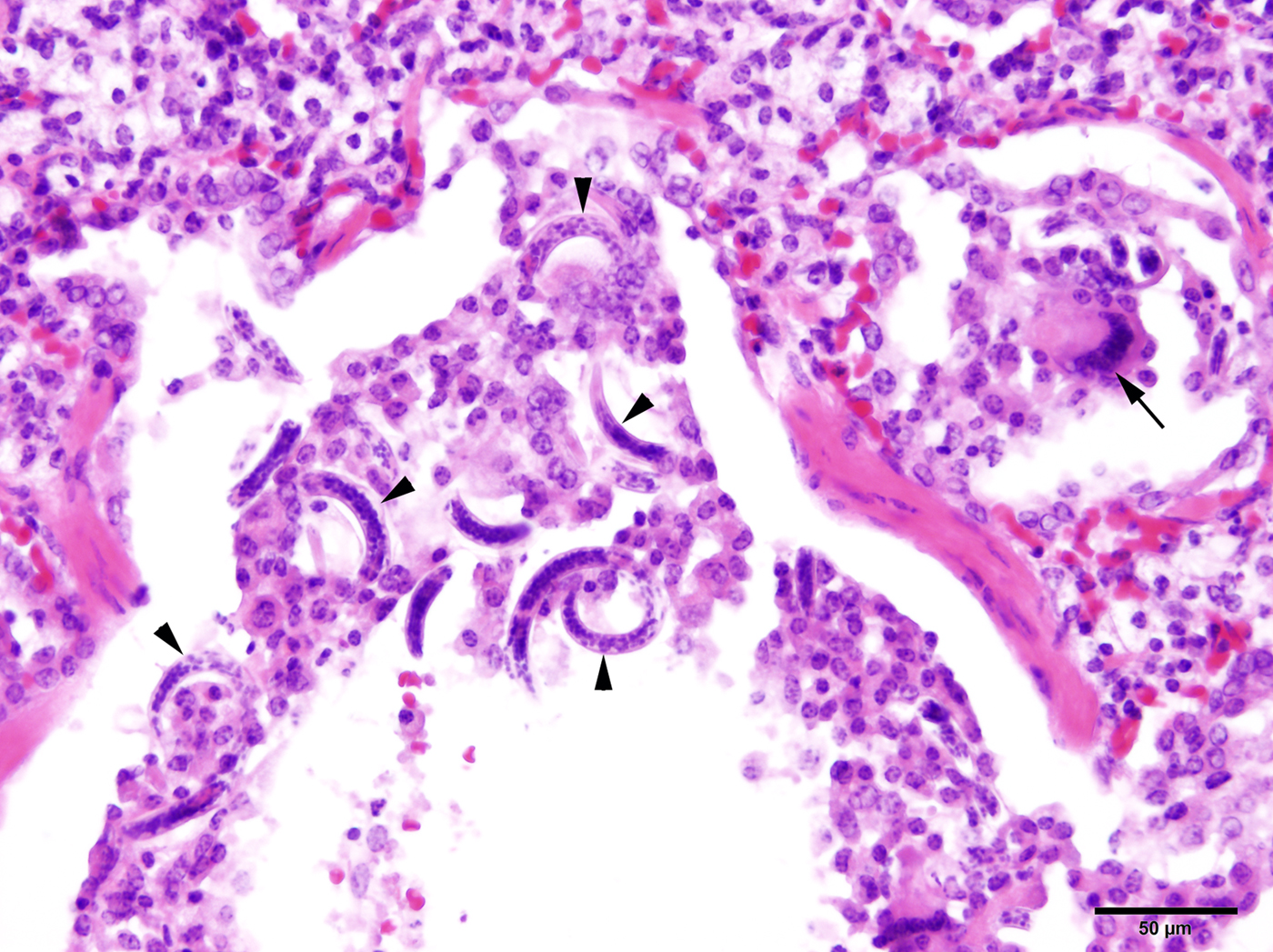
Histology of the German orca's lung revealed an oligofocal moderate granulomatous pneumonia with predominant infiltration of macrophages and lymphocytes admixed with few multinucleated giant cells, neutrophilic and eosinophilic granulocytes. Numerous nematode larvae were present intralesionally (Fig. 2). There were moderate proliferations of type II pneumocytes and a severe alveolar histiocytosis. In addition, few haemorrhages and low numbers of macrophages with coarse granular brown cytoplasmic pigment positive with Turnbull´s blue stain for iron were found. Mild follicular hyperplasia of the Peyer's patches was observed in the intestine. The cervical lymph node adjacent to the thyroid gland and the retropharyngeal lymph node displayed mild follicular hyperplasia.
German orca, lung; severe granulomatous pneumonia with the multinucleated giant cell (arrow) and numerous intralesional nematode larvae (arrowheads), HE.
Morbillivirus antigen was not detected in the brain.
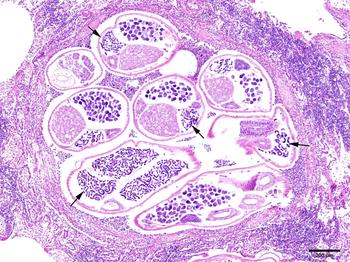
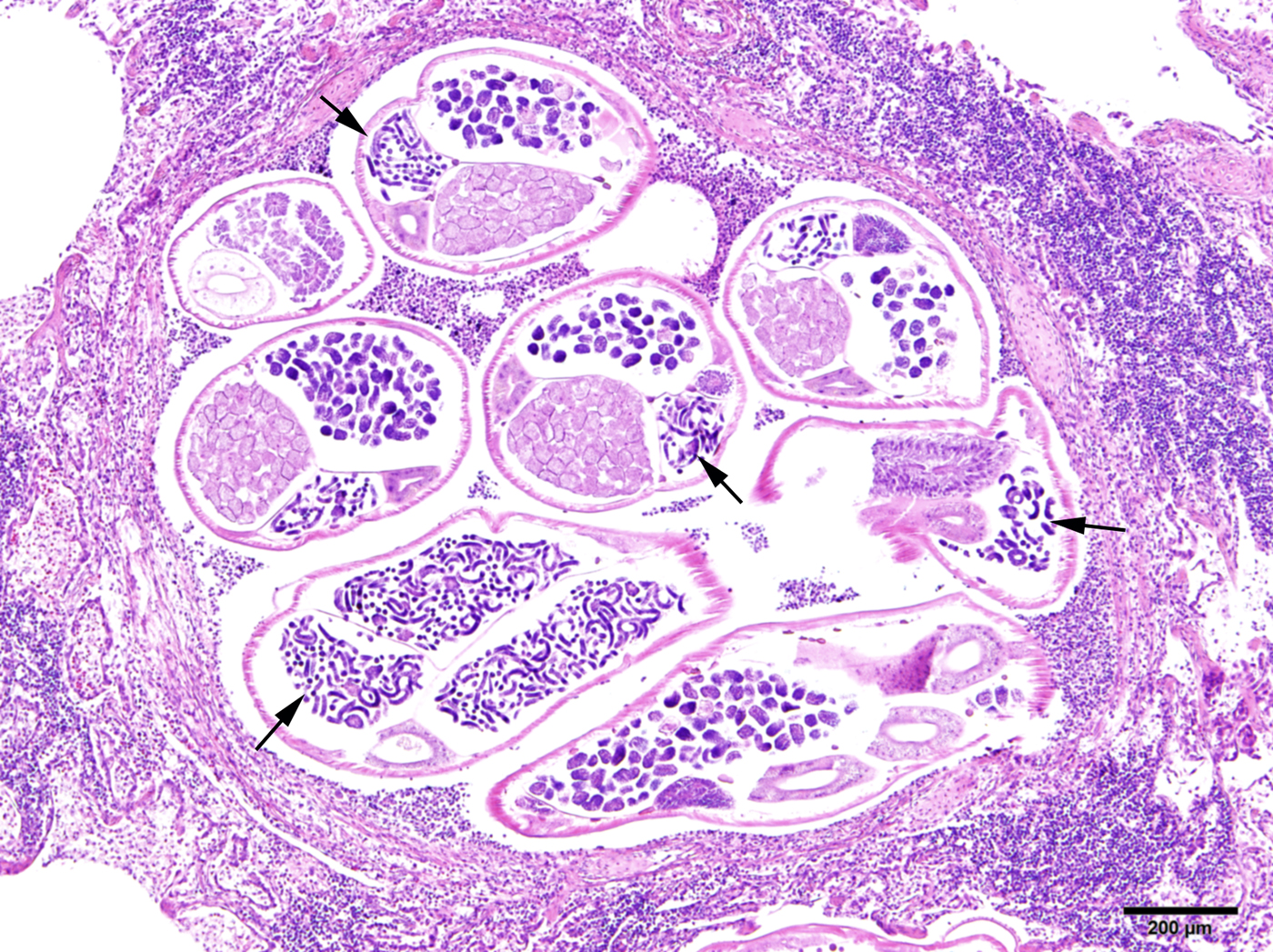
The lung of the Norwegian orca displayed multifocal mild to moderate necrotising bronchitis and bronchiectasis with intraluminal adult nematodes that contained larval stages within the genital tract (Fig. 3). Mild to moderate numbers of macrophages were present, adjacent to the nematodes in the bronchial lumina. A multifocal mild to severe, predominantly lymphocytic broncho-interstitial pneumonia was evident with a few eosinophilic granulocytes, mild interstitial fibrosis, type II pneumocyte proliferation and partly severe accumulation of foamy macrophages in the alveolar lumina. Mild follicular hyperplasia of Peyer's patches was observed in the intestine. In one umbilical artery, thrombosis with infiltrating fibroblasts, collagen fibre synthesis (Azan stain) and moderate numbers of macrophages with cytoplasmic haemosiderin storage (Turnbull blue's stain) was observed.
Norwegian orca, lung; necrotising bronchitis with ectasia and numerous intraluminal adult nematodes displaying larvae in the genital tract (arrows); severe predominantly lymphocytic peribronchitis; HE.
All other histologically examined organ samples of both individuals did not show any morphological alterations.
Genetic analysis
Both killer whales carried mitochondrial haplotypes previously described for the North Atlantic (NA): The German orca exhibited haplotype 35, the Norwegian calf haplotype 33 (Foote et al. Reference Foote2009).
Discussion
The examined orcas were regarded to be neonates with total body lengths of 246 and 216 cm, respectively and a weight of 185 kg (German orca). In both cases, there was no apparent indication of human interaction and a pulmonary nematodiosis with accompanying chronic inflammation was found. In addition to neonatal colouration and further attributes including freshly severed umbilical cords, distinct neonatal papillae on the tongues and unerupted or only partly erupted teeth were found. However, the exact age of both individuals cannot be determined. The partial organization of the umbilical arterial thrombosis with collagen fibre neosynthesis and haemosiderosis in the Norwegian orca are regarded as additional histological parameters for age determination. According to wound-healing parameters in terrestrial mammals these findings indicated an estimated age of at least 3 days (Wohlsein and Reifinger, Reference Wohlsein, Reifinger, Baumgärtner and Gruber2015), but possibly older.
The most striking finding in both neonatal orcas was the pulmonary endoparasitosis caused by Halocercus sp., associated with moderate to severe inflammatory reactions. Adult males with spiculae were found in both individuals. Histologically, nematode larvae were found in the pulmonary parenchyma of the German orca, most likely representing stage I larvae. Therefore, a patent infection producing offspring is assumed. Pseudaliid lungworms are ovoviviparous and first-stage larvae are hatched in utero and shed in tissues (Anderson, Reference Anderson2000; Houde et al. Reference Houde, Measures and Huot2003). They could be transported upwards by mucus with the bronchial escalator, swallowed and then shed with the feces. In the Norwegian orca, adult nematodes were present in bronchi with numerous larvae inside the uteri/genital tract. The life cycle of many metastrongyloid nematodes is heteroxenous and infection of final hosts usually occurs via third stage larvae which have undergone two moults within intermediate hosts to become infective (Anderson, Reference Anderson2000; Measures, Reference Measures, Samuel, Pybus and Kocan2001). As little is known about the life cycle in members of the Pseudaliidae family the authors can only speculate if the first-stage larvae in this study were already infective or if larval developments outside the final host and obligate intermediate hosts were necessary. The larval development into the infective third stage was shown experimentally in Otostrongylus circumlitus (Crenosomatidae; Metastrongyloidea), a lungworm of seals, after 56 days (Bergeron et al. Reference Bergeron, Huot and Measures1997) and in Parafilaroides decorus (Parafilaroididae; Metastrongyloidea), a lungworm of California sea lions (Zalophus californianus) after ~36 days (Dailey, Reference Dailey1970) in fish intermediate hosts. Developmental durations of larval pseudaliids inside the genital tract and up to the mature stage are unknown.
Conclusions concerning the duration of the infection in the orcas of a minimum age of 1–2 weeks and inferences about the probability of intrauterine or galactogenic infection must remain speculative. However, the lack of infections with any other parasitic species, especially gastro-intestinal anisakid nematodes which are known to be transmitted with intermediate fish hosts when ingested as prey, clearly points to a direct transmission of Halocercus sp. in these young nursing orcas.
The nematode findings are remarkable for such young individuals, as in many marine mammals lungworm infections are only diagnosed when they begin to hunt and consume potential invertebrate and vertebrate prey intermediate hosts (Measures, Reference Measures, Samuel, Pybus and Kocan2001; Lehnert et al. Reference Lehnert, Raga and Siebert2005). The gestation period in orcas lasts about 15–18 months and the single calf is nursed for a minimum of 1 year but may start eating solid food as early as 6 weeks post natum (Kastelein et al. Reference Kastelein2003). Although little is known about the life cycles of lungworms in marine mammals, there is evidence that certain fish species act as intermediate hosts for their transmission in the marine environment (Lehnert et al. Reference Lehnert2010). In experimental studies on marine metastrongyloids, American plaice (Hippoglossoides platessoides) and Arctic sculpins (Myoxocephalus scorpioides) were reported to act as potential intermediate hosts for Pharurus pallasii in beluga whales (Delphinapterus leucas) in Canada (Houde et al. Reference Houde, Measures and Huot2003). Girella nigricans, a coprophagic fish, is a suitable intermediate host in the transmission of P. decorus to California sea lions (Dailey, Reference Dailey1970) and American plaice were reported to act as a potential intermediate host for O. circumlitus in ringed seals (Phoca hispida) (Bergeron et al. Reference Bergeron, Huot and Measures1997). However, in one report on mother-to-calf infections with Halocercus lagenorhynchi in bottlenose dolphins the authors suggested that transplacental infection may take place in some pseudaliid species infecting cetaceans (Dailey et al. Reference Dailey1991). In this previous study, four dolphin calves displayed multiple mature nematodes in the lung tissue. Recent studies support that prenatal infections in lung nematodes of cetaceans are probable. Neonatal bottlenose dolphins investigated in South Florida were found to have the highest prevalence and severity of H. lagenorhynchi infections compared to juveniles and adults (Fauquier et al. Reference Fauquier2009) and lungworm infections (H. lagenorhynchi, Pharurus alatus, Stenurus ovatus) in dependant calves of Australian short-beaked common dolphins and bottlenose dolphins were found to be more prevalent than in juveniles or adults (Tomo et al. Reference Tomo, Kemper and Lavery2010).
The present cases of two male neonatal orcas with lungworm infections are indicators for a direct, vertical infection route of Halocercus species. As both individuals were only days to weeks old and had most probably only ingested milk, it seems highly likely that they caught the infection from their mother. With mature lungworms being present in their respiratory tract, they either caught the infection in utero or via the galactogenic route. However, the likelihood of pseudaliid lungworms having differing, species-specific life cycles or being able to use both direct and indirect transmission pathways requires further study.
The mitochondrial haplotypes 35 and 33 detected in the two killer whale specimens are common in the NA: Type 35 is carried in about 16% of the NA killer whales and has been detected mostly in or close to the North Sea (i.e., the UK, the Netherlands, Denmark) (Foote et al. Reference Foote2009). Type 33 is carried in approximately 36% of the NA killer whales and has NA-wide distribution, from the Netherlands and the UK over Iceland to Greenland according to Foote et al. (Reference Foote2009), and from Gibraltar to Norway and Iceland in the sampling of Morin et al. (Reference Morin2010). Both belong to Ecotype I, the widely distributed ‘generalist’ feeder (Foote et al. Reference Foote2009).
The parasites and associated tissue inflammations may have contributed to respiratory distress, but the low level of infection and the distribution of the lungworms did not contribute to the stranding/cause of death. Without a clear cause of death in both cases, external influences and environmental causes, as well as non-specific calf mortality, need to be taken into consideration as a cause for these strandings. The German neonate had sunken caudo-dorsal flanks and a depression behind the head, which are typical signs of malnutrition in cetaceans (Mazzariol and Centelleghe, Reference Mazzariol and Centelleghe2013). However, both neonates had milk residues in their stomachs, which suggests that they had been nursing recently and were not separated from their mothers for long before becoming stranded. The German orca's body condition and the Norwegian orca's small size may suggest insufficient maternal milk production, maternal neglect, separation, failure to thrive or other factors. As apex predators, orcas are prone to accumulate very high PCB concentrations in their bodies, which is very likely to have a negative effect on their health and can suppress population growth and recovery (Jepson et al. Reference Jepson2016). Furthermore, they exhibit a high neonatal mortality rate of ~43% (37–50%) within the first 6 months of life (Olesiuk et al. Reference Olesiuk, Bigg and Ellis1990), thus losing a newborn is not uncommon for this species.
The stranding on Sylt probably marks the ninth recorded orca stranding along German coasts since the mid-1800s (Kinze et al. unpublished; personal communication U. Siebert & C. Kinze).
Conclusion
An infection with pseudaliid nematodes was found in two stranded neonatal orcas in northern Europe. Morphological and phenotypic findings indicated an estimated age of ~1 week for the Norwegian orca, while the German individual appeared to be slightly older. The presence of larvae in the German orca's lung and adult worms in the lung tissue of both animals is regarded as a strong indicator for a vertical infection route in Halocercus species and provides valuable new data on the life cycle of this parasitic genus as well as the ecology of its host.
Acknowledgements
The authors thank all people involved in the reporting, transport and imaging, as well as all ITAW colleagues who helped with necropsy and sampling of the German individual. Special thanks go to Eve Jourdain and Richard Karoliussen from Norwegian Orca Survey (www.norwegianorcasurvey.no) for providing the Norwegian neonate for necropsy and sampling. Additional thanks go to Katja Havenstein, University of Potsdam, for the mitochondrial DNA analyses.
Financial support
The investigations were partly funded by the Ministry of Energy, Agriculture Environment and Rural Affairs, and the National Park Service of Schleswig-Holstein. This research received no specific grant from any funding agency, commercial or not-for-profit sectors.
Conflict of interest
The authors declare no conflict of interest.
Ethical standards
Not applicable.