


“By the constitution of Russia, the Czar may choose whom he has in mind for his successor, whether of his own or of a strange family. Such a settlement produces a thousand revolutions and renders the throne as tottering as the succession is arbitrary.”
— Montesquieu, The Spirit of the Laws, Book 5.
“Men have preferred the risk of having children, monstrosities, or imbeciles as rulers to having disputes over the choice of good kings.”
— Jean-Jacques Rousseau, The Social Contract,
Book 3, Chapter 6.
Arranging a planned and peaceful succession of leadership is extremely difficult in autocracies (Brownlee Reference Brownlee2007,598; Svolik Reference Svolik2012,198). A majority of all exits from office in authoritarian regimes from 1946 to 2008 were nonconstitutional, and more than two-thirds of the nonconstitutional exits were orchestrated from within the ruling elite (Svolik Reference Svolik2012). Apart from the obvious problem this poses for the autocrat, the political insecurity that the succession creates is likely to have wider consequences for the society. As Mancur Olson has pointed out, an autocrat who cannot trust the elite to remain loyal has few incentives to make the long-term investments that are necessary for building a strong and prosperous state; the autocrat is better advised to provide private goods to his rivals in order to remain in office in the short term (Clague, Keefer, Knack, and Olson 1996; Olson Reference Olson1993). Therefore, the issue of succession is of fundamental importance for understanding both leader survival and state-building efforts in autocracies.
There are several notable reasons why succession is problematic in autocracies. If the autocrat designates a successor, this person has strong incentives to depose the autocrat and take power (Herz Reference Herz1952). However, if the autocrat does not appoint a successor, the elite have few incentives to remain loyal to him when he grows old, as he cannot promise them that the regime will survive and reward their loyalty after the power struggle that is likely to ensue upon his death (Bueno de Mesquita et al. Reference Bueno de Mesquita, Smith, Siverson and Morrow2003; Kurrild-Klitgaard Reference Kurrild-Klitgaard2000). Either way is perilous for the autocrat. Gordon Tullock (Reference Tullock1987) has argued that a succession based on primogeniture (i.e., the principle of letting the oldest son inherit power) offers a solution to the dilemma. It provides the autocrat with an heir who, because of his young age, can afford to wait to inherit power peacefully, and it provides the elite with assurance that the regime will live on and continue to reward their loyalty after the incumbent autocrat has passed away (cf.Brownlee Reference Brownlee2007; Kurrild-Klitgaard Reference Kurrild-Klitgaard2000). If correct, Tullock's argument would lend credibility to Rousseau's and Montesquieu's claim that primogeniture may be a preferable order of succession despite the obvious risk of having incompetents rule the state.
The argument that a succession based on primogeniture increases the autocrats’ chances of surviving in office—and thereby their incentives for state building—has scarcely been tested. The lack of studies might be a consequence of contemporary autocracies’ reluctance to formalize their succession orders. Another explanation can be that there is an overlap between regime types and succession orders that makes it difficult to disentangle the effect of succession orders per se. Historically, autocracies were less reluctant to make their succession orders official. There was also considerable variation in how autocracies arranged the succession. In AD 1000, Europe was dominated by autocratic states with succession orders based on election, or the principle of agnatic seniority, according to which the ruler's oldest brother inherited the throne before any of his sons (Dvornik Reference Dvornik1962; Kern Reference Kern1948). Only a few states on the Iberian Peninsula practiced primogeniture. Taking advantage of these facts we test Tullock's hypothesis on a new dataset that covers 961 monarchs in 42 European states during the period AD 1000–1800. We find that the risk of deposition was substantially lower for monarchs that ruled states practicing primogeniture.
Furthermore, we present tentative evidence that the political stability that primogeniture created may have facilitated state building and state survival. While the variation in succession orders was great around AD 1000, it had virtually disappeared by the dawn of the nineteenth century: the states that practiced election or agnatic seniority had either changed their constitutions, or like Poland, succumbed to their rivals. By highlighting how important succession orders were in this development, our findings complement the literature on European state building that has mostly focused on how autocrats co-opted elites and built strong states by creating parliaments (cf. Blaydes and Chaney Reference Blaydes and Chaney2013; Ertman Reference Ertman1997; Levi Reference Levi1988; North, Wallis, and Weingast Reference North, Wallis and Weingast2010; Stasavage Reference Stasavage2010).
Finally, we show that primogeniture is also negatively associated with monarchs’ risk of being deposed in the world's few remaining absolute monarchies.
THEORY: RULER-ELITE RELATIONS, AUTOCRATIC SURVIVAL, AND STATE BUILDING
In order to build a strong state an autocrat must eliminate the myriad of external and internal threats to his power. External threats are dealt with through war and the threat of war, and internal threats are dealt with through what Charles Tilly (Reference Tilly, Evans and Skocpol1985) termed state making. The internal threats can be divided into two categories: those from within the ruling elite, and those from the masses (cf. Bueno de Mesquita et al. Reference Bueno de Mesquita, Smith, Siverson and Morrow2003; Gandhi and Przeworski Reference Gandhi and Przeworski2007; Magaloni Reference Magaloni2008; Svolik Reference Svolik2012). These two threats require responses from the autocrat, creating what Milan Svolik (Reference Svolik2012) terms the problem of authoritarian control (repression of the masses) and the problem of authoritarian power-sharing (co-opting the elite), which is the focus of this article.
The problem of autocratic power-sharing is present in virtually all autocracies, regardless of place or historical period. According to Thomas Ertman (Reference Ertman1997, 8), an autocrat has to rely on the support of other groups as soon as the size of the state grows beyond what the staff of the ruler's household can manage. Thus, almost all autocrats must share power with other influential groups in society, be they feudal lords, generals, ministers, or business leaders. However, such power concessions give these groups the tools to depose the autocrat (Svolik Reference Svolik2012). Often they are more than willing to do so: a majority of the autocrats that are deposed today are deposed by persons from within the government (Svolik Reference Svolik2012). Historical rulers also had ample reason to fear members of the elite. Mark Bloch writes about feudal vassals that “of all the occasions for going to war, the first that came to mind was to take up arms against one's lord” (Bloch 1961, 235). Any autocrat therefore needs to keep a precious balance of power with the domestic elite.
The mechanisms by which elites are co-opted are remarkably similar in historical times and the modern world. One alternative is to “buy them off” with private goods (Bueno de Mesquita et al. Reference Bueno de Mesquita, Smith, Siverson and Morrow2003). To distribute this patronage and thus extend the autocrat's influence a party organization can be used (Gandhi and Przeworski Reference Gandhi and Przeworski2007; Geddes Reference Geddes1999; Magaloni Reference Magaloni2008; Svolik Reference Svolik2012). Another alternative is to give the elite influence in a parliament with legislative authority. Jennifer Gandhi and Adam Przeworski (Reference Gandhi and Przeworski2007) argue that a parliament allows the autocrat to control negotiations and select groups that can be granted influence. Parliaments have also been used since medieval times to manage opposition from elites and facilitate tax extraction, and remain the focus for most research on state building in autocracies (Blaydes and Chaney Reference Blaydes and Chaney2013; Downing Reference Downing1992; Ertman Reference Ertman1997; Levi Reference Levi1988; Tilly 1992).
In contrast, the succession orders’ role in co-opting the elite has received scant attention. This is somewhat surprising given the prominent role an ordered succession plays in providing the elite with a long-time guarantee that their loyalty will be rewarded. Whenever a disputed succession is expected it creates instability ahead of the fact, as the elite will live in uncertainty about whether the new autocrat will keep rewarding them for their loyalty to the incumbent autocrat. Biology plays a part in creating succession crises, for instance when no living children are born to a king. However, it is ultimately institutions that determine whether ambiguity about the succession can be avoided. In the remainder of the article, we discuss the two main problems of succession: the coordination problem and the crown-prince problem, and how succession institutions can solve these problems, thereby contributing to the understanding of the European state-building experience and the functioning of autocracies.
The Coordination Problem
In line with much of the research on autocratic rule (Bueno de Mesquita et al. Reference Bueno de Mesquita, Smith, Siverson and Morrow2003; Gandhi and Przeworski Reference Gandhi and Przeworski2007; Svolik Reference Svolik2012), we assume that an autocrat must share his income with his supporters in order to assure their loyalty. Because of these rents, the members of the regime have an interest in keeping the autocrat in power. If the autocrat dies, or is deposed, and the regime members cannot agree on a successor, the regime will fall and an internal struggle over the succession will ensue. While such a power struggle provides the members of the regime with an opportunity to seize power and grab more rents for themselves, it is likely that they will “prefer maintaining their status to pursuing a potentially disastrous power grab” (Brownlee Reference Brownlee2007, 606). First, regime members cannot be certain about whether they will succeed in grabbing power. Second, they know that the winning contender will likely dispose of his competitors once in power. In other words, trying to overthrow the autocrat is a high risk strategy. As long as the autocrat continues to share his rents, the regime is therefore likely to stay loyal to him. However, the succession struggle cannot be postponed forever. Sooner or later the incumbent must die. In that event the struggle can only be avoided if the elite can agree on a successor and coordinate their efforts to uphold the regime and the status quo.
The problem is that it is difficult for the members of the regime to plan for the demise of the ruling autocrat and coordinate their efforts to uphold the regime if the autocrat does not provide them with a successor. In such circumstances they will anticipate the struggle that is likely to break out when the autocrat dies and plan for it (Herz Reference Herz1952). They might even be tempted to carry out a coup, as the instigator of a successful coup is likely to become a focal point for other members of the regime. Montesquieu (2011 [1750], 61) argues that since possible contenders for the throne in such circumstances know that they likely will be imprisoned or put to death if they do not manage to grab power for themselves, they have “a far greater incentive to ambition” than when the line of succession is clear. The absence of a successor is therefore not only highly problematic for the regime but also for the autocrat. From this perspective, the autocrat is therefore wise to appoint an heir.
The Crown Prince Problem
Although designating a successor solves the coordination problem, it creates another problem for the autocrat. The appointed successor has very strong incentives to stage a coup, as he will assume power if the incumbent autocrat dies. Furthermore, the crown-prince status is likely to allow him to accrue power in the regime. The successor, thus, increasingly has both motive and opportunity to mount a coup (Brownlee Reference Brownlee2007, 604). John Hertz has termed this the “crown-prince problem” (Hertz 1952, 30).
However, some successors are more dangerous than others, with relative age being an important factor. A successor who is much younger than the incumbent autocrat can afford to wait for the throne as he can look forward to enjoying the rents of being the autocrat for many years after the incumbent autocrat's natural death. Older successors cannot afford to be as patient. The autocrat is therefore wise to appoint an individual who is much younger than himself, for instance his son, as heir. As Tullock puts it, “the son is wise to simply wait for his father to die” (1987, 163). Brothers, generals, and other possible successors are more likely to be closer in age to the incumbent autocrat and therefore have fewer incentives to be patient.
A young successor also provides the elite with a longer time horizon, as ill health and old age diminish the autocrat's ability to provide private goods (Bueno de Mesquita et al. Reference Bueno de Mesquita, Smith, Siverson and Morrow2003). By appointing a young successor, the autocrat thus not only buys more time in office for himself, he also likely buys more time in office for his successor.
Solving the Dilemma—Royal Succession in Medieval and Early Modern Europe
From the autocrat's point of view, a good order of succession solves the coordination problem without exacerbating the crown-prince problem. The discussion above indicates that a succession order that automatically selects a relatively young successor provides a compromise solution to both problems. However, the autocrat's safety was historically not the only consideration guiding the choice of succession orders. Another important consideration was the elite's need for leaders who could command the nation successfully in war against foreign enemies. Foreign enemies constituted a major threat to European states throughout the medieval and early modern period. Although such threats declined with time, they always remained a concern for the elite, as they were potentially quite costly. They could ultimately result in a complete replacement of the elite, such as in the case of the Norman Conquest of Anglo-Saxon England. Succession orders whose purpose was to produce able and experienced war leaders were therefore also common in much of Europe's political history. The succession orders that resulted from this balancing of interests can be roughly divided into three categories: election, agnatic seniority, and primogeniture.
Election or acclamation of monarchs was common practice in much of medieval Europe at the dawn of the second millennium. This occurred for instance in Anglo-Saxon England, France under the Capetians, the Nordic countries and, perhaps most famously, the Holy Roman Empire. As Fritz Kern has noted, the justification for electing kings seems to have arisen from the need to produce strong monarchs, able to lead the nation in war (Kern Reference Kern1948). It is misleading to think of the elections that took place in the modern sense of the word, as it was primarily the elite who were allowed to vote and because the elected came chiefly from a royal family. For example, elective monarchy in England has been described as a system where the royal family inherited the throne—not individuals (Douglas Reference Douglas1964). The fact that the pool of candidates was limited did not, however, solve the coordination problem. Uncertainty about succession was a constant factor of concern. On the positive side, the monarch did not need to fear a crown prince.
In some monarchies with elective elements, succession by appointment became an established custom (as in the mixed system of Tanistry, which was practiced in Scotland—e.g., Stephenson Reference Stephenson1927). In Russia under Peter the Great, the principle even achieved legal status. However, succession by appointment did not solve the coordination problem. First, monarchs often avoided appointing a successor (or took a long time doing so). Second, monarchs often changed their mind and appointed new successors, making it questionable who was the legitimate heir. It was, for instance, such ambiguity that sparked the Norman invasion of England in 1066 (Oleson Reference Oleson1957).
The coordination problem is solved by the other succession order that dominated in Europe at the start of the second millennium: agnatic seniority. Under this rule, which was practiced primarily in Slavic countries, such as Piast Poland and Rurikid Kiev, the eldest brother of the current ruler inherited the throne (Dvornik Reference Dvornik1962; Fine Reference Fine1986). It was then supposed to pass to his younger brothers until the last living brother, who at his death was supposed to hand it over to the oldest brothers’ oldest living son (to pass it on to his brothers, cousins, and their offspring). As a consequence, the system in ordinary circumstances produced a large pool of potential successors who were only slightly younger than the current ruler. This pool of successors aggravated the crown-prince problem because the next in line for the throne could not usually afford to wait for the incumbent monarch to die of old age if he wanted to enjoy the benefits of ruling (Brownlee Reference Brownlee2007, 605). At the same time, the system guaranteed that there were always successors of a sufficient age who were ready to lead the defense of the people if the incumbent monarch died. This capacity to produce capable successors seems to be the reason why the system was adopted in the first place (Engel Reference Engel2001; Fletcher Reference Fletcher1979; Merrills Reference Merrills2010).
The third succession order that dominated medieval Europe, primogeniture, in theory both solves the coordination problem and mitigates the crown-prince problem.Footnote 1 The most common version was agnatic primogeniture, according to which the eldest living son and his male offspring inherited. This system assured that there was only one legitimate crown prince who could function as a focal point for the ruling regime as long as the monarch produced eligible children. For natural reasons, the crown princes were also considerably younger than their fathers and could therefore afford to wait to inherit the throne. In addition, monarchs tended to be young when ascending to power and were thus able to promise the elite a long time-horizon. Thus, the monarchs’ risk of being deposed from within the regime is likely to have been lower under primogeniture than under competing succession orders. It is more difficult to make a judgment about the relative merits of systems based on election and agnatic seniority, as it involves estimating how threatening the coordination problem was in relation to the crown-prince problem.
Before proceeding to test whether the actual consequences of primogeniture conform to the theoretical expectations, we review the literature on succession and autocratic survival.
PREVIOUS RESEARCH
Barbara Geddes (Reference Geddes1999) notes that in the few cases when personalist regimes, which are notorious for eliminating potential rivals and successors, have outlasted their founders, they often have seen the transfer of power from father to son. The Somoza family in Nicaragua and the Duvaliers in Haiti are two examples. Geddes also argues that single-party regimes are better at weathering leadership struggles, as party organizations usually provide mechanisms for leader selection. Beatriz Magaloni (Reference Magaloni2008) argues that such mechanisms give the elite incentives to invest in the stability of the regime, and thus lengthens its time horizon, echoing the arguments about the benefits of primogeniture. The Mexican PRI party is an example of a party that has managed to achieve a series of peaceful leadership successions in an autocracy (Magaloni Reference Magaloni2008; Svolik Reference Svolik2012). Magaloni also notes that one potential reason explaining why monarchies appear to be more stable than most other autocracies is that they generally have clear succession arrangements (Magaloni Reference Magaloni2008, 724; see also Hadenius and Teorell Reference Hadenius and Teorell2007).
Succession is, however, not the main focus for either Geddes or Magaloni. In one of the few studies that actually focus on succession arrangements in autocracies, Jason Brownlee (Reference Brownlee2007) finds that when there are succession arrangements in place, that is, when the party predates the autocrat, hereditary succession is unlikely. However, when the autocrat predates the party, and there are no tested succession arrangements, the elite are more likely to support a hereditary succession over “a tumultuous free-for-all” (Brownlee Reference Brownlee2007, 628). The argument and evidence are in line with our hypothesis, but the empirical investigation does not reveal whether the institutions governing the succession enhance stability and autocratic survival. One reason for the lack of studies might be contemporary autocracies’ reluctance to formalize succession orders. Additionally, the close overlap between regime types and de facto succession orders makes it difficult to disentangle the effect of succession orders per se.
None of the few historical studies on the topic can be used to draw any firm conclusions. Manuel Eisner investigates the patterns of regicide in Europe between 600 and 1800 and finds a clearly decreasing trend (2011). During the eleventh century, 1.1 autocrats were murdered per 100 autocrat years, while only 0.19 autocrats were murdered per 100 autocrat years during the eighteenth century (Eisner Reference Eisner2011, 569). Eisner notes that this trend seems to coincide with the gradual codification of primogeniture as the main order of succession, but he does not explicitly test the connection.
Lisa Blaydes and Eric Chaney (Reference Blaydes and Chaney2013) find that monarchs’ tenures gradually increased in Europe with the spread of feudalism and parliamentarianism. Blaydes and Chaney do not directly test how succession orders affected monarchs’ tenures, but they do note that primogeniture first became a widespread practice in the twelfth century, hundreds of years after tenures started to increase in length. However, this observation does not say anything about whether the spread of primogeniture contributed to further increasing the tenures of European monarchs.
The only direct test of the succession orders’ impact on autocratic survival that we know of is Peter Kurrild-Klitgaard's studies (Reference Kurrild-Klitgaard2000; Reference Kurrild-Klitgaard, Rowley and Schneider2004) of how changes in succession laws and practices in medieval and early modern Denmark and Sweden affected monarchs’ risk of being deposed. The studies clearly show that Danish and Swedish monarchs sat more safely on their thrones after the introduction of de jure primogeniture. However, generalizability is always an issue with case studies. Thus there is a need for a more thorough test of Tullock's hypothesis.
ALTERNATIVE EXPLANATIONS
The main internal factor highlighted in research on state formation in Europe is the spread of parliaments (Blaydes and Chaney Reference Blaydes and Chaney2013; Downing Reference Downing1992; Ertman Reference Ertman1997). Blaydes and Chaney argue that the elite's incentives to overthrow monarchs decrease when monarchs implement executive constraints on their own power, as the elite then have more privileges to lose if they rebel. Similar arguments can be found in studies of modern dictatorships (Gandhi and Przeworski Reference Gandhi and Przeworski2007; Svolik Reference Svolik2012). Blaydes and Chaney seek the roots of the rise of executive constraints in the development and spread of feudalism. However, they also argue that, after feudalism had spread over Europe in the eleventh century, the rise of parliamentarianism was the important factor driving political stability. The authors find strong support for this conclusion in their empirical analyses, and it is therefore important to control for the emergence of parliamentarianism when testing the impact of succession orders.
European monarchs were given their offices for life and were typically justified in their authority to rule by the religious authorities (the Pope or the head of the national church), which also defended monarchy as a political system (Bendix Reference Bendix1980). State capacity and the size of the bureaucracy varied, with the general trend over time showing the movement from weak to strong states and from small to large bureaucracies (Charron, Dahlström, and Lapuente Reference Charron, Dahlström and Lapuente2012). The autocratic elements of the systems did not change to the same degree, however. Even towards the end of the period a monarch's power usually depended on a small elite, albeit that this elite had started to incorporate groups that had previously found themselves outside the system, such as self-made bureaucrats of humble origins and members of the growing bourgeoisie (Bush Reference Bush1983).
In sum, with the notable exceptions of parliamentarianism and state capacity, succession orders were the most obvious, important factors relating to autocrats’ chances of surviving in office that separated European monarchies from each other during the medieval and the early modern period. In most other relevant political aspects, monarchies resembled each other at any given point in time. This fact makes medieval and early modern Europe fertile grounds for testing succession orders’ impact on autocratic survival.
DATA AND EMPIRICAL STRATEGY
To test Tullock's hypothesis, we constructed a dataset of European monarchs with data on their tenure and the nature of their departure from the throne as well as the succession orders in the states they ruled. We choose the year 1000 as our starting point, as reliable historical sources are very scarce prior to that time.Footnote 2 We defined “monarchy” as a political system where sovereignty is vested in a person (e.g., a king, basileous, prince, or emperor) who is empowered by law or custom to remain in office for life. In other words, monarchy is a type of autocracy with legal and/or customary foundations (Tullock Reference Tullock1987).
Construction of a dataset that spans over 800 years of history obviously entails difficulties in terms of source material. Blaydes and Chaney base their dataset on the work of John Morby, who compiled information on royal dynasties over five millennia in his work Dynasties of the World (Morby Reference Morby1989). Manuel Eisner instead bases his database on Wikipedia articles, cross-checking it against dynastic tables such as Morby's (Eisner Reference Eisner2011). A dataset based on a single source such as Morby is probably more consistent than one based on several sources. However, Morby also uses sources of varying quality, and the information provided omits important aspects of the monarchs’ political fates.
We have constructed a new dataset that builds on Morby's data but for reliability reasons we have cross-referenced all information with the sources he uses as well as various other bibliographical sources on monarchs and their reigns. Especially, our dataset contains more detailed information on the way in which monarchs left office. This is of importance, as Morby's coding of “deposed” monarchs is ambiguous for a number of reasons. First, he does not distinguish between monarchs who were deposed by domestic and foreign enemies. Our theory only concerns the former kind of depositions and for this reason we have constructed a new dependent variable only containing depositions carried out by domestic actors.
Second, Morby does not count murdered monarchs as deposed. In contrast, we count all monarchs who were murdered by domestic actors as deposed.Footnote 3 A third problem is that Morby does not count monarch deaths in civil wars, which were especially common early in the period, as depositions. In our broader definition, we define all monarchs who died in civil wars as deposed.
Although we deem that the dependent variable we have constructed more reliably measures monarchs’ political fates, we also test, for robustness and comparability issues, our statistical models with two alternative dependent variables. The first is the dependent variable coded by Morby and used by Blaydes and Chaney (Reference Blaydes and Chaney2013). The results from the models using this variable are presented in our main tables alongside the results from the models using our coding.
Second, in some cases it is doubtful whether crown princes or some group of the elite were actually responsible for the murder of a monarch. In other cases monarchs were killed in civil wars even when they had the support of a majority of the elite. In both cases the term “elite deposition” might seem improper. To test whether our results are robust for the exclusion of such depositions we have also run models with a second alternative variable that builds on Morby's coding, but excludes foreign depositions. As noted above, Morby excludes almost all depositions that occurred as a result of murders and deaths in civil wars.Footnote 4 Thus, the resulting dependent variable only contains clear-cut cases of elite depositions. Similar depositions made by groups outside the elite—e.g., peasants and the bourgeoisie—are almost unheard of in the studied period. The three possible exceptions we have found are right-censored.Footnote 5 The resulting models (which are presented in Tables A5 and A6 in the online appendix) produce similar results to those presented in our main tables.
State sovereignty raises further coding issues. During certain time periods, many states were joined together in personal unions under a single monarch.Footnote 6 We count such states as separate political entities if they retained separate councils and/or estates and lacked a unified succession. The reason is that most personal unions did not translate into political unification in more than the person of the monarch. This means that some monarchs appear more than once in our dataset (i.e., as monarchs for different states). These monarchs are only counted as deposed for the state that deposed the monarch. If a deposition resulted in the death or imprisonment of the monarch, we censor the monarch's rule in the other states he ruled (i.e., we do not count him as deposed in those states).Footnote 7
Our main independent variable differentiates between the three succession orders described in the theoretical section: (i) election/selection, (ii) agnatic seniority, and (iii) primogeniture. We do not know of any comprehensive dataset that lists the orders of succession in European states during the period of study and thus had to compile our own data from different historical sources.Footnote 8 The resulting dataset is presented in Table B1 in the appendix. To the greatest extent possible we have focused on coding de jure succession orders. Only in the cases where states lacked a codified succession (which was not uncommon at the start of the period) have we coded established customs.Footnote 9 Changes in customs that took place after succession laws and procedures had been adopted have only been coded insofar as they gained legal status. To be certain that the adopted succession laws were actually implemented, we have chosen to only code laws that were followed by a succession that obeyed the proscribed procedure and where the successor was not deposed during his first year on the throne. This one-turnover test assures that only laws that resulted in at least one succession, according to the proscribed principle after they were adopted, are counted as being implemented. A law that fulfills the criteria is counted as implemented from the rule of the monarch who adopted it. We use the resulting de jure based coding to construct three dummy variables that represent the succession orders described above. These variables are used in all models presented in the article, with elective monarchies functioning as the reference category.
Although we believe that the focus on de jure succession laws constitutes the most reliable test for our hypothesis, we have also rerun our models with a variable capturing long periods of de facto primogeniture (see Appendix Table B1 for coding). The results from the models that use this variable, instead of the de jure variable, are presented in Tables A3 and A4 in the Appendix and they essentially confirm our main findings.
Exploring the Causal Mechanisms
The succession orders’ effect on the coordination problem is measured directly by the dummy representing elective monarchies (which functions as the reference category in all models), as the other succession orders in normal circumstances point out a single successor. However, primogeniture and agnatic seniority also have a stabilizing effect because they allow the crown prince to be groomed by the elite. To separate between these effects we use dummy variables to test whether sons and brothers of the former monarch survived longer in office than other relatives and nonrelatives. These dummy variables are not perfect for the purpose, as we do not know whether a particular son or brother was the crown prince. However, on the whole, sons and brothers are likelier to have been crown princes.
There is no perfect way to test the crown-prince problem mechanism. It would theoretically be possible to collect data to test whether it is the relative age of the successors that the different succession orders produce that drives differences in autocratic survival between systems based on primogeniture and agnatic seniority. Unfortunately, identifying all potential successors and collecting data on their dates of birth and on their family relationships to the monarch is impossible for many states, and especially those practicing agnatic seniority. However, in most cases it is possible to establish the family relationship between a monarch and his actual successor. We use this information to construct dummy variables that allow us to explore whether monarchs who were succeeded by their sons survived longer in office than monarchs who were succeeded by their brothers (and other relatives and nonrelatives). Admittedly, these dummy variables are not perfect for testing the crown-prince problem, as we do not know whether the particular son or brother that succeeded the monarch was the intended crown prince. There is also a risk that the variable introduces endogeneity into the model, as the variable is measured after the dependent variable. However, most sons and brothers who succeeded monarchs are likely to have been intended successors. We therefore argue that this is the best available test of the crown-prince mechanism, even if the results cannot be taken as the definitive answer.
Another advantage of primogeniture is that it produces crown princes that are young in absolute terms. We isolate this effect with a variable that measures a monarch's age at ascension. Most of the data we have used for the construction of this variable comes from the English version of Wikipedia. To the extent that we have been able to check, the reliability of Wikipedia's information is very high.
Control Variables
To account for the appearance of executive constraints on the monarchs’ power in the form of parliaments, we use a variable identical to the one used by Blaydes and Chaney (Reference Blaydes and Chaney2013). The variable—based on data about the history of European parliaments from van Zanden, Buringh, and Bosker (2011)—measures, for each state and century, whether the state had a parliament that met at least once during the century. If the state had such a parliamentary meeting it is assigned a value of 1, and if it did not, it is assigned a value of 0 for the century in question.
We also control for the branch of Christianity that dominated during the monarch's rule (defined as the religion that the monarch adhered to). We distinguish between Catholic (the base category), Orthodox, and Protestant states. States that changed their religion from Catholicism to Protestantism are counted as Protestant from the first monarch who ascended to the throne as a Protestant (a list of these states are provided in Table B2 in the Appendix).
To account for the impact of foreign threats we use two alternative approaches. First, in most models we use a variable that, for each state and century, measures how many monarchs were deposed by foreign actors. To avoid endogeneity issues we subtract each monarch's own political fate (in relation to foreign actors) from the variable before introducing it in our models. Second, in a few models we use a variable that measures whether foreign enemies deposed a monarch's predecessor.Footnote 10 Admittedly, the variables measure both the existence of foreign threats and the state's (and monarch's) ability to cope with them. Ultimately, we would have liked to separate between these factors, but the lack of reliable comparative data on the frequency and scale of wars makes it difficult to do so. Overall, foreign depositions were rare. However, there were exceptions that show severe outside pressure (see Table B3 for the 12 most vulnerable states). One illustrating example is that monarchs in states that were about to lose independence—for example, the Byzantine Empire in the fifteenth century and Anglo-Saxon England in the eleventh century—were relatively likely to be deposed by foreign enemies.
To control for state capacity, we use a variable inspired by the State Antiquity Index developed by Bockstette, Chanda, and Putterman (Reference Bockstette, Chanda and Putterman2002; Bockstette and Putterman Reference Bockstette and Putterman2007). Using the State Antiquity Index, Jacob Hariri has shown that a legacy of early statehood increased non-European states’ ability to resist European colonization (2012). Hariri argues that this ability might also have strengthened the rulers’ control of the state apparatus (2012, 472). Reasonably, a legacy of early statehood should also be informative of the European states’ and monarchs’ ability to resist foreign aggression and internal opposition. However, because the State Antiquity Index only covers modern states, we had to construct our own version of the index. Based on Bockstette and Putterman (Reference Bockstette and Putterman2007), Peter Heather (Reference Heather2009), and the sources provided in the Appendix, our index measures the history of continuous statehood at each monarch's ascension. A state is assigned a value of 0.5 for each year some other state(s) existed on its territory and a value of 1 for each year it survived as an autonomous state. Following Bockstette and Putterman we start assigning values from the year 0 (see Table B4 in the Appendix). The intuition behind the index is that durable states are likely to have built stronger institutions than states that have only existed for a brief period. To account for the fact that the first years of state building are likely to matter more for state capacity than additional years of state building, we use the log of the resulting index in our models.Footnote 11
A fifth control variable measures whether a monarch's immediate predecessor ended his rule by being overthrown by domestic actors. This variable serves as a rough control for longer periods of political instability, for example civil wars. Although such wars can be reasonably argued to be partially a product of succession orders, they can also have other causes. And as this control variable is reasonably endogenous to the main independent variable, its inclusion in the models constitutes a very tough test for Tullock's hypothesis.
Finally, following Carter and Signorino (Reference Carter and Signorino2010), we control for general time trends in autocratic survival, by including a linear, a squared, and a cubic function for the year of ascension in all models.Footnote 12
The resulting dataset sample, excluding control variables, includes 961 monarchs from 42 states. Unfortunately, we lack data for some of the monarchs in three control variables. First, we do not have information on the fate of all of the monarchs’ predecessors. Second, we have been unable to find information on some monarchs’ birth dates, and thus their ages at ascension. Third, we lack data on some monarchs’ relationship to their predecessors and successors. In the full models, we therefore only have 858 monarchs. The models that use the dependent variable coded from Morby (Reference Morby1989) only contain monarchs from 40 states, as Morby does not cover Wallachia and Moldavia.
Estimation Strategy
We apply survival analysis to the resulting datasets. Survival time is measured as the time a monarch survived in office without being deposed.Footnote 13 Failure is coded as 1 if the monarch was murdered, forced to abdicate, or died in a civil war. Observations are right-censored if the monarch's reign ended peacefully, either by his natural death or voluntary abdication, or if he died in a war against foreign enemies.
We use the Cox proportional hazard model, which is a semi-parametric duration model for survival analysis, to model the risk of monarchs being deposed. Box-Steffensmeier and Jones advise using Cox models when researchers do not have “strong theoretical reasons to expect one distribution function over another” (2004, 48) as the Cox model leaves the form of duration dependency unspecified.
We run two kinds of models. First, we run shared frailty models, based on country, to account for the fact that monarchs are nested within states and thus are not truly independent observations.Footnote 14 The results from these models build both on the between-country and the within-country variation that is present in the sample.
Second, we run models that allow each state to have its own baseline hazard, meaning that only the within-country variation in succession orders over time is allowed to affect the results. These models provide a stricter test of Tullock's hypothesis than the first models, as they eliminate all influence from unobserved, time-constant, state-level factors that make monarchs within particular states more vulnerable than others to deposition. Both kinds of models are run both with our and Morby's dependent variable. We present our results below.
RESULTS
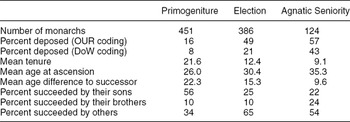
As a preliminary analysis, we examine descriptive statistics of how monarchs fared under different principles of succession in Table 1. Both according to our coding and coding in the Dynasties of the World (DoW), fewer monarchs were deposed under primogeniture than under election and agnatic seniority. Monarchs also enjoyed considerably longer tenures under primogeniture, with the average being 21.6 years, compared to 12.4 years under election and 9.1 years under agnatic seniority.
Descriptive Statistics by Succession Order

Succession orders seem to have had the expected effects on other outcomes as well. Monarchs who ascended to the throne under primogeniture were substantially younger than monarchs who ascended to the throne under other succession orders. Compared to monarchs in other systems, they were also relatively old compared to their successors. This observation strongly hints that age differences between incumbents and potential successors were greater on average under primogeniture than under competing succession orders.
Actual successions largely correspond to the orders of succession: under primogeniture, a majority of monarchs were succeeded by their sons, while nonrelatives were the most common successors under election. Under agnatic seniority it was most common to be succeeded by a nonrelative. However, it was more common to be succeeded by brothers under agnatic seniority than under the other two succession orders.
Although the descriptive statistics seem to support the hypothesis that primogeniture increased monarchs’ chances of surviving in office, there is a risk that the differences observed in deposal rates are driven by a general time trend or other confounding factors. We therefore proceed to the results of the Cox models, which are presented in Table 2.
Survival Analysis, Shared Frailty Cox Models

Note: Exponentiated coefficients; t statistics in parentheses.
*p < 0.10, **p < 0.05, ***p < 0.01
Model 1a, which only contains the dummy variables measuring succession orders and the three variables measuring the time trend, clearly shows that succession orders had an impact on monarchs’ chances of surviving in office. Monarchs in states that practiced primogeniture had a 75% lower hazard of being deposed compared to monarchs in elective monarchies. In comparison, monarchs in states that practiced agnatic seniority had a 98% higher hazard of being deposed than their counterparts in elective monarchies. Model 1b, which uses the DoW coding, gives a similar impression: compared to elective monarchy, primogeniture strongly reduced and agnatic seniority strongly increased monarchs’ hazard of being deposed.
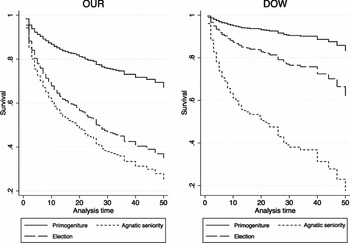
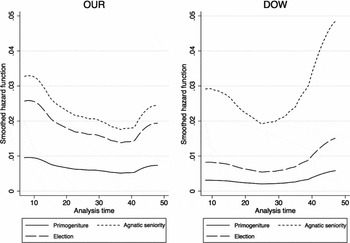
The differences between succession orders diminish somewhat when control variables for power sharing, religion, foreign threats, and state capacity are introduced in Models 2a and 2b. Most notably, the effect of agnatic seniority ceases to be significantly higher than the election reference category using our coding. However, primogeniture is still associated with a significantly lower risk of being deposed regardless of which dependent variable is used. Even when the endogenous control for periods of civil unrest (i.e., whether a monarch's predecessor was deposed) is introduced in Models 3a and 3b, the succession orders retain their effect. In Figure 1, the estimated survival rates under the different principles of succession are displayed graphically, while Figure 2 displays the estimated yearly hazard rates.
Estimated survival function

Estimated hazard function

Regarding the control variables, Blaydes and Chaney's (Reference Blaydes and Chaney2013) hypothesis, that monarchs who ruled states with power-sharing arrangements in the form of parliaments were less likely to be deposed, gains support in all models. Monarchs in states that were strongly threatened by foreign enemies (i.e., experienced many foreign depositions) were more likely to be deposed by the elite. Monarchs ruling Orthodox states also were more likely to be deposed than their Catholic counterparts. State antiquity is not related to the risk of deposition. Neither is there any clear time trend in depositions.
Can the proposed mechanisms explain primogeniture's effect on autocratic survival? Models 4a and 4b show that being the son or brother of the previous monarch was associated with a lower risk of deposition, which lends some credibility to the hypothesis that monarchs, who had been groomed by the elite before they came to power, were more successful in surviving in office. However, the effect of being the son is only significant in the model using the DoW coding. The coefficient for the age variable is positive and significant using our coding of the dependent variable, meaning that monarchs who were young when they ascended to power were less likely to be deposed than their older counterparts. Thus it seems as if a young monarch could gain the loyalty of the elite by providing them with a long time-horizon. However, the age variable is insignificant in the model using the DoW coding. The introduced variables only marginally reduce the effect of primogeniture.
When the dummies measuring the monarch's relationship to his successor are introduced in Models 5a and 5b the effect of primogeniture is reduced, and ceases to be significant in the model using the DoW coding. The variables measuring the monarch's relationship to his predecessor also cease to be significant, whereas the introduced variables show that monarchs who were succeeded by their sons were less likely to be deposed than monarchs who were succeeded by their brothers, other family members, and nonrelatives. The differences are considerable. Monarchs who were succeeded by their brothers were between four (using our coding) and six times (using the DoW coding) as likely to be deposed as monarchs who were succeeded by their sons. Together these observations support Tullock's argument that having a son as crown prince reduces the crown-prince problem.
ROBUSTNESS CHECKS
Since we are dealing with observational data, a reasonable objection is that of reverse causality. Perhaps primogeniture was only adopted in states where the power of the king was sufficiently consolidated. One approach to reduce this risk is to focus on the 12 cases in which states changed their succession orders during the period of study. Descriptive statistics show that in all but a few cases, fewer monarchs were deposed in periods when primogeniture was practiced (see Table B5 and Figure C1 in the Appendix). However, more rigorous testing is called for, which we do through stratified Cox models that remove all between-country variation. Table 3 presents the results.
Survival Analysis, Stratified Cox Models

Note: Exponentiated coefficients; t statistics in parentheses
* p < 0.10, ** p < 0.05, *** p < 0.01
The main independent variables have the expected signs and are statistically significant in the models that do not contain mechanism variables. Models 8a and 8b show that the risk of deposition was lower in periods when primogeniture was practiced than in periods when election was practiced—79% lower by DoW coding and 66% lower by our coding. Regardless of the coding, the risk of deposition was highest in periods when agnatic seniority was practiced (when it was between 2.6 and 10.7 times as high as in periods when election was practiced). Overall, the conclusion that primogeniture reduced monarchs’ risk of being deposed thus seems warranted. It also seems that agnatic seniority increased the risk of deposition compared to election, indicating that the monarchs’ safety was more affected by the crown-prince problem than the coordination problem.
The mechanism variables behave similarly in the models using shared frailty, confirming that parts of the stabilizing effect of primogeniture were channeled through a higher likelihood of producing young monarchs who were succeeded by their sons. We show in the Appendix that the stabilizing effect of primogeniture also resulted in longer tenures (see Table A9).
PRIMOGENITURE AND STATE SURVIVAL
Primogeniture obviously reduced monarchs’ risk of being deposed by internal rivals, and was thus an essential ingredient of state making in Europe. However, it remains an open question what consequences primogeniture had for the other side of state building, namely the ability to withstand foreign enemies. As we do not have access to direct data on war making we examine two interrelated outcomes: depositions made by foreign enemies and state survival.
States practicing primogeniture experienced a higher number of foreign depositions than states practicing alternative succession orders in the eleventh and twelfth centuries, but fewer in the following centuries (see Table B6 in the Appendix). Models we have run on the risk that foreign enemies deposed individual monarchs (presented in Table A10 in the Appendix), and which build on the within-country variation of this risk, show that primogeniture initially increased the risk of a foreign deposition, but the risk declined over time and turned into an advantage after about 200–300 years. This pattern could be interpreted as evidence that the often inexperienced and inept monarchs that primogeniture produced had a detrimental effect on states’ war-making efforts, but primogeniture states, due to the long-term benefits of internal political stability, over time became stronger than their counterparts practicing other succession orders. This initial cost of primogeniture can possibly explain why the elites in many states were reluctant to adopt the principle. Agnatic seniority and election may well have been preferable in the short perspective.
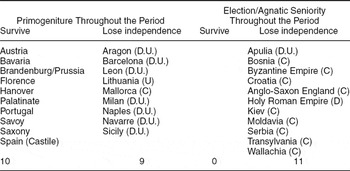
The impression that primogeniture was beneficial in the long run is strengthened if patterns of state survival are taken into consideration. Table 4 shows that of the 19 states that practiced primogeniture throughout their existence, 10 survived to the end of the period we study. Of the 9 states that lost their independence, only the Kingdom of Mallorca was conquered, whereas the rest lost their independence peacefully due to dynastic unions with other states.
State Survival Among States that Did Not Change their Succession Orders
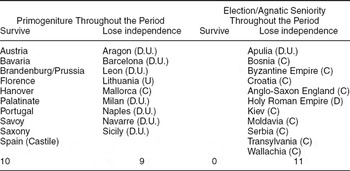
Note: C = Conquered, D = Disintegrates, D.U. = Dynastic Union, U. = Union
In contrast, all of the 11 states that adhered to agnatic seniority or election, throughout their existence, lost independence. With the exceptions of the Holy Roman Empire and the County of Apulia, all succumbed to foreign invasions.
Of the 12 states that changed their succession orders over time, 5 survived the period (see Table B7 in the Appendix). Of these, 4 practiced primogeniture at the end of the period, and had done so for hundreds of years. The only exception, Russia, adopted primogeniture in 1801. Although the evidence admittedly is tentative the pattern is obvious: Primogeniture seems to have increased the states’ likelihood of surviving in the long run, and by the end of eighteenth century the few surviving states that practiced other succession orders acknowledged the fact and adopted primogeniture to increase their competitiveness in the international arena.Footnote 15 However, for some states it was too late. Poland, which adopted a succession law based on primogeniture in 1791 as part of a constitution aimed at strengthening the state, did not live to see the new law implemented before being conquered by its neighbors.
SUCCESSION ORDERS’ IMPACT ON AUTOCRATIC SURVIVAL IN THE CONTEMPORARY MONARCHIES
Although the number of absolute monarchies is dwindling, according to Cheibub, Gandhi, and Vreeland (Reference Cheibub, Gandhi and Vreeland2010), 11 states in the world still qualified as “royal autocracies” in 2008.Footnote 16 Since then two of the states (Samoa and Tonga) have become democracies. The few remaining monarchies are all found in the Muslim world, and all but one (Brunei) is Arab. Are succession orders still relevant for understanding autocratic survival in these states? Interestingly, the succession orders in most of the monarchies contain elements of agnatic seniority, appointment, and election but usually successors are ultimately chosen by a consensus of the royal family (Hadenius and Teorell Reference Hadenius and Teorell2007; Herb Reference Herb1999; Lucas Reference Lucas2012). However, three monarchies (Bahrain, Brunei, and Morocco) practice primogeniture and have done so since their modern foundations (Herb Reference Herb1999; Lucas Reference Lucas2012). This variation in succession orders makes it possible to test whether succession orders also affect autocratic survival in contemporary monarchies. To increase the contemporary relevance of the test we have restricted the sample to include only monarchs that ascended to the throne in the twentieth and twenty-first centuries. The admittedly limited empirical evidence (in total it encompasses only 9 states and 44 monarchs), which is presented in Table 5, shows a remarkably similar pattern to that found in our study on medieval and early modern Europe.
Succession Orders and Deposed Monarchs in Modern Day Absolute Monarchies

Notes: The monarchs of Jordan, Morocco, and Saudi Arabia are included from the time the states became independent. Monarchs in other states are included from the first monarch that ascended to power in the twentieth century, despite the fact that the states for a time were British protectorates. The reason for this is that the British left the succession in the Gulf monarchies and Brunei to be decided by the royal families themselves, and only provided protection from foreign aggression (Herb Reference Herb1999). Monarchs are counted as deposed if they were deposed or murdered by members of the elite (i.e., the royal family). King Abdullah I of Jordan was murdered by an outsider (a disgruntled Palestinian), and is therefore not counted as deposed (the numbers in brackets represent the figures if Abdullah I's murder is counted as a deposition). Morocco's succession law proscribes primogeniture, but gives the king the right to appoint a younger son as heir if he does not find the oldest son fit for the throne. However, no king has used this right and appointed a younger son heir, which is why we have coded the state as practicing primogeniture. In 1952 Jordan introduced a succession law that proscribes primogeniture, but allows the king to appoint a brother as heir if he wishes. The king has on several occasions appointed a brother as his heir, which is why we have coded the country as practicing appointment throughout the period. Sources: Herb Reference Herb1999; Lucas Reference Lucas2012.
None of the monarchs that ascended to the throne in states practicing primogeniture have been deposed. In contrast, at least one monarch has been deposed in all states that build their succession on the mix of seniority, appointment, and election that is typical for the Gulf monarchies. Indeed, the pattern is so strong that it inhibits statistical analyses. Although there might be other factors influencing the found variation in political stability, this preliminary evidence thus points to the claim that primogeniture still increases monarchs’ chances of surviving in office over other succession orders. The detrimental effects of the existing alternative succession orders for other outcomes have certainly not gone unnoticed by the ruling monarchs. Already King Abd-al Aziz Al Saud, the founder of modern Saudi Arabia, worried that the state's succession order—based on a mix of seniority, appointment, and election—threatened to result “in a succession dispute [that] would destroy the Saudi state, as had happened in the past” (Lucas, Reference Lucas2012, 80).
The tentative evidence presented here serves to show that the problem of autocratic succession is not confined to a specific historical period or region. Although the succession orders’ impact in autocracies today is most easily studied in monarchies, there are many indications that point to autocratic succession being a universal and timeless problem (Brownlee Reference Brownlee2007; Svolik Reference Svolik2012). Regardless of whether an autocrat calls himself king, chairman, general, or president, the surrounding elite will have to prepare for his eventual demise. Institutions for creating a credible and predictable order of succession, without empowering an ambitious crown prince, are therefore crucial for any autocrat.
CONCLUDING DISCUSSION
We have assembled a new dataset on succession orders in 42 European states during the period AD 1000–1800, and analyzed the impact these institutional arrangements had on the survival of monarchs. The results show that primogeniture increased European monarchs’ chances of surviving in office in a time when autocratic rule was the political norm. Our findings lend strong credibility to Tullock's argument that primogeniture makes autocrats more secure, because the principle, in contrast to most other historically practiced succession orders, addresses both the coordination and the crown prince problems.
Furthermore, we find that the risk for deposition was higher in states that practiced agnatic seniority than in states that elected their monarchs, and that monarchs who were succeeded by their sons were much less likely to be deposed than monarchs who were succeeded by their brothers. These findings strongly indicate that the crown-prince problem is a graver threat to autocrats’ security than the coordination problem, and that it is preferable for autocrats to not have a clear successor than to have one of similar age.
We also provide tentative evidence that the internal political stability that primogeniture delivered over time strengthened the states’ ability to survive external threats. At the dawn of the nineteenth century all European monarchies had adopted primogeniture or succumbed to foreign enemies. However, there is some evidence that primogeniture weakened the states’ ability to resist foreign enemies in the short term, perhaps because it produced unsuited monarchs. This fact can potentially explain why the elites in many states initially were reluctant to adopt the principle. Together these observations highlight the important role succession orders played in European state building, and thus add to a state-building literature concerned with ruler-elite relations that hitherto mostly has focused on the role played by executive constraints in the form of parliaments (Blaydes and Chaney Reference Blaydes and Chaney2013; Ertman Reference Ertman1997; Stasavage Reference Stasavage2010).
Finally, we show that succession orders are closely correlated with the prevalence of depositions in the world's few remaining absolute monarchies, and thus continue to be important for understanding autocracies. However, not only monarchies are affected by succession problems; the succession poses a difficult challenge for all autocracies (Brownlee Reference Brownlee2007; Geddes Reference Geddes1999; Svolik Reference Svolik2012). Students of modern autocracies have, for example, observed that the existence of a regime party appears conducive both for the longevity of the regime and for the security of individual autocrats (Gandhi and Przeworski Reference Gandhi and Przeworski2007; Geddes Reference Geddes1999; Magaloni Reference Magaloni2008). One suggested explanation for the observed pattern is that parties provide clear mechanisms for leadership succession. However, existing studies have been unable to distinguish the effect of such succession orders from the effect of the party organizations in general. The results we present indicate that the order of succession is in itself important.
Further research should expand both on the role of leadership succession in modern autocracies, and the role ruler-elite agreements such as succession orders acted in the development of modern states. By highlighting the important role that the rise of primogeniture played in delivering political stability to Europe, our article shows that such research endeavors can pay off.
Supplementary materials
To view supplementary material for this article, please visit http://dx.doi.org/10.1017/S000305541400015X







Comments
No Comments have been published for this article.