


Introduction
Political interest constitutes a fundamental component of civic culture and a prerequisite for democratic citizenship (Almond and Verba, Reference Almond and Verba1963; Neundorf et al., Reference Neundorf, Smets and García-Albacete2013; Strömbäck and Shehata, Reference Strömbäck and Shehata2010). The emergence of a critical citizenry depends on individuals who demonstrate a strong interest in politics and possess a sophisticated understanding of political processes (Norris, Reference Norris1999). In authoritarian regimes, political interest carries particular significance as it may signal latent democratic tendencies and affect prospects for political transition (Tessler and Gao, Reference Tessler and Gao2008; Tessler et al., Reference Tessler, Jamal and Robbins2012). This study investigates the evolution of political interest in China, the world’s most populous authoritarian country. The transformation of values and beliefs during economic modernization has long been a central issue in political science. Cultural modernization theory integrates insights from both modernization theory and political culture theory to construct a comprehensive framework for understanding human development (Welzel et al., Reference Welzel, Inglehart and Klingemann2003). According to this theory, economic development fosters material security, which in turn leads individuals to deprioritize survival concerns and increasingly focus on autonomy, public affairs, and politics (Inglehart and Welzel, Reference Inglehart and Welzel2005). Originally developed to explain value change in Europe, conceptualized as a “silent revolution” (Inglehart, Reference Inglehart1977), the theory has also been extended to analyze democratization processes in authoritarian settings. In these contexts, growing political interest and demands for autonomy are expected to undermine authoritarian legitimacy and promote democratic change (Dalton and Shin, Reference Dalton and Shin2006; Inglehart and Welzel, Reference Inglehart and Welzel2010; Inglehart and Welzel, Reference Inglehart and Welzel2005: 164).
However, economic development does not unfold in a political vacuum. The political institutions within which modernization occurs significantly influence its political consequences. In addition to the effects of modernization, political institutions shape individuals’ interest in politics through mechanisms such as education and media, which are often employed by political elites to mold societal values and beliefs (Lu and Shi, Reference Lu and Shi2015; Wu and Wilkes, Reference Wu and Wilkes2018; Zhai, Reference Zhai2023b). Therefore, any analysis of political interest must account for the interaction between economic and political factors. China provides a compelling empirical case in this regard. As a one-party authoritarian regime, it has experienced rapid economic growth over recent decades. This context allows for an investigation into whether economic prosperity has led Chinese citizens to become more attentive to public affairs and more interested in politics. The pivotal moment of Deng Xiaoping’s Southern Tour Speech in 1992, which legitimized market-oriented reforms, marked a turning point in China’s economic trajectory. An open question, therefore, is whether the generations born and raised after this shift exhibit higher levels of political interest compared to earlier cohorts. The Chinese case enriches the study of political interest by providing insights into its evolution in a non-democratic context and prompting reflection on cultural modernization theory.
Analyzing changes in political interest over time is methodologically complex, as temporal variation often reflects a combination of aging processes, period-specific dynamics, and generational shifts. Research based on single-wave surveys encounters difficulties in distinguishing cohort-based differences from age-related life-cycle effects (Fosse and Winship, Reference Fosse and Winship2019; Luo and Hodges, Reference Luo and Hodges2022). Moreover, political interest is frequently treated as a purely cognitive variable, with less attention paid to its behavioral dimensions. This study addresses these limitations by drawing on multiple waves of nationally representative survey data to examine the separate effects of age, period, and cohort on the evolution of various forms of political interest within an authoritarian regime.
It makes three major contributions to the existing literature. First, it disentangles the distinct effects of age, period, and cohort on Chinese citizens’ political interest during the first two decades of the 21st century. Special attention is given to two types of cohort effects: inter-cohort average deviations and intra-cohort life-course dynamics, both of which yield new insights into generational change. Second, it conceptualizes political interest through a more robust framework, incorporating not only self-reported political interest but also behavioral indicators such as participation in political discussions and attention to political news in daily life. Third, it contributes to theoretical debates by illustrating how the liberalizing effects of economic modernization have been moderated, or even neutralized, by sustained authoritarian control. In doing so, it offers a more nuanced understanding of the evolution of political interest in authoritarian regimes, challenging the linear progression assumptions of modernization theory.
Conceptualization of political interest
Political interest refers to individuals’ curiosity about, attention to, and desire to engage with political matters (Hannuksela et al., Reference Hannuksela, Söderlund and Miklikowska2024; Lupia and Philpot, Reference Lupia and Philpot2005). It represents the motivational dimension of political life and serves as a crucial driver of political participation (Levy et al., Reference Levy, Solomon and Collet-Gildard2016; Russo and Stattin, Reference Russo and Stattin2017). Individuals who demonstrate higher levels of political interest are more likely to develop political literacy, which supports critical thinking and contributes to the formation of active citizenship (Geddes and Zaller, Reference Geddes and Zaller1989). The degree of political interest is shaped by both dispositional traits and situational factors, including specific political events or issues (Prior, Reference Prior2010). Dispositional traits are relatively stable and sustain political interest over the long term (Freitag and Zumbrunn, Reference Freitag and Zumbrunn2024; Russo and Stattin, Reference Russo and Stattin2017), whereas situational factors evoke temporary emotional responses that can draw attention to political issues. Political interest encompasses both attitudinal and behavioral dimensions, and this study distinguishes between expressed political interest and practiced political interest. Recognizing these dual dimensions allows for a more comprehensive and nuanced understanding of how political interest is manifested in individuals’ lives.
Expressed political interest refers to the attitudinal component of political interest, capturing the extent to which individuals perceive themselves as being interested in political affairs. It is typically measured through self-reported political interest in surveys, reflecting both cognitive awareness and emotional engagement with political issues, even if such interest does not translate into observable behavior. As a form of self-assessment, expressed political interest is inherently subjective and shaped by broader social and cultural contexts. For instance, individuals may report high levels of political interest as a reflection of internal psychological dispositions, yet refrain from corresponding behaviors such as following political news, due to external constraints.
By contrast, practiced political interest captures the behavioral aspect of political interest as it is enacted in everyday life. Instead of focusing on attitudes or preferences, this form of political interest emphasizes individuals’ actual behaviors. Practiced political interest can be further categorized into public and private behavioral forms. Public forms include outwardly visible actions that reflect political attentiveness in social or collective settings, such as participating in political discussions or engaging in group conversations about political issues (Schmitt-Beck and Neumann, Reference Schmitt-Beck and Neumann2023). These activities are typically observable and involve interaction with others. Private forms, in contrast, occur in more individual and less visible contexts. They include activities such as reading political news, following political developments online, or watching political debates (Strömbäck and Shehata, Reference Strömbäck and Shehata2010). While these behaviors do not involve direct social interaction, they nevertheless represent meaningful and consistent expressions of political interest. By emphasizing actual behaviors in both social and individual contexts, this conceptualization provides a more comprehensive framework for analyzing political interest.
In China, political interest has fluctuated significantly over the past few decades (Zhai, Reference Zhai2023a). Following the reform and opening-up that began in the late 1970s, Chinese citizens became more politically aware, particularly in the 1980s (Zuo and Benford, Reference Zuo and Benford1995), when public enthusiasm for politics was heightened. However, after the 1989 Tiananmen Square incident, political interest sharply declined, as political participation became increasingly risky. Since the 1990s, the expansion of the market economy, coupled with an increasing focus on material well-being, has led many Chinese citizens to prioritize materialism and personal affluence over political issues (Chao and Myers, Reference Chao and Myers1998; Rosen, Reference Rosen2004). The rapid development of the entertainment industry further diverted attention from political issues, leading to a general decline in public interest. However, it is crucial to recognize that, in China, political interest is not solely confined to government affairs. Instead, it is often intertwined with economic and cultural concerns. Issues such as economic inequality, environmental degradation, food safety concerns, and public health crises frequently emerge in public debates (Han and Zhai, Reference Han and Zhai2022; Li et al., Reference Li, Koppenjan and Homburg2017; Zhou and Jin, Reference Zhou and Jin2018). Although these may seem non-political at first glance, they carry significant implications that could potentially shape political dynamics.
Temporal dynamics of political interest
The temporal evolution of political interest is inherently complex, as it is shaped by the simultaneous and interacting influences of multiple time-related factors. Existing literature commonly distinguishes among three key sources of temporal variation: age effects, period effects, and cohort effects (Elder and George, Reference Elder, George, Shanahan, Mortimer and Kirkpatrick Johnson2016; Fosse and Winship, Reference Fosse and Winship2019; Luo and Hodges, Reference Luo and Hodges2022; O’Brien et al., Reference O’Brien, Hudson and Stockard2008). Age effects refer to developmental changes that individuals undergo over the life course, reflecting the ways in which political interest may shift as people grow older. Period effects capture variations that arise from historical or social events affecting all individuals at a specific point in time, thereby highlighting the influence of broader societal transformations on political interest. Cohort effects, by contrast, relate to generational differences and reflect the unique political orientations of groups of individuals born during the same historical period. This study systematically investigates all three time-related variations to better understand the evolving patterns of political interest in an authoritarian context.
Age effects
The effect of age on individuals’ political interest reflects how political interest evolves over the course of one’s life. Age effects emphasize the general developmental patterns that individuals tend to follow as they grow older (Luo and Hodges, Reference Luo and Hodges2022). Differences in political interest across age groups are often attributed to individuals’ positions within the life cycle, which influence their exposure to political stimuli and their cognitive and emotional readiness to engage in political matters (Eisenstein et al., Reference Eisenstein, Clark and Jelen2017). Political interest at various ages can be shaped by both cognitive development and the accumulation of life experiences. Empirical studies consistently show that younger individuals are less interested in politics compared to older age groups (Ahmad, Reference Ahmad2015; Henn et al., Reference Henn, Weinstein and Forrest2005; Sloam, Reference Sloam2016). Several factors contribute to this pattern. Young people often lack political experience and adequate knowledge of political systems, which leads to a sense of detachment or alienation from politics. Being in school may also constrain the political interest of adolescents and young adults, as the demands of academic life often divert their attention from public affairs (Neundorf et al., Reference Neundorf, Smets and García-Albacete2013).
Upon leaving school, young individuals typically enter the workforce, pursue career development, acquire property, and form families. These transitions demand significant time and energy, which often limits their capacity or motivation to become involved in political life. In their leisure time, younger individuals may prioritize social or recreational activities, such as sports and entertainment, over politics (Russo and Stattin, Reference Russo and Stattin2017). During this stage, politics is rarely perceived as central to their daily lives. Many young people do not yet see how political decisions directly impact their personal experiences, which contributes to the perception that politics is distant or irrelevant (Henn et al., Reference Henn, Weinstein and Forrest2005). However, as individuals accumulate life experience, they tend to develop greater political awareness. Engagement with civic life over time also contributes to a growing interest in political affairs (Wray-Lake, Reference Wray-Lake2019). Consequently, political interest may increase with age, suggesting a positive relationship between age and political interest over the life course.
Hypothesis 1. The level of political interest increases as individuals get older.
Period effects
Period effects capture the influence of contextual and historical changes that occur at a specific point in time and affect all or most segments of society simultaneously (Eisenstein et al., Reference Eisenstein, Clark and Jelen2017; Lu and Luo, Reference Lu and Luo2021). The development of political interest is sensitive to such temporal shifts and may either increase or decrease depending on the nature of external stimuli. These stimuli can arouse curiosity, which may, over time, develop into a sustained and stable political interest (Russo and Stattin, Reference Russo and Stattin2017). Certain social or political events are particularly influential in shaping individuals’ levels of political interest. For example, during the Maoist era, the Chinese Communist Party (CCP) actively mobilized the population to participate in state-led political campaigns, with the explicit goal of cultivating citizens’ political interest (Zhai, Reference Zhai2023a). The CCP promoted the narrative that the people were the masters of the country and bore the responsibility to engage in political life. Politics became a central dimension of daily existence (Gao and Su, Reference Gao and Su2018).
In contrast, the post-reform era witnessed a significant shift in state priorities. The CCP began promoting materialism, consumerism, and individualization as key features of modern Chinese society (Cao, Reference Cao2024; Davis, Reference Davis2000; Yan, Reference Yan2009). National discourse and policy shifted away from political mobilization and toward economic development, thereby diminishing the centrality of politics in everyday life. Unlike the mass political participation that characterized the Maoist period, post-reform Chinese society experienced a retreat from public political life. Economic development and private consumption became dominant pursuits, and political interest gradually ceased to be viewed as a civic duty (Zhai, Reference Zhai2016). As Chu and Yu (Reference Chu and Yu1993: 100) note, the pursuit of wealth emerged as the defining theme of life for many Chinese citizens. In this context, private concerns overshadowed public ones, and political failures were often overlooked. The CCP’s meritocratic narrative and the increasing individualization of society encouraged citizens to prioritize personal advancement and social competition over collective political concerns (Zhai et al., Reference Zhai, Wu and Lu2023). As a result, many became disengaged from political matters and refrained from questioning the legitimacy of authoritarian rule.
Further transformations occurred after the 2010s, when political alienation deepened among the Chinese population. China’s formerly rapid economic growth began to decelerate and, in some cases, reverse into economic stagnation (Hung, Reference Hung2025). In this deteriorating economic climate, citizens increasingly focused on improving their personal material conditions, which led to a corresponding decline in attention to political affairs. Simultaneously, the rise of Xi Jinping to power marked a period of intensified ideological control and political repression (Creemers, Reference Creemers2017; Jin and Zhou, Reference Jin and Zhou2021; Zhao, Reference Zhao2016). Various political measures have intensified individuals’ desire to distance themselves from politics. Under Xi’s administration, the level of political tolerance that had characterized the eras of Jiang Zemin and Hu Jintao was sharply curtailed (Zhao, Reference Zhao2016). Political expression became riskier, and public commentary on Xi’s policies was explicitly prohibited. As a result, many citizens deliberately avoided politics to protect themselves. These developments contributed to a further decline in political interest.
Hypothesis 2. The level of interest in politics decreases over the first two decades of the 21st century.
Cohort effects
A cohort refers to a group of individuals born within the same specific time period and raised under a shared historical and social context, resulting in life experiences that differ from those of other cohorts (Cai et al., Reference Cai, Fan and Ikeda2025). Socialization is a major driver of cohort effects, as each cohort grows up under distinct institutional settings, cultural norms, and political climates (Lu and Luo, Reference Lu and Luo2021). These early-life experiences contribute to the formation of cohort-specific characteristics and can lead to significant differences in outcomes across generations (Lu et al., Reference Lu, Luo and Santos2022). In China, cohorts such as those shaped by the Cultural Revolution, the post-reform era, or the emergence of Generation Z (Gen Z) represent generational groups that experienced historically unique developmental environments.
Changes in political interest over time may reflect generational replacement. Because childhood and adolescence are widely recognized as critical periods for political socialization (Jennings, Reference Jennings, Dalton and Klingemann2007; Neundorf et al., Reference Neundorf, Smets and García-Albacete2013; Sears and Brown, Reference Sears, Brown, Huddy, Sears, Levy and Jerit2023), age 18 is commonly regarded as a watershed in the development of individuals’ value orientations (Harmel et al., Reference Harmel, Yeh and Liu2019; Jin and Zhou, Reference Jin and Zhou2021). Two competing theoretical perspectives offer distinct explanations for cohort effects on political interest. The first explanation is grounded in economic factors. According to modernization theory, economic development fosters a shift in individual priorities from immediate material concerns to public and political affairs, thereby increasing political interest. Individuals raised in environments of economic security are more likely to take survival needs for granted and turn their attention to public affairs and politics. Political interest, in this view, aligns with self-actualization, which occupies a higher tier in Maslow’s hierarchy of needs (Inglehart and Welzel, Reference Inglehart and Welzel2005). Based on this reasoning, Gen Z—those born between 1995 and 2009—should demonstrate a higher level of political interest than previous cohorts. China’s rapid economic growth following Deng Xiaoping’s Southern Tour Speech in the early 1990s created an era of material abundance, which shaped the more comfortable upbringing of Gen Z compared with previous generations. If modernization theory holds true, then Gen Z, having grown up with their basic needs securely met, should exhibit elevated political interest. Under this framework, cohort effects should follow a continuous generational pattern, with post-1995 cohorts displaying a sustained increase in political interest over time.
The second theoretical rationale attributes cohort differences in political interest to the influence of pivotal historical events. Unlike the economic determinism of modernization theory, this perspective emphasizes the formative impact of specific events that occur during adolescence or early adulthood. In the context of the People’s Republic of China, such formative events may include the Great Famine in the late 1950s, the Cultural Revolution from 1966 to 1976, the political succession following Mao’s death in the late 1970s, the 1989 Tiananmen student protests, Deng Xiaoping’s Southern Tour Speech in 1992, accession to the World Trade Organization in 2001, the SARS outbreak in 2003, the Sichuan earthquake and the Beijing Olympics in 2008, the leadership transition in 2012, and the COVID-19 pandemic between 2020 and 2023. If this rationale holds, we would expect cohorts that experienced such events during their adolescence or early adulthood to display distinct levels of political interest. In this scenario, cohort effects may appear in a non-continuous and event-driven pattern. Moreover, high levels of political interest may emerge not only among those raised in conditions of material affluence but also among those whose formative years were marked by economic hardship or political upheaval. In these cases, major historical events may serve as catalysts for increased political awareness and interest, regardless of economic background.
Both theoretical perspectives are grounded in plausible assumptions and offer testable predictions. As a result, this study proposes two competing hypotheses and evaluates them through empirical analysis.
Hypothesis 3.1. Gen Z’s level of political interest is higher than that of preceding cohorts.
Hypothesis 3.2. Historical events and socialization shape the political interest of specific cohorts.
Data and methods
Data
Integrating data from multiple survey waves provides a more nuanced understanding of temporal effects on political interest. This study utilizes five waves of Chinese data from the Asian Barometer Survey (www.asianbarometer.org), covering the period from 2002 to 2019. The surveys were conducted nationwide through face-to-face interviews. All interviews were conducted anonymously, and participants were informed that their responses would remain confidential and would not be shared with third parties. A probability proportional to size (PPS) sampling method was used to randomly select participants. The basic sampling frame was derived from the Census Yearbook published by the National Bureau of Statistics (https://www.stats.gov.cn/sj/pcsj/), which served as the basis for identifying the primary sampling units (PSUs). Within each selected household, residents aged 18 and above were randomly chosen to participate in the survey.
The first wave was conducted in 2002 and included 3,183 respondents. Their ages ranged from 18 to 90 years, with an average age of 44.26 years. Among the respondents, 1,608 were male (50.52%) and 1,575 were female (49.48%). The second wave, carried out in 2008, yielded 5,075 valid responses. Participants’ ages ranged from 18 to 95 years, with an average of 47.09 years. In this wave, 2,598 respondents were male (51.19%) and 2,477 were female (48.81%). The third wave took place in 2011 and involved 3,473 respondents aged between 18 and 93, with a mean age of 45.06 years. Among them, 47.38% were female and 52.62% were male. The fourth wave was conducted in 2016 and produced 4,068 valid responses. Respondents were aged between 18 and 94, with an average age of 48.27 years. Of these, 51.10% were female and 48.90% were male. The fifth wave, completed in 2019, included 4,941 valid responses. Respondents’ ages ranged from 18 to 94, with an average age of 48.88 years. In this wave, 2,606 participants (52.74%) were female, while 2,335 (47.26%) were male. Respondents who did not provide their age were excluded from the final dataset. The final sample comprises a total of 20,660 respondents (Zhai, Reference Zhai2026).
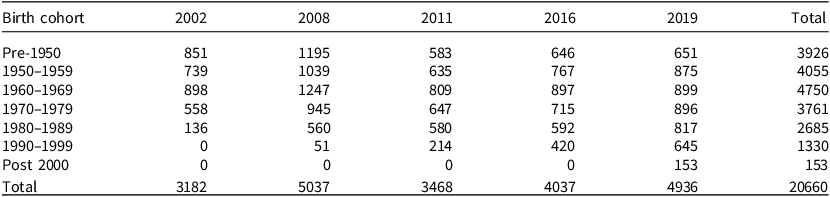
Table 1 presents a cross-tabulation of the data by birth cohort and survey year. Respondents are nested within both specific birth cohorts and distinct survey years, enabling an analysis that captures the aging and generational dimensions of political interest.
Cross-tabulation of the complete data by birth cohort and survey year

Table 1. Long description
The table presents a cross-tabulation of data by birth cohort and survey year. It has six rows labeled by birth cohort and five columns labeled by survey year, along with a total column. The birth cohorts are Pre-1950, 1950-1959, 1960-1969, 1970-1979, 1980-1989, 1990-1999, and Post 2000. The survey years are 2002, 2008, 2011, 2016, 2019, and Total. Row 1: Pre-1950, 851, 1195, 583, 646, 651, 3926. Row 2: 1950-1959, 739, 1039, 635, 767, 875, 4055. Row 3: 1960-1969, 898, 1247, 809, 897, 899, 4750. Row 4: 1970-1979, 558, 945, 647, 715, 896, 3761. Row 5: 1980-1989, 136, 560, 580, 592, 817, 2685. Row 6: 1990-1999, 0, 51, 214, 420, 645, 1330. Row 7: Post 2000, 0, 0, 0, 0, 153, 153. Row 8: Total, 3182, 5037, 3468, 4037, 4936, 20660. The table shows the number of respondents in each birth cohort for each survey year and the total number of respondents across all years.
Source: Zhai (Reference Zhai2026).
Measures
Based on the aforementioned conceptualization of political interest, this study distinguishes three dimensions: overt expression of political interest, public behavior related to political interest, and private behavior related to political interest. Correspondingly, political interest is measured using three indicators: self-declared political interest, discussing politics with others, and following political news in everyday life. These indicators capture both the attitudinal and behavioral manifestations of political interest. Among them, self-declared political interest and following political news were included in all five waves of the survey, whereas political discussion was only assessed in the last four.
Self-declared political interest was measured by asking respondents to indicate how interested they were in politics. Responses were recorded on a four-point scale ranging from 1 (not at all interested) to 4 (very interested), with higher scores indicating greater overt expression of political interest. Political discussion was measured by asking how frequently respondents discussed political matters with others. This was recorded on a three-point scale from 1 (never) to 3 (frequently), with higher scores reflecting a greater frequency of political discussion in everyday life. Following political news was measured by asking respondents how often they followed information related to politics and government. Responses were coded on a seven-point scale from 1 (never) to 7 (every day), where higher scores represent more frequent engagement with political news.
Regarding the interrelationships among the three interest indices, Tables A1–A6 present the correlation coefficients between the three indicators in the pooled samples as well as in each individual survey (see the online Appendix). Generally, the correlation coefficients between self-declared political interest and discussing politics in everyday life, as well as between self-declared political interest and following political news, range from 0.40 to 0.60, indicating a moderate correlation. The correlation coefficient between discussing politics in everyday life and following political news ranges from 0.20 to 0.39, indicating a weak correlation.
The primary independent variables in the analysis are age, period, and cohort. Age was grouped in five-year intervals. The first group includes individuals aged 18 to 24, followed by 25 to 29, 30 to 34, 35 to 39, and so forth. Period was defined by the year of each survey wave, covering five distinct time points. Cohort was determined by respondents’ year of birth, with each cohort spanning five years. The first cohort includes those born between 1914 and 1920, followed by successive five-year birth cohorts such as 1921 to 1925, 1926 to 1930, and so on.
In addition, gender and education were included as control variables in the analysis. Gender was coded as a binary variable, where 0 represents male and 1 represents female. Education was coded on a four-point scale, ranging from 1 (primary school) to 4 (college and above).
Analytical strategy
The analytical strategy follows that of Zhai (Reference Zhai2026). As previously stated, the effects of age, period, and cohort are often interwoven, making it difficult to disentangle their independent influences using data from a single wave of the survey. By employing data from multiple waves of surveys, age–period–cohort (APC) analysis offers a methodological approach capable of addressing these limitations. APC analysis enables the simultaneous examination of the three temporal dimensions—age, period, and cohort—on individual-level outcomes. As foundational work in this area, Mason et al. (Reference Mason, Mason, Winsborough and Kenneth Poole1973) introduced the classical APC accounting model, which serves as a basis for later methodological refinements.
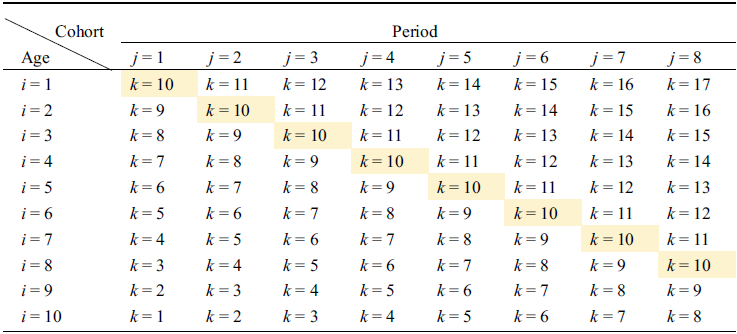
Table 2 presents a Lexis table that illustrates the structure of APC analysis using age, period, and cohort indices. In this example, there are ten age groups (i = 1, 2, 3, …10) and eight periods (j = 1, 2, 3, …8), while cohorts are denoted by k. The shaded cells in the table track the trajectory of the 10th cohort across different time periods as it ages. By analyzing data from multiple survey waves, APC analysis can assess the distinct characteristics of a given cohort—such as the 10th cohort in the example—by observing how its political interest evolves with age across different periods.
Structure of a Lexis table with indices for age, period, and cohort

Table 2. Long description
Panel A: Table with age groups labeled i1 to i10 on the vertical axis and periods labeled j1 to j8 on the horizontal axis. Cohorts are denoted by k. The table cells contain indices for age, period, and cohort. The shaded cells track the trajectory of the 10th cohort across different time periods as it ages. The table illustrates how data from multiple survey waves can be used to assess the distinct characteristics of a given cohort by observing how its political interest evolves with age across different periods.
Source: Zhai (Reference Zhai2026).
This study adopts the age–period–cohort interaction (APC-I) model proposed by Luo and Hodges (Reference Luo and Hodges2022) to examine the influence of temporal dimensions on political interest. In contrast to previous approaches such as the APC mixed model, intrinsic estimator (IE) method, and hierarchical APC models, the APC-I model treats cohort effects as the interaction between age and period, rather than assuming them to be linearly structured. This approach offers several advantages over traditional APC methods. First, the APC-I model addresses the identification problem caused by collinearity (age = period – cohort), which hinders traditional APC models, making it easier to estimate the independent effects of age, period, and cohort on outcomes. Second, the APC-I model provides more accurate and valid estimates of inter-cohort differences (Luo and Hodges (Reference Luo and Hodges2022). Third, older APC models assume constant cohort effects across ages, whereas cohort effects are dynamic and can be influenced by age–period-specific turning points within broader structural and social contexts (Lu and Luo, Reference Lu and Luo2021). The APC-I model allows researchers to explore more complex relationships, such as life-course dynamics within cohorts.
The model used in this study follows the specification provided by Luo and Warren (Reference Luo and Warren2023):
 ${\rm{g}}\;\left( {E\left( {{Y_{ij}}} \right)} \right) = {\rm{\mu + }}{\alpha _i} + {\beta _j} + \alpha {\beta _{ij}} +\mathop \sum \limits_c^C {\pi _c}{x_c}$
for age groups
 $i = 1,2, \ldots, a$
, and periods
 $j = 1,2, \ldots, p$
, where
 $\mathop \sum \nolimits_{i = 1}^a {\alpha _i} = \mathop \sum \nolimits_{j = 1}^p {\beta _j} = \;\mathop \sum \nolimits_{i = 1}^a \alpha {\beta _{ij}}=\mathop \sum \nolimits_{j = 1}^p \alpha {\beta _{ij}}\; = 0$
.
 $E\left( {{Y_{ij}}} \right)$
denotes the expected value of the outcome Y for the i th age group in the j th period of time; g is the “link function”;
 ${\alpha _i}$
denotes the mean difference from the global mean
 ${\rm{\mu }}$
associated with the i th age category (the age main effect);
 ${\beta _j}$
denotes the mean difference from
 ${\rm{\mu }}$
associated with the j th period (the period main effect);
 $\alpha {\beta _{ij}}$
denotes the deviation from the main effects of age and period due to the membership in the cohort at age i and period j (the age-by-period interaction terms contained in each cohort); and
 ${\pi _c}$
denotes the coefficient for the c th covariate
 ${x_c}$
such as education, gender, and political ideology.
According to Luo and Hodges (Reference Luo and Hodges2022), the APC-I model estimates the main effects of age and period while calculating cohort effects as the interaction between age and period. This approach identifies two forms of cohort variation: average inter-cohort deviations and intra-cohort life-course dynamics (Lu and Luo, Reference Lu and Luo2021). Inter-cohort deviations indicate whether there are systematic differences across cohorts, thereby confirming the presence of cohort effects. Intra-cohort dynamics, on the other hand, assess whether the influence of cohort membership remains stable or changes as individuals progress through their life course. This method does not rely on the assumption that cohort effects are fixed across time, thereby enabling the detection of dynamic cohort-specific patterns that may evolve with age. The data analysis in this study was conducted using the “APCI” package in R, developed by Xu and Luo (Reference Xu and Luo2022), which implements the APC-I modeling framework.
Results
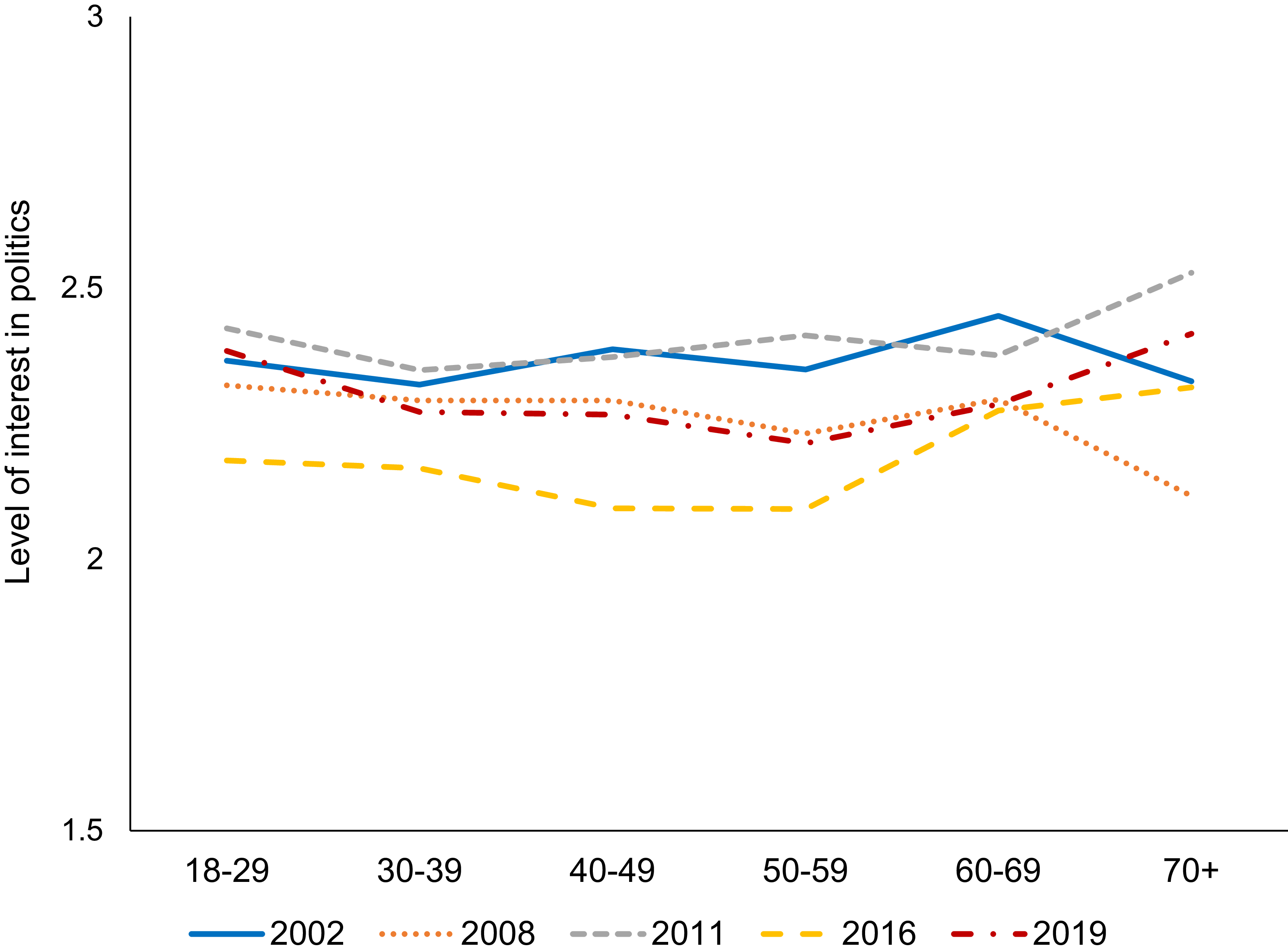
The analysis begins by describing trends in the level of political interest among Chinese citizens across different age groups. As previously stated, this study distinguishes three forms of political interest: overt expression of political interest, public activities related to political interest, and private activities related to political interest. Figure 1 illustrates the overall age-related pattern in expressed political interest, which follows a shallow U-shaped curve. Individuals under the age of 30 years and those over the age of 60 years are more likely to report being interested in politics. Notably, the overall level of expressed political interest was relatively high in the survey waves conducted in 2002 and 2011. Among the 18–29 age group, the level of expressed political interest recorded in the 2019 survey ranks as the second highest across all five waves.
Gross age and period effects on self-declared political interest.

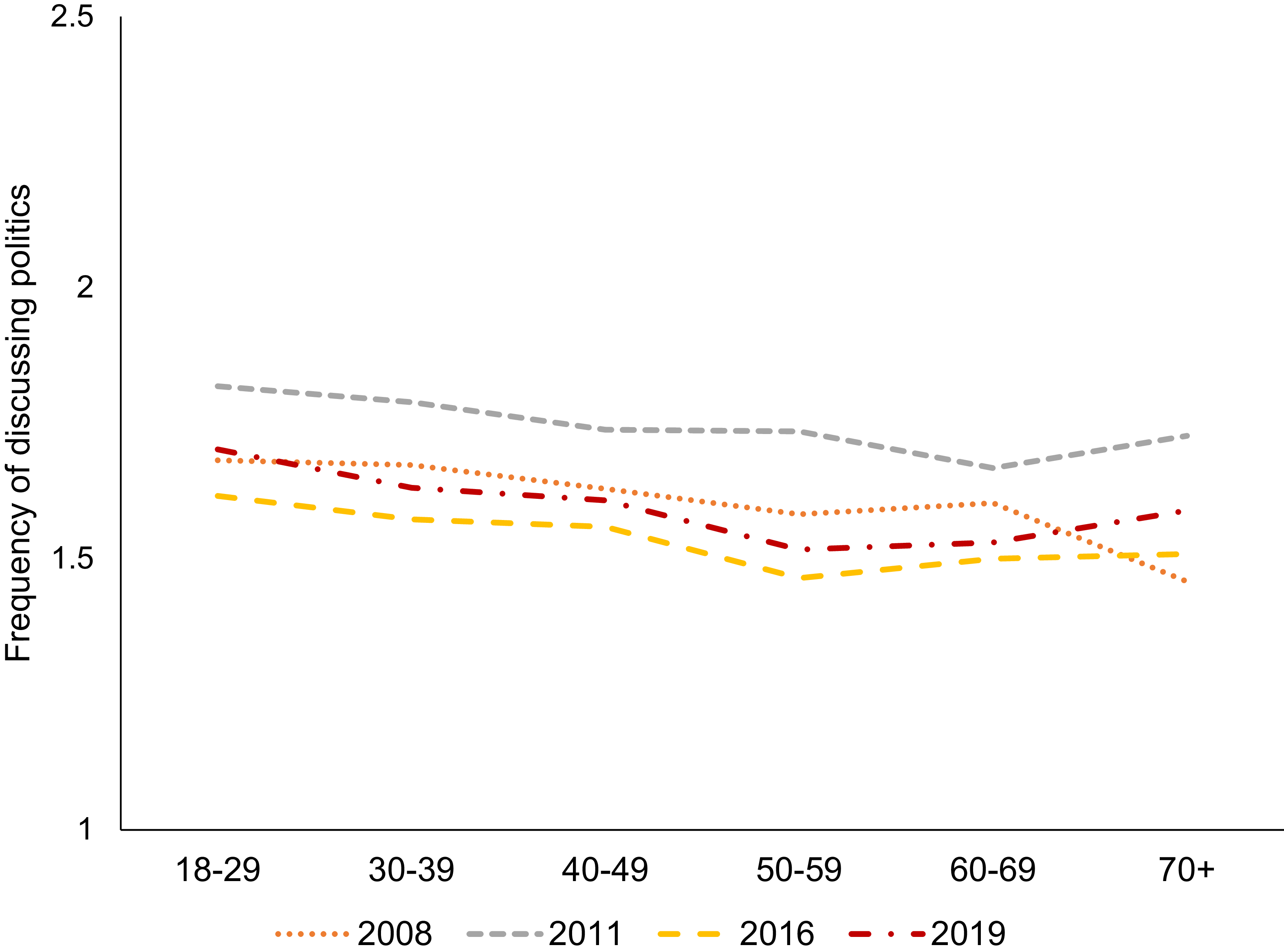
Figure 2 illustrates the changes over time in the frequency with which Chinese individuals discuss politics with others in daily life, representing a public activity related to political interest. The data reveal a slight downward trend in the tendency to engage in political discussions as age increases. However, this declining pattern reverses after the age of 60, showing a modest increase in political discussion among older adults. It should be noted that the political discussion item was not included in the first wave of the survey; therefore, Figure 2 only reflects data from the subsequent four waves. Furthermore, the level of political discussion was higher in the 2008 and 2011 surveys compared to the waves conducted during the latter half of the 2010s.
Gross age and period effects on the tendency to discuss politics in everyday life.

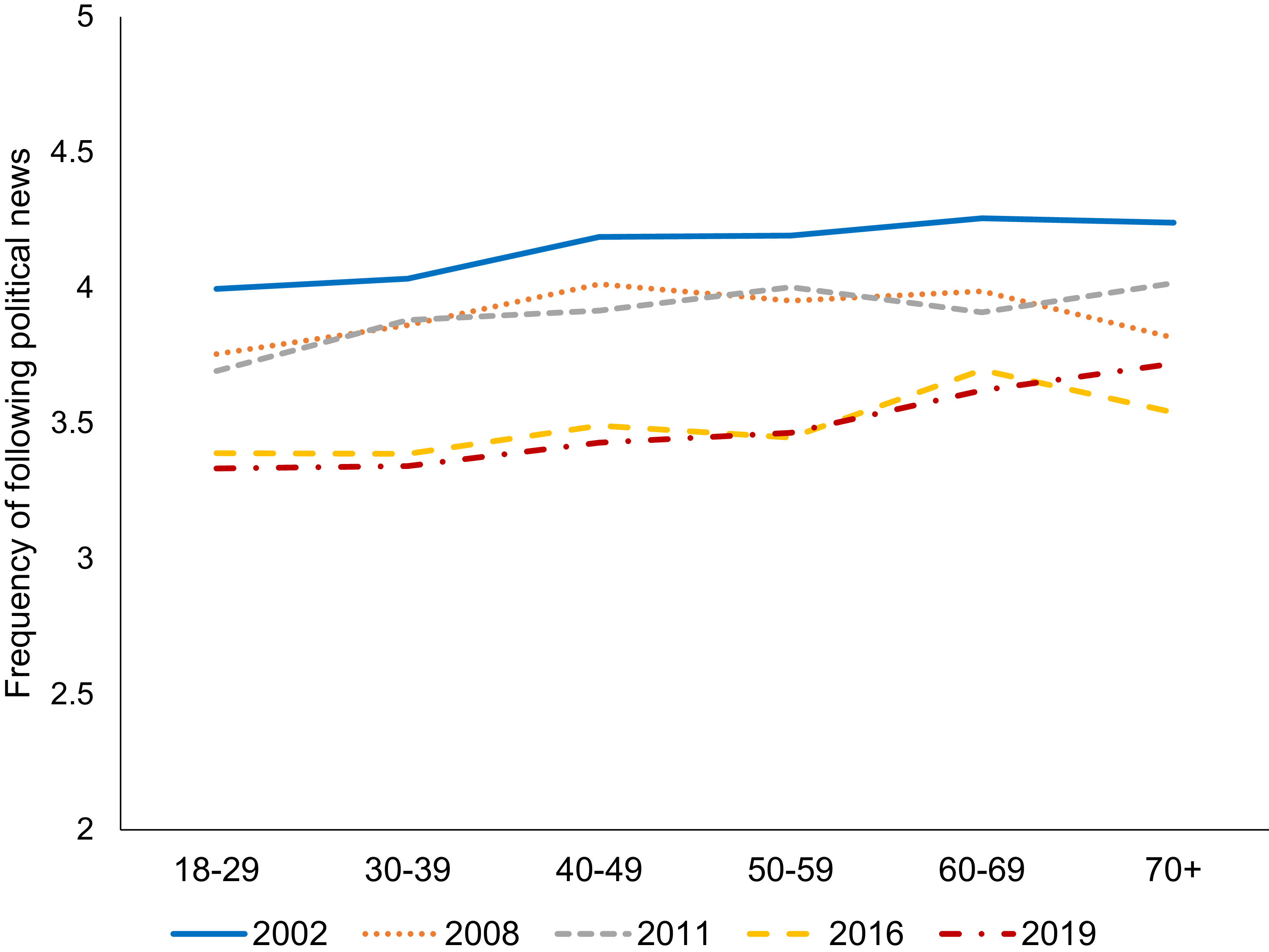
Figure 3 illustrates the tendency of Chinese individuals to follow political news, a private activity indicative of their interest in politics. There is a gradual upward trend in the frequency of following political news as age increases. Relatively high levels of political news consumption were observed in the 2002, 2008, and 2011 survey waves. However, a notable decline occurred during the mid-to-late 2010s, a downward trend that is apparent across all age groups. Interestingly, while Figure 1 shows that the 18–29 age group exhibited the second highest level of expressed political interest in 2019, Figure 3 reveals that this same age group had the lowest level of following political news in 2019 among all survey years. These findings indicate that incorporating both expressed and practiced dimensions into the assessment of political interest yields a more comprehensive understanding of people’s interest in politics.
Gross age and period effects on the tendency to follow political news.

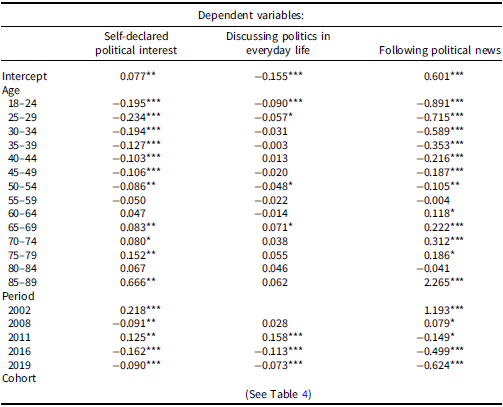
Table 3 presents the estimated age and period main effects on the three forms of political interest within the APC-I model. The age effects reflect developmental changes over the life course. Individuals aged 18 to 54 exhibited significantly lower levels of expressed political interest and followed political news less frequently. However, low levels of political discussion in daily life were primarily observed among the 18–29 and 50–54 age groups. Conversely, respondents aged 65 and older showed higher levels of expressed political interest; notably, the 65–69 age group discussed politics more frequently in daily life, and those over 60 tended to follow political news more regularly. These findings support Hypothesis 1, indicating that political interest generally increases with age, particularly after retirement when individuals devote more attention to politics.
Estimated age and period main effects

Table 3. Long description
A table comparing the estimated age and period main effects on three forms of political interest: self-declared political interest, discussing politics in everyday life, and following political news. The table has 12 rows and 4 columns. The columns are labeled as Self-declared political interest, Discussing politics in everyday life, and Following political news. The rows are labeled with age groups and periods. Row 1: Intercept, 0.077 **, 0.155 ***, 0.601 ***. Row 2: Age. Row 3: 18-24, 0.195 ***, 0.090 ***, 0.891 ***. Row 4: 25-29, 0.234 ***, 0.057 *, 0.715 ***. Row 5: 30-34, 0.194 ***, 0.031, 0.589 ***. Row 6: 35-39, 0.127 ***, 0.003, 0.353 ***. Row 7: 40-44, 0.103 ***, 0.013, 0.216 ***. Row 8: 45-49, 0.106 ***, 0.020, 0.187 ***. Row 9: 50-54, 0.086 **, 0.048 *, 0.105 **. Row 10: 55-59, 0.050, 0.022, 0.004. Row 11: 60-64, 0.047, 0.014, 0.118 *. Row 12: 65-69, 0.083 **, 0.071 *, 0.222 ***. Row 13: 70-74, 0.080 *, 0.038, 0.312 ***. Row 14: 75-79, 0.152 **, 0.055, 0.186 *. Row 15: 80-84, 0.067, 0.046, 0.041. Row 16: 85-89, 0.666 **, 0.062, 2.265 ***. Row 17: Period. Row 18: 2002, 0.218 ***,, 1.193 ***. Row 19: 2008, 0.091 **, 0.028, 0.079 *. Row 20: 2011, 0.125 **, 0.158 ***, 0.149 *. Row 21: 2016, 0.162 ***, 0.113 ***, 0.499 ***. Row 22: 2019, 0.090 ***, 0.073 ***, 0.624 ***. Row 23: Cohort, (See Table 4).
Note: *p < 0.05, **p < 0.01, ***p < 0.001, two-tailed test.
Period effects capture year-to-year variations in political interest, controlling for other factors. Table 3 reveals a general declining trend in political interest in China. Respondents expressed significantly lower levels of political interest in 2008, 2016, and 2019. The frequency of following political news began to decline after 2011. As noted earlier, the survey question on political discussion was not included in the first wave; however, Table 3 shows that the frequency of political discussion also decreased from 2016. These findings support Hypothesis 2, indicating a decline in Chinese citizens’ political interest during the first two decades of the 21st century—a trend that became particularly pronounced during Xi Jinping’s tenure.
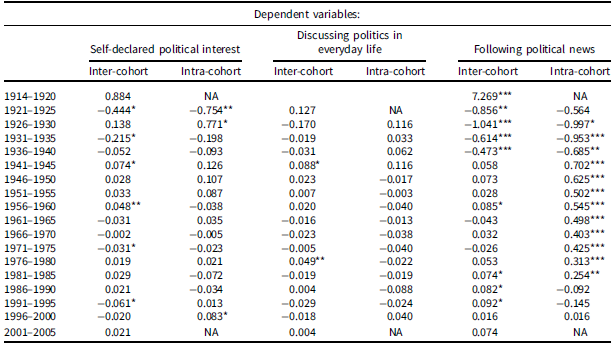
Table 4 presents the cohort effects estimated by the APC-I model, which distinguishes between two types of cohort variation: inter-cohort average differences and intra-cohort life-course dynamics. Inter-cohort average differences assess whether the mean deviation of a given cohort across its lifespan is statistically significant. The results indicate that the 1941 and 1956 cohorts exhibited notably higher levels of expressed political interest. Similarly, the 1941 and 1976 cohorts showed a higher frequency of political discussion, while the 1914, 1956, 1981, 1986, and 1991 cohorts followed political news more frequently.
Estimated cohort effects

Table 4. Long description
The table presents estimated cohort effects on three dependent variables: self-declared political interest, discussing politics in everyday life, and following political news. It includes inter-cohort and intra-cohort comparisons across different birth cohorts ranging from 1914 to 2005. The table has 12 rows and 10 columns. Column headers are Self-declared political interest Inter-cohort, Self-declared political interest Intra-cohort, Discussing politics in everyday life Inter-cohort, Discussing politics in everyday life Intra-cohort, Following political news Inter-cohort, Following political news Intra-cohort. Row labels are birth cohorts from 1914-1920 to 2001-2005. Each cell contains numerical values representing the estimated effects. Notable trends include varying levels of political interest and engagement across different cohorts, with some cohorts showing significant positive or negative effects. For example, the cohort born between 1914-1920 shows a high value of 7.269 for following political news inter-cohort, while the cohort born between 1996-2000 shows a value of 0.074 for the same variable. The table also includes statistical significance indicators (*, **, ***) for some values, denoting levels of significance in two-tailed tests.
Note: *p < 0.05, **p < 0.01, ***p < 0.001, two-tailed test.
If modernization theory were correct, Gen Z (born 1995–2009) who experienced rapid economic growth during childhood and adolescence would display higher political interest. However, the 1995 and 2000 cohorts did not demonstrate elevated political interest. Instead, cohorts born during particular historical periods, such as 1941, 1956, 1976, 1981, and 1986, showed substantially higher political interest than other cohorts. These cohorts are discussed in greater detail in the Discussion and Conclusion section. The findings support Hypothesis 3.2, which posits that historical events and socialization processes shape cohort-specific levels of political interest.
The study also explored whether cohort differences in political interest remain stable over the life course by examining intra-cohort dynamics. Interpreting intra-cohort slopes alongside inter-cohort deviations (Lu and Luo, Reference Lu and Luo2021; Luo and Hodges, Reference Luo and Hodges2022), the analysis focused primarily on cohorts with significant inter-cohort differences. For expressed political interest, the 1921 cohort exhibited a significant negative intra-cohort slope coupled with a negative inter-cohort deviation, indicating that individuals born between 1921 and 1925 had lower political interest, which further declined as they aged—reflecting cumulative disadvantage. Although the 1926 and 1996 cohorts showed significant intra-cohort slopes, their inter-cohort deviations were not significant, suggesting that changes over the life course did not distinguish them from other cohorts. Cohorts born in 1931, 1971, and 1991 had significant negative inter-cohort deviations with insignificant intra-cohort slopes, indicating stable lower levels of expressed political interest throughout their lives. Conversely, the 1941 and 1956 cohorts had significant positive inter-cohort deviations with insignificant intra-cohort slopes, meaning their higher political interest remained stable with age.
Regarding political discussion, the 1941 and 1976 cohorts had significant positive inter-cohort deviations but insignificant intra-cohort slopes, suggesting their greater propensity to engage in political discussions remained constant over the life course. Most other cohorts showed no significant intra-cohort changes in political discussion.
For the activity of following political news, the 1926, 1931, and 1936 cohorts had both significant negative intra-cohort slopes and inter-cohort deviations, indicating low and decreasing engagement with political news over time. Conversely, the 1956 and 1981 cohorts showed significant positive intra-cohort slopes and inter-cohort deviations, reflecting increasing and sustained higher levels of following political news. The 1986 and 1991 cohorts had significant positive inter-cohort deviations but insignificant intra-cohort slopes, indicating consistently higher engagement that remained stable with age. Overall, these findings reveal that cohort differences in political interest either change or remain stable as cohorts age.
Discussion and Conclusion
This study reconceptualizes political interest by examining both attitudinal and behavioral dimensions. The distinction between expressed and practiced political interest is of significant theoretical and empirical importance. Political interest manifests in various ways, not only through overt expressions but also in actions such as engaging in political discussions and following political news. Over the past two decades, the three forms of political interest among the Chinese population show both similarities and differences. Age and cohort effects have a more significant impact on the overt expression of political interest and the act of following political news. In contrast, period effects are significant across all three forms of political interest, revealing a general decline over the past two decades.
The age–period–cohort analysis offers a nuanced understanding of the temporal variations in political interest among the Chinese population. These findings have significant implications for the theoretical understanding of how political interest evolves in an authoritarian context marked by rapid economic development. The analysis of age effects reveals that young people generally exhibit lower levels of political interest compared to older generations. This mirrors findings from other countries (Ahmad, Reference Ahmad2015; Henn et al., Reference Henn, Weinstein and Forrest2005; Sloam, Reference Sloam2016), where young people prioritize personal issues, such as their studies, job search, work, marriage, and child-rearing, over politics. Politics is thus not a central focus for many young Chinese. The results indicate that Chinese citizens aged 18 to 59 do not exhibit high levels of political interest in any of the three forms: expressed political interest, discussing politics with others, or following political news. While we might expect political interest to increase with age, the significant positive age effects are only observed in individuals aged 60 years and above. This finding is somewhat surprising, as it suggests that many Chinese people tend to express greater interest in politics and engage more frequently in political discussions and news consumption after retirement. A plausible explanation for this trend is that retirement provides individuals with more discretionary time, allowing them to devote greater attention to political matters. In addition, accumulated life experience may provide individuals with a deeper understanding of political issues, which in turn further enhances their political interest.
Since Xi Jinping assumed office in 2012, his policies, such as strengthening ideological control, limiting freedom of expression, and extending state power into society, have had far-reaching effects (Creemers, Reference Creemers2017; Jin and Zhou, Reference Jin and Zhou2021; Zhao, Reference Zhao2016). Under his leadership, public fear and apathy toward politics have been exacerbated. This study finds that period effects, rather than age or generational replacement, are the primary drivers of the decline in political interest among the Chinese population. Specifically, the results indicate a consistent downward trend in political interest across all three dimensions since the mid-to-late 2010s. The Chinese public has become increasingly reluctant to express political opinions, and participation in activities related to political interest, such as political discussions and following political news, has diminished significantly. Several factors could explain this decline. First, the intensification of ideological control may have led people to perceive politics as uninteresting or even boring. Second, the CCP’s efforts to reinforce Xi Jinping’s authority, including the restriction of public debate and criticism. As a result, many individuals have distanced themselves from political life, contributing to the widespread decline in political interest observed in the 2010s.
In addition to the aforementioned effects of intensified ideological control under Xi’s rule, other factors may also have contributed to the decline in political interest since 2012. One possible explanation relates to rising material prosperity. The expansion of capitalism has reinforced individualistic and consumption-oriented lifestyles (Cao, Reference Cao2024; Yan, Reference Yan2009), leading to the increasing predominance of material considerations in contemporary Chinese society. In this context, personal career advancement, income growth, and consumption occupy a central place in everyday life. Particularly, with China’s economic growth slowing since the 2010s, people may place even greater emphasis on material satisfaction, which in turn leaves less attention devoted to political matters (Zhai, Reference Zhai2016). Moreover, as a strategy to maintain authoritarian control, shifting public focus from politics to entertainment has proven effective (Kern and Hainmueller, Reference Kern and Hainmueller2017; Xia, Reference Xia2022). In China, the rise of algorithm-driven entertainment platforms, such as Douyin and Toutiao, in the mid-2010s has further contributed to this decline in political interest. These platforms prioritize highly personalized and engaging content, which captures the public’s attention, especially among younger generations. As a result, interest in political issues has waned, while entertainment—often trivial or escapist—has dominated people’s time and attention, fostering political apathy. This trend not only distracts from political matters but also supports the regime’s control by offering a more appealing alternative to politics. This study provides compelling evidence of Chinese citizens’ increasing detachment from politics, both in terms of expressed and practiced political interest, over the past two decades.
The analysis of cohort effects reveals that some cohorts exhibit higher or lower levels of political interest compared to others, with significant intra-cohort variation over the life course. According to political socialization theory, political attitudes are shaped primarily during adolescence, although they may continue to evolve later in life (Jennings, Reference Jennings, Dalton and Klingemann2007; Neundorf et al., Reference Neundorf, Smets and García-Albacete2013; Sears and Brown, Reference Sears, Brown, Huddy, Sears, Levy and Jerit2023). Adolescence is commonly defined as the period between the ages of 12 and 18 (Harmel et al., Reference Harmel, Yeh and Liu2019; Jin and Zhou, Reference Jin and Zhou2021). Consequently, historical events experienced during this formative stage are likely to leave lasting imprints on individuals’ political interest. This study therefore focuses on major historical events that occurred during respondents’ adolescent years.
The results show that cohorts born in 1941, 1956, 1976, 1981, and 1986 exhibit higher levels of political interest. For example, during the critical period of political socialization, the 1941 cohort lived through the Great Famine (1959–1963), while the 1956 cohort experienced the late Cultural Revolution (1974–1978). These formative events, including the Tiananmen Incident of 1976, the fall of the “Gang of Four,” Deng Xiaoping’s return to power, and China’s shift toward economic reforms, had a profound impact on their interest in politics. Similarly, those born in the late 1970s and 1980s experienced key moments of political socialization during the tenures of Jiang Zemin and Hu Jintao. During this period, China’s patriotic education campaigns intensified, and the country made significant efforts to integrate into the global economy, notably joining the World Trade Organization in 2001 and hosting the Beijing Olympics in 2008. Despite the CCP maintaining authoritarian rule, state power during this period was increasingly characterized by coordination with civil society, rather than mere repression (Korolev, Reference Korolev2017; Newland, Reference Newland2018; Zang, Reference Zang and Zang2015). As a result, these cohorts demonstrated lower resistance to politics and exhibited higher levels of political interest compared to others.
These findings suggest that cultural modernization theory needs to be reconsidered, particularly with respect to political interest during economic development. Cultural modernization theory posits that as people’s economic security needs are met, they become more politically engaged and supportive of democratic ideals (Inglehart and Welzel, Reference Inglehart and Welzel2005). However, economic modernization can also lead to political apathy, as individuals become increasingly disengaged from public affairs and focus more on their private lives (Ikeda, Reference Ikeda2007). Evidence from this study undermines the assumption that economic development necessarily drives an increase in political interest. Moreover, the policies of the ruling political elites can significantly delay or even prevent the liberalizing effects of economic development. The case of China illustrates that while economic growth has been rapid since Deng Xiaoping’s Southern Tour in 1992, the political impact of this development has been muted by the CCP’s control over domestic affairs (Gallagher, Reference Gallagher2002; Liu et al., Reference Liu, Su and Wu2023; Zhai, Reference Zhai2023b). For instance, Gen Z (those born between 1995 and 2009) enjoys higher living standards and their basic survival needs have largely been met. Yet, this generation does not show increased political interest. Other studies have similarly challenged the linear and progressive view of modernization theory, demonstrating inflated satisfaction with a relatively low level of liberal democracy and the stalled liberalization of gender egalitarianism in China (Ji et al., Reference Ji, Wu, Sun and He2017; Su and Ottervik, Reference Su and Ottervik2023). The political control exercised by the CCP has effectively offset the liberalizing effects of economic development, ensuring that political liberalization is delayed, if not entirely prevented.
This study suggests that China’s political trajectory will largely be shaped by those born in the late 1970s and throughout the 1980s, now in the prime of their lives and serving as the backbone of Chinese society. Unlike other cohorts, which tend to show greater political apathy, this generation exhibits significantly higher levels of political interest. Although they may not openly express this interest—as indicated by the insignificant results for self-claimed political interest—they are more likely to engage in political discussions or follow political news in their daily lives. Political interest is a key motivator for political participation (Levy et al., Reference Levy, Solomon and Collet-Gildard2016; Russo and Stattin, Reference Russo and Stattin2017). Whether this generation gravitates toward supporting authoritarian politics or advocates for democratic governance will have profound implications for China’s future political landscape.
As for Gen Z, their apparent apathy does not necessarily guarantee stability for the authoritarian regime. While the findings show that Gen Z does not exhibit a higher frequency of following political news, this pattern may partly reflect the evolving nature of what constitutes “political news.” Unlike older generations, Gen Z may engage less with traditional news outlets such as newspapers or television and instead consume news through social media platforms. Survey items that focus primarily on conventional channels may underestimate the extent of their political news consumption. Compared with previous generations, Gen Z has greater exposure to alternative political ideas and discourses, including those related to freedom, democracy, and individual rights. Consequently, their relatively low level of political interest should not be interpreted as evidence of strong support for authoritarian rule. When their own interests are at stake, they may very well participate in anti-government activities. Real-world challenges, such as rising unemployment, political corruption, and income inequality, could trigger political protests among this generation. Indeed, authoritarian regimes often push formerly apolitical citizens—who had not openly opposed the government—into political opposition through systematic repression. The White Paper Movement in late 2022, during which many previously politically indifferent young people protested against the regime’s restrictive COVID-19 policies, is a prime example of this phenomenon. Therefore, the evolving political interest of Gen Z warrants further investigation in future studies.
Finally, it should be acknowledged that surveys conducted in authoritarian contexts are susceptible to social desirability bias, which may affect the measurement validity of the variables. Nevertheless, questions concerning political interest are generally less politically sensitive than items addressing trust in government, attitudes toward political corruption, or evaluations of a one-party political system. Political interest itself is not typically regarded as a politically taboo subject by authoritarian authorities. As a result, social desirability pressures are likely to exert a comparatively limited influence on respondents’ answers to questions measuring political interest. At the same time, the interpretation of the results remains open to alternative perspectives and debate. Such scholarly debate is important for developing a more accurate understanding of changes in ordinary citizens’ political interest in China, and more generally, in authoritarian regimes.
Supplementary material
The supplementary material for this article can be found at https://doi.org/10.1017/S1755773926100642.
Data availability statement
The data analyzed in this study are publicly available from the Asian Barometer Survey (ABS) headquarters at https://asianbarometer.org/.
Acknowledgments
The authors would like to thank anonymous reviewers for their valuable comments and suggestions on earlier drafts of this article. The data analyzed in this article were collected by the Asian Barometer Project (2001–2003, 2005–2008, 2010–2012, 2013–2016, and 2018–2021), which was co-directed by Professors Fu Hu and Yun-han Chu and received major funding support from Taiwan’s Ministry of Education, National Science and Technology Council, Academia Sinica, and National Taiwan University. The Asian Barometer Project Office (www.asianbarometer.org) is solely responsible for the data distribution. The author appreciates the assistance in providing data by the institutes and individuals aforementioned. The views expressed herein are the author’s own.
Funding statement
The author received no financial support for the research, authorship, or publication of this article.
Competing interests
The author declared no potential conflicts of interest.
Ethical standards
The study did not require ethics committee approval because it did not involve the collection of any new data from human participants.


 Open access

