That democracy increases social spending is a political science truism. As politicians in democracies try reaching a broader audience to stay in office, they prioritize spending items for the general public. In the context of Latin America, however, recent econometric studies provide a complicated version of this truism. For one thing, evidence is mixed for social spending in general. While some studies find a positive effect of democracy, others fail to show any discernable effects (Brown and Hunter Reference Brown and Hunter1999; Huber and Stephens 2012; Kaufman and Segura-Ubiergo Reference Kaufman and Segura-Ubiergo2001). Moreover, evidence also varies across different social policy domains: democracy increases human capital spending, such as public health or education, but its effect on social welfare spending is limited (Avelino et al. Reference Avelino, David and Hunter2005; Eterovic and Sweet 2014; Haggard and Kaufman 2008). Understanding the relationship between democracy and social spending continues to be a challenging task for students of Latin America.
In a recent, pathbreaking work, Bárbara Zárate-Tenorio (2014) tackles the issue by focusing on interactions between collective protest and democracy. Drawing on the insider-outsider approach to distinguish varying policy preferences among laborers (cf. Rueda Reference Rueda2005), her analysis assumes that governments face two distinct sets of preferences over social policies in Latin America. While the “insiders,” formal sector workers, project targeted demands for social security and welfare benefits, the “outsiders,” informal sector workers, project unorganized and heterogeneous demands for social spending with broad, diffused appeals. As governments find less difficulty in dealing with the protests of outsiders than those of insiders, Zárate-Tenorio theorizes that labor strikes of the latter can effectively press governments in obtaining policy concessions while mass demonstrations or riots do not generate a comparable effect. A statistical analysis of 18 Latin American countries from 1970 to 2008 provides substantial evidence for the proposed hypotheses.
The study by Zárate-Tenorio contributes to the extant debate largely in two respects.Footnote 1 First, it provides a balanced explanation of the relationship between democracy and social spending. Previous studies emphasize only one side of the story: politicians’ incentives to handle social spending as a way to enhance their political survival (Bueno de Mesquita et al. 2003; Meltzer and Richard 1981). Zárate-Tenorio, however, studies social policy as a product of interactions between politicians and protesters in democracy. Second, with this balanced view, the analysis articulates the Latin American version of the political science truism. Instead of focusing on the independent effect of democracy, it incorporates a defining feature of Latin American labor markets: the large informal sector. Because formal sector workers are the sole beneficiaries of social security and welfare programs, the success of organized labor protest—in contrast to the ineffectiveness of the informal sector’s collective protest—demonstrates the insider-outsider issue in Latin America. Democracy in this region seems to work differentially for formal workers compared to informal sector workers, or vice versa.
The Scale and Intensity of Protest
Despite these contributions, we believe that Zárate-Tenorio gives too much credit to organized labor protest in achieving effective policy concessions. The principle of democracy prescribes that politicians meet the demands of as wide an electorate as possible with limited resources available. In this regard, formal sector workers in Latin America have a significant numerical disadvantage, given that the size of the informal sector far exceeds that of the formal sector. According to the International Labor Organization (2014), in 14 Latin American and Caribbean countries, the rate of informal employment in nonagricultural industries was about 50.1 percent in 2009 and remained as high as 46.8 percent in 2013. Including the agricultural sector, which employed approximately 17 percent as of 2009, the number goes a lot higher.
We agree with Zárate-Tenorio that formal sector workers are better equipped to orchestrate their voices than their informal sector counterparts, due to the political and economic costs of labor strikes, which force governments to listen. However, the simple fact that the formal sector comprises a minority electorate compared to the informal sector majority poses a truly intriguing puzzle as to why democracy works for labor strikes but not so well for mass demonstrations.
Building on Zárate-Tenorio’s analysis, this study pays attention to the synchronizing effects that mass protest could provide to organized labor strikes. We argue that without concurrent episodes of mass protest, strikes alone cannot pressure democratic governments in Latin America as effectively as Zárate-Tenorio contends. In fact, various types of protests coincide commonly in this region, such as in the late twentieth century, when most Latin American countries experienced democratization, and various types of protest occurred simultaneously, opposing the austerity policies that governments had adopted to cope with chronic economic recessions and debts during that period.
Almeida (Reference Almeida2007) further contends that from the 1990s on, social movements in Latin America, whether from the formal sector, the informal sector, or the general public, have been driven largely by a common cause: economic threats and erosion of citizenship rights under the neoliberal policy packages. According to this view, strikes in an affected industry can accompany mass demonstrations and even riots. Theoretically, if the cause of labor strikes resonates with the general public and gives rise to other mass demonstrations, organized labor can overcome its numerical disadvantage of being a fractional segment in its effort to push government to obtain what it wants. Another possibility is that labor strikes turn violent and some labor groups initiate and orchestrate riots.
Even if mass protests do not share the same cause with that of organized workers and have nothing to do with labor strikes, we argue that the mere simultaneous occurrence along with the strikes helps organized labor win policy concessions from democratic governments. As Zárate-Tenorio correctly observes, mass protests are not well organized and involve heterogeneous voices in general. However, the coincidence of mass protests heightens the intensity of civic contentiousness and increases popular pressure that the government feels. When pressed on many sides, political leaders in democracy should signal that they care. By applying Zárate- Tenorio’s logic, we argue that strikes that happen at the same time as mass demonstrations or riots may reinforce politicians’ incentives to listen to the organized voices more strongly than when strikes alone take place, while government might still tolerate or demobilize mass demonstrations and riots.
In sum, we argue that strikes in sync or in concurrence with mass protest amplify the voices and political clout of organized labor by helping it to overcome its numerical disadvantage in pressuring democratic government. Therefore, the effectiveness of organized labor protest in Latin America cannot be solely attributed to organized labor itself but should also credit its informal sector counterparts. We do not argue that mass protest has independent or additive effects on social welfare spending. Using the aggregate measure of all types of protests, Zárate-Tenorio demonstrates this point. What we emphasize here is that the effect of strikes on social security and welfare spending varies depending on the concurrence of mass protests. Put differently, the success of labor insiders is not a pure function of their positional privileges but the combination of those privileges and the concurrence of social unrest, which could amplify their voices.
Replication and Reanalysis
Without changing any of Zárate-Tenorio’s estimation strategies, we first replicate her study. Relevant results are presented in table 1.Footnote 2 The replication reconfirms her conclusions: organized labor protests (strikes) increase social security and welfare spending, while mass protests (demonstrations + riots) do not increase human capital spending (education + health spending) in Latin American democracies. The interaction between strikes and democracy has a positive and statistically significant long-term effect on social security and welfare policy spending in model 3, while the interaction between mass protests and democracy does not have a comparable effect, as shown by model 6.
Labor Strikes, Mass Protests, and Social Spending: Replication of Zárate-Tenorio Reference Zárate-Tenorio2014

***p < 0.01, **p < 0.05, *p < 0.1
Standard errors in parentheses.
L = one-year lag, D = first difference.
Notes: All other variables are omitted, including both country and year fixed effects. Due to limited space, the long-run multipliers (LRM) are also omitted and separately reported in the online appendix. The model numbers follow table 1 of Zárate-Tenorio 2014.
Source: Zárate-Tenorio 2014, table 1.
Labor Strikes versus Labor Strikes: The Concurrency of Mass Protests

p < 0.01, **p < 0.05, *p < 0.1
Standard errors in parentheses.
L = one-year lag, D = first difference.
Note: All other variables are omitted, including both country and year fixed effects. The full table is available in the online appendix.
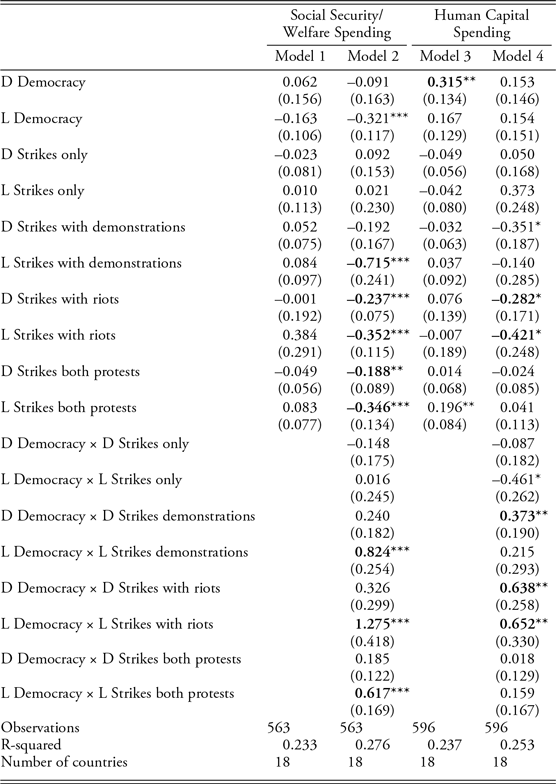
To explore the synchronizing effects of mass protests on strikes, we break down the original “strikes” variable into four strike variables according to the concurrent episodes of mass protests. Four types of synchronization were considered: strikes only with no concurring mass protests, strikes concurrent with demonstrations only, strikes concurrent with riots only, and strikes concurrent with both demonstrations and riots. Among the total 179 strike cases included, we have 48 cases for strikes only, 55 cases for strikes with demonstrations, 19 cases for strikes with riots, and 57 cases for strikes with both protests. With these four strike variables, we reestimate Zárate-Tenorio’s table 1 and present the relevant results in table 2. The entire table is presented in the online appendix.
From this reanalysis, our expectations are simple. First, we expect that the strikes-only variable does not have any discernable influence on social security and welfare spending. Second, we also expect that labor strikes can increase social security and welfare spending in Latin American democracies only if they accompany mass protests.
As predicted, our results show that strikes alone are not able to obtain organized labor policy concessions. In model 2, the coefficient of the interaction term between strikes only and democracy fails to reach any statistical significance. Second, all strike variables with concurring mass protests have long-term positive effects on social security and welfare spending in Latin American democracies. All these interaction terms are positive and statistically significant at the .01 level. Because democracy is a dummy variable, the baseline lagged strike variables show their long-term effects in autocracies. These coefficients are all negative and statistically significant.
This means that with simultaneously occurring mass protests, strikes have long-term negative effects on social security and welfare spending in autocracies, while democracy successfully mitigates these negative influences.
We also calculate the long-term multipliers with Bewley transformation (appendix; De Boef and Keele Reference De Boef and Keele2008). The long-term multipliers of two interaction terms, both Democracy × Strikes with riots and Democracy × Strikes both protests, are positive and statistically significant. The long-term multiplier of Democracy × Strikes with demonstrations is positive, but the statistical significance is at the .1 level. We need to look at the interaction terms more closely.
Note: The points are coefficient estimates from error correction model with country and year fixed effects (model 2 in table 1), and the lines provide a 95 percent confidence interval. Coefficients for other variables were suppressed.
In the literature, there is a well-established practice of interpreting the results of multiplicative interactions (Brambor et al. Reference Brambor, Clark and Golder2006). To see the effects of strikes with the synchronizing mass protests in democracies, we can take the partial derivative of the equation with the strike variables. In the case of the L strikes with riots variable in table 2, its effect in democracies equals –0.352 + 1.275 × democracy (model 2). As democracy is a dummy variable, we can add up two coefficients to calculate the point estimate of the effect. However, the standard error is not easily available from the table. Instead of calculating it manually, we create a dummy variable for autocracy and reestimate the entire model so that we can refer to the table to get both the coefficient and standard error for the effects of strike variables in democracies (Solt et al. Reference Solt, Kim, Lee, Willardson and Kim2014). Figure 1 gives the results for relevant coefficients in table 2.
Coefficients of Strike Variables on Social Security and Welfare Spending, by Regime

This coefficient graph reconfirms our argument. First, strikes alone cannot press democratic government and obtain policy concessions. The 95 percent confidence interval for L Strikes only includes zero in both regimes. Second, L Strikes with demonstrations has a negative and statistically significant impact on the dependent variable in autocracies, while democracy only mitigates its negative effect; it does not help strikes achieve their objectives. When strikes are accompanied by riots, this coefficient becomes positive and statistically significant in democracies. The coefficients of both L Strikes with riots and L Strikes both protests are positive and statistically significant in democracies. Again, we arrive at the same conclusion: organized labor protests require the synchronization of mass protests to persuade democratic governments in Latin America successfully.
Last, and surprisingly, we can also see the immediate effects of strikes on human capital spending when strikes accompany either demonstrations or riots. In model 4, the interaction terms of both D Strikes with demonstrations and D Strikes with riots are positive and statistically significant. This is a very interesting result because Zárate-Tenorio did not find any discernable effect of protests, whether organized or mass protests, on human capital spending. What she found instead was that mass protests contribute to avoiding cutbacks in human capital spending. Our reanalysis shows that at least in the short run, strikes are able to push democratic governments and obtain policy concessions for the general public. Furthermore, we see the longterm effects of the interaction between democracy and Strikes with riots in model 4. However, the long-term multiplier is not statistically significant (table A.2). In sum, our analysis reveals the potential routes for mass protest to obtain government concessions for human capital spending, at least in the short run.
These findings remain remarkably robust to alternative measures of democracy and various model specifications. First, we reran the entire analysis with two additional measures of democracy (Cheibub et al. Reference Cheibub, Gandhi and Vreeland2010; Mainwaring et al. Reference Mainwaring, Daniel, Pérez-Liñán and Munck2007). The results remained robust. Second, across different measures of democracy, we replicated figure 1 and reconfirmed the robustness of these results. Third, all additional control variables in Zárate-Tenorio’s sensitivity analysis were tested against our arguments: IMF agreement periods, the age of the social security system, debt service, state repression index, and a different measure of financial globalization (capital account openness). The inclusion of these variables does not change the outcomes of this analysis. Last, specifying each interaction term in a separate model also yields the same conclusion. All tests results are presented in the appendix.
Discussion and Conclusions
Without a doubt, in understanding the varying social policy responses of Latin American governments to protests, Zárate-Tenorio’s Reference Zárate-Tenorio2014 analysis is pioneering and insightful. However, our reanalysis reveals that her analysis gives too much credit to organized labor in its capacity to obtain policy concessions from democratic government. Strikes alone cannot bring about policy concessions, but the effect of synchronizing mass protest can help organized labor overcome its numerical disadvantage, putting pressure on the democratic government. Overall, our findings add more nuances to Zárate-Tenorio’s analysis, suggesting that the insider-outsider dichotomy is a bit too simple to understand the varying policy responses to protest in Latin America. The relationship between formal and informal sectors in obtaining policy concessions in Latin American democracies might be more complementary than Zárate-Tenorio suggests.
Our alternative analysis reveals some interesting insights and thoughts for future research. First, this study focuses on the effects of organized labor protest while emphasizing the importance of simultaneous mass protest. By doing this, it clarifies the theoretical mechanism of Zárate-Tenorio’s argument—assumed but underspecified in her original work—and provides a refined argument that links organized labor to social welfare and security spending. However, our analysis does not fully explicate the general conditions under which protests successfully achieve policy concessions. This is the next step we need to take to better understand the linkage between protest and government responsiveness.
Second, and relatedly, our reanalysis shows that the concurrent episodes of violent protests, operationalized as riots, also help organized labor achieve increased social security and welfare spending. This result is somewhat interesting because the extant literature suggests that violent protests are not effective in achieving policy goals. We believe that this puzzle can be solved by investigating who the participants in riots are and what motivates them to engage in the violent protests in sync with strikes.
With the CNTS data, however, we cannot identify participants in different types of protests, and thus the data create theoretical challenges in explaining what makes the concurrence of strikes and riots possible. It could be that the cause of a labor strike resonates with the public and spreads to riots. Or it could be that a labor strike escalates in violence and some actors or groups in labor carry out a riot, which actually is not rare in Latin America. Therefore, it is important to identify the types of actors in strikes and riots and examine the dynamics of their concurrence more deeply in order to understand the relationship between protests and government response. In that regard, we believe that qualitative research of some events would be helpful. It would shed light on the types of actors, their demands, the conditions in which different actors meet, and the mechanisms by which governments respond using social policy. We leave these tasks for future research.
Supporting Information
Additional supporting materials may be found with the online version of this article at the publisher’s website: Appendix