Introduction
Recent research has focused on elucidating motivational processes underlying obsessive-compulsive disorder (OCD) in order to understand its complexity and heterogeneity.Reference Chik, Calamari, Rector and Riemann 1 – Reference Rasmussen and Eisen 3 One motivational process is harm avoidance (HA), whereby people undertake behaviors in order to reduce the anxiety they experience from worrying about potentially harmful future events. Another motivational process, which appears to be widespread within the OCD population, and to which to date less empirical attention has been paid, that drives some compulsive behaviors is “not just right experience” (NJRE).Reference Coles, Heimberg, Frost and Steketee 4 According to this account, some symptoms of OCD, especially those concerned with ordering, symmetry, and arranging, reflect a need to make the environment “feel right.”Reference Ecker and Gönner 2 (p 899), Reference Ferrão, Shavitt and Prado 5 – Reference Starcevic, Berle and Brakoulias 8 Furthermore, NJRE has been associated with pertinent OCD characteristics that impact on functioning and prognosis including age of onset,Reference Ferrão, Shavitt and Prado 5 , Reference Rosario, Prado and Borcato 6 , Reference Do Rosario-Campos, Leckman and Mercadante 9 symptom severity,Reference Ecker and Gönner 2 , Reference Leckman, Walker, Goodman, Pauls and Cohen 10 , Reference Leckman, Grice and Barr 11 and level of comorbidity.Reference Coles, Pinto, Mancebo, Rasmussen and Eisen 12 – Reference Miguel, do Rosário-Campos and Prado 15
NJRE in OCD may signal a neurodevelopmental origin similar to autism spectrum disorder (ASD). Descriptive clinical profiles of OCD show parallels to ASD and its subclinical manifestations (“autistic traits”), including difficulties with social communication,Reference Bejerot 16 sensory processing,Reference Rieke and Anderson 17 and cognitive rigidity.Reference Lawrence, Wooderson, Mataix-Cols, David, Speckens and Phillips 18 To date, the question of whether NJRE may be the link between OCD and ASD, and/or whether NJRE is part of the autistic phenotype, has not been extensively investigated. Support for these speculations can be found in a family study showing that the parents of children with ASD frequently experience NJRE.Reference Kloosterman, Summerfeldt, Parker and Holden 19 NJRE, as a neurodevelopmental risk factor for OCD, may also be suggested by prevalence studies showing high occurrences of NJRE in OCD comorbidities with Tourette syndrome.Reference Miguel, Coffey, Baer, Savage, Rauch and Jenike 14 , Reference Miguel, do Rosário-Campos and Prado 15
The current research seeks to contribute to an understanding of the nature of NJRE in OCD. First, we were interested in investigating whether NJRE in OCD is a distinct motivational process from HA by examining the correlation between these two constructs. A weak to moderate correlation was predicted, as these constructs have been proposed to be orthogonal dimensions.Reference Summerfeldt 20 Second, this research aimed to test whether NJRE in OCD can be understood as a manifestation of autistic traits in a sample of adults with OCD. It was predicted that NJRE would be (a) positively associated with autistic traits as measured by the Autism Quotient (AQ),Reference Kloosterman, Summerfeldt, Parker and Holden 19 (b) positively associated with sensory processing difficulties,Reference Rieke and Anderson 17 and (c) negatively associated with cognitive flexibility.Reference Lawrence, Wooderson, Mataix-Cols, David, Speckens and Phillips 18 Third, NJRE was examined as a potential broader marker for a developmental origin in OCD. Based on previous findings,Reference Ferrão, Shavitt and Prado 5 , Reference Do Rosario-Campos, Leckman and Mercadante 9 it was predicted that NJRE, but not HA, would be associated with an earlier age of OCD onset.
Methods
Design
This study used a cross-sectional observational design that aimed to examine the association between motivational processes (NJRE and HA) and a range of factors, including autistic traits, sensory processing, set-shifting difficulties, and age of OCD onset.
Participants
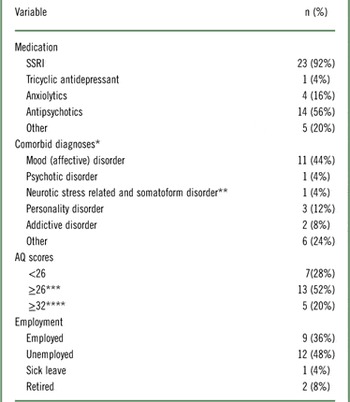
Twenty-five participants from a national OCD service were included in the study. The inclusion criteria were as follows: (i) participants had to have a primary diagnosis of OCD 21 and (ii) be at least 18 years of age. There were no formal exclusion criteria. The sample consisted of 16 (64%) women and 9 (36%) men. The mean age was 46.84 years (SD=11.19), ranging from 25–65 years of age. Their mean score on the Yale–Brown Obsessive Compulsive Scale (Y-BOCS) was 24.33 (SD=6.91), which is in the severe range. All participants met the cut-off on the Y-BOCS (≥8). The mean score for overall compulsions was 13.32 (SD=3.02) and overall obsessions was 11.89 (SD=3.4). As is shown in Table 1, the majority of the participants (n=17, 68% of the sample) had at least 1 additional diagnosis, and all were treated with psychiatric medication.
Clinical and demographic variables

Note. SSRI=selective serotonin reuptake inhibitors. *Diagnoses were based on a series of extended clinical interviews and using ICD-10 codes; **F40-F41; F43-F44; AQ=Autism Quotient; ***possible autism spectrum disorder, ****probable autism spectrum disorder.
Measures
A range of self-report questionnaires, clinician-rated questionnaires (administered by professionals trained in their use), and a cognitive task assessing set-shifting were administered to address the research questions.
Self-report measures
Obsessive-Compulsive Trait Core Dimensions Questionnaire (OC-TCDQ).Reference Summerfeldt, Kloosterman, Parker, Antony and Swinson 22
This is a 20-item, self-report measure of harm avoidance (HA) (10 items) and incompleteness (INC) (10 items). (INC is also known as NJRE. The article will use the term NJRE to refer to this experience.) Questions referring to NJRE assess, for example, whether people repeat activities until it is “just right.” HA questions include questions referring to whether people aim to prevent harm. Items are rated on a 5-point Likert scale from 1=“never applies to me” and 5=“always applies to me.” It is found to have excellent internal consistency for HA (.91) and NJRE (.90–.93).Reference Ecker and Gönner 2 , Reference Coles, Heimberg, Frost and Steketee 4
Adolescent/Adult Sensory Profile (AASP).Reference Brown and Dunn 23
This is a 60-item, self-report measure to evaluate sensory processing abilities. There are 4 scores that produce a sensory profile (low registration, sensory sensitivity, sensation seeking, and sensation avoiding). Example question topics include feeling distracted by, eg, noise (sensory sensitivity); using strategies to minimize sensory input (sensation avoiding); not detecting, eg, smells others smell (low registration); seeking, eg, bright lights (sensation seeking). Overall scores range between 60 and 300.Reference Horder, Wilson, Mendez and Murphy 24 Behaviors related to the everyday sensory experiences are rated on a 5-point Likert scale ranging from whether it applies 1=“almost never” to 5=“almost always.” It is found to have acceptable reliability with coefficient alphas being around 0.64 and 0.78.Reference Brown and Dunn 23
State–Trait Anxiety Inventory (STAI).Reference Spielberger, Gorsuch, Lushene, Vagg and Jacobs 25
This is a self-report questionnaire measuring state and trait anxiety. There are 20 items measuring how the participant feels at the moment (state anxiety), for example, feeling at ease, and 20 items measuring how the participant feels generally (trait anxiety), for example, feeling like a steady person. Items are rated on a 4-point Likert scale ranging from 1=“not at all” to 4=“very much so” for the STAI state and 1=“almost never” to 4=“almost always” for the STAI trait form. It has been found to have excellent internal consistency (.89).Reference Barnes, Harp and Jung 26
Autism Quotient (AQ).Reference Baron-Cohen, Wheelwright, Skinner, Martin and Clubley 27
This is a 50-item, self-report questionnaire measuring symptoms of ASD in adults. It can be subdivided into 5 domains: social skill, attention switching, attention to detail, communication, and imagination. Items are scored to be either autistic-like (score of 1) or non-autistic-like (score of 0). Respondents rate whether they agree or disagree on a 4-point Likert scale, 1=“definitely agree” to 4=“definitely disagree.” The overall internal consistency has been found to be acceptable (.74) with the subtests ranging from .42 (imagination) to .76 (social skills).Reference Bishop and Seltzer 28 The internal consistency for the subtests has been reported to be slightly higher in a previous study (.63–.77).Reference Baron-Cohen, Wheelwright, Skinner, Martin and Clubley 27
Clinician-rated measures
Montgomery–Åsberg Depression Rating Scale (MADRS).Reference Montgomery and Asberg 29
This is a 10-item, clinician-rated questionnaire measuring the severity of depression. Items are rated on a 7-point Likert scale. The scale ranges from 0 to 6, the values of which are added up to ascertain a total score. Overall scores range between 0 and 60. The internal consistency has been found to be excellent (.90–.92).Reference Carmody, Rush and Bernstein 30 Inter-rater reliability also has been reported to be excellent (.83).Reference Bech 31
Yale–Brown Obsessive Compulsive Scale (Y-BOCS).Reference Goodman, Price and Rasmussen 32
This is a semistructured interview consisting of a symptom checklist and measure of severity. The measure assesses the severity of the obsessions and compulsions separately. In addition, it provides an overall measure of symptom severity ranging from 0 to 40. All severity items are measured using a 5-point Likert scale ranging from 0=“no symptoms” to 4=“extreme symptoms.” The internal consistency has been reported to be good (.78).Reference Deacon and Abramowitz 33 Inter-rater reliability has been found to be excellent (>.97).Reference Goodman, Price and Rasmussen 32
Cognitive task
Intra-Extra Dimensional Shift (ID/ED) Task
This is a subtest from the Cambridge Automated Neuropsychological Test Battery (CANTAB).Reference Lowe and Rabbitt 34 The subtest is thought to require prefrontal function and is believed to specifically assess set-shifting abilities.Reference Ozonoff, Cook and Coon 35 , Reference Robbins, James and Owen 36 It is a computer-administered task, and it requires participants to respond to visual (nonverbal) multidimensional forms consisting of shapes and lines on a computer screen. Through trial and error, participants learn to respond in a certain way to a specific shape. The contingencies eventually change, and the respondent has to shift to another cognitive set/contingency. In total there are 9 stages, including discrimination and learning phases, intradimensional tasks, and extradimensional tasks. The extradimensional tasks are the main trials measuring set-shifting. Three outcome variables associated with the extradimensional shift task (set-shifting measure) were identified in collaboration with the Cambridge Cognition team, who designed the CANTAB. These included (i) extradimensional shift (EDS) errors, (ii) intradimensional (IED) total errors adjusted, and (iii) number of trials completed. EDS errors refer to errors made when a new dimension is initially introduced. The IED “total errors adjusted” averages the total number of mistakes made in choosing a stimulus incompatible with the current rule and adjusts for discontinued trials. Number of trials allows us to look at early discontinuation due to set-shifting errors.
Procedure
Ethical approval was obtained from a National Research Ethics Service committee. Participants were recruited from a pool of individuals (n=52) who had taken part in a preliminary study of ASD in OCD, and who had consented to be contacted about future research. In total, 25 people agreed to take part in the research. The diagnoses were made as part of routine clinical assessment in the OCD and Related Disorders Clinic by highly experienced clinic staff (trained psychiatrists), based on a series of extended clinical interviews and using International Classification of Diseases, Tenth Revision (ICD-10) codes, which are routinely used in clinical practice in the hospital clinic. A set order of task administration had been planned; however, at times it was necessary to deviate from this order to minimize missing data.
Data analysis
All variables were tested for normality using the Kolmogorov–Smirnoff test. None deviated from normality, so parametric statistics were used throughout. Bivariate Pearson’s correlations were used to measure the association between, on the one hand, NJRE and HA and, on the other hand, NJRE and HA association with ASD including the AQ, sensory processing difficulties, and set-shifting difficulties, as well as age of OCD onset.
Furthermore, the relationship of the core motivational processes to anxiety, depression, and OCD severity were explored using Pearson’s correlations to assess whether these factors could be possible confounding variables. If, for example, anxiety was related to both the predictor and outcome variables, then a partial correlation was calculated to statistically control for this potentially confounding variable.
The numerous comparisons increase the risk of a Type I error. The corrected Bonferroni alpha level based on the primary hypotheses indicated a stringent alpha level (0.05/14=0.004). Due to limited power in terms of the small sample size, reporting findings based on the corrected alpha level could inflate the risk of a Type II error. Hence, comparisons described below were hypothesis-driven, and the exact p values were reported.
Results
The distribution of motivational processes (HA and NJRE) was assessed using the Kolmogorov–Smirnov test. Neither HA (p=.20) nor NJRE (p=.17) violated the assumption of normality, and were continuously distributed in this sample. The relationship between NJRE and HA was modest to low, and did not reach statistical significance (r=.34, p=.092) in this small sample.
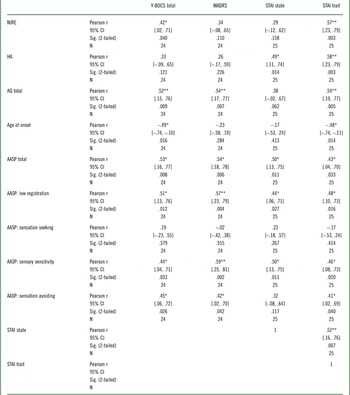
The calculations of bivariate correlations to identify the presence of potential confounding variables are presented in Table 2.
Exploring possible confounding variables including OCD symptom severity (Y-BOCS), low mood (MADRS), and anxiety (STAI)

Note. NJRE=“not just right experience,” HA=harm avoidance, AQ=autism quotient, AASP=Adolescent/Adult Sensory Profile, EDS=extradimensional shift, IED=intradimensional shift, Y-BOCS=Yale–Brown Obsessive Compulsive Scale, MADRS=Montgomery–Åsberg Depression Rating Scale, STAI=State Trait Anxiety Inventory.
*Correlation is significant at the 0.05 level (2-tailed); **correlation is significant at the 0.01 level (2-tailed).
The relationship between NJRE and elements of the autistic phenotype
The main aim of the study was to identify whether NJRE was related to ASD traits (AQ) and to a broader phenotype of ASD including cognitive rigidity and sensory processing difficulties. Sensory thresholds for processing difficulties, including sensory sensitivity, sensation avoiding, low sensory registration, and sensation seeking, were points of interest. The findings presented here are preliminary due to the small sample size and need to be interpreted with caution.
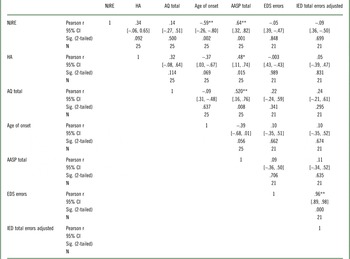
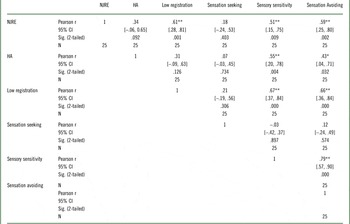
Contrary to predictions, the AQ total score was not significantly correlated with NJRE in this sample, nor was it correlated to HA, as is shown in Table 3. NJRE was, however, positively correlated with sensory processing difficulties. The relationship to sensory processing survived controlling for total OCD severity (r=.53, p=.008) and trait anxiety (r=.53, p=.008) using partial correlations. Table 4 shows that NJRE was positively correlated to a sensory processing profile of low registration, sensory sensitivity, and sensory avoiding. The relationship between NJRE and low registration was still significant after controlling for OCD symptom severity (r=.49, p=.016) and trait anxiety (r=.46, p=.024). Similarly, the relationship to sensation avoiding withheld controlling for OCD symptom severity (r=.50, p=.014) and trait anxiety (r=.47, p=.021). The relationship between NJRE and sensory sensitivity remained significant after controlling for OCD symptom severity (r=.49, p=.018) using partial correlations. The relationship was no longer significant when factoring in trait anxiety (r=.34, p=.103).
NJRE and HA relationship to AQ, age of onset, sensory processing (AASP), set-shifting (EDS) errors, and IED total errors adjusted

Note. NJRE=“not just right experience,” HA=harm avoidance, AQ=autism quotient, AASP=adolescent /adult sensory profile, EDS=extradimensional shift, IED=intradimensional shift.
*Correlation is significant at the 0.05 level (2-tailed); **correlation is significant at the 0.01 level (2-tailed).
Correlations between core motivational processes (NJRE and HA) and 4 categories of the sensory profile

Note. NJRE=“not just right experience,” HA=harm avoidance.
*Correlation is significant at the 0.05 level (2-tailed); **correlation is significant at the 0.01 level (2-tailed).
While HA was also associated with overall sensory processing difficulties, this relationship ceased to be significant once controls were made for state anxiety (r=.32, p=.132) and trait anxiety (r=.32, p=.128). Two significant relationships were found between HA and the subcomponents sensation avoiding and sensory sensitivity. This relationship between HA and sensation avoiding did not withstand analyses with partial correlations to control for trait anxiety (r=.26, p=.224). The relationship between HA and sensory sensitivity remained significant after controlling for state anxiety (r=.41, p=.047). It was no longer significant after controlling for trait anxiety (r=.40, p=.056).
Set-shifting difficulties were measured based on the error rate in the extradimensional shift task of the ID-ED. There are 3 important variables associated with extradimensional (set-shifting) performance: (i) EDS errors, (ii) IED total errors adjusted, and (iii) number of trials completed. Contrary to the study hypothesis, NJRE was not associated with set-shifting difficulties as measured by EDS errors and IED total adjusted errors in this sample, as is seen in Table 3. In addition, it was predicted that NJRE would be associated with more set-shifting errors and hence earlier trial discontinuation. However, NJRE did not predict early discontinuation of trials. The majority of participants completed all trials [n=13 (61.9%)], whereas n=8 (38.1%) completed only 7 trials. Neither HA nor NJRE predicted early discontinuation in a logistic regression, χ2(2)=.15, p=.933.
Discussion
This study aimed to explore the “not just right experience” (NJRE) in OCD. It was of interest to investigate whether NJRE could be defined as a distinct construct and a possible marker for a subgroup of OCD individuals with an autistic phenotype. The study did not clearly support these predictions. NJRE was, nevertheless, shown to be associated with sensory abnormalities and was associated with an earlier age of OCD onset. These preliminary findings need to be verified but may strengthen the argument of NJRE reflecting a possible neurodevelopmental pathway distinct from HA in OCD.
The following results need to be interpreted with caution due to inherent methodological limitations related to the sample size, measures chosen, sample population, and confounding variables. First, due to its sample size of n=25, the study lacked statistical power to detect medium to small effects and may have missed important associations. Second, the present study was primarily based on self-report questionnaires. Self-report questionnaires, even though commonly used in research, require sophisticated insight into one’s own symptoms. There is little information about the questionnaires’ discriminant validity as to whether they can distinguish between, for example, behavioral patterns seen in OCD versus ASD. The AQ and AASP, in particular, could have been falsely inflated with positive answers due to OCD symptoms affecting the internal validity of the study. Direct assessment methods of sensory aversions or of NJRE using behavioral experiments may have been a useful supplement to questionnaires.Reference Pietrefesa and Coles 37 Furthermore, limited sensitivity of the AQ in diagnosis of ASD has been reported.Reference Bishop and Seltzer 28 , Reference Ketelaars, Horwitz and Sytema 38 Additionally, confounding variables, such as low mood, trait anxiety, and OCD symptom severity, were correlated to the AQ in this study. Verification of autistic traits with a standardized, clinician-rated diagnostic measure would seem essential, even though challenging in adult populations, as measures have usually been designed to detect symptoms in children.Reference Murphy, Beecham, Craig and Ecker 39 Third, the sample was recruited exclusively from a national OCD service. It is possible that this sample is not representative of the general OCD population due to the complexity and severity of their clinical presentations. In addition, all participants were being psychopharmacologically treated. It is, likewise, unclear as to what extent medications could have affected answers on the questionnaires or outcomes on the neuropsychological testing.Reference Quednow, Kühn, Stelzenmuelle, Hoenig, Maier and Wagner 40 Last, this study did not control for a comorbid tic disorder. Tics are likely to be a critical confounding variable, as they are frequently associated with NJRE.Reference Leckman, Walker, Goodman, Pauls and Cohen 10 , Reference Miguel, do Rosário-Campos and Prado 15
Despite these shortcomings, the present study demonstrated some interesting initial findings. The correlation between NJRE and HA was modest to low at 0.34, and, in analyses powered to detect moderate to large effects (r>.5), was not statistically significant. These findings are consistent with the notion that NJRE and HA are 2 separate constructs contributing to the heterogeneity of OCD. The correlation in this study was relatively small when considering that the phenotypic overlap between ASD and attention deficit hyperactivity disorder (ADHD), which are widely recognized as 2 distinct disorders, is between .51 and .54.Reference Ronald, Simonoff, Kuntsi, Asherson and Plomin 41 One possibility is that that like ASD and ADHD, NJRE and HA have shared but also unique pathophysiologies and etiologies. Our findings on the relationship between NJRE and HA will require replication in a larger clinical population, and it should be noted that nonclinical studies have found moderate to large correlations between NJRE and HA (.45–.93).Reference Pietrefesa and Coles 37 , Reference Taylor, McKay, Crowe, Abramowitz, Conelea, Calamari and Sica 42
This study attempted to define neurodevelopmental features in NJRE by focusing on concurrence with ASD traits. Contrary to predictions, in this study NJRE was not related to autistic traits as measured by the AQ. Due to methodological limitations, it is, however, difficult to completely rule out a relationship between NJRE and ASD.
It is possible that NJREs may not be related to autism in their entirety. ASD is considered to be a “fractionable” condition, and the present understanding is that the social (social interaction and communication) and nonsocial (repetitive and restrictive behaviors and interests) domains are likely related to distinct etiologies and cognitive mechanisms.Reference Happé and Ronald 43 The nonsocial domain of ASD has been independently reported in other types of psychopathologies, such as eating disorders.Reference Pooni, Ninteman, Bryant-Waugh, Nicholls and Mandy 44 The association of NJRE with the nonsocial domain of ASD has been cited in past research. Parental levels of incompleteness (NJRE) were found to be related to their autistic children’s repetitive behavior.Reference Kloosterman, Summerfeldt, Parker and Holden 19 A comprehensive measure of restricted repetitive behaviors (RRB) and their association with NJRE might yield more plausibility to this relationship in future research.Reference LeCouteur, Lord and Rutter 45 – Reference Bodfish, Symons, Parker and Lewis 47
This study was not able to differentially measure repetitive behaviors. However, sensory abnormalities and set-shifting difficulties as 2 further features associated with the nonsocial domain of ASD were assessed for parallels to OCD. Sensory abnormalities including hypo- and hypersensitivity are more likely to occur together with repetitive behaviors rather than with social and communication difficulties in ASD.Reference Mandy, Charman and Skuse 48 Set-shifting difficulties, as well as problems in preservation and planning, exemplify rigid cognitive strategies common in nonsocial domains of ASD.Reference Hill 49
Dunn’s Adolescent Adult Sensory Processing Profile has been used to report sensory processing difficulties in adults with OCD.Reference Rieke and Anderson 17 Dunn’s model (1997)Reference Dunn 50 targets 4 behavioral patterns, which were selected to differentiate sensory abnormalities in this study. Interactions between an individual’s neurological threshold and his or her self-regulatory behavior are categorically summarized into the following 4 sensory processing patterns: low registration, sensory sensitivity, sensation seeking, and sensation avoiding.
In this study, sensory processing difficulties were interestingly found to be associated mainly with OCD subjects experiencing NJRE and not HA. OCD individuals with NJRE were more likely to demonstrate specific low registration, sensory sensitivity, and sensation avoiding patterns. The findings of this study suggest that neurological thresholds in persons with OCD and NJRE may differ from those with OCD and HA, and that they respond more readily (sensory sensitivity) or with delays (low registration) to stimuli in their environment. They are also more likely to avoid overwhelming stimuli (sensation avoiding). Within this sensory processing profile, only sensory sensitivity was similarly associated with HA and not uniquely related with NJRE. One could propose that fearful individuals may be highly aware of their environment and “sensitive” to any changes in their surroundings. However, it is less clear whether this awareness is due to neurological differences or to learned experiences. In order to better understand sensory processing mechanisms related to HA and NJRE, it would be helpful to use more objective measures of sensory processing.Reference Blakemore, Tavassoli and Calò 51
Cognitive explanations for nonsocial domains of ASD have focused on difficulties with preservation, planning, and set-shifting.Reference Hill 49 This study explored NJRE’s relationship to set-shifting difficulties as measured by the intra-extra dimensional shift task (IDED) subtest of the CANTAB. Contrary to our prediction, NJRE was not related to set-shifting difficulties. Currently, there is limited information as to whether the CANTAB is sensitive enough to detect differences within clinical populations.Reference Smith, Need, Cirulli, Chiba-Falek and Attix 52 Perhaps the CANTAB was unable to detect subtle set-shifting differences between OCD populations experiencing HA or NJRE. It would be interesting to replicate this study using the Wisconsin Card Sorting task, which was successfully used to detect a negative association between set-shifting difficulties and the symmetry/ordering dimension in OCD.Reference Lawrence, Wooderson, Mataix-Cols, David, Speckens and Phillips 18 At this stage, it appears that set-shifting difficulties as measured by the IDED are not differentially related to HA and NJRE.
In summary, there is some limited evidence to speculate that NJRE may be a manifestation of the nonsocial domain of ASD in particular with regard to sensory abnormalities; however, findings are tentative due to methodological limitations. Further investigations are warranted to explore this idea.
In adjunct to the hypothesis of NJRE being a marker of ASD was the suggestion that NJRE in OCD could be more broadly conceptualized as a marker for an atypical developmental pathway distinct from HA. Hence, it was predicted that NJRE would be related to an earlier age of OCD onset. Current results suggest that an earlier age of OCD onset is related to NJRE, corresponding to results found in previous research.Reference Ferrão, Shavitt and Prado 5 , Reference Do Rosario-Campos, Leckman and Mercadante 9 However, it is important to consider that the study may have been underpowered and so not able to detect an association between age of OCD onset and HA. Findings, if substantiated, may imply earlier key differences in the developmental trajectory of OCD and could support the notion that OCD plus NJRE is better understood as a developmental disorder. These findings concur with a previous review suggesting that juvenile OCD onset reflects a developmental subgroup.Reference Geller, Biederman and Jones 53
Conclusion
In summary, OCD is a heterogeneous clinical disorder. Research endeavors attempt to explain the possible divergent pathways leading to the repetitive behaviors characteristic of OCD. Acknowledging the role of NJRE in OCD offers alternative theoretical assumptions about the sustaining factors undermining behaviors beyond anxiety reduction, and encourages treatment considerations aiming to reduce a general sensory discomfort. SummerfeldtReference Summerfeldt 20 suggested that these sensory-affective experiences may be internally generated and, hence, less responsive to conventional treatments of OCD addressing the cognitive components identified in cognitive behavioral therapy (CBT) formulation.
This study has explored the role of NJRE in OCD presentations as a marker for a phenotypically autistic-like OCD subgroup. The study provided interesting preliminary findings, but, nevertheless, a number of research questions remain insufficiently answered. NJREs in OCD may be related to nonsocial symptom domains of autism with sensory processing difficulties. They may underscore underlying neurological differences as a mechanism in OCD distinct from HA. NJREs may point out an atypical developmental trajectory in OCD. Speculations about an etiology and pathophysiology differing from HA warrant further research in consideration of improving alternative treatment approaches in OCD.
Disclosures
Naomi Fineberg reports personal fees from Otsuka, personal fees from Lundbeck, nonfinancial support from Janssen, grants and nonfinancial support from ECNP, personal fees and nonfinancial support from BAP, nonfinancial support from WHO, personal fees and nonfinancial support from RANZCP, grants from Shire, grants from NIHR, personal fees and nonfinancial support from College of Mental Health Pharmacists, nonfinancial support from Intl. Society of Behavioural Addiction, nonfinancial support from Royal College of Psychiatrists, nonfinancial support from International College of OC Spectrum Disorders, nonfinancial support from Novartis, grants and nonfinancial support from Servier, personal fees from Bristol Myers-Squibb, grants from MRC, grants from Wellcome, personal fees from Taylor and Francis, and personal fees from Oxford University Press, outside the submitted work. Josselyn Hellriegel, Caroline Barber, Maheshi Wikramanayake, and William Mandy do not have anything to disclose.