Early on the afternoon of March 11, 2011, the east coast of Honshu, Japan's main island, was the scene of a triple assault. Intense ground shaking from an offshore underwater earthquake was followed within minutes by the high-velocity on-shore run-up of powerful tsunami waves.1, 2 The tsunami overtopped the protective seawalls surrounding the Fukushima Dai-ichi nuclear power plant, precipitating multiple reactor meltdowns; radiation was released over a period of weeks. This complex emergency, variously labeled “The Great East Japan Earthquake,” “The Tohoku Earthquake,” or “3/11,” was a hybrid disasterReference Keim3, Reference Boyarsky and Shneiderman4 in 3 acts: earthquake, tsunami, and radiation hazards.
Positioned along the Pacific Ocean's seismically-active Ring of Fire, Japan's history has been punctuated by powerful and deadly earthquakes and tsunamis. Although well prepared for these eventualities, on 3/11, Japan was subjected to the forces of the largest earthquake in its national history, a tsunami of the highest intensity on the Japanese meteorological agency's rating scale, and a nuclear crisis that evolved over several weeks to be ranked 7 (highest) on the International Nuclear Events Scale.
This disaster provided a multiple-impact case study for examining the psychological consequences of the affected population using trauma signature (TSIG) analysis.Reference Shultz, Marcelin, Madanes, Espinel and Neria5-Reference Shultz, McLean and Herberman Mash7 TSIG examines the extent to which disaster survivors were exposed to empirically-documented risk factors for psychological distress and mental health disorders.Reference Norris, Friedman, Watson, Byrne and Diaz8-Reference Andrulis, Siddiqui and Gantner11 Based on the disaster ecology model,Reference Shultz, Espinel, Galea and Reissman12, Reference Shultz, Espinel, Flynn, Cohen and Hoffmann13 the premise of TSIG is that each disaster exposes the affected population to a novel pattern of traumatizing hazards, loss, and change. This singular “signature” of exposure risks is a predictor of the psychosocial and mental health consequences.
Disaster-specific analysis is important because, as Kessler and team have documented across a spectrum of international disasters, “secondary stressors unique to a particular disaster situation have more impact than the disasters themselves” in determining the prevalence of postdisaster mental disorders.Reference Kessler, McLaughlin, Koenen, Petukhova and Hill14 Currently under development with contributing investigators on 5 continents, TSIG is intended to provide actionable guidance for mental health and psychosocial support that is tailored, timed, and targeted to the profile of the event. For each disaster case study, TSIG analysis combines expertise from disaster sciences (in this case, earthquake geophysics and environmental engineering), disaster management, disaster public health, and disaster mental health (including input from Japanese experts).
Methods
The TSIG analysis reported here consisted of the following components: (1) collection and synthesis of information from real-time disaster situation reports (sitreps) issued in the immediate aftermath; (2) collection of information from international earthquake and tsunami monitoring systems and consultation with subject matter experts; (3) construction of a multihazard profile for this triple-threat event; (4) review of the scientific literature on evidence-based risk factors for psychological distress and psychopathology for persons exposed to earthquake, tsunami, and radiation hazards; (5) enumeration of event-specific disaster stressors and risk factors based on a review of sitreps and news accounts, cross-referenced with the evidence-based literature; (6) creation of a trauma signature summary for the disaster based on the estimated psychological severity of exposures to hazards, loss, and change; and (7) review of Japan's disaster mental health response.
Disaster Situation Reports
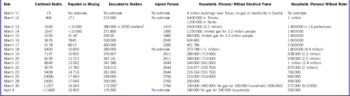
Beginning on March 11, 2011, TSIG investigators collected and examined situation reports (sitreps; Table 1) as they became available on ReliefWeb (http://reliefweb.int), a resource that serves the disaster response community as the international repository for late-breaking and archival information for major disaster events. Within hours of the initial impact, the first sitreps were posted on ReliefWeb as they were issued from sources such as the Government of Japan, United Nations Office for the Coordination of Humanitarian Assistance, and US Agency for International Development.
2011 Great East Japan Disaster: Disaster Situation Report Summary

aIncluding 210 000 within 20-km radius of Fukishima plant.
b(national media reporting <15,000 missing/unaccounted for)
cNumber dropped significantly due to double counting in Fukishima prefecture.
Sitreps were issued almost daily during the first 3 weeks, providing estimates of confirmed deaths; missing, displaced, and injured persons; and numbers of households lacking access to clean water and electrical power. Sitrep data have served as proxies for disaster stressors and indicators of exposure to hazards, loss, and change. Sitrep estimates were examined to see how rapidly they attained equilibrium and stability. As a reliability check, sitrep estimates produced in the immediate postimpact period were compared with the figures available 1 year postdisaster to gauge the data's utility and accuracy.
Disaster Monitoring Systems and Expert Consultation
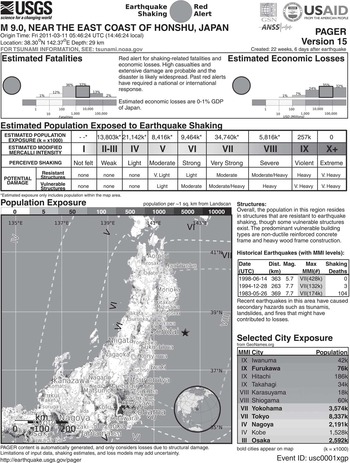
Scientific information was gathered from earthquake, tsunami, and radiation-monitoring systems. Within the first day, preliminary estimates of magnitude and cartographic depictions of the earthquake shaking intensities throughout Japan were characterized; the tsunami wave heights and wave arrival times were mapped for the entire Pacific Ocean; and early estimates of radiation exposure near the damaged power plants were published. TSIG researchers consulted subject matter experts from the physical sciences to assist in accurately characterizing the exposure of the Japanese population to the earthquake and tsunami hazards. One of these experts is a geophysicist from the US Geological Survey who created the Shake-Map technology for graphically displaying (Figure 1) the geographic areas and the corresponding human populations that experience varying levels of earthquake ground shaking (D.W.), and another is an environmental engineer and dean of research specializing in coastal flooding (H.S.-G.).
Earthquake Shaking Map: M 9.0, Near the East Coast of Honshu, Japan. From the United States Geological Survey.24

Construction of a Multi-Hazard Profile
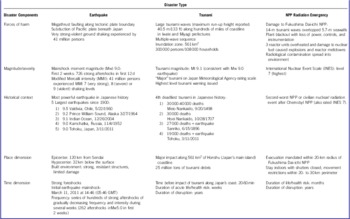
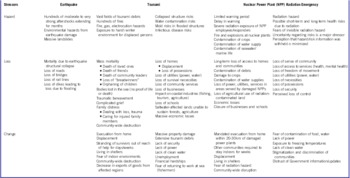
Based on the review of sitreps and hazard-monitoring websites, and with direct consultation from subject matter experts, the TSIG team created a hazard profile with separate descriptions for the earthquake, tsunami, and radiation hazards (Table 2). TSIG hazard profiles use an epidemiologic approach to disaster description (hazard, person, place, and time). Type of disaster was based on disaster classification schemes used by the Centre for Research on the Epidemiology of Disasters15 and the World Association for Disaster and Emergency Medicine16; forces of harm were derived from the Disaster Ecology Model;Reference Shultz, Espinel, Galea and Reissman12, Reference Shultz, Espinel, Flynn, Cohen and Hoffmann13 magnitude and severity were based on hazard-specific rating systems (eg, moment magnitude and Modified Mercalli Index for earthquakes, International Nuclear Events Scale for radiation events); and place and time descriptions were from the hazard-monitoring websites. For added perspective on the exceptional nature of each of the 3 hazards, Table 2 presents information on the historical context.
2011 Great East Japan Earthquake: Hazard Profilea

aTechnical event description: Hybrid disaster with natural (geophysical: earthquake/tsunami) and human-generated (nuclear power plant [NPP] radiation hazard) components and complex humanitarian emergency.Reference Keim3, Reference Boyarsky and Shneiderman4, 15, 16
Evidence-Based Literature on Psychological Risk Factors for Earthquake, Tsunami, and Radiation Hazards
The disaster mental health literature on human population exposure to earthquake, tsunami, and radiation hazards was searched to expand the TSIG database and identify evidence-based risk factors that were incorporated into the construction of the disaster stressor matrix.
Event-Specific Disaster Stressors and Risk Factors
For weeks following impact, TSIG investigators continuously perused print and media news accounts, accumulating photographic and video documentation of the disaster. Based on a review of sitreps and news accounts, cross-referenced with the evidence-based scientific literature, a table was constructed of disaster stressors experienced by Japanese citizens during the impact and postimpact phases (Table 3a3b). The resulting stressor matrix provided an event- and hazard-specific delineation of evidence-based risk factors for psychological consequences that were prominent and specific to this disaster. Development of the disaster stressor matrix was an important step for understanding how this disaster's unique pattern of harmful physical forces was likely to cause concomitant psychological reactions, distress, and psychopathology.
2011 Great East Japan Disaster: Disaster Stressors - Impact phase

2011 Great East Japan Disaster: Disaster Stressors - Post-impact phase

Trauma Signature Summary
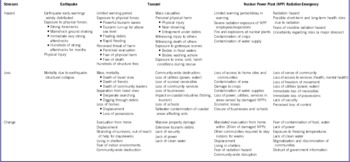
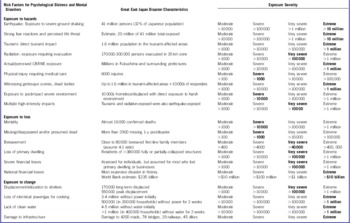
The TSIG team created a composite trauma signature summary table listing the most prominent disaster exposures conferring psychological risk (Table 4). Within the disaster ecology model,Reference Shultz, Espinel, Galea and Reissman12, Reference Shultz, Espinel, Flynn, Cohen and Hoffmann13 exposure to the forces of harm is subcategorized into exposures to hazards, loss, and change. The major evidence-based risk factors were categorized under these headings by disaster phase along with information specific to this Japanese disaster.
2011 Great East Japan Disaster: Trauma Signaturea

Abbreviation: CBRNE, chemical, biological, radiological, nuclear, and explosive.
a This disaster was of sufficient magnitude to be rated Extreme (frequency of several times per century) or Very Severe (frequency of 1 or several times within a 10- to 20-year period) on most of the psychological risk factors. Severe ratings occur 1 or several times within a 3- to 5-year period.
To our knowledge, this TSIG is the first case study to classify the exposure severity of the major psychological risks factors. The exposure severity ratings, developed by the disaster epidemiologists on the TSIG team, used order-of-magnitude (10-fold) differences between adjacent categories. Based on 112 years of data from the Centre for Research on the Epidemiology of Disasters,15 ratings of “Extreme” for a specific measure have been reserved for disasters that produce consequences at that order of magnitude only several times per century. “Very Severe” ratings reflect the order of magnitude threshold reached with a frequency of 1 or several times within a 10- to 20-year period, while “Severe” ratings occur 1 or several times within a 3- to 5-year period. This classification approach will soon be scrutinized and refined by an international group of disaster mental health professionals using a web-based Delphi process. The Japanese disaster was of sufficient magnitude to be rated Very Severe or Extreme on most of the psychological risk factors appearing in Table 4.
The Disaster Mental Health Response
Japan mounted an immediate and multifaceted disaster mental health response.Reference Kim17 This response was examined from the vantage point of the findings from the TSIG analysis.
Results
Situation Report Overview
Results are presented according to the sequence of steps in the TSIG analysis and summarized in a series of detailed tables. Table 1 combines information from 2 complete sets of sitreps produced by the United Nations Office for the Coordination of Humanitarian Assistance and the Center of Excellence for Disaster Management and Humanitarian Assistance. Because many persons who were engulfed in the tsunami waves disappeared, the number of fatalities was estimated from a combination of confirmed deaths and “missing” persons. As expected, the earliest sitreps (from day 1 of the disaster) grossly underestimated these numbers due to incomplete data. However tallies increased rapidly, and the sum of dead and missing surpassed 20 000 on March 20 and peaked at 28 000 on the final sitrep (April 4). This last number was actually an overestimate, primarily due to multiple counts of missing persons. At the 1-year anniversary, the number of confirmed deaths was 15 867, and 2909 persons were still reported as missing, a figure that continues to be updated.18 For the TSIG analysis, the focus was on estimating numbers of bereaved family members dealing with known or presumed loss of loved ones; precise mortality figures were not essential, but a workable estimate emerged and stabilized within the early weeks.
As anticipated in a tsunami, injuries were far fewer than fatalities,Reference Keim19 and tabulating injuries was not an urgent priority initially. Although the highest count of injuries recorded in the sitreps was less than 3000, these slowly accumulated to an official estimate of 6109 injuries at the 1-year anniversary.18 Displacement of disaster-affected persons peaked at 550 000 on March 15, including those displaced due to tsunami destruction and those evacuated from the 20-km “no-go” zone around the Fukushima Dai-ichi power plant. Numbers of displaced and sheltered persons declined quickly to about 170 000 by the end of March 2011.
Widespread power outages affected large numbers of persons, creating significant hardships during the March winter season. Millions remained for weeks without access to water that was clean and not contaminated with radiation. Along Honshu's east coast, from Chiba to Aomori, 129 225 buildings were totally destroyed, 254 204 were partially destroyed, and 691 786 sustained major damage.18 A total of 4200 roads, 78 bridges, and 29 railways were damaged or destroyed.18, 20-22 The World Bank estimated the economic cost of the disaster at $235 billion, making this the costliest disaster in history.23
Event Description and Hazard Profile
As a tectonic event of extraordinary scale, the earthquake was caused as the Pacific plate slipped violently downward beneath the tectonic plate on which Japan sits, causing a sudden upthrust of 400 km of seafloor, which triggered the tsunami at the ocean surface. Along the fault plane of origin, in the vicinity of the profound ocean depths of the Japan Trench, the earthquake and the tsunami were inseparable geophysical phenomena. In contrast, the impacts were experienced along the Japanese coastline as 2 discrete and highly-distinctive disaster events. Damaging earthquake S waves reached the Japanese coast in less than a minute (and Tokyo within 90 seconds), while tsunami waves arrived along Japan's east coast 20 to 80 minutes later.
The Earthquake
This earthquake was the largest in Japanese history and 1 of the 5 most powerful seismic events since 1900.20, 21 Releasing 1000 times more energy than the temblor that flattened Port-au-Prince, Haiti, in 2010, the Japanese earthquake subjected 41 million persons (32% of the 2011 Japanese population) to very strong, severe, or violent ground shaking.24 The main shock was followed by frequent, high-magnitude aftershocks (726 powerful aftershocks were recorded throughout the Japanese archipelago within the first 12 days).25
The Tsunami
The tsunami was the most deadly and destructive of the 3 hazards. The epicenter was sufficiently distant from Japan (120 km) to generate a procession of powerful tsunami waves, yet close enough to land that the warning interval to alert the public was typically less than 40 minutes. Tsunami waves rushed ashore, propelling massive quantities of debris (estimated at 25 million tons).26, Reference Oh27 Waves surged inland, “running up” the coastal hillsides. More than 94% of total deaths were attributed to the tsunami, with drowning accounting for 92% of the fatalities.21, 22 An additional 922 deaths were attributed to acute hardships in the aftermath (eg, unprotected exposure to winter conditions), especially in populations cut off from aid by inland flooding and the destruction of roads and bridges.21, Reference Norio, Ye, Kajitani, Shi and Tatano28
Radiation Hazards
An onrush of tsunami waves affected multiple coastal nuclear power plants. Fukushima Dai-chi, one of the world's largest nuclear power facilities, sustained significant damage from high-velocity tsunami waves that cascaded over the protective seawalls.29-Reference Becker31 Damage from the waves inactivated the plant's cooling systems, leading to explosions, fires, and complete meltdowns in 3 of the 6 reactors. The radiation crisis worsened during a period of weeks, as various remedies to cool the reactors were implemented and failed. The severity of the radiation health threat escalated to a 7 (highest) on the International Nuclear Events Scale as Fukushima Dai-ichi became the second worst civilian nuclear/radiation event in history (after Chernobyl). Significant quantities of radioactive materials were released into the environment, prompting authorities to evacuate approximately 200 000 citizens from a 20-km radius zone around the power plant and to severely restrict activities for citizens living within the 20- to 30-km perimeter.32 Japan began monitoring food and water, conducting radiation scans of evacuees, and placing radiation limits on food products.Reference Dauer, Zanzonico, Tuttle, Quinn and Strauss30 Radiation contamination will remain in the environment for many years, resulting in long-term, low-level exposures.32
Disaster Stressors
Japanese citizens experienced a wide range of disaster stressors associated with exposure to hazards during the impact of the disaster and adversities thereafter. A comprehensive array of stressors was tabulated by disaster phase (impact and postimpact) and hazard (earthquake, tsunami, and radiation) and compiled from news sources and published research. Many of the listed stressors were recognized risk factors for psychological distress and potential psychopathology.
Trauma Signature
A triple-threat trauma defines this event.Reference Shultz, Kelly and Forbes6 Historically, undersea or coastal earthquakes have generated massive tsunamis, and this combination of seismic hazards has proved to be deadly and destructive.Reference Keim19 The March 2011 disaster in Japan introduced the additional element of a major radiation hazard, creating a hybrid disaster event.Reference Keim3, Reference Boyarsky and Shneiderman4 Among the 41 million Japanese citizens who directly experienced forceful ground shaking from the earthquake, 1.6 million lived in coastal areas that were also inundated by the tsunami. All 200 000 persons living within the 20-km evacuation zone around the Fukushima Dai-ichi nuclear power plant had initially experienced ground shaking from the earthquake, and many were also affected by the tsunami.
Discussion
Synopsis of Psychological Risk Factors
The Great East Japan Disaster will be remembered for the superimposition of earthquake, tsunami, and radiation hazards that amplified the degree of harm and complicated the response. With almost 19 000 dead, or missing and not found, widespread damage to infrastructure, and an economic price tag unequaled in disaster history, this was a landmark event. Less quantifiable, but much more prolonged and pervasive, were the psychological effects of this disaster that will need to be monitored. The entire nation has been mourning the loss of life, and some Japanese citizens will need mental health intervention, including bereaved family members of those who died or whose bodies have never been found. One-third of the nation was subjected to very strong ground shaking from the earthquake, and some have been traumatized. Hundreds of thousands were in the path of life-threatening tsunami waves, fleeing for survival and witnessing harm and death. Hundreds of thousands were in mandatory evacuation zones due to potentially high radiation exposure, and they will be fearful of ongoing contamination and lifelong health risks. Predictably, the need for psychological support and mental health intervention related to the various exposures to hazards, loss, and change will be sustained. One essential component of the TSIG analysis was the review of the evidence-based literature; a synopsis of key findings follows.
Mental Health Correlates
The Earthquake
The exposure of one-third of the Japanese population to the fear-provoking ground shaking during the mainshock, followed by a barrage of potent aftershocks, was a major psychological stressor, as documented in previous studies of earthquakes in Japan and elsewhere.Reference Shultz, Marcelin, Madanes, Espinel and Neria5, Reference Kuwabara, Shioiri and Toyabe33-Reference Basoglu, Kilic and Salcioglu35 Intense fear during an earthquake and perceived threat to life are risk factors for psychological distress and posttraumatic stress disorder (PTSD), independent from the extent of damage, death, or harm.Reference Basoglu, Kilic and Salcioglu35, Reference Kato36 For millions of Japanese citizens who felt the sensations of the earthquake without injury, and were beyond the geographic range of the tsunami or radiation hazards, the experience of the mainshock/aftershock kinesthetics was the most salient psychological stressor.
The Tsunami
Studies of the psychological impact of the 2011 Japanese tsunami were built on a robust literature, in which the severity of traumatic exposure to a tsunami37-Reference Wahlström, Michélsen, Schulman and Backheden40 and perceived threat to lifeReference Hollifield, Hewage and Gunawardena39, Reference Wahlström, Michélsen, Schulman and Backheden40, Reference Thienkrua, Cardozo and Chakkraband41 were identified as the strongest psychological risk factors. The experience of loss in the tsunami, including loss of loved ones, livelihood, and resources, has consistently predicted psychopathology, complicated grief, depression, and distress.37, Reference Carballo, Heal and Horbaty38, Reference Souza, Bernatsky, Reyes and de Jong42-Reference Bryant45 Wide-ranging psychological consequences were observed among tsunami survivors who were displaced and experienced loss of place.Reference Carballo, Heal and Horbaty38, Reference Thienkrua, Cardozo and Chakkraband41, Reference van Griensven, Chakkraband and Thienkrua43 In a tsunami, loss of loved ones is intermingled with myriad other stressors: separation of family members during frenzied flight, companions submerged in the on-rushing waves, bodies swept into the sea, prolonged searching for the missing, lack of proof of either life or death, discovery of decomposed bodies in the debris fields or washing ashore, prolonged delays required for body identification, and inability to conduct funerals or to perform rituals of remembrance.
Rates of psychological consequences in tsunami survivors have been found to be higher in women,Reference Carballo, Heal and Horbaty38, Reference Wahlström, Michélsen, Schulman and Backheden40, Reference Lommen, Sanders, Buck and Arntz44, Reference MacDonald46, Reference Carballo, Heal and Hernandez47 the elderly,Reference Bhugra and van Ommeren48 and individuals with preexisting mental illness.Reference Bhugra and van Ommeren48, Reference Kristensen, Weisaeth and Heir49 For children who survived tsunami disasters, the strongest psychological risks factors were loss of parents, impairment of caregivers, disruption of daily routines, and interruption of schooling.Reference Thienkrua, Cardozo and Chakkraband41, Reference Neuner, Schauer, Catani, Ruf and Elbert50 Disaster health care workers have been severely affected psychologically.Reference Carballo, Heal and Horbaty38, Reference Carballo, Heal and Hernandez47, Reference Armagan, Engindeniz, Devay, Erdur and Ozcakir51
Radiation Hazards
Undetectable by the human senses, radiation is one of the most dreaded hazards, with the capacity to provoke disproportionate fear and horror.Reference Dodgen, Norwood, Becker, Perez and Hansen52-Reference Becker55 Radiation may cause DNA damage that may progress to cancer or genetic abnormalities, a fact that further magnifies the fear level for persons who perceive that they have been exposed.Reference Christodouleas, Forrest, Ainsley, Tochner, Hahn and Glatstein56
Communicating radiation risks accurately to a fearful public is essential for favorably influencing prosocial behaviors in situations of mass congregation (eg, sheltering) or exodus (eg, evacuation) to defuse conditions that could incite mass panic.Reference Auf der Heide57, Reference Drury, Cocking and Reicher58 Members of an international team of radiation experts invited by the Japanese government to survey radiation hazards at Fukushima Dai-ichi concluded that “the provision of timely, accurate, clear, and credible information may be the single most important way to save lives.”Reference Becker31, Reference Becker59
The incineration of the Chernobyl nuclear power plant was the worst peacetime radiation incident. Decades after the event, radiation-exposed residents reported symptoms of anxiety, depression, PTSD, and unrelenting stress; appraised their physical health negatively; and described pervasive feelings of powerlessness.60-Reference Beehler, Baker and Falkner63 Radiation can lead to lifelong displacement from home communities, stigmatization, and discrimination against people and products from the contaminated areas.Reference Dodgen, Norwood, Becker, Perez and Hansen52, Reference Bromet, Havenaar and Guey62 Psychological consequences may persist for multiple generations.Reference Beehler, Baker and Falkner63-Reference Havenaar, Rumyantzeva and van den Brink65
Multiple Impacts
The nation of Japan experienced 3 high-severity exposures combined into a megadisaster. Each of the 3 major events had the potential for producing significant psychological consequences, but their co-occurrence magnified the effects. Many Japanese citizens were exposed to 2 or all 3 of the major events, and were affected by a composite of adversities and a nationally-shared sense of grief and loss in the aftermath. Disaster mental health research has consistently demonstrated that multiple-exposure events are more stressful and more traumatizing than single exposures.Reference Shultz, Espinel, Galea and Reissman12, Reference Shultz, Espinel, Flynn, Cohen and Hoffmann13, Reference Butler, Panzer and Goldfrank66, Reference Raphael, Taylor and McAndrew67
Evidence-Based Mental Health and Psychosocial Responses
Immediately postimpact, TSIG investigators outlined key elements that would constitute an effective and comprehensive mental health response to the Japan disaster: (1) prioritizing disaster mental health response, (2) guiding mental health response based on identification of the event-specific risk factors, (3) providing timely evidence-based mental health and psychosocial support in the early aftermath (coupled with a gatekeeper function to minimize the use of nonempirically-based interventions), (4) conducting on-scene validated mental health assessment, (5) tailoring mental health interventions to the cultures represented within the affected population, and (6) maintaining postdisaster mental health surveillance.Reference Shultz, Kelly and Forbes6
The Japanese disaster mental health response was exemplary from several vantage points. In the first two days, operating on national guidelines for mental health and psychosocial response (enacted after the Kobe earthquake),Reference Kim17, Reference Kim, Abe and Araki68 the Japanese Society for Psychiatry and Neurology established a disaster-response committee and activated a disaster-response operations center to coordinate the efforts of all major national disaster mental health research and professional entities. By the third day, the National Center for Neurology and Psychiatry had launched a disaster mental health information website containing national guidelines, policy directives, and manuals.Reference Kim17, Reference Takeda69, Reference Suzuki and Kim70 This consolidation of national mental health leadership was instrumental in staffing and coordinating the rapid dispatch of mental health teams and professional advisors to the field.Reference Kim17, Reference Suzuki and Kim70
The mental health response was multipronged: (1) maintaining and reestablishing access to psychiatric care and medications for the population of patients with preexisting psychiatric diagnoses; (2) providing outreach and support for disaster-affected citizens dealing with event-related distress, traumatic memories, loss of loved ones, complicated grief and bereavement, postimpact adversities, stressful shelter conditions, displacement from tsunami-devastated areas, and evacuation from areas threatened by radiation; and (3) providing psychological support for disaster responders.Reference Kim17, Reference Takeda69, Reference Suzuki and Kim70
Particularly impressive was the degree of command and control exerted by mental health leadership regarding the use of acceptable interventions based on standardized guidelines. The coherence among mental health professionals, including nationally recognized opinion leaders, facilitated adherence to science-based policy for acute and long-term mental health care. The centralization of psychiatric leadership and ongoing communications among the leading entities presented a unified front.
In terms of the actual response, emphasis was placed on psychoeducation, early dispatch of mental health teams, outreach to vulnerable and hard-to-reach populations, early and ongoing mental health surveillance, and the provision of practical support and evidence-based interventions. Specifically proscribed were nonscience-based approaches and interventions that have been demonstrated to be ineffective, such as single-session psychological debriefing.Reference Kim17, Reference Suzuki and Kim70 Emphasis was placed on individual and community resilience, spontaneous (natural) recovery, watchful waiting, and provision of psychological first aid.Reference Kim17, Reference Suzuki and Kim70 Based in part on lessons learned from the Kobe earthquake and intimate knowledge of the affected populations, strong emphasis was placed on cultural competence. Matched to the suggested template for optimal response,Reference Shultz, Kelly and Forbes6 the Japanese response was laudable.
Current and Future Directions for Trauma Signature Analysis
TSIG analysis appears to provide a useful framework for translating early and available data from sitreps, scientific disaster monitoring systems, and subject matter experts into guidance regarding the constellation of major psychological risk factors at play. Collaborating researchers are in the process of calibrating and refining the 6 components that constitute the complete TSIG analysis process: (1) initial predeployment/postimpact TSIG analysis, (2) TSIG-targeted deployment of disaster mental health assets, (3) evidence-based early intervention with evaluation, (4) on-scene validated mental health assessment, (5) identification and intervention for high-risk individuals, and (6) monitoring and evaluation throughout recovery. This TSIG analysis case study addresses the first of these components.
The first TSIG analysis case study examined the 2010 earthquake in Haiti as “a potent example of the rare catastrophic event where all major risk factors for psychological distress and impairment are prominent and compounding.”Reference Shultz, Marcelin, Madanes, Espinel and Neria5 In contrast to the Japanese disaster, the disaster mental health response in Haiti was neither prioritized nor evidence based. Prevailing challenges in disaster mental health response (all evident in Haiti) included: (1) mass convergence of responders to the disaster scene, (2) provision of nonevidence-based “psychosocial” programs, (3) failure to evaluate and target programs to event-specific psychological risks, (4) failure to conduct on-scene needs assessments, (5) failure to identify persons at high risk for psychopathology, (6) lack of disaster mental health services maintained throughout the recovery period, (7) absence of ongoing monitoring of survivor mental health status, and (8) failure to evaluate intervention efficacy. The complete TSIG analysis process is currently under development to address these gaps and to infuse science-based assessment, intervention, and evaluation for disaster-affected populations and disaster response personnel.
This TSIG analysis is one in a series of case studies that apply the TSIG methodology to a range of natural and human-generated disasters and complex emergencies.Reference Shultz, Marcelin, Madanes, Espinel and Neria5-Reference Shultz, McLean and Herberman Mash7, Reference Shultz, Marcelin, Espinel, Madanes, Allen and Neria71-Reference Shultz, Herberman Mash, Rosen, Espinel, Kelly and Neria76 We have conducted TSIG case studies for the Haitian 2010 earthquake;Reference Shultz, Marcelin, Madanes, Espinel and Neria5, Reference Shultz, Marcelin, Espinel, Madanes, Allen and Neria71, Reference Shultz, Neria, Espinel, Marcelin and Madanes72 Deepwater Horizon oil spill in the Gulf of Mexico;Reference Shultz, Neria, Espinel, Marcelin and Madanes72 the Great East Japan Disaster;Reference Shultz, Kelly and Forbes6, Reference Shultz, Espinel, Kelly and Neria73 river floods in North Dakota;Reference Shultz, McLean and Herberman Mash7, Reference Shultz, McLean, Rosen, Youngs, Jensen and Neria74 internal displacement in Colombia, South America;Reference Shultz, Bueno Ramirez and Espinel75 the 2011outbreak of “super tornadoes” in the United States;Reference Shultz, Herberman Mash, Rosen, Espinel, Kelly and Neria76 and the Russia-Georgia conflict in South Ossetia.Reference Migline and Shultz77 With each case study, the database of evidence-based research studies has been expanded. In addition, TSIG developers have presented a series of workshops and institutes to introduce the methodology and to actively seek feedback and collaboration.Reference Shultz, Neria, Espinel and Kelly78-Reference Shultz80 For further refinement and validation of the TSIG approach, developers will conduct an Internet-based Delphi process with a group of nominated experts in disaster public health, and disaster mental and behavioral health, to examine all elements of the process in depth. Once the process is validated, developers will seek real-world, real-time applications, with the ultimate goal of providing timely, actionable guidance for international disaster mental health response.
Conclusions
The defining signature of the Great East Japan Disaster was the triple impact of earthquake, tsunami, and radiation hazards, compounded by extreme environmental conditions in the immediate aftermath that created challenges for survival and response. The psychological impact of these 3 events was extreme, and feelings of fear, panic, and threat to life during the disaster were powerful stressors experienced by up to one-third of the Japanese population. Economic losses were unequaled in disaster history and translated into personal stressors for those who lost homes and livelihoods. Displacement will be long term for former inhabitants of coastal communities that were obliterated by the tsunami and the evacuation zone around the Fukushima Dai-ichi nuclear power plant. Residents from areas near the plant will experience ongoing health surveillance and stigmatization of both the contaminated land and its people. From these events, we created a TSIG analysis that translates the physical forces of harm into the most probable and prominent psychological correlates for the disaster-affected populations. This analysis was achieved rapidly with the help of sitrep data that were collected as the disaster unfolded.
The Japanese disaster mental health response was timely, vigorous, science based, and exemplary. Few nations have the capacity to prioritize, mount, and coordinate an evidence-grounded response of such excellence. TSIG analysis was designed to provide critical information to guide and expedite a disaster mental health response in the manner so ably modeled by Japan.