Introduction
Oryctes monoceros (Ol.) and Oryctes rhinoceros L. (Coleoptera, Dynastidae) are insects with a long adult life of at least three months (Lepesme, Reference Lepesme1947; Hinckley, Reference Hinckley1973; Bedford, Reference Bedford1980). Females lay eggs in rotting stems where the larvae develop then build a fibrous cocoon in which pupation takes place.
The behaviour of O. rhinoceros adults was studied by Hinckley (Reference Hinckley1973) and Zelazny & Alfiler (Reference Zelazny and Alfiler1987). These authors found that virgin females were sexually immature on emergence and moved to palms to feed. Adults had long feeding periods on palms, usually remaining alone there for up to ten days in a gallery, and moving occasionally to the reproduction (larval breeding) sites to mate and lay eggs. Similar behaviour was found in O. monoceros (Mariau, Reference Mariau1967).
Since the discovery of the same male-produced aggregation pheromone, ethyl 4-methyloctanoate (e4mo) for both O. rhinoceros and O. monoceros (Gries et al., Reference Gries, Gries, Perez, Oehlschlager, Gonzalez, Pierce, Zebeyou and Kouame1994), numerous trapping trials have been conducted to determine the best way to use synthetic pheromone to control O. monoceros (Allou et al., Reference Allou, Morin, Kouassi, Hala N'klo and Rochat2006). Studies were undertaken to determine how pheromone-based trapping could reduce Oryctes populations and damage, but questions remain about which insects are actually receptive to the lure. Indeed, trapping carried out in Indonesia on O. rhinoceros and in Ivory Coast on O. monoceros in young plantations has revealed that a part of the population does not enter pheromone traps (Morin et al., Reference Morin, Prawirosukarto, Purba, Beaudoin-Ollivier, Kakul, Aldana, Philippe, Dery, Desmier de Chenon and Rochat2001) and burrows galleries in the palms of plots ‘protected’ by pheromone trap networks. To determine the potential and limitations of pheromone-based mass trapping, it is necessary to characterize the differences between individuals that are receptive and non-receptive to the pheromone and whether unresponsiveness is only temporary.
To tackle this question, we compared the sex-ratio of the beetle and studied the sexual maturity and mating status of females collected in traps baited with pheromone plus decaying palm material, compared to those collected in galleries made on living palms or in reproduction sites (rotting coconut stems). Females were dissected to determine their ovarian development and the presence of spermatophores in the spermatheca.
Material and methods
Study sites
Observations were conducted in Ivory Coast at the Marc Delorme station in Port Bouet village (longitude 05°16W and latitude 03°05N) and at the Robert Michaux plantation in Dabou (04°22W and 05°18N). The climate was equatorial with two rainy seasons.
Observations of insects arriving on coconut palms
Observations were carried out in plot 050 (6.5 ha) at the Marc Delorme station, in genetic trials set up to replace the old coconut plantings that were older than 50 years old. The presence of rotting fallen stems increased Oryctes development. In order to protect the young crops planted in 2002, regular phytosanitary inspections were carried out to remove O. monoceros adults from the galleries burrowed in the young palms. Inspections were made every three days, recording the reference number of the attacked palm and the number and sex of the beetles found in the galleries. We determined the distribution of Oryctes beetles on the young coconut palms, along with the sex ratio, from these data.
Study of insects collected in pheromone-baited traps
The sex ratio of insects responding to the aggregation pheromone with decaying palm material was determined from collections made during trials conducted between 2001 and 2003 at the Robert Michaux plantation. The trials were done to assess the attraction of synthetic pheromone, e4mo, formulated in a sachet (25×50 mm, made from a high-density polyethylene 200-μm-thick film, which emitted 13–14 mg d−1 under field conditions) and combined with plant synergists (oil palm empty fruit bunches and/or coconut stem wood). Those trials were described by Allou et al. (Reference Allou, Morin, Kouassi, Hala N'klo and Rochat2006).
Physiological status of females
Initial work consisted of dissecting several females reared from ten pupae in the laboratory, to describe the reproductive system and observe its development in young females (one and two weeks old) and in females that had mated. As reported by Hinckley (Reference Hinckley1973) for O. rhinoceros, we found that O. monoceros females were still sexually immature on adult emergence, with slightly developed ovaries. Mating first occurred after an initial feeding period lasting a minimum of 2–3 weeks.
Ovarian development and its variability were then compared for females from three sources: (i) taken from galleries on young living coconut palms in plot 050; (ii) collected in traps using e4mo with coconut stem wood as the attractant; and (iii) collected from natural reproduction sites formed by old rotting coconut stems around Port Bouet village.
For each origin, we dissected 50 females. We categorized the ovarian development and mating status as follows: bursa copulatrix: empty or full of spermatophores; ovaries: (i) undeveloped without oocytes; (ii) slightly developed with small oocytes, <2.5 mm; (iii) fully developed with large oocytes, >2.5 mm, and few eggs (⩽9); and (iv) fully developed with large oocytes, >2.5 mm, and many eggs (>9).
Sexual maturity was not studied in males because we found no typical phase of testicle development related to sexual activity.
Statistical analyses
The balance of the sex-ratio of the beetles was analysed using Wilcoxon signed-rank tests. Differences in the sex-ratios of the beetles collected from two different situations were compared by χ2 tests on contingency tables. The proportions of mated females and their ovarian development category from two different origins were also compared using χ2 tests on contingency tables.
Results
Insects arriving on coconut palms vs. insects collected by pheromone-baited traps
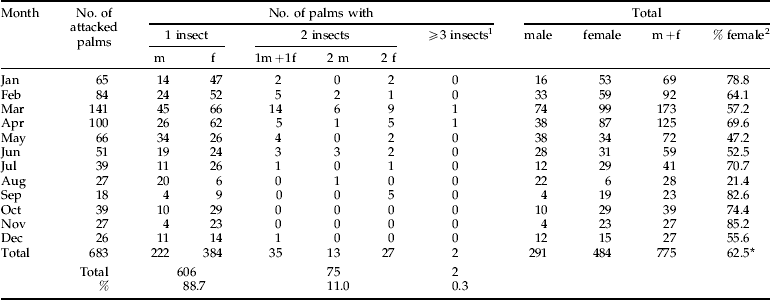
In 2004, 484 females were collected (62.4% out of a total of 775) on coconut palms in plot 050 (table 1). There was a significant female bias in the monthly collections (U=70.0, n=12, P<0.05). Inspection showed that the palms were mostly attacked by a single male or a single female (89%). Two insects (all combinations of sexes) on the same plant were observed in 11% of the checks.
Distribution of O. monoceros on coconut palms attacked in plot P050 (6.5 ha) at Port Bouet village in 2004.

m, male; f, female.
1 March, 1 coconut palm with 3m+1f; April, 1 coconut palm with 5m+10f.
2 Mean sex-ratio of monthly collected beetles is significantly female-biased (Wilcoxon signed-rank test; n=12; *, P=0.017).
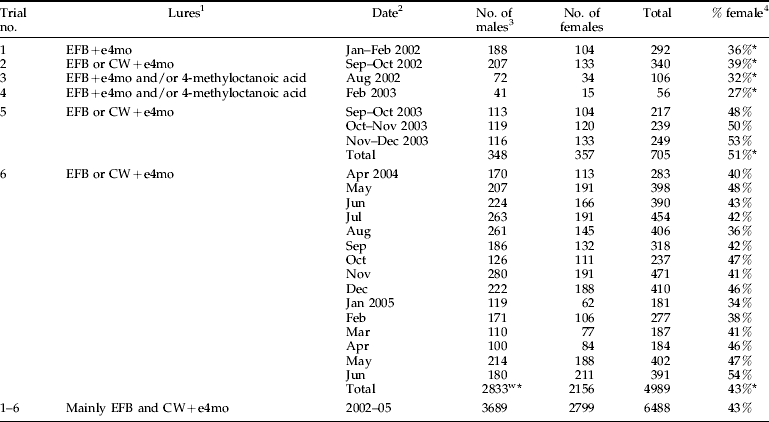
The percentage of females collected during the six pheromone trials, listed in table 2 (Allou et al., Reference Allou, Morin, Kouassi, Hala N'klo and Rochat2006), varied from 27% to 54%. Overall, 2799 of the 6488 trapped beetles (43%) were females. The analysis of the collections in trial six on a monthly basis (total=4989 beetles) showed that the average sex-ratio was biased towards males during 15 months (#: U=5.0, n=15, P<0.01). For all six trapping trials, the sex-ratio of the trapped beetles differed significantly from that of the insects collected in the feeding galleries on coconuts (*: χ2 values ranging from 25.7 to 100.0, 1 df, P<0.001).
Numbers and sex-ratio of O. monoceros collected during six pheromone trapping trials in Dabou (Allou et al., Reference Allou, Morin, Kouassi, Hala N'klo and Rochat2006).

1 CW, split coconut stem wood; e4mo, synthetic aggregation pheromone, ethyl 4-methyloctanoate; EFB, empty oil palm fruit bunches.
2 Captures per line correspond to monthly totals per assay irrespective of the number of traps (see Allou et al., Reference Allou, Morin, Kouassi, Hala N'klo and Rochat2006 for detail).
3 Mean sex-ratio of monthly collected beetles of trial six is significantly male-biased (Wilcoxon signed-rank test; n=15, w*, P=0.002).
4 The percent females in the traps and in the attacked palms (sample described in table 1) differ significantly with *, P<0.001 (Khi2 tests with 1 df).
General organization of the female reproductive system
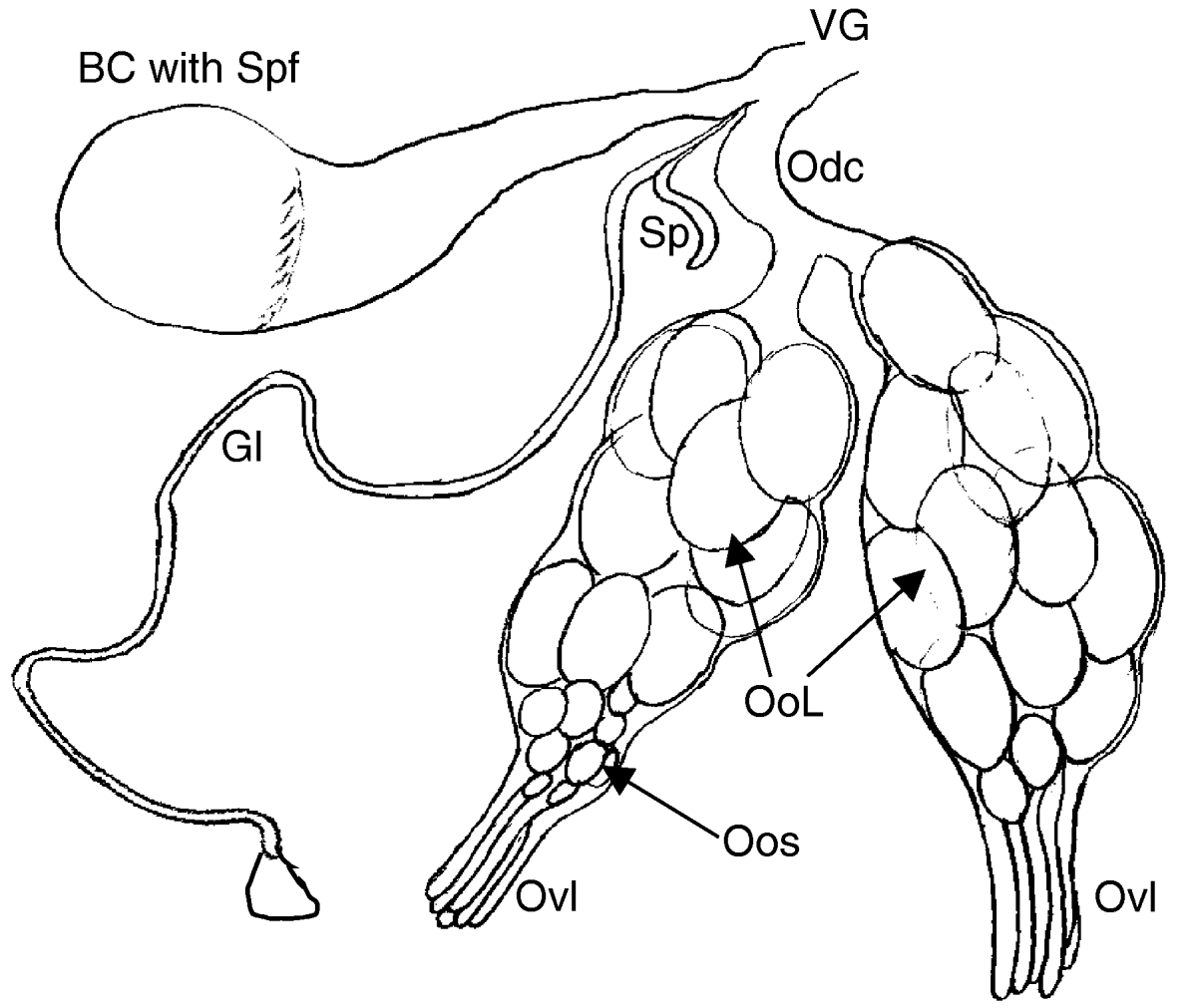
Figure 1 shows the female reproductive apparatus; it consisted of one pair of six ovarioles. In the mature female, many fully developed oocytes (2.5–3 mm) were found in the paired oviducts and the common oviduct, which occupied a large part of the abdomen. The bursa copulatrix was orange in colour and swollen by spermatophores. Near its connection with the vagina, there was the spermatheca and a long accessory gland. In the immature female, the ovarioles were slightly developed with only small oocytes and the bursa copulatrix was flat and contained no spermatophores. Nematodes were very often found in the bursa copulatrix of females. Spermatozoids from the spermatheca, placed in a drop of physiological saline, could be seen easily under the microscope.
Reproductive apparatus of a mature and mated O. monoceros female showing developed ovaries with large oocytes and a bursa copulatrix with a spermatophore.
Legend: BC: bursa copulatrix, Gl: accessory gland, Odc: common oviduct, OoL: large developed oocytes (>2.5 mm), Oos: small oocyte (<1 mm), Ovl: ovarioles, Sp: spermatheca, Spf: spermatophore, and VG: vagina.

Physiological status of females from pheromone traps (table 3)
All females except two (96%) had a bursa copulatrix containing spermatophores, indicating that they had mated. All individuals contained well-developed oocytes and 96% had large oocytes and eggs. The females were, therefore, all sexually mature.
Physiological status of O. monoceros females depending on their origin in the coconut plot with characteristics of the bursa copulatrix and the ovaries.

Proportions between origins are compared by Khi2 tests. Comparisons: s living palms vs. rotting stem; and p living palms vs. pheromone traps. Differences are significant with
*, P<0.05; **, P<0.01; and ***, P<0.001.
Physiological status of females from feeding galleries
Out of 50 females observed, 76% had a bursa copulatrix containing spermatophores and 24% had an empty one. Almost half of the insects (46%) had slightly developed ovaries. The proportion of mated females and of ovarian development differed with females collected from pheromone traps (χ2=8.31, 1 df, P<0.01; and χ2=52.1, 2 df, P<0.01, respectively).
Physiological status of females from rotting coconut stems (reproduction site)
We observed as many mated (52%) as unmated (48%) females based on the content of the bursa copulatrix. Half of the females observed had slightly developed ovaries (56%) and 24% of them contained no oocytes. The proportion of mated individuals and the ovarian development differed with those of females collected from pheromone traps (χ2=6.25, 1 df, P<0.05; and χ2=60.0, 3 df, P<0.001, respectively), and also from those collected from living coconuts (χ2=25.2, 1 df, P<0.001; and χ2=13.8, 3 df, P<0.01, respectively).
Discussion
Our data showed that the beetle populations, which damaged the coconut palms by burrowing feeding galleries and which were collected in pheromone-baited traps, were different regarding the sex-ratio and the sexual maturity of the females. This result confirms that the coconut plots shelter populations with heterogeneous reproductive status, as suggested by several previous studies; larvae develop in rotting stems and other palm debris (reproduction sites) where females mate and lay eggs. The adult is immature on emergence (Hurpin & Fresneau, Reference Hurpin and Fresneau1970) and has to spend 2–3 weeks feeding to mature its muscles and reproductive apparatus. It then passes through reproduction cycles (mating+egg laying at reproduction sites), each likely alternating with feeding periods on fresh palm tissue to complete the oogenesis processes for females (Mariau, Reference Mariau1968).
Living coconut palms were mostly attacked by isolated males or females. This suggests that the beetles came for feeding and not for mating, and agrees with reports of aggregation for mating only in reproduction sites (Lepesme, Reference Lepesme1947). Conversely, male and female Scapanes australis (Boisduval) (another dynastid coconut pest in Papua New Guinea) mate and feed in a gallery burrowed in living palms and only females go to the larval breeding sites (Prior et al., Reference Prior, Morin, Rochat, Beaudoin-Ollivier, Staters, Kakul and Embuba2000). Therefore, there is not a single scheme common to the palm Dynast species for the meeting of the sexes on the host plant, as previously suggested by Rochat et al. (Reference Rochat, Mohammadpoor, Malosse, Avand-Faghih, Lettere, Beauhaire, Morin, Pézier, Renou and Abdollahi2004) for Oryctes elegans Prell, a date palm species. Whether the few cases of several beetles found feeding on one palm were a random event or the expression of a particular suitability of the plants or of the site is not clear, but based on our regional experience, such occurrences are very rare.
On coconut palms, the sex-ratio of beetles was female-biased, whereas it was male-biased for beetles collected in the traps baited with synthetic aggregation pheromone and decaying palm woody material. Thus, beetles responsive to the male aggregation pheromone with decaying palm material were not the same population as those responding to the fresh palm odour. Half the females found feeding in galleries on living coconuts were sexually immature, and even virgin, while such females were rarely found in pheromone-baited traps. This suggests that young females were not responsive to the male aggregation pheromone and to the odour of decaying palm wood. They might also be more receptive to volatile cues from green fresh palm tissues. The female biased sex-ratio in feeding galleries is also consistent with a longer feeding activity due to higher energy requirements for oocyte and egg maturation and subsequent flight to reproduction sites as compared to the males. The latter could find enough food in the reproduction sites where they stay to recruit females by emitting aggregation pheromone. Thus, the male pheromone appears essentially to promote colonization of reproduction sites in females as reported for O. rhinoceros (Morin, Reference Morin2002; Norman & Basri, Reference Norman and Basri2004). As shown by our dissections, most females collected in pheromone-baited traps had fully developed eggs and were likely seeking sites to lay them. A strictly sexual role of this pheromone is not consistent with the male-biased sex-ratio of the pheromone-trapped populations and further investigation must be carried out to clarify this point.
In rotting woody palm material, the larval breeding sites, we found more sexually immature females, which had no doubt just emerged, than in the pheromone traps and the feeding galleries. Thus, O. monoceros females were not sexually mature on emergence as documented for O. rhinoceros (Hinckley, Reference Hinckley1973; Bedford, Reference Bedford1980; Zelazny & Alfiler, Reference Zelazny and Alfiler1987).
Finally, our observations confirm that using synthetic pheromone and rotting plant matter as the co-attractant mimics the beetle's reproduction sites, where males are emitting their pheromone. From a practical point of view, the potential for trapping O. monoceros with the aggregation pheromone is restricted to insects responsive to the male pheromone, which is synergistic with the odour from decaying woody material (Allou et al., Reference Allou, Morin, Kouassi, Hala N'klo and Rochat2006). Trapping as the main method of pest management is worthwhile in an isolated area and/or in old coconut plantings where adult coconut palms can afford one or more gallery that are not fatal to the plant, contrary to young palms, which can be killed by a single attack. Allou et al. (Reference Allou, Morin, Kouassi, Hala N'klo and Rochat2006) showed trapping to efficiently reduce the number of attacks over two to three years in such a situation. However, other trials in replantings in village farming with young coconut palms were not as conclusive (Morin, unpublished data). Unresponsive females, which are either immature or have just laid eggs and which need to feed on fresh palm tissue to initiate a new oogenesis process, cannot be targeted by the pheromone lure. Consequently, trapping can only have a partial effect in reducing damage on young coconut palms depending on the population size and dynamics. It remains important to determine which males are responsive to the pheromone, since this could not be determine using our approach. Laboratory experiments, using an olfactometer with laboratory bred beetles of known age and reproductive status, should provide such information. Finally, it will be also very important to determine which cues are used by insects searching for fresh palm tissue to feed and propose an additional tool, possibly based in part on fresh palm odours, to eliminate or divert them from damaging palms.