Australia, like many other industrialised countries, is concerned about maintaining its place in the world. Its economic development is underpinned by attempts to build a ‘world-class’ education system that produces results among the best in the world (Australian Curriculum Assessment and Reporting Authority, 2012). There have recently been concerns that Australia's standing among developed nations is slipping and that outcomes represented in standardised tests are not keeping pace, particularly with emerging economies in Asia (Jensen, Reference Jensen2012). One reason for this slippage is the relatively ‘low performance’ (Thomson, Bortoli, Nicholas, Hillman, K., & Buckley, Reference Thomson, Bortoli, Nicholas, Hillman and Buckley2011, p. 299) and ‘poor results’ (Johns, Reference Johns2006, p. 9) from Aboriginal and Torres Strait Islander students, and more particularly those from remote geographical locations across the nation.
While there is much discussion in Australia about the appropriateness of educational tests such as the National Action Plan—Literacy and Numeracy (NAPLAN) and other measures that are used to indicate educational success and failure, one cannot help but be shocked by the apparent difference in the measures of success between non-Indigenous Australians and others. On the surface, it would seem that the word ‘disadvantage’ properly describes what appears in the comparative statistics. Indeed, this word is used both to describe the disparity between indicators of success and to describe the consequent policy response — ‘overcoming disadvantage’. The disparity, sometimes referred to as ‘the gap’, needs to be closed in order to overcome the disadvantage.
The basis of the discourse of disadvantage is largely the empirical evidence. That is, regular data collections such as school-based tests, Census data, measures of progress and an array of other measures, confirm that on a range of measures Aboriginal and Torres Strait Islander students are failing. ‘They’ fail more in very remote contexts than they do in urban or regional contexts. Further, on some measures the ‘gap’ is widening, despite the effort put into closing it. While the discourse is not unique to the remote context (Vass, Reference Vass2012), it is amplified in remote Australia. This article then is not concerned about the discourse of ‘Indigenous disadvantage’ across Australia. Rather, the focus is on the context of very remote Australia — a context quite different to that of urban and regional communities.
The education system in Australia is complex. It contains an array of actors (state, federal, independent, community-based) and elements which, by and large, work together to support a set of prescribed outcomes. Increasingly, the system is becoming nationalised, with national approaches to testing, professional standards for teachers and curriculum. Seldom is the system itself interrogated or tested to see whether it works. It is a given. But what if the education system was itself flawed in its response to remote Aboriginal and Torres Strait Islander students and their families (Ford, Reference Ford2012)? What if the desirable outcomes of education in remote Australia — particularly in the remote communities where Aboriginal and Torres Strait Islander people live — were different than those that are desirable elsewhere? What if the underpinning assumptions about curriculum, pedagogy and professional standards were somehow wrong?
This article was prompted by research being conducted by the Cooperative Research Centre for Remote Economic Participation in its Remote Education Systems project. The authors are in the early stages of data collection, working across a number of sites in remote parts of South Australia, Western Australia and the Northern Territory. The focus of the research is on how to improve educational outcomes for remote Aboriginal and Torres Strait Islander people. It is within this context that we have been confronted by a prevailing discourse that on the one hand provides a long list of problems and issues framed around the deficits and disadvantages associated with remote education and, on the other, is short on solutions. Some may argue that this paper tells researchers and educators what is already known. However, we suggest that the binaries of disadvantage and advantage, and success and failure are not the best way to understand what is happening in remote education, nor how to address the issues. In this light, we wish to bring thinking back to the ‘red dirt’ of remote Australia. We do not wish to constrain the possibilities for innovation, but we want to ensure that with innovation we are not just recreating a new version of the old system, which perpetuates and exacerbates the unhelpful rhetoric of disadvantage and failure.
In the end, the aim of the article is to develop a frame of reference that is based outside the education system by providing a theoretical and philosophical exploration of why the education system promotes particular measures of success and advantage. This will help the reader to understand why the discourse of disadvantage as it relates to remote Aboriginal and Torres Strait Islanders, prevails. It will hopefully also prompt an examination of what a new discourse that promotes advantage for those living in remote communities of Australia, might sound like.
The Discourse of Remote Aboriginal and Torres Strait Islander Educational Disadvantage
One of the predominant themes that pervades much of the literature on remote education is one about Aboriginal and Torres Strait Islander ‘disadvantage’. The intent of the word is perhaps to convey a sense of the ‘disparity’ (Bath, Reference Bath2011) between Aboriginal and Torres Strait Islander and non-Indigenous people on a range of indicators (see, e.g., Steering Committee for the Review of Government Service Provision, 2011a). It has been defined specifically as ‘The difference (or gap) in outcomes for Indigenous Australians when compared with non-Indigenous Australians’ (Steering Committee for the Review of Government Service Provision, 2012, p. xiv). The concept then extends to ‘closing the gap’ (Council of Australian Governments, 2009) in a general sense and in a more specific educational context (What Works: The Work Program, 2012).
There can and should be no denial of the data and their practical consequences that are behind these labels, but there are problems with the pervasive rhetoric of disadvantage. First, there is a real risk that being Aboriginal or Torres Strait Islander is the disadvantage, in effect ‘cultural dysfunction’ (Cowlishaw, Reference Cowlishaw2012, p. 412). Second, the deficit discourse is most frequently based on non-Indigenous understandings of advantage, and developing a sense of the ‘Aboriginal problem’ (Gorringe, Reference Gorringe2011). Third, the racialised nature of disadvantage may lead to a promulgation of responses that lead to ‘exceptionalism’ of Aboriginal and Torres Strait Islander people on the basis of race (Langton, Reference Langton2012) — that is, an exceptionalist view that comes with race categorisations segregates and therefore discriminates against Aboriginal and Torres Strait Islander peoples. Fourth, the disadvantage discourse may idealise the interests of the privileged, reinforcing a hegemony that in turn reinforces existing power dynamics in society and results in ‘self-fulfilling prophecies’ of the disadvantaged (Orlowski, Reference Orlowski2011, p. 43).
Furthermore, the stereotyping of Aboriginal and Torres Strait Islander peoples as a homogenous ‘Indigenous’ population, rather than a diverse mix of peoples (see Rowse, Reference Rowse2012) tends to result in false binaries along racial lines: Indigenous versus non-Indigenous. In the process, indicators used to describe culture end up describing disparity rather than aspects that are considered of value within the culture being described (Rowse, Reference Rowse, Altman and Hinkson2010). There are several ways these false binaries are perpetuated with data. In the next section we consider a selection of ways that data and indicators are used to reinforce gap talk that does not recognise the worth and value of remote community life.
The Data Used to Support the Discourse
For the purposes of illustration, we have chosen to present three of the many data sources that are used to support the discourse of disadvantage. There are, of course, many more data sets — qualitative and quantitative — that would point to similar conclusions.
Overcoming Indigenous Disadvantage
The Overcoming Indigenous Disadvantage Report (Steering Committee for the Review of Government Service Provision, 2011a) points to a number of key indicators that represent the ‘gap’. These are:
• lower school attendance and enrolment rates;
• poorer teacher quality;
• a lack of Indigenous Cultural Studies in school curricula;
• low levels of Year 9 attainment;
• low levels of Year 10 attainment; and
• difficulties in the transition from school to work.
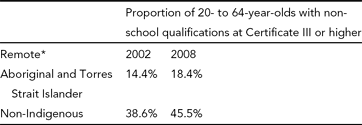
The Overcoming Indigenous Disadvantage Report, while not singularly focused on remote disadvantage, highlights the larger gap for remote Aboriginal and Torres Strait Islander peoples. Further, it makes links from education to other areas of disadvantage: health, employment, early childhood development, and the home environment. The report paints what could be described as a very sad picture of the Aboriginal and Torres Strait Islander population. This picture on the whole does not appear to be significantly improving over time (with the notable exceptions of mortality rates, home ownership, post-secondary outcomes, employment and income). Again, the data should not be dismissed. They do have utility in providing population measures, and therefore allow for strategic policy responses to particular issues. Table 1 presents data from the appendices of the report in relation to post-school qualifications. Here we see a gap of 24.2 percentage points in 2002 and 27.1 percentage points in 2008. The gap has widened.
Changes in Proportion of 20- to 64-Year-Olds With Non-School Qualifications at Certificate III or Above
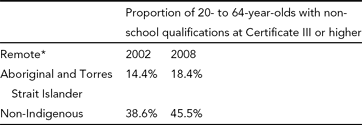
Note: * does not include very remote as they were not shown for non-Indigenous population.
Source: Steering Committee for the Review of Government Service Provision (2011b), Table 4A.7.4.
NAPLAN Data
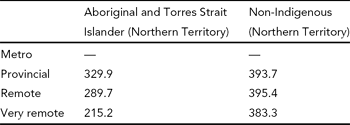
The relative disparity between Aboriginal and Torres Strait Islander students and non-Indigenous students is demonstrated by the following excerpt from the 2011 National Report on NAPLAN (Table 2). The excerpt from the Northern Territory shows that while for the non-Indigenous student population the Year 3 persuasive writing results are fairly consistent across geolocations (from provincial to very remote), there is a sharp decline in the results for Aboriginal and Torres Strait Islander students. The difference in scores increases from 63.8 points at the provincial level through to 168.1 points at the very remote level.
Excerpts from the 2011 National Report on NAPLAN, Year 3 Persuasive Writing, by Geolocation, State and Territory
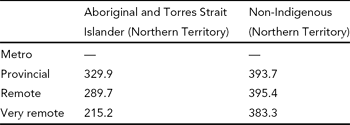
Source: Australian Curriculum Assessment and Reporting Authority, 2011, pp. 18–19.
A range of other data sources could be drawn on (such as ABS Census and survey data) to present a similar picture of disparity and disadvantage. Both NAPLAN and Overcoming Indigenous Disadvantage data are frequently used to highlight disparity. But are there other measures that focus on strengths? The Australian Bureau of Statistics’ Measures of Australia's Progress potentially offers a different way of demonstrating growth.
Measuring Australia's Progress
The recently released Measures of Australia's Progress (MAP) consultation paper (ABS, 2012a) acknowledges the significance of the rights of Indigenous peoples globally and the importance of taking these into account at a national level when considering Australians’ aspirations. It also acknowledges issues of reconciliation, issues of disparity in terms of opportunity, and the importance of equity and culture. It makes no attempt to distinguish Aboriginal and Torres Strait Islander aspirations from those of other Australians, which could be taken to mean that they are homogenous. However, it does attempt to identify issues of concern for Aboriginal and Torres Strait Islander peoples under thematic headings. The progress framework itself recognises diversity without following the pattern of other indicator frameworks that appear to focus on ‘gaps’ and disparities. Nevertheless, the notion of ‘progress’ and aspiration as they are presented in the consultation and the existing headline indicators (ABS, 2012b), continue to support the discourse by using lenses that assume uniformity and homogeneity of aspirations and outcomes across the nation.
There should be no doubt that Aboriginal and Torres Strait Islander peoples are in many ways different from other population groups and peoples in Australia — and the differences are perhaps more obvious in very remote communities. There is no single indicator that captures the breadth of aspirations of the nation as a whole, despite the attempts of the MAP process to do so. Difference and diversity can be celebrated. However, seldom is the richness and diversity of life in remote communities discussed in the media, let alone the literature. Nor are the learning journeys of many remote Aboriginal and Torres Strait Islanders often celebrated. An alternative rhetoric is emerging from Aboriginal and Torres Strait Islander authors, who allow those of us who are non-Indigenous to take a step back from our otherwise uncontested philosophical positions and reflect on difference in terms of epistemologies, axiologies, ontologies and cosmologies (see, e.g., Arbon, Reference Arbon2008; Ford, Reference Ford2010; Martin, Reference Martin2003; Nakata, Reference Nakata2008; Rigney, Reference Rigney1999). These philosophical positions have the potential to help policy-makers and educators move to an alternate position that articulates success in a different way. It is not the intention here to tease out these positions — they speak for themselves. However, it may be helpful to articulate the complex array of philosophies and theories (albeit briefly) to shed light on why discourse is the way it is.
What is Behind the Discourse and Data?
What then is behind the rhetoric associated with the discourse? It is argued here that the basis of the rhetoric derives from a set of assumptions about the theoretical and philosophical foundations of education — and acceptance or rejection of philosophical positions. These ideas are contested, and while some brief overview of some theoretical and philosophical perspectives are given, it is not the intention here to argue that there are unifying strands of philosophy or sociology that provide a singular basis for the education system in Australia as it is today. The education system is complex and draws on a range of foundations. Nevertheless, an increasingly nationalised system reflected in Council of Australian Government agreements (Standing Council on Federal Financial Relations, 2012; Standing Council on Federal Financial Relations, 2013) national declarations such as the 2008 Melbourne Declaration (Ministerial Council on Education, 2008), a National Curriculum (Australian Curriculum Assessment and Reporting Authority, 2012) and national professional standards for teaching (Australian Institute for Teaching and School Leadership, 2011) may tend to homogenise the complexity — or at least attempt to.
The Discourse of Education and Individualism
Pring (Reference Pring, Bailey, McCarthy, Carr and Barrow2010) argues that the language associated with education and its aims is often unhelpful. He describes an ‘educated person’ in terms of intellectual development, practical capability, community participation, moral seriousness, pursuit of excellence, self-awareness and social justice. By contrast, the rhetoric around quality education is often discussed in terms of a narrow frame of reference which sees the purpose of education largely prescribed by an individual's ability to live independently (i.e., in financial self-sufficiency through paid employment) and to a lesser extent by conforming to the social norms and expectations of the nation. The focus on individualism has its roots in ancient Greek philosophy and perhaps more so in Enlightenment philosophers such as Kant and Rousseau, who emphasise individual autonomy and individual freedom (for a discussion of the historical development of philosophies of education see Carr, Reference Carr, Bailey, McCarthy, Carr and Barrow2010). The argument of liberalist education philosophers suggests that ‘schools should encourage competition between individual students and prepare students to live independent lives in society, respecting their uniqueness and distinct capabilities’ (Portelli & Menashy, Reference Portelli, Menashy, Bailey, McCarthy, Carr and Barrow2010, p. 421). Individualism is also reflected in the economic theories of Adam Smith (Reference Smith1904), which is reflected in what could be described as free market capitalism.
Discourse of Education and Social Theories
A range of other philosophical theories also underpin our current education systems. John Dewey saw the purpose of education as an end in itself, for ‘growth’ (Noddings, Reference Noddings2012, p. 39). While this is to some extent an individualistic process, Dewey (Reference Dewey1938) does acknowledge the need for mechanisms of ‘social control’ in education, though he tends to view these as ‘indirect . . . not direct or personal . . . not external and coercive’ (Dewey, Reference Dewey1966, p. 39). George Counts, a follower of Dewey's, was concerned that individualism did not allow for moral and social formation, and education inevitably involved some elements of imposition or influence and that education itself needed to promote a ‘theory of social welfare’ (Counts, Reference Counts1932). A more intentional theory of social transformation is proposed by Friere (Reference Friere1970), but not from the structures in which power resides. Rather he saw education as a transformative process in which: ‘The revolutionary effort to transform these structures radically cannot designate its leaders as thinkers and the oppressed as doers’ (p. 107).
The field of the sociology of education is somewhat more recent than the fields of educational psychology or philosophy. One of the earliest scholars in this field, James Coleman, conducted the first major study of sociology in education with his 1966 Equality of Educational Opportunity project, which resulted in significant findings about school resourcing and desegregation in American schools. In terms of the latter, he found that minority students benefited from attending high schools with white students (Schneider, Reference Schneider and Hallinan2000). However, perhaps his greatest contribution to the field was his Foundations of Social Theory (Coleman, Reference Coleman1990) in which he described what he called the development of ‘social capital’. His discussion about the development of norms is particularly relevant. He suggests that those who lay claim to a norm — ‘beneficiaries’ — can legitimately impose sanctions on those who do not necessarily hold the norm — ‘targets’. Inevitably, the target will consider the consequences of the sanction when deciding whether to comply or not. He also suggests that the stronger the social ties, the greater the social capital, and concomitantly, the greater the trust between the various actors. Social capital fosters normative behaviour ‘that enhances the productivity of the system. This is accomplished through the fulfilment of expected obligations that are reciprocal and that engender trust’ (Schneider, Reference Schneider and Hallinan2000, p. 377).
The Development Discourse and Education
The international discourse around education and development suggests strongly that better education leads to increased levels of development (Hanushek & Woessmann, Reference Hanushek and Woessmann2007; Keeley, Reference Keeley2007; OECD, 2012a). The empirical evidence that education and learning is related to a range of benefits including social equity (Field, Kuczera, & Pont, Reference Field, Kuczera and Pont2007; OECD, 2012b), health (Ross & Mirowsky, Reference Ross, Mirowsky, Bird, Conrad, Fremont and Timmermans2010), justice and criminal behaviour (Lochner, Reference Lochner, Hanushek, Machin and Woessmann2011; Machin, Marie, & Vuji, Reference Machin, Marie and Vujić2011), employment, economic and developmental (Hanushek & Woessmann, Reference Hanushek and Woessmann2009; OECD, 2012a), and family and individual outcomes (Schuller, Preston, Hammond, & Bynner, Reference Schuller, Preston, Hammond and Bynner2004) is readily available in an array of literature. Economists Oreopoulos and Sylvanes (Reference Oreopoulos and Salvanes2011) identify a range of what they term ‘non-pecuniary’ benefits of schooling:
Schooling generates occupational prestige. It reduces the chance of ending up on welfare or unemployed. It improves success in the labor market and the marriage market. Better decision-making skills learned in school also lead to better health, happier marriages, and more successful children. Schooling also encourages patience and long-term thinking. Teen fertility, criminal activity, and other risky behaviors decrease with it. Schooling promotes trust and civic participation. It teaches students how to enjoy a good book and manage money. (pp. 179–180)
The hope of education is that it leads to a better life, particularly for those living on the margins of society. Leadbeater (Reference Leadbeater2012, p. 23) suggests that education ‘offers them a hope that their place in society will not be fixed by the place they were born’ and that through education people can ‘remake their lives’.
Because it provides knowledge and skills, encourages new behaviour and increases individual and collective empowerment, education is at the centre of social and economic development. (UNICEF, Save the Children (UK), & State of Qatar, 2010)
However, there is some debate about the causal relationship between development and education (which drives which?). The risk, according to educational sociologists Chabbott and Ramirez (Reference Chabbott, Ramirez and Hallinan2000) is that international blueprints for education and development tend to lead to a ‘loose coupling between policies and practices and practices out of sync with local realities’ (p. 183).
The Knowledge and Skills Discourse
Modern education systems are built on transfers of knowledge from teachers to students. That is, students go from a position of not knowing, to knowing; from not having skills, to having skills. The various educational theorists (such as Vygotsky, Piaget, Erikson, Montessori and Dewey) each present different ways that this knowledge is acquired by children and throughout life (see Mooney, Reference Mooney2000). The purpose here is not to discuss the various theories of learning. Rather, the aim is to assert a view that for educators it is reasonable to expect that it is ‘possible, and desirable for people to know and do things, and to engage in and take seriously the fruits of rational inquiry, where such inquiry is understood to involve the pursuit of truth’ (Siegel, Reference Siegel, Bailey, McCarthy, Carr and Barrow2010, p. 283). This assertion, coming from a philosopher of epistemology, raises more questions than it answers. While defending this proposition, Siegel acknowledges the contentious nature of knowledge, rational enquiry and truth.
However, when we consider curricula and the apparently universalist approaches to knowledge transfer, built on the foundations of literacy, numeracy and the sciences, we are led to ask whose knowledge is given privilege, whose logic is applied to rational inquiry, and whose truth is assumed. Carr (Reference Carr and Siegel2009) suggests that there are no objective epistemic grounds on which to base curriculum. Rather, there is ‘nothing but competing political arguments’ (p. 297) which determine the value of knowledge.
The work of de Leo (Reference de Leo2012) sheds light on the priorities of the Australian National Curriculum in the light of historical international documents that define the basis of education systems. Her analysis shows that in Australia, the references to values in education that are reflected in the international documents, such as equality, responsibility, democracy, participation, dignity, freedom, security and peace (de Leo, Reference de Leo2012, p. 85), are virtually absent in the Australian National Curriculum. De Leo argues that the ‘integration of values in the curriculum also contributes significantly to the personal, psycho-social, spiritual and emotional development of the whole learner’ (p. 220). De Leo's work sheds light on the otherwise hidden assumptions that underpin the Australian education system.
Knowing these political and ideological positions allows us to critically reflect on the various ontologies, cosmologies and axiologies that are applied to our epistemologies and pedagogies. The philosophical foundations of the Australian education system as it is now have been shaped by Greek philosophers such as Socrates, Plato and Aristotle, by Rousseau from the Enlightenment period, and in the 20th century, by Dewey (see summaries in Johnston, Reference Johnston, Bailey, McCarthy, Carr and Barrow2010; Noddings, Reference Noddings2012). These philosophers (among others) bring a history of western thought to contemporary education, and their influence in schooling and teaching is undeniable.
A number of contemporary Aboriginal and Torres Strait Islander academics are challenging the unquestioned philosophical assumptions of the mainstream and presenting alternative ways of being, thinking, believing and valuing to education and learning (see, e.g., Arbon, Reference Arbon2008; Ford, Reference Ford2010; Martin, Reference Martin2008; Nakata, Reference Nakata2008; Nakata, Nakata, Keech, & Bolt, Reference Nakata, Nakata, Keech and Bolt2012; Yunkaporta & McGinty Reference Yunkaporta and McGinty2009). They allow us to step back from our sometimes uncontested assumptions and think differently about what an advantaged education might look like in Aboriginal and Torres Strait Islander contexts, particularly in and for remote communities.
Where Then Does Advantage Lie in Education?
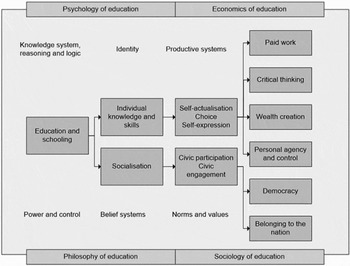
While there may be debate about the finer points, the foregoing discussion presents a number of theoretical bases from which the Australian education system draws. These theoretical and philosophical bases offer a lens through which we may view advantage in education. Figure 1 attempts (perhaps imperfectly) to represent the Australian education system bounded by these theoretical and philosophical ways of viewing the world. In reality, there are variations on the schema presented, with different education sectors in Australia aligning more or less with the system elements proposed. The education system is one of many systems that operate within these boundaries. Other systems cut across or influence the education system generally in ways that are mutually supportive. For example, systems of power and control, already embedded in the democratic political and economic structures of the nation, govern to a large extent how education plays out in terms of its defined measures of success and anticipated outcomes. We accept that this way of constructing advantage in education can be contested.
A frame of reference for advantage in the Australian education system.

However, if this is a reasonable representation of the education system, it follows that those who are able to align their identities, values, beliefs and ways of knowing to this education system will be more likely to succeed and thrive because of the system — and produce the expected outcomes of education, which Figure 1 describes, in terms of paid work, critical thinking, wealth creation, personal agency and control, democracy and belonging to the nation. It is therefore proposed here that those who are unable for whatever reason to align their identities, values, beliefs and ways of knowing to this system are less likely to succeed.
The measures of advantage are aligned to the logic of the system. For example the measures of success for students in this system include:
• transitions to employment (high achievement is rewarded with better paid work);
• further and higher education transitions (high achievement in literacy and numeracy unlocks the world of critical thinking);
• occupational destination and status (increased status yields greater individual wealth);
• career choice (the broader the range of choices the greater the apparent personal agency); and
• progress and aspiration (a better education leads to societal and national progress).
If the above are indicators of advantage, the converse of the above is logically an indication of disadvantage. For example, disadvantage in Australia would be represented by:
• higher levels of unemployment;
• low achievement in English language literacy and numeracy
• low levels of wealth;
• higher levels of welfare dependence;
• social marginalisation; and
• disengagement from the democratic process.
This is then how the discourse of disadvantage perpetuates itself. The logic behind the discourse is in some ways circular. You are educationally disadvantaged because your ways of being, valuing, believing and knowing do not align with the prescribed system requirements. Any attempt to live outside this system is not recognised as advantageous because there is only one education system that produces advantage. Our argument is that if a different logic and philosophical basis were applied, then the suggestion that Aboriginal and Torres Strait Islander students are ‘behind’ could well be challenged.
An Alternative Discourse of Success in Remote Learning
Imagine for a moment then, what an alternative universe might look like where the schema presented in Figure 1 was an option rather than a given. Would it look any different if it was planned to work for a remote Australian context?
What would happen, for example, if we underpinned our new system with Aboriginal and Torres Strait Islander philosophies? What would happen if we incorporated into our system a new set of norms and values, identities and knowledge systems? What would happen if we built into our new curriculum a set of values that reflected internationally recognised expectations of equality, responsibility, participation, cooperation, dignity, freedom, security, peace, protection (conservation), respect, dialogue, integrity, diversity, tolerance, justice and solidarity (de Leo, Reference de Leo2012, Appendix 18)?
Would the strong focus on individual learning be replaced by a cooperative approach? Would the process of education lead to self-actualisation or an alternative standard based on a different hierarchy of needs? Would civic participation be replaced by something completely different? Would the education system start with the premise of schooling or some other teaching and learning structure?
In Australia, there has been a vigorous debate about bilingual and two-way learning approaches (see, e.g., Devlin, Reference Devlin, Purdie, Milgate and Bell2011) but Standard Australian English remains the primary language of teachers and teaching in most remote communities across Australia (Grote & Rochecouste, Reference Grote, Rochecouste, Beresford, Partington and Gower2012). What would happen if English were taught as a second language in remote schools (like Japanese and French are taught as second languages in other schools)? What difference would a recognition of the distinctions between Aboriginal English and Standard Australian English make?
What would happen if the outcomes of education were reshaped to better suit the needs of people living in remote communities? Would the list include those suggested in Figure 1, and if they were included, would they be redefined? Without wanting to pre-empt the array of possible answers, maybe the list would include emphases that redefined the nature of work; that allowed for remote problem-solving skills; that targeted the ability to live in two worlds; that recognised the importance of maintaining and strengthening culture; or that focused on belonging to country?
We raise these questions to prompt the beginnings of a new discourse of success in remote learning. Rather than focus on what needs to be fixed either in the system or fixed in the community, we would like to promote a discussion that considers first how success might be reimagined, and second, how a system might be reshaped, based on an alternative set of paradigms. The discourse will be one of advantage rather than disadvantage. Our research methodology is focused on bringing forward the voices of Aboriginal and Torres Strait Islander peoples in remote communities. The kinds of questions raised above are the kinds of questions we are seeking answers to.
Conclusions
Statistics, indicators of success and measures of progress tell a useful story. In educational terms, they tell us whether we are passing or failing. However, they do so based on a set of assumptions that are mostly unquestioned and mostly unstated. The data presented earlier in this article presents pictures of failure for remote Aboriginal and Torres Strait Islander students and families — poor school performance, poor post-school outcomes and widening ‘gaps’.
The article has attempted to provide a rationale for the discourse of disadvantage in remote Aboriginal and Torres Strait Islander education. It has done so by examining some illustrative examples of the philosophical and theoretical foundations of the current education system in Australia, drawing on the literature of the philosophy of education, the sociology of education and the psychology of education. From these sources we have shown that purpose and outcomes of education in Australia are underpinned by a set of foundational assumptions that are largely hidden from view in the disadvantage discourse itself, but which strongly influence it. The assumptions reveal that the presence of particular system elements and prescribed system outcomes related to work, wealth, critical thinking, personal agency and control as well as democracy and belonging to the nation, frame the indicators and therefore the rhetoric of educational advantage. The absence of these system elements and outcomes is therefore reflected in the discourse of disadvantage.
To better reflect the philosophical and theoretical assumptions that underpin an advantageous education for remote Aboriginal and Torres Strait Islander students and their families, we propose that there must be an alternative set of elements and outcomes. We cannot at this point of our research say precisely what they may be, but once we learn what they are, the education system will be in a better position to respond to the needs of those living in remote communities. Further, the various actors in the system should be able to reframe their rhetoric towards one of advantage rather than disadvantage.
But perhaps these questions remain: What levers can we use to influence the system accordingly and ultimately will the system be able to respond? While on the one hand it is perhaps useful to promote lofty and laudable ideas (which could be described as ‘blue sky’ thinking), we are particularly concerned to produce findings that are grounded in the reality of our context — hence the notion of ‘red dirt thinking’. To this end we are proposing that elements of the educational system can and should be redefined in ways that reflect the strengths and aspirations of remote community life. We do, however, invite critique and feedback from interested remote education stakeholders.
Acknowledgments
The work reported in this publication was supported by funding from the Australian Government Cooperative Research Centres Program through the Cooperative Research Centre for Remote Economic Participation (CRC-REP). The views expressed herein do not necessarily represent the views of the CRC-REP or Ninti One Limited or its participants. Errors or omissions remain with the author.
About the Authors
John Guenther (Guest Co-Editor of this issue) is the Principal Research Leader for the Remote Education Systems project with the Cooperative Research Centre for Remote Economic Participation and Flinders University. John has worked as a researcher and evaluator in remote Australian contexts — particularly the Northern Territory — for the past 10 years on issues related to education, training, families and children, justice, child protection and domestic violence. His current role is focused on understanding how education systems can better respond to the needs of students and families living in very remote Aboriginal and Torres Strait Islander communities. Beyond this, the Remote Education Systems project is looking for innovative models of schooling, teaching and learning that improve livelihood opportunities for students from remote communities.
Melodie Bat (Guest Co-Editor of this issue) is currently working as an education consultant in her business, Pracademic Solutions. Melodie has been working in Indigenous education for two decades, beginning her career as a remote teacher in the Northern Territory. Her own learning journey has led her through a career that has spanned teaching, project management, leadership and research across the many sectors and spaces of Indigenous education, always with a focus on working towards a more equitable education system.
Sam Osborne is a Senior Research Fellow at the University of South Australia and is undertaking a PhD through Victoria University. He has worked in Aboriginal Education since 1995 across urban and remote contexts in a range of roles including primary and secondary teaching, Pitjantjatjara language teacher and Deputy Principal and Principal in Ernabella in the remote north west of South Australia. He has worked as a Central Australian consultant on the Principals Australia Institute Dare to Lead project and continues a range of roles in research and Pitjantjatjara language interpreting across remote communities in South Australia, Western Australia and the Northern Territory.