INTRODUCTION
The mental state of cancer patients has received much attention in recent years due to the progress of psycho-oncology and supportive care. Numerous studies have found that cancer has a widespread impact on patients, in terms of general psychiatric symptomatology (e.g., depression), psychological distress, or impaired quality of life (Mermelstein & Lesko, Reference Mermelstein and Lesko1992; Montgomery et al., Reference Montgomery, Pocock and Titley2002; Mitchell et al., Reference Mitchell, Vahabzadeh and Magruder2011). Previous research has also shown that the meaning-making process, or finding meaning in life, is associated with emotional well-being, coping strategies, and adjustment in cancer survivors (Jim et al., Reference Jim, Richardson and Golden-Kreutz2006; Chan et al., Reference Chan, Ho and Chan2007).
Demoralization, defined as a persistent inability to cope, combined with associated feelings of helplessness, hopelessness, meaninglessness, subjective incompetence, and diminished self-esteem, is one of the major indicators for maladjustment in the field of psycho-oncology (Kissane et al., Reference Kissane, Clarke and Street2001; Clarke & Kissane, Reference Clarke and Kissane2002; Cockram et al., Reference Cockram, Doros and de Figueiredo2009; Mehnert et al., Reference Mehnert, Vehling and Hocker2011; Lee et al., Reference Lee, Fang and Yang2012). Notably, and contrary to expectations, both positive and negative psychological processes have frequently been reported following a cancer diagnosis. For instance, posttraumatic growth, which is the positive change that emerges after struggling with highly challenging life crises, has been repeatedly observed in cancer patients (Cordova et al., Reference Cordova, Cunningham and Carlson2001; Ho et al., Reference Ho, Chan and Ho2004; Tedeschi & Calhoun, Reference Tedeschi and Calhoun2004; Schroevers & Teo, Reference Schroevers and Teo2008; Park et al., Reference Park, Chmielewski and Blank2010).
Although demoralization and posttraumatic growth are both crucial to understanding a patient's adjustment to cancer, little attention has been given to the associations between these two processes. More importantly, previous studies have discovered many predictors of posttraumatic growth or demoralization. Meaninglessness is a core factor of demoralization (Clarke & Kissane, Reference Clarke and Kissane2002; Kissane et al., Reference Kissane, Wein and Love2004), and a sense of global meaning can protect against demoralization and depression in cancer patients (Vehling et al., Reference Vehling, Lehmann and Oechsle2012). In addition, cancer survivors' efforts at meaning-making may influence the extent to which they successfully achieve posttraumatic growth (Park et al., Reference Park, Edmondson and Fenster2008). In light of these findings, we hypothesized that meaning-making plays an important role in demoralization and posttraumatic growth.
The assessment of meaning-making in our study focused on two major construals of meaning—sense-making and benefit-finding—the paradigm commonly used in loss and grief studies (Davis et al., Reference Davis, Nolen-Hoeksema and Larson1998; Holland et al., Reference Holland, Currier and Neimeyer2006). Broadly speaking, loss can comprise a welter of human experiences, such as bereavement, natural disaster experiences, job loss, aging, and physical illness (Harvey, Reference Harvey2002). Suffering from cancer could be interpreted as a loss of health, of one's previous lifestyle, destruction of personal identity, or dashing of hope. Thus, the theoretical grief model is an adequate framework within which to study demoralization and posttraumatic growth in cancer patients.
Posttraumatic growth has been a crucial issue in the field of oncology over the last few decades, and the Posttraumatic Growth Inventory (PTGI) (Tedeschi & Calhoun, 1996) is the most widely used assessment instrument (Ho et al., Reference Ho, Chan and Ho2004; Jaarsma et al., Reference Jaarsma, Pool and Sanderman2006; Schroevers & Teo, Reference Schroevers and Teo2008; Brunet et al., Reference Brunet, McDonough and Hadd2010; Smith et al., Reference Smith, Samsa and Ganz2014). It includes five factors: relating to others, appreciation of life, personal strength, new possibilities, and spiritual change.
Ho and colleagues (Reference Ho, Chan and Ho2004) suggested that there may be cultural differences in posttraumatic growth between Eastern and Western cancer patients. By using a sample of Chinese cancer patients in Hong Kong, their confirmatory factor analyses suggested a different factor structure than that obtained by the original 21-item English-language version. Specifically, the dimension of posttraumatic growth in the Chinese sample could be characterized as a four-factor model (self, spiritual, life orientation, and interpersonal), which could also be broadly dichotomized into interpersonal and intrapersonal (a second-order factor onto which self, spiritual, and life orientation are loaded) dimensions. Given the findings of the confirmatory factor analysis, Ho et al. (Reference Ho, Chan and Ho2004) developed a 15-item revised version of the CPTGI. One of the aims of our study was to examine which model the data fitted better using confirmatory factor analysis, which led us to the decision to use either PTGI or CPTGI scores as indicators of posttraumatic growth.
Demoralization is also commonly seen among the medically and psychiatrically ill. Patients need to maintain meaning-based coping during serious illnesses that challenge their assumptive world or personal meaning in order to maintain hope and bear up under stress (Park & Folkman, Reference Park and Folkman1997; Folkman & Greer, Reference Folkman and Greer2000). When the maladjustment of cancer patients in particular situations extends to general situations, they are likely to experience demoralization, including existential despair, hopelessness, helplessness, and loss of meaning and purpose in life (Clarke & Kissane, Reference Clarke and Kissane2002).
While demoralization and depression share the symptom of distress, they are differentiated by the fact that demoralization is associated with subjective incompetence, and anhedonia is symptomatic of depression. Demoralization can occur among cancer patients, regardless of whether they are depressed or not, and it serves as a better predictor of suicide ideation or as a useful screening criterion for clinical intervention (Cockram et al., Reference Cockram, Doros and de Figueiredo2009; Kissane et al., Reference Kissane, Clarke and Street2001; Kissane, Reference Kissane2004).
Demoralization and posttraumatic growth are both important processes witnessed in cancer patients. Several researchers posit that the occurrence of a highly stressful or traumatic event challenges one's basic assumptions or meaning structures about oneself and the world. This, in turn, may drive meaning-making or cognitive processing to reconstruct affected beliefs or meaning, thereby resulting in the perception that one has grown or achieved better adjustment (Taylor, Reference Taylor1983; Janoff-Bulman, Reference Janoff-Bulman2004; Tedeschi & Calhoun, Reference Tedeschi and Calhoun2004).
Davis and colleagues (Reference Davis, Nolen-Hoeksema and Larson1998) differentiated two major construals of meaning: (1) making sense of the event and (2) finding benefit in the experience. Sense-making denotes the comprehensibility of the loss or the bereaved person's capacity to find some sort of benign explanation for the suffering experience, which is usually constructed in spiritual or philosophical terms. By contrast, benefit-finding refers to the aspect of the loss that entails the bereaved person's paradoxical ability to uncover a “silver lining” within the personal or social consequences of the loss, such as having more meaningful interpersonal relationships, experiencing an increased sense of personal strength, or changing priorities.
Davis et al. (Reference Davis, Nolen-Hoeksema and Larson1998) found that each of these two construals of meaning predicted emotional adjustment to the loss both concurrently and prospectively. There was no interaction between sense-making and benefit-finding in predicting emotional adjustment; however, making sense of loss was associated with less distress in the first year after the loss, whereas benefit-finding in loss was strongly associated with adjustment at both 13 and 18 months after the loss. These results suggest that there might be an interactional effect between sense-making and time-since-loss, as well as between benefit-finding and time-since-loss, in their predictions of emotional adjustment (Davis et al., Reference Davis, Nolen-Hoeksema and Larson1998).
Holland et al. (Reference Holland, Currier and Neimeyer2006) extended Davis et al.'s (Reference Davis, Nolen-Hoeksema and Larson1998) study by utilizing a larger sample with more diverse forms of bereavement and by examining the role of sense-making, benefit-finding, and time-since-loss in predicting complicated grief (the elevated and persistent separation distress that seriously impairs functioning and results in difficulties in “moving on” with life following the loss of a loved one). They found that making sense and finding benefit from one's experience of loss were both associated with decreased complications in grieving. Contrary to Davis et al.'s (Reference Davis, Nolen-Hoeksema and Larson1998) findings, sense-making was a stronger predictor of grief outcomes than was benefit-finding. In addition, the relationships of sense-making and benefit-finding with complicated grief did not vary as a function of time-since-loss, suggesting that neither meaning-making nor attenuation of complicated grief should be expected by the passage of time alone.
The purpose of our study was to examine the role of sense-making, benefit-finding, and time-since-diagnosis in predicting better psychological adjustment among cancer patients. According to the model of loss and grief, meaning-making of cancer may exert different influences on demoralization and posttraumatic growth. Demoralization is expected to decrease and posttraumatic growth to increase; therefore, this study concurrently assesses posttraumatic growth, demoralization, and meaning-making in cancer patients to explore their psychological states and evaluate the independent and joint effects of finding meaning in cancer on demoralization and posttraumatic growth.
METHODS
Our study was conducted in accordance with the principles embodied by the Helsinki Declaration and was approved by the MacKay Memorial Hospital Committee on Human Testing. It further passed the inspection of our institutional review board (11MMHIS097). Convenience sampling was employed to recruit cancer patients from MacKay Memorial Hospital in Taipei City. Research assistants approached potential participants and invited them to participate; all participants were evaluated by two research assistants trained as counseling psychologists. Those who agreed to participate completed the assessment package after providing informed consent.
The original Demoralization Scale (DS) (Kissane et al., Reference Kissane, Wein and Love2004) was designed to assess existential distress in patients with advanced disease and has proved to be useful in the study and practice of psycho-oncology (Mehnert et al., Reference Mehnert, Vehling and Hocker2011; Vehling et al., Reference Vehling, Lehmann and Oechsle2012). The DS consists of 24 items in 5 subscales: Loss of Meaning, Dysphoria, Disheartenment, Helplessness, and Sense of Failure. The items are rated on a 5-point Likert-type scale ranging from 0 (not at all) to 4 (always). The DS demonstrated good reliability and validity (Kissane et al., Reference Kissane, Wein and Love2004).
Hung and colleagues (Reference Hung, Chen and Chang2010) translated the DS into Mandarin and created the Demoralization Scale–Mandarin Version (DS–MV), which showed high internal reliability (full scale α = 0.92) and sound divergent–convergent validity with both the McGill Quality of Life Scale–Taiwan Version (r = –0.68, p < 0.001) and the Beck Hopelessness Scale (r = 0.70, p < 0.001), indicating that the DS–MV has acceptable psychometric properties when used to assess Taiwanese cancer patients (Hung et al., Reference Hung, Chen and Chang2010). Thus, we used the DS–MV to measure demoralization in our study. It included 24 items categorized into 5 subscales: Loss of Meaning (5 items, α = 0.84), Dysphoria (5 items, α = 0.69), Disheartenment (6 items, α = 0.88), Helplessness (4 items, α = 0.72), and Sense of Failure (4 items, α = 0.63). The participants responded using a 5-point scale ranging from 0–4 to denote which answer best fit their situation. Both Kissane et al. (Reference Kissane, Wein and Love2004) and Hung et al. (Reference Hung, Chen and Chang2010) proposed using a score of 30 on the DS or DS–MV to discriminate between high and low levels of demoralization.
The PTGI is composed of 21 declarative statements with responses ranging from 0 to 5 to describe the degree of change experienced (e.g., 0 = “I did not experience this change as a result of my crisis”; 5 = ”I experienced this change to a very great degree as a result of my crisis”). In our study, the crisis was cancer. The PGTI includes 5 factors that accounted for about 60% of the variance, including Relating to Others, New Possibilities, Personal Strengths, Spiritual Change, and Appreciation of Life. Both the full scale (α = 0.90) and the separate subscales (α = 0.67–0.85) of the PTGI had good internal reliability, and the test–retest reliability (for a small group over two months) of the PTGI was acceptable at r = 0.71.
The Chinese version of the PTGI was developed from the PTGI and utilized with Chinese cancer survivors in Hong Kong. The internal reliability coefficients (α) of the subscales ranged from 0.63 to 0.79, except for Spiritual Change (α = 0.37). The Chinese version of the PTGI was translated by Ho et al. (Reference Ho, Chan and Ho2004); however, there are cultural differences between Hong Kong and Taiwan. Thus, a senior clinical psychologist with a doctoral degree modified some of the wording to make it more relevant for a Taiwanese population.
Sense-making and benefit-finding were assessed by single-item questions on a five-point scale. Sense-making was assessed first by having participants respond to the question “How much sense would you say you have made of your cancer?” on a scale from 1 (not at all) to 5 (a great deal of sense). Later, benefit-finding was measured in the same way by asking participants to respond to “Have you found any positive change from the experience of your cancer?” on a scale from 1 (not at all) to 5 (a great deal of change). These single-item questions correspond well to the single-item questions that other researchers have used to measure the two construals of meaning (Davis et al., Reference Davis, Nolen-Hoeksema and Larson1998; Holland et al., Reference Holland, Currier and Neimeyer2006).
RESULTS
The participant group consisted of 200 Chinese cancer patients. Some 95 (48%) were male, and 105 (52%) female. They ranged in age from 20 to 72 years, with a mean of 50.7 years (SD = 11.33).
The cancer types included lung cancer (n = 93, 46.5%), lymphoma (n = 67, 33.5%), and leukemia (n = 40, 20%). Participants' time-since-diagnosis ranged from less than 1 month to a survival of 27 years (M = 35 months, SD = 44.43 months). Concerning marital status, 22.5% of participants were single, 65.5% married, 9% divorced, and 3% widowed. Most participants (38.5%) had a university degree or higher, 15.5% had completed elementary school, 16.5% junior high school, and 29.5% senior high school.
We employed confirmatory factor analysis to examine the goodness of fit of several factor structures of the PTGI. We tested the five-factor structure proposed by Tedeschi and Calhoun (1996) as well as the four-factor first- and second-order models proposed by Ho et al. (Reference Ho, Chan and Ho2004) in the CPTGI. The confirmatory factor analysis was conducted using Analysis of Moment Structures (AMOS 16.0.1), which showed that the model fit of the four-factor model (χ2(84, n = 200) = 212.655, p = 0.001, GFI = 0.877, AGFI = 0.824, CFI = 0.924, TLI = 0.905, and RMSEA = 0.088) and the second-order model (χ2 (86, n = 200) = 215.442, p = 0.001, GFI = 0.874, AGFI = 0.824, CFI = 0.924, TLI = 0.907, and RMSEA = 0.087) were better than that of the five-factor model (χ2 (179, n = 200) = 494.811, p = 0.001, GFI = 0.812, AGFI = 0.75 8, CFI = 0.887, TLI = 0.867, and RMSEA = 0.094). This suggests that the CPTGI might be more suitable for Taiwanese cancer patients than an equivalent translated version of the PTGI. Therefore, the following analyses were conducted with the 15-item CPGTI (Ho et al., Reference Ho, Chan and Ho2004) scores as the indicator of posttraumatic growth.
There were no significant differences between the scores on the CPTGI, the DS–MV, and the meaning-making questions among patients with different cancer types, other than the fact that the demoralization of lung cancer patients was higher than that of the lymphoma patients (F = 3.66, p < 0.05). The time-since-diagnosis was longer for the lymphoma patients than for lung cancer patients (F = 6.13, p < 0.01) (see Table 1). Some 42% of cancer patients scored higher than 30 on the DS–MV and experienced a moderate to high level of demoralization.
Dependent variables between cancer sites

a > b sig., p < 0.05
Table 2 shows the means, standard deviations, and bivariate correlations for CPTGI scores, DS–MV scores, time-since-diagnosis, sense-making, and benefit-finding. Demoralization was negatively associated with posttraumatic growth, time-since-diagnosis, sense-making, and benefit-finding—that is, with time, demoralization decreased. In addition, participants who reported making more sense of their cancer, finding greater benefit from or having higher posttraumatic growth after diagnosis experienced less demoralization. Posttraumatic growth was related to greater sense-making and benefit-finding. Time-since-diagnosis was not significantly correlated with posttraumatic growth, benefit-finding, or sense-making.
Mean, standard deviation, and correlations between variables (N = 200)

*p < 0.05; **p < 0.01
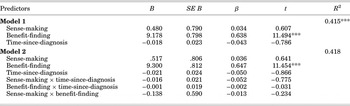
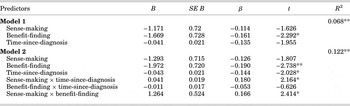
Prior to conducting a multiple regression analysis, the independent variables, including sense-making, benefit-finding, and time-since-diagnosis, were centered. These centered scores were utilized to form the interaction terms in order to minimize problems with multicollinearity and aid interpretation of the first-order terms in the test (Aiken & West, Reference Aiken and West1991). Three interaction terms were created: (1) sense-making × time-since-diagnosis, (2) benefit-finding × time-since-diagnosis, and (3) sense-making × benefit-finding. The CPTGI and DS–MV were separately regressed on sense-making, benefit-finding, time-since-diagnosis, and the three interactions. These equations with first-order terms were constructed in the first model and the interaction terms in the second model. Tables 3 and 4 display the regression coefficients for these analyses.
Interactive and main effects of sense-making, benefit-finding, and time-since-diagnosis on the Chinese Posttraumatic Growth Inventory (CPTGI) (N = 200)

*** p < 0.001.
Interactive and main effects of sense-making, benefit-finding, and time-since-diagnosis on the Demoralization Scale Mandarin Version (DS–MV) (N = 200)

*p < 0.05, **p < 0.01.
When regression was conducted on the CPTGI scores, model 1 (with only the first-order terms in the regression, including sense-making, benefit-finding, and time-since-diagnosis) predicted 40.4% of the variance in CPTGI scores (R 2 = 0.404, F(3, 196) = 44.21, p < 0.001). In model 2, the interaction terms were added, and overall these second-order terms did not increase predictive ability (ΔR 2 = 0.003, ΔF(3, 193) = 0.336, p = 0.799). It is worth noting that only benefit-finding emerged as a unique predictor of posttraumatic growth in the first model (B = 12.86, t = 11.31, p < 0.001) (see Table 3).
On the other hand, the regression equation conducted on DS–MV scores was fitted in a different model. The first-order model predicted 6.8% of the variance in DS–MV scores (R 2 = 0.068, F(3, 196) = 4.78, p < 0.01). In model 2, overall, these second-order terms significantly increased the predictive ability of the regression (ΔR 2 = 0.054, ΔF(3, 193) = 3.982, p < 0.01) (see Table 4). These findings revealed that benefit-finding, time-since-diagnosis, sense-making × time-since-diagnosis, and sense-making × benefit-finding were significant predictors of demoralization.
However, similar to the model proposed by Davis et al. (Reference Davis, Nolen-Hoeksema and Larson1998), an examination of the β coefficients in model 2 revealed that the sense-making × time-since-diagnosis interaction term was a significant predictor of demoralization (B = 0.041, t = 2.164, p < 0.05). Contrary to Davis et al. (Reference Davis, Nolen-Hoeksema and Larson1998), but in line with the model suggested by Holland et al. (Reference Holland, Currier and Neimeyer2006), the interaction between sense-making and benefit-finding was significant in this model (B = 1.264, t = 2.414, p < 0.05). In addition, these two interactions were interference types of interaction effects.
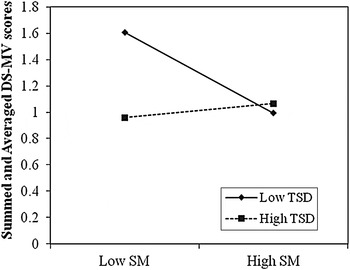
To investigate these significant findings further, a second set of analyses was performed with these two interaction terms: sense-making × time-since-diagnosis and sense-making × benefit-finding. The interaction between sense-making and time-since-diagnosis was decomposed by testing the simple slopes of sense-making on demoralization at low and high levels of time-since-diagnosis (categorized by below and above the time-since-diagnosis median of 19.5 months). The results showed that sense-making and demoralization were negatively correlated with each other when time-since-diagnosis was relatively shorter (B = –2.211, t = –2.354, p = 0.021); however, they were not associated significantly when time-since-diagnosis was relatively longer (B = –0.993, t = –0.905, p = 0.368). These results suggest that participants who survived longer experienced less demoralization whether they made sense of their cancer or not. In contrast, when participants were tested within a relatively brief period after being diagnosed with cancer, making more sense of their cancer was linked with lower demoralization (see Figure 1).
The simple slopes of the effects of sense-making (SM) on demoralization at high and low levels of time-since-diagnosis (TSD).

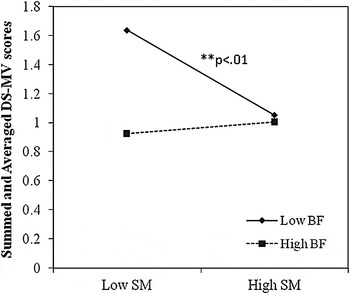
The same pattern was found within the interaction between sense-making and benefit-finding, which was separated by testing the simple slopes of sense-making on demoralization at low and high levels of benefit-finding (categorized by below and above the benefit-finding median of 3). The results revealed that sense-making and demoralization were not significantly correlated when benefit-finding was high (B = 0.513, t = 0.496, p = 0.621); however, there was a significant negative association between sense-making and demoralization when benefit-finding was low (B = –3.268, t = –3.257, p = 0.002).
In order to test the model put forward by Holland et al. (Reference Holland, Currier and Neimeyer2006), we decomposed the interaction between sense-making and benefit-finding in another way, testing the simple slopes of benefit-finding on demoralization at low and high levels of sense-making (categorized by being below or above the sense-making median of 3). Contrary to the patterns found in Holland et al. (Reference Holland, Currier and Neimeyer2006), benefit-finding and demoralization were negatively associated when sense-making was low (B = –2.744, t = –2.551, p = 0.012). However, when sense-making was high, no significant association was found between benefit-finding and demoralization (B = –0.801, t = –0.816, p = 0.417). Put more simply, these analyses suggest that cancer patients with low sense-making and low benefit-finding tended to adjust worst, and those with high sense-making and high benefit-finding experienced the least demoralization. These findings are depicted in Figure 2.
The simple slopes of the effects of sense-making (SM) on demoralization at high and low levels of benefit-finding (BF).

DISCUSSION
Overall, our study indicates that posttraumatic growth and time-since-diagnosis are negatively correlated with demoralization. Furthermore, these findings show that sense-making and benefit-finding in one's experience of cancer is associated with increased posttraumatic growth, and sense-making, benefit-finding, and time-since-diagnosis are associated with decreased demoralization. Although benefit-finding and time-since-diagnosis, compared to sense-making, are stronger predictors of demoralization, making sense of one's experience of cancer significantly buffers demoralization at low levels of these two predictors. As a result, a longer time-since-diagnosis and benefit-finding could be long-term protective factors for cancer patients to decrease demoralization, and sense-making could be a short-term protective factor.
Regarding the correlation between demoralization and posttraumatic growth, our results show that cancer patients with higher posttraumatic growth experience lower demoralization. However, our findings also reveal that the time elapsed since diagnosis of cancer is a relatively weak predictor of posttraumatic growth but a fairly strong predictor of demoralization in cancer patients. A potential explanation for these patterns could be the dual-process model of coping with bereavement, which identifies two oscillating coping processes, including loss orientation and restoration orientation (Stroebe & Schut, Reference Stroebe and Schut1999).
Stroebe and Schut (Reference Stroebe, Schut and Neimeyer2001) found that bereaved people have to cope with the loss of their loved ones and make the most of the adjustments in their lives that come about as secondary consequences of the deaths; however, they cannot attend to both simultaneously. Thus, coping at one point in time is either loss- or restoration-oriented. In fact, bereaved people can, to some degree, choose to ignore or concentrate on one aspect or another concerning the losses and changes in their lives. In order to cope effectively, “oscillation” is a necessary regulatory process in the dual-process model. It is essential for optimal psychological adjustment.
If we consider cancer patients' demoralization and posttraumatic growth within the dual process model, we can categorize demoralization in loss orientation and posttraumatic growth in restoration orientation. Demoralization after cancer is related to increased negative mental health (Kissane et al., Reference Kissane, Wein and Love2004; Grassi et al., Reference Grassi, Sabato and Rossi2005; Marchesi & Maggini, Reference Marchesi and Maggini2007; Hung et al., Reference Hung, Chen and Chang2010), whereas posttraumatic growth after cancer is related to decreased negative mental health (Ho et al., Reference Ho, Chan and Ho2004; Barskova & Oesterreich, Reference Barskova and Oesterreich2009; Sawyer et al., Reference Sawyer, Ayers and Field2010; Tallman et al., Reference Tallman, Shaw and Schultz2010). This corresponds to the patterns observed in the dual-process model, which suggests that loss orientation is predictive of negative psychological adjustment, while restoration orientation is related to better adjustment (Wijngaards-de Meij et al., Reference Wijngaards-de Meij, Stroebe and Schut2008). In our findings, the negative correlation between demoralization and posttraumatic growth suggests that these two psycho-oncological processes could be alternative orientations.
As time goes by, the oscillation of the bereaved person will slow down and stay at restoration orientation more often (Stroebe & Schut, Reference Stroebe and Schut1999; Reference Stroebe and Schut2010; Richardson, Reference Richardson2010). This may help to account for why time can buffer the demoralization of cancer patients. In our findings, demoralization that decreased with time-since-diagnosis also fit the pattern of the dual-process model, which indicates that the swing between the two orientations will slow down and bereaved people will stay in restoration orientation more as time-since-loss increases. Accordingly, demoralization may be an indication that cancer patients focus on the loss dimension of their disease (e.g., loss of one's health or identity), while posttraumatic growth may indicate that cancer patients attempt to reconstruct their personal meanings in the aftermath of cancer (e.g., they reevaluate their lives or have more courage to face life after cancer). Thus, it is natural, even necessary perhaps, for cancer patients to experience demoralization and posttraumatic growth as a dual process when coping with their cancer.
What leads to the two different mental processes? The results of multiple regressions in this study indicate that: (1) benefit-finding is significantly associated with posttraumatic growth but not sense-making or time-since-diagnosis, and (2) attenuation of demoralization could be expected by the passage of time and finding more benefit, and that their interactions with sense-making account for a substantial amount of the variability in demoralization.
Like posttraumatic growth, finding benefit or positive changes from cancer is also common among cancer patients (Tallman et al., Reference Tallman, Altmaier and Garcia2007; Schroevers et al., Reference Schroevers, Kraaij and Garnefski2011; Thornton et al., Reference Thornton, Owen and Kernstine2012). In addition, benefit-finding and posttraumatic growth are supposed to be conceptually related, but distinct, constructs (Sears et al., Reference Sears, Stanton and Danoff-Burg2003; Davis & Nolen-Hoeksema, Reference Davis, Nolen-Hoeksema, Lopez and Snyder2009). We proposed that benefit-finding is a potential factor to increase posttraumatic growth, as evident by the longitudinal findings of breast cancer patients (Mols et al., Reference Mols, Vingerhoets and Coebergh2009).
Based on the theoretical, empirical, and practical points of view, Davis (Reference Davis and Stroebe2008) also suggested that benefit-finding reflects one of three different processes that have distinct implications for posttraumatic growth. However, in our study, neither a main effect nor a simple main effect of time-since-diagnosis on posttraumatic growth was found, which was inconsistent with prior research (Helgeson et al., Reference Helgeson, Reynolds and Tomich2006; Barskova & Oesterreich, Reference Barskova and Oesterreich2009). One explanation for this inconsistent finding is that posttraumatic growth is a dynamic process that requires one's efforts to cope with stressful events (Calhoun & Tedeschi, Reference Calhoun, Tedeschi and Neimeyer2001; Davis, Reference Davis and Stroebe2008; Tedeschi & Calhoun, Reference Tedeschi and Calhoun2004). Whether posttraumatic growth is an outcome or a coping strategy (Zoellner & Maercker, Reference Zoellner and Maercker2006), the meaning-making efforts of cancer patients are related to better adjustment through the successful creation of adaptive meanings resulting from the cancer experience (Park et al., Reference Park, Edmondson and Fenster2008).
On the other hand, the pattern of demoralization results only partially replicated the findings of Davis et al. (Reference Davis, Nolen-Hoeksema and Larson1998) and Holland et al. (Reference Holland, Currier and Neimeyer2006). After the loss of a loved one, studies have found that, with increasing meaning-making, people experienced lower distress (Davis et al., Reference Davis, Nolen-Hoeksema and Larson1998) and complicated grief (Holland et al., Reference Holland, Currier and Neimeyer2006). In our study, we also found that cancer patients who made more meaning from the illness experienced less demoralization. However, the two-way interactions between predictors (sense-making, benefit-finding, and time-since-diagnosis) show different predictions of negative mental health. Davis et al. (Reference Davis, Nolen-Hoeksema and Larson1998) suggested that making sense of loss is important in the early period of adjustment to it, while finding benefit may be a longer-term process that is revealed over time.
Conversely, Holland et al. (Reference Holland, Currier and Neimeyer2006) proposed that sense-making and benefit-finding would interact with each other (but not with time-since-loss) in predicting complicated grief. In our study, time-since-diagnosis interacted with sense-making but not benefit-finding. Moreover, there is an interaction between sense-making and benefit-finding when predicting demoralization. These trends suggest that perhaps sense-making is an important moderator in cancer patients' demoralization levels.
Loss of a loved one could be classified as interpersonal loss, while diagnosis with cancer (loss of health) could be seen as an intrapersonal loss. Their impacts might differ in various domains, such as self-identity, attachment, reappraisal of loss, or reconstruction of meaning (Davis, Reference Davis and Neimeyer2001; Harvey, Reference Harvey2002). Diagnosis of cancer and the loss of a loved one are different kinds of loss experiences. Holland et al. (Reference Holland, Currier and Neimeyer2006) proposed that the most favorable adaptation to bereavement is associated with high sense-making but low benefit-finding, perhaps because the bereaved frames the loss in their own sense-making terms and would view any implication of finding personal benefit as selfish. However, in our findings, high sense-making and high benefit-finding were associated with the most favorable mental adjustment among cancer patients. This suggests that patients who make sense of cancer within their own framework of meaning, and find benefit in their experiences of cancer, do not blame themselves as being selfish for their grief. These findings, taken together, provide preliminary evidence for the importance of meaning-making after personal loss. They also suggest that there are multiple methods of meaning-making for different kinds of loss.
Consistent with other work in the loss and grief fields (Calhoun & Tedeschi, Reference Calhoun, Tedeschi and Neimeyer2001; Davis, Reference Davis and Neimeyer2001; Neimeyer, Reference Neimeyer and Neimeyer2001; Stroebe & Schut, Reference Stroebe, Schut and Neimeyer2001; Neimeyer, Reference Neimeyer2004; Holland et al., Reference Holland, Currier and Neimeyer2006), our results suggest that cancer patients who find an appraisal of meaning in the experience of cancer seem to fare better in the process of adapting to cancer. Therefore, counselors working with patients struggling with their cancer could utilize strategies that focus on sense-making and benefit-finding to help them in accommodating their global meaning or developing meaningful life narratives (Clarke & Kissane, Reference Clarke and Kissane2002; Neimeyer, Reference Neimeyer2004; Tedeschi & Calhoun, Reference Tedeschi and Calhoun2004).
There were some limitations to our study. A nonexperimental, cross-sectional design precluded causal statements based on the study's findings alone. Longitudinal studies are still needed to validate these findings. The individual differences in the effects of different cancer sites on patients were not significant in our study; however, it may be worth taking a closer look at these individual differences with more participants and with different types of cancer. Nonetheless, the current findings support a model of grief in meaning-making and have an important role in psycho-oncology. These patterns deserve replication and further exploration through a variety of analyses or a blend of qualitative and quantitative methods in future studies.
In conclusion, this study suggests that meaning-making efforts, sense-making, and benefit-finding complement each other. The presence of either sense-making or benefit-finding buffers the negative effects of demoralization on cancer patients. Second, cancer patients who achieve higher posttraumatic growth experience less demoralization. Trying to uncover positive changes in the experience of cancer may be the most powerful step in increasing posttraumatic growth.
ACKNOWLEDGMENTS
We appreciate all the doctors and research assistants who helped in this study, including Dr. Ming-Chih Chang, Dr. Yu-Jen Chen, Dr. Pei-Jan Chen, Dr. Ching-Chi Lin, Dr. Gon-Shen Chen, Dr. Johnson Lin, Dr. Ruey-Kuen Hsieh, Dr. Yi-Fang Chang, Dr. Chien-Liang Wu, Dr. Kuan-Chia Lin, Dr. Chih-Kung Lin, Dr. Huan-Chao Lin, Dr. Nai-Wen Su, Dr. Jian Su, Dr. Kou-Hwa Chang, Dr. Chang-Yi Lin, Dr. Yu-Chung Kung, Dr. Ming-Jen Peng, Dr. Wen-Chien Huang, and Miss Yu-Jing Chiu.