Introduction
As work environments become increasingly globalized, fast-paced, and competitive, the pressure on organizations to continuously improve and adapt remains vital (Berg, Grimstad, Škerlavaj, & Černe, Reference Berg, Grimstad, Škerlavaj and Černe2017). Innovativeness is considered an important driver of organizational performance, success, and long-term survival (Oldham & Cummings, Reference Oldham and Cummings1996). The resource-based perspective recognizes individual employee behaviors as important sources of firm innovativeness (Jaiswal & Dhar, Reference Jaiswal and Dhar2017). One type of employee behavior particular to organizational innovativeness is creative behaviors (Cerne, Jaklic, Skerlavaj, Aydinlik, & Polat, Reference Cerne, Jaklic, Skerlavaj, Aydinlik and Polat2012; Mustafa, Coetzer, Ramos, & Fuhrer, Reference Mustafa, Coetzer, Ramos and Fuhrer2021). As a form of discretionary behavior, employee creativity can lead to the generation of ideas and improvements in organizational effectiveness and functioning (Son, Cho, & Kang, Reference Son, Cho and Kang2017). Yet, encouraging employee creative behaviors represents a pivotal challenge for organizations and managers alike, as such behaviors not only require favorable work contexts (Mustafa, Badri, & Ramos, Reference Mustafa, Badri and Ramos2022; Sue-Chan & Hempel, Reference Sue-Chan and Hempel2016), but also the individual resources necessary to deal with the challenges associated with such behaviors (Agarwal & Farndale, Reference Agarwal and Farndale2017).
Prior studies on creativity in the workplace have traditionally focused on the positive aspects of workplace such as rewards, feedback, and learning cultures with respect to creative behaviors (Joo, McLean, & Yang, Reference Joo, McLean and Yang2013; Sue-Chan & Hempel, Reference Sue-Chan and Hempel2016). Nonetheless, an employee's workplace may also consist of attributes that may hinder their creativity (Kwon & Kim, Reference Kwon and Kim2020; Woods, Mustafa, Anderson, & Sayer, Reference Woods, Mustafa, Anderson and Sayer2018; Yoo, Jang, Seo, & Yoo, Reference Yoo, Jang, Seo and Yoo2019). Thus, it is increasingly important to consider both the motivational and impairment aspects of an employee's workplace context to properly understand how creative behaviors emerge in the workplace (Ma et al., Reference Ma, Gong, Long and Zhang2021; Shalley, Gilson, and Blum, Reference Shalley, Gilson and Blum2009). Zhou and Hoever (Reference Zhou and Hoever2014) and others have further called for future creativity in the workplace literature to consider the interactive effects of multiple individual- and context-related factors in the workplace (Shalley, Gilson, & Blum, Reference Shalley, Gilson and Blum2009; Zhou & Hoever, Reference Zhou and Hoever2014). An interactionist perspective (Woods et al., Reference Woods, Mustafa, Anderson and Sayer2018) suggests that individual dispositions and positive psychological states not only self-motivate individuals to engage in creative behaviors (Ma et al., 2021; Shalley, Gilson, and Blum, Reference Shalley, Gilson and Blum2009), but also influence how they perceive and respond to the elements of their workplace. Hence, an interactionist perspective may help overcome the limited view in the current literature and understanding of how and why some employees remain creative in the workplace and not others.
In developing our arguments for how workplace and individual factors interact to influence employee creative behaviors, this study draws on the Job Demands-Resources (JD-R) model. The JD-R model describes the interplay between job demands, and both job and personal resources that employees are surrounded with in their workplace (Demerouti & Bakker, Reference Demerouti and Bakker2011). Central to the JD-R model are two underlying psychological processes, namely, the health impairment and the motivational processes (Demerouti, Bakker, De Jonge, Janssen, & Schaufeli, Reference Demerouti, Bakker, De Jonge, Janssen and Schaufeli2001) which can influence employee creativity (Kwon & Kim, Reference Kwon and Kim2020). Within the JD-R model, job demands represent ‘aspects of the job that require sustained physical and/or psychological (cognitive and emotional) effort and are therefore associated with certain physiological and/or psychological costs’ (Bakker, Demerouti, & Verbeke, Reference Bakker, Demerouti and Verbeke2004: 86). Work overload represents an important feature of an employee's work environment which can shape their willingness to engage in creative behaviors. Prior research has shown that excessive workloads can curtail employee creativity by depleting their energy reserves and forcing them to draw on resources beyond individual capabilities (Altaf & Awan, Reference Altaf and Awan2011; Binnewies & Wörnlein, Reference Binnewies and Wörnlein2011; De Clercq & Belausteguigoitia, Reference De Clercq and Belausteguigoitia2019). However, a small body of literature has also suggested that excessive workloads can foster creativity (Altaf & Awan, Reference Altaf and Awan2011). Such ambiguity warrants further investigation to whether work overload may either enable or inhibit employee creative behaviors (Aleksić, Mihelič, Černe, & Škerlavaj, Reference Aleksić, Mihelič, Černe and Škerlavaj2017) and more specifically the conditions under which it may do so.
The JD-R further stipulates that job resources have motivational potential and are likely to induce higher work engagement and performance (Bakker & Demerouti, Reference Bakker and Demerouti2007; Van den Heuvel et al., Reference Van den Heuvel, Demerouti, Bakker and Schaufeli2010). One particular job resource provided by an organization which may influence creative behaviors is training and development (Kwon & Kim, Reference Kwon and Kim2020). As a form of organizational support, training and development initiatives have been closely linked to the promotion of creative behaviors (Collin, Lemmetty, & Riivari, Reference Collin, Lemmetty and Riivari2020; Stoffers, Van der Heijden, & Jacobs, Reference Stoffers, Van der Heijden and Jacobs2020) by equipping employees with the relevant knowledge and skills and motivation to engage in creative behaviors. However, prior research on the training and development–creative behavior relationship remains largely focused on the mechanisms behind such a relationship, with little consideration regarding the influence of potential boundary conditions (Chaubey, Sahoo, & Das, Reference Chaubey, Sahoo and Das2021). While the JD-R model suggests that job resources such as training and development initiatives may equip employees with the skills and abilities to buffer the negative effects of job demands such as work overload on creative behaviors, this study instead focuses on their direct effects. Such an approach is in-line with calls by Zhou and Hoever (Reference Zhou and Hoever2014) for more focus on the multiple aspects of the workplace environment on creative behaviors and is also consistent with motivational pathway hypothesis as part of the JD-R. Therefore, a primary objective of this study is to investigate whether both training and development and perceptions of work overload influence employee's creative behavior.
The JD-R has traditionally focused on the characteristics of the job such as demands and resources. However, recent research has moved toward considering the role of the individual as a ‘job crafter’ (Hakanen, Seppälä, & Peeters, Reference Hakanen, Seppälä and Peeters2017) as individuals bring personal resources to bear on the work situation (Grover, Teo, Pick, & Roche, Reference Grover, Teo, Pick and Roche2017; Huang, Wang, & You, Reference Huang, Wang and You2016; Xanthopoulou, Bakker, Demerouti, & Schaufeli, Reference Xanthopoulou, Bakker, Demerouti and Schaufeli2007). Personal resources refer to aspects of the self that are generally linked to resilience and include one's sense of their ability to control and impact upon their environment successfully (Xanthopoulou et al., Reference Xanthopoulou, Bakker, Demerouti and Schaufeli2007: 123–124). Personal resources can support the ability of individuals to influence the demands, resources, and outcomes of the job. One critical personal resource is passion for work. Referring to the personal joy that one derives from working hard, passion for work captures the positive energy residing internally in an employee and has been consistently linked to a number of positive attitudes and behaviors in the workplace (De Clercq & Belausteguigoitia, Reference De Clercq and Belausteguigoitia2017; Gong, Zhang, Ma, Liu, & Zhao, Reference Gong, Zhang, Ma, Liu and Zhao2020). Passion for work can not only help employees cope with excessive work overload (Lavigne, Forest, Fernet, & Crevier-Braud, Reference Lavigne, Forest, Fernet and Crevier-Braud2014) but also influences how they perceive and react to various forms of organizational support (Trepanier, Fernet, Austin, Forest, & Vallerand, Reference Trepanier, Fernet, Austin, Forest and Vallerand2014). Consistent with the moderating role of personal resources in the JD-R model, the second objective of this study is to examine whether passion for work moderates the relationship between perceptions of work overload and employee creative behavior as well as the effects of training and development on employee creative behavior (Hobfoll, Reference Hobfoll2001). Knowing whether passion for work moderates these relationships may help inform managers as to why certain characteristics of the workplace either enable or hinder employee creativity. Hence, this study seeks to address the following two research questions:
RQ1: What are the effects of work overload and training and development initiatives on employee creative behavior?
RQ2: Does work passion moderate the relationship between work overload, training and development initiatives, and employee creative behavior?
We test our empirical model using data from 142 subordinate–supervisor dyads from a Singaporean telecommunication organization. Our study makes several contributions to the literature. First, we respond to growing calls in the literature to consider multiple elements of an employee's workplace that influence their creative behaviors (Woods et al., Reference Woods, Mustafa, Anderson and Sayer2018; Yoo et al., Reference Yoo, Jang, Seo and Yoo2019). Second, we detail boundary conditions under which work overload and training and development may influence creative behavior. Traditionally, previous studies have focused mostly on how personal resources can increase employees' ability to cope with difficult and challenging work environments (De Clercq & Belausteguigoitia, Reference De Clercq and Belausteguigoitia2019; Pentareddy & Suganthi, Reference Pentareddy and Suganthi2015). By exploring the moderating role of personal resources, we add further insights into how emotion-based competencies can influence perceptions of job resources and demands with the work context.
Third, the empirical context of this study is Singapore, which responds to calls to examine how work contexts influence creative behaviors in a non-Western context (Zhao, Cooke, & Wang, Reference Zhao, Cooke and Wang2021). The Singaporean context can influence employees' creative behaviors in two distinct ways. Firstly, the prevalence of a risk-averse attitude in Singaporean society (Choo, Reference Choo2005) can curtail the development of entrepreneurial culture and individual willingness to engage in creative behaviors (Cheng & Hong, Reference Cheng and Hong2017). Secondly, attitudes to risk and failure within the organizational cultures of many Singaporean firms (Amin, Thurasamy, Aldakhil, & Kaswuri, Reference Amin, Thurasamy, Aldakhil and Kaswuri2016) may further curtail individual creativity (Mustafa, Caspersz, Ramos, & Siew, Reference Mustafa, Caspersz, Ramos and Siew2018). However, recently the need for Singaporean organizations to remain competitive locally and globally has led many enterprises to provide support for employee creativity (Tang, Hu, & Zhang, Reference Tang, Hu and Zhang2017b). Accordingly, Singapore offers an interesting context to investigate how employees perceive elements of their work environment, as well as the role of their passion for work, in influencing those perceptions.
Theoretical background
An important path through which employees can contribute to organizational innovativeness is through their creative behaviors (Binyamin & Carmeli, Reference Binyamin and Carmeli2010). Creativity is described as the creation of new and useful ideas by demonstrating creative thinking (Csikszentmihalyi, Reference Csikszentmihalyi1988). Creativity can occur at various levels such as the organizational, team, and the individual (Anderson, Potočnik, & Zhou, Reference Anderson, Potočnik and Zhou2014; Audenaert & Decramer, Reference Audenaert and Decramer2018). This study focuses on creativity at the individual-level as employees represent focal agents in performing creatively (Oldham & Cummings, Reference Oldham and Cummings1996). We define employee creative behavior as the production of novel and organizationally valued ideas (Farmer, Tierney, & Kung-Mcintyre, Reference Farmer, Tierney and Kung-Mcintyre2003). Given its importance to organizational effectiveness and innovativeness, scholars have examined a range of personal and contextual factors that condition employee creative behavior (Anderson, Potočnik, & Zhou, Reference Anderson, Potočnik and Zhou2014). Specifically, research has alluded to the roles of specific human resource (HR) practices and the demands of one's job (Audenaert & Decramer, Reference Audenaert and Decramer2018; Chiang, Hsu, & Shih, Reference Chiang, Hsu and Shih2015; Jaiswal & Dhar, Reference Jaiswal and Dhar2017). This study focuses on one type of underexplored HR practice – training and development initiatives, and one type of job demand – work overload, as workplace characteristics that influence employee creative behavior (De Clercq & Belausteguigoitia, Reference De Clercq and Belausteguigoitia2019)
The JD-R model provides an important means to understanding how perceptions of work overload and training and development initiatives may influence creative behaviors. Job demands include factors such as work pressure, emotional demands, and changes in tasks and have the potential to steer employees away from positive work behaviors (Pooja, De Clercq, & Belausteguigoitia, Reference Pooja, De Clercq and Belausteguigoitia2016). One of the most significant types of job demand is work overload, which refers to individuals perceiving they have too much work to do within a too short period of time (Kahn, Wolfe, Quinn, Snoek, & Rosenthal, Reference Kahn, Wolfe, Quinn, Snoek and Rosenthal1964). Maslach, Leiter, and Schaufeli (Reference Maslach, Leiter, Schaufeli, Cooper and Cartwright2009: 10) suggested that work overload represents a mismatch in expectations between the person and the job and is related to the perception that demands are going beyond what is reasonable, thus representing a source of work stress. Work overload can be both qualitative and quantitative in nature. Qualitative work overload refers to the necessity of going beyond the employees' abilities, skills, and knowledge (Kirch, Reference Kirch2008), while quantitative work overload relates to the amount of workload and the time available for that work (Reid & Ramarajan, Reference Reid and Ramarajan2016). This study focuses on quantitative workload and considers that excessive work overload undermines employees' beliefs that they have the capability to contribute successfully to their organization through their creative activities by reducing their personal motivation to engage in such behaviors (Chen, Chang, & Chang, Reference Chen, Chang and Chang2015). Our approach is consistent with prior studies which have found excessive work overload to inhibit employees' willingness to engage in creative behaviors (Binnewies & Wörnlein, Reference Binnewies and Wörnlein2011; Ohly & Fritz, Reference Ohly and Fritz2010).
Job resources are job-related attributes that positively influence an employee's work achievement, physical and psychological well-being, and learning and growth. Job resources operate through a motivational process by helping to bolster core self-concept and to fulfill their work roles and achieve goals (Bakker & Demerouti, Reference Bakker and Demerouti2007). Training and development initiatives constitute an important form of job resource, which not only includes cross-functional, multi-skills training, but also training for firm-specific skills such as problem identification or idea generation (Posthuma, Campion, Masimova, & Campion, Reference Posthuma, Campion, Masimova and Campion2013; Teng, Hu, & Chang, Reference Teng, Hu and Chang2019). Training and development initiatives are likely to influence employee creativity by developing their creativity-specific skills, abilities, and competencies (Chaubey, Sahoo, & Das, Reference Chaubey, Sahoo and Das2021; Collin, Lemmetty, & Riivari, Reference Collin, Lemmetty and Riivari2020).
In extending the JD-R model, scholars have integrated the Conservation of Resource (COR) theory (Hobfoll, Reference Hobfoll2001; Xanthopoulou et al., Reference Xanthopoulou, Bakker, Demerouti and Schaufeli2007) to understand the dynamic role of personal resources. Personal resources are aspects of the self that are generally linked to resiliency and capture employees' ability to control and impact upon their environment successfully (Hobfoll, Shirom, & Golembiewski, Reference Hobfoll, Shirom, Golembiewski and Golembiewski2000). As a personal resource, passion for work (De Clercq & Belausteguigoitia, Reference De Clercq and Belausteguigoitia2019; Kong & Ho, Reference Kong and Ho2018) refers to one's love of, or intense affective state toward work (Baum & Locke, Reference Baum and Locke2004). As an aspect of employee's intrinsic motivation to work hard (Vallerand et al., Reference Vallerand, Blanchard, Mageau, Koestner, Ratelle, Léonard and Marsolais2003), passion for work provides employees with the perseverance and drive to achieve work goals and sustain positive feelings from work. Despite recent research interest in personal resources, the understanding of their connection to job demands and resources is still unclear. Research shows that personal resources may behave as other job resources (Mayerl, Stolz, Waxenegger, Rásky, & Freidl, Reference Mayerl, Stolz, Waxenegger, Rásky and Freidl2016), affect perceptions of job demands (Boudrias, Desrumaux, Gaudreau, Nelson, Brunet, & Savoie, Reference Boudrias, Desrumaux, Gaudreau, Nelson, Brunet and Savoie2011), moderate the influence of demands and resources on outcomes (Grover et al., Reference Grover, Teo, Pick and Roche2017), or act as mediators (Huang, Wang, & You, Reference Huang, Wang and You2016; Xanthopoulou, Bakker, Demerouti, & Schaufeli, Reference Xanthopoulou, Bakker, Demerouti and Schaufeli2012).
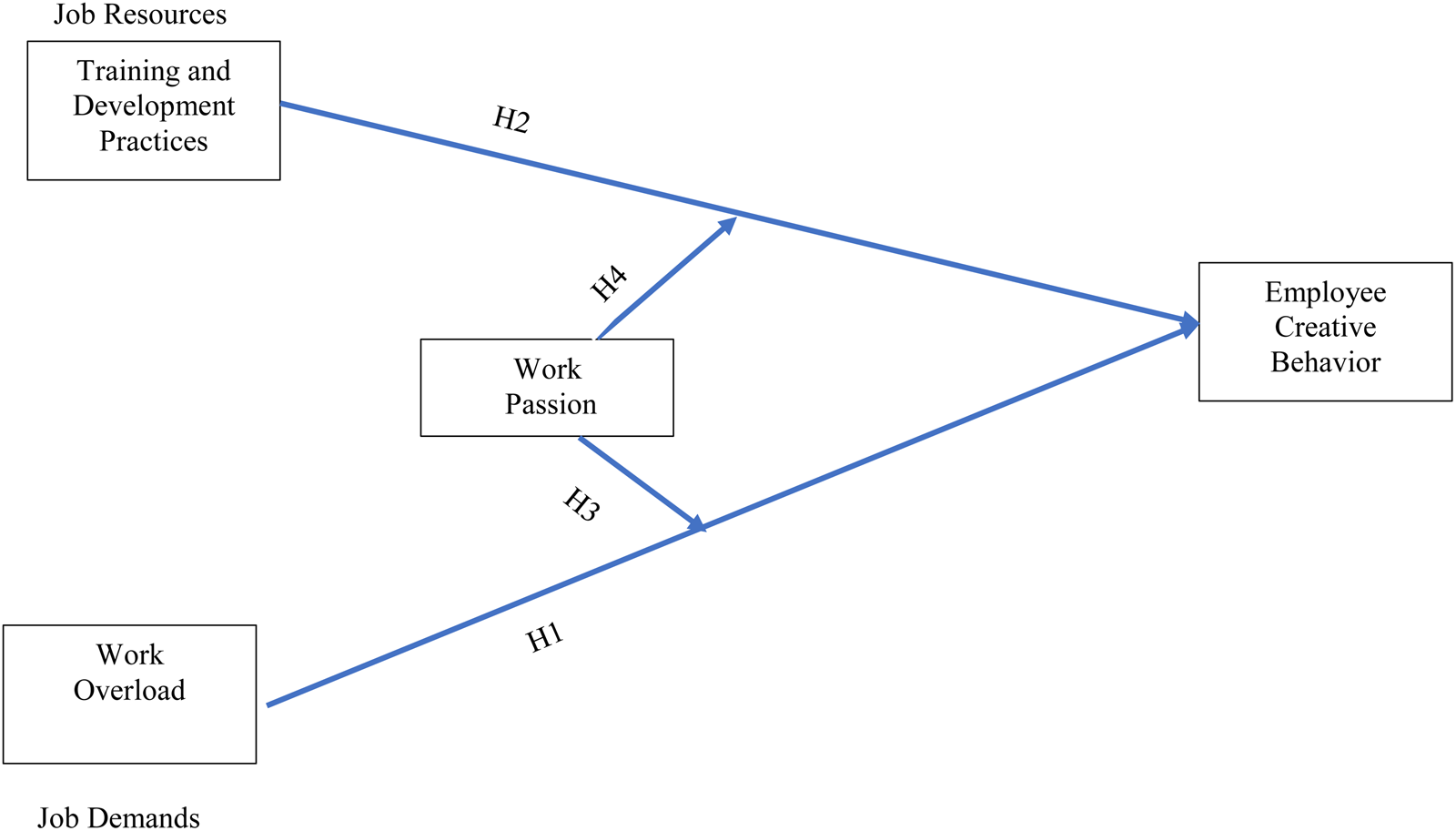
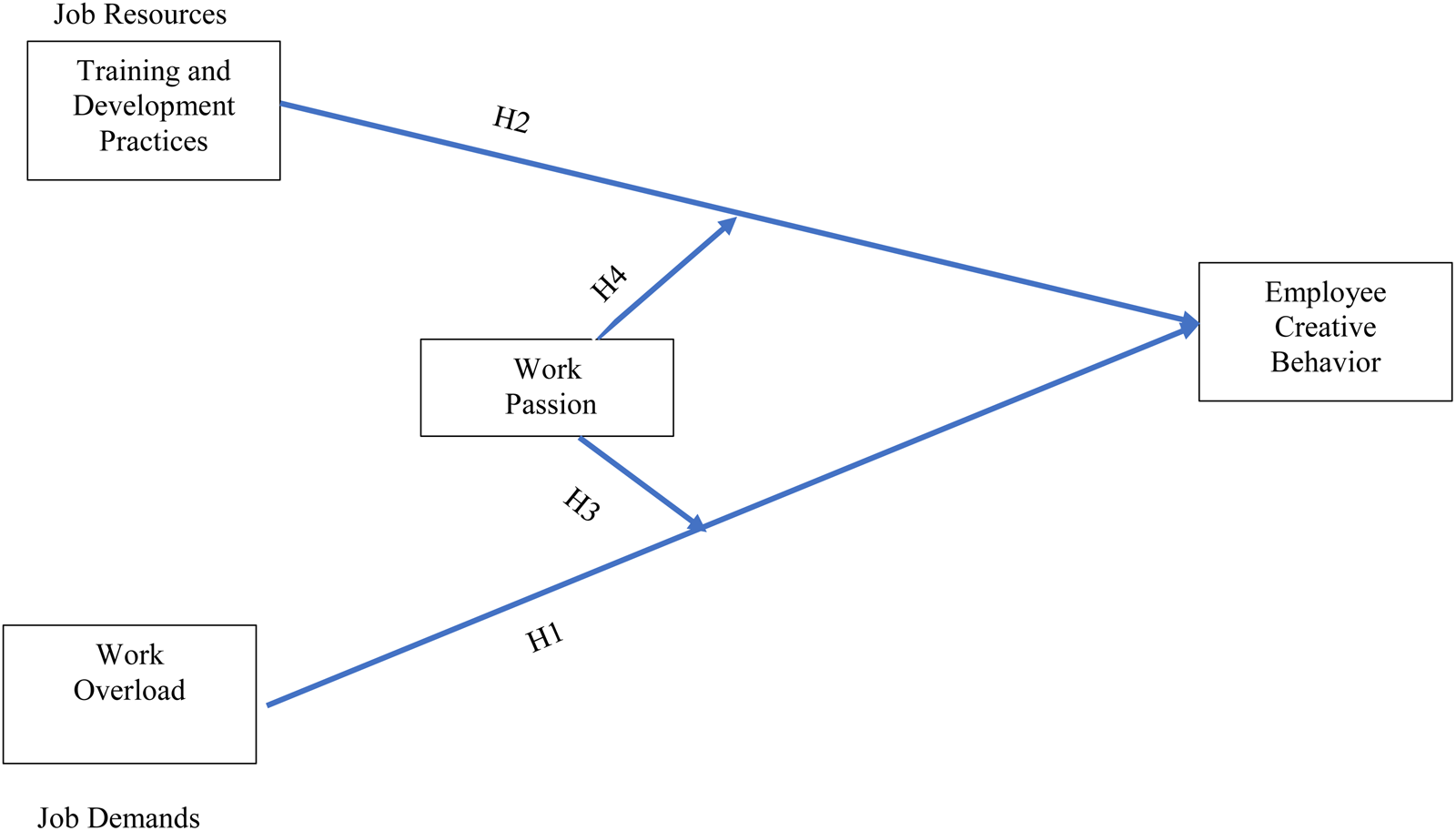
Adopting an actor-context orientated approach to understanding creativity (Zhou & Hoever, Reference Zhou and Hoever2014), we postulate that personal resources moderate the effects of both work overload and training and development initiatives on employee creativity. This is consistent with earlier observations that personal resources may influence how employees perceive and react to job demands and resources in their workplace (Jex, Bliese, Buzzell, & Primeau, Reference Jex, Bliese, Buzzell and Primeau2001; Xanthopoulou et al., Reference Xanthopoulou, Bakker, Demerouti and Schaufeli2007). Specifically, we propose that passion for work may mitigate the hardships stemming from work overload (De Clercq & Belausteguigoitia, Reference De Clercq and Belausteguigoitia2019; Lavigne et al., Reference Lavigne, Forest, Fernet and Crevier-Braud2014). We also propose that employees with higher levels of passion for work will be more motivated to not only acquire new skills and capabilities but also to apply them to generate novel ideas that benefit their organization (De Clercq & Pereira, Reference De Clercq and Pereira2020; Gulyani & Bhatnagar, Reference Gulyani and Bhatnagar2017). This is consistent with recent literature showing how individual attributes and dispositions can influence employees' perceptions of job demands and job resources (Herr, van Vianen, Bosle, & Fischer, Reference Herr, van Vianen, Bosle and Fischer2021). Our conceptual model is presented in Figure 1 below.
Conceptual model of proposed relationships.
Hypothesis development
Work overload and employee creative behavior
Studies examining the relationship between work overload and creative behavior have remained largely inconsistent in nature (Gutnick, Walter, Nijstad, & De Dreu, Reference Gutnick, Walter, Nijstad and De Dreu2012). Some suggest a negative (Amabile, Reference Amabile1996) while others a positive (Janssen, Reference Janssen2000; Mehta & Zhu, Reference Mehta and Zhu2016) association between workload and creative behaviors (Baer & Oldham, Reference Baer and Oldham2006). Such discrepancy in findings can be partially explained by Person-Environment fit theory (Van Vianen, Reference Van Vianen2018) which proposes that people have an innate need to fit environments that match their own characteristics. Thus a specific work environment can be thriving for one employee and oppressing for another, depending on an employee's individual dispositions and attributes (Herr et al., Reference Herr, van Vianen, Bosle and Fischer2021). This study views work overload as a hindrance type of job demand, and suggests that excessive workloads may frustrate employees in their roles, thereby undermining their propensity to engage in creative behaviors (De Clercq & Belausteguigoitia, Reference De Clercq and Belausteguigoitia2019; Hon, Reference Hon2013; Zhang, Zhang, & Song, Reference Zhang, Zhang and Song2015).
Generating new and useful ideas requires considerable time and the consumption of a great deal of personal energy by employees (Anderson, Potočnik, & Zhou, Reference Anderson, Potočnik and Zhou2014; Hon, Reference Hon2013). Employees with high workloads may have little room to generate creative ideas because they are busy dedicating their time and effort to accomplishing routine tasks (De Clercq & Belausteguigoitia, Reference De Clercq and Belausteguigoitia2019; Hon, Reference Hon2013). Pooja, De Clercq, and Belausteguigoitia (Reference Pooja, De Clercq and Belausteguigoitia2016) suggested that employees may be less enthusiastic to positively contribute to their organizations when they feel that their organization imposes unrealistic workloads on them. Consequently, work overload may be interpreted as a negative signal by employees that their organization does not respect their work, thus making them believe that their organization does not deserve to benefit from their creative efforts (Altaf & Awan, Reference Altaf and Awan2011).
Consistent with the health impairment process in the JD-R, we suggest that when employees experience excessive workloads, they may become distressed and experience a drain on their energy levels (Shao, Nijstad, & Täuber, Reference Shao, Nijstad and Täuber2019). In such circumstances, employees may feel de-motivated to engage in creative behaviors and instead focus on completing routine tasks (De Clercq & Belausteguigoitia, Reference De Clercq and Belausteguigoitia2019). Therefore, we propose the following hypothesis.
Hypothesis 1. Work overload will inhibit employees' creative behavior.
Training and development and employee creative behavior
Amabile (Reference Amabile1996) suggested that domain-related skills, creative aptitude, and motivation to work on a particular job are very much essential for creative performance in that domain. Such skills can be attained and developed through training and development initiatives (Tang, Yu, Cooke, & Chen, Reference Tang, Yu, Cooke and Chen2017a, Reference Tang, Hu and Zhang2017b). The existing literature has identified a positive association between training and development initiatives and creative performance (Valgeirsdottir & Onarheim, Reference Valgeirsdottir and Onarheim2017). For example, De Massis, Audretsch, Uhlaner, and Kammerlander (Reference De Massis, Audretsch, Uhlaner and Kammerlander2018) found training as a major influence on employee creativity in German SMEs, while Stoffers, Van der Heijden, and Jacobs (Reference Stoffers, Van der Heijden and Jacobs2020) demonstrated how training programs foster employee creativity through the creation of a culture of flexibility and innovation.
Training and development initiatives may influence employee creativity in several ways (Collin, Lemmetty, & Riivari, Reference Collin, Lemmetty and Riivari2020). Firstly, they can develop the know-how and cognitive skills needed by employees to sense the environment and seize opportunities (Úbeda-García, Claver-Cortés, Marco-Lajara, Zaragoza-Sáez, & García-Lillo, Reference Úbeda-García, Claver-Cortés, Marco-Lajara, Zaragoza-Sáez and García-Lillo2018) by developing new and novel ideas (Joo, McLean, & Yang, Reference Joo, McLean and Yang2013). Secondly, they may signal to employees that management is committed to their individual and career development (Bauernschuster, Falck, & Heblich, Reference Bauernschuster, Falck and Heblich2009). Employees may reciprocate such signals in the form of generating new solutions to organizational problems or by finding and implementing new ideas (Wang & Horng, Reference Wang and Horng2002). Consistent with the motivational pathway of the JD-R, we propose that training and development initiatives not only broaden employee knowledge and skills necessary for creativity, but also motivate them to go beyond their roles by developing novel and unique solutions to organizational issues.
Hypothesis 2. Training and development initiatives will enhance employee creative behavior.
The moderating role of work passion
Both the JD-R model and COR theory stipulate that an employee's propensity to leverage valuable resources into resource-enhancing work behaviors varies with their possession of personal resources, which influence their perceptions that these leveraging activities are within their reach (Hobfoll, Reference Hobfoll2001). According to Vallerand et al. (Reference Vallerand, Blanchard, Mageau, Koestner, Ratelle, Léonard and Marsolais2003) passionate employees are likely to experience joy and excitement when executing their jobs. Although employee passion may be contingent upon their organizational status (Sharp & Kidder, Reference Sharp and Kidder2013), its effects may also have trickledown effect in that the work passion of those higher up in the organization may influence those below them (Ho & Astakhova, Reference Ho and Astakhova2020). Consequently, passion for work may exist among all employees within an organization (Mustafa, Ramos, & Badri, Reference Mustafa, Ramos and Badri2020). Employees who have passion for work are less likely to be content with organizational status quos and be more likely to go out of their way to engage in creative behaviors even in the face of significant organizational constraints (De Clercq & Belausteguigoitia, Reference De Clercq and Belausteguigoitia2019; Ho, Wong, & Lee, Reference Ho, Wong and Lee2011). This is because employees with passion for work are more likely to cope with the stress of having to meet their job requirements in the presence of significant constraints (Altaf & Awan, Reference Altaf and Awan2011), while still maintaining some residual energy to develop new ideas (De Clercq, Mohammad Rahman, & Belausteguigoitia, Reference De Clercq, Mohammad Rahman and Belausteguigoitia2017).
Employees high in passion for work are also likely to enjoy challenging situations, and as such are more likely to remain motivated in engaging in creative behavior in the presence of excessive workloads (De Clercq & Belausteguigoitia, Reference De Clercq and Belausteguigoitia2019). Employees with heightened work passion actively embrace the challenge of coping with severe time constraints in the execution of their daily jobs and may also find the task of generating novel ideas to deal with organizational problems quite appealing (Baer & Oldham, Reference Baer and Oldham2006). Thus, we propose that:
Hypothesis 3. Higher passion for work will reduce the negative effects of work overload on employee creative behavior relative to lower passion for work levels. Furthermore, lower passion for work levels will amplify the negative effects of work overload on employee creative behavior.
Positive emotions can foster individual performance by increasing flexibility, creativity, integration, and efficiency of thought (Van De Voorde, Veld, & Van Veldhoven, Reference Van De Voorde, Veld and Van Veldhoven2016). Such positive attitudes suggest that employees with passion for work are more likely to apply the knowledge, skills, and abilities gained through training and development initiatives to risky behaviors such as creativity (De Clercq & Pereira, Reference De Clercq and Pereira2020). The positive energy that comes from passion for work may also widen the repertoire of cognitive tools available to employees as they undertake daily work activities. Ultimately this may motivate employees with passion for work to actively engage in the application of newly acquired knowledge and skills toward creative behaviors (Hobfoll, Reference Hobfoll2001)
Research has also acknowledged that individual learning requires motivation, and that intrinsic motivation is a raw material for being creative (Amabile, Reference Amabile1996). Employees who are passionate about their work are likely to build linkages between divergent ideas, use more resources, and experiment, therefore activating creativity (Isen, Reference Isen, Aspinwall and Staudinger2003). Thus, employees' passion for work may invigorate the relationship between the training and development they receive and their creative behaviors, as they are more likely to experience an intrinsic satisfaction from the challenge of finding new ways to leverage their newly acquired knowledge and skills in the work environment (Baum & Locke, Reference Baum and Locke2004). Similarly, employees high on passion for work may feel motivated to apply their knowledge and skills in the generation of novel ideas for organizational improvement as they experience a sense of felt obligation arising from their organization's investment in their development. Based on the above line of reasoning, we propose the following:
Hypothesis 4. Higher passion for work will enhance the positive effects of training and development on employee creative behavior relative to lower passion for work levels. Furthermore, lower passion for work levels will lower the positive effects of training and development on employee creative behavior.
Method
Sample and procedures
As per Podsakoff, MacKenzie, Lee, and Podsakoff (Reference Podsakoff, MacKenzie, Lee and Podsakoff2003) suggestion, data were collected from both subordinates and their immediate-supervisors in order to reduce common-method variance. Empirical evidence was drawn from the experiences of employees who were part of a new product and markets division of an established telecommunications organization in Singapore. Comprising 362 employees in total (both managerial and nonmanagerial employees), the division is responsible for spearheading new products and service development in the region. The division has won a number of local and regional awards for innovativeness. Consequently, we felt that compared to other divisions in the MNC (e.g., HR, procurement, sales, etc.), employees in the new product and markets division were more likely to engage in creative behaviors as part of their roles. Over the past decade, the division in question has focused on developing an entrepreneurial culture which has resulted in the successful development of several new innovative products and services into various markets throughout the region despite facing both local and foreign competition. In developing an entrepreneurial culture, the division in question has instituted a number of initiatives to support and help develop employees’ creativity and innovativeness. A core part of this support has been recognizing and rewarding employees for the creative behaviors as well as investing in the development of their skills and competencies. The context may be considered relevant in investigating how employee job demands and job resources might influence their creative behavior. Additionally, our focus on a single division as part of a larger organization is consistent with De Clercq, Mohammad Rahman, and Belausteguigoitia's (Reference De Clercq, Mohammad Rahman and Belausteguigoitia2017) approach as it can help to mitigate the presence of unobserved differences in terms of how external competitive pressures may influence the likelihood that employees generate new ideas.
A snowball sampling strategy was used to collect the data. Once ethical approvals from both the academic institution and the division in question were obtained, an electronic questionnaire was distributed to all 362 employees in the division. At this stage, respondents were asked to indicate their perceptions of work overload and training and development provided by the division and their demographic information. Respondents were also asked to provide the contact details of their immediate-supervisors. A total of 178 useable responses were returned at this stage. Two weeks later, the immediate-supervisors of the 178 returned responses were contacted by email and asked to evaluate the creative behavior of their subordinates. In some instances, one immediate-supervisor was responsible for evaluating the creative behavior of multiple subordinates. In total we received 142 completed subordinate–supervisor dyads, representing an overall response rate of 39%. Regarding the gender of respondents, 53% were female and the average age of respondents was 34 years (SD = 6.10). On average, respondents had been in the organization for 6 years (SD = 3.47). Nearly 78% of respondents had an undergraduate degree, while 13% had postgraduate qualifications.
Measures
All items were measured using a 5-point Likert scale ranging from 1 (‘strongly disagree’) to 5 (‘strongly agree’). IBM SPSS AMOS package version 26 for structural equation modeling was used to assess a measurement model using confirmatory factor analysis (CFA) to evaluate construct validity of all the instruments. The goodness-of-fit was reported based on absolute and incremental fit indices suggested by Awang (Reference Awang2012) with the following cut-off: χ2 less than <5 and p > .05, root mean square error approximation (RMSEA) is less than <.008, comparative fit index (CFI) and normed fit index (NFI) higher than >.90. Furthermore, the reliability coefficients were assessed to evaluate consistency of all scales using Cronbach's α and convergent validity using average extracted variance (AVE) with cut-off higher than .70 for Cronbach's α .50 for AVE.
Employee creative behavior
Immediate-supervisors rated their subordinates' creative behavior using a three-item scale based on previous research (De Clercq, Mohammad Rahman, & Belausteguigoitia, Reference De Clercq, Mohammad Rahman and Belausteguigoitia2017; Janssen, Reference Janssen2000). Example items included ‘This employee often generates original solutions to problems’ and ‘This employee often creates new ideas for improvement.’ Cronbach's α for the scale was .71. The CFA for employee creative behavior scale confirmed it as a single-factor construct, with indices of χ2(1) = .152, χ2/df = .152, p > .05, CFI = 1.00, NFI = .998, RMSEA ≤ .001, and AVE scored of .500.
Training and development
Respondents rated their perceptions of training and development initiatives using three items from Guan and Frenkel (Reference Guan and Frenkel2019). Sample items included ‘I have developed my work skills through formal and informal training provided by the organization,’ and ‘the training I received enables me to do my work better.’ Cronbach's α was .82. A CFA confirmed perceptions of training and development as a single-factor model with χ2(1) = .129, χ2/df = .129, p > .05, CFI = .999, NFI = .999, RMSEA ≤ .001, and AVE score of .608.
Work overload
Respondents evaluated their sense of work overload using four items from Janssen (Reference Janssen2000). Example items included ‘I often have to work too fast’ and ‘I often have to deal with a backlog at work.’ Cronbach's α was .81. Work overload was found to be a single factor construct with χ2(2) = 1.853, χ2/df = .926, p > .05, CFI = 1.00, NFI = .987, RMSEA ≤ .001, and AVE score of .501.
Passion for work
Respondents rated their passion for work using four items from De Clercq and Belausteguigoitia (Reference De Clercq and Belausteguigoitia2019). Example items include: ‘I look forward to returning to work when I am away from work’ and ‘I accomplish a lot at work because I love to work.’ Cronbach's α for this scale was .73. The scale was confirmed as a single-factor model with χ2(n = 142) = .426, p > .05, χ2/df = .426, RMSEA ≤ .001, TLI = 1.00, CFI = 1.00, GFI = .998, and AVE score of .514.
Control variables
Similar to Yoo et al. (Reference Yoo, Jang, Seo and Yoo2019), we controlled for age (in years), gender (0 = male, 1 = female), and the number of years working in the new products and markets division (organizational tenure measured in years) in order to account for alternative explanations of employee creative behavior.
Analysis
The issue of common method variance was addressed both as part of our multi-source research design and through using post-hoc tests such as Harman's (Reference Harman1967) single-factor tests (Podsakoff et al., Reference Podsakoff, MacKenzie, Lee and Podsakoff2003). We entered all of our study variables into a principal axis factor analysis, extracting factors accounting for 49.436% of the cumulative total variance. Because no single factor accounted for majority of the variance and the cumulative percentage was less than the 50% threshold, common method bias is not considered a major problem for the data (Podsakoff et al., Reference Podsakoff, MacKenzie, Lee and Podsakoff2003).
Measurement model
A combined measurement model was also conducted to confirm discriminant validity between all the tested variables. The measurement model demonstrated a good fit with χ2(n = 142) = .96.849, p < .001, χ2/df = 1.309, RMSEA = .047, CFI = .964, GFI = .911 indicating good distinctiveness between the constructs.
Results
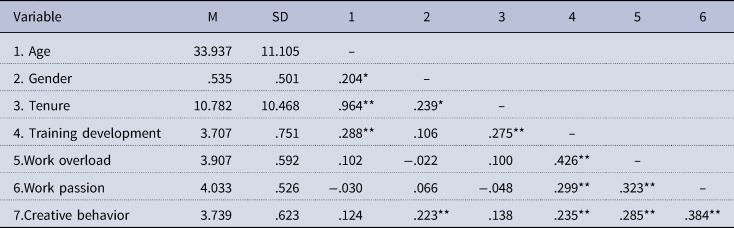
Descriptive statistics and intercorrelations among the study variables are presented in Table 1. The correlation analysis suggested that training and development (TD) (r = .235, p < .01) and work overload (WO) (r = .285, p < .01) had a weak positive correlation with creative behavior. Passion for work (WP) was also positively correlated to creative behavior (CB) (r = .384, p < .01).
Intercorrelations among key study variables
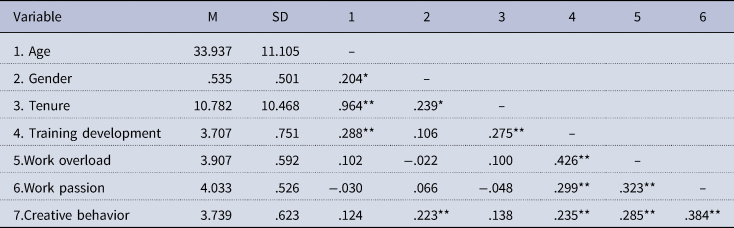
*p < .05; **p < .01.
A four-step hierarchical moderated regression analysis was performed using SPSS version 26 based on model 1 errors to evaluate all F and partial F-tests (Cohen, Cohen, West, & Aiken, Reference Cohen, Cohen, West and Aiken2003). Using Cohen et al.'s (Reference Cohen, Cohen, West and Aiken2003) model 1 error term implies using the MS residual at each step to evaluate the statistical significance of each variable entered into the regression model at that step.
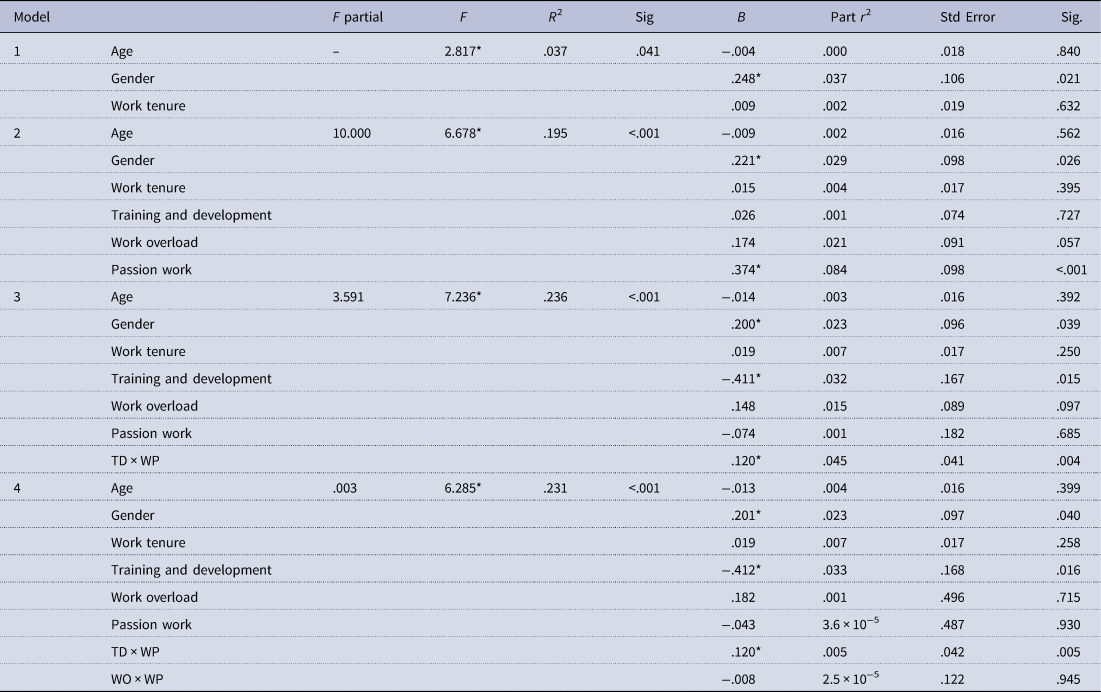
The control variables – age, gender, and work tenure – were entered in step/model 1. Then all three controls variables and main effects (TD, WO, and WP) to CB were entered in step 2. Step 3 included all control variables, the main effects (TD, WO, WP) and interaction of TD × WP to CB. Lastly, step 4. The full model included all control, main effects (TD, WO, WP), and the TD × WP and WO × WP interactions. Statistical model significance and unique variance of added variables were determined based on F and partial F-tests as suggested by Cohen et al. (Reference Cohen, Cohen, West and Aiken2003) followed by observation of R 2. Results suggest that adding another variable in each step significantly improved the model based on the increased F-test statistic from 2.817 in model 1 to 6.285 in model 4 with p value less than .001. The residual sum of squares based on partial F-test ((RSSfull–RSSreduced)/p)/(RSSfull/n–k) was lowest in the full model (partial F-testmodel 4 = .003). The findings also suggest an increase in variance from R 2model 1 = .037, R 2model 2 = .195, on R 2model 3 = .236 and R 2model 4 = .231 with .194 increase of proportional variance between model 1 to the full model 4. Such increment from model 1 to the full model 4 implores improved accountability when new variable sets are added in each step.
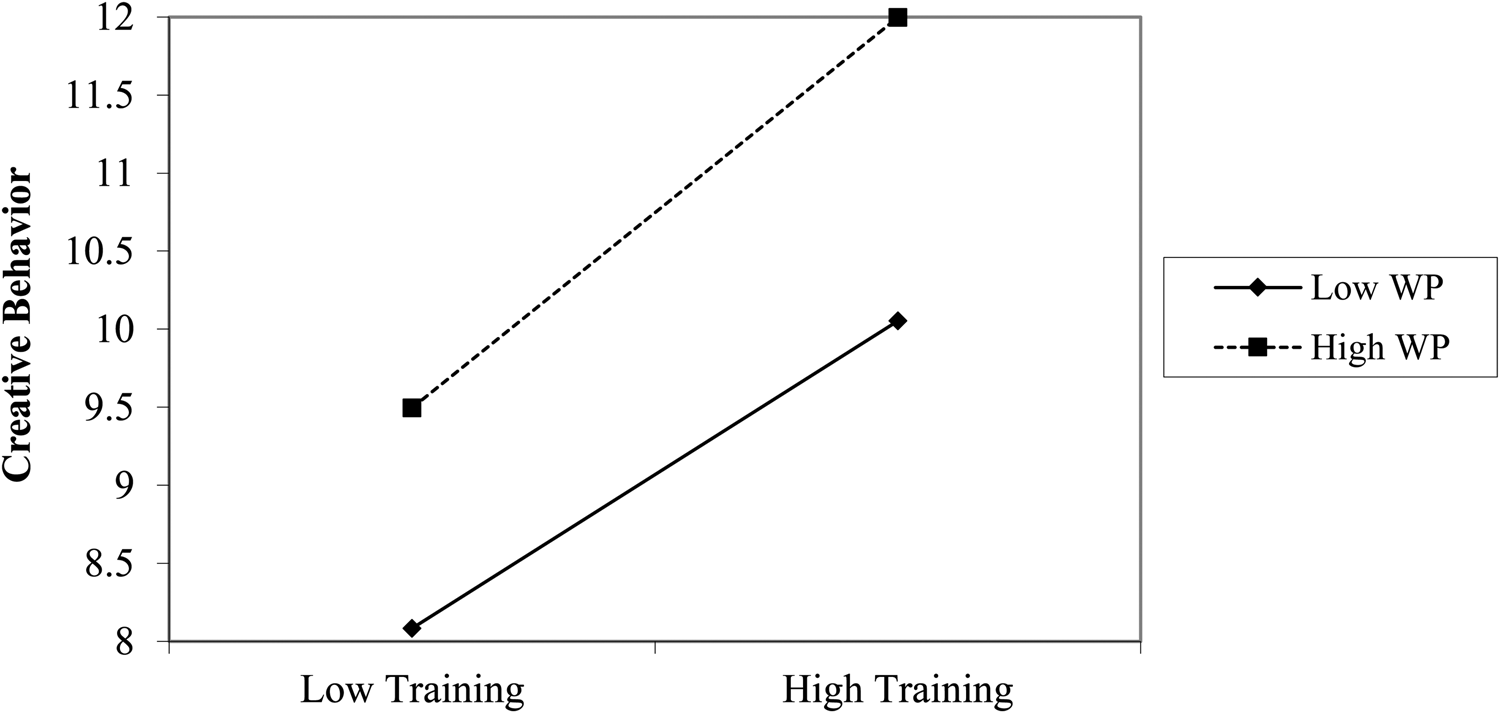
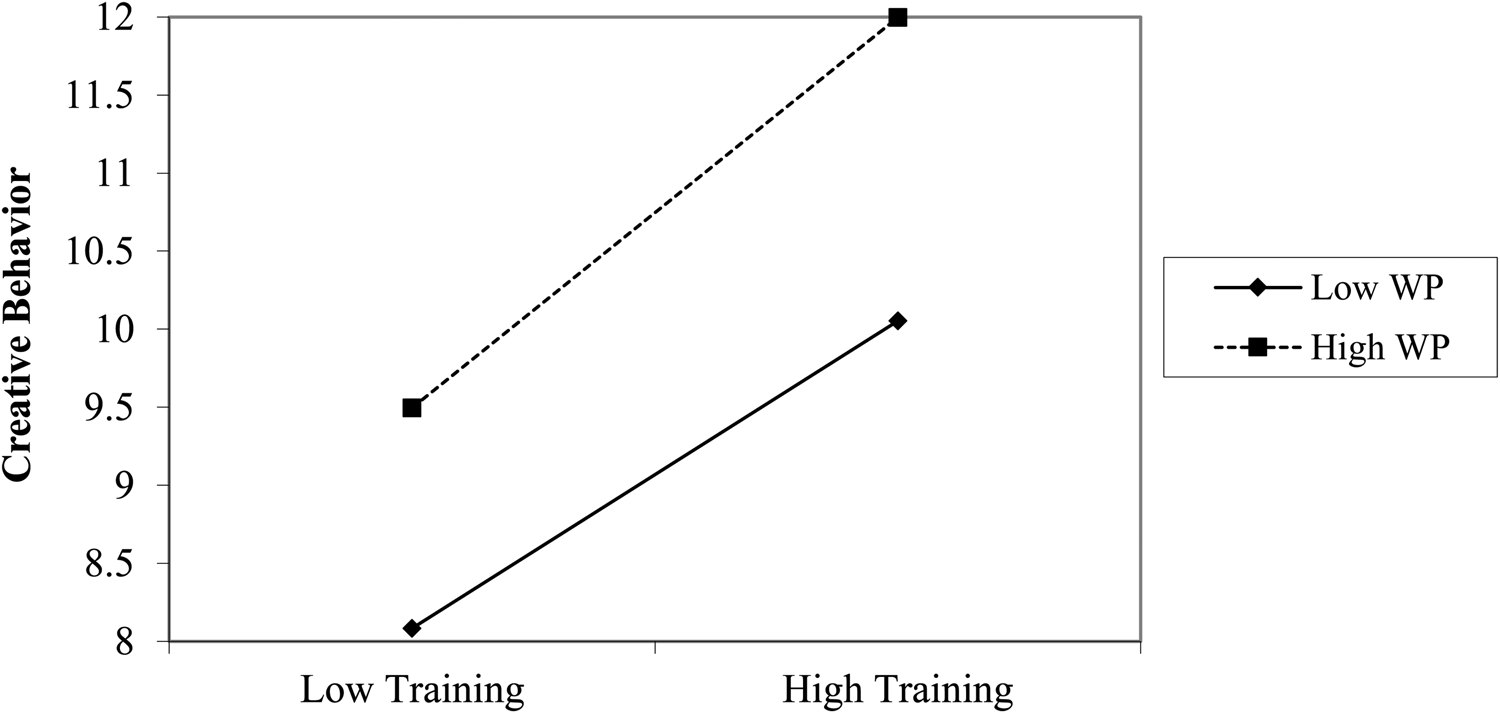
The significant gender effect in model 1 suggests that female employees had a higher level of creative behavior (CB) relative to male employees (B = .248, p = .021, part r 2 = .037). The significant effects of passion for work on employee CB in model 2 is indicative of an association between passion for work with high levels of CB (B = .374, p < .001, part r 2 = .084). We found WO to be marginally significant (B = .174, p = .057, part r 2 = .021) in model 2 suggesting that perceptions of higher workload is marginally predictive of higher CB contrary to hypothesis 1. TD had no significant effects on CB (B = .026, p = .727, part r 2 = .001) contrary to Hypothesis 2. The interaction effect between TD × WP on CB was significant at model 3 albeit with a small effect size (B = .120, p = .004, part r 2 = .045). Figure 2 suggests a slight but significant interaction between TD × WP. Hence there is a tendency for high passion for work to amplify the effects of TD on employees CB, whereas a low passion for work has a very slight tendency to dampen the TD effect. In contrast, the interaction effect between WO × WP was not significant (B = −.008, p = .945, part r 2 < .001). Based on these findings, Hypothesis 4 is supported, while Hypothesis 3 is not. However, it is worth noting that the effect size for TD × WP is low, suggesting that only 4.5% of variance in CB was uniquely explained by this interaction over and above all other variables entered in to model 3 (Table 2).
Moderating effects of work passion on training and creative behavior.
Hierarchical moderated regression analysis on creative behavior
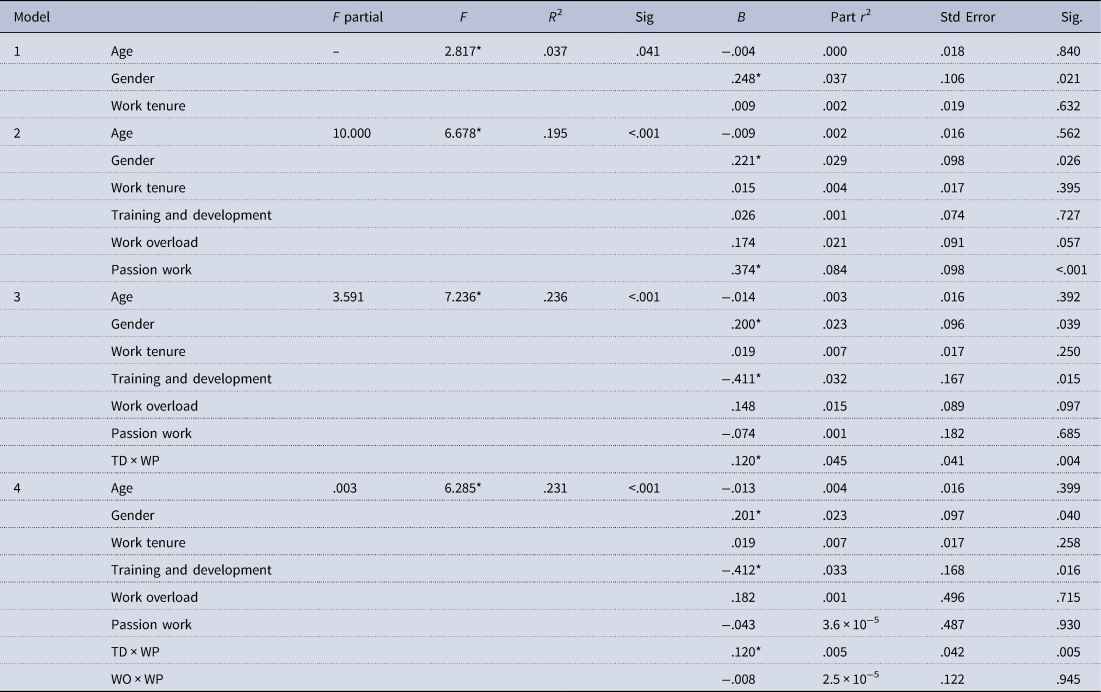
Note. B = unstandardized coefficients; * is marked when the result is significant at p < .05; TD, training development; WP, work passion; WO, work overload.
Discussion
Drawing on the JD-R model, this study developed competing hypothesis regarding the effects of job demands and job and personal resources on employee creative behavior. Specifically, we postulated that perceptions of excessive workload may demotivate employees from engaging in creative behavior, while the provisions of training and development should motivate employees to engage in creative behaviors (De Clercq & Belausteguigoitia, Reference De Clercq and Belausteguigoitia2019; Tang et al., Reference Tang, Yu, Cooke and Chen2017a, Reference Tang, Hu and Zhang2017b). Additionally, drawing on COR theory, we stipulated that employee passion for work would mitigate the negative effects of work overload on their creative behavior and enhance the positive effects of training and development on their creative behavior.
Broadly the study found partial support for our hypotheses. An interesting, yet unexpected finding from the study was the positive effect of gender on creative behavior. Despite equivalence between the genders regarding creative abilities (Baer & Kaufman, Reference Baer and Kaufman2008), females creative performance has been found to be dampened compared to males because of the stereotypical gender biases and heuristics based on perceived social roles experienced in the workplace (Hora, Lemoine, Xu, & Shalley, Reference Hora, Lemoine, Xu and Shalley2021). Contrastingly, we found females to have significantly higher levels of creative behavior relative to males. This may be attributed to the fact that within the workplace, females may experience different levels of social support compared to males (Baer & Kaufman, 2008), thus enabling them to engage in creative behaviors. Nevertheless, our finding regarding the effect of gender warrants future research into why females may be more inclined toward creative behavior in the workplace than males.
In contrast to theoretical expectations, excessive workload was found to have a positive effect on creative behavior (Ohly & Fritz, Reference Ohly and Fritz2010). Podsakoff, LePine, and LePine (Reference Podsakoff, LePine and LePine2007) argued that job demands can function as both a hindrance and challenge (Wood & Michaelides, Reference Wood and Michaelides2016). When viewed as challenges, job demands can promote desirable behaviors such as goal achievement. The study context, a new products and markets division of a Singaporean MNC, may partially account for this finding. Many Singaporean organizations operate in a highly competitive and dynamic marketplace. Accordingly, employees may experience high workload and demands as part of their job. Given our sample it is quite plausible that employees in the division viewed excessive work demands as a challenge associated with working in the division and thus motivated to engage in creative behaviors (Tang, Hu, & Zhang, Reference Tang, Hu and Zhang2017b). However, we note that the effect was only marginally significant, thus suggesting that future research is needed to understand additional factors which may influence employee creative behaviors.
Although not hypothesized, passion for work was found to have a significant positive effect on creative behavior. The explanation for such a finding lies in the motivational role of passion for work. Employees with a strong passion for work tend to gain positive energy from completing challenging work tasks such as creativity (Baum & Locke, Reference Baum and Locke2004). Accordingly, passionate employees may view challenging task such as creativity, as opportunities to thrive at work and to develop their sense of personal accomplishment (Vallerand et al., Reference Vallerand, Blanchard, Mageau, Koestner, Ratelle, Léonard and Marsolais2003). In contrast to prior studies though, training and development initiatives were found to have no significant effect on employee creative behavior (Collin, Lemmetty, & Riivari, Reference Collin, Lemmetty and Riivari2020; Guan & Frenkel, Reference Guan and Frenkel2019).
Although the effect size was small, findings showed that high passion for work amplified the effects of training and development initiatives on creative behavior. This suggests that employees with passion for their work are able to utilize the knowledge and skills gained from training and development, and channel them toward creative endeavors in the workplace. There may be several possible explanations for the small effect sizes observed here. Firstly, it is highly possible that other within-person resources such as ‘conscientiousness, and openness to experience’ (Zhou & Shalley, Reference Zhou, Shalley and Martocchio2003) and not passion for work may play more important roles in the relationship between training and development initiatives and creative behavior. Secondly, we argued that employees with a high level of passion for work are likely to apply their newly gained knowledge, skills, and abilities from training toward generating novel ideas for organizational improvement. This assumes that the training and development initiatives provided by the organization under investigation were relevant to developing the necessary skills for creativity. It is quite plausible that passionate employees may redirect the knowledge gained through training and development initiatives toward completing in-role tasks. Finally, creative behaviors are likely to emerge in the workplace as a result of complex process. Consequently, passion for work alone may not be sufficient to engage in challenging and risky behaviors such as creativity. In fact, besides being passionate about their work, employees may also need to feel both psychologically and structurally empowered in the workplace in order to successfully engage in creative behaviors (Tang et al., Reference Tang, Yu, Cooke and Chen2017a, Reference Tang, Hu and Zhang2017b). Hence further investigation is needed to explore the role of psychological factors that may invigorate the training and development–creative behavior relationship.
Theoretical contributions
Our study extends the literature on creativity in the workplace in several ways (Chen, Chang, & Chang, Reference Chen, Chang and Chang2015; Yoo et al., Reference Yoo, Jang, Seo and Yoo2019). Firstly, we respond to calls by Shalley, Gilson, and Blum (Reference Shalley, Gilson and Blum2009) and Woods et al. (Reference Woods, Mustafa, Anderson and Sayer2018), by deepening our understanding of how individual–context interactions can influence creative behaviors in the workplace. Prior empirical work has predominantly focused on the effects of either individual or organizational factors, thus providing a limited understanding regarding the emergence of employee creativity (Shalley, Zhou, & Oldham, Reference Shalley, Zhou and Oldham2004). By drawing on the JDR-mode, this study focused on the characteristics of an employee's job (work overload), and work context (training and development) as well as their own psychological states (passion for work). In showing how an employee's passion for work can elicit positive responses to training and development, our study illuminates the complexity that surrounds the emergence of employee creative behavior and suggests that research on creative behaviors needs to take into account the interaction between individual and contextual factors in the workplace (Tang et al., Reference Tang, Yu, Cooke and Chen2017a, Reference Tang, Hu and Zhang2017b). Secondly, we add to the continued ambiguity surrounding the effects of work overload on employee creative behavior. Although marginally significant, our finding that work overload had a positive effect on creative behavior contradicts earlier findings that excessive work pressures diminish an employee's propensity to develop new ideas for organizational improvement (Chen, Chang, & Chang, Reference Chen, Chang and Chang2015). Nevertheless, our contradictory and marginally significant finding points to the need to further investigate the work overload–creative behavior relationship.
Thirdly, the core contribution of this study lies in its elaboration of how an energy-enhancing resource – passion for work – enhanced the effects of employees' perceptions of training and development on their creative behavior. In doing so, our study adds to the understanding of the relationship between specific Human Resource Management (HRM) practices and employee creativity (Chiang, Hsu, & Shih, Reference Chiang, Hsu and Shih2015). Prior research into the relationship has typically focused on unpacking the ‘black box’ regarding the mechanisms through which such relationships exist (Boxall, Reference Boxall2012). However, little is known of the boundary conditions under which employees may or may not respond positively to specific HR practices such as training and development initiatives. In conceptualizing and modeling passion for work as a personal resource, which moderates the effects of job resources on creative behaviors, our study also helps to clarify the role of personal resources within the JD-R model, as research still remains unclear regarding the place they should occupy in the model (Schaufeli, Reference Schaufeli2017). Specifically, we provide further empirical evidence of a personal resource (passion for work) influencing an outcome, by influencing how employees perceive the provision of organizational resources (Xanthopoulou et al., Reference Xanthopoulou, Bakker, Demerouti and Schaufeli2007).
Finally, given the Singaporean context of this study, we also contribute to the knowledge regarding the determinants of employee creativity in the Asian context. Recently, Cooke (Reference Cooke2018) and Zhao, Cooke, and Wang (Reference Zhao, Cooke and Wang2021) argued that the different economic and social development stages, and different cultures and value systems found throughout the Asian region may give rise to distinct forms of work conditions and employee behaviors. Unfortunately, many of the existing studies exploring the effects of job and contextual-related factors on employee creativity have done so within the Western workplace context (Yoo et al., Reference Yoo, Jang, Seo and Yoo2019). Thus, by examining how job demands, job and personal resources interact and influence employee creative behavior in the Singaporean workplace context, our study goes somewhat in responding to calls to examine the determinants of creativity in the Asian context. Interestingly, our finding that excessive workloads lead to employee creative behavior suggests that the dynamic fast-paced work environments found in many Singaporean organizations (Cheng & Hong, Reference Cheng and Hong2017; Stefanidis, Strogilos, & Kyriakidou, Reference Stefanidis, Strogilos and Kyriakidou2020) may have a motivating effect on employees' creative behavior. Nevertheless, our findings suggest that the interactions between individuals and contextual conditions may also reflect distinct cultural values, norms, and leadership styles, thus underscoring the need to further examine cross-cultural effects in HRM and creativity research (Arun & Gedik, Reference Arun and Gedik2020; Cooke, Reference Cooke2018). Broadly, our findings suggest that further research is needed to understand the uniqueness of HR practices in the Asian region in the management of employees (Tang et al., Reference Tang, Yu, Cooke and Chen2017a, Reference Tang, Hu and Zhang2017b).
Practical implications
Our study also provides some practical implications for organizations who aim to foster employee creativity. Our findings highlight the need for organizations to consider how they support their employees in order to enhance their creativity. Specifically, our findings showed that employees who feel passionate about their work may be better at channeling the organizational support they received toward pro-organizational behaviors. To increase the likelihood that current and future employees exhibit a strong passion for work, organizations can provide training to demonstrate how that passion can help resolve a wide-range of organizational problems. However, the small effect size of the variables under investigation points to the notion that creative behaviors in workplace may come about through complex means. That is managers may need to think broadly about other job-related factors that drive creative behaviors, and the types of support that they provide their employees. Our findings suggest that employees individual attitudes and even possibly their dispositions may have an effect on how they perceive and utilize the type of support provided to them (Mustafa, Badri, & Ramos, Reference Mustafa, Badri and Ramos2022). Hence, managers and organizations may be more mindful of screening for favorable attitudes and dispositions during the selection process.
Limitations and future research
Like any study, our study is not without its limitations. First, the study used a cross-sectional design and although the data was a combination of self-report and supervisor-rated measures, causality cannot be directly inferred from the study's findings. We also note the limitation associated with using supervisor rather than self-ratings of creative behavior. Creative behavior is qualitatively different from other performance dimensions as it is not easily assessed by outside evaluators. Hence supervisors may not be in the best position to rate the creative behavior of their subordinates as they may not be fully cognizant of their subordinates’ behaviors (Janssen, Reference Janssen2000). Additionally, in this study, supervisors often rated more than one of their subordinates for their creative behavior. There could be recall biasness effects associated with such an approach (Harris & Schaubroeck, Reference Harris and Schaubroeck1988). Future research may strive to ensure that the supervisors rate only one subordinate at a time. Second, the study focused on one specific work context and sample. The fast paced and dynamic employee culture in Singapore could have an impact on why employees behave creatively at work. This kind of context may not necessarily be true across other cultures and organizational contexts throughout the Asian region. Hence, the generalizability of our findings to other context is limited.
Future studies may wish to explore the use of longitudinal designs and collect data from multiple contexts throughout Asia, particularly looking into cross-cultural variations that can broaden our understanding of how employee creativity is fostered in different environments. Third, the study focused on only one specific HR practice (training and development) and work overload as a determinant of employee creativity. This is an inherent limitation of the research model which limits our ability to make generalized conclusions about potential relationships/variables that may also affect creative behavior. Further to this, the effects of the various variables under investigation were rather small, suggesting that other factors may be at play. Research has shown that bundles of HR practices may have a collective/joint impact on employee creativity (Tang et al., Reference Tang, Yu, Cooke and Chen2017a, Reference Tang, Hu and Zhang2017b). Thus future research may wish to consider multi-level studies which consider the effects of discrete contextual and individual-level factors on creative behaviors (Ma, Long, Zhang, Zhang, & La, Reference Ma, Long, Zhang, Zhang and La2017).
Fourthly, in developing our conceptual model, we hypothesized that personal resources played a similar role to that of job resources. However, the JD-R model also stipulates that the effects of job demands can be buffered by the presence of job resources. Hence future research may wish to examine whether job resources may mitigate or enhance the effects of job demands such as work overload. For example, ineffective training and development may lead to greater workload problems, while more work overload may reduce the effectiveness of training and development. Hence we encourage future researchers to build on the JD-R model and the assumptions behind it more deeply explore the relationships between job demands and job resources and their effects on creativity in the workplace. Finally, in this study, we did not control for the organizational status of employees. Organizational status has been shown to be a critical factor in determining work passion (Sharp & Kidder, Reference Sharp and Kidder2013). Accordingly, we suggest that future research may consider how organizational status influences work passion and whether those with higher organizational status.
Conclusion
Employee creative behaviors are considered key drivers of organizational innovativeness (Amabile, Reference Amabile1996). Yet further examination is warranted to examine the conditions under which employee creative behaviors emerge. Drawing on the JDR model to examine how work and job contexts influence employee creativity behavior, this study contributes to furthering the knowledge base on creativity and by providing important theoretical and practical implications for HR scholars and managers. Specifically, we deepen the literature understanding of the effects of work passion on employee creative behaviors. We also provide further insights into the effects of specific training and development initiatives and job characteristics in an Asian context and encourage future researchers to explore cross-cultural dimensions of employee creative behavior.
Hazel Melanie Ramos studied Business Administration at the University of the Philippines Diliman, and received a Master's in Counseling Psychology as well as her PhD in Clinical Psychology from Ateneo De Manila University. She is the Head of the Division of Organisational and Applied Psychology at the University of Nottingham Malaysia. Her research interests include human resource management of nonfamily employees, psychological ownership, and work-life balance.
Michael Mustafa studied Economics at the Australian National University, specializing in international and development economics, and received a Master's in Management from the National Graduate School of Management. His current research interests include innovative work behaviors, proactivity in the workplace, and corporate entrepreneurship.
Siti Khadijah Zainal Badri studied I/O Psychology and received a PhD in Management under a fast track PhD program at the Universiti Teknologi Malaysia (UTM). Her research interests include various organizational behaviors.