INTRODUCTION
The gastropod fauna of the Russian part of the Barents Sea is relatively well studied and includes more than 200 species (Golikov, Reference Golikov1995; Golikov et al., Reference Golikov, Sirenko, Chaban and Sirenko2001; Kantor & Sysoev, Reference Kantor and Sysoev2006); however the study of the fauna of this region has not been completed. New species are still being recorded quite frequently (Granovitch & Sokolova, Reference Granovitch and Sokolova2001; Martynov et al., Reference Martynov, Korshunova and Savinkin2006; Kantor et al., Reference Kantor, Rusyaev and Antokhina2008; Chaban & Nekhaev, Reference Chaban and Nekhaev2010). Some may reflect recent range extension; others have probably not been recognized before because they closely resemble other local species. During the cruise of RV ‘Dalnie Zelentsy' along the Barents Sea coast of Kola peninsula in May–June 2009, 49 species of gastropods were collected some of which were recorded for Russia for the first time (Nekhaev, Reference Nekhaev2011). The re-examination of this collection revealed one more species—Alvania punctura (Montagu, 1803)—previously unrecorded from this region. The purpose of this note is to describe this finding.
MATERIALS AND METHODS
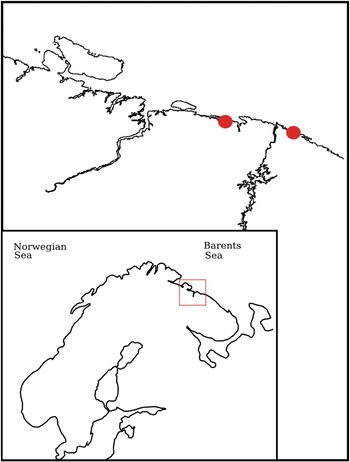
Single live specimens of Alvania punctura were found in samples from Dolgaya Bay and Yarnishnaya Bay (Figure 1) collected using a 0.1 m2 van Veen grab. The sample from Dolgaya Bay (69°11.490′N 34°58.319′E) was collected on 29 May 2009 at 19 m depth with water temperature at + 2.42°С and salinity at 34.27‰; the bottom was sandy with stones and broken bivalve shells. The sample from Yarnishnaya Bay (69°07.32′N 36°02.12′E) was collected on 3 June 2009 at 26 m depth with water temperature at + 3.75°C and the salinity 34.48‰; the bottom was stones and sand. The samples were sieved over a 0.25 mm sieve and then fixed with 4% formaldehyde. The samples were sorted in the laboratory using an MBS-1 stereomicroscope. The scanning electron microscopy (SEM) images were taken with a CamScan S2 microscope.
Localities of new finds of Alvania punctura.

RESULTS AND DISCUSSION
This is the first record of Alvania punctura in Russian waters, and the easternmost record of this species.
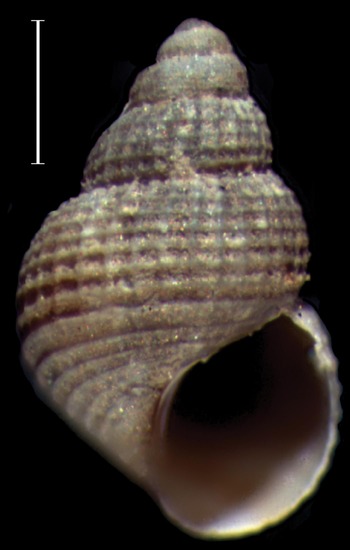
The specimens are small and conical, covered by yellowish or brownish periostracum, with 5–6 moderately convex whorls (Figure 2). The sutures are distinct, and the apex is acute. The teleoconch has both straight spiral and axial ribs, producing reticular sculpture; in the basal part of the body whorl axial ribs are absent. The embryonic shell can be divided into protoconch 1 and protoconch 2 (Figure 3A). Protoconch 1, the first 1.1–1.2 whorls, has spiral lines and rows of small elongated tubercules (Figure 3B); protoconch 2 consists of more than 2 whorls, with spiral rows of tubercles and no lines (Figure 3C). The aperture is oval with a distinct angle in the upper part. The umbilicus is very narrow, mostly closed by the inner lip.
Shell of Alvania punctura from the Barents Sea. Scale bar: 0.5 mm.

Protoconch details of Alvania punctura from the Barents Sea: (A) general view; (B) protoconch 1; (С) protoconch 2. Scale bars: A, 90 µm; B, C 40 µm.

The shells are about 1.9 mm high and 1.1 mm wide. According to Fretter & Graham (Reference Fretter and Graham1978) the maximum shell height is 3 mm and maximum shell width is 1.8 mm.
Alvania punctura has a wide distribution including the western part of the Mediterranean Sea (Arduino & Arduino, Reference Arduino and Arduino2001), the Atlantic coast of Spain (Gofas, Reference Gofas2007), and the English (Fretter & Graham, Reference Fretter and Graham1978; Hayward et al., Reference Hayward, Wigham, Yonow, Hayward and Ryland1995) and Scandinavian coasts (Warén, Reference Warén1996; Høisœter, Reference Høisæter2009). It has been found along almost all the Norwegian coast but it is rare north of Lofoten and has not been recorded in the Varangerfjorden (Høisœter, Reference Høisæter2009). In the majority of its area A. punctura inhabits sandy and silty substrates up to 100 m depth, but is most commonly found in less than 40 m (Fretter & Graham, Reference Fretter and Graham1978; Høisœter, Reference Høisæter2009).
This discovery of Alvania punctura in Russian waters may be connected with current climate change. The larvae of A. punctura may reach the coast of Kola Peninsula regularly, but they survive only when the environment is acceptable. Thus the finding of adult individuals of A. punctura may provide an indication of changing conditions in the region. This hypothesis also seems reasonable because several warmer water mollusc species have recently been found in the North Atlantic region, including the gastropods Apporrhais pespelecani (Linnaeus, 1758) (Kantor et al., Reference Kantor, Rusyaev and Antokhina2008), Retusa pellucida (Brown, 1827) (Chaban & Nekhaev, Reference Chaban and Nekhaev2010), Xandorovula patula (Pennant, 1777) (Høisœter et al., Reference Høisæter, Sneli, Schander, Rapp and Berggren2011), Eulima bilineata Alder, 1848, Odostomia turrita Hanley, 1844 (Nekhaev, Reference Nekhaev2011), Thesbia nana (Lovén, 1846) (Nekhaev & Kantor, Reference Nekhaev and Kantor2012) and a cephalopod, Todaropsis eblanae (Ball, 1841) (Sabirov et al., Reference Sabirov, Lubin and Golikov2009). A link between changes in species distribution and climate is consistent with studies showing that benthic animals are good indicators of water temperature and its changes (Golikov, Reference Golikov1968; Galkin, Reference Galkin1998), and suggests that they can be used in palaeoclimate reconstruction (Golikov & Tzvetkova, Reference Golikov and Tzvetkova1972).
It is however also possible that Alvania punctura has not been previously recognized from Russian waters because it may have been confused with other local rissoid species. The fauna of the Russian part of the Barents Sea includes 15 rissoid species (Golikov, Reference Golikov1995; Kantor & Sysoev, Reference Kantor and Sysoev2006). Well-preserved specimens of Alvania punctura may be clearly distinguished from all of them by protoconch sculpture and coloured periostracum. But dirty shells and shells preserved in formalin may easily be confused with Alvania scrobiculata (Møller, 1842) and especially with Punctulum minutum (Golikov & Fedjakov in Golikov, Reference Golikov, Starobogatov and Naumov1987). The last-mentioned species is very similar to Alvania punctura in its shell shape and teleoconch sculpture, but has a larger number of spiral ribs (about 40 on the body whorls as compared with less than 25 in A. punctura), and an open umbilicus (Golikov, Reference Golikov, Starobogatov and Naumov1987).
ACKNOWLEDGEMENTS
I express my thanks to Nataliya Dnestrovskaya (Moscow, Russia) for her help in the SEM study of Alvania punctura, Anders Warén (Stockholm, Sweden) for confirming the identification of the species, Sebastian Payne (Drewsteignton, UK) for correcting the English text, and two anonymous referees. This research received no specific grant from any funding agency, commercial or not-for-profit sectors.