


Introduction
Anger is a frequent problem for many people with intellectual disabilities (ID), and while many individuals are able to manage anger-provoking situations appropriately, anger is often expressed inappropriately as verbal and/or physical aggression (Benson and Brooks, Reference Benson and Brooks2008; Taylor and Novaco, Reference Taylor and Novaco2005). Challenging behaviour by people with ID has traditionally been managed pharmacologically or behaviourally (Didden, Duker and Korzilius, Reference Didden, Duker and Korzilius1997; Matson et al., Reference Matson, Bamburg, Mayville, Pinkston, Bielecki and Kuhn2000), but increasingly, cognitive-behavioural therapy (CBT) is being used. There is an extensive evidence base for the effectiveness of CBT in the general population, across a wide range of mental health problems including anger and aggression (Roth, Fonagy, Parry, Target and Woods, Reference Roth, Fonagy, Parry, Target and Woods2006; Hofmann et al., Reference Hofmann, Asnaani, Imke, Vonk, Sawyer and Fang2012), and widening access to CBT is seen as a major policy priority in the UK, implemented in the Increasing Access to Psychological Therapies (IAPT) programme (Department of Health, 2011). IAPT guidance states that this service should extend to people with ID, but progress is very slow (Increasing Access to Psychological Therapies, 2009): as a result, people with ID have higher levels of unmet need but receive less effective treatment, despite the legal requirement to deliver health services in a non-discriminatory manner (Equality Act, 2010).
This situation arises in part because CBT is difficult to deliver to people with ID, as a result of their cognitive limitations in relation to logical thinking, planning, memory, language and emotional literacy. Therefore, standard CBT techniques need to be adapted to make them accessible (Lindsay, Jahoda and Willner, Reference Lindsay, Jahoda, Willner, Taylor, Lindsay, Hastings and Hatton2013). There is now a burgeoning literature reporting controlled trials of CBT for people with ID, and the majority of the published trials have targeted anger as the clinical indication. There have been several recent systematic reviews of this literature, which concur in concluding that adapted CBT interventions for anger are effective for people with ID, with effect sizes similar to those seen in the general population, albeit that the studies are mostly small and methodologically weak (Nicoll, Beail and Saxon, Reference Nicoll, Beail and Saxon2013; Hamelin, Travis and Sturmey, Reference Hamelin, Travis and Sturmey2013; Veernooghe and Langdon, Reference Vereenooghe and Langdon2013; Willner and Lindsay, Reference Willner, Lindsay and Singhin press).
The principle of CBT is that how people feel depends on how they think and what they do, so people can be helped to feel better by helping them to think and behave differently. However, as applied to people with ID, there is a deep controversy over the relative contributions of the behavioural and cognitive components of CBT interventions (e.g. Sturmey, Reference Sturmey2006; Lindsay, Reference Lindsay2006), an extreme view being that Pw ID cannot benefit from cognitive interventions and that any improvement following CBT interventions can be accounted for by changes in behaviour. While unlikely, it is certainly possible that the effectiveness of CBT interventions might derive entirely from their behavioural components. Indeed, a recent study reported that the behavioural elements of an effective CBT intervention for anger were delivered to people with ID more effectively than the cognitive elements, although the therapists in this study were minimally trained day service staff and the results cannot therefore be generalized to the practice of more experienced therapists (Jahoda et al., Reference Jahoda, Willner, Rose, Stenfert Kroese, Lammie and Shead2013).
The issue of the extent to which people with ID benefit from the cognitive elements of a CBT intervention is difficult to resolve in the absence of a suitable instrument to measure cognitive change by people with ID following a CBT intervention. Most incidents of anger arise in situations of interpersonal conflict, where the critical cognitive domains for CBT are irrational beliefs about, and appraisals of, the other person's behaviour (Crick and Doidge, Reference Crick and Doidge1996; David, Schnur and Belliou, Reference David, Schnur and Belliou2002; Martin and Dahlen, Reference Martin and Dahlen2004; Larkin, Jahoda and MacMahon, Reference Larkin, Jahoda and MacMahon2013). While there are a number of scales that assess anger-related cognitions (e.g. Buss and Durkee, Reference Buss and Durkee1957; Martin and Dahlen, Reference Martin and Dahlen2007), they have not been adapted for use by people with ID. One instrument that has been adapted is the Novaco Anger Scale (NAS: Novaco, Reference Novaco2003; Novaco and Taylor, Reference Novaco and Taylor2004). The NAS includes a “cognitive” subscale, with four items in each of the categories of justification, rumination, hostile attitude and suspiciousness, but very few of the items relate to interpersonal perceptions and appraisals in anger-provoking situations
The NAS has rarely been used in controlled trials of CBT interventions for people with ID (Taylor, Novaco, Gillmer, Robertson and Thorne, Reference Taylor, Novaco, Gillmer, Robertson and Thorne2005; Hagiliassis, Gulbenkoglu, Di Marco, Young and Hudson, Reference Hagiliassis, Gulbenkoglu, Di Marco, Young and Hudson2005). In practice, anger in people with ID is typically assessed using the Novaco Provocation Index (Novaco, Reference Novaco2003) or similar instruments, which ask participants how angry they would feel in a series of very briefly described hypothetical situations such as “you are in a queue to get something and someone pushes in front of you” or “being slowed down by another person's mistakes” (see Willner and Lindsay, Reference Willner, Lindsay and Singhin press). While most people with mild ID can work with these instruments, there is an element of random responding because participants cannot easily imagine themselves in many of the situations presented. A more ecologically valid method, the Imaginal Provocation Test (IPT) involves a small number of situations (typically three) that are presented as scenarios with greater contextual detail and temporal development. The IPT has been established as valid, reliable and sensitive to change (Taylor, Novaco, Guinan and Street, Reference Taylor, Novaco, Guinan and Street2004). However, it is a standardized test that does not address individual concerns, which could vary greatly between different participants, and it evaluates participants’ reports of their behavioural tendencies, not their cognitions.
An alternative is to take an ideographic approach in which anger experiences recalled by individual participants are used as the basis for anger ratings (Tafrate, Kassinove and Dundin, Reference Tafrate, Kassinove and Dundin2002). In a fore-runner to the present study, an individualized IPT was incorporated into The Profile of Anger Coping Skills (PACS), which was developed to measure coping skills in people with intellectual disabilities undertaking anger management training (Willner, Brace and Phillips, Reference Willner, Brace and Phillips2005). The PACS is based around three anger-provoking scenarios that are personalized individually for each participant, followed by questions about the usage of a specified set of coping skills in each situation. The PACS was originally developed as a third-party instrument for carers to report on the coping skills of their carees (Willner et al., Reference Willner, Brace and Phillips2005; Willner and Tomlinson, Reference Willner and Tomlinson2007). However, carers cannot directly access the cognitions of the people for whom they care, and there is evidence that carers and carees use different sources of information when reporting on the caree's anger (Rose et al., Reference Rose, Willner, Shead, Jahoda, Gillespie and Townson2013). Subsequently, a first-person version of the PACS was developed, which incorporates an individualized IPT, in which the participants themselves rate the degree of anger elicited by each of the PACS scenarios. People with mild to moderate ID were able to use the PACS-IPT to record significant decreases in felt anger following an anger-management intervention, alongside significant increases in the use of anger-coping skills (Willner et al., Reference Willner, Rose, Jahoda, Stenfert Kroese, Felce and Cohen2013).
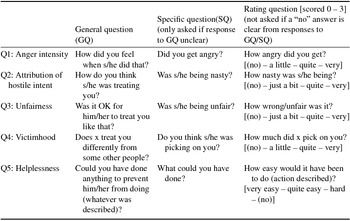
In the present study we have extended the PACS to incorporate a new instrument, the Profile of Anger-related Cognitions (PAC), to elicit participants’ cognitions regarding their individualized anger-provoking scenarios. Cognitions can be accessed directly by having participants verbalize their thoughts while engaging in a task or situation. This procedure, the Articulated Thoughts in Simulated Situations (ATSS) paradigm, uses an unstructured response format where people report their thoughts “on-line” as events unfold, rather than retrospectively, and their responses are subsequently coded using content analysis methods (Davison, Vogel and Coffman, Reference Davison, Vogel and Coffman1997). This method has been used to study anger-related cognitions (e.g. irrational beliefs, cognitive biases, attributional biases) in violent and non-violent men who performed the ATSS task while listening to anger-arousing audiotapes (Eckhardt, Barbour and Davison, Reference Eckhardt, Barbour and Davison1998). A similar procedure was used in a study in which people with ID listened to audiotapes of CBT sessions and commented on events that they found interesting, with subsequent thematic analysis (Burford and Jahoda, Reference Burford and Jahoda2012). The results provided insight into the participants’ feelings and opinions about CBT, but more importantly for present purposes, they also provide evidence that people with ID are able to report their thoughts in relation to an ongoing situation. The present study was inspired by the ATSS but adopted a more structured methodology in order to obtain quantitative ratings that would be more amenable to use in the context of an assessment of a CBT intervention. Drawing on social information processing theory (Crick and Doidge, Reference Crick and Doidge1996; Larkin et al., Reference Larkin, Jahoda and MacMahon2013), the PAC focuses on the interpersonal domain in which most incidents of anger arise, and addresses four cognitive determinants that are prominent in the anger literature, attribution of hostile intent (Eckhardt et al., Reference Eckhardt, Barbour and Davison1998; Basquill, Nezu, Nezu, Klein and MacLean, Reference Basquill, Nezu, Nezu, Klein and MacLean2004; Jahoda, Pert and Trower, Reference Jahoda, Pert and Trower2006), perceptions of injustice (Berkowitz and Harmon-Jones, Reference Berkowitz and Harmon-Jones2004; Jahoda, Pert, Zquire and Trower, Reference Jahoda, Pert, Zquire and Trower2002; Batson et al., Reference Batson, Kennedy, Nord, Stocks, Fleming and Marzette2007), perceptions of self as victim (Jones and Trower, Reference Jones and Trower2004; Larkin, Jahoda, MacMahon and Pert, Reference Larkin, Jahoda, MacMahon and Pert2011; Hunter, Nadany and Cragg, Reference Hunter, Nadany and Cragg2010), and inability to cope with social demands (Deffenbacher, Reference Deffenbacher1999; Jahoda, Trower, Pert and Finn, Reference Jahoda, Trower, Pert and Finn2001; Griffith, Hutchinson and Hastings, Reference Griffith, Hutchinson and Hastings2013). Each dimension was assessed by asking the participant to talk about the general issue (e.g. “Does X treat you differently from some other people”), followed if necessary by a request to focus on the specific issue (e.g. “Do you think X was picking on you”), and finally, a request for a rating (e.g. “How much did X pick on you”) using a 4-point scale.
The PAC thus comprises two elements: a set of individualized anger-provoking interpersonal scenarios, provided by the participant as reports of recent incidents, followed by ratings of the intensity of anger elicited by each event and the four anger-related cognitions. This study provides an initial evaluation of the reliability and validity of the PAC when used with a group of adults with ID identified as having difficulties with anger control. Reliability was assessed using conventional psychometric methods, and validity was assessed through both psychometrics and content analysis of participants’ conversational responses. Additionally, the usability of the PAC was assessed by surveying a group of clinicians for their impression of using the PAC in the assessment of clients referred for help with anger problems.
As noted above, the ability of people with ID to engage with the CBT model has been questioned. One of the central constructs in CBT is the ability to link Antecedents (triggers), Beliefs and emotional Consequences (the A-B-C model). Several studies have investigated this “cognitive therapy skill” using formal tasks (A-B, choose C, or A-C, choose B), with the finding that the majority of people with ID performed very poorly, and that performance was related to verbal ability (Dagnan, Chadwick and Proudlove, Reference Dagnan, Chadwick and Proudlove2000; Joyce, Globe and Mooney, Reference Joyce, Globe and Mooney2006; Oathamshaw and Haddock, Reference Oathamshaw and Haddock2006), with the implication that people with ID are greatly impaired relative to the general population. This in turn implies that people with ID might be expected to engage poorly with CBT, yet, as reviewed above, this has not been the clinical experience. Moreover, performance in A-B-C tasks was substantially better if stimuli were presented pictorially rather than verbally (Vereenooghe, Reynods, Gega and Langdon, Reference Vereenooghe, Reynolds, Gega and Langdon2015), suggesting that the earlier results might present a misleading under-estimate of the true abilities of people with ID. The PAC represents a naturalistic assessment of the accessibility of the beliefs that mediate the emotional response to anger-provoking situations. Therefore, a further aim of the study was to evaluate whether people with ID were in fact impaired in accessing anger-related beliefs. To this end, a second group of participants without ID was tested, and the prospect of detecting an impairment, if one exists, was increased by recruiting them from a population with above-average IQ, university students.
Method
Participants
The ID group (n = 12) were adults with mild to moderate ID (8 male, 4 female, mean age 40.4 years, range 23–65). Potential participants with diagnoses of psychosis, autism, personality disorder or dementia, or who did not meet criteria for a diagnosis of ID, were excluded. They were recruited within day services for people with mild to moderate ID and identified by staff as having difficulty with anger control. They were tested either in the day service or their home, according to the service user's preference. Post-session support from carers was available in both environments. The GP group (n = 23) were university students (9 male, 14 female, with a mean age of 27.2 (range 21–47) years, who reported experiencing anger but were not selected for problems of anger control. They were recruited through advertisements and personal contact with the researcher, and tested at convenient locations. It should be borne in mind when reading the results of this study that the two groups differed in many ways, including IQ and other demographic factors such as age, gender distribution and occupation, but also in the fact that while the general population (GP) group reported experiencing anger – a sine qua non of the study – this had not been identified as problematic, unlike the situation of the ID group. All participants gave informed consent; to guard against coercion the consent process for people with ID was witnessed and signed off by a member of the day service staff. Ethical approval for both halves of the study was obtained from Swansea University Psychology Department, and the testing of people with ID was also approved by the Research Ethics Committee for Wales (now Wales REC 3).
The Profile and Anger Coping skills (PAC)
The PAC is based on real-life scenarios provided by participants in which they recalled experiencing anger. These situations should have occurred recently and frequently (at least weekly) and must involve interpersonal conflict. The timing requirements could be relaxed if participants were unable to identify situations that met the recency and/or frequency criteria, but the interpersonal conflict criterion was obligatory. Each participant was asked to identify three such scenarios. Each scenario was assessed in turn.
The PAC comprises five questions designed to elicit ratings of subjective and cognitive dimensions of each anger experience. The style of presentation was conversational, beginning with a request to “tell me about the last time that happened”. This was followed, for each of the five questions, by a general question intended to open up the conversation, followed by a more specific question if needed, and a request for a rating. Answers to all questions were recorded verbatim. Question 1 (Q1) assessed the intensity of anger experienced, while questions 2–5 (Q2-5) assessed the four cognitive dimensions of attribution of hostile intent (Q2), unfairness (Q3), victimhood (Q4) and helplessness (Q5). Responses were rated on 4-point scales (0-3). The questions and rating scales are summarized in Table 1.
The PAC interview schedule and scoring

The PAC questions, for each scenario, were followed by the eight PACS questions about the usage of anger coping skills in the specific situation. The administration procedure was as previously described (Willner et al., Reference Willner, Brace and Phillips2005), using a 3-point rating scale for frequency of use (no – sometimes – always) that can be reliably completed by people with ID (Willner et al., Reference Willner, Rose, Jahoda, Stenfert Kroese, Felce and Cohen2013).
Other measures
State-Trait Anger Expression Inventory (STAXI)
The STAXI is a self-report instrument that provides a profile of an individual's experience, expression and control of anger. It includes a number of sub-scales, but for the purposes of this study, the three main measures of State Anger, Trait Anger and Anger Expression were calculated. The STAXI exists in several versions. The GP group completed the 57-item STAXI-II (Spielberger, Reference Spielberger1999), while the ID group completed the Northgate modification of the original 44-item STAXI, which was adapted specifically for people with ID (Novaco and Taylor, Reference Novaco and Taylor2004). Because the two versions of the STAXI are of different length, in order to compare performance of the two groups, scores were expressed as either mean score per item or percentage of the maximum score for each scale (see below).
Novaco Anger Scale – Provocation Index (NAS-PI)
The NAS-PI is a self-report instrument that comprises the 60-item NAS, which measures an individual's experience of anger in the behavioural, arousal and cognitive domains, as well as anger regulation, and the 25-item PI, which measures the propensity to respond in an angry manner to provocative situations. For this study the NAS Total (sum of the three domains) and Anger Regulation scores and the PI total score were calculated. The GP group completed the original version of the NAS-PI (Novaco, Reference Novaco2003), while the ID group completed the Northgate modification of the NAS-PI (Novaco and Taylor, Reference Novaco and Taylor2004), in which the same questions have been adapted for ease of completion by people with ID.
How I Think Questionnaire (HIT-Q)
The HIT-Q is a 54-item self-report instrument that measures four types of self-serving cognitive distortions, Self-Centred cognitions, Minimizing/Mislabelling cognitions, Blaming Others cognitions and Assuming the Worst cognitions (Gibbs, Barriga and Potter, Reference Gibbs, Barriga and Potter2001). For the purposes of this study, it was predicted that the Blaming Others subscale might relate more closely to the PAC measure of anger-related interpersonal cognitions than the other scales, which do not specifically reference either interpersonal or anger-related cognitions.
Glasgow Depression (GDS) and Anxiety (GAS) Scales
The 30-item GDS (Cuthill, Espie and Cooper, Reference Cuthill, Espie and Cooper2003) and the 27-item GAS (Mindham and Espie, Reference Mindham and Espie2003) are self-report measures that were developed to measure levels of depression and anxiety, respectively, of people with ID. Both scales have a clinical cut-off score of 13.These scales were included to characterize the clinical status of the ID group more fully, for comparison with other studies (e.g. Rose et al., Reference Rose, Willner, Shead, Jahoda, Gillespie and Townson2013).
Procedure
Participants attended for three sessions. In session 1, participants in the ID group completed the GDS, GAS, STAXI and NAS-PI, all of which were presented verbally, while those in the GP group self-completed the STAXI, NAS-PI and HIT-Q. Tests were administered in the order listed. Participants in the GP group also identified the scenarios to be used in the PAC at this time.
In session 2, participants completed the PAC and PACS. Participants in the GP group were first reminded of the scenarios that they had previously described. (These participants also wore a small and unobtrusive heart-rate monitor attached to an ear-lobe; the data so collected are not reported here.) At the end of the session, GP participants were asked to indicate their mood using a visual analogue scale, and those indicating that their mood was below the midpoint were asked to read 10 statements taken from Velten's positive mood induction procedure (Velten, Reference Velten1968) until they reported above-average mood. Participants in the ID group first identified the scenarios to be used, in some instances with help from the participant's key-worker, and then completed the PAC/PACS. The Velten procedure was not used because participants had carer support available, and none of them showed any signs of distress at the end of the session.
Session 3 was planned to take place one to two weeks later (although testing was delayed beyond this window for a few participants) and involved a second completion of the PAC, using the same scenarios that had been elicited in the first PAC session. At the end of the session, participants in the ID group completed a short informal satisfaction questionnaire, and all participants were debriefed.
Statistical analysis
Intraclass correlations (two-way mixed method; absolute type; single measure) were used to compute test-retest reliability, using data from the first and second administrations of the PAC. All subsequent analyses used only session 1 data. Questions 2–5 of the PAC comprise the Cognitions measures, for which Cronbach's alpha was used to evaluate scale consistency. Correlational analyses employed Pearson product-moment correlations: all data reported met criteria for parametric analysis. Comparisons between the GP and ID groups were by t-tests and analysis of covariance. Further details of the analyses are reported in the Results section.
Content analysis
The verbal information obtained at time 1 in the PAC scenario description and the five open-ended general questions was subjected to content analysis (Atkins, Reference Atkins1984). For each scenario and question, initial categories were proposed characterizing the nature of the responses given, which were then reviewed and modified or combined to create the final coding categories. The scenario was analysed for the nature of the trigger described, the identity of the protagonist, and the location; responses to Q1 were categorized according to the emotions identified; responses to Q2-5 were categorized according to the cognitions expressed. These analyses were conducted independently for the two samples. An independent rater subsequently recoded the two groups’ responses to each questions, using the categories that had been generated, and reliability was evaluated using Cohen's kappa statistic (Cohen, Reference Cohen1960). A high level of reliability was found for both samples (GP: K = 0.80; ID: K = 0.77).
Results
Test-retest reliability
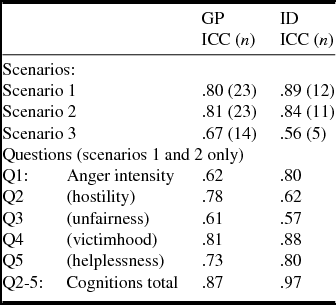
The reliability of the total Cognitions score (sum of Q2-5) was first computed for each of the three scenarios separately. The upper part of Table 2 shows that, for both groups of participants, test-retest reliability was markedly lower for scenario 3 than for scenarios 1 and 2, and moreover, that whereas all but one of the participants provided two scenarios, only around half of the participants in each group provided a third scenario. Consequently, for all subsequent quantitative analyses, scenario 3 was disregarded and mean scores were computed for scenarios 1 and 2.
Inter-rater reliability for PAC scenarios and individual questions

We next examined the reliability of each of the five PAC questions (lower part of Table 2). Q1 (anger intensity) scores were somewhat more reliable in the ID sample than in the GP sample, which just met the 0.60 threshold for acceptability (Chinn, Reference Chinn1991). For the four cognitive dimensions (Q2-5), similar data were obtained in the two groups of participants: in each case, Q3 (unfairness) was the least reliable and Q4 (victimhood) was the most reliable item. The total Cognitions score (sum of Q2-5) showed excellent reliability in both the GP (0.87) and particularly, the ID (0.97) groups.
Consistency
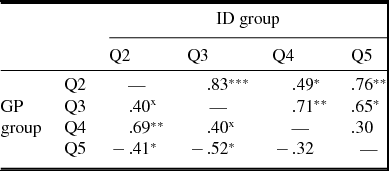
Consistency was assessed by computing Cronbach's alpha for the four cognitive dimensions, using the mean of scenario 1 and 2 scores. Scale consistency was high for the ID sample (α = 0.75) but very low for the GP sample (α = 0.12). In order to understand this discrepancy, we examined the inter-correlations between the four scale items. Table 3 shows the results for the ID group above the diagonal (upper right) and results for the GP group below the diagonal (lower left). There were strong inter-correlations between all scale items, but whereas for the ID group all correlations were positive, as expected, for the GP group Q5 was negatively correlated with the other items, which was unexpected but explains why the overall consistency of the scale is so low in this group.
Inter-correlations between ratings of individual PAC questions

Q2: hostility; Q3: unfairness: Q4: victimhood; Q5: helplessness.
x p = .06; *p < .05; **p < .01; ***p < .001
Anger intensity and anger-related cognitions
Scores on Q1 (anger intensity) were significantly correlated with total Cognitions scores (Q2-5), both overall (r = 0.43, p < .01) and for each of the GP and ID groups separately (GP: r = 0.48, p < .05; ID: r = 0.58, p < .05).
Anger intensity scores were (nonsignificantly) higher in the GP group [mean (SEM): GP, 2.35 (.08); ID, 2.08 (.22); t(33) = 1.38, NS]. The total Cognitions score was higher in the ID group [GP, 5.78 (.32); ID, 7.38 (.98)]: in light of the correlation with anger intensity, this difference was analysed by entering anger intensity as a covariate in an analysis of covariance, which confirmed that the difference in total Cognitions scores was significant [F(1,32) = 9.25, p < .005].
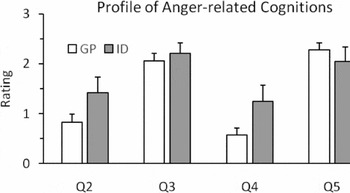
The profile of anger cognitions is shown in Figure 1, where it can be seen that the two groups had similar profiles, with low scores on Q2 (hostility) and Q4 (victimhood) and high scores on Q3 (unfairness) and Q5 (helplessness). A repeated-measures analysis of covariance, with Q1 scores (anger intensity) as the covariate, found significant main effects of question [F(3,96) = 5.28, p < .002] and group [F(1,32) = 8.33, p < .01],together with a significant question x group interaction [F(3,96) = 3.98, p < .01] and a significant cubic component to the interaction [F(1,32) = 9.16, p < .01], indicating that not only were scores on Q2 and Q4 lower, but also that scores on Q2 and Q4 differed significantly between the groups, while scores on Q3 and Q5 did not.
Ratings of perceived hostility (Q2), unfairness (Q3), victimhood (Q4) and helplessness (Q5) by participants in the general public (GP) and intellectual disability (ID) groups. Values are means plus standard error.

Relationship to other measures
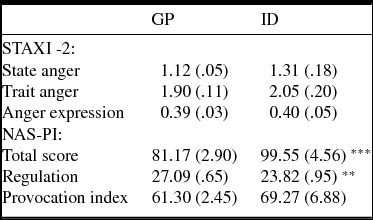
Table 4 shows the scores of the two groups on each of the three main measures from the STAXI-2 and NAS-PI. Because the modified STAXI used with the ID group and the STAXI-2 used with the GP group differ in some respects, the State and Trait anger scores are expressed as the mean score per item, and the Anger Expression Index is expressed as a proportion of the maximum possible score. STAXI scores were similar in the two groups. NAS-total scores were significantly higher in the ID group [t(32) = 3.51, p < .001], consistent with the significant difference in Q2-5 total scores. Anger Regulation was significantly lower (by 12%) in the ID group [t(32) = 2.85, p < .01]; a somewhat larger (18% decrease), albeit nonsignificant, trend is also apparent in the PACS scores [GP, 7.04 (.57); ID, 5.08 (.89); t(33) = 1.93, p = .063].
Scores on other anger measures

**p < .01; ***p < .001
GP: general public group; ID: intellectual disability group
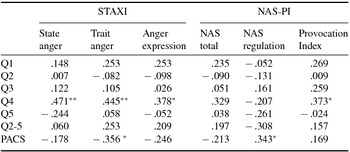
Table 5 shows the correlations between the three PAC/PACS measures (Q1: anger intensity; Q2-5: Cognitions, shown separately for each question and for the total score; and the PACS measure of usage of anger coping skills), and the six STAXI and NAS-PI measures. These data were calculated as partial correlations, using the whole data set from both groups (N = 34), and controlling for group. There was a significant correlation between the PACS and the NAS Regulation score, which was predicted because these are both measures of the use of anger coping skills; there was also a significant negative correlation between the PACS and Trait Anger. Otherwise, the only significant correlations were between Q4 (victimization) and various measures of anger disposition or expression. When examined in the individual groups separately, the only significant correlation was between Q4 and State Anger (r = .652, p <. 01) in the GP group. The dearth of significant correlations, and in particular, the absence of significant correlations for the Q1 or the Q2-5 total scores, does not simply reflect a lack of statistical power, because there were numerous highly significant correlations among PAC measures (Table 3), among STAXI and NAS subscales (data not shown), and between STAXI and NAS subscales (data not shown).
Correlations between PAC scores and scores on other anger measures

Q1: anger; Q2: hostility; Q3: unfairness: Q4: victimhood; Q5: helplessness.
*p < .05; **p < .01
The HIT-Q was administered to the GP group only. There was a significant correlation between the PAC Cognitions score and the HIT Blaming Others subscale (r = .494, p < .02), which also correlated significantly with Q4 (r = .485, p < .02). All other PAC-HIT correlations were nonsignificant.
The GDS and GAS were administered to the ID group only. Mean (SEM) scores were GDS, 11.5 (3.3) and GAS, 19.3 (2.9), with 5/11 and 7/11 participants, respectively, scoring above the clinical cut-off of 13. Correlations with PAC Cognitions scores were nonsignificant (GDS: r = .158; GAS: r = .111).
Content analysis
All anger-provoking scenarios were included in the content analysis (GP: n = 60; ID: n = 28). The two groups produced scenarios of comparable length: there was a tendency for some quite long scenarios to be produced by the GP group resulting in a skewed distribution (median 41 words, range 10–152), which was not seen in the ID group (median 35 words, range 12–66), but the overall difference was not significant (Mann-Whitney U-test, p = .17). The mean number of prompts used in eliciting the PAC ratings was also similar for the two groups (GP = 2.23, ID = 2.03).
Perhaps unsurprisingly, the scenarios reflected the lives of the participants. For both groups, the predominant locations for the events described were home settings (GP = 47%, ID = 54%) or professional settings (GP = 19%, ID = 29%), which for the ID group mainly involved the day centre. Parental homes were mentioned by some of the students (14%) but not by any of the ID group. For the ID group, the other person in the scenario was typically a staff member (36%) or another service user (29%), but only infrequently a professional (7%) or a family member (4%), while for the GP group the other person was typically a professional, usually a supervisor or work-mate (30%), a family member (27%) or a co-habitant (18%). For the GP group, the predominant triggers (88% of the total) were irritation (32%), disrespect (28%), disappointment (17%) and being put down (11%). For the ID group the predominant triggers (93% of the total) were inconsideration/disrespect (36%), disempowerment (35%), and being pestered (21%). Themes of disempowerment (not listened to, ignored, let down, told “no”, told what to do) were prominent in the ID scenarios but much less apparent in the GP scenarios, perhaps reflecting the objective realities of life for the two groups of participants. The predominant emotion expressed by both groups in response to Q1 was anger (GP = 57%, ID = 67%) followed by sadness (GP = 10%, ID = 17%), and a variety of other emotions including (for both groups) fed up, disappointed and anxious.
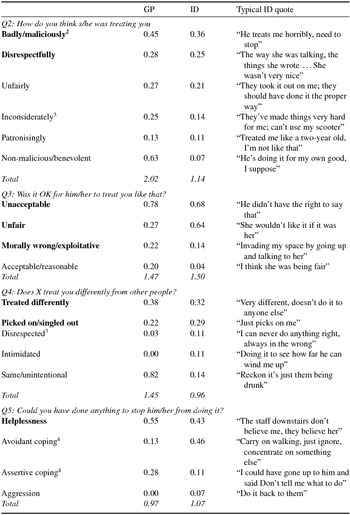
Table 6 summarizes the content analyses of questions 2–5. The two analyses were conducted independently but returned similar sets of concepts. (Except as described in the Table footnotes, the category labels listed were identified in both of the analyses.) The table shows the frequency with which each category of cognition was expressed, along with typical examples, all of which were provide by participants in the ID group. As the total number of scenarios available for analysis differed between the two groups, the numerical data are expressed on a per scenario basis. The items shown in bold represent cognitions that map directly onto the concept that the question was designed to explore, and on which the numerical ratings reported earlier were made: attribution of hostile intent (Q2), unfairness (Q3), victimhood (Q4) and helplessness (Q5).
The most striking feature of these data is the similarity between the cognitions expressed by the two very dissimilar groups of participants. The only notable difference is that the GP group were much more likely than the ID group to attribute benign intentions to the other person in respect of hostility (Q2, non-malicious: 0.63 vs. 0.07) and victimization (Q4, same treatment: 0.82 vs. 0.14), which corresponds to the lower-rated scores by the GP group on these two dimensions (Figure 1). Otherwise, the two sets of data are remarkably similar in respect of both the total number and the distribution of the concepts expressed.
Acceptability
Service users reported a high degree of satisfaction with the PAC/PACS. They all said that they liked the instrument, found it easy to complete, and could not think of anything to change.
The clinicians surveyed had used the PAC between 1 and 3 times. They reported that they found the instrument thorough and well-structured for a person-centred conversation, and liked the use of personally relevant scenarios. Completion was generally straightforward although in some cases service users needed help to understand the concepts (this was more in relation to the PACS than the PAC), and the presence of carers was reported to be helpful. Concerns were expressed about the length of time to administer the instrument (an average of c.25 minutes) and the difficulty of eliciting three scenarios. Clinicians also identified that visual aids to completion and clearer guidance on scoring would be helpful.
Content analysis of responses to PAC scenariosFootnote 1

1 The numerical data shown are the number of responses per scenario in each category identified in the content analyses, followed by the total number of responses per scenario for each question.
2 The GP analysis identified “badly” and “maliciously” as separate categories; they were not separately identified in the ID analysis.
3 In two instances, similar categories have been combined that were described differently in the two analyses. For Q2, the category “inconsiderately” in the GP analysis corresponds to categories labelled “unreasonable” or “irritating” in the ID analysis; for Q4 the category “disrespected” in the GP analysis corresponds to the category “disparaging” in the ID analysis.
4 The categories of “avoidant coping” and “assertive coping” were described together as “adaptive coping” in the ID analysis, and have been separated out post hoc.
Discussion
Reliability of the PAC
In both groups of participants, the PAC showed excellent test-retest reliability for two scenarios (ICC > 0.8), relative to the conventional criterion of ICC > 0.6 (Chinn, Reference Chinn1991), but was much less reliable for a third scenario. Additionally, around half of the participants in both groups were unable to generate a third interpersonal-conflict scenario. Accordingly, the data for scenario 3 were dropped from all subsequent quantitative analyses, and future work with the PAC will ask participants to generate only two scenarios. The ID group in particular showed almost perfect test-retest reliability for the combined scenario 1 and scenario 2 score (ICC = 0.97). As might be expected, reliability was somewhat variable across the four individual cognitive dimensions so caution should be exercised in interpreting the profile of individual scores. However, Q1, anger intensity, was also reported with a high degree of reliability (ICC = 0.8), at least in the ID group. It is striking that on both of the PAC measures, test-retest reliability was higher for the ID group than for the GP group.
The ID group also out-performed the GP group on the consistency of the PAC, with Cronbach's alpha statistic (= 0.75) comfortably above the conventional criterion of 0.7 for a “good” level of internal consistency (Nunnally, Reference Nunnally1978). This could be considered an ideal situation, because, unlike test-retest reliability, where higher means better, a very high degree of consistency is undesirable because this implies that items included in the test may be redundant.
By contrast, consistency was extremely low in the GP group, apparently because there was a negative correlation between Q2-4, which evaluate appraisals of the other person's intentions, and Q5, which evaluates an appraisal of one's own action to relieve the situation. This unexpected finding is difficult to understand and was not clarified by a close reading of the qualitative data for participants showing the most extreme negative relationships. (The disjunction could be characterized at the extreme as “This is a bad situation but I can handle it” versus “I can't do anything about this situation but I'm not blaming”.) However, it is important to emphasize that the two groups differed not only in intellectual ability (and associated lifestyle factors), but also in the fact that the ID group had been identified as having problems of anger control, while the GP group had not. Some studies have indicated that what distinguishes dysfunctional anger from controlled anger is the presence of irrational interpersonal attributions and beliefs (relevant to Q2-4 but less so to Q5) (Eckhardt et al., Reference Eckhardt, Barbour and Davison1998; David et al., Reference David, Schnur and Belliou2002; Martin and Dahlen, Reference Martin and Dahlen2004). It is possible that other- and self-appraisals are normally independent factors (as in the GP group), and that dysfunctional anger emerges (as in the ID group) when these two factors run together, leading to personal resources being overwhelmed by intensely perceived social demands (Deffenbacher, Reference Deffenbacher1999). But whether the differing relationships of other- and self-appraisals reflects the presence of dysfunctional anger in the ID group (perhaps associated with a greater personal meaning of the events described) and its absence in the GP group, or the many other differences between the two groups, remains to be established.
Validity of the PAC
Three aspects of these data bear on the criterion-related, construct and content validity (Kendall, Reference Kendall1984) of the PAC. First, there is evidence of criterion-related validity, insofar as the two groups reported comparable levels of anger intensity, but the ID group, who display problem anger, reported a higher level of dysfunctional cognitions than the GP group, who did not. We acknowledge that the small sample sizes and the non-equivalence of the samples weaken this conclusion. However, the difference was apparent in two of the four dimensions sampled (Q2 and Q4) and in both cases, the lower ratings by the GP participants were accompanied by verbal statements to the effect that the other person's behaviour was not malicious (Q2) or discriminatory (Q4). As all other verbal data collected were very similar between the two groups, this supports the interpretation that the higher ratings by the ID group reflect their status as people for whom anger is problematic, rather than other differences between the two groups.
Second, PAC scores showed an interesting pattern of correlation with other variables. Supporting the construct validity of the PAC, Cognition scores were significantly correlated with anger ratings in both groups, notwithstanding the small sample sizes. Cognition scores were not, however, significantly correlated with most of the other measures. Although the sample size for these computations remained small even after amalgamating the two groups, the lack of significant correlation is unlikely to result simply from a lack of statistical power because many other correlations did achieve statistical significance: in addition to the significant PAC Cognitions vs. anger intensity correlation, there were significant correlations between various STAXI and NAS-PI measures, significant inter-correlations between PAC, STAXI and NAS-PI subscales, and a significant correlation between two measures of anger coping, the PACS and NAS Anger Regulation. There was also a significant correlation in the GP group between the PAC Cognitions score and HIT-Q Blaming Others subscale, as predicted. (The HIT-Q was not administered to the ID group.) Our overall inference from these data is that the PAC has discriminant validity, in that it measures something different from the STAXI and the NAS-PI, each of which includes relatively few items that focus specifically on inter-personal perceptions.
Third, the PACS was designed to have content validity by basing it on four constructs that are well evidenced as characteristics of uncontrolled anger. Evidence that content validity was achieved comes from the content analyses of participants’ verbal responses to the questioning that preceded the ratings, which demonstrate that both groups of participants had a good understanding of the issues that they were being asked to rate. This was never in doubt for the GP group, but was less certain for the ID group. However, there is nothing in the qualitative data to suggest that people with ID understood the issues any less well than the GP group of university students.
In addition to the data reported, the methodology used here may itself contribute to the validity of the PAC. Self-report data are typically captured using either standardized endorsement methods, in which participants are required to respond to a fixed set of items, or ideographic production methods, such as the ATSS (Davison et al., Reference Davison, Vogel and Coffman1997; Zanov and Davison, Reference Zanov and Davison2010), in which participants verbalize their thought processes in a relatively unconstrained manner. While culminating in a standardized set of ratings, the ideographic basis of the PAC scenarios, the conversational style of presentation, and the verbatim recording of participants’ responses mean that the PAC is essentially a production method. It has frequently been reported that production methods can reveal differences in thought processes, including those related to anger, that may go undetected by traditional endorsement methods (e.g. Eckhardt et al., Reference Eckhardt, Barbour and Davison1998; Eckhardt and Dye, Reference Eckhardt and Dye2000; Tafrate et al., Reference Tafrate, Kassinove and Dundin2002; Jones and Trower, Reference Jones and Trower2004), and it has been argued that production methods have greater validity for this reason (Chamberlain and Haaga Reference Chamberlain and Haaga1999; Zanov and Davison, Reference Zanov and Davison2010). The use of content analysis data to understand the difference between groups in two of their quantitative ratings, as discussed above, provides a further example of the greater insight that production methods can provide.
Usability of the PAC
The PAC was field tested by a small group of clinicians, who reported that it was straightforward to use and provided clinical insights. By highlighting clients’ individual concerns and eliciting narratives around specific anger-related cognitions, the PAC may offer a more useful component of a clinical assessment than standard endorsement-based scales. The clinicians’ main criticism of the PAC/PACS was the length of time required to administer it (which at c.25 minutes amounts to half a clinical session). They also reported difficulty in eliciting a third scenario, as was also seen in the psychometric study. These considerations, alongside the inferior psychometric properties of the third scenario, prompted a decision that in future two, rather than three, scenarios should be used, decreasing the completion time for the combined PAC and PACS to less than 20 minutes. (It should be noted that two rather than three scenarios was the basis for the psychometric validation reported.)
Clinicians also commented that visual aids to support the quantitative ratings and greater clarity about scoring would be helpful. These comments identify aspects of good practice and will also be taken on board for future use of the PAC (although, strikingly, even without these enhancements, the test-retest reliability for completion of the PAC by people with ID was almost perfect.)
Service users enjoyed completing the PAC, which, informally, we have not found to be the case when using endorsement-based rating methods. Although clinicians commented that some service users needed prompting to express themselves, it appeared from the content analyses that this was no more the case for service users than for university students, since the frequency of prompting was similar in the two groups. In contrast to standard anger rating scales, which need adaptation to make them accessible to people with ID (Novaco and Taylor, Reference Novaco and Taylor2004), it appears that people with mild to moderate ID have no greater difficulty than university students when describing anger-provoking events in which they have participated, reporting cognitions in relation to those events, and providing reliable ratings of those cognitions.
Conclusions
When questioned in a conversational manner about events in their personal lives, people with ID had no difficulty in verbalizing their beliefs about those situations, and showed no impairment relative to a group of people with above-average IQ. We assume that university students, by and large, have a good understanding of the A-B-C model linking antecedents to consequences via beliefs, and infer that this appears to be equally true for people with ID. Their poor performance on standard A-B-C assessments may reflect the lesser personal relevance of the assessment items, or task demands such as perspective taking or working memory.
The PAC appears to have excellent test-retest reliability in both ID and general population samples, and when completed by people with ID and problems of anger control, the PAC also displayed a high level of consistency. (However, as completed by a group of university students whose anger control was not problematic, the PAC appears to have a two-factor structure: further work will be needed to understand this discrepancy.) Two limitations of the study are the small sample size of the ID group and the non-equivalence of the two groups in factors other than IQ. Despite these limitations, evidence has been presented of validity in the criterion-related, construct and content domains, and that the PAC measures something different from standard endorsement-based rating scales. We also report that the PAC is acceptable to both service users and clinicians, and unlike traditional instruments does not require adaptation for use by people with ID: its particular strengths are personal relevance and the conversational mode of administration. We conclude from this initial study that the PAC may be a useful instrument for both clinical and research purposes. An important first step will be to use the PAC to examine whether anger-related cognitions change during a therapeutic intervention for problem anger.
Acknowledgements
Conflict of interest: The authors have no conflicts of interest with respect to this publication.



Comments
No Comments have been published for this article.