I, [the Peacemaker], and the Union Lords, now uproot the tallest pine tree and into the cavity thereby made we cast all weapons of war. Into the depths of the earth, down into the deep underearth currents of water flowing to unknown regions we cast all the weapons of strife. We bury them from sight and we plant again the tree. Thus shall the Great Peace be established and hostilities shall no longer be known between the Five Nations but peace to the United People.
—Article 65, Haudenosaunee Great Law, as recorded by Arthur C. Parker and Seth NewhouseWhen thou reflectest on the mildness of my habits, my antipathy to scenes of violence and bloodshed, my unacquaintance with the use of fire-arms, and the motives of a soldier, thou wilt scarcely allow credit to my story.
—Charles Brockden Brown, Edgar HuntlyIn the second half of Charles Brockden Brown's novel Edgar Huntly (1799), the peace-loving, benevolence-seeking eponymous narrator wakes in a cave after a sleepwalking episode, buries an “Indian Tom-hawk” in the head of a lurking “savage” (a panther [108, 111]), and proceeds over the course of a few hours to murder five Indigenous people on the Pennsylvania frontier, one with a hatchet and the rest with a rifled musket. The three chapters in which this violence occurs include over forty variants of the words musket, gun, arms, stock, rifle, piece, bullet, and powder (115–34). Narrating these events, Edgar Huntly focuses excessively on the weapons themselves. He details the ways “arms” rest on the ground beside bodies, draws attention to loaded or unloaded stocks, and describes how bullets strike their targets. He finds his own gun among the “Indians,” a discovery that stimulates fantasies of revenge for what he erroneously imagines the Indians have done to his family and home.Footnote 1 His actions in these scenes depend upon the guns’ mechanics: in one moment, he feels he must kill an Indian when he cocks his gun and the sound alerts the man to his presence (133). In this way, the means (guns) help create a situation in which the ends (the killing of “savage” enemies) must occur. The guns inspire decisions Huntly struggles to explain to his fiancée in the novel's first-person, epistolary form: in what Huntly describes as a “freak of fancy” after killing the final Indian, he sticks “his musquet in the ground, and [leaves] it standing upright in the middle of the road” (134).
In many ways, Huntly's actions in these moments are motivated by the weapons that fall into his hands. The guns facilitate a suspension of rational thought similar to sleepwalking, figured in the novel as a state in which the walker is responsive to external objects but unable to navigate social relations. Both Clithero, the Irish immigrant whom Huntly suspects of his friend Waldegrave's murder, and Huntly himself sleepwalk directly past people who try to engage them; Huntly's responses to human suffering after his killing spree suggest that gun usage also, and more insidiously, dulls the social senses. Trying to make his way home through the Pennsylvania wilderness after shooting several Indians, Huntly comes upon a house belonging to an Irish family called the Selbys, where a scene of domestic violence has recently occurred. Inexplicably determining that he can be of absolutely no help or comfort to the wife and child who have taken refuge in the barn, Huntly prepares to move on, but he first sees that the Indians have been here as well: Huntly discovers a Native person face-down near the house, his “musquet” beside him (153). He finds himself “weary of contemplating these rueful objects” and observes that “Custom” has, “even in so short a period, … inured [him] to spectacles of horror.” “Callous” and “immovable,” Huntly snatches up the gun for his “defence,” then quickly leaves the scene (153). Responsive to the weapon but not to the broken family relations or the murdered man, Huntly shows that his personal “defence” is a retreat from sympathy and human connectedness, the touchstones of eighteenth-century philosophical inquiry that ostensibly drive the novel.
Scholars have paid much attention to Edgar Huntly's violence (Ogden 426, 436–38; Gardner 69–70; Slotkin 382–90), but almost none at all to his guns.Footnote 2 Yet guns carry particular weight in a novel concerned with what Brown calls “springs of action” (Edgar Huntly 3): the forces (social, psychological, emotional) that motivate and clarify human behavior. Written at a time when “the meaning of arms bearing was not static … but evolving” in political and juridical discourse (Cornell, “Right” 34),Footnote 3 Edgar Huntly displays gun culture's pernicious effects on human sensibilities. For Huntly, a character with constantly wavering motives and responses—indeed, it is impossible to define him as, in today's National Rifle Association (NRA) parlance, a good guy or a bad guy—the question of the consequences of accessibility to weapons is paramount. Anticipating Bruno Latour's concern with “what things make us do,” the novel's protagonist transforms when he grabs hold of a gun (178).Footnote 4 He exhibits a degree of what Roxanne Dunbar-Ortiz calls “gun love” in her analysis of her own 1970s “women's study-action group” that fell “under the spell of guns” as the women held them, cleaned them, loaded them. The group's relationship to guns, Dunbar-Ortiz writes, became “a kind of passion that was inappropriate to [their] political objectives, and it ended up distorting and determining them” (14). Edgar Huntly constantly calls attention to the ways his murderous actions belie his principles and education: the guns and accompanying claims of self-defense amplify the inconsistencies in his moral claims, and he is never able to offer satisfying explanations for his behavior.
Concerned not only with guns but also with “Indian hostility” (Brown, Edgar Huntly 4), and American national identity (Gardner 53–54; Goudie 64; Levine 17–65), Edgar Huntly is a promising starting point for a literary archaeology of American gun culture and its ties to settler colonial violence.Footnote 5 Yet the theoretical concerns that interested Brown did not originate with white philosophical and political inquiry. One key lesson of Edgar Huntly is that, just as its protagonist's understanding is clouded by access to guns, so too its Eurocentric viewpoint cannot alone help us think through early American gun violence. Huntly's relationship to guns is accompanied by a limited perspective on Indigenous people; for all of Huntly's moralizing about his own actions, the novel draws from Euro-American philosophy and captivity narratives in which Indians appear as irrational aggressors or targets rather than subjects whose actions come under philosophical scrutiny. In contrast, a long-standing archive of Indigenous materials, philosophy, and story reveals that the Lenape (Delaware).Footnote 6 Indians depicted in Edgar Huntly were one of many Native nations whose approach to transnational relations in the eighteenth century emphasized burying, not embracing, the weapons of war and highlighted precise objects of communication conducive to peace. Recognizing the fundamental problem of human frailty (McCarthy 131), these Indigenous communities accepted the need to put weapons out of sight in order to cease hostilities. At the same time, they brought other objects into view, such as wampum, that invited intimacy and clarity. As Christine DeLucia observes, Indigenous communities were “highly savvy producers and users of material objects” (110); they were also profoundly aware of the ways certain objects inspire certain types of actions. The images woven into wampum belts, often used to initiate or maintain relationships between people and between nations, recognized distinct polities and worldviews as well as “a shared identity as humans” (Kelsey 2).Footnote 7 The materials from which these belts were made, the ways they moved, and the ways they were handled underscored this common humanity and its relation to other, nonhuman entities. Even as they took up guns for the purposes of hunting and warfare (Silverman), Native people used wampum belts not only to keep records of treaties but also to induce posturing and positionality appropriate to the work of human connection. A key mechanism of Indigenous diplomacy, wampum required ongoing return to the archives and actions of peace.
Indigenous articulations of the relationship among weapons, alternative objects, and human subjectivity challenge the European epistemic foundation of scholarship on early American literary, intellectual, and legal history (Barnard et al. x; Kamrath xii; Ogden; Cornell, Well-Regulated Militia),Footnote 8 as well as the texts and contexts that inform crucial legal decisions regarding rights to “self-defense” (District of Columbia v. Heller). More attention to Indigenous epistemologies is needed to counter the ongoing popular association among Indians, the wild “frontier,” and the nonhuman. In the eighteenth-century philosophy that informs Brown's novel—and indeed in the twenty-first-century popular imagination of the past—Indians are hostile enemies to defend against rather than subjects entitled to their own self-defense (Tweedy 696). Non-Natives’ “fears of ‘hostile’ Indians at least partially motivated the Framers’ commitment to a right to bear arms” (Riley 1677; Tweedy 698–700), and these fears continue to inform white gun culture and discussions of the Second Amendment. The landmark 2008 Supreme Court case District of Columbia v. Heller, which “interpreted the Second Amendment as an individual right to possess a weapon for self-defense outside of the context of service in a well-regulated militia” (Cornell, “Right” 11), included a discussion of self-defense from Indians. In oral arguments, Anthony Kennedy asked the District of Columbia counselor, who had argued that the Second Amendment was limited to a military context, whether the amendment “had nothing to do with the concern of the remote settler to defend himself and his family against hostile Indian tribes and outlaws, wolves and bears and grizzlies and things like that” (Tweedy 694). These associations permeate American gun culture today, evident in the names of such shooting ranges as Frontier Justice (Kansas City, KS), Frontier Sportsman's Club (Colorado Springs, CO), and Frontier Firearms (Knoxville, TN). As Jodi Byrd has observed, “In the United States the Indian is the original enemy combatant who cannot be grieved” (xviii). Americans’ sense of entitlement to self-defense—which has in recent decades “emerged as the dominant reason for American gun ownership” (Carlson and Goss 103)—relies on the erasure of Indigenous peoples’ humanity, including their sophisticated philosophical approaches to central human questions.
Acknowledging historical Indigenous object orientations and approaches to peace and defense is a step toward meaningful recognition of Native communities’ defense of environments and bodies in America today. Indigenous people work tirelessly to reclaim control over and recognition of objects such as wampum belts and, by extension, the epistemologies and sovereignties those objects enable (Hill, “Regenerating Identity”; Kelsey xiv–xv). As I detail below, wampum comes from water and highlights human integration with nonhuman actors, a fact with wide-reaching implications. For instance, when in early 2016 members of many Indigenous communities gathered near Lake Oahe to protest the Dakota Access Pipeline, they came together to “protect the water,” which “is animated and has agency; it streams as liquid, forms clouds as gas, and even moves earth as solid ice—because it is alive and gives life” (Jensen, par. 3; Estes 9). Indigenous scholars and authors have drawn attention to the entanglement of gun violence with the historical and ongoing oppression of Indigenous bodies and the environments that sustain them (Deloria 20–21; Jensen). Meanwhile, the NRA presents its efforts to ensure gun accessibility as a protection of civil rights.Footnote 9 The popular pro-gun-rights talking point “Guns don't kill people; people kill people”—recently echoed in President Trump's response to the 2019 El Paso and Dayton mass shootingsFootnote 10—willfully denies guns’ long-standing participation in fostering white, male, patriarchal, colonialist mentalities. What would it mean to actively bury the weapons of war, as the Haudenosaunee Peacemaker proposed, even as we might analyze the killer's mind and morals, as Edgar Huntly does? Such a question requires us to reassess the colonial environment of the past; it might also challenge the conversation surrounding gun violence today.
Guns, Indians, and Humanity in the Euro-American Archive
Brown's notice “To The Public” that precedes Edgar Huntly proclaims “incidents of Indian hostility, and the perils of the western wilderness” to be most “suitable … ingredients” (4) for an author tasked with “calling forth the passions and engaging the sympathy of the reader” (3). In line with this turn to Indian aggression to enliven the (presumed non-Native) reader's “passions” and “sympathy,” the novel unfolds with an act of gun violence that displaces transnational Indigenous diplomacy. The novel begins with Huntly's return to the scene of his friend Waldegrave's murder, where he attempts to uncover some new knowledge of the killer. This scene unfolds by “the Elm,” associated with “the famous Treaty Elm where, according to legend, William Penn founded Pennsylvania by signing a treaty of peace with the Delaware Indians” (8n5). As he approaches this site famed for Indigenous-European peacemaking, Huntly observes the Irish servant Clithero, in a state of sleepwalking, digging into the ground under the elm, seeking to literally unearth something that he cannot uncover. We do not learn until the end of the novel that Waldegrave was murdered at the elm not by Clithero but by a Native person with a pistol, in what is described as a random assault on “the first human being” the Native met, in order to satisfy his desire for vengeance against white settlers in the region (187). This act of gun violence propels the novel's action, overriding the history of Indigenous diplomacy referred to at the elm.
Having seen Clithero sleepwalking at the site of the murder, Huntly begins a relentless quest to uncover his motivations. Clithero, an Irish foreigner in Huntly's Pennsylvania neighborhood, tells Huntly the long story of what led him to leave Ireland—how he had received a wealthy patroness's attentions, as well as her daughter's love, only to ruin these relationships by murdering the patroness's beloved yet evil twin brother in self-defense and then killing the patroness too, because he believed she could not withstand the death of her twin (46–62). This kind of deep digging into a stranger's past, this sharing of words that moves Huntly to help the troubled outsider who, it now seems, has not murdered his friend, is not extended to the novel's Native characters. These violent aggressors Huntly meets later in the book have a motive briefly and imprecisely articulated by Huntly himself, since they themselves never speak: they are “exasperated” by “a long course of injuries and encroachments” (116). And, we learn as soon as Huntly encounters them, they possess the tools for vengeance. In his first view of the Indian party he exterminates, Huntly observes “four brawny and terrific figures, stretched upon the ground. They lay parallel to each other, on their left sides; in consequence of which their faces were turned from [him]. Between each there was an interval where lay a musket. Their right hands seemed placed upon the stocks of their guns, as if to seize them on the first moment of alarm” (115). The Indians’ mechanical “arms” extend their corporeal limbs.
In its immediate association of Natives with technologies of violence (a pistol, stocks, guns) rather than sympathetic conversation and the potential for reconciliation, Edgar Huntly joins (and perhaps critiques) a vast array of Euro-American narratives that amplify Indigenous aggression while obscuring Indigenous motivations. In Our Beloved Kin: A New History of King Philip's War, the Abenaki scholar Lisa Brooks seeks to “animate the historical landscape through Indigenous frameworks and to give a sense of humanity to historical characters whose stories have been silenced, repressed or misunderstood” (140). Brooks observes that in the events leading up to what is known as King Philip's War, many of the Indigenous people at the Wampanoag settlement of Pocasset “had lost family, acts of war that had been answered not with violence but with gritty tolerance and determined diplomacy” (141). Puritan narrators of the war eliminate such peacemaking efforts. Likewise, seventeenth-, eighteenth-, and nineteenth-century captivity narratives present Indians as intimately connected to violence; in such narratives, Indian bullets fly senselessly and Indians indiscriminately dash babies against walls, bury their hatchets in people's brains, and torture prisoners.Footnote 11 Edgar Huntly, associated with Quakers whose moral scruples about violence and war raised significant questions about armed “defense” of the Pennsylvania colony,Footnote 12 only vaguely considers Indigenous motivations and quickly arms himself against the Natives’ supposedly inevitable vengeance (116).
One essential quality of Huntly's narrative is its one-sidedness as a story told almost entirely in one letter, whose author is alone much of the time and blind to the broader social structures and series of events informing his experience and actions. Huntly privileges his own motives, which are largely based on false assumptions, and he never attempts to initiate dialogue with the Native people he encounters. Even the early forms of firearms portrayed in Edgar Huntly are a fitting tool for such a situation: one of many weapons that might kill, guns allow dissociation from the victim. The “rifled musket” Huntly employs enabled accuracy at a distance (Lansford); as John Adams remarked in a 1775 letter to his wife, Abigail, the “peculiar kind” of firearm called a “Rifle,” has “circular grooves … within the Barrell, and carries a Ball, with great exactness to great Distances.” The “Rifle Men” being sent to the “American Army” from Pennsylvania, Maryland, and Virginia, he wrote, “are the most accurate Marksmen in the world.” When Huntly kills three Indians from a distance as they emerge from the hut of the Lenape leader “Old Deb,” he describes the shots thus: “I fired, and my enemy sunk upon the ground without a struggle,” “The ball entered above his ear,” and “he received my bullet in his breast” (127). This language of entering and reception conveys a perverted sense of intimacy, in which the bullets make contact while, in contrast, Huntly detaches himself from the thoughts, words, and motivations of these “four antagonists, trained from their infancy to the artifices and exertions of Indian warfare” (129).
Huntly's experience of Indians as violent aggressors echoes portrayals of “savages” in political and philosophical treatises related to war and defense. Revolutionary-era calls to arms claimed Indigenous lands as American “property” and declared the British and the Indians to be inhuman threats to that ownership. In his 1775 essay “Thoughts on Defensive War,” Thomas Paine addressed Pennsylvania's Quaker, pacifist legacy by appealing to fear of an “unprincipled [British] enemy” that “nothing but arms or miracles can reduce … to reason and moderation. They have lost sight of the limits of humanity” (55). Paine claims that the British want only economic control over America's “property” (56); he further develops this defense-of-property argument in his first “Crisis” essay, printed in The Pennsylvania Journal in December 1776: “Not all the treasures of the world, so far as I believe, could have induced me to support an offensive war, for I think it murder; but if a thief breaks into my house, burns and destroys my property, and kills or threatens to kill me, or those that are in it, and ‘bind me in all cases whatsoever’ to his absolute will, am I to suffer it?” (“Crisis I” 176–77). The concluding paragraph of the essay connects this need for defense directly to Indians: “Ye men of Pennsylvania, do reason upon these things! Were the back counties to give up their arms, they would fall an easy prey to the Indians, who are all armed: this perhaps is what some tories would not be sorry for” (177–78). The accusations against the British monarch in the Declaration of Independence include that he “has endeavoured to bring on the inhabitants of our frontiers, the merciless Indian Savages, whose known rule of warfare, is an undistinguished destruction of all ages, sexes and conditions” (431). Brown himself echoed this depiction of Indians in an 1803 pamphlet on the Louisiana Territory that has been read as nationalist and antialien (Gardner 55–56) and, conversely, as “an ethical challenge to forms of nationalist exceptionalism” (Levine 26). In it, a French minister of state's fictional letter advocating for a French takeover of Louisiana calls Indians “dangerous inmates” whose “restless and warlike habits” and “notions of ancient right” make them highly threatening to “the states” (Address 45). Then, an American narrator qualifies and refutes some of the fictional Frenchman's claims regarding the national weakness of the United States, even as the narrator reasserts that “the Indians have ever been destructive neighbors” (48). The notion of always armed, innately destructive Indians lays the foundation for nationalist calls to armed defense in the United States.
Such arguments are tied to assumptions in eighteenth-century European philosophy about the nature of humanity. In a chapter of his Essays on the Principles of Morality and Natural Religion (1779) called “Of the Law of Nations,” the Scottish judge Henry Home, Lord Kames, shares Brown's interest in “the motives by which the agent is impelled to the performance of actions,” which, in Brown's view, “cannot be certainly known” (Brown, “Difference” 234). Home describes “man” as “a complex machine, composed of various principles of motion, which may be conceived as so many springs or weights, counteracting or balancing one another.” Problems arise if “some springs or weights [are] withdrawn.” If, for instance, “those principles of action … directed to general and complex objects” and “conducted by reflection” are removed (as they are when Edgar Huntly sleepwalks), then “the force of the appetites and passions, which act by blind impulse, will of course be doubled.” “This,” Home avers, “is the character of savages,” who “abandoning the authority of reason, surrender themselves to every appetite” and “have no consistent rule of conduct” (95): they desire “unbounded revenge for the smallest injury” (97). Applying this theory to wars between nations, he observes that despite the intentional killing of enemies, morality is preserved by civilized nations’ treatment of individuals: “we treat the prisoners of war with humanity” (100). Known in particular for their presumed cruelty to captives, Indigenous people offer a counterpoint to this reclamation of humanity in times of war.
By “general and complex objects,” Home means abstract conceptual frameworks that guide one's actions. He does not consider a causal relation between material object and action, the way a particular technology might figure into human motivations and compel certain behaviors. Relatedly, he assumes a lack of Indigenous ideals, principles, and moral foundations. Such theorizing obscures established Indigenous mechanisms that balance the “complex machine” of humanity and counteract the “force of the appetites and passions” by acknowledging the ways objects, with their particular material properties and moral associations, can frame human rationality. As they confronted the challenges of human shortcomings, both before and during European colonization, Indigenous nations cultivated philosophical approaches to peace and technologies of diplomacy (Williams 5; McCarthy 131). These practices challenge Eurocentric readings of the early American fictional and documentary history concerning weapons and defense. Like Paine's and Home's writings, and like the broad range of Euro-American captivity narratives, Brown's depiction of his fictional Indians and his character Edgar Huntly's one-sided, uninformed response to them erases this history, even as the novel potentially invites critical reflection on English colonialism and Indigenous dispossession (Kamrath 46; Hinds 340; Barnard and Shapiro xlii; Luck 298). The novel thus archives a pervasive set of assumptions about who counts as a theorist of human subjectivity.
Wampum, Weapons, and Peacemaking Formations
The Lenape (Delaware) people referred to in Edgar Huntly had important diplomatic ties to many other Native nations, including the Haudenosaunee (also known as the Six Iroquois Nations), the Shawnees, the Wyandots, the Miamis, the Cherokees, and the Ojibwes. These nations’ diplomatic protocols integrated emphasis on interhuman relationships with recognition of human beings’ relationships to nonhuman, material, and sacred beings. In diplomatic conferences, the participants brought forth objects and materials that drew attention to these relationships in order to promote clarity, intimacy, and conversation, and they buried or removed others that inspired animosity. Wampum belts, constructed of purple and white shell beads woven or strung with sinew, hemp, or other materials, served a crucial purpose in diplomacy.
Wampum has long held specific, diverse meanings in different Indigenous nations. As the Tuscarora scholar Richard Hill, Sr., observes, wampum beads, strings, and belts have served as sacred objects, repositories of knowledge, and communicative devices in “the Iroquois, Huron, Ojibwa, and Algonquian nations” (“Regenerating” 131). Wampum has also connected various nations in expansive networks. Brooks emphasizes that “all wampum originated in the sea” and traveled riverine routes of exchange “that connected the interior forests to the coast” (Common Pot 54–55). Wampum belts’ ribbonlike form simulates a river, a “navigable waterway” that “facilitates the mutual meeting of nations,” as the nineteenth-century linguist Jean-André Cuoq put it (qtd. in Bruchac 100). Margaret Bruchac, an Abenaki scholar, connects this water property to the “inherent animacy … of the objects themselves” and writes that “[f]rom an Indigenous ontological perspective, wampum belts embody the literal weaving together of thoughts from living human beings and materials from living marine, floral, and faunal beings” and are “entangled in social (and not just material) relationships with the non-human persons … who provide the raw materials.” Moreover, as objects “both imbued with meaning and embodied with memory,” wampum belts “can potentially recall and communicate” their own histories: they might be viewed by contemporary Indigenous people as ancestors, relatives, and informants (69). Far from the museum relics that they are often portrayed to be, wampum belts are “animate beings” and “partners in diplomacy” (100). A Haudenosaunee account even proclaims wampum held in one's hand during a condolence ceremony to be the equivalent of a “human being” and thus suitable to addressing a human loss (Hewitt 17).Footnote 13
Indigenous diplomats called upon these properties of wampum to help them remove grief, stress, and any object inconducive to peace from treaty councils. In his observations on Delaware treaty councils, the eighteenth-century Moravian missionary John Heckewelder notes their “custom … to remove out of the place where the peace-makers were sitting, all warlike weapons and instruments of destruction, of whatever form or shape.” Doing “good work” requires that nothing “bad … be visible,” the diplomats told him: “We are met together to forgive and forget, to bury the destructive weapon, and put it quite out of sight.” “So particular were they on this point,” Heckewelder continues, “that if a single weapon had been in sight, while a treaty was negotiating, it would have disturbed their minds by recalling the memory of past events, and instead, (as they say) of gladdening their hearts, by the prospect of a speedy peace, would, on the contrary, have filled them with sorrow” (185). Native people (and, following the required protocol, Euro-American diplomats) who wished to end war used wampum belts to symbolically wipe away any splatters of blood and to bury weapons and the bones of the dead deep underground. In this way, the memory of them would be “forever lost,” “no further mention” might be made of them (Le Moine 93), and the diplomats’ “grandchildren” would never see them (Hewitt 13). When the Oneida leader Thomas King “went about the work of peace” between fourteen Indigenous nations and delegates from the British colony of Pennsylvania at Lancaster in August 1762, he used a wampum belt to “take the Hatchet out of” the Pennsylvania governor's “Head.” He then gathered the bones of the dead, stating:
There is a large Pine Tree in the Oneida Country, which I take and pull up by the Roots, and then it makes a great Hole; when I look down the Hole, I see a great River, running very strong at the Bottom. By this Belt I gather all your Bones, wherever I can find them, and bury them in that Hole, and the Hatchet with them; when I put them down the Hole, they fall into that strong Stream, and float down it, I know not where. I stick that Pine Tree down again in the same Hole, and then no Body can discover that there has been a Hole, so that neither you nor I, nor our nor your Grandchildren, shall ever be able to know where your bones are laid. This is the Custom of our Forefathers, that when any Difference arose between them and their Brethren, they buried it in this manner.” (“Minutes of Conferences Held at Lancaster” 280)
The speaker quotes article 65 of the Great Law of the Haudenosaunee Confederacy (Parker and Newhouse 49; Wallace 78), cited in this essay's epigraph, which relies on earth and trees to cover dead bodies and weapons, and on water to carry away past deeds that might motivate revenge. Human beings call on nonhuman entities to mitigate human offenses. Notably, King also requests arms for his people at this council and calls out colonial officials for providing gun locks but no guns (Boyd 281). Guns were a necessity in the climate of settler colonial violence; weapons burial and wampum delivery were meant to enact other possibilities, to return to the prospect of peace and connection rather than deception and aggression (Porter 302–03).
The Haudenosaunee (Iroquois) Peacemaker epic perhaps most profoundly articulates the ways wampum's physical properties and handling by human beings helped end cycles of revenge and prevent violent conflict.Footnote 14 In this story of the foundation of the Haudenosaunee Confederacy—an alliance of the Mohawk, Oneida, Onondaga, Cayuga, and Seneca nations, later to include the Tuscarora, that likely dates to the twelfth century—the Peacemaker, sent by the Creator, comes to heal a people constantly at war, among whom violence has become commonplace. He collects wampum for this purpose (Porter 284). In an iconic scene of condolence, the Peacemaker uses wampum to clear the mind of Hiawatha, a man in deep grief after his wife and children have been murdered. Hiawatha wanders aimlessly and yearns for an embodied encounter with objects and words of condolence: when he finds wampum on the bottom of a lake, he strings it on rushes, hangs the strings on crotched sticks, and declares that, if he finds another in deep grief, he will “take these shell strings in my hand and console them. The strings would become words and lift away the darkness with which they are covered. Holding these in my hand, my words would be true” (Wallace 54). The Peacemaker overhears Hiawatha's lament and his call for an exchange of wampum; he then speaks the condolences to Hiawatha using the wampum, thus clearing his mind of grief (Parker and Newhouse 20; Wallace 51–57; Porter 295–97). This moment laid the foundation for the condolence ceremony that became an essential component of Haudenosaunee diplomacy. Use of wampum reminds the condoler of the words contained in it, as well as the contact necessary to console: the strings are handed to the bereaved, who offers a reply as he hands them back (Parker and Newhouse 24). This and other ceremonies, continued today in the Haudenosaunee Confederacy, recognize that while suffering clouds the mind, the clear-minded can restore sufferers to their true potential by acknowledging “the interrelatedness of word, thought, belief, and action” (Alfred 15).Footnote 15
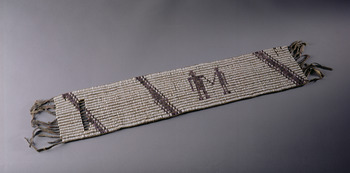
Wampum's power to clear the mind, enact purposeful intentions, and participate in the work of human connection is underscored in patterns woven into diplomatic belts. These include lines that represent paths between nations and configurations of human figures holding hands (figs. 1 and 2). The Moravian missionary David Zeisberger, who worked among Lenape and other Native people in the second half of the eighteenth century, described the common “Road Belt” (fig. 1): “This is a white belt with two rows of black wampum running the entire length with a white row between the two black rows also running the entire length of the belt. This signifies the way from one nation to another has been cleared of all brush, trees and stones. At the ends of the belt the two nations are likewise represented by two small dark spots.” In contrast, a predominantly black or purple wampum string or belt is “intended to confirm a warning against evil or an earnest reproof” (95). The colors, which are contained in the same quahog shell, convey the inevitable coexistence of peace and violence and the need to constantly return to and renew peaceful relations: purple wampum surrounding white villages might convey a troubled environment surrounding peaceful communities, while the white wampum traces among this background suggest the ongoing potential for peace.
An example of a “road” wampum belt. Courtesy of the Penn Museum, object no. NA9143.

A wampum belt that is said to have been given by the Lenape to William Penn at the signing of a treaty. Philadelphia History Museum at the Atwater Kent. Courtesy of Historical Society of Pennsylvania.
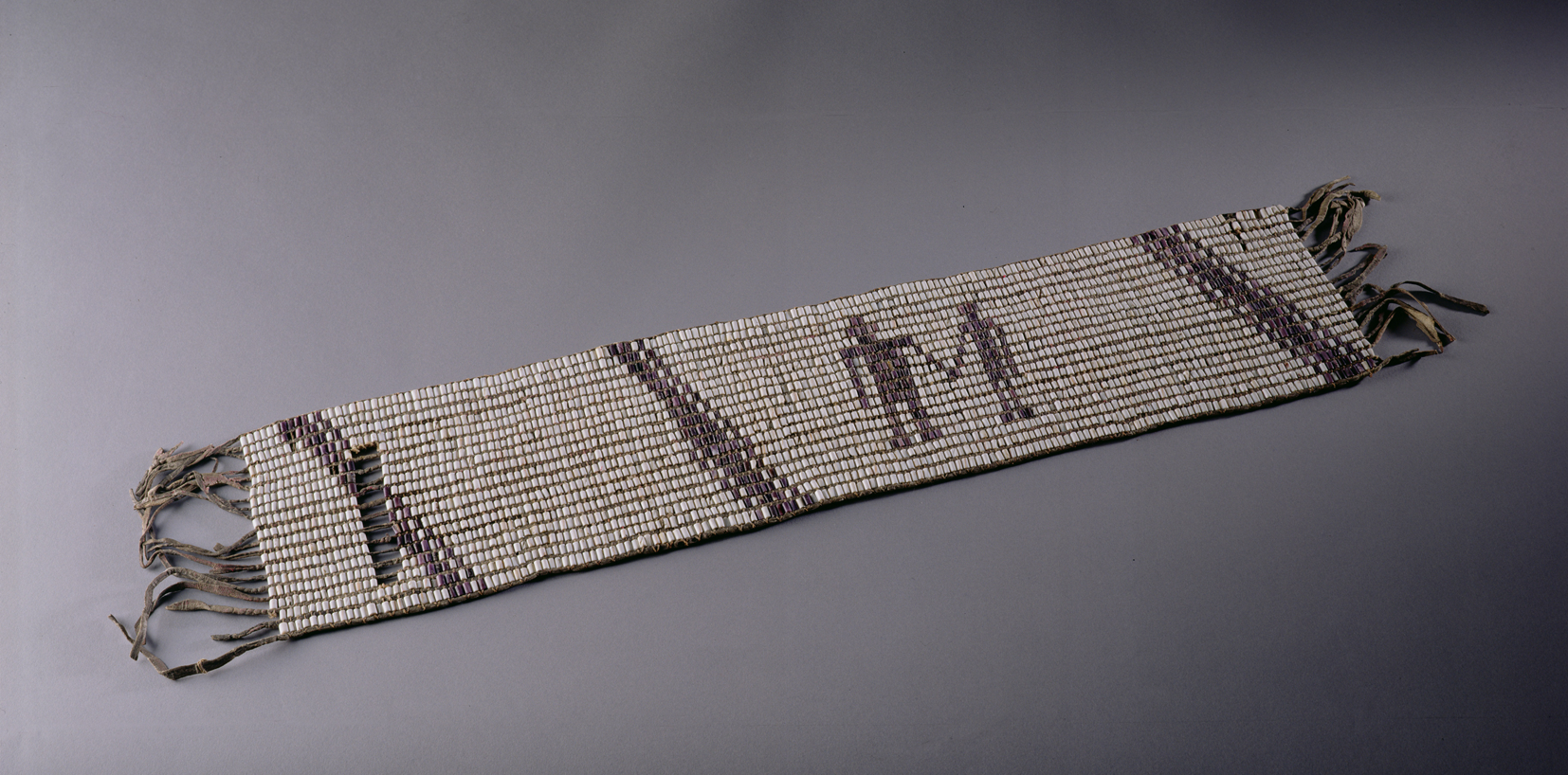
A “Road Belt” also situates an alliance within a broader network, whether of towns, nations, institutions, or other-than-human beings. Modern Indigenous communities continue to use such belts in ways that convey their historical functions. For example, Hill recently delivered a belt to the American Philosophical Society (APS) in Philadelphia representing a partnership between Six Nations Polytechnic and the APS (fig. 1). The belt design, based on an eighteenth-century belt that linked the Oneida and Stockbridge nations, in this case represents two “houses” of knowledge connected by a path, the weave of the belt trailing off either end signifying connections to other archives and communities on either side. The belt conveys how a single alliance is situated in and enlivened by many other relationships. The belt also makes clear that this particular alliance has to be continuously renewed and maintained: in an interview recorded by the APS, Hill explains, “[W]e have to make sure that path is always clear. When things would get interrupted we would polish that chain or knock that dust off of the wampum belt, which means that we won't let anything stand in the way of us having an ongoing friendship” (Interview).
Keeping the path clear involves meticulous attention to a belt's physical properties. Wampum belts in museum and tribal archives show signs of careful repair over time, as they are meant to be brought out and handled frequently but are also a crucial documentary record that Native people have assiduously preserved (Bruchac; Kelsey 2–5). In 1748, Wendat officials demonstrated such archival attentiveness in the service of peace when they showed the interpreter Conrad Weiser a belt they had kept for fifty years that signified a treaty of friendship “with the Governor of New York at Albany.” The belt, “25 Grains wide and 265 long,” consisted of “Seven Images of man holding one another by the hand,” representing the New York governor, the Mohawks, the Oneidas, the Cayugas, the Onondagas, the Senecas, and the Wendats. The belt included “two rows of black wampum under their feet through the whole length of the belt to signifie the road from Albany through the five Nations to the Wantats.” The Wendats further explained that they had traveled that road “Six years ago” when “they had sent Deputies to Albany with the same Belt to Renew the friendship” (Weiser).
The human figures holding hands on such a belt (fig. 2) echo the ways wampum belts require proximity, touching, cleaning, and passing back and forth and thus guide people into peacemaking formations. Belts might be delivered tied together (Post, “Second Journal” 114), or those delivering them might hold hands (“Minutes of Conferences Held with the Indians at Easton” 194, 210–11) to further convey the crucial relation between material object, physical posture, and the “general … objects” (to use Home's phrasing) represented on the belts: peace, connection, humanity, respect. When Edgar Huntly picks up a gun, he immediately distances himself from the gun-toting Indians he has just encountered. His actions take shape around weapons that maintain the mythological space of the “frontier” by perpetuating presumed, inherent difference. In contrast, receivers and delivers of wampum spent much time together considering the physical properties of belts. In 1764, the Protestant missionary Samuel Kirkland observed a meeting at Kanadesaga in the Seneca nation where his message belt was “passed round the whole circle.” Kirkland writes, “Some would stroke it up and down with the hand and perhaps make some remarks—others would only look upon it apparently with intenseness of thought and not open their lips and then passed it to the next” (13–14). Zeisberger described in contrast how a message might be rejected: “the chief does not take the belt into his hands but pushes it to one side with a stick, in which case no one will touch it. The messenger who has brought it must in this case take it back” (94). Such acts of touching, gazing upon, stroking, or refusing to lay hands on a belt acknowledge the work and power that lie within it; as Hill notes, “wampum can actually capture the words spoken” (Interview).
In what often became tense negotiations in the context of settler colonialism and the wars of empire, belts literally carried the weight of difficult relationships and corresponded in size and dimension with the import of the situation. At a conference at Easton in 1756, the Delaware leader Teedyuscung displayed a belt that “[held] together ten Nations,” including the English, French, Delaware, and the Haudenosaunee. He suggested the precariousness and complexity of peace among such nations, declaring to the Pennsylvania officials, “[S]ee the dangerous circumstances I am in; strong Men on both Sides; Hatchets on both Sides; whoever does incline to Peace, him will I join” (“Minutes of Conferences Held with the Indians, at Easton” 144–45). Speaking in private after this display, Pennsylvania officials, the Haudenosaunee representative Captain Newcastle, and the interpreter Conrad Weiser considered whether it would be proper to keep this belt or return it. Newcastle advised that it ought to be “preserved among the Council Wampum, being a Belt of great Consequence,” and that another of equal weight must be returned to Teedyuscung the following day (Boyd 146–47). Weiser concurred, noting that “the French gave great Quantities of Wampum to their Indians, and on Matters of Consequence their Belts were several Fathom long, and very wide.” The council sent a messenger to Bethlehem who returned with five thousand white wampum, “upon which Indian Women were employed to make a Belt of a Fathom long, and sixteen Beads wide; in the Center of which was to be the Figure of a Man, meaning the Governor of Pennsylvania, and on each Side five other Figures, meaning the ten nations mentioned by Teedyuscung” (Boyd 147). Concerns about the material properties of the response belt guided an extensive, collaborative effort to maintain the peace.
At one point, Teedyuscung, suspicious that the colonists were holding another council without him, burst into the room, declaring, “I desire all that I have said, and you have said to one another, may be taken down aright; some speak in the Dark; do not let us do so; let all be clear and known. What is the Reason the Governor holds Councils so close in his Hands, and by Candle Light?” (Boyd 147).Footnote 16 Teedyuscung assumed that the governor had called the women there for a council without his knowledge; after the governor explained that they were “sent for to make a Belt, not to Council,” Teedyuscung was satisfied. Although not always successful at defusing the tensions of colonial negotiations, wampum guided an effort to invite clarity and intimacy in these negotiations, a direct counter to speaking and acting “in the Dark.” These exertions to put forth and preserve the healing properties of wampum were omitted, ignored, or overlooked in countless early American documents that remove Indigenous humanity in the creation and defense of an American nation.
Bearing Arms in Edgar Huntly
Far from being buried out of sight, weapons appear, reappear, and seem to multiply in Edgar Huntly's scenes of frontier violence; one is always at the ready when Huntly wonders how to act. In the midst of his “defence” against Delaware assailants, for instance, Huntly's thoughts yield “to an expedient suggested by the sight of [a] gun” in front of him (128). The weapons possess an agency of their own: diction such as “My arms were ready for use” and “A shower of bullets fell upon the water” is common in Huntly's narrative (146, 147). This availability and activity of weapons reinforce Huntly's and other characters’ inclinations to act precipitately, without full knowledge of the given circumstances or presence of mind. Huntly participates in a cycle of vengeance that was the exact target of Native diplomatic practices involving wampum. As they buried vengeful thoughts and the weapons of war by crafting and handling wampum belts, Indigenous diplomats worked against the practices of impulsive decision-making that preoccupy the latter half of Edgar Huntly. Here, I return briefly to the novel to show the crucial relevance of these Indigenous approaches to even the texts and theories that fail to engage them. The second half of Edgar Huntly investigates the behavior that accompanies “being armed” (131): its theorizations of gun culture are clarified in conversation with Indigenous object orientations and theoretical approaches to peace and defense.
Huntly's encounters with weapons begin when he sleepwalks and wakes in a pit in an immense cavern, surrounded by complete darkness. Finally escaping the pit after several “laborious efforts” (111) to scale its sides, Huntly immediately comes upon a panther in the cavern and remarks, “The first impulse was to arm myself against this enemy” (111–12). He proceeds to kill the panther with an “Indian Tom-hawk” (108) he found next to him in the pit and then consumes the panther raw. Although popularly associated with Indians (the word tomahawk itself is Algonquian), the steel tomahawk/hatchet that became the symbol of Indian warfare was an intercultural rather than an “Indian” weapon, the steel head having been introduced by Europeans (Stevens 481). The hatchet's prominence in symbolic burials of weapons throughout colonial treaty negotiations (from which we get the phrase “bury the hatchet”) suggests a shared responsibility for violent behavior, a recognition by both parties of their role in past violence and future peace. Huntly's tomahawk is, in contrast, immediately drawn into relation with firearms and contributes to his mounting concerns with revenge and “self-defense.”
As he proceeds through the dark cavern looking for a way out, Huntly is drawn by firelight to “the entrance of a cave” that opens to the outside (114). Here, Huntly encounters four sleeping Indians, their firearms alongside them, and a young girl they have captured. Sneaking by them to escape, and picking up one of their guns on the way, he finds a fifth Indian outside, seated near a “torrent” of water (118). On the brink of a thirst-induced delirium brought on by having gorged himself on raw panther meat, Huntly considers his options for getting to the water. He realizes that the “piece which [he] held in his hand was cocked. There could be no doubt that it was loaded. A precaution of this kind would never be omitted by a warrior of this hue.” “Perhaps,” he writes to his fiancée, “you will conceive a purpose like this to have argued a sanguinary and murderous disposition. Let it be remembered, however, that I entertained no doubts about the hostile designs of these men. This was sufficiently indicated by their arms, their guise, and the captive who attended them.” Gun in hand, Huntly also links these men to the traumatic loss of his parents in an Indian attack: “I was not certain but that these very men were the assassins of my family, and were those who had reduced me and my sisters to the condition of orphans and dependents.” He reconsiders use of the gun, however, for “the discharge of a musquet would only alarm the enemies which remained behind,” and he “had another and a better weapon in [his] grasp,” the hatchet, which “could rive the head of” the enemy without attracting attention (119). Together, gun and hatchet inspire Huntly's murderous orientation.
Associated with combative behavior and violence-producing objects, Native people create the circumstances in which they are killed. Without further hesitation, Huntly delivers a “stroke” and his “hatchet burie[s] itself” in the Indian's “breast” (120). The human-object collaboration here (the hatchet, associated with the Indian, seems itself to actively complete the deed) echoes Huntly's justification for it: “How otherwise could I act?” he wonders. “The danger that impended aimed at nothing less than my life. To take the life of another was the only method of averting it. The means were in my hand, and they were used. In an extremity like this, my muscles would have acted almost in defiance of my will” (120). The presumed hostility of Indians and the weapon itself combine to induce the killing. Huntly increasingly embraces a particular relationship to weapons, echoed in today's legal decisions, that presumes the persistent need to be prepared for “confrontation” (United States 10, 19) and, in the process, creates the necessity of that confrontation.
Huntly is largely repulsed by his first murderous action with the hatchet. But the gun he carries soon distracts him from confronting the moral depths of his actions. Once he has quenched his thirst, Huntly returns to the cave, rescues the captive girl, and travels with her to the first hut he encounters, which unbeknownst to him happens to be that of “Old Deb,” the Delaware leader who is currently not at home. While in the hut, Huntly has time to observe that the gun he acquired in the cave “had two barrels, and was lighter and smaller than an ordinary musquet” (124). The gun, he realizes as he views the “[s]hapes, ornaments, and cyphers” on the “stock,” is his own, a gift from his mentor, Sarsefield (124). Here, Huntly's “emotions were totally changed” and he begins to view his act of killing the first Indian as “necessary vengeance” (124, 125). The term “defence” suddenly enters his vocabulary to justify his actions (124, 132). We later learn that Huntly's uncle in fact took up the gun to use against the Indians and was killed in a skirmish during which the Indians acquired it. Huntly, however, believes the gun had been locked safely in his uncle's house and infers that his uncle and sisters have been murdered at home by Indians. As he continues to examine the gun, he explains:
This piece was of extraordinary workmanship. It was the legacy of an English officer, who died in Bengal, to Sarsefield. It was constructed for the purposes not of sport but of war. The artist had made it a congeries of tubes and springs, by which every purpose of protection and offence was effectually served. A dagger's blade was attached to it, capable of being fixed at the end, and of answering the destructive purpose of a bayonet.(125)
The weapon now accommodates both distanced killing and proximate murder; the hatchet is not buried but rebirthed in new form (the dagger's blade), attached to a weapon designed specifically for colonization and suited to Huntly's new purpose of “bloody retribution” (125).
The workmanship and artistry that produced this gun have been intended solely for destructive purposes: its materials are in this respect the direct opposite of a peace belt's components, and it is unsurprising that the gun produces illogic that leads to further confrontation. Huntly immediately considers returning to the cave to attack the Indians in revenge. He writes in retrospect, “I might … have admitted some doubts as to the catastrophe which I imagined to have befallen my uncle and sisters. I might, at least, have consented to ascertain their condition with my own eyes; … and have patiently waited till the morning light should permit me to resume my journey” (125). Here Brown gestures toward possibilities other than immediate vengeance, figured as waiting for the “morning light” rather than traveling in the darkness. Just as meetings could not be held until the wampum belts were there to pace and guide them, meeting after dark was prohibited during Indigenous treaty councils, since night symbolized the inability to see clearly, and fatigue and irritability made it difficult to achieve peace (Parker and Newhouse 32; Wallace 73). Huntly's actions take place in darkness, in situations of extreme fatigue, under a cloud of uncertainty, and along a circuitous path (Edgar Huntly 135). It would clarify little to call him mentally ill: instead, his guns provoke impulsive thought and action and create circumstances that prevent conscious deliberation with other beings.
In Edgar Huntly guns not only kill Indians, those presumed hostile and essentially different, but also prevent or unsettle fellowship and intimacy among colonists. Huntly, for instance, abandons the child he has rescued. When Indians approach Deb's hut before Huntly has time to return to the cave, Huntly grabs his gun and “precipitately” throws himself into a “cavity partly in the wall and in the ground” from which he believes he can attack the enemy. Huntly makes much of his poor judgment here, for the “loose and mutable soil” cannot contain his weight and sinks, leaving Huntly outside the cabin and the vulnerable girl he has rescued alone within (126). As the gun overrides his consideration of the young girl, guns from this point forward lead Huntly to sever or disturb relationships, particularly with women in domestic settings. At this point in the novel, he kills all the remaining Indians with guns and creates the situation in which he must kill the final Indian because he has alerted the man to his presence by cocking his gun, shooting him in “what may surely be deemed an indispensable necessity” (133). He soon after chooses to pick up a gun at the Selby house rather than intervene and comfort the victims of domestic violence, and over the course of his narrative Huntly's actions and words imply an increasing distance from consideration of his own fiancée's well-being. In an imagined defense of his “hearth and home” (United States 63), Huntly commits a white, male, colonialist violence that privileges an orientation to weapons of defense over the lives and sensibilities of those he seems intent on protecting or avenging.
Similarly, the militia that arms itself to fight the Indians fails to protect Huntly on two occasions, once recognizing him but leaving him for dead (130–31) and, later in the novel, attacking him when they presume he is “incontrovertibly, a savage and a foe” who deserved “a bullet” (172). That this militia includes Huntly's friend and mentor, Sarsefield, further clarifies the effect guns have on intimate relationships. When Huntly encounters the militia while hiding on a ledge overlooking a river, he mistakes Sarsefield for an Indian and fires his weapon, after which “Every one … was eager to destroy an enemy” (172). Huntly escapes by jumping into the river, and Sarsefield takes up Huntly's “gun which was fired and thrown down” and identifies it as his own, the weapon he had given Huntly (167). “In order to recognize it,” he tells Huntly once they finally reunite, “I needed only to touch and handle it.” Touching and handling the gun leads Sarsefield to one possible conclusion: that the possessor who had fired it was a savage enemy (172). The men then send a shower of bullets raining down on Huntly in the river. Blinding both Huntly and the militia to the presence of kin and community, the gun violently creates enemies from friends. Even when Huntly and Sarsefield finally reconcile and learn the truth, their relationship retains the tension of these encounters.
The gun, leading two friends to almost murder each other, is not a technology of civilized society or of savagery but a tool for creating and maintaining these categories. When guns appear in the narrative, they establish frontier violence as inevitable and inspire decision-making based on distance and difference. With no check on either man or militia's assumptions and only the presence of weapons to encourage their violence, guns produce in Edgar Huntly a behavior that was coded as “savage” in a wide range of early national writing but had been actively countered by Indigenous people for centuries. Edgar Huntly's failure to see alternatives to weapons technologies provides an opportunity to consider why such alternatives fail to enter his vision, and to explore the ways this limited vision remains prevalent in today's scholarly and popular approaches to legal, philosophical, and human questions considered central to American national identity.
Conclusion: Second Amendment Rights and Indigenous Relations
Considerations of gun violence in the United States today replace Native Americans’ precise relation to violence and peace with mythological understandings of the frontier as a space of Indian combat. Records of Indigenous alliances and object orientations, meanwhile, reveal not simply anticolonial resistance but also deep engagement with fundamental questions about human susceptibility to weapons and, alternatively, to materials that might bind people to peaceful actions. The question raised by early American meditations on weapons and alternative technologies is largely one of relationships: do we embrace objects that inspire cold distance, or do we bury such objects and produce those that require contact and connection? As Latour formulates technical mediation, “You are another subject because you hold the gun; the gun is another object because it has entered into a relationship with you” (178).
When they symbolically or physically buried the weapons of war, Indigenous peacemakers asked, What types of relationships do we want? Delivering wampum while burying weapons creates space for the work (arduous, to be sure) of cultivating relationships between human subjects in difficult circumstances, relationships that also account for the broader networks that contribute to human activity. In this way, the stories told in colonial archives and by Indigenous theorists and interpreters today profoundly engage issues central to the gun debates, the identity of the United States, and the nature of humanity itself. Arguments about bearing arms continue to rely on a legal and political context that has actively produced and reproduced settler colonial trauma and silenced Indigenous voices, particularly those of Indigenous women, in the United States (Deer xiv; Jensen). Shifting the terms of the debate and its consequences for Indigenous and other consistent victims of white violence requires recognition of Indigenous archives and actions of peace and connection.