


1. Introduction: knowledge economy and the organisation of work
Knowledge economy has shifted economic activity away from the classical image of production, in which a manufacturing enterprise transforms raw materials into products by using physical labour and machine power. This mode of production replaces human skills with technology in many processes. Production workers use their bodies, which keep them distinct from their employers, i.e. managers (Braverman, Reference Braverman1974; Taylor, Reference Taylor1911). Physical effort is the key element in the production process, since the physical effort and intellectual skills of workers are de-coupled.
The increased prominence of the knowledge content of work in the last three decades has made the tacit and dispersed character of knowledge in the hands of workers more important to the production process (Hodgson, Reference Hodgson1999; Zuboff, Reference Zuboff1989). Contrary to the deskilling arguments (Braverman, Reference Braverman1974), mastering this new environment requires developing higher levels of intellectual skills, and theoretical conception of the work process. In this regard, knowledge intensive technology has the potential to free workers from manual labour, allowing them to enjoy a comprehensive and abstract learning (Adler and Borys, Reference Adler and Borys1996). In short, whereas under industrial technology workers are only a source of physical effort, under knowledge intensive technology they are also a source of intellectual skills (Zuboff, Reference Zuboff1989).
If returns to this type of high skilled labour are relatively high, production technology can evolve so that workers acquire more skills, and eventually rights in the production process. Moreover, setting aside efficiency considerations, such a development may be desirable from another point of view. This development has the power to mitigate the undemocratic and unequal nature of employment relations that has prevailed under industrial technology (Archer, Reference Archer, Pagano and Rowthorn1996; Bowles and Gintis, Reference Bowles, Gintis, Pagano and Rowthorn1996; Rowthorn, Reference Rowthorn1974; Screpanti, Reference Screpanti2001).
Yet, technological change is only the half of the story. Even though the developments in technology may favour overall increase in human knowledge and skills, constraints in the institutional structure of the economy may block the continuation of such a trend. Fundamentally, technological change does not take place in an institutional vacuum. It is true that knowledge and its ownership are vital elements in the production process. In this regard, the contractual relations regarding ownership between knowledge workers and the firm, which employs them is of utmost importance since studies show that there may be a resistance on the side of knowledge workers and scientists to the attempts to exclude them from the use of knowledge produced within firms through intellectual property protection (Bok, Reference Bok2003).
Governing rules of the economy, i.e. intellectual property rights regime, have changed profoundly (both in scale and scope) over the last three decades. The unprecedented development of intellectual property rights has been one of the most important factors in the transformation of the organisation of production over this period of time (Boldrin and Levine, Reference Boldrin and Levine2008; Coriat and Weinstein, Reference Coriat and Weinstein2011; Jaffe and Lerner, Reference Jaffe and Lerner2004; Orsi and Coriat, Reference Orsi and Coriat2006). Progressive tightening of intellectual property rights as well as the extension of patentable subjects to new areas such as software, business methods, and living entities are among the developments that characterise this period. For example, in the US, the Patent and Trademark Amendments Act – well known as the Bayh-Dole Act (1980) – allowed public research institutions to patent their findings.Footnote 1
A parallel, yet older trend has also gained importance in the knowledge economy: the ownership of intellectual assets by business firms. Most workers do not hold property rights on inventions produced as part of their job. Intellectual assets are usually appropriated by the firm. The employer retains title to any patentable invention produced by workers since the latter have already been compensated through their wages. This rule is the outcome of a legal transformation, from a relatively pro-employee legal standard to a contemporary pro-employer rule, which took place steadily between 1830 and 1930 (Fisk, Reference Fisk1998, Reference Fisk2001). The driving force behind this change was the rise of corporate industry and the institutionalisation of R&D activities within business firms, which steadily eroded the importance of individual inventors (Schumpeter, Reference Schumpeter1942).
However, information is not like any other commodity, since owning an abstract idea means that you have the right to control all copies of that idea (Boldrin and Levine, Reference Boldrin and Levine2008). Private property on knowledge creates global excludability. Intellectual property rights create rights for an individual or a firm that involve duties for every other person around the world (Pagano, Reference Pagano, Yotopolus and Romano2007a, Reference Pagano2007b). Hence a dilemma emerges: Employing skilled workers may be highly favoured due to higher returns; however, a typical employment contract assigns title to any invention made by these workers during the employment period to the firm (Merges, Reference Merges1999). This type of ownership regime may dampen incentives to invest in intellectual skills on the side of knowledge workers, because a worker who has acquired intellectual skills specific to a piece of intellectual property faces the risk of being denied access to it in the future (Pagano and Rossi, Reference Pagano and Rossi2004, Reference Pagano and Rossi2011).
Obviously, the ownership of ideas may not be the only form of employee compensation. Higher wages constitute effective compensation for knowledge workers. Alternatively, employees may be permitted to exit a firm before an inventive concept has taken on a concrete form, allowing them to retain intellectual property rights over their ideas and inventions (Merges, Reference Merges1999: 3). Nevertheless, we argue that regardless of other possible compensation schemes, the dominant intellectual property rights regime, which determines the default distribution of intellectual assets between firms and knowledge workers, has a significant effect on the evolution of production organisation in the knowledge economy.
We address the interaction between intellectual property rights regimes and technology in the knowledge economy. In particular, we explore the trade-off between weak and strong intellectual property rights in firms with reference to the importance of job termination. The question is framed within the institutional complementarities approach. We demonstrate the effect of different intellectual property rights regimes on the determination of production organisation. The paper contributes to the literature by pointing out that when intellectual property rights regimes are taken into account, under simple assumptions, predictions such as increase in the skill and knowledge content of work are not inevitable in the knowledge economy.
Institutional complementarities suggest that the existence of a particular institution in one sphere of the economy tends to favour complementary institutions in other spheres. Complementarities can arise at various levels of economic analysis. For example, a firm may encounter several coordination problems; in its internal relations with workers or in its external relations with financiers (Hall and Soskice, Reference Hall and Soskice2001: 7).Footnote 2 Coordinating decisions at the corporate level is a multidimensional task, and the transformation of the organisation of production usually entails simultaneous changes in several domains. In other words, change is usually uncoordinated because it takes place simultaneously in many divisions of business firms. The idea that there are complementarities among the elements of firms’ strategies was first introduced by Milgrom and Roberts (Reference Milgrom and Roberts1990). Later, the argument that the interplay between technology and property rights constitutes an uncoordinated simultaneous change in different domains of business firms’ strategies was studied by Pagano and Rowthorn (Reference Pagano and Rowthorn1994). Aoki (Reference Aoki2001) argues that this situation arises due to boundedly rational agents. In the next section, we extend this framework to the analysis of the interaction between intellectual property rights and technology in the knowledge economy.
2. Intellectual property rights – technology equilibria in the firm
In our framework, institutional complementarities arise because shareholders and production managers face different domains of choice, and they are not able to coordinate their choices across these domains. Therefore, both parties treat choice in one domain as an exogenous parameter in the other domain. Complementarities between shareholders’ property rights decisions and managers’ technology decisions are crucial in understanding the developments that have arisen due to the rise in knowledge intensive technology. Lastly, when analysing this interplay, we take into account the effect of intellectual property rights regimes on the type of workers favoured, i.e. skilled and unskilled workers.
Following Pagano and Rowthorn (Reference Pagano and Rowthorn1994), we derive conditions under which intellectual property rights and technology reinforce each other. We show that, in a strong intellectual property rights regime the most profitable technology has a low proportion of skilled workers. Moreover, with this technology, the strong intellectual property rights regime is more profitable than the weak intellectual property rights regime. Conversely, in a weak intellectual property rights regime, the most profitable technology has a high proportion of skilled workers, and with this technology, the weak intellectual property rights regime is more profitable than the strong intellectual property rights regime. Finally, under certain conditions both types of equilibria are possible.Footnote 3 When multiple organisational equilibria prevail, initial conditions in intellectual property rights and technology have an effect on the selection of equilibrium. In other words, there is a path dependent co-evolution between technology and intellectual property rights.
We distinguish two domains of choice: (i) intellectual property rights, and (ii) technology. We assume that there are only two intellectual property rights regimes regarding workers’ rights. When shareholders adopt a strong intellectual property rights regime, knowledge workers do not acquire any rights on the inventions made during the production process. This type of regime signals that the firm appropriates all knowledge produced in the firm. Shareholders could recover the valuable knowledge in the case of job termination before a project is completed. Under a weak intellectual property rights regime, the firm grants knowledge workers’ property rights on the inventions made during the production process. This type of firm may make a higher ex-post return if knowledge workers prefer receiving some of their compensation in terms of intellectual property rights. However, a weak intellectual property rights regime carries a risk since skilled knowledge workers may quit the firm before the project is finalised, taking the valuable knowledge away from the firm.
Shareholders choose which intellectual property rights regime to institute based on their preferences over the expected return on projects, and the risk of losing useful knowledge in the case of job termination. Production technology utilising unskilled workers, who are indifferent to alternative intellectual property rights regimes, yields moderate gains to the corporation, but retains intellectual assets in the case of job termination. When the returns to skilled labour are negligible, we expect shareholders to choose strong intellectual property rights regimes because in the case of job termination they will earn higher returns on investment generated by unskilled labour. On the contrary, employing unskilled labour may be less attractive for shareholders when extra returns to skilled labour are relatively high. In this case, investment in skilled labour is worth pursuing despite the risk of job termination since the technology generates extra returns. Thereby, owners will favour weak intellectual property rights schemes, despite the possibility of job termination.
In the technology domain, production managers choose the production technology, deciding on the skill content of labour. When the firm is endowed with a strong intellectual property rights regime there will be bias in favour of employing unskilled labour. By contrast, when a firm is endowed with a weak intellectual property rights regime, managers will employ more skilled labour due to its higher returns. As discussed in the previous section, extra returns are highly unlikely under a strong intellectual property rights regime, since workers will be reluctant to invest in intellectual skills due to the disincentive inherent in the strong intellectual property rights regime. When the returns to skilled labour increase, shareholders will try to adopt strong intellectual property rights structures, and appropriate the extra returns to skilled labour. Yet, since returns to skilled labour are only realised under a weak intellectual property rights regime, managers may not find it profitable to employ skilled labour under a strong intellectual property rights regime.
Formally, production managers choose employing unskilled and skilled labour. We assume the technological structure of the firm is given by the ratio l/L, where L indicates the amount of skilled labour, and l indicates the amount of unskilled labour with l, L > 0. Hence, the strategy set of production managers consists of two continuous variables l and L. The technological choice domain is thus given by the continuum of ratios l/L. In addition, we assume that output is a linear function of the two types of labour.
Shareholders may select either a weak intellectual property rights regime (denoted by Pw ), or a strong intellectual property rights regime (denoted by Ps ). Let r be the economic return generated by unskilled labour, while R is the economic return generated by skilled labour with R > r. As outlined above, the latter is not realised under a strong intellectual property rights regime. It is due to the disincentive effect of a strong intellectual property rights regime on knowledge workers.
What about the returns in the case of job termination? Let zw and zs denote the returns perceived by the firms using weak or strong intellectual property rights, respectively. The returns will be different for the firms following these distinct strategies, since the firm could recover the valuable knowledge in the case of job termination before a project is completed in the case of strong intellectual property rights. On the other hand, when the weak intellectual property rights prevail, skilled knowledge workers may quit the firm before the project is finalised, taking all the valuable knowledge away from the firm. Overall, a strong intellectual property rights regime is advantageous in the case of job termination, since it allows firms to retain at least some of the gains generated by unskilled labour. Thereby, in the case of job termination with probability (1 − φ), the returns will be between 0 and r such that 0 ⩽ zw ⩽ zs ⩽ r. For simplicity, assume that the extreme case holds such that zw = 0, and zs = r. According to this assumption, in the case of job termination under a strong intellectual property rights regime, the firm can use the intellectual assets at a later date, recovering all the amount invested; whereas, under a weak intellectual property rights regime the firm recovers nothing because it does not legally own the intellectual assets created in the firm.
The costs of employing unskilled and skilled labour are given by c(l) and C(L) respectively. This cost comprises wages and monitoring cost associated with unskilled and skilled labour. We assume that, in addition to receiving higher wage, skilled labour has higher monitoring cost since it is more difficult-to-monitor. Therefore, we have that C(0) ⩾ c(0) and C′(L) ⩾ c′(l) for L = l. In addition, C′′(L) > 0 and c′′(l) > 0.
Denote now by π w and π s , the profits of firms with weak intellectual property rights and strong intellectual property rights, respectively.
 $$\begin{equation}
\pi _w = \varphi \left( {rl + RL} \right) + \left( {1 - \varphi } \right)z_w l - \left[ {c\left( l \right) + C\left( L \right)} \right]\end{equation}$$
 $$\begin{equation}
\pi _s = \varphi r\left( {l + L} \right) + \left( {1 - \varphi } \right)z_s l - \left[ {c\left( l \right) + C\left( L \right)} \right]\end{equation}$$
When zw = 0, and zs = r; we have,
 $$\begin{equation}
\pi _w = \varphi \left( {rl + RL} \right) - \left[ {c\left( l \right) + C\left( L \right)} \right]\end{equation}$$
 $$\begin{equation}
\pi _s = \varphi r\left( {l + L} \right) + \left( {1 - \varphi } \right)rl - \left[ {c\left( l \right) + C\left( L \right)} \right]\end{equation}$$
Given the intellectual property rights regime (Pw , Ps ), management will choose technology by maximising profits:
Under weak intellectual property rights (Pw )
 $$\begin{equation*}
\pi _w = \varphi \left( {rl + RL} \right) - \left[ {c\left( l \right) + C\left( L \right)} \right]\end{equation*}$$
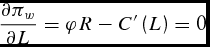
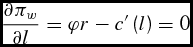
The first order conditions for a maximum imply that,
 $$\begin{equation}
\frac{{\partial \pi _w }}{{\partial L}}= \varphi R - C'\left( L \right) = 0\end{equation}$$
 $$\begin{equation}
\frac{{\partial \pi _w }}{{\partial l}} = \varphi r - c'\left( l \right) = 0\end{equation}$$
Denote by Lw and lw the arguments that maximise π w . This is the optimum technique under weak intellectual property rights, Pw .
Under strong intellectual property rights (Ps )
 $$\begin{equation*}
\pi _s = \varphi r\left( {l + L} \right) + \left( {1 - \varphi } \right)rl - \left[ {c\left( l \right) + C\left( L \right)} \right]\end{equation*}$$
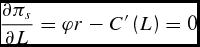
The first order conditions for a maximum imply that,
 $$\begin{equation}
\frac{{\partial \pi _s }}{{\partial L}} = \varphi r - C'\left( L \right) = 0\end{equation}$$
 $$\begin{equation}
\frac{{\partial \pi _s }}{{\partial l}} = \varphi r + \left( {1 - \phi } \right)r - c'\left( l \right) = 0\end{equation}$$
Similarly, denote by Ls and ls the arguments that maximise π s . This is the optimum technique under strong intellectual property rights, Ps .
Comparing equations (3) and (5) we have
 $$\begin{equation}
L_w > L_s\end{equation}$$
And comparing equations (4) and (6) we have
 $$\begin{equation}
l_w < l_s\end{equation}$$
From equations (7) and (8) it follows that
 $$\begin{equation}
\frac{{l_s }}{{L_s }} > \frac{{l_w }}{{L_w }}\end{equation}$$
Let Tw (skilled or intellectual) and Ts (general purpose) denote the technologies (Lw, lw ) and (Ls, ls ), respectively.
Given the technology, owners will choose the best intellectual property rights structure. Weak intellectual property rights will prevail when their benefit is greater than the benefit of strong intellectual property rights:
 $$\begin{equation*}
\pi _w \ge \pi _s \end{equation*}$$
that is,
 $$\begin{equation}
\varphi \left( {R - r} \right)/\left( {1 - \varphi } \right)r \ge l/L\end{equation}$$
Strong intellectual property rights regime prevails when its benefit is greater than the benefit of weak intellectual property rights regime:
 $$\begin{equation*}
\pi _s \ge \pi _w \end{equation*}$$
that is,
 $$\begin{equation}
l/L \ge \varphi \left( {R - r} \right)/\left( {1 - \varphi } \right)r\end{equation}$$
The following proposition holds.
Proposition 1:
 $$\begin{equation}
\pi _w \left( {T_w } \right) \ge \pi _s \left( {T_s } \right)\;{\rm if}\;\frac{{l_w }}{{L_w }} \le \varphi \left( {R - r} \right)/\left( {1 - \varphi } \right)r\end{equation}$$
 $$\begin{equation}
\pi _s \left( {T_s } \right) \ge \pi _w \left( {T_w } \right)\;{\rm if}\;\frac{{l_s }}{{L_s }} \ge \varphi \left( {R - r} \right)/\left( {1 - \varphi } \right)r\end{equation}$$
Proof. We already know that
 $\frac{{l_s }}{{L_s }} > \frac{{l_w }}{{L_w }}$
(equation 9). Then, (a) holds when equation (10) is satisfied, and (b) holds when equation (11) is satisfied.
If condition (a) is satisfied, then intellectual property rights regime Pw is preferred when technology Tw is in use. If condition (b) is satisfied, then intellectual property rights regime Ps is preferred when technology Ts is in use. In each case, there is no incentive to change only technology or only intellectual property rights regime unilaterally. Proposition 1 implies that multiple intellectual property rights-technology equilibria are possible where (Pw , Tw ) is characterised by the complementarity of weak intellectual property rights and technology utilising skilled labour, and (Ps , Ts ) is characterised by the complementarity of strong intellectual property rights and technology utilising unskilled labour. Note that this proposition establishes a link with the modularity formulation of institutional complementarities approach proposed by Milgrom and Roberts (Reference Milgrom and Roberts1990).
A weak intellectual property rights equilibrium is defined by the set of values for which these rights bring about the highest benefit to the firm given the technology Tw , and in turn the technology Tw maximises profits under these rights. This occurs when the values of the arguments (lw , Lw ), that maximise equation (1b) also satisfy equation (10)
 $$\begin{equation}
\varphi \left( {R - r} \right)/\left( {1 - \varphi } \right)r \ge l_w /L_w\end{equation}$$
A strong intellectual property rights equilibrium is defined by the set of values for which these rights bring about the highest benefit to the firm given the technology Ts , and in turn the technology Ts maximises profits under these rights. This occurs when the values of the arguments (ls , Ls ) that maximises equation (2b) also satisfy equation (11)
 $$\begin{equation}
l_s /L_s \ge \varphi \left( {R - r} \right)/\left( {1 - \varphi } \right)r\end{equation}$$
Note that φ(R − r)/(1 − φ)r is the ratio between the expected return from skilled labour and the return from unskilled labour. Since
 $\frac{{l_s }}{{L_s }} > \frac{{l_w }}{{L_w }}$
, this ratio must either fall within the interval defined by (lw/Lw
) and (ls/Ls
) or in the interval defined by 0 and (lw/Lw
), or in the interval defined by (ls/Ls
) and infinity. Thereby, there are only three possibilities.
Proposition 2: Multiple intellectual property rights equilibria exist when φ(R − r)/(1 − φ)r falls between the values (ls/Ls ) and (lw/Lw ). A unique strong intellectual property rights equilibrium exists when the ratio is smaller than (lw/Lw ), and a unique weak intellectual property rights equilibrium exists when the ratio is greater than (ls/Ls ).
Proof. When:
 $$\begin{equation*}
\frac{{l_s }}{{L_s }} \ge \varphi \left( {R - r} \right)/\left( {1 - \varphi } \right)r \ge \frac{{l_w }}{{L_w }}\end{equation*}$$
Both equations (12) and (13) are satisfied. Combinations (Pw , Tw ) and (Ps , Ts ) are both feasible equilibria. When:
 $$\begin{equation*}
\frac{{l_s }}{{L_s }} > \frac{{l_w }}{{L_w }} > \varphi \left( {R - r} \right)/\left( {1 - \varphi } \right)r\end{equation*}$$
Equation (13) is satisfied but equation (12) is not satisfied. Combination (Ps , Ts ) is the only equilibrium. Finally, when:
 $$\begin{equation*}
\varphi \left( {R - r} \right)/\left( {1 - \varphi } \right)r > \frac{{l_s }}{{L_s }} > \frac{{l_w }}{{L_w }}\end{equation*}$$
Equation (12) is satisfied while equation (13) is not satisfied. Combination (Pw , Tw ) is the only equilibrium.
Proposition 2 implies that when the probability of job termination is low, and returns to skilled labour are relatively high, only weak intellectual property rights equilibria are possible. By contrast, when the probability of job termination is high, and returns to skilled labour are relatively low, only strong intellectual property rights equilibria are possible. Significantly, under certain conditions both types of equilibria are possible. In the present world, since the move from one to the other requires both intellectual property rights and technology must be changed simultaneously, it may be an obstacle to the evolution of a weak property rights regimes if incumbent regime is of strong intellectual property rights.
3. Discussion: the evolution of work in the knowledge economy
Proposition 2 clarifies under what conditions weak intellectual property rights are viable in the knowledge economy. The organisation of production could increasingly rely on weak intellectual property rights when the returns to skilled labour are sufficiently large. However, if strong intellectual property rights are historically predominant, there will be a disincentive for knowledge workers to invest in intellectual skills that may reduce or even eliminate additional returns generated by this type of labour. This observation has already been made by Pagano and Rossi (Reference Pagano and Rossi2004, Reference Pagano and Rossi2011).
The first condition, i.e. a low probability of job termination has to do with both macroeconomic and microeconomic policies at national and industry level. It can be guaranteed, for example, by coordinating institutions such as the state or trade unions. The German and Japanese styles of capitalism provide examples (Hall and Soskice, Reference Hall and Soskice2001; Pagano, Reference Pagano, Bowles, Gintis and Gustafson1993). Coordinating institutions, indeed, also has an effect on the skill content of work, for example by providing vocational training. Notwithstanding that, the condition on the relative returns to skilled and unskilled labour may also favour the continuation of unequal relations between firms and knowledge workers. In this regard, knowledge workers in the twenty-first century may share the fate of clerical workers in the twentieth century that was neatly analysed by Braverman (Reference Braverman1974).
It is due to the fact that, business firms could control intellectual assets, and use this control to advocate production technology favourable to their existence. In particular, firms could adopt technologies that favour disembodied intellectual capital, i.e. technologies based on strong intellectual property rights at the expense of those that favour workers’ intellectual skills. Given that workers will underinvest in intellectual skills when working under a strong intellectual property rights regime, the higher skills-based return will decline over time further reinforcing the strong intellectual property rights equilibrium. Under this scenario, it is the initial distribution of intellectual assets that inhibit the emergence of alternative institutional structures, since it discourages knowledge workers from investing in intellectual assets. While workers’ intellectual skills are highly specific to an intellectual asset, firms have strong incentives to improve technologies favouring incumbent property relations (Pagano and Rossi, Reference Pagano and Rossi2004).
In this regard, there is a parallel between clerical workers of the twentieth century and knowledge workers of the twenty-first century. The deskilling of workers in the two periods has always been about the extraction of useful knowledge from the shop floor and its concentration in the hands of managers. The introduction of scientific management at the turn of the twentieth century had implications not only for blue collar workers but also for clerical workers, whose skills were believed to make them qualitatively different from unskilled workers. As Braverman (Reference Braverman1974) explores, clerical workers shared the same fate as their blue collar peers. In the twenty-first century, history may repeat itself by placing the ownership of useful knowledge in the hands of business firms due to incumbent intellectual property rights regime.
Knowledge economy has the power to alter incumbent structure of production, because sharing knowledge makes alternative forms of production organisation viable, e.g. weak intellectual property rights. However, as we have said, there has been a growing trend of tightening of intellectual property rights regime as well as the extension of patentable subjects to new areas (Boldrin and Levine, Reference Boldrin and Levine2008). If the incumbent intellectual property rights regime maintains its dominance, it could deprive knowledge workers of the right to use knowledge acquired in the production process. This deprivation will gradually close the gap between returns to skilled and unskilled labour.
If it is so, what we observe is not a secular trend in the rise of the knowledge content of work, but only a part of a long wave motion, in which there is a temporary rise of the knowledge content of work only during the initial phase of the knowledge economy (Screpanti, Reference Screpanti2001: 249–251). In essence, increase in the skill and knowledge content of work may be a temporary event. In our paper, under relatively simple conditions, we show that the secular trend is strictly based on the prevalence of a weak intellectual property rights regime. However, when multiple organisational equlibria exist, the deskilling argument is as viable as the skilling argument. Simply, the latter is not inevitable.
In such an environment, the emergence and sustainability of a new organisational form based on weak intellectual property rights requires some form of protection or deliberate planning by actors in the economy. If policy makers want to impede the over-privatisation of knowledge, institutional intervention is necessary because institutional complementarities require active economic policy making to keep institutional diversity alive. Depending on the type of institutions considered desirable for society as a whole, institutional change may be directed by policy interventions and legislative changes. Moreover, a highly skilled work force and an alternative intellectual property rights regime may be favoured, for example, on democratic grounds. Researchers have been criticising de-skilling on the grounds that the authority relation that goes hand in hand with de-skilled labour is mainly due to the control of the knowledge base of the firm by the owners. Unskilled labour produces only what the management wants. As Rowthorn (Reference Rowthorn1974) argued, there is a lack of freedom and an inherent inequality in this type of relation.
Successful implementation of a weak intellectual property rights regime, e.g. in the realm of free and open source software (F/OSS) shows us the importance of institutional complementarities in the evolution of production organisation. The resistance of programmers to the commercialisation and privatisation of software programs, i.e. strong intellectual property rights, over the development of the software industry was crucial in the success of F/OSS (Landini, Reference Landini2012; Moody, Reference Moody2001). The emergence of an alternative was not just about technology, but also about the programmer's ethical values; namely, autonomy and freedom.
To sum up, the paper shows that, in the knowledge economy, strong intellectual property rights have a low proportion of skilled workers, whereas weak intellectual property rights have a high proportion of skilled workers, and intellectual property rights and technology reinforce each other. Under certain conditions both types of equilibria are possible. If this is the case, initial conditions characterised by strong intellectual property rights may inhibit the evolution of work relations favouring the rights of knowledge workers, since the proliferation of production methods reliant on intellectual skills crucially depends on incumbent intellectual property rights. A final word and a caveat: it is reasonable to assume that in the long run the coordination problem between shareholders and managers within the firm is solved. Further research is needed to study the effects of such a development. Coexistence of weak and strong intellectual property rights regimes in the short run gives a hint that in the long run we may observe, across sectors and nations, convergence to one of the alternative intellectual property rights regimes.
Acknowledgements
The author is thankful to Samuel Bowles, Ugo Pagano, Robert Rowthorn, Nicodemo De Vito, Ariel Dvoskin, Fabio Landini, Ufuk Karagöz, Baxter Robinson and three anonymous referees for their comments on earlier versions of the paper.


