One of the frequent and problematic contaminants from sectors including mining, electroplating and pharmaceuticals is wastewater that contains hexavalent chromium (Cr(VI); Almeida et al., Reference Almeida, Cardoso, Tavares, Freitas, Trindade and Vale2019). Cr(VI) is thought to be extremely poisonous and poorly biodegradable, which poses a major threat to environmental ecology as well as human health (Kumar et al., Reference Kumar, Ray and Chakraborty2007; Li et al., Reference Li, Feng, Han, Zang and Yang2017; Muthumareeswaran et al., Reference Muthumareeswaran, Alhoshan and Agarwal2017; Maitlo et al., Reference Maitlo, Kim, Kumar, Kim and Park2019). As a result, effluents containing Cr(VI) must be treated or transformed into less hazardous Cr(III) using various methods. Among these, adsorption represents a promising strategy due to its simplicity and efficiency and the wide variety of available adsorbents. It has been demonstrated that many adsorbents, including carbon, chitosan (CS) and biochar, have excellent Cr(VI)-removal capabilities (Tran et al., Reference Tran, Nguyen, Le, Tomul, Lima and Woo2019). However, their activity is limited by acidic conditions or the existence of coexisting cations (e.g. Cu2+; Chen et al., Reference Chen, Liang, Ploychompoo and Luo2020). Therefore, a high-efficiency, acid-resistant Cr(VI) adsorbent is needed for when coexisting cations are present.
Reduced graphene oxide (rGO) can remove metal cations effectively because of its negative charge and chemisorption functional groups (Yu et al., Reference Yu, Wang, Sun, Chen, Liu and Zhou2021). However, rGO could see reduced adsorption performance and commercial applicability in aqueous solutions because of its high price, irreversible aggregation and accumulation and poor adsorption selectivity under acidic conditions (Abu-Nada et al., Reference Abu-Nada, McKay and Abdala2020). Therefore, numerous researchers have tried to functionalize rGO with clay minerals to improve its dispersibility and performance. Montmorillonite (Mnt) has been a focus of researchers because of its wide accessibility and low cost. rGO-Mnt hybrids have great chemical stability and have been shown to remove Cr(VI) efficiently (Peng et al., Reference Peng, He, Feng, Chen, Ding and Wang2020; Zhao et al., Reference Zhao, Chen, Zhou, Zhang, Huo and Hou2020). For example, Zhang et al. (Reference Zhang, Yan, Yan, Chen, Huang and Zhang2018) synthesized an rGO-Mnt that could remove 94.87% of Cr(VI) from an initial Cr(VI) solution at a concentration of 20 mg L–1 at 35°C. Nevertheless, the significant dispersion and suspension of rGO-Mnt in the solution resulted in low recyclability. Recently, a combination of magnetic separation and adsorption processes with the addition of Fe3O4 improved the separating efficiency of an adsorbent from wastewater (Shan et al., Reference Shan, Deng, Jiang, Chen, Wang and Wang2018; Sun et al., Reference Sun, Sun, Cai, Ye, Xu and Ji2019). However, protecting Fe3O4 from acid corrosion is key in acidic Cr(VI) wastewaters. Previous research has shown that Fe3O4 coated with CS exhibited good acid corrosion resistance (Feng et al., Reference Feng, Ma, Zhang, Zhang, Xiao and Ma2019). Furthermore, due to its distinctive sandwich structure, great chemical stability and mechanical stability, bentonite (BT), which has smectite as its primary component, is a common, inexpensive natural clay that is capable of eliminating Cr(VI) from sewage. Loading rGO over magnetically modified smectite may be effective in terms of providing an affordable and highly effective Cr(VI) removal material. A magnetically reduced graphene oxide bentonite (MrGO-BT) material has not been reported previously in the literature.
Here, an MrGO-BT material was developed for the joint adsorption of Cu2+ and Cr(VI). The removal effectiveness of MrGO-BT for Cr(VI) and the associated adsorption isotherms, kinetics and thermodynamics were investigated. Analyses were conducted regarding the Cr(VI) elimination process. We also investigated and tested the acid resistance and reusability of MrGO-BT and the influence of Cu2+ on Cr(VI) elimination.
Experimental
Materials and reagents
Analytically pure sulfuric acid, sodium hydroxide, hydrogen peroxide, hydrochloric acid, ferric chloride hexahydrate, sodium nitrate, sodium acetate anhydrous, glycol, potassium permanganate, CS, acetic acid, epichlorohydrin, ethylenediaminetetraacetic acid disodium salt, potassium dichromate and cupric chloride dehydrate were obtained from Sinopharm Chemical Reagent Co., Ltd (P.R. China). Natural sodium BT was acquired from Runlong Bentonite Co., Ltd (P.R. China), and its cation-exchange capacity was 88 mmol 100 g–1. The chemical constitution (wt.%) of the BT was: SiO2 = 71.20; TiO2 = 0.10; Al2O3 = 13.00; Fe2O3 = 0.75; FeO = 0.17; MnO = 0.07; CaO = 1.62; K2O = 1.01; Na2O = 0.83; and P2O3 = 0.04. Graphene oxide (GO) was fabricated using a modified Hummers method.
Characterization
X-ray diffraction (XRD) was conducted using a Rigaku Max 2550 VB/PC device (Japan) at a step size of 4°2θ min–1 over 5–85°2θ. Fourier-transform infrared (FTIR) spectroscopy was recorded at 400–4000 cm–1 using a Tensor 27 device (Bruker, Germany). Transmission electron microscopy (TEM) images were obtained using a JEM-2100 F device (JEOL, Japan). Energy-dispersive spectroscopy (EDS) was conducted using a X-Max N (Tescan, Czechia). The specific surface area and pore size of the material were measured using an ASAP-2020 C (USA) and calculated using the Brunner–Emmett–Teller (BET) method. The ζ-potential was measured using a JS-94 Zeta microelectrophoresis apparatus (China). The element valence change was determined using X-ray photoelectron spectroscopy (XPS; Amicus, Shimadzu Co., Japan).
Preparation of MrGO-BT
A flask containing H2SO4 (250 mL) was placed into an ice bath and then NaNO3 (2.5 g) and natural graphite (5 g) were added and stirred for 15 min. KMnO4 (32 g) was transferred to the flask and mechanical agitation was conducted for 30 min at 10°C. This was then heated to 35°C and held at that temperature for 60 min. After that, distilled water (240 mL) was added and heated to 98°C. After mechanical agitation for 25 min, more distilled water (1000 mL) was added, and 30% H2O2 was then added to the mixture until the pH was 7.0. GO was acquired after filtering and vacuum drying at 60°C for 24 h (Marcano et al., Reference Marcano, Kosynkin, Berlin, Sinitskii, Sun and Slesarev2010).
For the preparation of MrGO, CS (2.4 g), GO (0.1 g), FeCl3⋅6H2O (2.0 g) and CH3COONa (5.3 g) were added to 40 mL of ethylene glycol and mixed for 40 min. Then, the solution was placed in an autoclave at 200°C for 12 h. After cooling, MrGO was acquired by washing (0.5% (v/v) CH3COOH) and drying at 60°C for 12 h.
For the synthesis of MrGO-BT, 100 mL CH3COOH (1.5% (v/v)) was added to a flask and then preheated to 30°C for 10 min. After that, MrGO powder (0.5 g) was dispersed in a round-bottomed flask filled with nitrogen, and this was stirred at 30°C for 20 min. Then, natural sodium BT (2 g) and epichlorohydrin (2 mL) were added, and this was then heated to 55°C for 2 h. After cooling, MrGO-BT was obtained after washing and drying at 60°C for 12 h.
Adsorption experiments
The adsorption of mixed ions of Cu2+ and Cr(VI) was investigated following the Cr(VI) adsorption studies. NaOH and HCl solutions were used to alter the pH. The water samples were collected after filtration through a 22 μm membrane. The remaining Cr(VI) and Cu2+ concentrations were chosen following ultraviolet–visible spectroscopy. The adsorption ability at equilibrium (q e (mg g–1)) was calculated according to Equation 1:

where C 0 and C e are the starting and equilibrium concentrations (mg L–1) of Cr(VI) or Cu2+ in solution, respectively, V is the solution volume of Cr(VI) or Cu2+ (L) and m is the amount of adsorbent added (g).
The elimination rate (R) for heavy-metal ion adsorption on MrGO-BT was determined using Equation 2:

Adsorption kinetics
Use of pseudo-first order and pseudo-second order kinetic models were used for fitting to the adsorption process. The linear shape of the first-order kinetic model can be expressed as is shown in Equation 3:

where q e and qt are the adsorption amounts of Cr(VI) (mg g–1) at steady state and at any time t (min), respectively, and k1 is the velocity constant for first-order adsorption (min–1).
The linear form of the second-order kinetic model can be represented as is shown in Equation 4:

where k2 is the steady-state velocity constant of second-order adsorption (g mg–1 min–1).
Results and discussion
Characterization
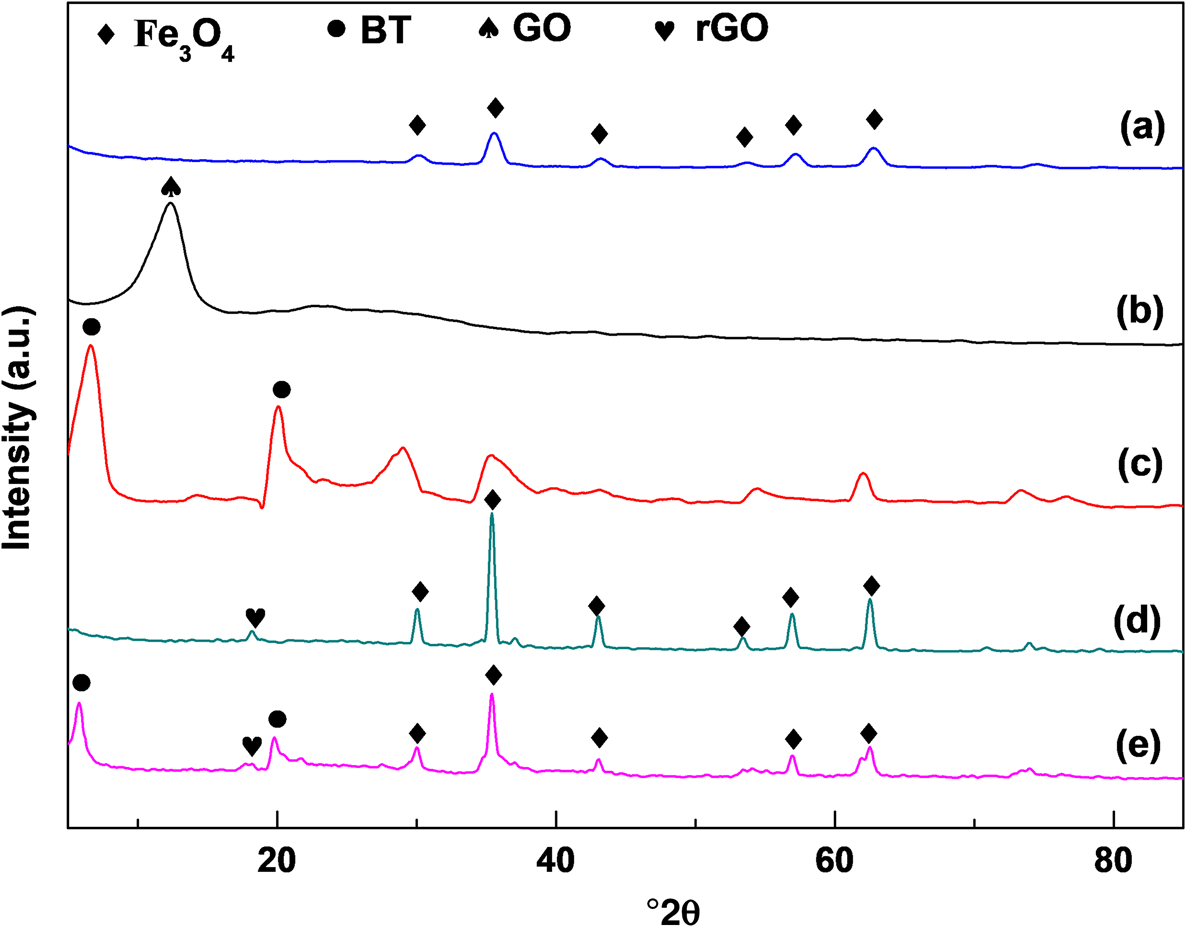
Figure 1 displays the XRD traces of Fe3O4, GO, BT, MrGO and MrGO-BT. The basal reflections of Fe3O4 at d 220, d 311, d 400, d 422, d 511 and d 440 were 2.96, 2.52, 2.09, 1.71, 1.61 and 1.48 Å, respectively (Fig. 1a,d,e). The positions of the Fe3O4 peaks remained unaltered (Fig. 1d,e), demonstrating that MrGO and MrGO-BT still had a solid Fe3O4 crystal structure. A peak (4.67 Å) for rGO occurred in the XRD traces for MrGO and MrGO-BT (Fig. 1d,e; Zhang et al., Reference Zhang, Yan, Yan, Chen, Huang and Zhang2018), revealing that GO was reduced to rGO, but the d 001 peak of GO (7.38 Å) disappeared, as can be seen in Fig. 1b. The primary d 001 peak of BT occurred at 13.33 Å (Fig. 1c), which moved to 15.21Å with the introduction CS into BT (Fig. 1e). This might be because CS was introduced into the BT interlayer, increasing the basal space of BT (Liu et al., Reference Liu, Xu, Zhao, Yang, Qi and Zeng2018; Jimtaisong & Sarakonsri, Reference Jimtaisong and Sarakonsri2019), which would increase the capacity of the substance to bind heavy-metal ions.
XRD traces of (a) Fe3O4, (b) GO, (c) BT, (d) MrGO and (e) MrGO-BT.

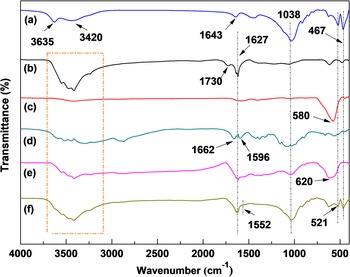
The FTIR spectra of BT, GO, Fe3O4, CS, MrGO and MrGO-BT are shown in Fig. 2. The absorptions at 1643 and 3420 cm–1 were caused by the twisting and flexion vibrations of the hydroxyl group in BT, respectively (Fig. 2a; Perelomov et al., Reference Perelomov, Sarkar, Rahman, Goryacheva and Naidu2016). BT showed a signal at 1038 cm–1 for the Si–O group (Liu et al., Reference Liu, Uddin and Sun2011), and two adsorption peaks at 521 and 467 cm–1 were caused by the bending vibrations of Si–O–Si and Al–O–Si of BT, respectively (Yang et al., Reference Yang, Zhao, Zhang, Lu, Chen and Yu2010). The aluminium hydroxyl group on the smectite was found to vibrate strongly and was responsible for the peak value at 3635 cm–1. The hydroxyl group in GO and adsorbed water were responsible for the peaks between 3000 and 3600 cm–1 (Fig. 2b; Liu et al., Reference Liu, Hu, Guo, Zhao, Li and Zhu2019), and the peak at 1730 cm–1 demonstrated the C=C bending of the sp2 carbon and the flexion vibratino of water (Kong et al., Reference Kong, Wei, Hu and Wei2019; Wang et al., Reference Wang, Wang, Cao, Liu, Chen and Chen2020). A distinct Fe–O peak could be seen at 580 cm–1 (Fig. 2c). The C=O twisting vibration of -NHCO- and the N–H bending vibration of -NH2 were attributable to the distinct bands at 1662 and 1596 cm–1 (Jiang et al., Reference Jiang, Su, Wen, Zhu, Liu and He2020).
FTIR spectra of (a) BT, (b) GO, (c) Fe3O4, (d) CS, (e) MrGO and (f) MrGO-BT.

The functional organization of rGO, Fe3O4 and CS was seen in the FTIR spectrum of MrGO (Fig. 2e). The signal at 1730 cm–1 disappeared, confirming that the carboxyl group on GO could be reduced completely. It is possible that the disappearance of the C=O asymmetric stretching vibration at 1662 cm–1 was caused by the connection between CS and oxygen-containing groups of rGO, as well as electrostatic forces attracting CS to the negatively charged organic compounds of rGO (Zhou et al., Reference Zhou, Qi, Bai and Fu2016; Qi et al., Reference Qi, Zhao, Lin and Wu2018). The peaks between 3300 and 3600 cm–1 in MrGO were attributed to rGO, but the intensity was weaker than that seen for GO, demonstrating that GO had not been reduced completely and that the surface of rGO still contained abundant hydroxyl groups. The interaction between the nitrogen-containing groups of CS and the hydroxyl bond of rGO may have been responsible for the red shift of N–H from 1596 to 1552 cm–1. MrGO showed a blue shift of the characteristic Fe–O peak from 580 to 620 cm–1, which was due to the local electron rearrangement on the nanoparticle surface (Yang et al., Reference Yang, Li, Hsieh, Juang and Gandomi2018).
The structural bonds of BT and MrGO were observable in the FTIR spectra of MrGO-BT (Fig. 2f), but the vibration peak at 3635 cm–1 disappeared. This is believed to be the consequence of the condensation of the surface functional groups of BT with the hydroxyl groups of rGO and CS. Following the addition of BT, a decrease in the N–H ratio and an increase in the -OH ratio led to a reduction in the peak at 1552 cm–1 and an increase in the peaks at in 3300 and 3600 cm–1. The decrease in peak area at 1038 cm–1 was attributed to a reduction in the overall proportion of BT in MrGO-BT.
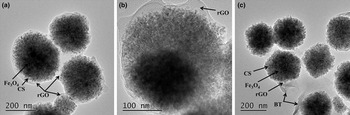
The TEM images of MrGO and MrGO-BT are shown in Fig. 3. The TEM images of MrGO (Fig. 3a,b) illustrate the presence of Fe3O4, CS and rGO sheets in the MrGO composite. Fe3O4 coated with CS formed a 200 nm sphere, and the CS was loose and flocculent (Liu et al., Reference Liu, Liu, Wang, Xu and Wang2016). The rGO sheets had sandwiched the CS and Fe3O4 (Fig. 3b), indicating that rGO and CS acted as a wall, protecting Fe3O4 from acid corrosion. The TEM image of BT (Fig. S1) demonstrates that BT presented a lamellar stacking structure, with dense lamellae in the centre. The image of MrGO-BT (Fig. 3c) shows that MrGO was located above BT, but the section of BT that was not covered by MrGO exhibited the characteristic layered structure and stacking features (Zhang et al., Reference Zhang, Luo, Jiang, Jiang and Yang2015).
TEM images of (a,b) MrGO and (c) MrGO-BT.

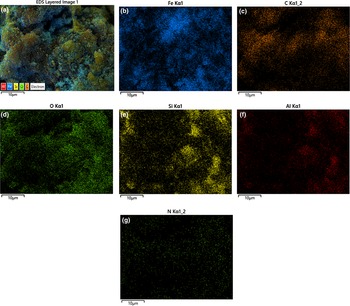
The EDS mapping of MrGO-BT is depicted in Fig. 4. Because of its layered structure, the distribution of the elements Fe, Si, Al, C, O and N was not uniform. A sandwich structure with rGO as the sandwich layer, Fe3O4 as the core and CS/BT as the shell was the proposed structural hypothesis based on the fact that the Fe was surrounded by a significant amount of C and O and that some Si and Al were spread over MrGO-BT.
EDS mapping images of MrGO-BT. (a) Layered EDS image and (b–g) elemental mapping of MrGO-BT.

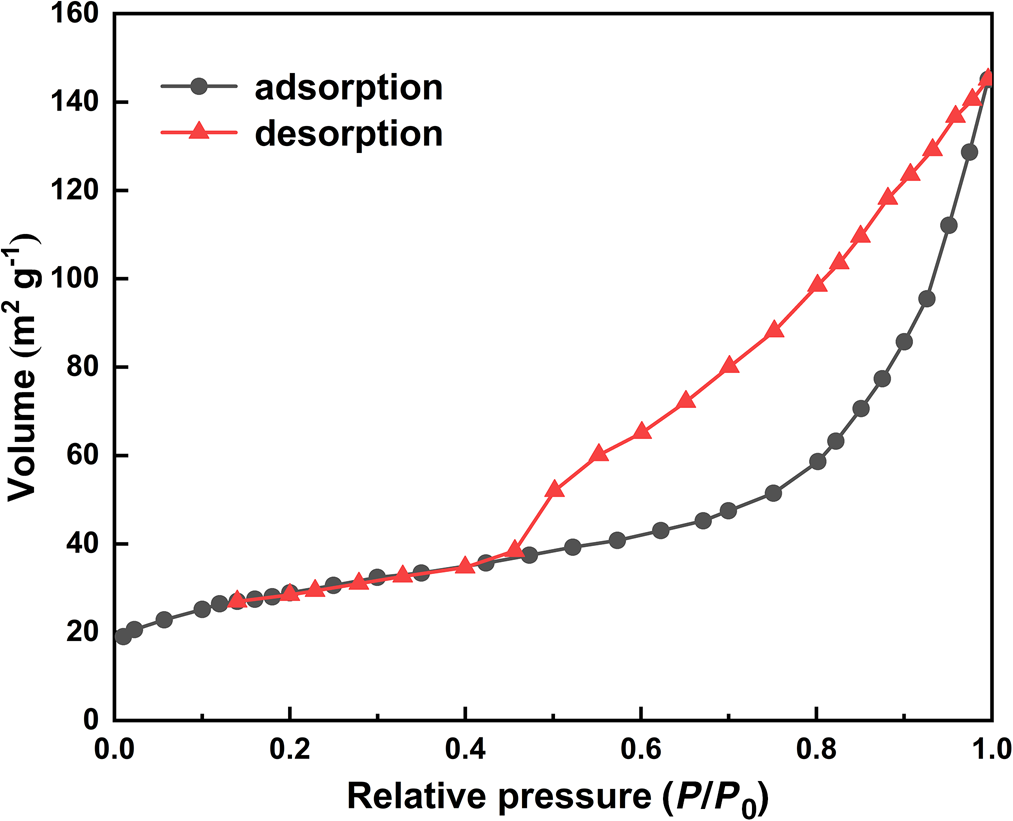
Figure 5 shows the N2-sorption isotherm of MrGO-BT. In accordance with the International Union of Pure and Applied Chemistry (IUPAC) classification, MrGO-BT showed a class IV isotherm and is a mesoporous adsorption material. The presence of the H3-type hysteresis ring in the P/P 0 range of 0.4–1.0 indicated the presence of slits created by the accumulation of flake particles in MrGO-BT. According to the pore-structure results obtained (Table 1), MrGO-BT had a specific surface area of 95.46 m2 g–1, a pore volume of 0.143 m3 g–1 and a mean pore size of 7.03 nm. The elimination of Cr(VI) was improved at greater pore volumes and specific surface areas, which facilitated ion exchange.
N2 adsorption–desorption curve of MrGO-BT.

Pore structure of MrGO-BT.

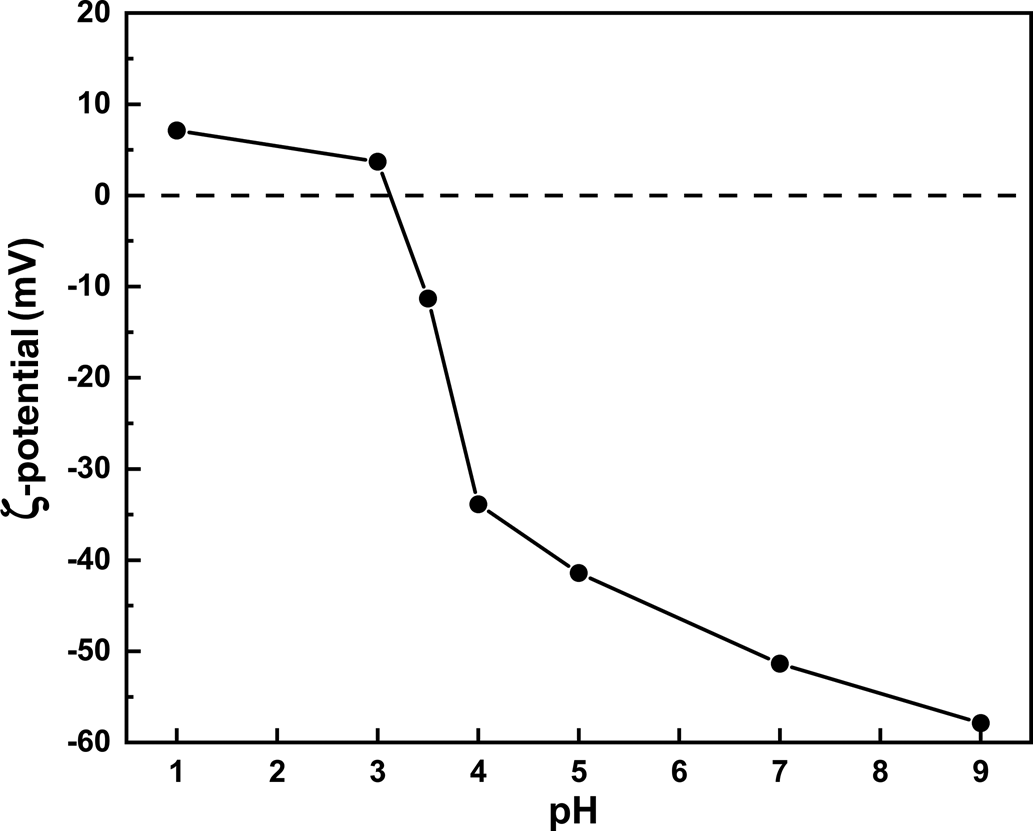
Figure 6 illustrates the MrGO-BT surface ζ-potential fluctuations between pH 1.0 and 9.0. It can be seen that the pH at the point of zero charge (pHpzc) of MrGO-BT was close to 3.1. As the pH increased, the ζ-potential decreased steadily. When pH was <3.1, the surface of MrGO-BT was positively charged due to its H+ coating, helping it to adsorb and dissociate the oxygenated anions of Cr(VI). By contrast, because MrGO-BT had a negatively charged surface, the oxygenated anions of Cr(VI) led to electrostatic repellence, decreased its adsorption capacity gradually.
ζ-potential of MrGO-BT.

Cr(VI) elimination with MrGO-BT
Processing parameters
Under the conditions of a solution temperature of 20°C, an initial pH value of 4.6, a reaction time of 40 min and a beginning concentration of 100 mg L–1, Cr(VI) elimination with MrGO-BT at doses of 0.55–5.00 g L–1 is shown in Fig. S2a. Increasing adsorption ability of Cr(VI) with MrGO-BT was observed with increasing adsorbent dosage, reaching a maximum value (22.6 mg g–1) at ~1 g L–1. A possible explanation for this is that with the increasing dosage of MrGO-BT, the total number of adsorption sites of Cr(VI) increased and so the elimination rate also increased. The ability of MrGO-BT to adsorb Cr(VI) was reduced at doses >1 g L–1. This could be because of the adsorption sites of MrGO-BT being unsaturated and having a greater number of vacant sites at increased dosages (Feng et al., Reference Feng, Ma, Zhang, Zhang, Xiao and Ma2019). Therefore, the optimal adsorbent dosage of MrGO-BT was chosen as 1 g L–1.
The impact of Cr(VI) was explored at 20°C and pH 1–9. The adsorption ability of MrGO-BT for Cr(VI) declined as pH increased (Fig. S2b). HCrO4– and Cr2O72− are present primarily at pH 1–6, but the pH of H2CrO4 is <1. At lower pH, there were numerous H+ ions, and these induced greater positively charged ions (e.g. -NH3+), which favoured the diffusion of the negatively charged chromate ions into the bulk of MrGO-BT due to electrostatic attraction (Niu et al., Reference Niu, Jia, Zhao, Liu, Zhong and Zhai2018). This adsorption ability decreased as the pH reduced from 6 to 9 because the significant level of OH– in the solution precluded the diffusion of Cr(VI) (Jin et al., Reference Jin, Jiang, Du and Chen2014). As a result, pH 1 was chosen the ideal value for MrGO-BT to adsorb Cr(VI).
The effect on Cr(VI) at the initial concentration range of 20–100 mg L–1was explored. Figure S2c shows rapidly increasing adsorption after 40 min, reaching saturation after 150 min. The maximum adsorption ability achieved was 69 mg g–1 at an initial concentration of Cr(VI) of 100 mg L–1 and a reaction time of 150 min, and adsorption ability was associated positively with initial Cr(VI) concentration. This indicated that the initial concentration was related to the pressure gradient and that a greater initial concentration of Cr(VI) made it easier for Cr(VI) to move from the solution to the particle surface. However, the greatest elimination rate of 90% was achieved at an initial concentration of 20 mg L–1, and the elimination rate was correlated inversely with the initial concentration of Cr(VI). Therefore, the initial concentration of Cr(VI) was chosen as 20 mg L–1 and the reaction time was selected to be 150 min.
The temperature-dependent equilibrium constant Kc (q e/q c) can be used for the calculation of thermodynamic parameters. Changes in enthalpy (ΔH 0) and entropy (ΔS 0) during the adsorption process were calculated using Equation 5:

where R is the perfect gas constant and T (K) is the temperature. ΔG 0 is the Gibbs free energy from a specific adsorption, which can be determined using Equation 6:

The experimental results are fitted to obtain the values of ΔG 0, ΔH 0 and ΔS 0 for Cr(VI) adsorption.
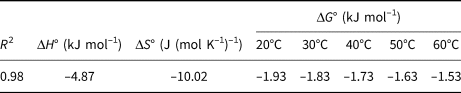
The experiments regarding the adsorption isotherm were undertaken by dissolving 100 mg MrGO-BT in a beaker containing 100 mL of a temperature-varying Cr(VI) solution at pH 1 under continuous mechanical agitation. The values of ΔH 0 and ΔS 0 derived from the fitted equation were –4.87 kJ mol–1 and –10.02 J (mol K)–1 (Table 2), demonstrating that Cr(VI) elimination with MrGO-BT is an exothermic process and increases in randomness. The ΔG 0 values at 20°C, 30°C, 40°C, 50°C and 60°C were –1.93, –1.83, –1.73, –1.63 and –1.53 kJ mol–1, respectively (Table 2), indicating that Cr(VI) was adsorbed spontaneously on MrGO-BT. As the temperature increased, the amount of Cr(VI) eliminated with MrGO-BT decreased slightly (Fig. S2d), indicating that Cr(VI) was adsorbed preferentially at lower temperatures.
Thermodynamic parameters of Cr(VI) removal with MrGO-BT.

Adsorption kinetics study
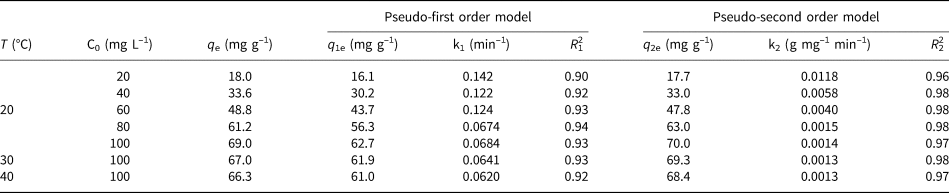
The adsorption kinetics of Cr(VI) were explored at an initial pH of 1. Pseudo-first order and pseudo-second order models might represent Cr(VI) elimination on MrGO-BT accurately (Fig. S3), as the correlation coefficient (R 2) resulting from the linear regression ranged from 0.90 to 0.99 (Table 3). The findings show that physicochemical adsorption may be used to control Cr(VI) elimination with MrGO-BT (Liu et al., Reference Liu, Dong, Zhong, Ren, Chen and Qiu2020; Zhong et al., Reference Zhong, Lu, Liang and Hu2020; Zhu et al., Reference Zhu, Wang, Yang, Tufail, Chen and Wang2020). The q e value of the pseudo-second order kinetic model was more similar to the observational data than that of the pseudo-first order model and the R 2 value was greater. This indicates that the pseudo-second order kinetic model was a superior fit in terms of the adsorption of Cr(VI) with MrGO-BT. As the sorbent and adsorbate contribute or transfer electrons during chemical sorption, chemisorption may be the rate-limiting step.
Kinetic models of Cr(VI) adsorption on MrGO-BT.

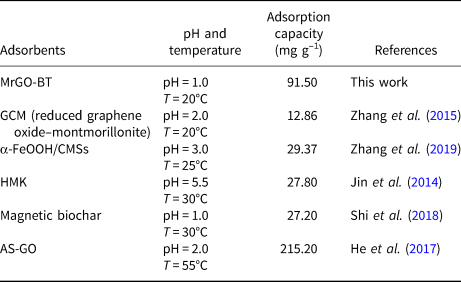
During continued mechanical shaking, 100 mg MrGO-BT was added to a beaker containing 100 mL Cr(VI) solution with variable starting concentrations and pH values to test the adsorption isotherm. The Cr(VI) absorption on MrGO-BT was agitated for 150 min at 20°C. The Freundlich and Langmuir isothermal models in Table 4 & Fig. S4 illustrate the greatest adsorption of Cr(VI) at 20°C, with values of 91.5 and 123.3 mg g−1, respectively. The Freundlich isothermal model had a lower R 2 than that of the Langmuir isothermal model. The Langmuir isothermal model is preferred for Cr(VI) adsorption with MrGO-BT based on the parameters in Table 4. In Table 5, the Cr(VI) elimination abilities with MrGO-BT and data from previous reports are contrasted.
Isotherm parameters for Cr(VI) adsorption.

Comparison of various adsorbents for Cr(VI) adsorption.

AS = 3-aminopropyltriethoxysilane; CMS = carbon microsphere; HMK = hexadecyltrimethylammonium chloride-modified kaolinite.
Effect of Cu2+ on Cr(VI) adsorption
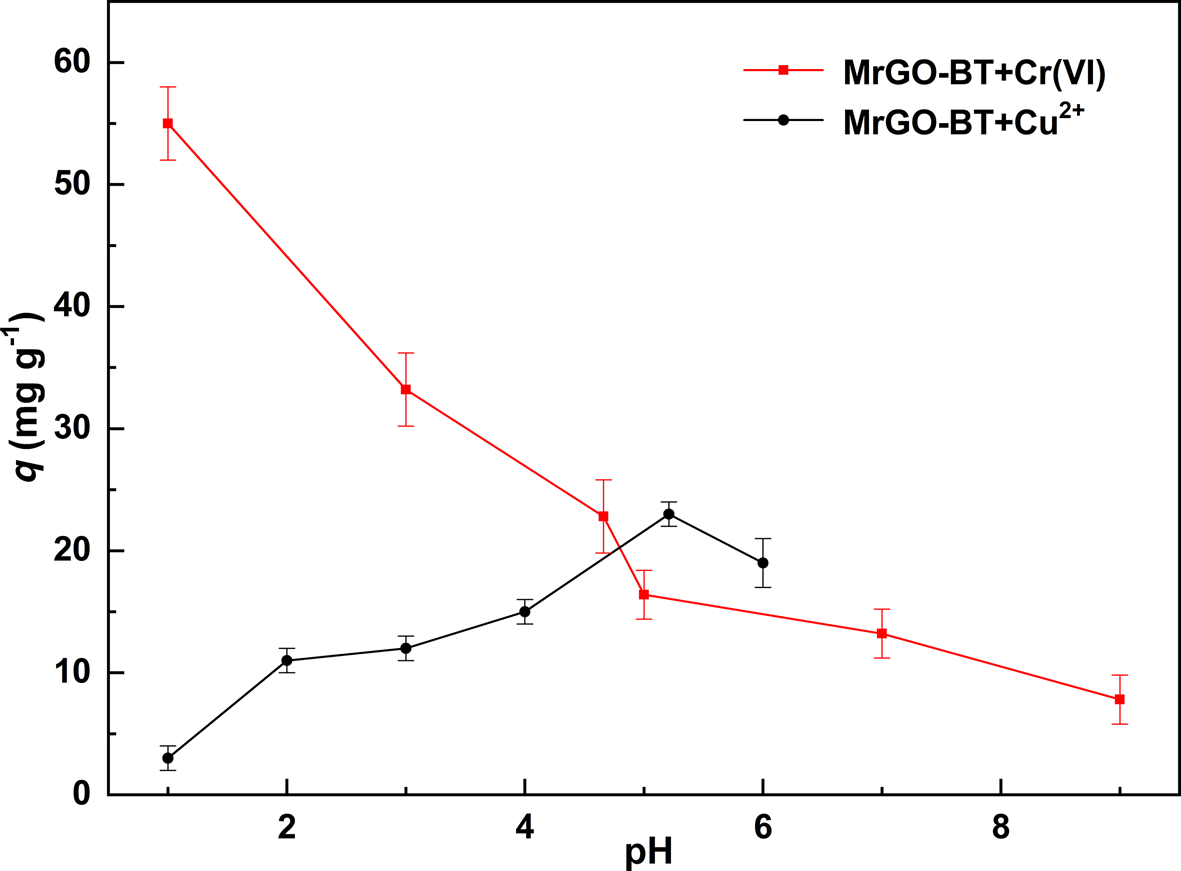
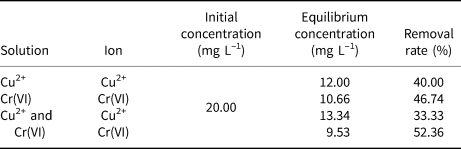
Cu2+ was chosen as the coexisting ion due to Cr-contaminated water containing a variety of cations. As illustrated in Fig. 7, the pH ranged from 1.0 to 5.2 initially with only Cu2+ in solution. As the pH of the solution increased, Cu2+ adsorption ability increased as H+ and Cu2+ engaged in stronger competition for the active sites. However, when the pH increased beyond 5.2, Cu2+ started to precipitate as Cu(OH)2, which reduced the amount of Cu2+ (Qin et al., Reference Qin, Fang, Zhou, Sun, Chen and Ding2019; Wu et al., Reference Wu, Deng, Zhou and Luo2019). Ultimately, both of these outcomes reflect an increase in saturation. In addition, adsorption experiments were conducted on the mixture of Cu2+ and Cr(VI). Table 6 compares the Cu2+ and Cr(VI) adsorption results and shows that Cu2+ removal in the mixed-ion adsorption process was reduced from 40.00% to 33.33%; however, the elimination rate of Cr(VI) increased from 46.74% to 52.36%. This implies that Cr(VI) and Cu2+ might compete for the same adsorption sites. However, other mechanisms were also identified in this study. This competition resulted from the increased cation strength of the mixed-ion solution after the addition of Cu2+ (Zhao et al., Reference Zhao, Chen, Xiong, Bai, Yilihamu and Ma2019). Alternatively, MrGO-BT favoured positively charged Cu2+ in the mixture of the Cu2+ and Cr(VI) system, which neutralized parts of the negative charge on the surface of MrGO-BT and increased the electrostatic attraction of HCrO4– and Cr2O72– (the main forms of chromate at pH 4.8), improving Cr(VI) elimination (Tanboonchuy et al., Reference Tanboonchuy, Grisdanurak and Liao2012; Lv et al., Reference Lv, Hu, Tang, Sheng, Jiang and Xu2013).
Adsorption on Cu2+ and Cr(VI) at various pH values. Reaction conditions: reaction time = 40 min, dosage = 1 g L–1, initial concentration = 100 mg L–1, temperature = 20°C.

Influence of Cu2+ on Cr(VI) adsorption. Reaction conditions: reaction time = 150 min, dosage = 1 g L–1, starting concentration = 20 mg L–1, temperature = 20°C, pH = 1.0.

Mechanism analysis
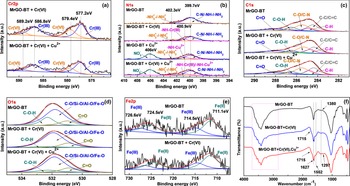
The elemental composition before and after Cr(VI) removal with MrGO-BT was analysed using XPS. Figure 8a shows component curves used to fit the Cr2p peak, and the binding energies were 577.2, 579.4, 586.8 and 589.2 eV. The binding energies at 577.2 and 579.4 eV are associated with Cr2p3/2 orbitals, whereas the peaks at 586.8 and 589.2 eV are identified with Cr2p1/2 orbitals. Cr(III) may be inferred from the bonding energies of 577.2 and 586.8 eV, whereas the peaks at 579.4 and 589.2 eV may be considered as evidence of Cr(VI) (Ma et al., Reference Ma, Zhang, Hu, Yan, Yu and Zhai2012). The results indicate that the MrGO-BT included Cr(VI) and Cr(III) and that Cr(VI) was transformed, to a significant extent, to Cr(III). According to the fitting results and peaks pattern, Cr(VI) accounted for 27.5% of the total Cr in MrGO-BT after adsorbing Cr(VI) and Cr(VI) made up 38.0% following the adsorption of the mixed ions.
(a–e) XPS and (f) FTIR spectra of MrGO-BT before and after adsorption.

To investigate this phenomenon further, the O, N and C of MrGO-BT were analysed using XPS. Figure 8b shows that N after Cr(VI) adsorption was present in the forms of -NH-/-NH2 (399.7 eV), -NH–Cr(III) (400.9 eV) and C–N/-NH2+/-NH3+ (402.3 eV) species (Zhu et al., Reference Zhu, Liu, Zhang, Wei, Zhang and Ling2016; Ghanbari & Nejabati, Reference Ghanbari and Nejabati2020). After the mixed ions were adsorbed, NO3– (406 eV) was found in MrGO-BT after the reaction of the mixed-ion solution (Fig. 8b), showing similar XPS results to MrGO-BT after Cu2+ adsorption alone, with equal intensities for the two NO3– peaks. Moreover, the two peak intensities were equal, proving that NO3– originated from the Cu(NO3)2 solution. Therefore, it was concluded that the presence elemental N and N-containing groups was unrelated to the decline in Cr(VI).
The peak fitting in Fig. 8c,d shows several interesting phenomena. Figure 8c shows the splitting peaks of C1s for C–C/C=C (284.4 eV), C–O/C–N (285.5 eV), C–O–H (286.5 eV), C–H (284.8 eV) and C=O (287.9 eV) (Mei et al., Reference Mei, Zhang, Mo, Zhang, Li and Ou2020). For clarity, fresh MrGO-BT, MrGO-BT after Cr(VI) adsorption and MrGO-BT after adsorption of the mixed ions are labelled as A, B and C, respectively. The C–H and C=O peak areas were in the order of B > C > A, and the C–O–H peak area was in the order of A > C > B, while the C–C, C=C, C–O and C–N peak areas remained unchanged across A, B and C. These findings reveal that Cr(VI) could react with C–O–H to form H–C=O, and Cu2+ could hinder the decrease in Cr(VI) because of the surface complexation and chelation between Cu2+ and C–O–H or -NH2. Figure 8d depicts the splitting peaks of O1s for C=O (530.9 eV), Si–O/C–O/Al–O/Fe–O (531.8 eV) and C–O–H (532.3 eV) (Zhang et al., Reference Zhang, Xiao, Li, Ali, Chen and Zhang2020). The C=O peak areas are displayed the order of B > C > A and the C–O–H peak area showed the order of A > C > B, while the Si–O/C–O/Al–O/Fe–O peak areas remained unaltered across A, B and C. These variations corroborated the conclusions derived from Fig. 8c. Figure 8e shows XPS peaks at 711.1 and 724.5 eV for Fe(II) and 714.5 and 726.6 eV for Fe(III) (Dong et al., Reference Dong, Chen and Hong2020). After eliminating Cr(VI) and the coexisting ions, the peak area remained unaltered, indicating that Fe(II) had no impact on the Cr(VI) reduction reaction. The high-resolution XPS spectrum of Cu2p for MrGO-BT after mixed-ion adsorption showed bands of Cu2p1/2 and Cu2p3/2 at 953.3 and 933.5 eV, respectively (Fig. S5). The former was assigned to free Cu2+, while the latter was assigned to Cu2+ that chelated with amino groups on MrGO-BT (Li et al., Reference Li, Zhang, Xia, Wang, Zhu and Lei2019).
Figure 8f shows the FTIR spectra of MrGO-BT before and after adsorbing heavy-metal ions. The bands ranging from 3000 to 3600 cm–1 decreased after Cr(VI) elimination due to the oxidation of C–O–H to H–C=O, whereas the band at 1715 cm–1 appeared as a result of the production of H–C=O on MrGO-BT. The peak area increased at 1552 cm–1, indicating the appearance of NH3+ in the acidic solution. These results are consistent with the XPS analysis and indicate that C–O–H supplied electrons for the reduction of Cr(VI) and was oxidized to H–C=O. The bands at 1380 and 1297 cm–1 could be generated via amino group chelation with Cr(III) and Cu2+, respectively.
Generally, the single metal ion (Cr(VI)) adsorption mechanism by MrGO-BT proceeded as follows: portions of the Cr(VI) reacted with C–O–H on MrGO-BT to generate H–C=O and Cr(III) as shown in Equations 7 and 8:


The electrons required for Cr(VI) reduction in mixed-metal ion adsorption (Cr(VI) and Cu2+) were supplied by C–O–H on MrGO-BT. The pHpzc of MrGO-BT was ~3.1, and at pH values between 1.0 and 3.1 the MrGO-BT adsorbent surface became positively charged via strong protonation (-NH2+/-NH3+), increasing electron attraction via electrostatic forces and also increasing the elimination rate of Cr(VI). In the presence of Cu2+ (pH 4.8), Cu2+ was adsorbed preferentially on MrGO-BT because of electrostatic attraction, neutralizing part of the negative charge, thereby reducing the electrostatic repulsion of negatively charged Cr(VI) and increasing the elimination rate of Cr(VI). In addition, there might have been exchange of cations between Cu2+ and Cr(III) and the BT interlayer, as well as chelation with -NH2 on MrGO-BT to form -NH–Cr(III) or -NH–Cu2+. MrGO-BT removed most of the Cr(VI) via electrostatic adsorption, the redox reaction and chelation.
Magnetic response, acid resistance and reusability of MrGO-BT
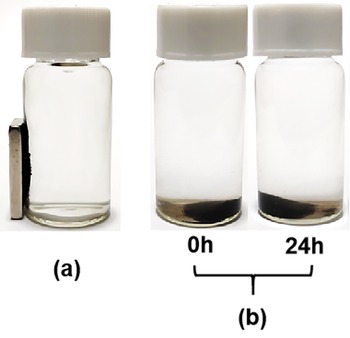
The magnetic response of MrGO-BT was tested by submerging the sample in a water solution. Then MrGO-BT was attracted to a magnet. As is shown in Fig. 9a, the MrGO-BT in the solution was attracted to the magnetic side. To evaluate the acid resistance of MrGO-BT, the sample was immersed in acidic water (pH 1.0) for 24 h (Fig. 9b). MrGO-BT showed strong acid resistance, as inductively coupled plasma-optical emission spectroscopy indicated the Fe3+ dissolution mass in the solution to be 8.59 μg and the Fe3+ dissolution rate to be 0.21%. This corroborates the TEM and FTIR results, which indicated that rGO and CS could shield Fe3O4 from acid corrosion.
(a) MrGO-BT magnetic recovery experiment. (b) MrGO-BT immersed in water for 0 or 24 h at pH 1.

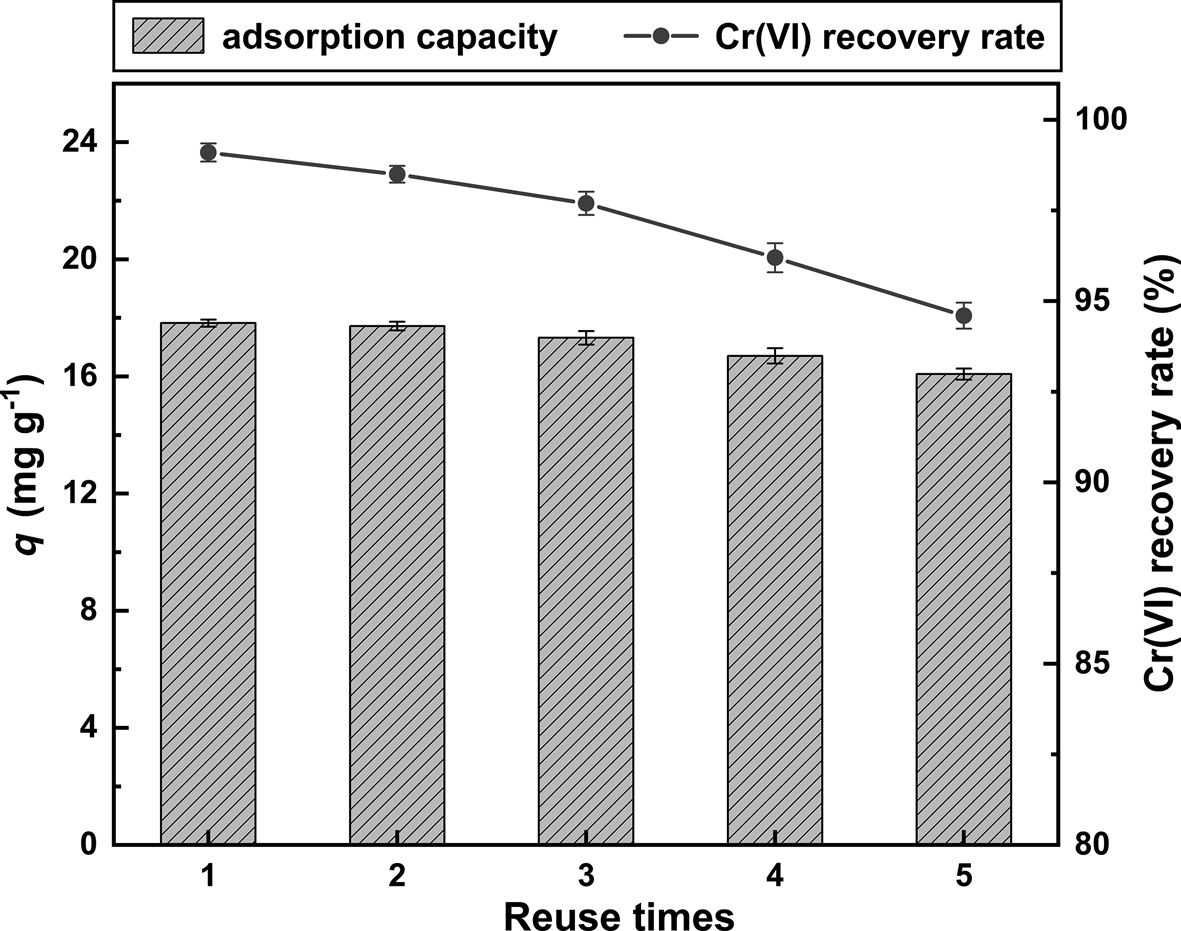
Five repeated sorption processes were performed to evaluate the reusability of MrGO-BT under optimal conditions (Fig. 10). It was observed that the adsorption ability for Cr(VI) by MrGO-BT decreased slightly over repeated sorption processes. This might be because the Cr(VI) adsorbed on MrGO-BT was only desorbed partially in saturated EDTA-2Na solution, with some adsorption sites remaining occupied. The recovery rate of Cr(VI) was 95.6–99.1% after five cycles and the adsorption capacity decreased to 16.08 mg g–1, which was only 1.92 mg g–1 less than that of fresh adsorbent. Therefore, MrGO-BT has good adsorption stability, as demonstrated by the recovery test.
Recycling performance of MrGO-BT.

Conclusion
MrGO-BT was prepared efficiently and utilized to remove Cr(VI), and it was discovered that MrGO-BT has a stable structure because of the condensation of organic compounds on BT and the -OH of rGO and CS. The optimal reaction conditions for Cr(VI) removal by MrGO-BT were determined to be 1 g L–1 of adsorbent, pH 1, 150 min of contact time, temperature of 20°C and an initial Cr(VI) concentration of 20 mg L–1. A total of 90% of the Cr(VI) can be removed under these circumstances. The pseudo-second order reaction kinetics and the Langmuir adsorption equation were employed to describe the sorption behaviour of Cr(VI) on MrGO-BT. The greatest adsorption ability for Cr(VI) was 91.5 mg g–1 at 20°C. The FTIR spectroscopy and XPS results indicated that Cr(VI) was eliminated by MrGO-BT via reduction and adsorption reactions. In an acidic environment, -NH/-NH2 on the surface of MrGO-BT could react with H+ to form -NH2+/-NH3+ in solution, which improved the electrostatic attraction to Cr(VI). C–O–H on MrGO-BT led to the electrostatic attraction of Cr(VI), and H–C=O and Cr(III) were generated via reduction reactions. In addition, the adsorption ability of MrGO-BT for Cr(VI) was increased via the addition of Cu2+ due to electrostatic attraction. MrGO-BT exhibited strong acid resistance and good magnetic responsiveness. It maintained great adsorption ability after five sorption and desorption tests (16.08 mg g–1). Therefore, Cr(VI) elimination on MrGO-BT holds significant promise for environmental remediation.
Financial support
The project is supported by the National Key Basic Research Program of China (No. 2019YFC0408604-4), the Natural Science Foundation of Shanxi Province (201901D111110), the Shanxi Program on Key Research Project (Social Development, 201903D321053), the Shanxi Scholarship Council of China (No. HGKY2019017) and the Shanxi Provincial Foundation for Leaders of Disciplines in Science, China.
Conflicts of interest
None.