Comprehensive knowledge of cardiac anatomy and associated malformations is critical for paediatric cardiologists; thus, cardiac morphology training is a fundamental part of paediatric cardiology fellowship education. Although guidelines provide general recommendations on content for morphology education,Reference Lewis, Martin and Bartz 1 – 3 the specific subject matter, nomenclature, and educational format – including use of pathology specimens – are left to the discretion of individual fellowship programmes. For example, there are two major nomenclature classification systems, Andersonian and Van Praaghian, which have some similarities, but can use different terminology for classification of the same cardiac malformations.Reference Ezon, Goldberg and Kyle 4 Efforts towards a common language are ongoing, but there is currently no agreed upon standard for teaching cardiac nomenclature.Reference Jacobs, Constantine, Jacobs, Maruszewski, Tchervenkov and Lacour-Gayet 5 The heterogeneity in fellowship morphology education has the potential to lead to communication errors between providers trained at different institutions who are using different nomenclature systems and diagnostic errors secondary to inadequate morphology knowledge. Miscommunication between medical providers and diagnostic errors have both been reported to contribute to medical error,Reference Cathchpole, De Leval and Mcewan 6 and movement towards standard communication practices has been shown to improve patient safety in a variety of settings.Reference Leonard, Graham and Bonacum 7 , Reference Starmer, Spector and Srivastava 8
Textbooks and lectures currently serve as the common resource for morphology education. Although these formats traditionally provide high-quality information, their utilisation is challenging in the current learning environment. Modern learning environments have increasing utilisation of online resources, while facing fellow work-hour restrictions and changing learning styles. Studies have shown that millennial learners value creative, interactive learning with trial and errorReference Eckleberry-Hunt and Tucciarone 9 and prefer online and interactive learning to the traditional lectures and textbooks.Reference Kitchin and Applegate 10 Inclusion of faculty experts and specimen review are a few options to create an active, hands-on learning experience; however, these resources may not be consistent between programmes.
The development of a standardised, readily available cardiac morphology curriculum for paediatric cardiology fellows could enhance training and impact the risk of medical errors. Consequently, we aimed to assess current practices and barriers in cardiac morphology training, define perceived effectiveness of current curricula, and determine preferences to inform the development of a standardised curriculum in cardiac morphology.Reference Hughes 11
Materials and methods
Study design
We carried out a cross-sectional descriptive study utilising survey methodology. This study was determined to be exempt by the Cincinnati Children’s Hospital Medical Center Institutional Review Board.
Study participants
Fellows, programme directors, and associate programme directors from United States paediatric cardiology fellowships, all accredited by the Accreditation Council for Graduate Medical Education, were invited to participate. In addition, non-accredited “advanced fellows” – that is, 4th year fellows – who had completed 3 years of cardiology training were also invited.
The paediatric cardiology fellowship programme directors and associate directors were identified using a listserv from The Society of Pediatric Cardiology Training Program Directors. As a complete list of fellows’ names and e-mail addresses was unavailable, we attempted to reach each fellow using a “snowball” sampling technique.Reference Patton 12 More specifically, each programme director or programme coordinator was asked to forward the survey invitation and link to their fellows. This method prevented us from determining the exact number of eligible paediatric cardiology fellows, but we estimated the number to be ~417 on the basis of the number of available slots in the 2016 match. This estimate does not include 4th year fellows, who are not included in the match.
Survey design
We developed two de novo surveys, one for fellows and one for programme directors, through an iterative process including feedback from educational experts from Cincinnati Children’s Hospital Medical Center’s Divisions of General and Community Pediatrics, Hospital Medicine, Emergency Medicine, and Education and Learning. The survey response process was used as a guiding framework to identify and address issues that might contribute to survey error, including question clarity, ease of completion, and correspondence with the stated research objectives.Reference Biemer and Lyberg 13 The questions were then pre-tested in interviews with four current cardiology faculty who would not be a part of the study using the Question Appraisal System as a discussion guide to identify and correct any remaining issues.Reference Willis 14
The surveys were comprised of demographic questions, followed by closed-ended questions with ordinal and categorical response options; many of these included open-ended opportunities for participants to provide additional thoughts. The questions addressed the following objectives: identify the various formats used to teach cardiac morphology to paediatric cardiology fellows, including use of cardiac pathology specimens and outside resources such as lecturers or conferences; identify cardiac morphology nomenclature systems used at various paediatric cardiology training programmes; identify barriers to teaching morphology to cardiology fellows; assess programme directors’ and fellows’ opinions regarding the efficacy of the current cardiac morphology curricula; identify personal experiences where individuals felt that inadequate knowledge may have resulted in clinical consequences; and identify curriculum content and format(s) likely to be utilised by fellows and fellowship programmes. Each survey also concluded with two open-ended questions to capture respondents’ views regarding effective components and areas to improve their programme’s current cardiac morphology curriculum. A print copy of each survey can be seen in Appendix.
Branch and display logic were incorporated into the design to ensure that respondents only received questions applicable to them based on their role and responses to previous questions. This functionality helps minimise respondent fatigue and associated non-response error.
An initial e-mail was sent to each programme director, associate director, and coordinator – if e-mail address was available – from the 57 distinct programmes 1 week before survey distribution to inform them of the purpose of the survey and to describe their role in forwarding the invitation e-mail and survey link to their programme’s fellows. The anonymous survey was administered using QualtricsTM online survey software (Qualtrics, Provo, Utah, United States of America) over a 3-week period in the spring of 2015 with weekly e-mail reminders. A follow-up invitation was sent to individual programme directors after the initial survey was closed to obtain programmatic information from programmes that had at least one fellow response but no programme or associate programme director response.
Data analyses
Descriptive statistics were generated for each question. For specific questions aimed at describing programmes at the institutional level, the programme director’s response was utilised; however, if the programme director did not respond, the associate director’s response was used. For ease of interpretation, these were collectively labelled as “director” responses. Open-ended responses were independently, thematically coded by two investigators (M.F., L.R.), who reviewed and discussed each until thematic agreement was reached.
Results
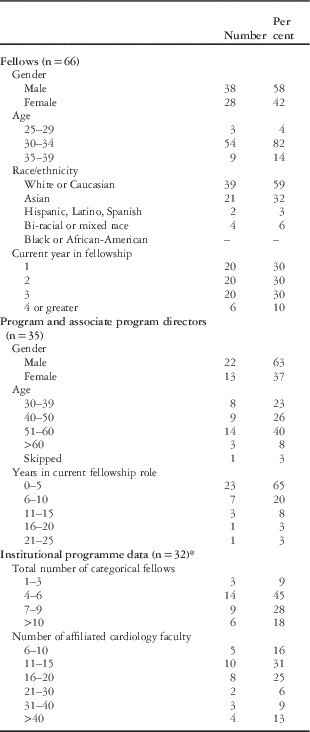
The programme response rate was 56%, representing 32 of 57 cardiology fellowship programmes. A total of 101 survey responses were received with a response rate of 51% from directors (35 of 69) and 16% from fellows (66 of ~417). Directors responded from 32 programmes, with three programmes having both director and associate director response. Among all, six programmes had responses from only fellows. Demographic data of respondents are presented in Table 1.
Demographic information of respondents and institutions.

* Responses from the institutional representative from each of the 32 institutions. The Fellowship Director’s response was used when a response was received from both Director and Associate Director
Current educational practices and barriers
Overall, 84% of programmes used some type of didactic lecture format to teach morphology to fellows. The lecture format was roughly, evenly split among programmes – 11 (34%) used stand-alone cardiac morphology lecture series, 9 (29%) had morphology lectures as part of the larger fellowship curriculum, and 7 (22%) had morphology topics incorporated into other topic-based lectures. Only one programme reported having small group sessions, and four programmes reported “other” format.
A total of 28 (88%) programmes had a cardiac pathology specimen collection, and all but one used the collection for teaching their fellows. Of those 27 programmes, 52% reported using the collection for teaching fellows at least once per month, 44% between two and 11 times per year, and 4% reported using the collection less than once per year.
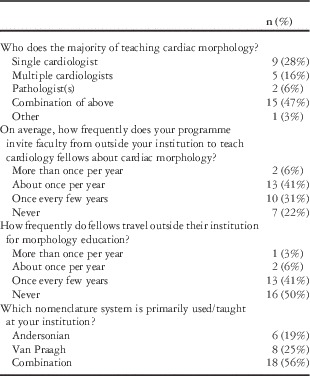
In all, 11 (34%) of the programmes had a single cardiologist or pathologist(s) teach the majority of morphology, 16 (50%) programmes had fellows attend educational programmes outside the institution, and 25 (78%) programmes invited outside faculty to teach morphology (Table 2).
Current fellowship teaching practices (n=32)Footnote *.

* Responses from the institutional representative from each of the 32 institutions. The Fellowship Director’s response was used when a response was received from both Director and Associate Director
The majority of programmes used a combination of Anderson and Van Praagh nomenclature systems (Table 2). At institutions that had both fellow and director responses, 9 (53%) had a discrepancy between fellow and director regarding the primary nomenclature system taught at their institution. In response to the open-ended question, “What do you most commonly call the type of ventricular septal defect seen with ‘typical’ Tetralogy of Fallot with pulmonary stenosis?”, there were 13 distinct answers from the 89 respondents. Responses included the following: malalignment/anterior malalignment ventricular septal defect (67%), conoventricular (6%), conoventricular with anterior malalignment (6%), perimembranous malaligned (4%), perimembranous (4%), perimembranous with outlet extension (3%), and membranous (3%), with the remaining 7% being comprised of single unique responses. Among those responders who self-identified as either Andersonian or Van Praagh, there were six different terms used to describe the defect in each nomenclature group.
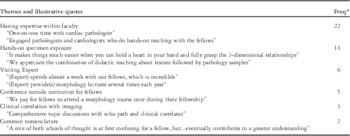
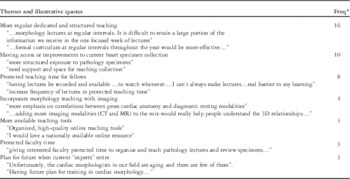
Assessment of the open-ended responses related to effective components (Table 3) and areas to improve their cardiac morphology curriculum (Table 4) revealed that directors and fellows agreed that faculty expertise and specimens were effective teaching tools. Many expressed interest in dedicated and structured teaching time for both fellows and faculty.
Director and fellow themes regarding what they think is particularly effective about their current cardiac morphology curriculum (n=101).

* Freq: frequencies indicate the number of individuals whose response included a particular theme.
Director and Fellow themes regarding what they would change to make their current cardiac morphology curriculum more effective (n=101).

* Freq: frequencies indicate the number of individuals whose response included a particular theme
Directors and fellows rated lack of faculty time (48%), faculty expertise (27%), faculty interest (29%), and available reference material (29%) as “moderately significant” or “very significant” barriers to teaching/learning morphology. The remaining percentage of directors and fellows thought these items were “not at all significant” or “only slightly significant” barriers. In an open-ended response question, four fellows and one director identified inconsistent nomenclature as another “very significant” barrier to teaching/learning cardiac morphology.
Perceived impact of curriculum on fellow graduate skills and clinical consequences
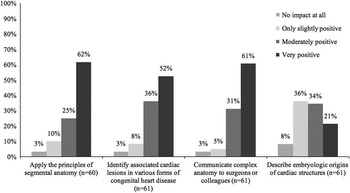
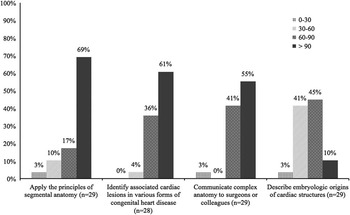
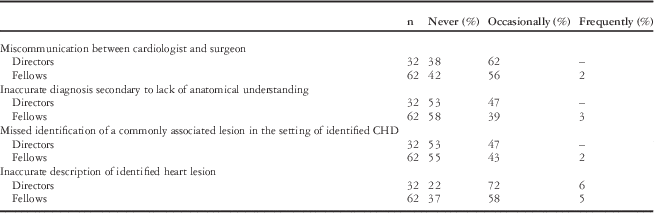
The majority of fellows positively rated the impact of their programme’s current cardiac morphology curriculum on their morphology knowledge and ability to perform various skills. Embryology training was consistently rated poorly compared with the other topics (Fig 1). In contrast, over one-third of programme directors reported that some recent fellowship graduates had inadequate cardiac morphology abilities (Fig 2). The majority of directors and fellows reported occasionally witnessing inadequate cardiac morphology knowledge contributing to miscommunication and inaccurate/incomplete description of identified heart lesions (Table 5).
Fellows’ perception of the impact of their institution’s curriculum on ability to perform each of the cardiac morphology skills.

Directors’ assessment of the percentage of recent fellowship graduates with adequate abilities and skills directly related to cardiac morphology.

Director and fellow assessment of impact of inadequate cardiac morphology knowledge.

How often directors and fellows have witnessed the following situations related to inadequate morphology knowledge.
Perceived effectiveness and likelihood of adopting various curriculum options
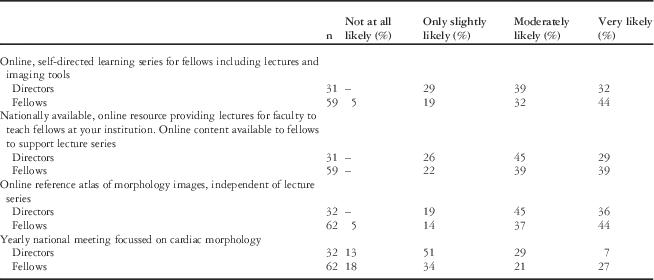
Directors and fellows rated the effectiveness of the following learning methods as “moderately effective” or “very effective”: online self-directed fellow learning series (79%), online faculty development resource with supplemental fellow-specific resources (80%), online cardiac morphology reference atlas (75%), and a yearly national meeting (65%). In addition, open-ended responses identified the use of three-dimensional models and online modules with question banks as additional methods that would be both effective and utilised by fellows and directors. The majority of responders also reported that they would be at least “moderately likely” to adopt an online learning format (Table 6).
Directors’ and fellows’ self-reported likelihood to adopt and use specific components of a cardiac morphology curriculum.

Discussion
This study characterises the current state of cardiac morphology education during paediatric cardiology fellowship in the United States of America. Heterogeneity exists among training programmes in terms of teaching structure, utilisation of outside faculty, conference attendance, and nomenclature. Directors and fellows reported that inclusion of pathologic specimens and lectures by local faculty and visiting expert professors are training strengths. Suggestions to improve education included more structured and protected teaching, uniform nomenclature system, and improved accessibility to specimen and content experts. In addition, directors indicated that recent fellow graduates did not all have adequate cardiac morphology abilities, with embryology standing out as an area in most need of improvement. Finally, with approximately half of respondents reporting negative clinical implications that they have attributed to inadequate cardiac morphology knowledge, this training gap may have patient safety implications. These issues highlight the need for improvement in the current system of cardiac morphology training for paediatric cardiology fellows.
The following four main themes emerged to describe the educational needs surrounding a cardiac morphology curriculum: communication utilising a common language, patient safety, faculty expertise, and curriculum format.
Utilising a common language to describe cardiac morphology is imperative to standardising communication. At present, programmes describe great variability in cardiac nomenclature, with half self-identifying as primarily Van Praaghian or Andersonian nomenclature and the other half using a combination of the two systems. More problematic, however, is the lack of internal consistency when individuals self-identify with a particular nomenclature system, as evidenced by the diverse number of responses provided to describe the type of ventricular septal defect seen in “typical” tetralogy of Fallot. These results suggest that terms have evolved from their original classifications and have taken on individual or institutional definitions. This evolution may be unbeknownst to the learner and poses a risk for communication failure. In addition, within individual programmes, fewer than half of fellows agreed with their director’s response with regard to the primary nomenclature system used at their institution, suggesting a lack of clear understanding of the two distinct systems.
Ezon et al made great strides in clarifying the similarities and differences between the Van Praagh and Anderson nomenclature systems, providing an excellent reference tool for classification of congenital heat malformation;Reference Ezon, Goldberg and Kyle 4 however, the book also exemplifies the lack of one common nomenclature system. International recognition of the need for a common nomenclature system has led to ongoing collaborations between The Society of Thoracic Surgeons and the European Association for Cardio-Thoracic Surgery with the subsequent creation of a common language and database to track congenital heart surgery outcomes.Reference Mavroudis and Jacobs 15 In addition, this partnership led to the formation of The International Nomenclature Committee for Pediatric and Congenital Heart Disease.Reference Jacobs, Jacobs and Mavroudis 16 This group has undertaken over a decade of work to unify CHD nomenclature. Their results are currently being made public on their website (ipccc.net). Standardised fellowship training could be one potential solution towards implementation of a common nomenclature system.
Over half of survey respondents reported witnessing miscommunication between providers and inaccurate description of heart lesions, which could have significant patient safety implications.Reference Catchpole, Giddings and deLeval 17 Standardising communication practices have been proven to enhance patient safety in other settings.Reference Leonard, Graham and Bonacum 7 , Reference Starmer, Spector and Srivastava 8 Although developing one common cardiac nomenclature system is beyond the scope of the proposed curriculum, we believe that current fellows should be able to understand both major classification systems, allowing for more streamlined communication. In addition, a solid foundation in cardiac morphology should help minimise diagnostic errors secondary to inadequate knowledge.
Directors and fellows reported hands-on training with specimen exposure as one of the most effective aspects of the current curricula; however, access to specimens was identified as a challenge. Hands-on training is consistent with the principles of adult learning theory, which suggest that active learning with deliberate practice maximises retention.Reference Mayer 18 , Reference Abela 19 In addition, having access to pathology specimens, either in person or electronically, is part of the recently revised paediatric cardiology fellowship training guidelines in non-invasive imaging.Reference Srivastava, Printz and Geva 20 However, cataloging, archiving, and maintaining heart specimens is a difficult, specialised, and resource-heavy endeavour; one that has many potential barriers at the individual and institutional levels.Reference Seslar, Shepard and Giroud 21 Utilising technology such as three-dimensional printed models or virtual cardiac models that simulate specimen collections may promote a feasible solution to minimise barriers and standardise training between different programmes. In addition, approximately a third of institutions have a single cardiologist responsible for morphology teaching, and the majority of institutions supplement morphology education with visiting professors and/or external conference attendance. These models may not be sustainable because of cost, time, and over-reliance on a single individual; thus, development of additional educational resources is critical.
The majority of directors and fellows expressed interest in a standardised, online curriculum that combines existing cardiac morphology expertise without reliance on any one individual. This type of core curriculum could utilise the common language created by the International Nomenclature Committee for Pediatric and Congenital Heart Disease to promote common understanding of cardiac nomenclature. Ideally, the curriculum could help disseminate the committee’s hard work by utilising an engaging online format that would be well-suited to the learning needs of the current generation of fellows.Reference Oblinger and Oblinger 22 , Reference Prensky 23 Specifically, this format would provide asynchronous access, support fellow assessment, and allow for continual evaluation of curricular content.
There are several limitations to this study. First, the study was limited only to training programmes in the United States of America. Selection bias among the fellow respondents is possible with only about 16% of fellows responding. The bias may be linked to the directors, as fellows were only surveyed if the director forwarded the invitation and fellow e-mail addresses were not readily available. Second, approximately half of the directors responded, which could also introduce non-response bias; however, the responding programmes do appear representative of a wide range of fellowship programme size, and therefore we believe they are a valid representation of United States of America training programmes. Third, we utilised a de novo survey that had not been previously validated; however, we did develop it through an iterative process with input from individuals with content and education expertise and piloted it for evidence of content validity and clarity to minimise measurement error.
Conclusion
Cardiac morphology training varies in content and format among fellowships. Inconsistent nomenclature and inadequate cardiac morphology knowledge and skills can lead to communication failures and ultimately medical errors. Directors reported that they would likely adopt a standardised, readily accessible cardiac morphology curriculum that combines virtual hands-on practice and exposure to content expertise. Therefore, we believe that the creation of a common, online cardiac morphology curriculum would fill a paediatric cardiology fellow’s educational need, allow for fellow assessment of competency, and potentially standardise communication with efforts to minimise medical error.
Acknowledgements
None.
Financial Support
This research received no specific grant from any funding agency or from commercial or not-for-profit sectors.
Conflicts of Interest
None.
Ethical Standards
The authors assert that all procedures contributing to this work comply with the ethical standards of the relevant national guidelines on human experimentation and human subjects and with the Helsinki Declaration of 1975, as revised in 2008, and has been deemed exempt by the Cincinnati Children’s Hospital Medical Center Institutional Review Board.
Supplementary material
To view supplementary material for this article, please visit https://doi.org/10.1017/S1047951116002481.