The development of elementary schools between 1833 and 1870 has, by comparison with research on progress later in the nineteenth century, received little recent attention. The consensus is that what developed was haphazard or unpatterned, although sectarian rivalry is seen as a significant explanatory factor for school foundations. This article argues that close attention to what took place in individual localities can reveal patterns not otherwise detectable. Three case studies from communities of different kinds, all within the county of Devon, are discussed. These are Throwleigh, a small Dartmoor parish; Bovey Tracey, a market town with some industry; and Dartmouth, a historic seaport. Specifically, the article demonstrates the significance for school development of the availability of a local individual, whatever their background or religious persuasion, able to champion the establishment of a school. Such champions needed to be able to set out the proposal, seize opportunities and manage relationships to deliver the change and to maintain the initiative. Where individuals lacked one or other of these attributes, the school might never be established, or might close prematurely.
A trio of studies of the development of education for the poor in England published between 1967 and 1971 set out a broad national narrative for the development of education.Footnote 1 This narrative posited that during the first half of the nineteenth century the traditional responsibilities of those fortunate enough to be well off for the welfare of the poor were challenged by mass industrialization and by new ideas which led to legal and constitutional reforms and to the wish to improve the ‘condition of the labouring poor’. One result was the widening of access to elementary education and the growth of schools. Continuing tensions, both between religious denominations and within them, meant that a state system was slow to emerge. Even though the government undertook national surveys of education in 1818 and 1833, and allocated funds to support school building in 1833, it was not until 1870 that legislation mandating universal elementary education and the creation of schools by local boards was introduced. The establishment of a state system was strongly contested throughout by the National Society for Promoting the Education of the Poor in the Principles of the Established ChurchFootnote 2 and the British and Foreign School Society.Footnote 3
Part of the prompt for these studies was the publication in the 1960s of a cluster of county histories of school development, including R. R. Sellman's Devon Village Schools.Footnote 4 Gillian Sutherland acknowledged these in her Historical Association pamphlet on Elementary Education: ‘The interaction of educational provision and institutions with patterns of social mobility and political behaviour are [sic] fascinatingly complex.’Footnote 5 More recently, however, scholarship relating to the history of education has been dominated by studies of particular aspects of education such as the child's experience,Footnote 6 or the Victorian teacher,Footnote 7 or institutional histories such as that of the National Society.Footnote 8 The question of an explanation for what many scholars term the ‘haphazard system’Footnote 9 of parish and private schools that developed before the 1870 Elementary Education Act requires further study. New tools such as online data collections, not available in the 1960s, can now facilitate detailed local research. This article uses three Devon case studies to examine how schools were developed in order to identify features that might explain success and failure.
The Case Studies
Empirical studies, or microhistories, of individual settlements use closely detailed observation to explore impact at a local level.Footnote 10 As Briggs noted,
It was from the periphery not from the centre that English education developed. … It is … necessary to explore local economic, social (including religious) and political structures to understand why initiatives and activities in education varied as much as they did before the passing of the Education Act of 1870.Footnote 11
Although Devon experienced little industrialization, the foundation of schools still proceeded apace in the mid-nineteenth century. Divergent beliefs about instruction in religion caused problems for school foundation and maintenance in Devon communities as they did elsewhere. The studies presented here illustrate that, while the circumstances in which the schools were or were not established were very different, taken together they illustrate the significance of the availability of individuals to ‘champion’ the foundation of particular schools.
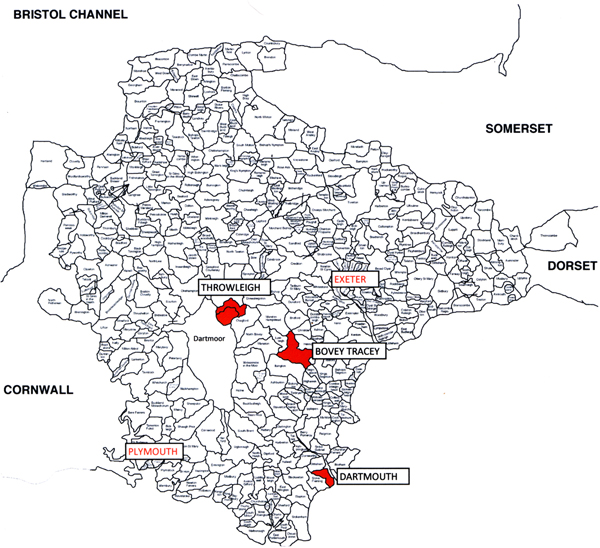
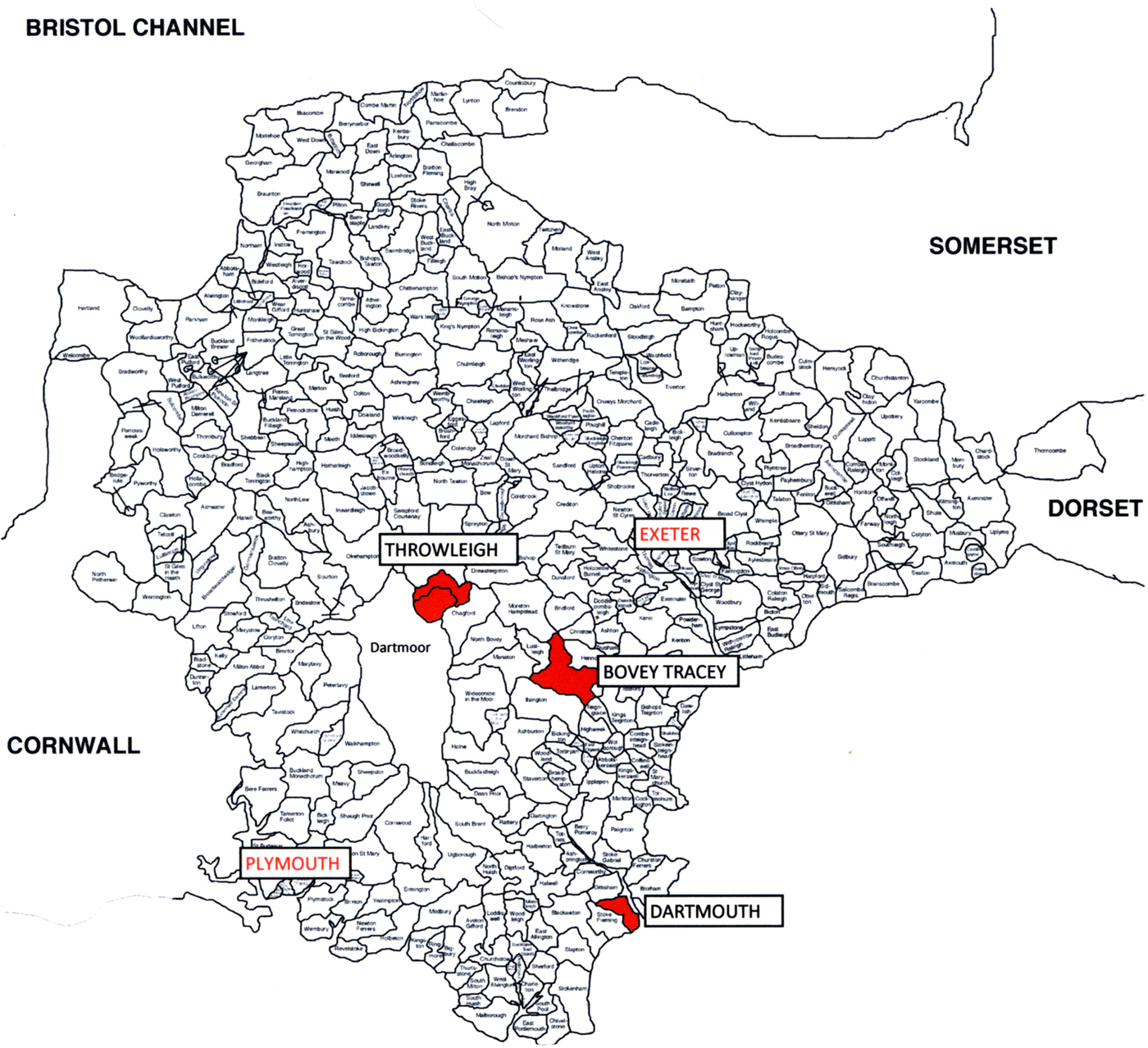
Devon in the early nineteenth century had lost the prosperity generated by its pre-industrial wool trades and gained little in the way of other manufacturing processes. The livelihood of its inhabitants depended chiefly on farming and fishing, although the development of tourism had begun to provide alternative employment. Emigration kept population growth slow. The overall picture in the 1851 religious census suggests a rough division between Nonconformist strength in the west and Anglican dominance in the east.Footnote 12 The three communities under consideration, identified on the map (Fig. 1), are very different. Throwleigh is a small parish on the north-east shoulder of Dartmoor, with a substantial proportion of the parish being common land on the moor. It is an area best described as dispersed settlement, with Throwleigh village and Murchington hamlet the only centres of population. The population in 1851 was 481. In the 1851 religious census the Anglican church recorded 100 people attending the principal service (with no Sunday school), while Providence Chapel, a Bible Christian establishment, recorded 112 (including a Sunday School). Bovey Tracey is a historic borough in rural south Devon, whose manor was held by the earls of Devon until they sold it in 1855. By the mid-nineteenth century its rural character was changing, with the development of a pottery industry from 1843. The population in 1851 was 2,086. That year's religious census found that attendance at the parish church (including Sunday school) was 515, at the Baptist chapel it was 368 and at the Methodist chapel 160. Dartmouth, on Devon's south coast, was a substantial port with a significant coastal carrying trade and shipbuilding industry. Tourism and leisure were increasing in importance, and the Royal Navy's new school for officer cadets moved to Dartmouth in 1863. The population in 1851 was 4,450. The religious census does not provide a full picture of church attendance here, as information for one Church of England congregation is missing, but the picture was more diverse, with Anglican, Independent, Wesleyan, Baptist, Particular Baptist and Brethren congregations all recorded. In 1833, 58 per cent of children attending Sunday school did so in the two Anglican parishes, while 42 per cent attended Nonconformist Sunday schools.Footnote 13
Devon Historic Parishes Map (2002), adapted to show case study parishes. Reproduced by kind permission of Devon County Council.
Other sources used for these studies include two national education enquiries: the Digest of Parochial Returns made to the Select Committee appointed to inquire into the Education of the Poor in 1818,Footnote 14 the Education Enquiry: Abstracts of Answers and Returns in 1833Footnote 15 and the complementary local replies to the Bishop's Queries before Visitation in 1821.Footnote 16 The records of the National Society and the British Society provide some information for individual schools. The studies also draw on a wide range of local sources, such as parish histories, newspapers and family documents.
Throwleigh
The rural parish of Throwleigh lies about twenty miles west of Exeter. In the early nineteenth century, the rectors were mainly absent and the parish was in the hands of curates.Footnote 17 Although the parochial returns in 1818 reported a school attended by about twelve children, whose parents paid for their instruction,Footnote 18 in 1821 the responses to the Bishop's Queries before Visitation stated that no Anglican religious instruction was taking place, and that Methodist preachers were active in the parish.Footnote 19 In 1833 there was no school in Throwleigh.Footnote 20
Between 1841 and the establishment of the board school in 1877, two successive rectors made efforts to establish a village school with the support of the National Society. Upon his appointment in 1841, Revd W. H. Schwabe immediately set up a Sunday School in the kitchen of his rectory. Within a month he was corresponding with, and applying to, the National Society for funding to build a two-storey school with classroom on the ground floor and teacher's accommodation above.Footnote 21 National Society documents record Schwabe's problems: in this poor rural parish there were no gentlemen farmers to offer financial support, and there was stiff competition from the Dissenting population:
The parish has been much neglected, the late incumbent not having been resident, … and consequently dissent has spread … a sect presumptuous of arrogating to themselves the title of Bible Christians, have built a lay meeting house in the middle of my parish and lay schoolroom in connexion with it to which the children eagerly flock, both on Sundays and weekdays.Footnote 22
Disappointed with the National Society's offer of only £20 towards his school, Schwabe left the parish for missionary work overseas, again consigning it to the hands of a curate.Footnote 23
Revd S. H. Archer, appointed in 1852, initially incurred heavy expenses in restoring the church and building himself a new parsonage, while also personally maintaining a school in the old rectory. His efforts to establish a purpose-built school are revealed in correspondence with the National Society commencing in January 1868.Footnote 24 Apart from his own support of the school, he was receiving £5 per annum from the Betton Charity.Footnote 25 The application to the National Society dated March 1868 estimated £134 to build the school, plus £8 13s professional fees. Archer asked for nothing for fitting out the school building, as he proposed to fund this himself. On the credit side, he had £20 from the diocesan board, and offered £22 13s of his own money. Having been led to believe that the National Society could offer £100 towards his school, he must have been disappointed when they offered him only £25 in April 1868. He returned the money in August, unable to raise the balance required. There were still no local landowners willing to provide financial support.
Schwabe's National Society correspondence provides evidence that the Bible Christians were running a successful day and Sunday School in the early 1840s, with about forty scholars attending the former.Footnote 26 The Bible Christians’ records show that before Providence Chapel was built meetings took place in private houses: they were often hosted by Richard Dunning Gay and his mother at Coombe Farm, and an associated school for infants was run nearby.Footnote 27 Gay was a major landholder in Throwleigh parish and a significant person within the Bible Christian community. He built the chapel and domestic accommodation at Providence Place by 1839: the house there bears a date plaque, and a commemorative portrait inside the chapel also bears this date. From 1839 until a few years before his early death in 1859, he appears in the chapel's papers, fulfilling various roles. Gay is mentioned as a circuit steward and an elder for several years between 1839 and 1848;Footnote 28 he and his wife were attenders and class leaders throughout the 1840s; in 1849 he was the superintendent and his wife one of the teachers; and in 1851 he was on the School Teachers Committee, and his wife was continuing to teach.Footnote 29 This is evidence that a school was in operation at Providence before the school room itself was built. In 1858 Gay was one of the trustees for Gooseford, Chagford and Providence.Footnote 30 In the 1851 census he is described as schoolmaster. His wife and widowed sister Agnes continued to live at Providence Place after his death, and Agnes was recorded as schoolmistress in the 1861 census.Footnote 31
From 1845 to 1855, minutes of the Sunday school teachers’ meetings record purchases of quantities of reading books, Testaments, Bibles and reward books as teaching materials, providing evidence that children were being taught to read at Providence at that time.Footnote 32 Kelly's Directory for 1856 records a school for both sexes at Providence Place, supported by R. D. Gay Esq.Footnote 33 Expenditure on class books continued through to 1866.Footnote 34 The 1867 building accounts for the school room record the sources of funding, such as donations of the site and the cost of carriage of materials and funds raised by the opening tea in September 1868, as well as the amounts paid to particular builders. A deficit of £40 was covered by a single anonymous donation.Footnote 35
The financing of the early education at Providence by chapel members with Gay's personal support and the Bible Christians’ charitable funding of their school room offer a significant contrast to the experience of Archer and Schwabe, their difficulties in raising funding and the National Society's offers of only £20 and £25.
Bovey Tracey
In 1818 the Digest of Parochial Returns showed that there was one school in Bovey Tracey, an endowed school which offered just ten places to poor children. The claim of the Digest that ‘the poor possess sufficient means of educating their children’ was therefore inaccurate.Footnote 36 But the vicar also reported an endowed school in his 1821 responses to the Bishop's Visitation Queries, and referred to ‘Anabaptist’ and Methodist teachers in the town.Footnote 37 A National School was established by the Church of England in 1834, but the poorest families could not afford it and provision for them was only available in the three church Sunday Schools.Footnote 38
In 1849 Revd the Hon. Charles Courtenay, a Queen's chaplain and brother of the earl of Devon, was appointed to the living of Bovey Tracey. This was no ordinary appointment for a small market town. Courtenay was married to one of the Queen's ladies-in-waiting, and his brother was Lord of the Manor.Footnote 39 As a supporter of the Oxford Movement, Courtenay pressed for the introduction of a more high church ethos in the parish church. Many of his parishioners disapproved, but he had the funds to put his vision into effect and built a new church, which was consecrated in 1853.Footnote 40 When it was dedicated, press reports complained about its ‘Tractarian and popish nature’Footnote 41 and later the local surgeon, Dr Croker, wrote to the bishop criticizing the vicar.Footnote 42
The local disputes against Tractarianism led one woman, Annie Croker, Dr Croker's daughter, to establish a nondenominational, coeducational school. She set up a British School in Bovey Tracey in 1861 and taught the children herself. In her words, the ‘Romanizing character of the instructions [sic] imparted at some neighbouring schools makes the necessity to rescue the children from error an imperative duty’.Footnote 43 She also wanted the poorest, mainly the children of the local pottery workers, to have access to education.
Opposition to Tractarianism continued, as illustrated by this press report from 1862:
The tractarian priesthood, and the silly sheep who follow the tinkling of their bell, had a flowery holiday on Monday. The day was observed as the ‘dedication’ of St John's – what to [sic] may best be learned from the altars, super-altars, reredos, crosses, candles, flowers, and ecclesiastical millinery, offending protestant eyes at every turn.Footnote 44
Courtenay then had another vision, to help so-called ‘fallen’ women. At his invitation the Clewer sisters of the Community of St John the Baptist, one of the most fashionable sisterhoods, set up a Devon House of Mercy in the parish in 1863.Footnote 45 The Clewer community had Tractarian leanings and now they effectively had a convent in Bovey Tracey. The local press criticized its popish nature and Annie Croker was angry that Clewer sisters taught in the National School. Despite Croker's antagonism, the history of sisterhoods shows that they were often pioneering women who escaped from female domesticity and trivial social activity, even taking their work to India.Footnote 46
In 1865 Annie Croker complained that pauperized mothers were being offered an extra payment each year if they kept their children from Dissenting places of education.Footnote 47 Her school newsletter described her own success – ‘The Puseyites … look jealously’ on her work – and referred to the school ‘stemming the tide of Tractarianism’.Footnote 48 She did not have the landed gentry as visitors or board members, but she did have the goodwill of the local pottery owner, John Divett, who employed most of her pupils’ parents and provided the land for her to build a new school in 1866.Footnote 49
Dartmouth
In 1818, Dartmouth had neither a National nor a British School, and both the historic charitable endowments in Dartmouth intended to provide free education had lapsed. Nonetheless, in the town's three administrative parishes there were twenty-three schools, attended by 453 children, perhaps a third to a half of all children in the town.Footnote 50 The 1833 Education Enquiry listed twelve ‘daily schools’ and two ‘infant schools’ across the three parishes, attended by 429 children.Footnote 51 Though not identified as such, there was by then at least one National School.Footnote 52 In 1823 John Seale (1752–1824) gave to the parish of St Petrox a site for a Sunday School building, and the gift was confirmed by his son, John Henry Seale (1780–1844).Footnote 53 Public subscriptions funded the building, and by 1831 a National School had been established.Footnote 54
It is not unusual that a major landowner should provide a school in his parish, but philanthropy may not have been John Seale's only motivation. Dartmouth was controlled by the Holdsworth family; they managed the borough for the government, exercising extensive patronage.Footnote 55 Excluded from these advantages, John Seale became the leader of local political opposition to the Holdsworth regime, and enthusiastic for parliamentary reform.Footnote 56 The family's role in endowing the school site thus acquired political significance. The Holdsworths were strongly against reform, and had little interest in education. The endowment may have helped to reinforce the Seale family's position as their opponents.Footnote 57 John Henry Seale finally became Dartmouth's MP after the 1832 Reform Act, and held the seat until he died in 1844. Politics certainly influenced the involvement of his son, Sir Henry Paul Seale (1806–97), in the development of Dartmouth's British School, although he did not go into Parliament himself. Sir Henry Paul Seale worked with Dartmouth's new Liberal MP, George Moffatt (1807–78),Footnote 58 and the Nonconformist communities to provide new buildings for the school.Footnote 59
Both Moffatt and Sir Henry were keen supporters of education for the poor. Sir Henry was an Anglican, but disliked what he called ‘the intolerant spirit of religious exclusiveness’; British Schools, he thought, were ‘unsectarian’, unlike National Schools.Footnote 60 But the project was not just about education. Moffatt thought the town he represented should have the prestige of ‘large handsome schoolrooms’, prominently positioned.Footnote 61 Narrower politics also applied. The British School building included a large room for political meetings because the Conservatives excluded the Liberals from other public venues. What the Dartmouth Chronicle called ‘party spirit’ was strong: ‘the promoters [of the British School] being principally liberals, the conservatives, with but few exceptions, declined to assist, and in some instances, even opposed the scheme to the utmost’.Footnote 62 Moffatt's money and close involvement enabled the building to open in 1848.Footnote 63 However, in 1852 politics ended the partnership. Moffatt and Sir Henry disagreed over free trade; Moffatt resigned his seat and Sir Henry abandoned the Liberals.Footnote 64
Because the British School was closely linked to the Liberal cause, the new Conservative MP did not take on his predecessor's financial commitment.Footnote 65 Neither did Sir Henry or anyone else. The changing political climate led to a reduction in support; by 1855, twenty-five subscribers were supporting the British School, whereas fifty-one were supporting the National School.Footnote 66 The building closed temporarily, and although determined fundraising cleared the debt in 1856, the school never achieved its full potential.
However, the 1851 education census showed that many children in Dartmouth did not attend any school.Footnote 67 Richard Browne Cleland (1809–92), an ex-Cunard steamship captain, and mayor in 1860, set up an ‘Evening Free School’, offering free education to the poorest children.Footnote 68 The school was funded by donations and ran for at least three years; apart from the superintendent, teachers were unpaid volunteers. About seventy children attended each year.Footnote 69 In contrast to the British School, the initiative was supported across the political and religious spectrum. With the right leadership, therefore, people in Dartmouth could and did work together successfully.
Conclusion
The climate of the early Victorian period fostered the willingness to extend an elementary education to all children of the labouring poor. Development of appropriate schools was no longer exclusively the province of religious organizations; it attracted parliamentary attention and resources, and drew in employers as well as philanthropists. However, the need to secure adequate local resources even when national grants were available meant that not all proposals succeeded.
The lack of schools in poor rural parishes was clearly not a priority for the diocese of Exeter at this period. The Diocesan Board of Education, established in 1839, worked through local boards set up within the archdeaconries. Their initial decision was to secure schools ‘in the principal towns’.Footnote 70 On the Exeter Local Board, for example, to which Throwleigh was assigned, members were more concerned with sorting out Exeter's schools and creating a commercial school for the middle classes than with the needs of peripheral villages for elementary education.Footnote 71 Where there was a dynamic individual like Revd James Holman Mason of Widecombe, the ‘Bishop of the Moor’, and a wealthy inhabitant of a generous turn, like Mrs Larpent who paid for the school at Leusdon, provision could be made, even though the quality of the teaching in these tiny schools led one inspector to refer to them as ‘hedge schools’.Footnote 72 In Throwleigh, however, where the Bible Christians had established a robust congregation capable of financing their children's education, the two successive Anglican rectors, whilst committed personally to developing a school, could not raise sufficient funds from the Diocesan Board, the Anglicans in the parish or the National Society to complement the money they were prepared personally to invest.
In Bovey Tracey the development of the National School might have proceeded on conventional lines, under a wealthy vicar willing not only to provide a subscription but subsequently to resource his preferred developments. However, doctrinal differences precipitated a split within his congregation, and abhorrence of his Tractarian views led to the emergence of an unlikely entrepreneur, Annie Croker. She was one of the unmarried, childless women of the ‘middling sort’ who had the time and could command the money to carry out her community vision. In this respect she was like other pioneering women in Victorian England.Footnote 73 Unlike Mrs Larpent, mentioned above, Croker was not just a passive investor in good works but an actual agent of change. She reacted against Tractarianism and perhaps, as her work continued, she was also spurred on by the counter-example of the female leadership of the local sisterhood. Susan Mumm has suggested that because of the sisterhoods other laywomen found themselves able to expand their roles within Anglicanism with less opposition and less scrutiny. ‘This can be seen as an example of how the advanced guard allows the centre of gravity to gradually shift; in this case to a more woman-oriented direction, although with great difficulty and considerable slowness.’Footnote 74
Jennifer Ayto has argued that it was difficult to measure the contribution of Victorian women to the establishment of schools for the poor. In Bovey Tracey the evidence is clear: the children of the poor benefited from a female philanthropist with a great deal of drive.Footnote 75 This is a small town example of the evolution of feminization in Anglicanism which supports Mumm's view that a religious impulse such as the Oxford Movement could have positive effects upon the lives of women, even when they were opposed to what it represented, an argument which some historians have been slow to recognize.Footnote 76 Strong points out that Anglican diversity was not just about divisions, and that antagonism invigorated both sides.Footnote 77
In Dartmouth, a community significantly larger than Throwleigh or Bovey Tracey, the development of both the National and the British Schools demonstrates a party political dimension absent from the other communities. Overt support for the National School may have been one tactic in the efforts of the Seale family to challenge the long-standing Tory control of the borough and build support for reform. The development of a British School for nondenominational teaching became a totemic Liberal cause to which both Sir Henry Seale and George Moffatt were attached. Their considerable influence gave momentum to the process, and when they fell out and removed their support from the school, it foundered. In contrast, Richard Cleland seems to have tried to overcome ‘party spirit’, and successfully involved leading members of Dartmouth's political and religious communities in his scheme. His success may have been because he was widely liked, or because the scheme was philanthropic, with no political dimension. However, the limited evidence suggests that the support he created for such a school evaporated soon after he ceased to lead it. It appears that without Cleland to champion it, the initiative could not survive.
The evidence from these studies suggests that inter- and intra-sectarian tensions were not the only explanatory factor for the haphazard pattern of elementary education provision before 1870. A further factor is the haphazard availability of local champions. It is unsurprising that so much of the development of schools for the poor in the early nineteenth century rested on the actions of individuals. Even when government grants were introduced, it remained the responsibility of local people to create and at least part-fund the premises and the teaching. A community leader or ‘entrepreneur’ was required, someone who could champion the idea that a school was needed, seize opportunities, such as the availability of premises or grants, and manage relationships to deliver the change.Footnote 78 These individuals can only be uncovered by detailed research at a local level: more local studies will surely identify similar community leaders elsewhere.