Introduction
In this contribution we report a Lower to probably Middle Devonian bryozoan fauna coming from the Precordillera in western Argentina. These new records represent the first description of middle Paleozoic bryozoans from Argentina, which contrast to the abundant reports from the Ordovician (Ernst and Carrera, Reference Ernst and Carrera2008, Reference Ernst and Carrera2012; Carrera and Ernst, Reference Carrera and Ernst2010; Halpern and Carrera, Reference Halpern and Carrera2014) and the Carboniferous (Sabattini, Reference Sabattini1972, Reference Sabattini1982, Reference Sabattini1983, Reference Sabattini1990, Reference Sabattini2002). We focus on the paleobiogeographical significance of these bryozoans in the context of Gondwana during the Devonian because the group had been interpreted as nearly absent from the cold waters and siliciclastic settings of the southwestern marine basins from this period.
The six genera recorded herein represent the most diverse Devonian association reported from the Malvinokaffric Realm, one of the major Devonian marine paleobiogeographic units worldwide. The geographic distribution of these taxa provides new insights into the paleobiogeographic affinities of the marine communities of this region.
Geological and stratigraphic setting
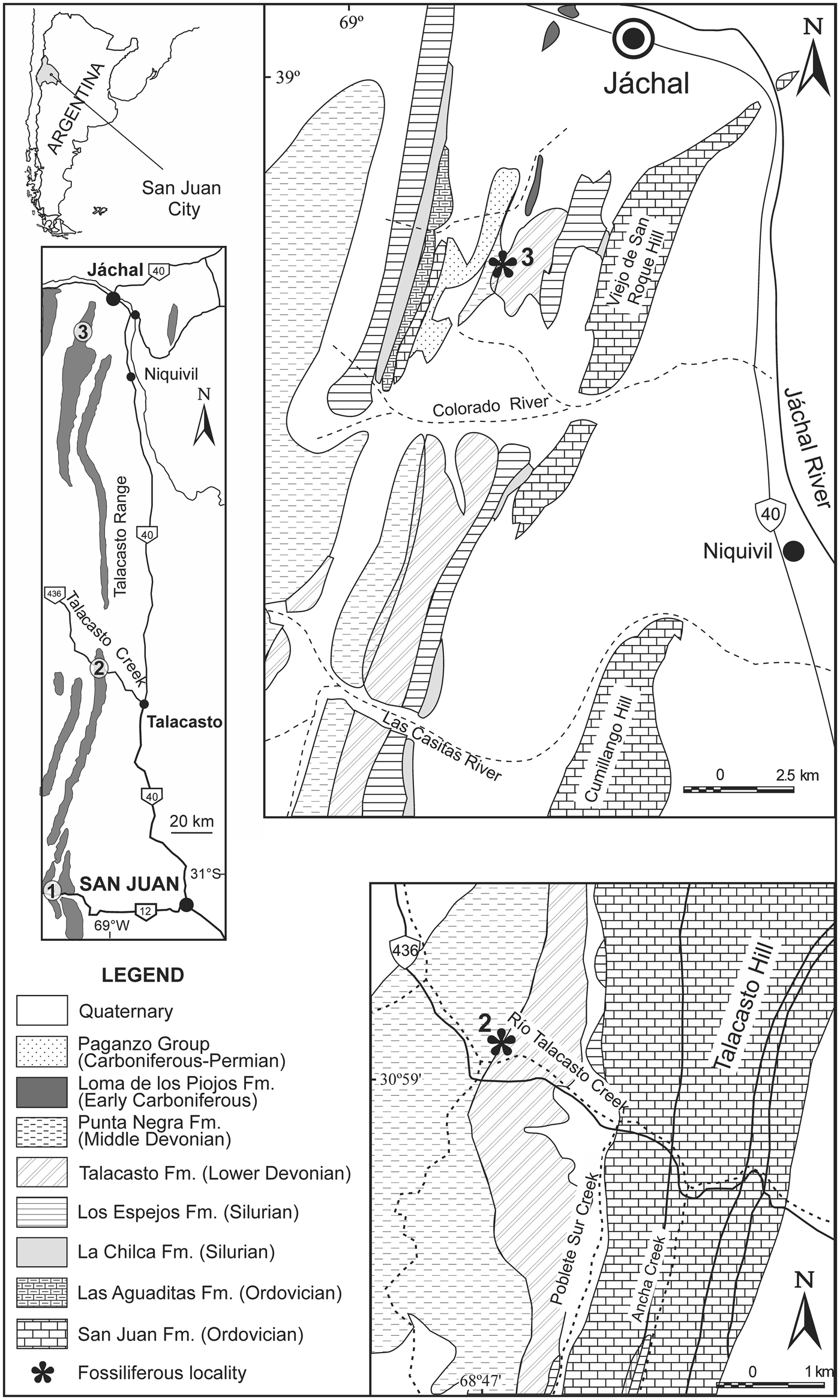
The bryozoans come from Devonian successions exposed in the Precordillera of San Juan Province, central-western Argentina (Fig. 1). Stratigraphic records correspond to the siliciclastic Talacasto and Punta Negra formations, which integrate the Lower–Middle Devonian Gualilán Group (Baldis, Reference Baldis1975).
Geological map of the studied area in the Central Precordillera of the San Juan province, between San Juan and Jáchal cities and location of the fossiliferous localities: 1-Portezuelo del Tambolar Creek, 2-Talacasto Creek and 3-Loma de los Piojos.

The Talacasto Formation (Padula et al., Reference Padula, Rolleri, Mingramm, Criado Roque, Flores and Baldis1967) is composed of a marine succession of dark argillaceous muddy intervals basally, passing upward to sandy levels. This unit corresponds to a muddy shelf depositional system developed during a highstand (Astini, Reference Astini1991), which overlies the (mainly) upper Silurian shelf system of the Los Espejos Formation and is overlain by the Punta Negra Formation. Conodonts and graptolites are absent and goniatites are extremely rare as in other closely related Lower–Middle Devonian Malvinokaffric basins, so that biostratigraphic calibrations are based on alternative groups. Thus, a Lochkovian to Emsian age was classically proposed for the Talacasto Formation based on brachiopod and palynological data (Benedetto et al., Reference Benedetto, Racheboeuf, Herrera and Brussa1992; Herrera, Reference Herrera1993, Reference Herrera and Racheboeuf1995a, Reference Herrerab; Le Hérissé et al., Reference Le Hérissé, Rubinstein, Steemans, Fatka and Servais1997; Herrera and Bustos, Reference Herrera and Bustos2001; García-Muro et al., Reference García-Muro, Rubinstein and Steemans2014, Reference García-Muro, Rubinstein and Rustán2017, Reference García-Muro, Rubinstein, Rustán and Steemans2018). According to brachiopod studies, the basal part of this unit is early (but not earliest) Lochkovian in the entire basin, while its top is diachronous and progressively younger to the north (Racheboeuf and Herrera, Reference Racheboeuf and Herrera1994; Herrera and Bustos, Reference Herrera and Bustos2001). The uppermost levels at the type section of Talacasto Creek correspond to a distinctive nodule-bearing horizon of ochre color referred as a stratigraphic marker by Keidel (Reference Keidel1921) and Astini (Reference Astini1991). The strata overlying this marker horizon were considered early Emsian in age or younger (Herrera and Bustos, Reference Herrera and Bustos2001), but recent palynological information suggests they might be Pragian (García Muro et al., Reference García-Muro, Rubinstein and Rustán2017, Reference García-Muro, Rubinstein, Rustán and Steemans2018).
The Punta Negra Formation overlies the top of the Keidel's guide horizon and is typically composed of coarsening- and thickening-upward succession of intercalated green to blackish-green sandstones and siltstones, arranged in tabular heterolithic layers, displaying conspicuous rhythmicity (Bustos and Astini, Reference Bustos and Astini1997). In the southern sections and up to Talacasto Creek section to the north, the base of the Punta Negra Formation is composed of a thick interval (nearly 35–40 m) of alternating green and purple pelites that overlies the Talacasto Formation through a sharp boundary located immediately above the Keidel's guide horizon. However, near Jáchal (typically at the Loma de Los Piojos section), the boundary between the Talacasto and Punta Negra formations is hundreds of meters above of the marker stratigraphic horizon of Keidel. Hence, the base of the Punta Negra Formation would be progressively younger to the north. This unit was considered to encompass lower Emsian to Middle Devonian levels (paleontological data supporting these interpretations have been summarized in Herrera and Bustos, Reference Herrera and Bustos2001). However, recent palynological information indicates an older, probably late Pragian age, for the lowermost interval at Loma de los Piojos section. The Punta Negra Formation is covered in almost all the sections by glacigenic deposits of the base of the upper Carboniferous Guandacol Formation, through an erosive discordance. In spite of this, an overall thickness of ~1000 m has been calculated for the Punta Negra Formation along the basin (Bustos, Reference Bustos1996). The sedimentary environment of the Punta Negra Formation was initially related to submarine fans (González-Bonorino and Middleton, Reference González-Bonorino and Middleton1976), and later was interpreted as deposited in a deltaic system (Astini, Reference Astini1991; Bustos, Reference Bustos1996; Bustos and Astini, Reference Bustos and Astini1997).
The bryozoan fauna (mainly accompanied by brachiopods, trilobites, ostracodes, bivalves, cephalopods, corals, conulariids, hyoliths, crinoids, and gastropods) derives from three different localities (Figs. 1, 2). From south to north:
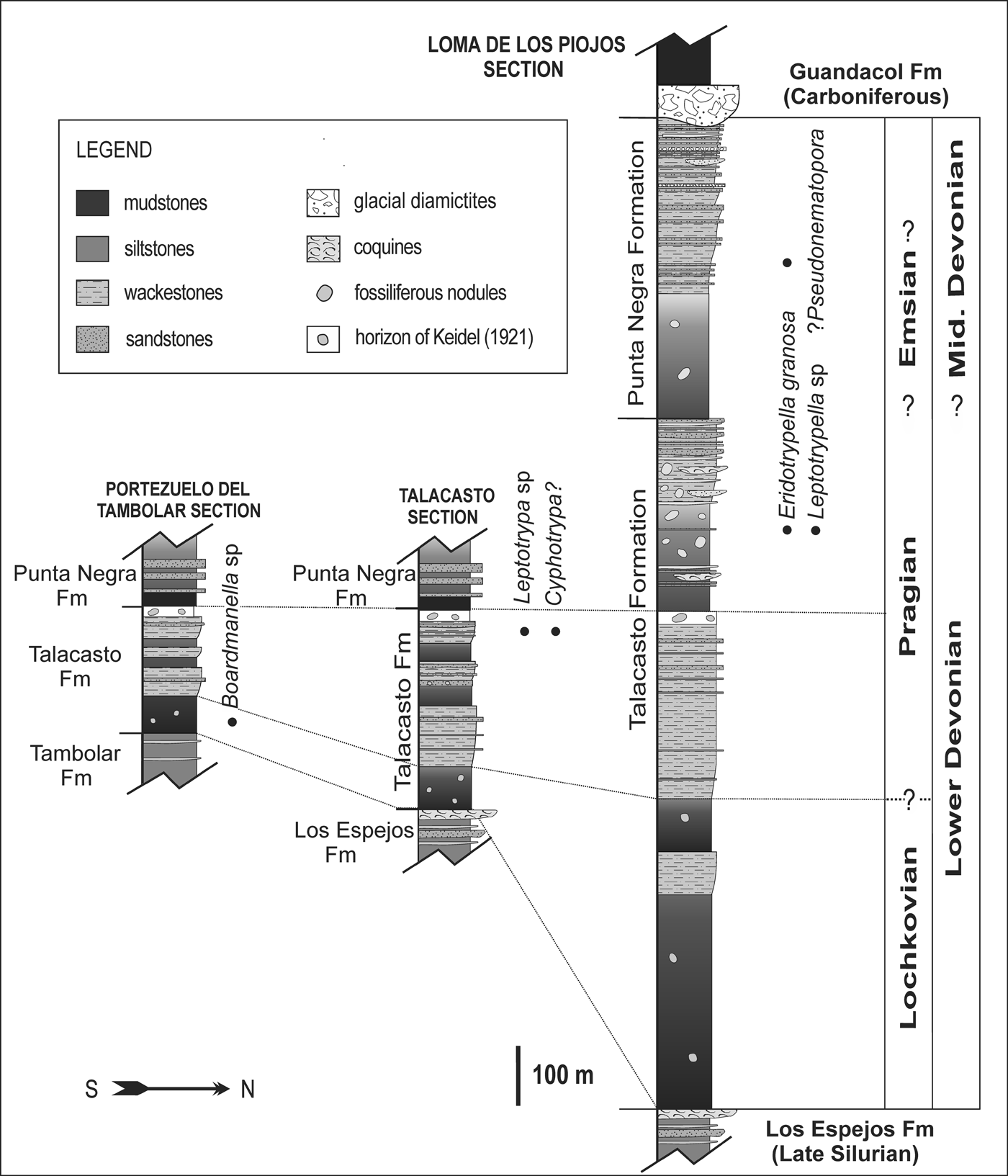
Stratigraphic sections and intervals of the studied bryozoan fauna.

Tambolar Creek Section
The section is located in the area known as Portezuelo del Tambolar, nearly 42 km to the west-northwest of San Juan city, next to the San Juan River and provincial route 20. In this section, the Talacasto Formation lies, through an unconformity, over the reddish upper Silurian Tambolar Formation (a southern equivalent of the Los Espejos Formation). Fossils are well preserved in dark muddy shales and concretions. Bryozoans come from concretions in the lower muddy interval. Age is considered Lochkovian to Pragian.
Talacasto Creek Section
This type section runs in an E-SW trend over provincial route 436, ~60 km to the northwest of San Juan city. Fossils are preserved in gray-bluish sandstones (Blue Sandstone Member of Baldis, Reference Baldis1975). In spite of preliminary early Emsian ages interpreted for these fossiliferous levels (Herrera and Bustos, Reference Herrera and Bustos2001, p. 369), recent palynological data suggest a late Pragian age (García Muro et al., Reference García-Muro, Rubinstein and Rustán2017, Reference García-Muro, Rubinstein, Rustán and Steemans2018).
Loma de los Piojos section
This section is located ~8 km to the southwest of Jáchal city. The units were studied in an east-west transect situated at 30°18,504′S/68°47,399′W. In the Talacasto Formation, bryozoans were recorded in the upper interval from calcareous concretions located in an interval nearly 150–160 m above the marker horizon of Keidel. This interval, previously considered Emsian, probably is Pragian according recent palynological data (García Muro et al., Reference García-Muro, Rubinstein, Rustán and Steemans2018). In the Punta Negra Formation, bryozoans were recorded 250 m above the base, including in a 1.5 m thick bed constituted by greenish dark-gray and slightly micaceous massive mudstones (same fossiliferous levels reported in Salas et al., Reference Salas, Rustán and Sterren2013; Sterren et al., Reference Sterren, Rustán and Salas2015). On the basis of the trilobite Acanthopyge (Lobopyge) balliviani (Kozlowski, Reference Kozlowski1923) reported by Rustán and Vaccari (Reference Rustán and Vaccari2010), this fossiliferous bed was considered of Middle Devonian age. However, recent palynological data suggest an Emsian age for this level (García Muro et al., Reference García-Muro, Rubinstein, Rustán and Steemans2018)
Repository and institutional abbreviation
The specimens are housed under the prefix CEGH-UNC in the paleontological collection of Centro de Investigaciones Paleobiológicas (CIPAL), at the building of Centro de Investigaciones en Ciencias de la Tierra (CICTERRA), Universidad Nacional de Córdoba, Argentina.
Systematic paleontology
Phylum Bryozoa Ehrenberg, Reference Ehrenberg1831
Class Stenolaemata Borg, Reference Borg1926
Superorder Palaeostomata Ma et al., Reference Ma, Buttler, Taylor, Rosso, Wyse Jackson and Porter2014
Order Trepostomata Ulrich, Reference Ulrich1882
Suborder Amplexoporina Astrova, Reference Astrova1965
Family Atactotoechidae Duncan, Reference Duncan1939
Genus Leptotrypa Ulrich, Reference Ulrich1883
Type species
Leptotrypa minima Ulrich, Reference Ulrich1883. Cincinnatian (Upper Ordovician); North America.
Diagnosis
Modified after Astrova (Reference Astrova1978). Thin encrusting colonies. Autozooecia with polygonal apertures. Autozooecial walls irregularly thickened throughout the colony or near the periphery, indistinctly laminated, usually integrated in initial parts and merged near the colony surface. Autozooecial diaphragms absent or rare. Exilazooecia rare to common. Acanthostyles small to moderately large, common to abundant.
Occurrence
Middle Ordovician to middle Carboniferous; worldwide.
Leptotrypa sp.
Figure 3.1–3.3; Table 1
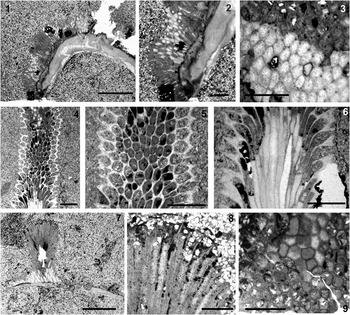
(1–3) Leptotrypa sp. (1) Encrusting colony on a shell, CEGH–UNC 27271; (2) detail of the previous photograph showing the longitudinal section of the thick encrusting colony; (3) transversal section showing polygonal zooecia and acanthostyles. (4–6) Leptotrypella sp. (4) Erect almost complete colony, CEGH–UNC 27273; (5) detail of the previous photograph showing tangential section of polygonal zooecia; (6) longitudinal section showing long zooecia in endozone without diaphragms, bending abruptly in exozone. (7–9) ?Cyphotrypa sp. (7) Erect colony with base encrusted on a shell CEGH–UNC 27274; (8) detail of previous photograph showing long straight zooecia in longitudinal section; (9) transversal section at the colony base. Scale bars: 1 mm for 2–6, 8, 9 and 5 mm for 1 and 7.

Descriptive statistics for Leptotrypa sp. Abbreviations: N = number of measurements, X = mean, SD = sample standard deviation, CV = coefficient of variation, MIN = minimal value, MAX = maximal value.

Description
Encrusting colonies, 2.75–3.75 mm in thickness. Autozooecia budding from a thin epitheca, growing a short distance parallel to the substrate, then bending sharply to the colony surface. Autozooecial apertures polygonal. Autozooecial diaphragms straight, 1–2 in each autozooecium. Exilazooecia not observed. Acanthostyles common, 4–5 surrounding each autozooecial aperture. Autozooecial walls finely laminated, 0.013–0.026 mm thick in endozone; laminated, merged without visible autozooecial boundaries, 0.022–0.043 mm thick in exozone. Maculae of larger zooecia present.
Material
Two specimens, CEGH-UNC 27271–27272, one encrusted on a shell, from gray-bluish sandstones of the Talacasto Formation at Talacasto section, nearly 3 m below the Keidel's marker horizon. Pragian.
Remarks
Leptotrypa Ulrich, Reference Ulrich1883 differs from Anomalotoechus Duncan, Reference Duncan1939 in having a thin encrusting colony and rare diaphragms. The present species is similar to the species Leptotrypa? spinifera Duncan, Reference Duncan1939 from the Middle Devonian (Givetian) of USA. Duncan (Reference Duncan1939, p. 222) gave the following measurements: colony thickness 0.4–0.6 mm (versus 2.75–3.75 mm in the present species), aperture width 0.20–0.28 mm (versus 0.18–0.25 mm in the present species). Furthermore, Leptotrypa? spinifera has 2–3 acanthostyles per aperture (versus 4–5 in the present species).
Genus Leptotrypella Vinassa de Regny, Reference Vinassa de Regny1921
Type species
Chaetetes barrandei Nicholson, Reference Nicholson1874. Middle Devonian; Ontario (Canada).
Diagnosis
Modified after Astrova (Reference Astrova1978). Branched colonies. Autozooecia with polygonal to rounded-polygonal apertures. Autozooecial diaphragms lacking in endozones; rare to common in exozones. Exilazooecia rare. Acanthostyles long, common to abundant. Autozooecial walls granular, thin in endozones; laminated, mainly merged but sometimes serrated, irregularly thickened in exozones.
Occurrence
Middle Silurian to lower Carboniferous; worldwide.
Leptotrypella sp.
Figure 3.4–3.6; Table 2
Descriptive statistics for Leptotrypella sp. Abbreviations as for Table 1.

Description
Branched colony, 2.67 mm in diameter, with 0.92 mm wide exozone and 0.83 mm wide endozone. Autozooecia long in endozones, bending at low angles in exozones. Autozooecial apertures oval to slightly polygonal. Autozooecial diaphragms absent. Exilazooecia few. Acanthostyles rare or absent. Autozooecial walls granular, 0.016–0.020 mm thick in endozones; laminated, merged, without distinct zooecial boundaries, 0.028–0.041 mm thick in exozones.
Material
A single specimen, CEGH–UNC 27273, found in a calcareous concretion. Talacasto Formation at Loma de los Piojos section, ~150–160 m above Keidel's marker horizon. Late Pragian? (see García Muro et al., Reference García-Muro, Rubinstein, Rustán and Steemans2018).
Remarks
Leptotrypella Vinassa de Regny, Reference Vinassa de Regny1921 differs from Leptotrypa Ulrich, Reference Ulrich1883 in having branched colonies, and from Anomalotoechus Duncan, Reference Dunaeva and Morozova1939 in having branched colonies and absence of diaphragms in endozones. The Argentinian material is similar to the species Leptotrypella brevis (Duncan, Reference Duncan1939) from the Middle Devonian (Givetian) of USA. That species has a maximum branch diameter of 4 mm, aperture width of 0.21–0.30 mm (versus 0.18–0.29 in the present material). The present species differs from L.? raritabulata Bigey, Reference Bigey and Rachebouef1986 from the Lower Devonian (Lochkovian) of France, in having larger autozooecial apertures (aperture width 0.18–0.29 mm versus 0.13–0.18 mm in L.? raritabulata). Leptotrypella? praecox Boardman in Doumani et al., Reference Doumani, Boardman, Rowell, Boucot, Johnson, McAlester, Miles and Hadley1965, from the Lower Devonian Horlick Formation in Antarctica, has remarkably abundant acanthostyles that clearly contrast with their almost absence in our material.
Genus Cyphotrypa Ulrich and Bassler Reference Ulrich and Bassler1904
Type species
Leptotrypa acervulosa Ulrich, Reference Ulrich1893a. Middle Ordovician; North America.
Diagnosis
After Astrova (Reference Astrova1978). Massive colonies, hemispheric, not differentiated into endo- and exozone. Autozooecia prismatic, having polygonal apertures. Diaphragms thin, usually abundant, sometimes rare. Exilazooecia very rare, appearing usually in lateral part of colony. Acanthostyles small, short, occurring in different number. Walls granular or indistinctly fibrous, irregularly thickened.
Occurrence
Lower Ordovician–Upper Devonian; worldwide.
?Cyphotrypa sp.
Figure 3.7–3.9; Table 3
Descriptive statistics for ?Cyphotrypa sp. Abbreviations as for Table 1.

Description
Colony shape unknown, apparently massive subramose, not differentiated into endo- and exozone. Autozooecia prismatic, having polygonal apertures. Diaphragms few, thin, straight or inclined. Exilazooecia absent. Acanthostyles small, short, few. Walls granular or indistinctly fibrous, 0.015–0.037 mm thick in endozone and 0.028–0.051 mm thick in exozone. Maculae of larger zooecia present.
Material
One colony, CEGH-UNC 27274, encrusted on a shell, from gray-bluish sandstones of the Talacasto Formation at Talacasto section, nearly 3 m below Keidel's marker horizon. Pragian.
Remarks
The genus Cyphotrypa Ulrich and Bassler, Reference Ulrich and Bassler1904 differs from the genus Leptotrypa Ulrich, Reference Ulrich1883 by massive colony and abundant diaphragms, and from the genus Orbignyella Ulrich and Bassler, Reference Ulrich and Bassler1904 by absence of cystiphragm-like diaphragms. The present species is similar to Cyphotrypa minuscula Volkova, Reference Volkova1974 from the Middle Devonian of Altai, but differs from it by having less abundant autozooecial diaphragms. The present species differs from Cyphotrypa columnaris Kopajevich, Reference Kopajevich1984 from the Middle–Late Devonian of Mongolia by having smaller autozooecial apertures (0.22–0.24 mm versus 0.36–0.63 mm in C. columnaris). A single specimen not completely preserved prevents an accurate identification.
Family Eridotrypellidae Morozova, Reference Morozova1961
Genus Eridotrypella Duncan, Reference Duncan1939
Type species
Batostomella obliqua Ulrich, Reference Ulrich1890. Middle Devonian; Michigan (USA).
Diagnosis
Branched colonies. Autozooecial apertures irregularly polygonal. Autozooecial walls laminated, without distinct zooecial boundaries, irregularly thickened, containing spherulites. Diaphragms complete, varying in number. Exilazooecia rare. Acanthostyles varying in size and number.
Occurrence
Silurian–?Carboniferous; worldwide.
Eridotrypella granosa Duncan, Reference Duncan1939
Figure 4.1–4.6; Table 4
1939 Eridotrypella granosa Duncan, p. 213, pl. 6, figs. 1–3. Middle Devonian (Givetian); USA (Michigan).
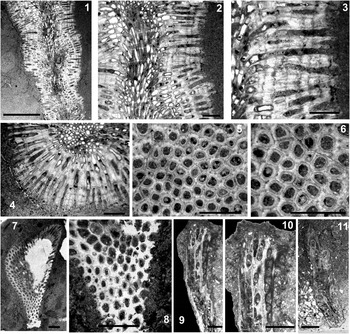
(1–6) Eridotrypella granosa Duncan, Reference Duncan1939. (1) Erect ramose zoarium CEGH–UNC 27275; (2) detail of previous photograph showing the longitudinal section and the abrupt bend of the zooecia in the exozone; (3) detail of the longitudinal section showing weakly crenulated autozooecial walls and acanthostyles; (4) transversal section; (5, 6) tangential sections showing polygonal zooecia and exilazooecia. (7, 8) Boardmanella sp. (7) Ramose colony CEGH–UNC 27276; (8) detail of the tangential section. (9–11) ?Pseudonematopora sp. (9) Longitudinal view of a ramose specimen CEGH–UNC 27277; (10) detail of the upper part of the colony; (11) longitudinal view of a fragmented specimen CEGH–UNC 27278. All scale bars 1 mm except 1, which is 5 mm.

Descriptive statistics for Eridotrypella granosa Duncan, Reference Duncan1939. Abbreviations as for Table 1.

Description
Ramose branched colony, 9.5 mm in diameter. Exozone 3.7 mm wide, endozone 2.1 mm wide. Exozones distinctly separated from endozones. Autozooecia long in endozones, bending sharply in exozones. Autozooecial apertures polygonal with rounded corners. Autozooecial diaphragms absent to rare in endozones; straight, usually thick, common in transition between endozone and exozone. Exilazooecia absent to rare, short, polygonal in cross section. Acanthostyles common, indistinct. Autozooecial walls granular, locally weakly crenulated, 0.005–0.010 mm thick in endozones; merged, irregularly thickened, 0.055–0.110 mm thick in exozones. Maculae, consisting of larger zooecia, present.
Material
A single specimen CEGH–UNC 27275, found in a calcareous concretion of the Talacasto Formation at Loma de los Piojos section, ~150–160 m above Keidel's marker horizon. Late Pragian? (see García Muro et al., Reference García-Muro, Rubinstein, Rustán and Steemans2018).
Remarks
Eridotrypella Duncan, Reference Duncan1939 differs from Eostenopora Duncan, Reference Duncan1939 in colony form (erect branched versus encrusting or massive colonies). Eridotrypella granosa Duncan, Reference Duncan1939 differs from E. devonica Duncan, Reference Duncan1939 in having larger autozooecial apertures (aperture width 0.11–0.21 mm versus 0.09–0.14 mm in E. devonica) and a sharp bend of autozooecia in the exozone. Eridotrypella granosa differs from E. valentinae Morozova, Reference Morozova1961, from the Middle Devonian of Siberia, by larger autozooecia (aperture width 0.11–0.21 mm versus 0.13–0.16 mm in E. valentinae) and less abundant autozooecial diaphragms.
Family Anisotrypidae Dunaeva and Morozova, Reference Dunaeva and Morozova1967
Genus Boardmanella Gorjunova and Weis, Reference Gorjunova and Weis2003
Type species
Boardmanella richardi Gorjunova and Weiss, Reference Gorjunova and Weis2003, by original designation. Middle Devonian (Givetian); Mongolia.
Diagnosis (emended)
Branched colonies with distinct exozones; autozooecia prismatic, growing parallel to the branch axis in endozones, then bending in exozones at moderate angles, polygonal in transverse section; autozooecial apertures rounded to oval or rounded-polygonal; basal diaphragms usually absent, locally present, thin, straight; exilazooecia rare to abundant, short, varying in size; paurostyles (Gorjunova and Weis, Reference Gorjunova and Weis2003) always covered by skeletal material; varying in size and number; autozooecial walls regularly thickened in exozones, straight, merged without distinct zooecial boundaries and showing reverse U-shaped lamination.
Occurrence
Lower–Upper Devonian; Kazakhstan, Europe, Altai, Mongolia.
Boardmanella sp.
Figure 4.7–4.8; Table 5
Descriptive statistics for Boardmanella sp. Abbreviations as for Table 1.

Description
Branched colony with distinct exozone. Autozooecia long in endozone, bending at low angles in exozone. Autozooecial apertures rounded-polygonal. Autozooecial diaphragms rare to absent. Exilazooecia rare, short, rounded to oval in cross section. Paurostyles 0.026–0.042 mm in diameter, 5–7 surrounding each autozooecial aperture; having indistinct cores and laminated sheaths. Autozooecial walls granular, 0.039–0.063 mm thick in endozones; thick, merged, laminated without distinct zooecial boundaries, 0.152–0.180 mm thick in exozones. Indistinct maculae consisting of larger autozooecia.
Material
Single specimen, CEGH–UNC 27276, found in a concretion of the Lower muddy interval of the Talacasto Formation at Tambolar section. Lochkovian to Pragian (see García Muro et al., Reference García-Muro, Rubinstein and Rustán2017).
Remarks
Boardmanella Gorjunova and Weis, Reference Gorjunova and Weis2003 is superficially similar to Dyscritella Girty, Reference Girty1911 in having rare to absent diaphragms and regularly thickened autozooecial walls. However, the styles in Boardmanella are different than those in Dyscritella. Gorjunova and Weis (Reference Gorjunova and Weis2003) correctly noted the similarity of these styles to paurostyles of Blake (Reference Blake, Boardman, Cheetham, Blake, Utgaard, Karklins, Cook, Sandberg, Lutaud and Wood1983). However, the styles in Boardmanella do not correspond completely to the term “paurostyle” sensu stricto. Species placed by Gorjunova and Weis (Reference Gorjunova and Weis2003) in the genus Boardmanella have a typical combination of morphological characters (e.g., wall structure, rare or lacking diaphragms), and they have styles varying in size and number, but always covered by skeletal material. Blake (Reference Blake, Boardman, Cheetham, Blake, Utgaard, Karklins, Cook, Sandberg, Lutaud and Wood1983, p. G538–G539) regarded paurostyles as the simplest kind of styles, consisting of small rods, usually 0.02–0.04 mm in diameter, and with narrow laminated sheaths. The main difference between acanthostyles and paurostyles is that acanthostyles usually protrude upon the colony surface and have wide, well-developed laminated sheaths. For the aims of the present paper, the term “paurostyles” is used in the description, although a new name is obviously needed.
The Argentinian material shows similarities to the genus Boardmanella Gorjunova and Weis, Reference Gorjunova and Weis2003 in presence of paurostyles, absence of autozooecial diaphragms, and in the merged wall microstructure with reversed U-shaped laminae. However, the type species, B. richardi Gorjunova and Weiss, Reference Gorjunova and Weis2003, as most of the other species of Boardmanella, possesses abundant exilazooecia, whereas the present material has few exilazooecia. In that character, it is similar to the species Boardmanella bohemica (Ernst, Reference Ernst2008) from the Lower–Middle Devonian of Europe, but differs from it in having regularly sized paurostyles and widely spaced autozooecial apertures (distance from center to center 0.26 mm versus 0.17 mm in B. bohemica).
Order Cryptostomata Vine, Reference Vine1884
Suborder Rhabdomesina Astrova and Morozova, Reference Astrova and Morozova1956
Family Arthrostylidae Ulrich, Reference Ulrich1882
Genus Pseudonematopora Balakin, Reference Balakin1974
Type species
Nematopora? turkestanica Nikiforova, Reference Nikiforova1948. Lower Carboniferous of Central Asia.
Diagnosis
Ramose colonies with occasional dichotomous branches. Branch width constant, circular to semicircular in transverse section. Autozooecia arranged in 6–16 longitudinal rows, budding in an annular manner from a central axis or median wall. Autozooecial apertures circular to oval shaped, with proximal peristomes. Vesicular skeleton may be present in the exozone. Diaphragms and acanthostyles absent, terminal diaphragms common.
Occurrence
Upper Devonian (Famennian) to Pennsylvanian (Bashkirian); Europe, Russia, Kazakhstan, China, Mongolia.
?Pseudonematopora sp.
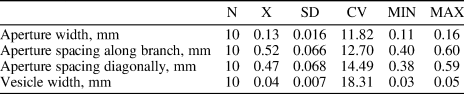
Figure 4.9–4.11; Table 6
Descriptive statistics for ?Pseudonematopora sp. Abbreviations as for Table 1.

Description
Branched colony, 1 mm in diameter. Autozooecia long in endozone, bending sharply in exozone. Autozooecial apertures oval, arranged in regular alternating rows. Hemisepta absent. Diaphragms not observed. Heterozooecia absent. Vesicles between apertures in two rows, small, polygonal, sealed by calcitic material on the colony surface. Autozooecial walls laminated, 0.037–0.060 mm thick in endozone; laminated, merged, punctate in appearance because of numerous small tubules in exozone. Styles not observed.
Material
Two specimens, CEGH–UNC 27277–27278, preserved in gray micaceous mudstones with plant debris. Punta Negra Formation at Loma de los Piojos Section. Levels 250 m above the base. Emsian? (see García Muro et al., Reference García-Muro, Rubinstein, Rustán and Steemans2018).
Remarks
Pseudonematopora Balakin, Reference Balakin1974 differs from Nematotrypa Bassler, Reference Bassler1911 by lacking both hemidiaphragms in autozooecia and nodes on colony surfaces. The present material is similar to the genus Pseudonematopora Balakin, Reference Balakin1974 in arrangement and shape of autozooecial apertures and in presence of vesicles between autozooecia. The present species differs from P. turkestanica (Nikiforova, Reference Nikiforova1948) from the lower Carboniferous of Kazakhstan, in smaller autozooecial apertures (aperture width 0.11–0.16 mm versus 0.17–0.22 mm in P. turkestanica). The present species differs from P. hextolgayensis (Xia, Reference Xia1997) from the Upper Devonian (Famennian) of China in having less abundant and smaller vesicles as well as in smaller autozooecia (aperture width 0.11–0.16 mm versus 0.13–0.19 mm in P. hextolgayensis).
Paleobiogeography
The Devonian faunas from Argentina have been classically considered of Malvinokaffric affinities. Together with the Old World Realm and the Eastern Americas Realm, the Malvinokaffric Realm is one of the three major paleobiogeographical units of the Devonian. This Realm mainly embraces Early–Middle Devonian marine records belonging to a paleo-circumpolar austral region in Southwestern Gondwana (see Bigey, Reference Bigey, Nielsen and Larwood1985), including basins from southern South America, South Africa, Ghana, and Antarctica. The Malvinokaffric Realm has been characterized by high endemism in taxa of suprageneric level (noticeably trilobites), unusual abundance of some taxonomic groups (such as hyoliths and conulariids), and the scarcity (or absence) of some typical Paleozoic groups like stromatoporoids, conodonts, graptolites, and goniatites. Boucot and Racheboeuf (Reference Boucot and Racheboeuf1993) included the absence of bryozoans as a hallmark of the Malvinokaffric Realm, in accordance with previous statements of Kozlowski (Reference Kozlowski1923) and Reed (Reference Reed1925). However, a number of preliminary reports on bryozoans from Southwestern Gondwana were known, although usually lacking illustrations (Bigey, Reference Bigey, Nielsen and Larwood1985).
A first mention appears to be that from the Lower Devonian of Bolivia by Knod (Reference Knod and Steinmann1908) who originally cited Monotrypa raritabulata (according to Reed, Reference Reed1925, p. 34). Later, Kozlowski (Reference Kozlowski1923) mentioned a taxon close to “Stenopora” steinmanni Ulrich, Reference Ulrich1893b from (supposed) Emsian layers of the Icla Formation in Bolivia. Material probably from the same locality was later illustrated by Bigey (Reference Bigey, Nielsen and Larwood1985, fig. 4A), which according to more recent stratigraphic proposals (Adrain and Edgecombe, Reference Adrain and Edgecombe1996) might be Pragian in age. Unfortunately, description and illustration of these forms are too limited to confirm any taxonomic assignment.
Other South American bryozoan records come from the Emsian of Cocachacra, southern Perú (Boucot et al., Reference Boucot, Isaacson and Laubacher1980, fig 5) and from the Lower Devonian of the Ponta Grossa Formation, in the Paraná Basin, Brazil (Lange and Petri, Reference Lange and Petri1967). Outside South America, Reed (Reference Reed1925, p. 34) cited Fenestella coming from the “Bokkeveld beds,” and Monotrypa from the Cape Town area, South Africa, presumably from the Eifelian of the Voorstehoek Formation. Also in South Africa, Hiller and Theron (Reference Hiller, Theron, McMillan, Embry and Glass1988) called the attention to the exquisite preservation of bryozoans in obrution layers of the Eifelian Waboomberg Formation, and a bryozoan encrusting a gastropod shell was mentioned by Boucot et al. (Reference Boucot, Eldredge, Gray, Pojeta and Theron1986) in the Emsian of the Gydo Formation, from a subsurface sample of borehole KL1/65, near Sutherland, South-Western Cape Province. Finally, Stone and Rushton (Reference Stone and Rushton2003, fig. 2) and Stone et al. (Reference Stone, Aldiss and Edwards2005, fig. 18) noted an encrustation of a trepostome Bryozoan on a snail shell contained in a carbonate concretion collected at Pebble Island, from Pragian mudstones of the Fox Bay Formation, Malvinas/Falkland Islands, and Boardman (in Doumani et al., Reference Doumani, Boardman, Rowell, Boucot, Johnson, McAlester, Miles and Hadley1965, p. 248) erected the trepostome species Leptotrypella? praecox from the Lower Devonian Horlick Formation in Antarctica, which has been the only formally described bryozoan from the Malvinokaffric Realm to date.
In spite of the good records of Lower–Middle Devonian marine faunas from the Argentine Precordillera, no bryozoans are known except by isolated references like those by Bigey (Reference Bigey, Nielsen and Larwood1985) and Peralta (Reference Peralta1991). Recently, Cichowolski and Rustán (Reference Cichowolski and Rustán2017, fig. 4.6) documented encrusting/epibiontic putative bryozoans on conchs of upper Pragian-lower Emsian bactritid cephalopods from the Talacasto Formation. However, these specimens merit further taxonomic analysis because they exhibit hedereloid affinities, a group not related to bryozoans (see Taylor and Wilson, Reference Taylor, Wilson, Hageman, Key and Winston2008).
In such a background, the Argentinian bryozoan fauna reported herein represents the bulk of Devonian bryozoan records from Southwestern Gondwanan basins. The Argentinian assemblage is composed by the trepostomate taxa Leptotrypa sp., Leptotrypella sp., Cyphotrypa sp., Eridotrypella granosa Duncan, Reference Duncan1939, and Boardmanella sp., along with the cryptostome ?Pseudonematopora sp. The previous records of Leptotrypella? praecox from Antarctica and the putative presence of Fenestella, Monotrypa, and Stenopora complete the list of bryozoans from the Devonian of southwestern Gondwanan basins.
The most striking feature of these bryozoans is the absence of Malvinokaffric endemics. Our new records support nearly cosmopolitan distributions for the bulk of the identified genera in southwestern Gondwana. Leptotrypa and Leptotrypella have Laurentian-European records, Boardmanella was mainly known from the Early to Late Devonian of Eurasia (Europe, Altai, Kazakhstan, Mongolia) and Cyphotrypa is cosmopolitan in the Devonian. The species Eridotrypella granosa Duncan, Reference Duncan1939 was recorded in the Devonian (Givetian) of Michigan, USA. Finally, the cryptostome Pseudonematopora Balakin, Reference Balakin1974 was mainly recorded in the Mississippian to Pennsylvanian (Moscovian) of Eurasia (Europe, Altai, Kazakhstan, Mongolia), with one species (P. hextolgayensis Xia, Reference Xia1997) known from the Late Devonian (Famennian) of China. The Middle Devonian record of this genus in the Argentine Precordillera would represent the earliest occurrence of the taxon. However, we take this with caution due to the uncertainty expressed in the taxonomic assignment.
The bryozoans described in this contribution provide interesting new elements to discuss biogeographic signatures of the Malvinokaffric communities. Because their faunas were recognized from relatively isolated basins, the Malvinokaffric Realm was proposed as a natural model to study the dynamics of spatial distribution of taxa controlled by the tectonic history of the region and global eustacy (Lieberman, Reference Lieberman1993). A few hypotheses regarding phylo-geographic processes involved in its definition include either Devonian radiations of ancestral cosmopolitan stocks already present since the Silurian in these basins or migrations from low paleolatitudes during the Devonian (Eldredge and Ormiston, Reference Eldredge, Ormiston, Gray and Boucot1979). Postulated controls driving these evolutionary and biogeographical processes classically refer to complex paleogeographical settings (Abe and Lieberman, Reference Abe and Lieberman2009), climate/temperatures/latitudinal position (Boucot et al., Reference Boucot, Johnson and Talent1969), and oceanographic factors, such as paleocurrents (Eldredge and Ormiston, Reference Eldredge, Ormiston, Gray and Boucot1979; Isaacson, Reference Isaacson, Díaz-Martínez and Rábano2007) and variations of relative sea level (Rustán and Vaccari, Reference Rustán and Vaccari2010). Such proposals tend to highlight the abiotic factors and sometimes overlook paleoecological/evolutionary dynamics of each taxonomic group involved. In this scenario, new contributions on poorly known taxonomic groups from the Devonian of the Precordillera, when compared to records from closely related basins, called attention to a number of contrasting biogeographical patterns in Southwestern Gondwana, which in many cases challenge the idea of strongly endemic faunas. Remarkably, trilobites, although exhibiting overall endemic signatures, record unexpected extra-Malvinokaffric affinities (Rustán and Vaccari, Reference Rustán and Vaccari2010, Reference Rustán and Vaccari2012; Holloway and Rustán, Reference Holloway and Rustán2012; Rustán and Balseiro, Reference Rustán and Balseiro2016). Ostracodes show wide distributions during Lochkovian while Emsian–Middle Devonian ones record frequent Malvinokaffric endemism (Salas et al., Reference Salas, Rustán and Sterren2013; Salas, Reference Salas2016). In turn, a ‘mixed area’ was proposed in the case of the Lower Devonian brachiopod faunas of the Argentine Precordillera (Herrera et al., Reference Herrera, Salas and Giolitti1998; Isaacson, Reference Isaacson, Díaz-Martínez and Rábano2007). With some exceptions, hyolithids (mainly known from Bolivia) exhibit Malvinokaffric endemisms (Malinky and Racheboeuf, Reference Malinky and Racheboeuf2011).
In this scenario, the bactritid cephalopods are the only group that exhibits as wide geographic distributions, as recognized herein in bryozoans (Cichowolski and Rustán, Reference Cichowolski and Rustán2017). However, the wide distributions of these cephalopods were explained as controlled by postulated planktonic life-styles, which would have favored dispersion. The contribution of cephalopods to the dispersion of bryozoans as eventual epizoans is unclear, although this biotic relationship, involving both taxonomic groups, has been documented since the Ordovician (Wyse Jackson and Key, Reference Wyse Jackson and Key2014). In the Argentinean material, no bryozoan encrustations have been found on the cephalopods, with the sole encrustations of non-bryozoan hederelloids seen on bactritids (Cichowolski and Rustán, Reference Cichowolski and Rustán2017).
Bryozoans provide the first record of an entirely sessile benthic group characterized by nearly cosmopolitan distribution in Southwestern Gondwanan basins, which exclude the influence of taphonomic factors in the distribution ranges. Although pending further precision on dispersion capabilities based on ecological requirements of larvae and more detailed autoecological analyses, our data suggest that paleocurrents, temperatures, substrate, turbidity, or sedimentation rate would not have been ecological barriers for distribution. The bryozoans reported herein, in the cold siliciclastic settings of the Malvinokaffric Realm, were also present in coeval warmer carbonate environments from low paleolatidudes, and consequently, they could be considered truly eurytopic. This implies that only those genera with fully pandemic capabilities from the Eastern Americas Realm (Laurentian-European records: Eridotrypella granosa, Leptotrypa, Leptotrypella) or from the Old World Realm (Eurasian records: Boardmanella, Pseudonematopora) were able to reach high-latitude, siliciclastic environments of the Southwestern Gondwanan basins.
Conclusion
Discovery and description of six bryozoan genera in the Devonian of the Argentine Precordillera Basin begin to fill a gap in our knowledge of the Devonian bryozoan records of South America. The diversity found is remarkable, considering the scarcity of bryozoan information in Gondwana, particularly during the Devonian. The bryozoan fauna records two main paleobiogeographic affinities: the Eastern Americas and the Old World Realm. As a whole, genera identified are considered eurytopic, cosmopolitan taxa. The distribution pattern recognized is similar to that of some orthoconic cephalopods, such as the necto-planctonic bactritoids. Hence, bryozoans provide the first record of an entirely sessile benthic group characterized by nearly world-wide distribution in Devonian marine basins from Southwestern Gondwana. The wide distribution of the described bryozoans is relevant in the context of the alleged, highly endemic nature of Malvinokaffric faunas.
Acknowledgments
The authors acknowledge support from the National Research Council of Argentina (CONICET) Project PUE 2016-2021, CICTERRA. The Compañía Minera del Pacífico and its local manager, engineer E. Alonso, provided permission to access to the outcrops in Loma de los Piojos section. Appreciation is extended to the reviewers and the editorial staff for their helpful comments and suggestions that significantly improved the final version of the manuscript. Special acknowledgement to M. Medina and the technical team of the LABGEO (CICTERRA- FCEFyN) for the effort in thin sections preparation.