A disaster, as defined by the International Federation of the Red Cross and Red Crescent Societies, is “a sudden, calamitous event that seriously disrupts the functioning of a community or society and causes human, material, and economic or environmental losses that exceed the community’s or society’s ability to cope using its own resources.” 1 Though often considered rare or infrequent events, disasters are common and are a fundamental part of normal life. Between 2004 and 2014 alone, there were more than 6300 reported disasters globally, an average of more than 12 disasters per week.Reference Ager, Baillie Smith and Barbelet 2 These events have been driven, in part, by an increasing frequency and severity of extreme weather events,Reference Easterling 3 , Reference Than 4 a rise in intrastate conflicts, and increasing threats from emerging infectious diseases.Reference Jones, Patel and Levy 7 Mounting a coordinated and effective response to a growing number of disasters globally is difficult even under the best circumstances, but the challenges have grown more complex as the pace of urbanization quickens around the world. At present, more than 54% of the world’s population resides in urban environments, and that figure is expected to increase to 66% by 2050. 8 Humanitarian emergencies taking place in urban areas present a complex landscape for disaster response, with challenges such as dense populations, massive human displacement, industrial activities, security risks, rapid and dynamic transmission of disease, and a variety of potentially hazardous exposures.Reference Currion 9 Increasingly sophisticated approaches are required to address these challenges.
Constrained by a general lack of available resources 10 and challenged by an increasingly complex disaster landscape, the humanitarian community, including national and international nongovernmental organizations and United Nations agencies, has recently turned to novel information and communications technology (ICT) for improving disaster response and has even begun to explore the use of big data for informing, monitoring, and evaluating response efforts. Big data is commonly defined by the so-called 3 vees: volume, velocity, and variety.Reference Gandomi and Haider 11 That is, big data can be defined by the large magnitude of data (volume), the fast rate at which data is generated (velocity), or the structural heterogeneity within the data itself (variety). It is not surprising then that the humanitarian community would look to ICT tools and big data approaches to achieve a more efficient and effective disaster response. Disaster settings rapidly generate a massive quantity and variety of potentially relevant data, which must be quickly collected, analyzed, shared, and used by the humanitarian community. Despite the potential utility of ICT and big data, there remains a dearth of available literature evaluating the effectiveness of their uses in disaster response, and we could find no integrative review published in the scientific literature providing a comprehensive overview of ICT and big data applications in disasters. The objective of this review is to describe the current state of the art in ICT and big data applications in disaster settings and to determine potential avenues for future research and application.
METHODS
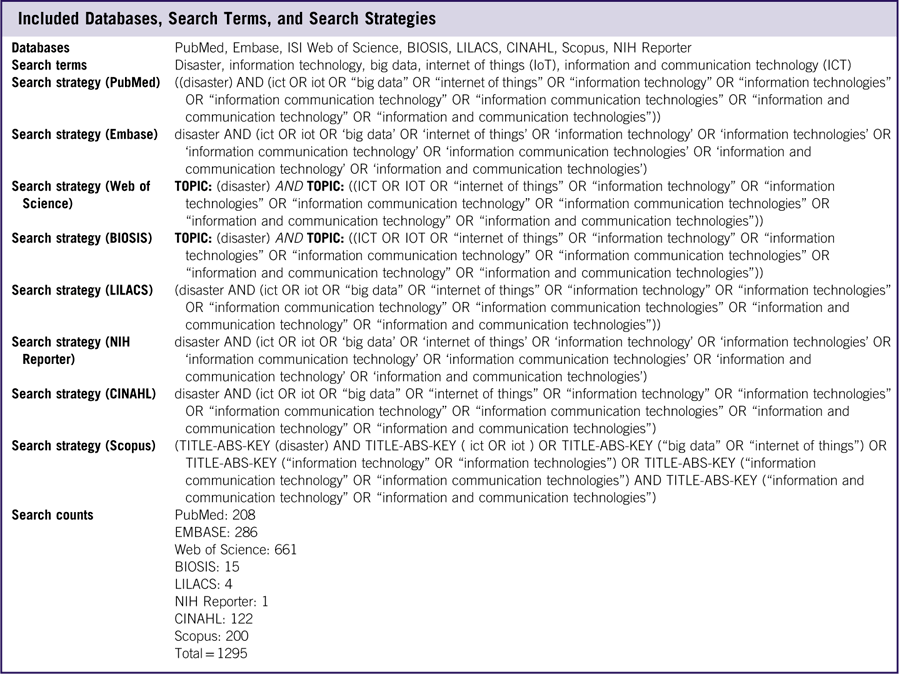
In order to examine how ICT tools and big data approaches have been used in disaster response, we conducted a structured literature search, with our final search taking place on May 1, 2017. Our title/abstract review included all studies identified by our search terms and published before our final search date. We did not place a limiter on date of earliest publication. Our search included the following databases: PubMed, Embase, ISI Web of Science, BIOSIS, LILACS, CINAHL, Scopus, and NIH Reporter. The general search terms for our study were created in consultation with medical librarians and a team of researchers with subject matter expertise in ICT, big data, and disasters. The final search terms were adapted to meet the search criteria requirements for each of the included databases (Table 1). No date limits were applied to the search. Title/abstract and full-text reviews were performed under dual review with conflicts resolved by a third reviewer. Inclusion/exclusion criteria for the review are provided in Table 2. We only considered articles that actively implemented ICT and big data tools in real-life disaster or simulation scenarios in order to examine the true utility of the tools being assessed. A data extraction tool was developed by the subject matter expert team and included the following items: first author and year, data type, disaster type, disaster setting (country), World Bank status 12 of the disaster setting, time of disaster, disaster phase, responders involved, type of ICT application, data input, data output, problems encountered, findings and significance, and additional comments. Because we were interested mainly in evaluating the contexts in which ICT and big data tools were used, as opposed to the quality of the methods used by study authors to evaluate them, we did not use quality assessment metrics in our inclusion and exclusion criteria.
Included Databases, Search Terms, and Search Strategies

Inclusion and Exclusion Criteria for Review

Abbreviation: ICT, information and communications technology.
Our first step in analysis was to calculate summary statistics on all the extracted data and create tables to better display patterns of research and of ICT and big data use in the various articles. We then performed 2 further steps. First, we pulled simple descriptive statistics on the nature of disaster research. These statistics focus on the nature of the research itself, including topics such as methods, location, and omitted information. Second, we conducted a review of the nature of the ICT and big data tools discussed in each article. This review identified the most commonly researched disaster management tools and described their applications in various disaster settings, making particular note of findings that the authors found to be surprising or unexpected.
RESULTS
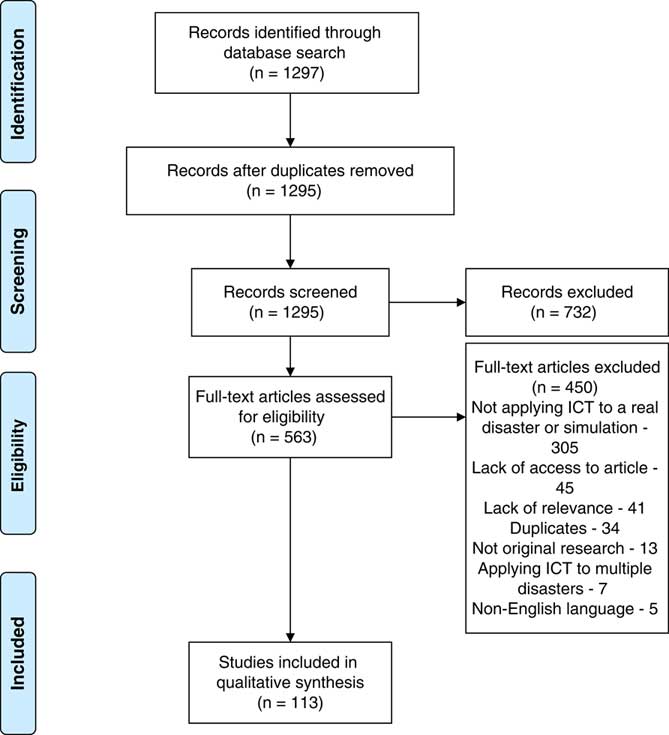
Of the 1295 abstracts captured in our final search, 732 (56.5%) were excluded at the title/abstract screening level. From the 563 full texts screened, 450 (79.9%) were excluded for the following reasons: 305 (67.8%) did not apply ICT or big data tools to a real disaster or simulation, 45 (10%) articles were inaccessible, 41 (9.1%) were not relevant, 34 (7.6%) were duplicates, 13 (2.9%) were not original research, 7 (1.6%) applied to multiple disasters, and 5 (1.1%) were not in English. The PRISMA diagramReference Moher, Liberati and Tetzlaff 13 is presented in Figure 1.
PRISMA diagram

Descriptive Research Statistics
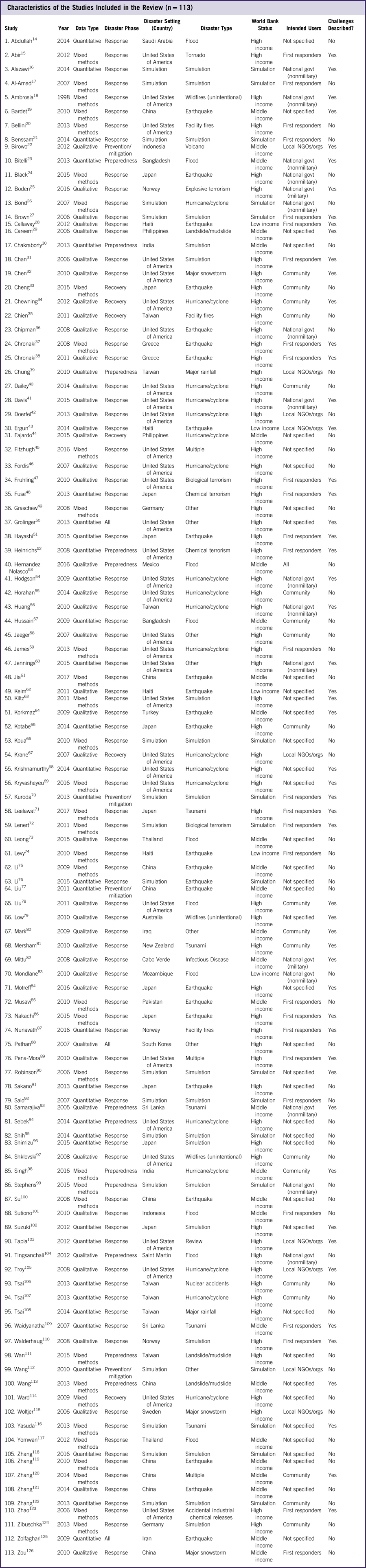
The final qualitative synthesis included 113 articles (see Table 3). The types of methodologies used in the studies we surveyed were distributed in roughly the same proportion across all ICT tool types, with slightly more studies using qualitative methods (n=45, 39.8%) than mixed methods (n=35, 31%) or quantitative methods (n=33, 29.2%). Half of the 113 included articles were published in the last 5 years (n=56, 49.6%), and only 1 article was published before 2005. Additionally, approximately 80% of the articles (n=88) on the application of ICT and big data tools covered only the response phase of a disaster, which demonstrates a lack of attention to the prevention/mitigation, preparedness, and recovery phases.
Characteristics of the Studies Included in the Review (n=113)

Abbreviations: govt, government; NGO, nongovernmental organization; org, organization.
The included literature covered disasters in 26 different countries around the world. Of those 26 countries, only 4 were included in more than 5 articles. These most commonly cited countries included Taiwan (7 articles), China (10 articles), Japan (11 articles), and the United States (32 articles). Similarly, over half of the included articles (n=63, 56.1%) reviewed ICT or big data technology applications in high-income countries, and only 17 of the 113 articles (15%) reviewed tool use in lower- and middle-income countriesFootnote a (LMICs). 12
We also categorized articles by disaster type, intended user, and implementation challenges of each ICT or big data tool. The articles we found included 20 separate disaster types (including “Multiple” and “Other”). Hurricanes and earthquakes were addressed in 19 (16.8%) and 25 (22.1%) articles, respectively, and were the only disaster types included in more than 10 articles. Furthermore, only 73 of the included articles (64.6%) clearly and intentionally specified the intended users (responder type) of the ICT or big data tools they were analyzing. Most of these articles (n=47, 64.4%) listed either clinical first responders or community members as the intended users. Finally, over half of the reviewed articles (n=61, 54%) made no mention of challenges they faced while implementing their ICT or big data tools.
Descriptive ICT and Big Data Statistics
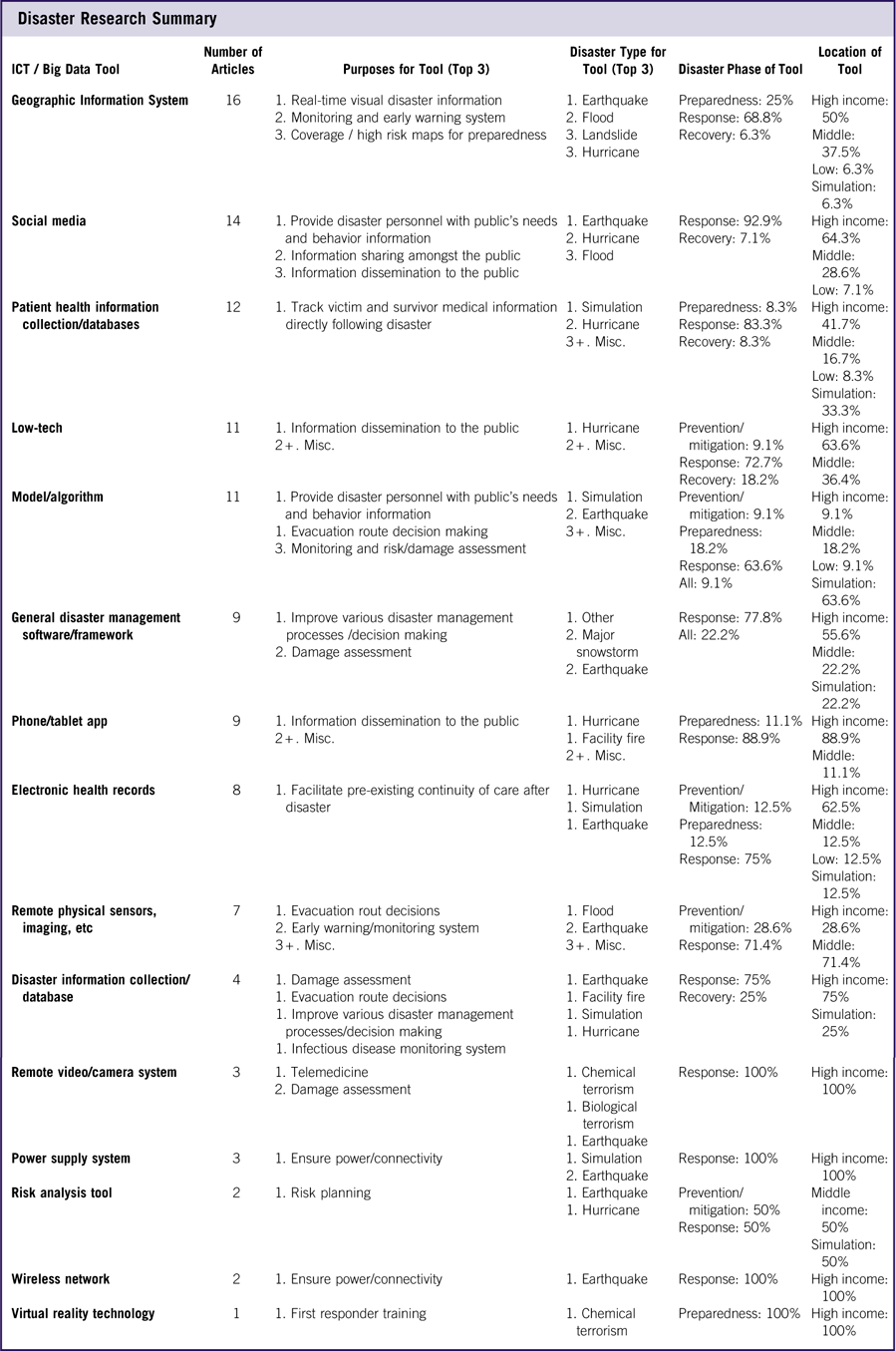
The ICT and big data tools used in the included literature can be broken down into 15 categories. The 4 most frequently mentioned ICT tools (geographic information system [GIS], social media, patient information collections/databases, and models/algorithms) are described in this section. A summary of all the ICT or big data tool categories can be found in Table 4, including the number of articles that reference the tool, the purpose of the tool, the disaster type that the tool was used before/during/after, the disaster phase that the tool was used in, and the World Bank status of the country where the tool was used.
Disaster Research Summary

Abbreviation: ICT, information and communications technology.
GIS
The most commonly reviewed ICT tool in the included literature was GIS. The majority of articles analyzed GIS with the intent of assessing its ability to visually capture and convey real-time disaster information (n=10, 62.5%). However, a number of articles also analyzed the capacity of GIS technologies to capture visual information for monitoring or preparedness purposes—for example, to create landslide susceptibility mapsReference Wan, Yen and Lin 111 or to inform early warning systems.Reference Wang, Tuo and Zhang 113
Social Media
Social media tools were the second most commonly discussed tools in the included studies. Of the social media types mentioned, Twitter was analyzed the most often. Social media tools were most commonly used to assist disaster management personnel in disseminating critical emergency information to the public.Reference Low, Burdon and Christensen 79 , Reference Zhang, Zheng and You 120 However, several articles also highlighted the use of social media by the public to exchange information and communicate amongst themselves.Reference Cheng, Mitomo and Otsuka 33 , Reference Huang, Chan and Hyder 56 , Reference Keim and Noji 62 , Reference Leong, Pan and Ractham 73 , Reference Mittu, Guleyupoglu and Johnson 82 We also found that social media tools were used by disaster response professionals to collect data on the needs and behaviors of the public.Reference Black, Dietz and Stirratt 24 , Reference Huang, Chan and Hyder 56 , Reference Jia, Jia and Hsee 61 , Reference Liu, Piyawongwisal and Handa 78 , Reference Mersham 81 Liu 2011, for example, analyzed how an app utilizing Twitter and global positioning system can inform disaster responders about where to prioritize critical response resources. Additionally, Jia 2017 characterized how social media data can be collected and analyzed to better understand the behavior and psychological state of populations during and after a disaster.
Model/Algorithm
Most of the 11 reviewed papers on computer models and algorithms focused on disaster planning and preparedness topics. These technologies typically assisted disaster responders in better understanding general population movement and needs during disastersReference Chakraborty and Banerjee 30 , Reference Ergun, Gui and Heier Stamm 43 , Reference Fordis, Alexander and McKellar 46 and planning evacuation routes.Reference Benssam, Bendjoudi and Yahiaoui 21 , Reference Stephens, Jafari and Boyles 99 , Reference Zhang, Zhang and Zhang 122 Other uses for models and algorithms included monitoring damageReference Robinson and Brown 90 and automating disaster communication to the public.Reference Zhang, Si and Ma 118
Patient Health Information Collection/Database
These ICT and big data tools primarily focused on tracking and storing patient health data during or directly after a disaster. Many tools in this category can be classified as disaster medicine technologies. The vast majority of these articles discussed web-based electronic health reporting tools for the automated coordination of patient care by facilitating the collection of patients’ health information during a disaster and consolidating the data in real time for use by all other health care providers using the tool.Reference Brown, Griswold and Demchak 27 , Reference Callaway, Peabody and Hoffman 28 , Reference Lenert, Kirsh and Griswold 72 , Reference Zhao, Rafiq and Hummel 123
Technology Use in Crisis Settings
Only one included article explored ICT use in situations of armed conflict or prolonged displacement.Reference Mark, Al-Ani and Semaan 80 This qualitative study analyzed how Iraqi used technology such as cell phones, localized internet service providers, and devices with access to the internet to overcome limitations to face-to-face contact. This ethnography found that by adapting relationships and social networks using technologies, Iraqis were able to build resilience during the ongoing war and self-organize to protect themselves from security threats.
DISCUSSION
Our review of the relevant literature on the use of ICT and big data tools during disasters revealed some important gaps to be filled in future research. Specifically, more information is needed on the use of these technologies in all types of disasters, in critical geographic locations, and at all phases of the disaster cycle, as well as practical implementation considerations that could limit future applications.
Almost all articles included in our study discussed the use of ICT and big data tools in the context of natural disasters, and of those, hurricanes and earthquakes were the most highly represented. This was due mainly to the high number of articles concerning Hurricane Katrina in 2005, the Haiti earthquake in 2010, and the Great East Japan Earthquake in 2011. While 40% of the total worldwide deaths due to natural disasters between 1995 and 2015 were caused by storms, 27% were due to extreme temperatures and 26% were due to flooding. 127 Our analysis suggests that further research is needed to determine the utility of ICT and big data tools in managing these types of disasters, which caused the majority of disaster deaths during that time frame.
Furthermore, the majority of articles identified in our literature search analyzed the use of ICT or big data tools in high income countries. By contrast, 59% of the deaths from weather-related disasters from 1995 to 2015 occurred in LMICs. 127 In fact, the numbers of deaths in low-income countries may itself be underreported. 127 This is an important problem that, while not the focus of this study, could be addressed by the types of tools our study addresses. A clear next step for researchers is to analyze the utility of ICT and big data tools in the geographic contexts where they are needed most for both disaster response and documentation.
Over three-quarters of the articles reported on the use of ICTs or big data in the response phase of the disaster cycle. The use of ICT and big data in other parts of the disaster cycle is therefore not well understood. More focus is needed in the literature on the ways that ICT or big data can be used during and across the phases of the disaster cycle.
The literature we reviewed also generally lacked important information on 2 important practical limitations of the tools used in disasters. First, most authors did not specify or were ambiguous about who were the end users of the ICT or big data tools under study. In order to assess the value of these or similar tools in the future, other researchers will need to know the intended users of a given tool, or at least the profession or education level of intended users.
Second, many of the included articles did not discuss the challenges posed in implementing the ICT or big data tools that they studied. There are 2 key reasons why future research should include this information. First, potential implementers should be aware of the logistical challenges that accompany disaster tool usage before disaster strikes, so as to ensure maximum effectiveness and harm reduction. Second, tool providers should be made aware of their tools’ limitations to allow for the limitations to be addressed, where practical.
Limitations
Given the complex relationship of causes contributing to complex humanitarian emergencies, it is possible that our search strategy did not capture studies of tools used in complex humanitarian emergencies that were cataloged under terms associated with warfare or conflict rather than disasters. Additionally, our research addressed peer-reviewed scientific literature, while the grey literature may provide examples of novel ICT or big data tools that have not been the subject of rigorous research. Our study addressed the scope of ICT and big data use and not the quality of the studies themselves, and did not assess the quality of the included studies. Finally, there may be studies in non-English languages that have not been reviewed in the major English-language databases used in our research.
CONCLUSION
This study focused on literature addressing the use of ICT and big data tools for use in disaster response. Our research revealed several important findings. First, published research on the use of ICT and big data tools in disasters has focused largely on a limited number of high-profile natural disasters in wealthy countries. This focus may be related to disparities between high-income countries and LMICs in terms of media coverage of disastersReference Joye 128 , Reference Adams 129 and the relative availability of ICT infrastructure and expertise,Reference Lucas and Sylla 130 but it suggests that the full potential of these tools in responding to the disasters in LMICs is still not fully understood. Additional research into the use, or lack thereof, of ICT and big data tools in LMICs is needed. Second, the types of disasters in which ICT and big data tools were used were limited geographically and did not reflect the human impact of disasters such as extreme temperatures. To clarify, studies identified in our search largely neglected nonresponse phases of disasters (ie, recovery, mitigation, and preparedness), as well as intended users (eg, first responders, humanitarian aid works, clinicians, logisticians), and did not often address the challenges of implementing ICT and big data tools in the field. More information on these aspects of ICT and big data tool uses in disasters would increase the utility of the available research. This information would help future implementers in assessing how to deal with practical limitations typical of LMICs such as nonexistent or failed infrastructure, language barriers, and the technological capacities and literacy challenges of potential users. These concerns will be particularly important to study when tools are intended to be used by front-line responders or community members in LMICs in order to avoid replicating existing socioeconomic disparities in disaster response.
The complexity of disasters in the 21st century, particularly in LMICs, is a reflection of overlapping natural and human causes. ICT and big data tools, characterized by their velocity, volume, and variety, have the corresponding potential to increase the speed, scope, and specificity of disaster response. Future research needs to focus on addressing disparities in the location, types, and phases of disasters under study and extend to the study of protracted disaster situations and those with multiple heterogeneous causes in order to maximize the utility if ICT and big data tools in disaster response.
Acknowledgement
This work did not receive any financial support. The authors wish to acknowledge Lori Rosman of the Johns Hopkins Medical Library for her help in conducting the literature review.
The views expressed are those of the authors and do not reflect the official policy or position of Johns Hopkins University.