INTRODUCTION
Palliative care, generally provided to individuals with advanced and serious physical illness, is a holistic interdisciplinary approach that focuses on symptom relief and enhancing quality of life (Blinderman & Cherny, Reference Blinderman and Cherny2005). Despite its holistic philosophy, palliative care has largely focused on physical states of suffering, despite the recognition that nonphysical states of distress are common at the end of life (Breitbart et al., Reference Breitbart, Gibson and Poppito2004; Chochinov et al., Reference Chochinov, Hack and Hassard2004; Reference Chochinov, Hassard and McClement2009). This incongruity suggests that psychosocial and existential/spiritual concerns warrant greater attention proportionate to their clinical relevance (Heintz, Reference Heintz2007; Kon & Ablin, Reference Kon and Ablin2010) and consistent with the central tenets of palliative care that emphasize treating the patient in totality (Saunders, Reference Saunders1988). The present study reflected an attempt to contribute to the growing movement in palliative care research to develop new interventions to meet patients' psychological needs. Specifically, we piloted a new intervention meant to harness the healing power of dreams and the importance of personal meaning for those facing the end of life.
One's sense of meaning is a primary component of existential well-being, as reflected poignantly in the work of Austrian psychiatrist Viktor Frankl, whose time in Nazi concentration camps inspired his approach to psychotherapy. This psychotherapeutic approach recognized the human capacity for choosing one's attitude toward suffering, and to survive otherwise intolerable conditions when one retains a sense of meaning in life. This theory is particularly relevant for the dying, who face one of the most difficult transitions of life and often struggle to find meaning in their suffering. Furthermore, facing loss and mortality can be paradoxically productive, as the process of redefining one's sense of personal meaning can transform tragedy into personal triumph (Breitbart et al., Reference Breitbart, Gibson and Poppito2004). Erikson (Reference Erikson1980) also recognized personal meaning at the end of life in the eighth stage of his developmental model, “integrity versus despair.” This stage is precipitated by an increased awareness of one's mortality and is characterized by a struggle between fears about death and acceptance of the course and meaningfulness of one's life (Jacobsen et al., Reference Jacobsen, Vanderwerker and Block2006). The existential distress experienced in the absence of meaning during dying is an acutely demoralizing condition (Schuman-Olivier et al., Reference Schuman-Olivier, Brendel and Forstein2008; Vehling et al., Reference Vehling, Lehmann and Oechsle2012).
Researchers have proposed several therapeutic interventions to assist the dying in fostering a sense of meaning. One of these is meaning-centered psychotherapy (Breitbart, Reference Breitbart2003), which was developed for use with advanced cancer patients and emphasizes meaning-making through a combination of didactic, experiential, and discussion activities. A randomized controlled trial found that cancer patients undergoing meaning-centered group psychotherapy demonstrated significant improvement in spiritual well-being and sense of meaning, decreased anxiety, and a lessened desire for death (Breitbart et al., Reference Breitbart, Rosenfeld and Gibson2010). A second trial found those undergoing individual meaning-centered psychotherapy experienced significant improvements in spiritual well-being, quality of life, symptom burden, and related stress (Breitbart et al., Reference Breitbart, Poppito and Rosenfeld2012). These promising initial findings suggest that further study and innovation on meaning-centered psychotherapy is warranted (Henoch & Danielson, Reference Henoch and Danielson2009), particularly for those at the end of life.
Dreams at the End of Life
Nonscientific literature has long suggested that end-of-life dreams can have existential significance (Barrett, Reference Barrett1926; Gurney et al., Reference Gurney, Myers and Podmore1886; Wills-Brandon, Reference Wills-Brandon2000). However, this suggestion remains largely unexplored in the clinical literature as well as in education and practice. The existential issues raised by dreams have also been underemphasized within palliative care (Brayne et al., Reference Brayne, Farnham and Fenwick2006). The limited data regarding end-of-life dreams suggest that they often reflect issues of grief and loss brought on by approaching death (Prince & Hoffmann, Reference Prince and Hoffmann1991). Studies also suggest that these experiences include common themes such as seeing deceased loved ones sitting by the bedside or coming to take the dying person away, resolution of psychological “baggage,” and comfort in the face of death (Brayne et al., Reference Brayne, Farnham and Fenwick2006; Reference Brayne, Lovelace and Fenwick2008; Fenwick et al., Reference Fenwick, Lovelace and Brayne2010; Kerr et al., Reference Kerr, Donnelly and Wright2014; Nosek et al., Reference Nosek, Kerr and Woodworth2014). These studies describe commonalities in the manifestation and impact of dreams at the end of life and suggest that vivid dreams are not only common during the dying process (Brayne et al., Reference Brayne, Lovelace and Fenwick2008; Fenwick et al., Reference Fenwick, Lovelace and Brayne2010) but may also influence existential well-being and may play a role in psychological preparation for death. Palliative care clinicians often view dreaming as an intrinsic part of the dying process, which assists people in reconciling their lives, completing “unfinished business,” and coming to terms with approaching death (Brayne et al., Reference Brayne, Farnham and Fenwick2006). Furthermore, 70% of clinicians in one study reported that end-of-life dreams were a source of meaning for their patients (Fenwick et al., Reference Fenwick, Lovelace and Brayne2010). Some research also suggests that the content and meaningfulness of dreams follow a predictable pattern at the end of life. In a longitudinal study, Kerr et al. (Reference Kerr, Donnelly and Wright2014) found that as participants approached death, end-of-life dreams and visions about deceased loved ones became more frequent and were associated with greater comfort than other kinds of dreams and visions. Taken together, these findings indicate that end-of-life dreams may be relevant to meaning-centered therapy for those preparing for death.
Although Freud (Reference Freud and Strachey1998) was the first to systematize an approach to utilizing dreams in psychotherapy, he did not believe that those at the end of life had the cognitive capacity or mental flexibility to engage in meaningful therapeutic work (Brink, Reference Brink1977). In contrast, Jung (Reference Jung and Hull2010) worked primarily with those in the second half of life and believed that dream work could assist patients in processing the psychological transition of oncoming death. While few studies have explored dream work with this population, those that are published appear to support Jung's position. Brink (Reference Brink1977) presented two case studies and reported that elderly clients benefited when they were able to affectively engage with their dreams. The dreams in those cases provided a catalyst for addressing clients' presenting concerns, and Brink noted that this procedure seemed helpful despite age-related reduction in REM sleep and dream recall. Muff (Reference Muff1996) reported increased acceptance of death following dream analysis with three AIDS patients. DeCicco and colleagues (Reference DeCicco, Lyons and Pannier2010) reported that 73% of women with breast cancer felt their dreams were directly related to their illness, provided insight, and lessened illness-related distress.
Terminal illness is often inherently isolating, which further contributes to existential distress. Goelitz (Reference Goelitz2001) suggested that working with dreams may lessen isolation by contributing to the development of the therapeutic relationship. This approach may be effective because dream work allows the therapist to access emotions and help a client affectively engage with his or her concerns (Brink, Reference Brink1977; Hill, Reference Hill1996). The emotional catalyst provided by dream work may accelerate the therapeutic process and build the foundation for discussion of difficult topics, such as the grief and loss associated with dying (Goelitz, Reference Goelitz2007). Magee (Reference Magee1992) postulated that dream analysis can be helpful in facilitating the life-review process for older adults because it allows for insight into memories and reflection on the present. While these case studies provide some initial support for the concept, it is clear that further research on dream work at the end of life is warranted (DeCicco et al., Reference DeCicco, Lyons and Pannier2010; Goelitz, Reference Goelitz2007).
The Cognitive–Experiential Model of Dream Work
The cognitive–experiential model of dream work (Hill, Reference Hill1996) is the most well-researched and empirically supported model of dream work currently in use (Pesant & Zadra, Reference Pesant and Zadra2004; Hill, Reference Hill2004). This model conceptualizes dreams as the result of an autonomous process by which the sleeping mind attempts to incorporate waking events with cognitive schemata based on past experiences. This functional approach to dreaming postulates that dreams may reflect the concerns of waking life, and vivid or emotionally arousing dreams may arise from experiences that are particularly discrepant with preexisting beliefs and memories.
Dream work in psychotherapy, according to Hill's model, is a means of augmenting this autonomous process and thereby a way to address challenging topics that otherwise might not arise in counseling. Hill postulates that because dreams are primarily composed of images and metaphorical representations, they can assist clients in approaching issues in therapy at an affective, experiential level. This approach is consistent with Epstein's (Reference Epstein1994) cognitive–experiential self theory, which suggests that both images and metaphors communicate with a person's experiential system of information processing. This allows for greater changes in cognition and behavior than when the individual is stimulated at a rational level alone. When dreams are utilized in psychotherapy, cognitive schemata may be activated through the experiential mode by means of exploring the affect associated with various dream symbols. This may allow the therapist and client to work collaboratively toward an interpretation and action plan for addressing the discrepant experiences brought to light by the dream.
The cognitive–experiential approach to dream work proceeds through three stages: “exploration,” “insight,” and “action.” During the exploration stage, the therapist guides the client through a retelling of the dream. Each important dream image is isolated, and the client then explores his or her associations with that image, each time returning to the original image. This leads naturally to the connection of dream images to waking experiences, feelings, and memories. During the insight stage, the therapist guides the client through the process of connecting his or her associations into a cohesive theory, or interpretation, regarding the meaning of the dream. The emphasis is on a collaborative effort between therapist and client, rather than a prescriptive approach. During this phase, several levels of interpretation are possible, including the phenomenological experience of the dream itself, the connection between the dream and waking life, reflection upon past experience, and/or the symbolic manifestation of aspects of oneself in the images of the dream. During the action stage, the client is encouraged to take some action to solidify the meaning of the dream arrived at in the insight stage, and to effect a change in schemata, behavior, and/or environment to resolve the conflicts uncovered by the dream. In forming an action plan, the client applies the new understanding achieved by consciously changing some aspect of the dream, continuing to mine the dream for further insights, developing ideas for action, or changing aspects of his or her waking life.
The efficacy of the cognitive–experiential approach to dream interpretation has been supported by a number of empirical studies (for reviews, see Hill & Goates, Reference Hill, Goates and Hill2004; Pesant & Zadra, Reference Pesant and Zadra2004). Hill and colleagues' study (Reference Hill, Zack and Wonnell2000) is of particular relevance to the application of this model to the end-of-life population. In this study, clients who had experienced recent losses and were suffering from troubling dreams benefited more from dream-focused counseling than from loss-focused counseling in terms of depth, working alliance, and insight. By extension, this intervention may be an effective way of addressing the losses associated with existential distress among the dying. Davis and Hill (Reference Davis and Hill2005) explored the efficacy of a modification of this model that included a spiritual and existential focus. They found that self-identified “spiritual” clients in a spiritual dream interpretation condition experienced greater gains in spiritual insight into dreams, as well as general existential well-being, compared to control groups. This was the first study to specifically and systematically examine the relationship between the cognitive–experiential model of dream interpretation and existential well-being. A recent study (Hess et al., Reference Hess, Knox and Hill2013) explored dream-work sessions with hospice workers and was the first published application of this model to the end-of-life environment. The results of that study, that dream work helped hospice workers come to terms with the deterioration and death of those they cared for, provide further impetus for studying this approach with the hospice patients themselves.
The Present Study
The present pilot study was based on Frankl's (Reference Frankl2006) theoretical assumption that the ability to find or create meaning allows human beings to transcend challenges to freedom, dignity, or personhood, including the prospect of death. Because hospice patients often struggle with meaning, and end-of-life dreams represent a potential source of meaning, the present study introduced a meaning-centered variant of the cognitive–experiential model of dream work for use with those at the end of life. Given the lack of dream-work studies within a hospice population, this pilot study sought to provide preliminary data on the process and outcomes of this novel counseling modality. The qualitative methodology employed was designed to facilitate exploration of the major themes in content, process, and outcome of dream sessions with hospice patients. Some quantitative data on the benefits of dream interpretation, existential well-being, and quality of life were also collected to enrich the qualitative data, in the fashion described by Seymour (Reference Seymour2012). It was hypothesized that dream work would be helpful to participants in reconnecting to sources of meaning, that dream content would be consistent with prior studies of hospice patients' dream, and that the intervention would prove feasible and safe with this sample.
METHODS
Participants
Hospice Patients
Hospice patients who reported vivid or disturbing dreams, who expressed a desire to explore dreams in more depth, or who were identified by the care team as needing additional psychosocial support were referred to the study by members of a multidisciplinary palliative care team (nurses, social workers, chaplains, and expressive therapists). Participants had been diagnosed with a terminal illness, were not pursuing curative or aggressive treatments, and had an estimated life expectancy of six or fewer months. Recruited participants were required to be at least 18 years of age. Only those with functional scores of 30 or greater on the Palliative Performance Scale (PPS) (Anderson et al., Reference Anderson, Downing and Hill1996) were considered eligible, as such patients are typically able to engage comfortably in normal conversation.
Those who met the criteria for cognitive disorder, delirium, or dementia according to the DSM–IV–TR (American Psychiatric Association, 2000) were excluded from the study. Referred patients who met the inclusion criteria were approached and given the opportunity to provide informed consent if they wished to participate.
The inherent difficulties in research with hospice patients posed recruitment challenges: of 19 patients approached, 10 agreed to participate, and attrition and participant death led to a final sample size of 7. While smaller than the ideal sample size of 12–15 recommended for consensual qualitative research (CQR) by Hill and Williams (2012), this number falls within one standard deviation (11.5) of the mean sample size (15.7) they reported for published CQR studies.
Participant Demographics
Most participants (n = 5) were female, and the average age was 69.9 years (SD = 14.7). Primary diagnoses included lung cancer (n = 2), colon cancer (n = 1), ovarian cancer (n = 1), cerebellar ataxia (n = 1), adult failure to thrive (n = 1), and COPD (n = 1). All participants were of white European descent, and all reported a Christian religious affiliation. Most (n = 4) were referred to the study for reporting vivid dreams, one was referred for disturbing dreams (n = 1), and others expressed both an interest in dream work and a need for additional psychosocial support, but did not report having dreams at the time of recruitment (n = 2).
Procedure
Meaning-Centered Dream-Work Process
Participants underwent up to two dream-work sessions with the research therapist (first author). Sessions followed the dream interpretation procedure developed by Hill (Reference Hill1996; Reference Hill2004), proceeding through the exploration, insight, and action stages. The insight stage was modified to include a focus on personal meaning, following the precedent set by Davis and Hill's (Reference Davis and Hill2005) spirituality-focused variant. This meaning-focused variant emphasized the relationship between participants' dreams and their sense of meaning in life. The work of Breitbart et al. (Reference Breitbart, Rosenfeld and Gibson2010; Reference Breitbart, Poppito and Rosenfeld2012), Frankl (Reference Frankl2006), and other existential psychotherapists provided the framework and theoretical foundation for this process. Specifically, the research therapist asked participants to reflect on and describe sources of meaning in their lives, attitudes toward meaning, obstacles to finding meaning, hopes for the future, and limitations related to illness, prior to commencing the insight phase of dream work.
Measurements
All sessions were digitally audio-recorded for the purposes of qualitative analysis. At the beginning of the first session and close of the second, participants also completed the Existential Well-Being Scale (Ellison, Reference Ellison1983) and the Spitzer Quality of Life Uniscale (Spitzer et al., Reference Spitzer, Dobson and Hall1981). At the close of each session, the research therapist administered the Exploration–Insight Gains subscale of the Gains from Dream Interpretation Scale (Heaton et al., Reference Heaton, Hill and Hess1998) and completed a session report form detailing the content of dreams and participants' subjective descriptions of the meaning of their dreams. The research therapist also completed the Therapist-Rated Adherence Measure (Hill, Reference Hill2004) to assess adherence to the cognitive–experiential model. Each of these instruments is described in more detail below.
Instruments
Exploration–Insight Gains Scale (EI)
The Exploration–Insight Gains (EI) subscale of the Gains from Dream Interpretation Scale (GDI) (Heaton et al., Reference Heaton, Hill and Hess1998) was employed to record participants' perceptions of benefits from participating in the dream-work process. The EI subscale consists of six 9-point Likert-type items (1 = strongly disagree, 9 = strongly agree) that ask participants to rate agreement with statements of the benefits gained from dream work (e.g., “I learned more about issues in my waking life from working on this dream”). Hill (Reference Hill2004) reported typical correlations of 0.60–0.70 between the GDI, its subscales, and other measures of benefits from dream work.
Session Report Form
This form was used for taking notes after each session. Information included the length of each session, a brief description of the dreams reported, a description of the session as a whole, and a notation of which stages of the dream-work model were completed.
Therapist-Rated Adherence Measure (TRAM)
The TRAM (Hill, Reference Hill2004) was utilized to assess the research therapist's self-perception of adherence to the cognitive–experiential model of dream work. This scale includes 13 nine-point Likert-type items (1 = strongly disagree, 9 = strongly agree) that ask therapists to rate how well they completed each stage of the dream-work process (e.g., “How completely and well did you do the step of experiencing for several images?”). Hill recommended dropping sessions from analysis in which therapists rate themselves lower than five on more than one of the three stages in the model.
Existential Well-Being Scale (EWBS)
The Existential Well-Being subscale of the Spiritual Well-Being Scale (SWBS) (Ellison, Reference Ellison1983) was employed previously in a study using the Hill dream model (Davis & Hill, Reference Davis and Hill2005). The SWBS assesses one's subjective sense of spiritual well-being using Likert-type responses (“strongly agree” to “strongly disagree”) to 20 items. It measures two constructs—religious well-being and existential well-being—which are assessed with two 10-item subscales. For the purposes of our study, only the EWBS subscale was employed (10 items with 6-point Likert-type scales). Both subscales have demonstrated high reliability, with test–retest reliability coefficients ranging from 0.73 to 0.89. The internal consistency of the EWBS ranges has coefficient alpha values of 0.82–0.94. The scale has good face validity, as well as good convergent and discriminant validity (Spiritual Well-Being Scale, 1995).
Spitzer Uniscale Quality of Life Measure (SUQoL)
The SUQoL (Spitzer et al., Reference Spitzer, Dobson and Hall1981) was utilized to assess quality of life. This single-item instrument asks participants to rate their quality of life on a visual analog scale ranging from 0 (lowest possible quality of life) to 100 (highest possible QoL). The SUQoL is a well-established measure with high reliability and validity (Mashele et al., Reference Mashele, Sumithra and Paul2007) that compares favorably to longer multiple-item questionnaires (de Boer et al., Reference de Boer, van Lanschot and Stalmeier2004), with a reliability coefficient of 0.87, and high correlations with multiple-item measures of quality of life. For the purposes of our study, the single-item SUQoL was used to help reduce the risk of participant fatigue.
Qualitative Analysis
All 12 sessions were transcribed verbatim for use in qualitative analysis. The data were analyzed using the consensual qualitative research (CQR) method (Hill, Reference Hill2012). CQR is characterized by a team-oriented approach that relies on the group process to offset individual biases. A primary team (the first three authors) followed a structured iterative process of coding domains, identifying core ideas within domains, and then categorizing core ideas across cases to represent the richness of data. Throughout this process, members of the primary team discussed their categorizations of data until a unanimous, or consensual, conceptual framework was created. Additionally, external auditors (the fourth and fifth authors) guided and checked the progress of the primary team, helping to offset possible biases. This method has been employed primarily for the study of therapeutic factors and techniques in counseling and psychotherapy. However, several studies have used CQR to analyze dream-work sessions using the cognitive–experiential model of dream work (Hess et al., Reference Hess, Knox and Hill2013; Tien et al., Reference Tien, Chen and Lin2009; Wonjin et al., Reference Wonjin, Hill and Chowdhury2010), as was the case in our study.
Ethical Considerations
This study was approved by the institutional review board at the State University of New York at Buffalo. Data were deidentified and stored in a secure location. Audio data were destroyed after transcription, and transcripts will be destroyed in accordance with professional ethics standards within three years of the end of data collection. Participants were informed about and monitored for possible side effects—including fatigue, discomfort, worsening mood, increased existential distress/anxiety, and increased distressing dream activity. If a participant felt unable or unwilling to continue, the session was discontinued or postponed, a supervisor was notified, and a follow-up was scheduled. Negative changes in existential well-being and quality of life were monitored, and the clinical team was notified and consulted when changes occurred. The research therapist was supervised by an experienced medical social worker and a palliative care physician.
RESULTS AND DISCUSSIONFootnote 1
Session Characteristics
Most (n = 5) participants underwent two sessions separated by an average of 8.8 days (SD = 5.8). Sessions averaged 66.4 minutes (SD = 11.2) in length for session 1 and 69.0 minutes (SD = 19.8) for session 2. Two participants did not complete a second analyzable session due to a lack of dreams in one case and rapid decline in physical condition in the other. All participants proceeded through the exploration and insight stages of the cognitive–experiential model of dream work during both sessions 1 and 2. For session 1, two participants did not proceed through the action stage. For session 2, all participants proceeded through the action stage.
Qualitative Results and Discussion
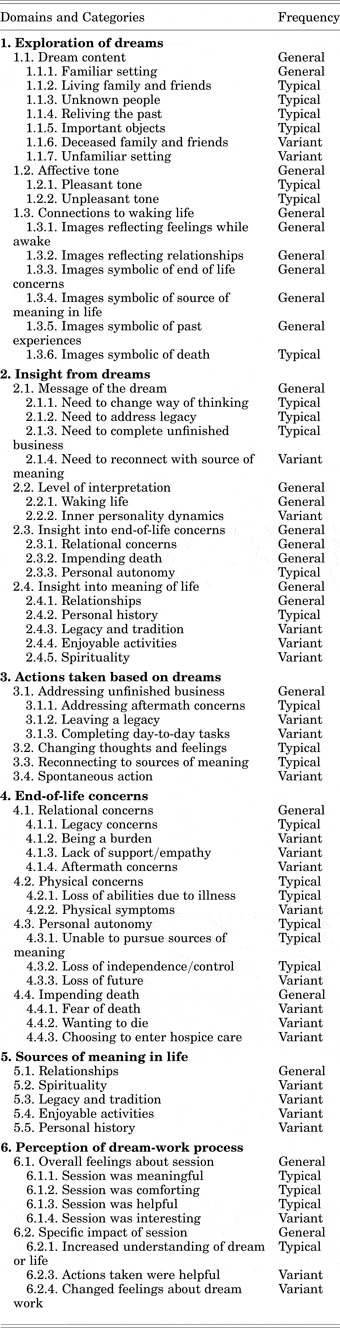
The six major domains (excluding the “other” domain) emerging from the transcripts were: (1) “exploration of dreams,” (2) “insight from dreams,” (3) “actions taken based on dreams,” (4) “end-of-life concerns,” (5) “sources of meaning in life,” and (6) “perceptions of dream-work process.”
After the team constructed core ideas for all domains within each case, team members independently reviewed all core ideas to identify common themes. Each team member shared an initial category list with the team, which was discussed and “argued” until consensus was reached. Once a final category list was completed, the representativeness of each theme was calculated in the manner described by Hill (Reference Hill2012). Categories represented in all or all but one case (6 or 7 cases) were labeled “general”; those occurring in more than half of cases (4 or 5 cases) were labeled “typical”; and categories occurring in fewer than half of cases (2 or 3 cases) were labeled “variant.” Those categories that were only represented in one case were considered unrepresentative and are not reported here. Table 1 presents the final consensual category list along with frequency ratings.
Categories and subcategories with frequency ratings

General = 6 or 7 cases; Typical = 4 or 5 cases; Variant = 2 or 3 cases.
Exploration of Dreams
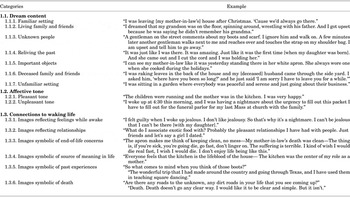
Participants' dreams generally took place in familiar settings and typically featured living friends and relatives or unknown individuals. Participants often relived meaningful past experiences and reported dreams that centered on objects of special significance. Reported dreams typically evoked a strong affective tone, which was equally likely to be pleasant or unpleasant. When making associations between specific dream images and waking life, participants usually made connections to their waking feelings, relationships, end-of-life concerns, sense of meaning, and important past experiences. Dream images representing the dreamer's impending death were also common. See Table 2 for representative examples of general and typical categories.
Examples of categories in the “exploration of dreams” domain

These findings are consistent with previous research findings that dreams typically reflect the experiences and concerns of waking life (Hill, Reference Hill1996). They also reinforce the findings of Prince and Hoffmann (Reference Prince and Hoffmann1991), who concluded that those at the end of life often dream of issues of grief and loss brought on by age and approaching death. In contrast to prior research on end-of-life dreams, the current study found that participants rarely dreamed of deceased relatives, and these dreams were often unpleasant and characterized by a sense of tension. This may reflect Kerr et al. (Reference Kerr, Donnelly and Wright2014) recent findings that hospice patients less proximate to death tend to dream more of living friends and relatives and are more likely to experience distressing dreams, compared to those who are imminently dying. It is noteworthy that the participants in our study were recruited from a home-based hospice program as opposed to an acute inpatient facility (as was the case in the Kerr study), and therefore it is possible that the content of their dreams reflected their relative distance from death or the severity of their physical decline.
Insight from Dreams
Participants in the current study generally interpreted their dreams as an indication that change was needed in their waking lives. In most cases, their dreams suggested a need to change their way of thinking, to address legacy concerns, or to complete unfinished business. These dreams appeared to represent the second type of end-of-life dreams identified by Fenwick and colleagues (Reference Fenwick, Lovelace and Brayne2010)—“final meaning” dreams—which are based on the dreamer's waking concerns and relate to themes of reconciling with family members and resolving unfinished business in preparation for death.
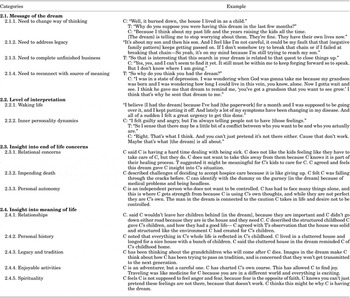
Working with dreams generally led participants to new insights regarding end-of-life concerns, which most often revolved around relational issues, the specter of impending death, or the desire for personal autonomy. In almost all cases, participants gained new insights into sources of personal meaning in life. Generally, this involved new ways of thinking or feeling about their relationships. In many cases, dream work also provided new perspectives on personal history. Occasionally, participants also gained new insight regarding their legacy and family traditions, enjoyable activities, and sense of spirituality. See Table 3 for representative examples of insight categories.
Examples of categories in the “insight from dreams” domain

C = Client; T = Therapist.
Actions Taken Based on Dreams
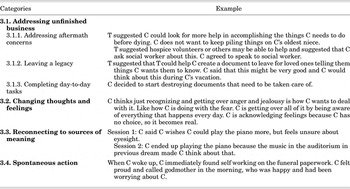
Based on dream interpretation, participants generally felt the need to take action by addressing unfinished business. Common examples included addressing concerns regarding the aftermath of their death, finding a way to leave a legacy, or completing day-to-day tasks. Action plans also typically involved making changes in thoughts or feelings and reconnecting to sources of meaning. Participants occasionally reported having been so moved by their dreams that they took spontaneous action immediately after awakening. See Table 4 for representative examples of the actions taken.
Examples of categories in “actions taken based on dreams” domain

C = Client; T = Therapist.
The action stage was the only stage of the cognitive–experiential dream-work process that was not completed for all sessions. In two cases, the session time expired and the action stage was postponed until the second session. While sessions were initially planned to take 50 minutes, it soon became clear that participants needed more time to explore their dreams. Originally, the session time had been limited in order to reduce the likelihood of fatigue among this vulnerable population. These findings suggest that Hill's (Reference Hill1996) observation that it can take up to 90 minutes to conduct a dream session also applies to those at the end of their lives.
The action stage was further complicated by the issue of personal autonomy, which is often compromised in those with an advanced, terminal illness. Dream work during the action phase therefore necessitated a focus on hope and the use of meaning to transcend despair and loss of autonomy. While some participants took concrete actions (e.g., one woman wrote a book of messages to be delivered to loved ones after her death), others took less overt actions (e.g., one man decided to spend his solitary time reflecting on the joy he felt about his new grandson, rather than ruminating on despair). It was helpful to ask clients to reflect upon the sources of meaning in their lives and encourage them to creatively reimagine ways of engaging with life. This is contention that, when all other freedoms are taken away, human beings retain the ability to choose their attitude towards life circumstances.
End-of-Life Concerns
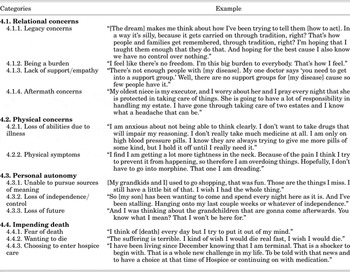
All participants voiced concerns regarding their death, most commonly pertaining to their relationships. This typically included concerns about personal legacy, as well as occasional feelings of being a burden, a lack of empathy or support, or concerns about the social aftermath of their death. Participants typically also shared their physical concerns, including loss of abilities due to illness as well as unpleasant physical symptoms. Loss of personal autonomy was another major concern, which included an inability to pursue sources of meaning, loss of independence, and loss of future. While participants generally expressed concern about their impending death, specific concerns varied between fear of death, a desire to die, and mixed feelings about entering hospice care. See Table 5 for representative examples of end-of-life concerns.
Examples of categories in the “end-of-life concerns” domain

Psychosocial concerns were more prevalent than physical concerns, lending further support to Chochinov et al.'s (2004) observations. This may reflect the relative strength of palliative care in addressing physical symptoms compared to psychological, social, and spiritual sources of suffering (Chochinov, Reference Chochinov2006; Heintz, Reference Heintz2007). This finding also reinforces the need for further attention to these aspects of hospice patients' lived experiences. End-of-life concerns expressed by participants reaffirm the importance of existential issues such as the need for dignity, loss of autonomy/control, and leaving a legacy. Some participants struggled with demoralization and loss of the will to live. Most participants described difficulties surrounding meaning, specifically the loss of connection to prior sources of worth or purpose. Collectively, these concerns are congruent with Schuman-Olivier et al.'s (Reference Schuman-Olivier, Brendel and Forstein2008) definition of existential distress, which includes identity disruption, loss of control, loss of dignity, hopelessness, meaninglessness, isolation, death anxiety, fear, and panic.
Sources of Meaning in Life
In the current study, most participants indicated that relationships provided their greatest source of meaning. Less frequently, participants reported finding purpose in spirituality, passing on traditions, leaving a legacy, engaging in enjoyable activities, and reflecting on their personal history. Table 6 displays examples of sources of meaning.
Examples of categories in “sources of meaning of life” domain

C = Client; T = Therapist.
These findings are closely related to the sources of meaning identified by Viktor Frankl, as summarized by Breitbart and Applebaum (Reference Breitbart, Applebaum, Watson and Kissane2011) (see Table 7). They identified “creativity,” “experience,” “attitude,” and “history” as the four major sources of meaning. In general, creativity, experience, and history accounted for the content of participants' own accounts of personal meaning, whereas attitude reflected the therapeutic process of dream work employed in our study (i.e., finding new ways to reconnect to sources of meaning in the face of limitations). As described in the sections on insights gained and actions taken, the interpretation of participants' dreams often involved reframing attitudes toward life and death and finding new ways to reconnect with sources of meaning. This reflects the spirit of Frankl's logotherapy, which suggests that the freedom to choose our attitude toward a situation is our final refuge against suffering. The findings of our study are also consistent with research on end-of-life dreams, supporting the observation that many dreams provide the dying with a renewed sense of meaning and help them in preparing for death (Brayne et al., Reference Brayne, Lovelace and Fenwick2008; Kerr et al., Reference Kerr, Donnelly and Wright2014).
Sources of meaning described by Breitbart and Applebaum (Reference Breitbart, Applebaum, Watson and Kissane2011)

Table adapted with permission from Breitbart and Applebaum (Reference Breitbart, Applebaum, Watson and Kissane2011).
Perception of Dream-Work Process
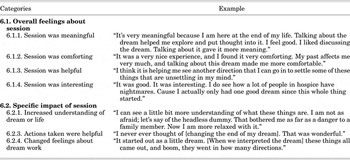
All participants expressed their thoughts and feelings regarding the dream-work intervention. Their comments fell into overall as well as specific categories. Participants typically reported perceptions that the sessions were meaningful, comforting, helpful, and occasionally interesting. More specific perceptions focused on increased understanding of the dream or waking life, the helpful nature of actions taken based on dreams, and occasionally changed feelings about dream interpretation itself. Table 8 provides examples of these perceptions.
Examples of categories in “perceptions of dream-work process” domains

Case Example: Mary's Dream of “A Fork in the Road”
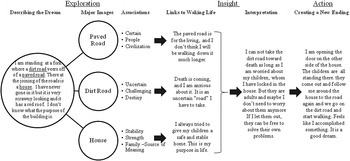
In her first session, 92-year-old Mary,Footnote 2 a hospice patient residing in a nursing home, described a recurring dream in which she was standing at a fork in the road where a dirt road branched off of the paved road she had been walking down. At the fork was a windowless house with a red roof (major images italicized). Figure 1 illustrates the following discussion of how the meaning-centered dream-work process unfolded with Mary.
Sample dream interpretation with a hospice patient using meaning-centered variant of the cognitive–experiential model of dream work.

Exploration Stage
The research therapist encouraged Mary to reexperience this dream in vivid detail as though it were happening there in the session. She described not only the setting of the dream but how it made her feel. She felt that in the dream she was being presented with a decision about which path to take, and when she awoke she often wondered why she always stopped at the fork. She was also very curious about the significance of the wooden house, which always stood out to her in this recurring dream. The research therapist then asked Mary to describe the associations that came to her mind when she envisioned each of the major images in the dream.
Mary stated that “the paved road is certainty.” She also associated it with “civilization, people, houses, and businesses.” This contrasted with her sense of uncertainty connected with the dirt road image, insofar as “you walk on it, but don't know where it is going.” She also described the dirt road as “challenging and rough” but described a sense that she was destined to walk down it eventually: “I wonder if I should take the paved road, but the dirt road is there, and I feel certain that I am going to take it.” Mary was struck by the red paint on the roof of the house. When asked what the color red reminded her of, she said, “It is a strong color. If you are painting something red, it is because you want it to be sure and certain.” She also associated the house with stability and structure, as well as her role as a mother having raised several children with little support from her husband.
Mary and the research therapist worked together to find connections between these associations and Mary's waking life. When asked where in her life she experienced something like a paved road (i.e., something certain and associated with people), she connected this to the path of her life up until her illness, which she would “not be walking down much longer.” When asked where she experienced something like the dirt road in her life (i.e., something challenging and uncertain that she was destined to do), she said, “My death. Death doesn't go any clear way. I would like it to be clear and simple. But it isn't.” When asked about what the house in the dream (i.e., something associated with stability, strength, and raising her children) might represent, Mary reflected on her childhood, during which she felt “uncared for.” “I tried to give my children a more structured and stable childhood than I had,” she said. She speculated that the red roof on the house symbolized the strength and stability she had provided for her children, but that the lack of windows and doors on the building might have reflected her having gone too far in ensuring her children's safety, to the point of limiting their freedom.
Insight Stage
The research therapist assisted Mary in processing feelings associated with her life as a mother and her approaching death and worked with her to weave her waking life associations into a coherent interpretation of what the dream might mean for her. As part of this process, the research therapist asked Mary to reflect on what gave her life meaning. Mary again described how her “uncared-for” childhood had inspired her to make sure her children had a better upbringing. This reflected Frankl's observation that adverse and challenging circumstances can give rise to one's sense of meaning in life. “My father wasn't around much, and my mother didn't care for us very well. Being a good mother for my children was my job. All I wanted was to have a pretty house and lots of children, though that seemed like a foolish wish so I never voiced it.”
The research therapist asked Mary to identify where her role as a mother would be located, if it were to appear in the scene depicted in her dream. She responded, “In the wooden house. That is where my motherhood would be, because it is built on solid ground. Built to last.” The meaning of the dream became somewhat clearer to Mary as she reflected on why she had always stopped walking in the dream when she reached the house, in spite of her feeling that the dirt road was her destiny: “I worry about the children. They're all alone. There's some animosity and unhappiness,” she said. “I don't want to keep walking down the dirt road while my children are still in that house.” Mary and the research therapist discussed her feelings that she was not ready to die yet because she was still concerned for her children, who were the most important thing in her life. As she said, “That must be why I am standing there. I don't go down either road because they are in the house, and they need me.” Mary concluded that she could not move on and start preparing for death as long as she was worried about her children, but acknowledged that her children were probably capable of caring for themselves by this point in their lives. When asked what the dream meant, Mary said, “It's telling me to stop worrying about them. They're fine. They have their own lives now.” Mary also expressed her wish to stay connected to her children after her death: “In the afterlife, I feel I will still have a connection to this life— I want to look back down the dirt road and see them— I feel that at some point, the house will have a door and windows again.”
Action Stage
Mary felt that she learned something from working on her dream but was unsure of what to do with this insight due to her isolation and physical immobility. The research therapist asked Mary what she was hoping for, and she said, “maybe I'll have a dream where I walk up the dirt road with the children.” The research therapist suggested that Mary could have that dream during the session, and she agreed to participate in a guided-imagery exercise to change the ending of the dream. The research therapist guided Mary through reexperiencing the dream once again. At the point where she reached the fork in the road, the research therapist asked Mary what would happen next. She said,
I'm going over to the door on the other side of the house. I never knew it had a door before now. I see five windows and one door. It is stained brown. I am going up and opening the door. I don't go in. The children are all standing there. Mark is in the forefront; Melissa is in the back. The others are there, too. They all come out. And they follow me around the house to the dirt road again, and we start walking.
At this point, Mary's eyes welled up in tears of joy:
I hear them talking as they follow me up the dirt road. It is an easy, calm walk. I see all the colors in the ground and sky and the red roof on the house. It feels like I accomplished something. It is a good dream.”
Mary appeared touched by the guided-imagery exercise, which served as an action to make the insights gained during meaning-centered dream work more concrete. When asked about her perceptions of the overall process, she said,
I liked talking about the dream and thinking about its benefits. It takes a load off me. My thoughts about the dream are much more peaceful. It was very illuminating and very good. It was a very nice experience, and I found it very comforting. My past affects me very much, and talking about this dream made me more comfortable.
QUANTITATIVE RESULTS AND DISCUSSIONFootnote 3
Exploration–Insight Gains
Mean scores on the Exploration–Insight Gains Scale, which measures a client's perceptions of what was helpful about participating in a dream session, were high for both sessions 1 (M = 7.57, SD = 0.55) and 2 (M = 7.43, SD = 1.03). Scores for each item were also high across the 12 sessions. Overall, these high ratings suggest that dream-interpretation sessions were helpful to them in terms of exploring and making new connections based on their dreams, supporting the hypothesis that meaning-centered dream work is therapeutically beneficial for those at the end of life. This is also consistent with the generally positive assessments reported in the qualitative results.
Therapist Adherence
Therapist self-reports of adherence averaged 5.76 (SD = 0.46) for session 1 and 6.36 (SD = 0.48) for session 2, out of a maximum score of 9. Scores fell within the acceptable cutoff limits of adherence suggested by Hill (Reference Hill2004). Because no more than one stage per session of the cognitive–experiential dream-work process was rated below a 5, no sessions were excluded from analysis due to lack of adherence. While therapist-adherence scores were adequate, some relatively low scores were noted. On item 9, “How completely and how well were you able to work on the level of inner dynamics?” the therapist rated himself low because this level of interpretation was rarely of interest to participants. The high salience of dying-related concerns may account for the relative preference of waking-life interpretations. For session 1, the item on the action stage was low because there was often not enough time to complete the action stage during the first session. In all such cases, action ideas for the first reported dream were addressed during session 2. Item 11—“How completely and how well did you do the step about changing the dream?”—received low ratings because that step was not conducted with all participants. In most cases, other forms of action seemed more appropriate to specific participants.
Existential Well-Being and Quality of Life
Overall existential well-being scores averaged 45.9 (SD = 12.3) before session 1 and 38.0 (SD = 15) after session 2, out of a maximum possible score of 60. These averages fall into the range (21–49) categorized as reflecting moderate life satisfaction and sense of purpose by Bufford et al. (Reference Bufford, Paloutzian and Ellison1991). Scores before session 1 ranged between 23.0 (low life satisfaction and sense of purpose) and 60.0 (high life satisfaction and sense of purpose). Scores after session 2 ranged between 14.0 (low) and 52.0 (high).
Quality-of-life scores on the Spitzer Quality of Life Uniscale (Spitzer et al., Reference Spitzer, Dobson and Hall1981) averaged 67.0 (SD = 24.7) before session 1 and 51.8 (SD = 31.1) after session 2 (maximum score 100), suggesting overall moderate levels of quality of life. Scores before session 1 ranged between 12.0 (low) and 83.0 (high), and scores after session 2 ranged between 10.0 (low) and 76.0 (high).
With the exception of one participant, there were no large increases or decreases in quality of life or existential well-being. In cases where scores decreased, the authors perceived these changes being due to two factors. First, participants typically physically declined between sessions, which may have affected their perceptions of overall quality of life and existential well-being. Second, some participants who were initially reluctant to endorse negative feelings on the questionnaires became more forthcoming as the therapeutic relationship developed. It is also possible that pre-intervention clinical issues (e.g., preexisting clinical depression) could have affected obtained scores. However, it should be noted that even those who reported declines in existential well-being and quality of life reported benefits from working with their dreams.
Implications for Counseling at the End of Life
The findings described provide tentative support for the hypothesis that dream work offers an effective method of assisting those at the end of life with the psychological transitions inherent in the dying process. The subjective reports from participants add to the findings of previous studies suggesting the therapeutic benefits of dream work with the dying, including addressing presenting concerns (Brink, Reference Brink1977), coming to terms with death (Goelitz, Reference Goelitz2001; Muff, Reference Muff1996), gaining insight and decreasing distress (DeCicco et al., Reference DeCicco, Lyons and Pannier2010), breaking through isolation to form a therapeutic bond (Goelitz, Reference Goelitz2001), facilitating life review (Magee, Reference Magee1992), and accelerating the therapeutic process (Goelitz, Reference Goelitz2001). In many cases, dream work appeared to provide a means to help participants address highly intimate concerns. Interpreting dreams with a focus on meaning in life seemed to allow indirect and relatively “safe” access to participants' core concerns, consistent with Goelitz's (Reference Goelitz2007) assertion.
The benefits of the meaning-centered dream-work intervention reflect the strategies for dealing with existential distress noted by other researchers (Boston & Mount, Reference Boston and Mount2006; Mok et al., Reference Mok, Lau and Lam2010) as well as the various interventions developed by clinicians. Specifically, research suggests that those who accept and positively reframe stressors related to illness experience greater existential well-being (Mazzotti et al., Reference Mazzotti, Mazzuca and Sebastiani2011). This is the essence of meaning-centered therapy (Breitbart, Reference Breitbart2003), which rests on the premise that finding meaning in despair can make the most difficult circumstances bearable. Meaning-centered dream work may offer another avenue through which people can accomplish this difficult task.
These pilot findings suggest that meaning-centered dream work may be safe for use with the vulnerable end-of-life population. No adverse reactions were reported as a part of this study, and though participants declined physically over time, no large changes in existential well-being or quality of life were evident. Even those individuals who experienced very low scores on these scales reported positive perceptions of the dream-work process. In cases where participants experienced strong emotions as a result of dream work, they expressed appreciation for the research therapist's assistance in helping them address those emotions constructively and safely.
CONCLUSIONS
The content themes that emerged during dream-work sessions reflected the most common end-of-life concerns. The dreams reported were also typical of those reported in other studies of dreams and visions at the end of life with respect to content and meaningfulness. Participants' dreams overwhelmingly reflected their reconciliation with the process of death and confrontations with crises of meaning. This is consistent with the well-supported theory that dreams arise from the concerns and events of waking life. During the process of dream work, participants were able to gain insights and take concrete actions based on what they learned from their dreams. In most cases, this involved resolving unfinished business pertaining to personal relationships.
The results of this pilot study support previous findings regarding the usefulness of dream work as a tool for counseling with the dying and contribute a new perspective to the body of literature on dreams experienced at the end of life. Our study provides initial support for the feasibility, safety, and efficacy of the meaning-centered dream work (MCDW) intervention. Based on Hill's (Reference Hill1996) three-stage model, this approach presents a simple and replicable technique that can be easily taught to mental health professionals working with those at the end of life. This novel combination of the cognitive–experiential dream-work model with meaning-centered therapy provides a promising new method of assisting the dying with the unique psychological and existential issues they face.
LIMITATIONS
Our study had a number of limitations. First, the sample was composed of mostly older women and consisted entirely of white European-American Christians. This homogeneity means that the content and process of dream work reported here may not reflect the way dream work would function within other cultural and religious groups. Second, one person conducted all the dream-work sessions, opening up the possibility that some of the results obtained are due to that person's therapeutic style, personality, and biases. Third, the overwhelmingly positive endorsements of the intervention by participants should be considered in the light of possible effects of social desirability, as the research therapist who conducted the intervention was the same person who surveyed participants. Fourth, the inherent logistical difficulty of conducting research with terminally ill hospice patients limited the research therapist's ability to collect complete data or to follow study protocols fully in some cases (e.g., one session was abbreviated due to a nurse visit).
FUTURE RESEARCH
Future research could address these limitations by recruiting a larger and more diverse sample, employing multiple therapists, and relying more on standardized quantitative research methods. Future research could also compare the MCDW intervention to other forms of therapy for the dying, such as dignity therapy, meaning-centered therapy, expressive therapies, and standard psychosocial care. It would also be interesting to know whether the meaning-centered element of MCDW has any advantages over the standard cognitive–experiential dream-work model for work with this population. Another direction would be to explore the use of this approach with family caregivers of hospice patients, both during patients' time in hospice and during bereavement. Future research could also include assessment of the therapeutic relationship, which as the largest factor in most psychotherapeutic success is likely responsible for at least some of the benefits of dream work. As hospice patients often struggle with loneliness and isolation, an evaluation of this factor might also help illuminate the intrinsic benefits of therapeutic presence, listening, and relationship in dream work with this population. Overall measures of participant affect and distress could also be included to help contextualize and evaluate quality-of-life and existential well-being measures.
ACKNOWLEDGMENTS
The first author designed and conducted the study for his master's thesis. Initial results were earlier presented at the Western New York Network in Aging Conference in November of 2013, and at the Hospice and Palliative Care Association of New York State Conference in May of 2014. The Hospice Buffalo Foundation and donor Phil Hubbell provided funding for this study.
The authors wish to acknowledge (1) Timothy Janikowski and Scott Meier for valuable suggestions and guidance; (2) Debra L. Luczkiewicz, for editorial revisions and comments; (3) Hospice Buffalo clinicians Stefanie Von Ohlen, Derek Davis, Susan Wesley, Ken Keenan, Annie Allen, Don Blesnuk, Tom Martin, and Kevin McKenzie for their assistance; and (4) the hospice patients who generously shared their dreams and experiences.