Vocal/verbal imitation in early infancy has been repeatedly linked with vocabulary acquisition. During the second year, infants who imitate more frequently have larger vocabularies concurrently and predictively (Bates, Bretherton & Snyder, Reference Bates, Bretherton and Snyder1988; Charman, Baron-Cohen, Swettenham, Baird, Cox & Drew, Reference Charman, Baron-Cohen, Swettenham, Baird, Cox and Drew2000; Folger & Chapman, Reference Folger and Chapman1978; Masur, Reference Masur1995; Masur & Eichorst, Reference Masur and Eichorst2002; Nelson, Baker, Denninger, Bonvillian & Kaplan, Reference Nelson, Baker, Denninger, Bonvillian and Kaplan1985; Snow, Reference Snow, Speidel and Nelson1989; Stone & Yoder, Reference Stone and Yoder2001). In particular, infants' novel word imitation, replication of words not present in their spontaneous productive lexicons, is predictive of vocabulary growth. Masur and Eichorst (Reference Masur and Eichorst2002) found that infants with more novel imitation at 1 ; 1 had larger lexicons at 1 ; 5 and 1 ; 9, even when lexical size at 1 ; 1 was controlled. The same relations were found between novel imitations at 1 ; 5 and vocabulary size at 1 ; 9. Because they controlled for initial vocabulary size, Masur and Eichorst argued that infant imitation is not simply a sign of advanced language skills but may also be a mechanism by which infants learn words. In line with this proposal, Clark (Reference Clark2007) suggested that infants' imitation of novel words signals their interest in the novel word as a topic of common ground. She further proposed that infants' novel replication may play a role in word learning because it overtly signals their attention to or uptake of a novel word.
Despite these arguments, it is not clear what mechanisms might be involved to explain why imitation, particularly novel imitation, and vocabulary learning are related. One possibility is that mothers' responses to infants' vocal/verbal imitation serve as a mediator in facilitating word learning (Clark & Bernicot, Reference Clark and Bernicot2008; Farrar, Reference Farrar1992; Masur & Olson, Reference Masur and Olson2008). This possibility is in keeping with the large body of research demonstrating the benefits of maternal responsivity, especially mothers' verbal responses, for infant word learning (Bornstein, Tamis-LeMonda & Haynes, Reference Bornstein, Tamis-LeMonda and Haynes1999; Masur, Flynn & Eichorst, Reference Masur, Flynn and Eichorst2005; Shimpi & Huttenlocher, Reference Shimpi and Huttenlocher2007; Tamis-LeMonda, Bornstein & Baumwell, Reference Tamis-LeMonda, Bornstein and Baumwell2001; Tomasello & Farrar, Reference Tomasello and Farrar1986). Mothers' verbal responses to infants' early vocal/verbal behaviors have been linked with language outcomes not only for children who are developing typically but also for those who are not (Brady, Marquis, Fleming & McLean, Reference Brady, Marquis, Fleming and McLean2004; Girolametto, Weitzman, Wiigs & Pearce, Reference Girolametto, Weitzman, Wiigs and Pearce1999; Goldstein & Schwade, Reference Goldstein and Schwade2008; McDuffie & Yoder, Reference McDuffie and Yoder2010).
There is already considerable evidence that mothers are verbally responsive to infants' early vocalizations (Gros-Louis, West, Goldstein & King, Reference Gros-Louis, West, Goldstein and King2006; Kishimoto, Shizawa, Yasuda, Hinobayashi & Minami, Reference Kishimoto, Shizawa, Yasuda, Hinobayashi and Minami2007; Otomo, Reference Otomo2001). Furthermore, mothers respond overwhelmingly to infants' vocal/verbal imitation with words from the end of infants' first to the end of their second year (Masur & Olson, Reference Masur and Olson2008). Masur and Olson (Reference Masur and Olson2008) described two kinds of verbal responses that mothers provided to infant imitations: return imitations (i.e. responses that include the imitated word) and social responses (i.e. responses that do not contain the imitated word). Overall, 44% of infants' vocal/verbal imitations received maternal return imitations and 46% received social responses, with 85% of the social responses containing words. This is evidence that infant imitation elicits a significant amount of linguistic stimulation from mothers, possibly contributing to the positive relation between infant imitation and vocabulary. Therefore, mothers' verbal responses to infants' vocal/verbal imitations deserve further attention.
However, these findings do not shed light on why infants' imitation of novel words is more strongly predictive of vocabulary acquisition than their reproduction of familiar words. It is possible that mothers are sensitive to novel versus familiar word imitation and adjust their responses accordingly. If this is the case, we might expect mothers to return more novel imitations than familiar ones, thereby providing extra models of the novel word. Infants' familiar imitations may receive more non-imitative social words instead. Researchers have established that the order and likelihood of early word learning is dependent on exposure (Brent & Siskind, Reference Brent and Siskind2001; Huttenlocher, Haight, Bryk, Seltzer & Lyons, Reference Huttenlocher, Haight, Bryk, Seltzer and Lyons1991). Moreover, the strength of initial semantic representation is enhanced by repeated exposure (Gershkoff-Stowe, Reference Gershkoff-Stowe2002; Gershkoff-Stowe & Hahn, Reference Gershkoff-Stowe and Hahn2007; Girolametto, Pearce & Weitzman, Reference Girolametto, Pearce and Weitzman1996; Storkel, Reference Storkel2004). For example, Brent and Siskind (Reference Brent and Siskind2001) found that the frequency with which mothers used novel words in isolation as they interacted with their infants from 0 ; 9 to 1 ; 0 predicted which words their infants would add to their production vocabularies at 1 ; 0, 1 ; 3 and 1 ; 6. They reported that the likelihood of acquiring a word at 1 ; 0 increased 12% each time infants heard the novel word. The corresponding increases were 9% at 1 ; 3 and 8% at 1 ; 6. This mechanism might be partially responsible for the relation between novel imitation and vocabulary size. It is possible that maternal repetitions of novel imitations help infants learn words more quickly and more readily because they hear those words more often during a context of rich, communicative exchange. However, because Masur and Olson (Reference Masur and Olson2008) did not directly investigate whether mothers' responses to infants' imitations were different after novel versus familiar imitations, this possibility has not yet been tested.
It is also possible that the way mothers return imitations might differ as a function of novel versus familiar imitations. This type of finely tuned maternal response pattern would lend support to the assertion of Bornstein, Tamis-LeMonda, Hahn and Haynes (Reference Bornstein, Tamis-LeMonda, Hahn and Haynes2008) that maternal responsivity is not a general global trait but is ‘multidimensional, modular, and specific’ (p. 868). In other words, the way mothers respond may depend on the nature of their infants' productions and their developmental levels. In particular, we expected mothers' verbal returns to differ based on the familiarity of the infant imitation and on the infants' age. To test this prediction, we narrowly coded mothers' verbal return imitations as repeating imitations, expanding imitations and/or reducing imitations as they interacted with their infants, categories also employed by others for classifying infants' and/or mothers' imitations (Clark, Reference Clark2007; Clark & Bernicot, Reference Clark and Bernicot2008; Farrar, Reference Farrar1992; Snow, Reference Snow1981). Exact repetitions, reductions, expansions and responses that include both reductions and expansions of the previous utterance (reductions+expansions) may act differently to scaffold language learning. For example, in a cross-sectional sample of French-speaking children at 2 ; 3 and 3 ; 6, Clark and Bernicot (Reference Clark and Bernicot2008) found that mothers provided different kinds of return imitations depending on the age of the children. As children became older and more linguistically advanced, mothers declined in their use of exact repetitions. However, mothers did not show significant change in the category of ‘repeat+new information’, which included expansions and reductions+expansions (p. 361). They argued that maternal expansion of children's imitations provides feedback on how to express specific information or intents in more adult-like ways. Clark and Bernicot suggested that children can easily compare their mothers' response to their own production because the expansion immediately follows the child's imitation, thereby providing contrasting syntactic and semantic frames that advance language. For these reasons, it would be important to examine whether mothers produce these types of return imitations differentially when infants repeat novel versus familiar words.
There is additional evidence that exact repetitions and expansions are related to language growth in contrasting ways. In an evaluation of a language stimulation program for infants with developmental delays that teaches parents to repeat infants' novel word productions and expand infants' production of familiar words, Girolametto and colleagues (Reference Girolametto, Weitzman, Wiigs and Pearce1999) found that the frequencies of both repetition and expansion of infants' words were associated with increases in their vocabulary size and in their production of multiword utterances. Could mothers be using similar types of scaffolding procedures during naturalistic imitative episodes with infants who are learning language typically? Previous studies have not answered this question. If mothers are differentially choosing when to repeat and when to expand based on whether or not the imitated word is in their infants' spontaneous vocabulary that would provide additional support both for this kind of intervention program and for the hypothesis of maternal response to imitation as a mechanism for lexical acquisition. The present study is the first to address this issue directly, by comparing mothers' responses to their infants' novel versus familiar imitations.
A final question of interest that might contribute to our understanding of the link between imitation and word learning is a structural one. It is possible that infants' imitation is related to word learning because mothers respond to their verbal matching with return imitations that place the reproduced word in the salient sentence-final position. It is well established that word learning is enhanced when a word occurs at the end of an utterance (Echols & Newport, Reference Echols and Newport1992). Because of this relation, it would be valuable to know how likely mothers are to place the imitated word in a return imitation in sentence-final position, thus contributing to its saliency. This question is also examined in the current study.
Therefore, the current study had three purposes. First, we investigated general structural characteristics – length, proportion of single-word replies, and the sentence placement of the imitated word – of mothers' responses to infants' verbal imitation in a longitudinal sample during the second year, when verbal imitation and lexical acquisition are burgeoning. Second, we examined two types of maternal verbal responses – return imitations and social words – as a function of infants' ages and the familiarity of the imitation. Finally, we assessed four kinds of return imitations as a function of the familiarity or novelty of the replicated word and of the age of the infants, at the beginning, middle or end of the second year. We analyzed mothers' return imitations as exact repetitions, reductions, expansions or reductions+expansions in comparison both to their own model utterances and to the infants' imitations. We asked two questions: Do mothers' responses vary according to the familiarity or novelty of the word imitated by their infants?, and Do mothers' responses to infants' novel and familiar imitations have characteristics likely to facilitate early language learning?
METHOD
Participants
Mothers' responses to their infants' imitation were analyzed in videotapes of 20 mother–infant dyads (10 boys and 10 girls, 6 of each first-born) as they played with a typical toy set and during bath time. The dyads were participants in a longitudinal, naturalistic study of infant development. Recruited through published birth announcements, the sample included 1 African-American and 19 European American middle-class dyads for whom English was the native language. Participants all lived in small towns, rural areas and suburban communities surrounding a large mid-western state university. The videotapes were collected during home visits that took place when the infants were 1 ; 1 (M=1 ; 1·15; SD=0 ; 0·7), 1 ; 5 (M=1 ; 5·19; SD=0 ; 0·8) and 1 ; 9 (M=1 ; 9·19; SD=0 ; 0·6). The visit included a maternal interview at the end, and dyads were also seen for an additional visit at each age, not included in this study, about a week later. All infants appeared healthy and typically developing. Although 17 of the 20 dyads had also participated when the infants were 0 ; 10, there were too few instances of infant verbal imitation at that age to include in these analyses.
Procedure
Videotaping
The dyads were recorded in their homes during a free-play session on the floor with a standard set of toys, designed to elicit typical mother–child interaction; during a bath session, chosen as a routine caretaking activity; and during a third situation not analyzed here. The order of sessions was counterbalanced across infants, with toy play either first or second and bath time either first or third. Mothers were requested to play with their infants and the toys as if they had 10 to 15 min of free time and to bathe their infants as they normally would. The toys provided during both free play (e.g. ball, blocks with a shape-sorter canister, stuffed animal and small blanket, tea set) and bath time (e.g. stacking rings and ring holder, stacking boxes with various holes, boat and sailor, two ducks and a washcloth) were chosen as common to many households and able to elicit play at a range of developmental levels, including exploration and manipulation, functional and relational play, and pretense (Belsky & Most, Reference Belsky and Most1981). Recordings averaged close to 15 min in each context (Ms=14·25 min in free play and 14·26 min in bath).
Coding infants' verbal imitation episodes and mothers' model utterances
All episodes of infants' verbal imitation, beginning with the mother's model utterance, followed by the infant's reproduction, either exact or approximate, of one or more words in the model utterance, and ending with the last verbal imitation by either partner, had previously been reliably identified on transcripts of the free-play and bath sessions (Masur & Rodemaker, Reference Masur and Rodemaker1999). Overall, there were 434 verbal imitation episodes −37 at 1 ; 1, 179 at 1 ; 5 and 218 at 1 ; 9. These imitation episodes were later converted to the SALT (Systematic Analysis of Language Transcripts; Miller & Iglesias, Reference Miller and Iglesias2008) format for ease of analysis. Three aspects of each infant verbal imitation episode were examined in the current study – the familiarity to the infant of the word(s) they imitated, the nature of the maternal model utterances the infants imitated, and the kinds of first responses the mothers provided to their infants' imitations.
Infants' verbal imitative episodes included their replication of conventional words or phrases and conventionally meaningful vocalizations, such as uh-oh or mmm (cf. Masur & Rodemaker, Reference Masur and Rodemaker1999, for additional information on identifying infants' verbal imitation). In addition, based on maternal reports employing vocabulary checklists at each age and on infants' spontaneously produced words during the videotaped sessions, each imitated word had been previously classified at each age as familiar (i.e. within the child's spontaneous productive vocabulary as reported by the mother or as observed), comprehended (i.e. understood by the child but not produced, according to maternal report), novel (i.e. reported by the mother as neither familiar nor comprehended and not produced spontaneously during the session) or indeterminate (cf. Masur & Eichorst, Reference Masur and Eichorst2002, for details on familiarity determination and reliability). These classifications of infants' imitated words were combined into two categories for the current analyses – familiar words (i.e. words in the child's spontaneous productive vocabulary) and non-familiar words (i.e. all other imitated words).
All maternal model utterances initiating infant imitative episodes were examined. The number of words in each model utterance and the mean length of all model utterances in words (MLUw) were calculated for each mother using the SALT software. In addition, the placement within the model utterance of the word(s) imitated by the infants was identified, and the number of model utterances for which at least one of the imitated words occurred in sentence-final position was tallied.
Coding mothers' responses to infants' familiar and non-familiar verbal imitation
To code mothers' responses to their infants' 434 imitation episodes, researchers viewed each episode of familiar and non-familiar verbal imitation using the existing transcripts and videotapes with superimposed time codes. A coding manual (available from the authors) was used for categorizing mothers' responses to infants' familiar and non-familiar verbal imitation. Researchers independently coded mothers' first behavior or set of behaviors following their infants' first verbal imitation in each episode on written data sheets. Responses to infants' verbal imitation during all free-play sessions were coded prior to bath sessions. Transcripts were randomly coded; however, sessions from the same dyads were never coded successively.
The first maternal behavior, or set of behaviors, occurring within 5 s of the offset of infants' verbal imitation was coded as one of the following three mutually exclusive broad categories: No Verbal Response, Social Words or Return Imitation. Behaviors were judged as meeting standards of attention and contingency outlined in Masur (Reference Masur1987) in order to be considered a responsive behavior. All maternal responses showed evidence that the imitation had been seen or heard and that the response occurred in reply.
1. No Verbal Response – included behaviors that followed verbal imitation but did not meet Masur's (Reference Masur1987) criteria for attention and contingency and also included responsive behaviors that did not include words. Behaviors in this category included continuation of an ongoing activity with no indication of noticing the imitation, initiation of an unrelated behavior, interruption by external factors, no response, laughter, responsive actions and/or smiling. For example, if a mother responded to an infant's imitation of the word duck by handing the duck to the child without any accompanying words, the response would be coded in this category. Indeterminate behaviors, which occurred rarely (less than 0·1% of all imitation episodes, most often due to obstructed view in the videotape), were also included here.
2. Social Words – included responsive words that followed infants' verbal imitation but did not contain any words in the imitation. An example involved a mother asking, Do you wanna have more pancakes?, her child aged 1 ; 9 imitating, Pancakes, and the mother responding, Shall we eat them?
3. Return Imitation – included responses to the imitation that contained words that were in the imitation. An example included the mother of a child aged 1 ; 9 saying, That's a chick, the child imitating, Chick, and the mother responding, Chicks go peep peep.
Several structural measures were collected for mothers' social words, return imitations and other non-imitative utterances (i.e. all utterances produced during the free-play and bath sessions that were not models for verbal imitations, spontaneous imitations or responses to verbal imitations). The mean length of each utterance category was calculated in words for each mother using SALT. In addition, the numbers of social words and return imitations that were just one word in length were tallied. Finally, return imitations that placed the imitated word(s) in sentence-final position, including single-word responses, were identified and separately tallied.
Coding types of maternal return imitations
Return Imitations were further coded into subtypes, first in comparison to the mother's model utterance and then with respect to the child's imitation, as Exact Repetitions, Reductions, Expansions or Reductions+Expansions. The four categories were mutually exclusive.
1. Exact Repetitions – responses that contained exact duplications of the model/imitation (e.g. the mother models, orange juice; the child imitates, orange juice; and the mother responds, orange juice).
2. Reductions – responses that omitted words from the model/imitation without adding any new words (e.g. the mother models, Pouring it in there; the child imitates, in there; and the mother responds, there).
3. Expansions – responses that contained the entire model/imitation plus additional words (e.g. the mother models, wet; the child imitates, wet; and the mother responds, It's all wet).
4. Reductions+Expansions – responses that omitted some words and also contained additional words not present in the model (e.g. the mother models, Want some milk?; the child imitates, milk; and the mother responds, milk tastes good) or in the imitation (e.g. the mother models, Where did you put the ducks?; the child imitates, duck here bucket; and the mother responds, in the bucket?).
Reliability for coding mothers' responses to infants' verbal imitation
Reliability for coding mothers' responses to verbal imitation was established between two independent researchers before full coding began, using a randomly chosen sample of dyads. Two boys and two girls and their mothers at each age during free play sessions and one boy and one girl and their mothers at each age during bath sessions were used. Imitation episodes from infants at age 0 ; 10 were included in reliability calculations although there were very few instances (2). Inter-rater agreement for the three broad categories of No Verbal Response, Social Words and Return Imitation, was 95·6%, Cohen's kappa=0·94, for classifying responses during the free-play sessions and 95·4%, Cohen's kappa=0·93, during the bath sessions. Inter-rater agreement for classifying subtypes of return imitations was calculated across bath sessions and free-play sessions to increase the number of occurrences. Inter-rater agreement was 93·3%, Cohen's kappa=0·89. All discrepancies were resolved through discussion.
Analyses
For the repeated measures analyses of variance, Mauchley's test of sphericity was used to test for assumptions of homogeneity of covariances, and degrees of freedom in F tests were adjusted by the Greenhouse–Geisser epsilon in the cases where assumptions were violated (Howell, Reference Howell1987). The analyses of variance employed proportions because infants' verbal imitation rates and mothers' opportunities to respond to infants' verbal imitations varied, and group means were used to replace any missing data. Because preliminary analyses of variance revealed no significant effects involving gender, gender was not included as a factor in any of the analyses. All pairwise comparisons of means following analyses of variance were conducted with 2-tailed Bonferroni adjustments of probability levels for multiple comparisons. All non-parametric tests, including chi-square tests, Friedman's Χr 2, and Sign Tests, also assessed differences with 2-tailed probability levels.
RESULTS
The ‘Results’ section is organized into three parts. The first describes some structural characteristics of maternal verbal responses to their infants' verbal imitations in general. The second assesses mothers' likelihood of providing return imitations following their infants' imitation of familiar versus non-familiar words, and the final section analyzes the kinds of return imitations mothers provided following their infants' familiar versus non-familiar imitation.
Structural characteristics of mothers' verbal responses to their infants' imitations
Verbal imitation episodes were produced by most infants at every age. Fifteen infants at 1 ; 1, 17 infants at 1 ; 5 and 19 of the 20 infants at 1 ; 9 replicated their mothers conventional vocalizations and/or words, with the number of such episodes averaging 2·47 at 1 ; 1, 10·53 at 1 ; 5 and 11·47 at 1 ; 9. In general, mothers' verbal responses to their infants' verbal imitations were short. A repeated measures analysis of variance examined differences in mean lengths in words among three kinds of maternal utterances: Model utterances containing words that infants had imitated; Responsive utterances that were replies to infants' verbal imitations, including both return imitations and non-imitative social words; and all other utterances produced during the interaction, excluding any that were spontaneous maternal imitations of infants' speech. The 3 (Age)×3 (Utterance type: Model utterances, Responsive utterances, Other non-imitative utterances) ANOVA yielded main effects for both age (F(2, 38)=10·76, p⩽0·001, ηp2=0·36) and utterance type (F(2, 38)=15·16, p<0·001, ηp2=0·44). As might be expected, MLUw increased as infants matured. Pairwise comparisons showed that overall MLUw was shorter at age 1 ; 1 (M=2·54) than at either 1 ; 5 (M=3·06, p<0·02) or 1 ; 9 (M=3·38, p=0·002). In addition, regardless of age, maternal responsive utterances were significantly shorter (M=2·40) than either model utterances (M=3·10, p=0·01) or other utterances (M=3·46, p<0·001).
The brevity of mothers' verbal responses was most likely due to the high proportion of one-word utterances in their composition. A 3 (Age)×2 (Response type: Return imitations vs. Social words) repeated measures ANOVA for the percentage of one-word responses found a high initial rate of one-word replies and a decline with age (F(2, 38)=12·98, p<0·001, ηp2=0·41). One-word responses constituted 61% of all responses at 1:1, considerably more than at 1 ; 5 (M=35%, p=0·001) or at 1 ; 9 (M=34%, p<0·001). And a higher proportion of return imitations (M=50%) than social responses (M=36%) contained one-word responses (F(1, 19)=6·40, p=0·02, ηp2=0·25).
Because return imitations, which constituted a majority of maternal verbal responses at each age (77% at 1 ; 1, 60% at 1 ; 5 and 70% at 1 ; 9) were a particular focus of this study, their structural composition was inspected more closely. In particular, we considered the percentage of mothers' return imitations that presented the words the infants had produced in prominent sentence-final position. For this analysis, single words were also counted as sentence-final. Examination of mothers' speech revealed that their return imitations almost always featured the imitated words in sentence-final position. Although mothers' sentence-final return imitations declined from 1 ; 1 to 1 ; 5 or 1 ; 9 (Ms=98%, 86% and 83%, respectively, with 71%, 43% and 36% as one-word responses, respectively), they remained the vast majority of all return imitations (F(1·5,29·0)=4·23, p=0·03, ηp2=0·18). Examination of all maternal model utterances revealed that the words imitated by the infants had also initially been presented in sentence-final position in a high proportion of all model utterances (Ms=83%, with 39% single words, at 1 ; 1; 89%, with 24% single words, at 1 ; 5; and 76%, with 19% single words, at 1 ; 9).
Mothers' verbal responses to infants' imitation of familiar versus non-familiar words
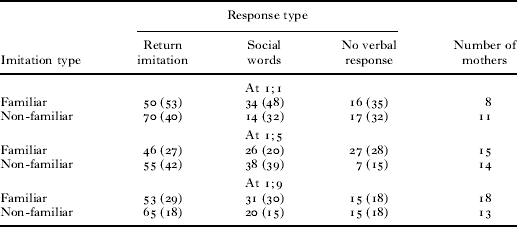
In order to compare mothers' responses to their infants' imitations of familiar versus non-familiar words, we first examined whether they produced different kinds of responses to these two categories of imitation, comparing their rates of providing return imitations, social words and no verbal responses. Although 15 infants at 1 ; 1, 17 infants at 1 ; 5 and 19 infants at 1 ; 9 produced imitations, because the numbers of infants imitating familiar and non-familiar words varied considerably by age (see Table 1), we employed non-parametric statistics to analyze these responses within each age separately for familiar and non-familiar imitations.
Mean percentages (and Standard Deviations) of mothers' responses to infants' familiar and non-familiar imitation by age
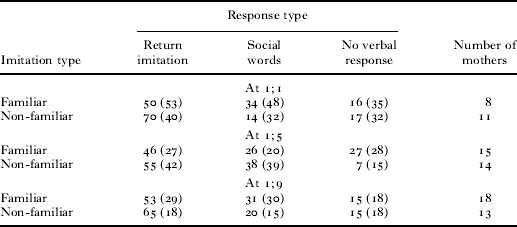
As Table 1 shows, in general mothers were more likely to reply with a return imitation than to provide non-imitative social words or fail to provide a verbal response. However, this pattern was more strongly evident following infants' non-familiar than familiar word imitations at every age. At the beginning of the second year, the kinds of responses mothers provided varied significantly following infants' imitations of non-familiar words only (Friedman's Χr 2(2)=8·71, p=0·01). Mothers produced higher proportions of return imitations than either social words or no verbal response following infants' replications of non-familiar words, but not familiar ones (ps <0·04 by follow-up Sign Tests).
Mothers' responses following their infants' non-familiar word matching also differed at 1 ; 5 (Friedman's Χr 2(2)=8·84, p=0·01). Mothers produced greater rates of return imitation than no verbal response to their infants' non-familiar verbal imitations (p=0·01 by a follow-up Sign Test), but not to their familiar imitations. A chi-square analysis of instances of maternal return imitations versus other responses, aggregated across all mothers, found that return imitations constituted 58% of all responses (32 out of 55) to infants' non-familiar imitations but only 39% of all responses (48 out of 124) to infants' familiar word replication (Χ 2(1)=5·84, p<0·02).
Toward the end of the second year, mothers' response types differed following both infants' familiar and non-familiar imitations (Friedman's Χr 2(2)=12·13, p=0·002, for familiar; and Friedman's Χr 2(2)=14·91, p=0·001, for non-familiar). Mothers' provision of return imitations exceeded their production of non-imitative social words and of no verbal responses following both infants' familiar (ps⩽0·05 by Sign Tests) and non-familiar word matching (ps⩽0·002 by Sign Tests). But the proportion of instances, aggregated across all mothers, of return imitations to infants' non-familiar word imitations (63%, 46 out of 73) still surpassed the proportion of instances of return imitations following infants' familiar imitations (48%, 69 out of 145) (Χ 2(1)=4·54, p=0·03).
Maternal return imitation types following infants' familiar versus non-familiar imitation
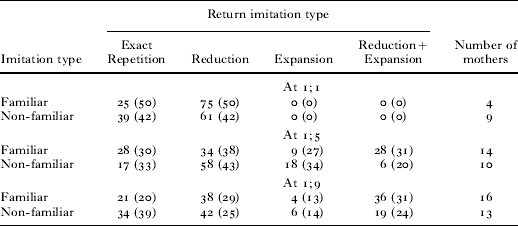
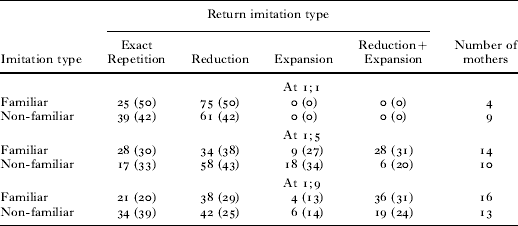
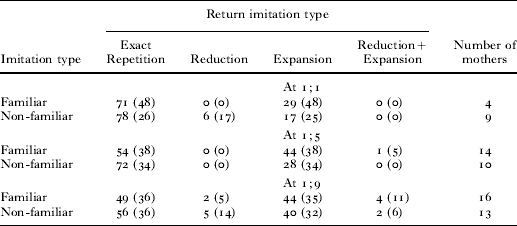
The next set of analyses examined the types of return imitations provided by the mothers – exact repetition, reduction, expansion or reduction+expansion – and whether these types varied according to the familiarity of the words imitated. Fifteen mothers at 1 ; 1, 16 mothers at 1 ; 5 and 18 mothers at 1 ; 9 produced return imitations to their infants' familiar and/or non-familiar words. However, because the numbers of mothers producing familiar versus non-familiar return imitations varied considerably by age (see Table 2), non-parametric analyses were performed separately for mothers' return imitations to familiar and non-familiar words within each age. The analyses were conducted using the categories of maternal return imitations classified first with respect to the model utterances the mothers provided (Table 2) and then with reference to the imitations the infants produced (Table 3).
Mean percentages (and Standard Deviations) of mothers' return imitation types to infants' familiar and non-familiar imitation in comparison to model utterances by age
Analyses with respect to the model utterances
As Table 2 shows, mothers' return imitations to their infants' familiar and non-familiar word imitations exhibited the same pattern at the beginning but diverged across the second year. At 1 ; 1, following both familiar and non-familiar words, mothers most often produced return imitations that were briefer and abbreviated reductions relative to their model utterances. In fact, mothers produced only reduced or exact repetitions, never expansions of their models, as return imitations to both infants' familiar and non-familiar verbal matching at the beginning of the second year. Friedman's tests found significant differences for mothers' exact and reduced versus expanded and reduced+expanded returns to both familiar (Χr 2(1)=4·0, p<0·05) and non-familiar words (Χr 2(1)=9·0, p=0·003).
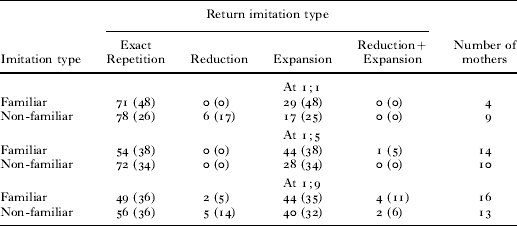
Mean percentages (and Standard Deviations) of mothers' return imitation types to infants' familiar and non-familiar imitation in comparison to infants' imitations by age
By the middle of the second year, return imitations that included some expansion in comparison to model utterances occurred in some mothers' responses to infants' familiar and non-familiar words, although they were more likely to be present in return imitations following infants' familiar (M=37% of return imitations) than non-familiar imitations (M=24% of return imitations). Following infants' familiar words, 64% of mothers produced expansions and/or the more advanced reductions+expansions, which offer contrasting syntactic frames for the imitated words between successive maternal model and response utterances. Moreover, mothers provided a significantly greater proportion of the more complex and contrastive reduced+expanded than of the simple expanded return imitations following infants' familiar word replications (Friedman's test Χr 2(1)=5·44, p=0·02). In contrast to comparable rates following infants' familiar matching of return imitations with reductions and with expansions, mothers most often provided return imitations that were reduced in comparison to their model utterances following infants' non-familiar word matching at 1 ; 5. They produced a significantly greater proportion of return imitations that were exact or reduced (M=75%) than of those that included any expansions of their models (M=24%) (Friedman's test Χr 2(3)=4·5, p=0·03). A chi-square test of instances of maternal return imitations at 1 ; 5 that were reductions versus those that included any expansion, aggregated across mothers, confirmed mothers' differential responding to their infants' familiar and non-familiar word matching. Mothers produced nearly equal frequencies of reduced versus expanded or reduced+expanded return imitations (20 vs. 19) following familiar words, while the distribution following non-familiar words was a lopsided 21 reduced and only 7 expanded or reduced+expanded returns (X 2(1)=3·86, p<0·05).
At 1 ; 9, the distinction between maternal responses to infants' familiar and non-familiar verbal imitation in comparison to their model utterances was still evident, with mothers providing more expanded responses following familiar words and more reduced responses following non-familiar words. By the end of the second year, on average 40% of the return imitations infants received after their familiar word replications included expansions of mothers' models, providing additional lexical input. And again mothers produced a greater proportion of the more complex and contrastive reductions+expansions than of simple expansions after familiar words (Friedman's test, Χr 2(1)=10·0, p=0·002). Following non-familiar imitations at 1 ; 9, infants also received a substantial proportion of utterances that included expansions, 25% on average, although mothers still provided a much greater proportion of return imitations that were exact or reduced (Friedman's test Χr 2(1)=6·4, p=0·01). In fact, mothers' rates of reduced return imitations following non-familiar word matching exceeded their rates of either expanded (Friedman's test Χr 2(1)=10·0, p=0·002) or reduced+expanded returns (Friedman's test Χr 2(1)=5·44, p=0·02). A chi-square test of all instances of maternal return imitations at 1 ; 9, aggregated across mothers, illustrated the mothers' tendency toward greater provision of expansions in responding to infants' familiar versus non-familiar words. Twenty-six out of 59 total maternal return imitations to familiar words included simple expansions or the more complex reductions+expansions, while only 13 of 46 return imitations to non-familiar words did so (X 2(1)=2·77, p<0·10).
Analyses with reference to the imitation
Parallel analyses were conducted categorizing mothers' imitative returns with reference to their infants' imitations. These also revealed maternal responses to infants' familiar and non-familiar verbal imitations that were equivalent initially but quite distinct by the middle of the second year. Because the infants' imitations were frequently only one word long, maternal reductions and reductions+expansions were rare throughout this entire age range. They occurred only twice following familiar and three times following non-familiar words. As Table 3 shows, at 1 ; 1 mothers provided exact repetitions of their infants' words more than twice as often as expansions following both familiar (Ms=71% versus 29%, respectively) and non-familiar imitation (Ms=78% versus 17%, respectively; Friedman's test Χr 2(1)=6·0, p=0·01).
By 1 ; 5, following infants' familiar word matching, mothers had increased their provision of return imitations that included expansions and decreased their provision of return imitations that were exact repetitions so that the two proportions were nearly comparable. In contrast, mothers' return imitations following infants' non-familiar imitations were still significantly more likely to be exact repetitions than expansions (Friedman's test Χr 2(1)=4·5, p=0·03). The pattern of divergent responding to infants' familiar versus non-familiar imitation was present as well in a chi-square analysis of all instances of maternal return imitations that did or did not include expansions, aggregated across mothers. Twenty-four of 49 instances of returns to infants' familiar word matching, but only 9 of 31 instances of returns to infant's non-familiar word matching, included some kind of expansion (X 2(1)=3·12, p<0·08).
Although mothers' provision of exact versus expanded imitations following infants' familiar words changed little from the middle to the end of the second year, mothers' responses to infants' non-familiar matching shifted markedly. From 1 ; 5 to 1 ; 9 mothers' rates of expanded return imitations to non-familiar imitations grew, and their provision of exact repetitions declined. By the end of the second year, in response to both infants' familiar and non-familiar imitations mothers produced nearly equivalent rates of exact repetitions (Ms=49% for familiar and 56% for non-familiar) and expanded return imitations (Ms=44% for familiar and 40% for non-familiar).
DISCUSSION
Infants' imitation of their mothers' words, and particularly their imitation of words not in their productive repertoires, has repeatedly been found to be associated with greater vocabulary acquisition (Bates et al., Reference Bates, Bretherton and Snyder1988; Charman et al., Reference Charman, Baron-Cohen, Swettenham, Baird, Cox and Drew2000; Masur, Reference Masur1995; Masur & Eichorst, Reference Masur and Eichorst2002; Snow, Reference Snow, Speidel and Nelson1989). This study investigated whether the characteristics of mothers' responses, and especially the differences in responses to infants' imitations of non-familiar versus familiar words during naturally occurring interactions, could help explain these relations. We examined developmental changes in the structural characteristics of maternal responses, the likelihood of different kinds of responses, especially return imitations, and the types of return imitations mothers produced during naturally occurring interactive contexts in a longitudinal sample observed at 1 ; 1, 1 ; 5 and 1 ; 9. These analyses addressed two questions: Do mothers respond differentially to infants' imitation of familiar versus non-familiar words?, and Do their responses exhibit characteristics likely to promote their infants' language development? Our results provide affirmative answers to both questions.
In the current study, infants' verbal imitations in general elicited overall responses from mothers that have several structural advantages for learning words. Mothers' responses to infants' verbal imitations were shorter than the other utterances they used when interacting with their infants, regardless of age. This is consistent with past findings that mothers adjust their utterance lengths to match their infants' utterance lengths and that this is beneficial for language learning (Conti-Ramsden, Reference Conti-Ramsden1985; Furrow, Nelson & Benedict, Reference Furrow, Nelson and Benedict1979; Phillips, Reference Phillips1973; Snow, Perlman & Nathan, Reference Snow, Perlman, Nathan, Nelson and Van Kleek1987). Moreover, our results expand on previous findings by revealing that mothers' responses to imitation are even shorter, and therefore likely to be more finely tuned to match infants' developmental levels, than other maternal utterances, potentially resulting in enhanced word-learning opportunities for infants. One reason mothers' responses to infants' imitations were so short was that they often responded with a single word. This is important because mothers' use of short and one-word utterances has been found to be related to their infants' word learning (e.g. Furrow et al., Reference Furrow, Nelson and Benedict1979). For example, Brent and Siskind (Reference Brent and Siskind2001) found that the frequencies with which mothers produced new words in isolation predicted the words infants would add to their vocabularies.
In addition, more than half of mothers' verbal responses at each age were return imitations. Return imitations provide infants not only acknowledgement and reinforcement for matching but also additional exposure to the words. This may be especially valuable in increasing input frequency, which has been shown to predict acquisition (e.g. Goodman, Dale & Li, Reference Goodman, Dale and Li2008). In addition, although we did not examine the phonological characteristics of the infants' imitations or their mothers' responses, because many of the productions by infants of these ages are likely to be phonetic approximations, mothers' return imitations also afforded immediate and contingent exemplars of correct pronunciation which may aid infants' acquisition of more mature phonetic forms (cf. Otomo, Reference Otomo2001). Furthermore, these return imitations almost always placed the imitated word in sentence-final position. Echols and Newport (Reference Echols and Newport1992) found that placing a word in sentence-final position increased its saliency, making it easier to learn. Thus, infants' verbal imitations elicit very short, simple utterances from mothers that highlight the imitated words either by using them in isolation or in sentence-final position. These structural characteristics of mothers' responses to verbal imitation in general could help explain why infants with high imitation rates have larger vocabularies during the second year of life (Bates et al., Reference Bates, Bretherton and Snyder1988; Nelson et al., Reference Nelson, Baker, Denninger, Bonvillian and Kaplan1985). Mothers' responses might mediate the relation.
As well as these beneficial structural features that characterized maternal responses to infant imitations in general, mothers diverged in their pattern of responding to infants' replications of familiar versus non-familiar words. These differences demonstrated mothers' awareness of the familiarity or non-familiarity of the words their infants imitated, a distinction observed previously in maternal object labeling as well (Cleave & Bird, Reference Cleave and Bird2006; Farran, Lederberg & Jackson, Reference Farran, Lederberg and Jackson2009; Masur, Reference Masur1997). More important, they modulated their responses to familiar and non-familiar verbal imitations in ways that might contribute to understanding why novel imitations are more strongly linked than familiar imitations to lexical acquisition (Masur & Eichorst, Reference Masur and Eichorst2002). In the current study, mothers' replies to non-familiar imitations had characteristics likely to be especially advantageous for learning new words. For example, although infants received high rates of verbal responses after both familiar and non-familiar imitations, they had more opportunities to immediately hear the imitated words again after non-familiar imitations. Mothers' greater production of return imitations, rather than other social words, following non-familiar than familiar infant imitations, provided additional exemplars of the non-familiar words. This is consistent with the known benefits of repeated exposure for word learning (Brent & Siskind, Reference Brent and Siskind2001; Gershkoff-Stowe, Reference Gershkoff-Stowe2002; Gershkoff-Stowe & Hahn, Reference Gershkoff-Stowe and Hahn2007; Girolametto et al., Reference Girolametto, Pearce and Weitzman1996; Storkel, Reference Storkel2004). Verbal imitation episodes appear to be naturally occurring situations during mother–infant interactions where infants can benefit from repeated presentations of new words. We recognize, however, that the experiences of infants in samples that are more culturally and/or linguistically diverse than this one may vary and deserve examination (Ochs & Schieffelin, Reference Ochs, Schieffelin and Blount1994). It would be important as well to examine the frequencies and kinds of responses mothers differing in socioeconomic status give their infants (cf. Hoff, Reference Hoff2003; Rowe & Goldin-Meadow, Reference Rowe and Goldin-Meadow2009). Such comparison studies could provide answers about the degree to which the patterns we have discovered here generalize.
In our sample, not only the rates but also the types of mothers' return imitations varied as a function of imitation familiarity. In comparison to their infants' imitations, mothers overwhelmingly produced exact repetitions of their infants at 1 ; 1 following both infants' familiar and non-familiar words. However, by 1 ; 5 mothers' exact repetitions had declined following familiar, but not non-familiar, imitation. By the middle of the second year, mothers were more likely to provide expanded return imitations following their infants' familiar than non-familiar imitations. For example, one child imitated the mother's word, juice; and the mother responded with get juice. This decline in mothers' exact return imitations by the middle of the second year following infants' familiar word matching parallels a decline Clark and Bernicott (Reference Clark and Bernicot2008) noted in their sample in the third year. However, where they failed to find an increase in maternal expansions of infants' imitations during that time period, we found that mothers increased their provision of expanded return imitations following infants' familiar words from the beginning to the middle of the second year. Such expansions can benefit lexical acquisition by providing immediate contrasts between infants' immature and adults' mature conventional forms (Chouinard & Clark, Reference Chouinard and Clark2003; Farrar, Reference Farrar1992; Girolametto et al., Reference Girolametto, Weitzman, Wiigs and Pearce1999) and evidence mothers' attunement to their infants' increasing developmental and linguistic capabilities (Conti-Ramsden, Reference Conti-Ramsden1985; Furrow et al., Reference Furrow, Nelson and Benedict1979).
Although mothers' exact repetitions of their infants' non-familiar imitations also eventually declined and their expansions grew, those changes occurred only at the end of the second year. At 1 ; 1 and 1 ; 5 mothers were most likely to produce exact repetitions of their infants' usually single-word non-familiar imitations. Thus, for most of the second year, infants' imitations of non-familiar words elicited shorter, simpler responses than their reproductions of familiar words. Mothers' exact repetitions allowed for an extra exemplar to be highlighted in the response, potentially making word learning easier (Brent & Siskind, Reference Brent and Siskind2001) and helping explain why novel imitation is more predictive of vocabulary growth during this developmental period (Masur & Eichorst, Reference Masur and Eichorst2002). Clark (Reference Clark2007) has also asserted that when infants imitate novel words they signal their interest to caregivers who notice the novelty as evidence of uptake. Our findings show that mothers differentially notice the replication of novel words and are more likely to respond with exact repetitions.
In comparison to their own model utterances as well, mothers' patterns of return imitations to their infants' familiar and non-familiar replications also diverged during the second year, although they started off similar. At the beginning of the second year, mothers' returns to both kinds of infant imitations were most often reductions of their own models. For example, one mother said, little duck; her child imitated the familiar word, duck; and the mother replied, duck. Although reduced return imitations decreased gradually for non-familiar imitations across the second year, they continued to surpass all other categories until 1 ; 9. Maternal reductions decreased earlier and more dramatically following infants' familiar imitations, however. The opposite pattern was evident in mothers' rapid increase with age in the use of reduced+expanded responses, the most complex return type, following familiar imitations. Reductions+expansions represented 36% of returns to familiar imitations by the end of the second year, but only 19% of returns to non-familiar imitations. Mothers increasingly reacted to familiar imitations by showing their infants another way to use the familiar word, rather than simply by repeating their models. For instance, one mother said, It's a yellow duck; the child imitated, duck; and the mother responded with The yellow duck's swimming. In this example the mother has very effectively provided the child with contrasting syntactic frames for the word duck, which was familiar for the child. From such imitative episodes infants can readily compare their mothers' imitations with their mothers' models and with their own productions. Infants' familiar imitations increasingly elicited these juxtapositions throughout the second year. Such contrasts of diverse frames have been shown to promote linguistic growth (DeVilliers, Reference DeVilliers1985; Naigles & Hoff-Ginsberg, Reference Naigles and Hoff-Ginsberg1998).
In sum, infants' familiar and non-familiar imitations elicited differential responses from mothers, providing evidence of mothers' awareness of and sensitivity to their infants' early vocabularies, their verbal imitations and the presence of the first within the second. These findings support the assertion of Bornstein and colleagues (Reference Bornstein, Tamis-LeMonda, Hahn and Haynes2008) that mothers' responsivity to infant behaviors is multidimensional, modular and specific and fit well with the larger body of literature demonstrating maternal verbal responsiveness and attunement to their infants' developing abilities and lexical knowledge (Cleave & Bird, Reference Cleave and Bird2006; Conti-Ramsden, Reference Conti-Ramsden1985; Farran et al., Reference Farran, Lederberg and Jackson2009; Furrow et al., Reference Furrow, Nelson and Benedict1979; Masur, Reference Masur1997). Although mothers responded to both kinds of imitations in ways that are likely to promote language development, the distinctions they made provide support for considering infants' familiar and non-familiar imitations separately when examining relations between infant matching and language acquisition. Mothers' greater provision of return imitations, especially exact repetitions or reductions, in response to infants' non-familiar imitations appear to be especially facilitative of early word learning, whereas mothers' expanded responses to their infants' familiar imitations might be particularly helpful for promoting early sentence development. These results highlight the richness of imitation episodes during naturalistic mother–infant interactions and support the value of further direct investigation of the role these episodes may play in the language learning process. As with maternal responses to children's gestures (e.g. Olson & Masur, Reference Olson and Masur2011) and with maternal responses to attentional focus (e.g. Akhtar, Dunham & Dunham, Reference Akhtar, Dunham and Dunham1991; Masur, Flynn & Eichorst, Reference Masur, Flynn and Eichorst2005; Shimpi & Huttenlocher, Reference Shimpi and Huttenlocher2007; Tamis-LeMonda et al., Reference Tamis-LeMonda, Bornstein and Baumwell2001; Tomasello & Farrar, Reference Tomasello and Farrar1986), mothers' replies to their children's imitations may serve as a mechanism mediating the relation between infants' behaviors and their later lexicons.