Introduction
The world crisis of 1929 encouraged a change in the development model of Latin American countries. The fall in the volume and value of commodity exports, the end of the Gold Standard and multilateral trade, and the generalisation of protectionism in industrialised countries promoted import substitution industrialisation (ISI), which was particularly dynamic in Argentina, Brazil and Mexico. It is agreed that the transformations associated with ISI came about as an answer to a hostile context for commodity exports. It was only in the 1940s that Latin American governments introduced explicit policies to foster industrialisation aimed at the domestic market, and it was only at the end of that decade that they began to obtain theoretical support from the studies of the Economic Commission for Latin America (ECLA).Footnote 1
ISI promoted a period of strong economic growth in the region following the Second World War, but in the 1960s it came in for criticism due to some serious imbalances that were becoming evident.Footnote 2 Structuralists criticised the policies implemented, especially excessive protectionism, which had created new imbalances.Footnote 3 Disapproval also came from Marxist authors and dependency theorists, who argued that ISI did not break dependency; on the contrary, it increased it in new ways such as through the expansion of multinationals and the growth of technological dependence.Footnote 4 A third line of criticism, inspired by neoclassical theory, condemned the model's concentration on the domestic market for having created an industry that was neither efficient nor competitive, slowing down economic growth in a period of expanding world trade.Footnote 5 The crisis in Keynesianism and structuralism during the 1970s strengthened this critical stance, especially in Argentina, Chile and Uruguay, where ISI had caused the greatest imbalances and intersectoral conflicts.
Argentina's slow growth during the second half of the twentieth century has been attributed to the inward-looking model adopted by the administration of Juan Domingo Perón during the post-war years. A study by Juan Llach offers an interesting interpretation of this particular situation. He argues that during the Second World War the Argentine economy was faced with two alternative paths. One was to have an open economy and direct industrialisation towards foreign markets.Footnote 6 The best expression of this alternative was the Pinedo Plan of 1940, a programme intended to confront the disruption caused by the onset of the war and the closure of the European market to Argentine grains. The other path, which Peronism would ultimately follow, consisted of closing the economy and promoting industrialisation centred on the domestic market. In the 1990s, with the growth of neoliberalism, this interpretation became more radical. According to Llach, Peronist economic policy was a drastic move, ‘a fatal option in favour of autarky’.Footnote 7 The ISI strategy would be intensified by later governments, but the small size of the domestic market would condemn Argentina to stagnation during the second half of the twentieth century.Footnote 8
This interpretation is the object of discussion by other authors who have started to review the economic policies, the context in which they were undertaken, their reach and their impact during the 1940s and the Peronist administrations.Footnote 9 These studies have remarked upon the increase of state interventionism and the advance of stances favourable to industrialisation throughout the 1940s.
The purpose of this article is to analyse the rise and fall of Argentine industrial exports during the 1940s and 1950s.Footnote 10 The analysis of this process, which has not been widely explored by the historiography, enables us to understand the complex relationship between the early stages of ISI and industrial exports. In the 1940s, I argue, Argentina did not face two opposing alternatives. In spite of the export boom during the war, industry did not possess the competitive capacity necessary to confront the resumption of world trade; consequently, a strategy based on industrial exports did not offer an alternative path.
Although the orientation of industry towards the domestic market seemed to a great extent the inevitable path, Perón's government provided a distinctive flavour to it. The redistribution of income from the export sector to the urban economy helped to strengthen domestic demand and foster industrial investment through various means. In this framework, as Llach argues, industrial exports were initially discouraged; this policy was later revised, however, giving way to one which had the intention of encouraging them. In fact, due to the pressure of a balance of payments crisis, after 1949 the Peronist government tried to stimulate some industrial exports by offering exchange rate and fiscal incentives and promoting trade with other Latin American countries. These measures constituted the first efforts to promote non-traditional exports, the onset of which has traditionally been placed by the historiography in the 1960s. The use of these instruments, exchange rate and fiscal incentives and an orientation towards Latin American markets, would also characterise the policies of the 1960s. The stimulus to industrial exports in the 1950s failed for a variety of structural reasons, characteristic of the early stages of ISI and policies to encourage industrialisation: high production costs, the relative technological backwardness of Argentine industry, overvaluation of the exchange rate (which at the same time was a means to transfer income from the rural export sector to industry) and the erratic nature of official policies. The limitations of these policies and their results fed back into the marked pessimism about exports which characterised specialists' diagnoses of Argentina and the region.
The study of the relationship between ISI and exports in Latin America constitutes a subject of great interest, given that during the post-war period the region lost world market share. Although a period of significant growth in international trade was achieved by the increase of trade in manufactured goods between industrialised countries, the share of raw materials declined and the terms of trade showed a negative trend in most of the commodity-exporting economies. In Argentina this was exacerbated by the stagnation of agriculture in the pampa and the decrease in export surpluses that resulted from the anti-export bias of Peronist policies, the country's technological lag vis-à-vis its global competitors, and the increase in domestic consumption.Footnote 11 The slow growth of industrial exports heightened the problems of Latin American foreign trade.
This article is divided into four parts. The first analyses the causes and characteristics of the export boom during the Second World War and assesses their economic importance. The second explores the problems Argentine industry faced in capturing foreign markets by analysing the history of the Corporación para la Promoción del Intercambio (Trade Promotion Corporation, CPI), a joint-stock company created to stimulate industrial exports to the United States and Latin America. The aim of the third section is to study industrial policies during the post-war period. The final section examines the decline of industrial exports during the post-war period and the 1950s. Finally, I present some conclusions about the problems of industrial exports in the early stages of ISI.
The War and the Boom in Industrial Exports
The outbreak of war in September 1939 confronted the Argentine government and the business sector with new economic difficulties. The most pessimistic diagnoses feared a decline in grain exports similar to or even greater than that suffered during the Great Depression. Faced with these difficulties, in November 1940 the minister of finance, Federico Pinedo, presented the Plan de Reactivación Económica (Economic Reactivation Plan). Commonly known as the Plan Pinedo, it included a series of measures of a counter-cyclical nature to limit the impact of the fall in exports and the expected balance of payments crisis. To begin with, the programme through which the state purchased harvests would be broadened. To prevent unemployment the construction of low-income houses would be encouraged, which would stimulate the economy without the need to increase imports. Finally, the plan aimed to foster investment in the industrial sector through the creation of a system of medium- and long-term credit. To fulfil these objectives, the government set up a financial agency in the Central Bank which would convert short-term deposits in the hands of commercial banks into long-term loans. This agency would provide private and state banks with funds, while the banks would be in charge of granting the loans, although the Central Bank would guarantee deposits.Footnote 12
The proposal to encourage industrial development as a minor but indispensable means of revitalising the economy, and to limit the stimulus to ‘natural industries’ that could generate exports, has generated a historiographical debate over the significance of the plan. For Llach it was a partial correction of the development model that Argentina had adopted at the end of the nineteenth century, through the stimulus it provided to export industries and its frank recognition of US hegemony. Other authors, however, have noted its short-term nature and the lack of coherence between some of its objectives.Footnote 13 With respect to industrial exports, the Pinedo Plan did not define which industries should be promoted. It only stated that ‘natural industries’, meaning those that used raw materials from the pampa, would be promoted, as a guiding principle of the sectoral policy.Footnote 14 In any case, the plan did not receive congressional approval, and a year later, with the change in the economic situation due to the improvement in the balance of payments, all interest in it was lost.Footnote 15
Henceforth the principal problem faced by the Argentine economy was the decline in imports of consumer and capital goods. The reorientation of industrialised economies towards war production, which caused the withdrawal of a great variety of manufactures from the world market, encouraged ISI. At the same time, this shortage of manufactures and the increase in prices fostered the growth of industrial exports from new regions which were in their early stages of industrialisation. This was not a new phenomenon given that during the First World War several countries, Argentina among them, had exported manufactures, but the moment then was too brief for local industry to take advantage of it.Footnote 16
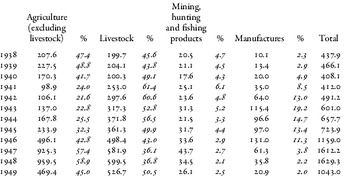
During the Second World War, however, the process was more important. Between 1939 and 1945, Argentina's total exports increased 55 per cent while industrial exports rose 625 per cent. Between 1939 and 1943, the period in which industrial exports hit their highest point during wartime, growth reached 762 per cent. In 1939 the sale of industrial products abroad had represented only 2.9 per cent of the total export trade; by 1943 it had reached a peak of 19 per cent, a value that would not be repeated during the following decades. As noted already, the increase in exports was due to unmet demand resulting from the withdrawal of the large manufacturing countries. This led to an increase in world prices, which provided a greater incentive for local entrepreneurs. Moreover, Argentine goods benefited from the depreciation of the real exchange rate that continued during the war (Table 1).Footnote 17
Argentina's Total Exports, 1938–49 (in US$ Million)

Source: Dirección General de Estadística y Censos (DIGESTYC), Anuario del comercio exterior de la República Argentina (Buenos Aires: Dirección General de Estadística de la Nación, 1938–50).
The boom in industrial exports may be less significant than these figures indicate, however. In the first place, this increase in industrial exports occurred at the same time as a substantial drop in agricultural exports. Taking 1938, a relatively normal year, as the base, agricultural exports shrank 36 per cent in volume between 1938 and 1945. The decline would be greater if we stopped in 1943, when they were 54 per cent lower than in 1938. Altogether, agricultural exports went from representing 80 per cent of the volume of Argentine trade to representing 62 per cent in 1942–3. Their share in the total value of exports dropped from 50 to 32 per cent between 1938 and 1945. They were at their lowest in 1941–3, when they fell to 23 per cent of the total. These changes disrupted the composition of the export trade as a whole and increased the weight of the sales of non-traditional products.
A second factor that explains the weight of industrial exports was their growth in value. Between 1938 and 1945 the volume of exports increased 27 per cent, but their value increased 940 per cent. The value per ton increased from m$n 222 in 1938 to m$n 2,161 in 1943 and then fell to m$n 1,815 in 1945. This was due both to the sales of products with greater added value and to the increase in world prices of manufactures. As a consequence of this increase, business leaders became interested in exporting and the government had problems in avoiding a rise in the cost of living.
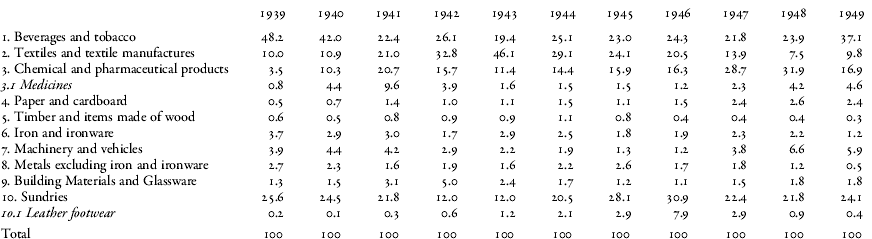
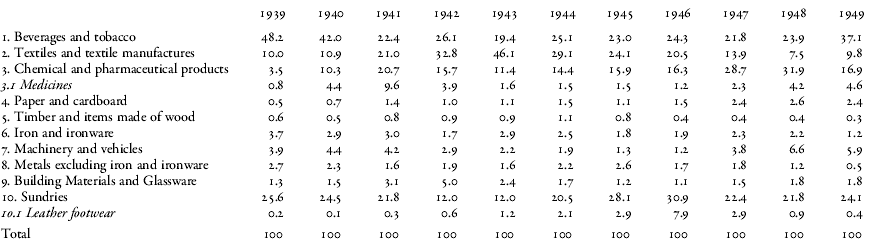
Table 2 shows the composition of exports divided by industry. The textile industry became the principal exporting sector in 1942–5, followed by the food industry. The table also highlights the significant performance of chemical and pharmaceutical products; their share in the total volume of exports went from 3.5 per cent in 1939 to 29 per cent in 1947, making this the principal manufacturing export sector by that date.
Composition of Manufactured Exports, 1939–49 (% of Total)
Source: DIGESTYC, Anuario del comercio exterior de la República Argentina (1938–50).
The most important products exported were wool and cotton yarn and cloth, and woollen garments, followed by medicines, chemical products, footwear and other leather goods, books, bond paper, pig iron and galvanised pipes. Clearly exports were diverse and included some products that the country produced in small quantities and at a high cost. Nevertheless, these factors are less significant when made against a background characterised by considerable shortages in the international market.
In the case of textiles, the war not only increased exports but also modified their composition. Initially exports focused on residues such as cotton linters, but from 1941 to 1942 exports of wool and cotton yarn and cloth ranked first; in other words, textile exports increased their value added. The principal markets for these products were South America, except for Brazil, and South Africa. The latter became an important customer for Argentine industry because during the war it lost its continental European suppliers, and Great Britain was having difficulties fulfilling its own textile requirements.Footnote 18
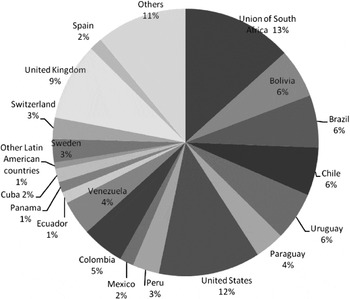
One of the characteristics of foreign trade during the war was its reorientation towards South American markets. In the case of manufactures, the distribution according to destination shows an important diversification of markets. The principal destination for industrial products was South Africa, followed closely by the United States and, a little further behind, the United Kingdom, Argentina's traditional partner. However, the importance of Latin American markets can be seen; altogether they represented 47 per cent of industrial exports, while the countries neighbouring Argentina represented 28 per cent of sales (Figure 1).
Argentine Manufactured Exports by Destination, 1939–45 (% of Total Exports)

As we shall see in the following section, a series of problems resulting from the war and other difficulties inherent in the degree of development that Argentine industry had reached limited the possibilities of placing products in the US market, but the war did allow Argentina to expand into South American markets.
The CPI and the Promotion of Industrial Exports
An analysis of the path followed by the CPI helps us to evaluate the difficulties encountered by trade between Argentina and the United States during the war and the challenges that local industry faced in capturing foreign markets.
The creation of the CPI occurred at a time when the conservative government of Ramón Castillo was attempting to introduce proposals that would favour industry; the most significant were bills concerning industrial credit, duty drawback measures and anti-dumping.Footnote 19 In fact, the CPI was one of the few official initiatives to provide indirect support to industry that was implemented before the military coup d’état of 1943 and the rise of Perón.Footnote 20
In November 1940 Pinedo had decided to encourage the export of new products in the ‘free’ exchange sector, with the intention of counterbalancing an increase in imports from the United States. Decree 78.466/40 created an auction market where the Central Bank would sell dollars arising from the export of new products.Footnote 21 The decree anticipated the organisation of special agencies to promote foreign trade and provided the basis for the creation of the CPI in May 1941. The agency was designed by the general manager of the Argentine Central Bank, Raúl Prebisch, and his counterpart at the Bank of America in Buenos Aires, Leo Welch, who was also a director of the Central Bank.Footnote 22 The initiative received the support of other business leaders and managers of US companies for whom the increase in exports to the US market and the availability of dollars were essential to their businesses.Footnote 23
The CPI was authorised to purchase dollars coming exclusively from non-traditional exports and sell them to pay for ‘non-essential’ imports. The benefits obtained from these transactions would have to be used to encourage foreign trade. Granting this capacity to a joint-stock company, in which large economic interests prevailed, was in line with the structure of agencies created during the 1930s such as the juntas reguladoras (regulatory boards) for agriculture, or the Central Bank, where the leaders of big business were represented. At the same time, it highlights the influence wielded by subsidiaries of foreign firms in Argentina, which frequently obtained other measures favourable to their interests.Footnote 24
In September 1941 the CPI started trading in dollars, an undertaking it would monopolise until May 1946. A few months later, the agency had established a functional organisation, hired staff and opened its first branch in New York; offices in Chicago, New Orleans and San Francisco would be added by 1943.Footnote 25
During its first year the CPI attempted to solve some of the problems it found when selling Argentine manufactures in the US market. To this effect steps were taken to hire technicians who would study the hat, footwear and milk industries. Contact was also made with the Armour Research Foundation (ARF) and General Mills; these were considered to be organisations that might help improve the competitiveness of Argentine products, given their considerable knowledge of the US market, commercial practices and technology.
Changes in the economic situation altered the CPI's plans. When the United States joined the war in December 1941, the shortage of raw materials, manufactured goods and machinery increased. The US ban on the export of certain products, the regulations imposed on the import of merchandise and the additional obstacles resulting from Argentina's neutrality imposed some changes in the CPI's orientation. Its main objective started to move away from fostering trade with the United States and towards doing so with Latin America.Footnote 26 In response to these difficulties, the board of directors agreed on a plan to establish branches in Peru, Mexico, Chile, Ecuador, Colombia and Venezuela; offices in Lima and Mexico would be opened in 1945. Even more important was the fact that the CPI went from encouraging non-traditional exports to promoting all types of exports.Footnote 27
Without doubt, however, the area in which the CPI would achieve most was the study of the export capacity of Argentine industry. This was carried out by a team contracted from the ARF and comprised of the chemical engineer Dr Francis W. Godwin, the agricultural chemist Dr John Shellenberger, and the economist Dr John A. Hopkins, all of whom arrived in Argentina in 1942. This group of technicians started touring the country with the intention of gathering information, visiting factories, agricultural and forestry establishments, and making contact with the most important universities and scientific institutions in the country. The results of this thorough exploration appeared in ten sectoral reports and a study on the structure of Argentine industry.Footnote 28
With regard to the possibilities of exporting manufactures, the importance of the CPI reports is twofold. First, they established criteria to limit industrialisation to those sectors that benefited from an abundant and cheap supply of Argentine raw materials. Second, the studies revealed some of the main weaknesses of Argentine industry that conditioned the possibilities of its competitiveness in the world market.
The first aspect of the problem was considered in depth in Hopkins' study of the country's industrial structure. Drawing on the theory of comparative advantage, he identified three types of industries with different degrees of competitiveness.Footnote 29 The first category comprised those that had cheap and abundant raw materials and an important domestic market; this would allow the establishment of large factories with modern technological processes that could take advantage of economies of scale. These ‘convenient’ industries included the production of pig meat, the milk industry, grain fermentation, tanning, the manufacture of some specific chemical products, and woollen textiles.Footnote 30
The following two categories of industries would not find it possible to compete on the world markets; Hopkins even believed that the development of some of them would be inconvenient from the point of view of the national economy. Among the industries in an ‘intermediate’ position were tiles, high-quality glass and the metallurgical industry (light machinery, spare parts, and assembly plants for agricultural machinery and cars which used imported parts). The final group included industries in a disadvantageous position, such as the production of basic chemicals, which required an abundant and cheap supply of energy, and the iron and steel industry, which would need imported iron and coal.Footnote 31
Even more important than Hopkins' position regarding the limits that should be imposed on industrialisation was the fact that the CPI reports revealed obstacles in some of the industries that the ARF mission believed would have the best chances of competing in the world market. Setting aside those products which could not compete for cost reasons, the problems arose from the poor quality or low uniformity of the goods produced, the small size of production batches and a lack of standardisation, all of which made US importers lose interest. In addition there were difficulties in shipping and payment conditions, and deficiencies in product presentation and packaging. These issues could not be resolved immediately, but they would have to be investigated if the intention was to maintain or increase exports. Some examples are revealing: the production of milk, butter, cheese and casein (the last three products were important for foreign sales) faced the problems of low-quality milk, lack of refrigerated transport, an absence of scientific methods of production and control guidelines, and inefficient state supervision of pasteurisation.Footnote 32 The chemical industry also lacked quality and uniformity standards. Moreover, the companies employed almost no technical staff, which were extremely scarce in the country, and had no research departments or laboratories either.Footnote 33 Another case was footwear manufacturing, which had to cope with problems arising from poor leather tanning, poor product standardisation and an inability to offer goods that were appropriate for US demand.Footnote 34
In 1945 the CPI indicated that the state of manufactured exports to the US market was the result of two concurrent factors: the shortage of shipping space, which made acquiring semi-manufactured merchandise more advantageous than raw material, and the lack of supplies resulting from the conversion of US industry to wartime production. The CPI understood that this was an abnormal situation and would not last during the post-war period. Thus, it stressed that ‘we must prepare ourselves to place a large amount of the products imported by the United States in other markets, because the United States will soon return to normal and our exports will fall. This will have a bearing on the overall situation of Argentine industry, affected by the decline of exports and foreign competition in the country and abroad.’Footnote 35
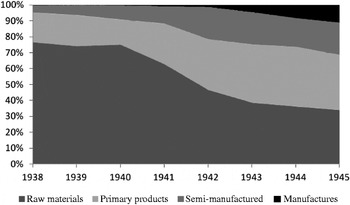
The analysis of trade between Argentina and the United States shows that the difficulties had persisted and that they would get worse as a consequence of the war and its economic and political repercussions. Argentina's neutrality led to severe restrictions on imports of fuel and machinery from the United States.Footnote 36 Between 1938 and 1941 Argentine exports to the United States had risen 325 per cent, but the growth had stopped in 1941 and they had remained at that level until 1945. Even more interestingly, exports were still predominantly composed of raw materials and primary products such as preserved meats, oils, wheat flour, fats and tallow. As can be seen in Figure 2, however, manufactures occupied a marginal position (less than 1.5 per cent) during the years of industrial export growth, although they reached a record 10 per cent of the total in 1945.
Composition of Argentine Exports to the United States, 1938–45 (% of Total Exports)

The difficulties encountered and the negative outlook for the post-war period led the CPI to carry out, with the help of international consultants, studies of the prospects in the US market. It was understood that this analysis would not only define the CPI's future actions but also provide ‘the information needed to define the guidelines and criteria that Argentine industrialists and exporters would have to follow if they wished to retain the US market’.Footnote 37 Initially the project included food, textiles, alcoholic beverages and tobacco, metals, and optical, electrical and radio products, but very soon its remit had reverted to studying traditional products which had little value added. The first reports studied the possibility of exporting reptile skins, kid-leather gloves, butter, flax fibre and burlap, fish oil and meal, shark liver oil and dog food, among other products.Footnote 38 It was clear that Argentine industry could not harbour great expectations as regards the export of these articles, whose share of total industrial production was very low. The focus of the CPI's studies on these products seems to confirm its diagnosis of the difficulties there would be in placing Argentine manufactured goods in the US market after the war.
Argentine Industry and Foreign Markets during the Post-War Period
By the end of the war, positions advocating industrialisation had been strengthened. A trend of thought composed of economists, engineers, military officers and business leaders held that it was essential to protect, though with some limits, the industries that had been born during the war. The renewal of world trade instilled fears that a sector of the industry that had surfaced under emergency conditions and had used its equipment intensively would now succumb, bringing about unemployment and social unrest.Footnote 39 A report prepared by the Consejo Nacional de Posguerra (National Post-War Council) estimated that 70,000 direct jobs in the manufacturing sector would be lost, together with a similar loss of indirect employment. Exporting industries would be the ones to suffer most, with a loss of 70 per cent of the total, around 32,000 jobs.Footnote 40
The favourable outlook that such leaders held with regard to industrialisation was based on a pessimistic view of the future of primary exports, which was present even in the reports prepared by the neoclassical economists of the League of Nations. It was understood that after a brief period of growth in the volume and price of primary exports, problems would start again and primary exporting countries would once again be affected by the deterioration of the terms of trade.Footnote 41
Llach has pointed out that the industrialisation policy followed by Peronism was an answer to the US boycott and the result of Perón's need to strengthen his leadership among the workers by redistributing income. However, Peronist policies were also underpinned by an economic belief in the advantages of industrialisation. The most important influence here came from a group of economists and engineers that had been formed under the wing of Alejandro Bunge, the most important local advocate of protectionism during the interwar period.Footnote 42 His follower, Emilio Llorens, was the director of economic and industrial policy at the Secretaría de Industria (Secretariat of Industry) between 1943 and 1947. Llorens believed that industrialisation would make it possible to absorb farming surpluses, increase the number of jobs and raise the standard of living of people in the provinces. Taking up the League of Nations studies, Llorens claimed that trade between industrialised countries was building up due to their population's higher standard of living, while the old international division of labour was losing strength.Footnote 43 Industrialisation would not isolate Argentina from world trade; it would modify the composition of its foreign trade by replacing industrial imports with imports of raw materials and machinery that the country did not produce. On the subject of exports, Llorens suggested exporting products ‘with the highest degree of industrialisation possible’.Footnote 44
Nevertheless, the bungistas were not in favour of industrial autarky, and they relaunched Bunge's 1909 proposal to build a Unión Aduanera del Sur (Southern Customs Union). The formation of such an economic bloc would broaden the market and give industrialisation greater encouragement.Footnote 45 These ideas agreed in various aspects with a body of opinion in favour of economic integration which existed throughout the region.Footnote 46 With regard to manufactured exports, the Bunge group considered their increase during the war in a positive manner.Footnote 47 Although they understood that such exports would have a secondary role in industrialisation, they held that it was appropriate to define a clear policy on what type of industries could continue exporting and what instruments might be used to encourage them.Footnote 48
In 1946, Perón's government took up these proposals. Llorens and his colleagues designed the projects on industry that constituted the most important part of the first Five-Year Plan. First, ‘existing industries’ which used national or partially imported supplies and were aimed at satisfying domestic demand, such as the textile, chemical and paper industries, would be encouraged. Second, ‘new industries’ aimed at the internal market and national defence would be stimulated. The former included a project to install the first integrated iron and steel plant, as well as the manufacture of newsprint. Finally, the plan envisaged providing support for manufactured exports. The activities selected were very few, and they were the same as those that the CPI report had considered to be in an advantageous position because of the resources available in the country: woollen yarn, vegetable oils, medicines manufactured from bovine glands, and leather tanning. Apart from the first two, these were activities that had little weight in industrial production. Even though the Five-Year Plan placed them in a secondary position, it was the first programme explicitly to name which industries should be encouraged. To that effect the government proposed to grant foreign exchange and tariff benefits, to limit the export of non-processed raw materials and to organise a system for sales in foreign markets.Footnote 49
As we shall see, the implementation of industrial policy differed from the objectives that had been laid out. The introduction of Peronist policies was accompanied by important reforms such as the nationalisation of the Central Bank, bank deposits and foreign trade.Footnote 50 In 1946 the military government dissolved the CPI and used its structure to establish the Instituto Argentino de Promoción del Intercambio (Argentine Institute of Trade Promotion, IAPI), a state agency that would play a central role in Peronist economic policy.Footnote 51 The IAPI was supposed to encourage foreign trade by negotiating bilateral agreements and granting commercial loans. More important still, it would monopolise agricultural exports by buying products in the internal market and selling them abroad. It could thus break the link between internal prices and world prices, earning substantial profits until 1949. The revenue from these operations was aimed at financing public spending and encouraging industry.
The Secretaría de Industria y Comercio (Secretariat of Industry and Commerce), created in 1944, was responsible for implementing sectoral policy. It had to coordinate the promotion of industry with solving the problems of supplying the domestic market, which had suffered serious disruptions as a consequence of the increase in exports during the war. Maximum prices were therefore set for essential items. The Dirección de Abastecimiento (Supply Directorate) and the Dirección de Exportación e Importación (Export–Import Directorate) imposed strict controls on industrial imports and exports, since they were in charge of issuing the certificates needed to request exchange permits at the Central Bank and IAPI.Footnote 52 The Secretaría de Industría y Comercio tried to make the most of the CPI experience. In 1947 the Dirección de Exportación e Importación started to supervise the quality of manufactured exports in order to avoid the sale of products that would damage the reputation of Argentine industry.Footnote 53
Another instrument that was attempted was the signing of trade agreements with neighbouring countries with the intention of expanding the market for Argentine products and in return obtaining sources of raw materials to supply the new industries that the Five-Year Plan aimed to establish.Footnote 54 This policy was inspired by Bunge's ideas, and important precedents can be found during the wartime years.Footnote 55 Two customs union agreements were reached with Chile (1946) and Bolivia (1947); these included the progressive elimination of duties for raw materials destined for manufacture in the partner country. Moreover, Argentina pledged to finance, through the IAPI, binational companies that would exploit and manufacture iron, steel and tin, and export them to Argentina.Footnote 56 Agreements for the exchange of products were also signed with Brazil, Peru, Ecuador, Bolivia and Venezuela. In order to stimulate intra-regional commerce, preferential exchange rates would be offered for trade with neighbouring countries. Yet in spite of all these efforts, the agreements with Chile and Bolivia failed – this was due to the fear that Peronism aroused abroad, US interference and the rapid deterioration of Argentina's foreign situation.
During the early years of the Peronist decade manufactured exports fell steeply, becoming an insignificant percentage of Argentina's foreign trade. Perón's government restricted the export of those goods which were scarce in the domestic market by establishing export quotas or eliminating advantageous exchange rates: the textile and shoe industries were the most affected. The intention of these measures was to increase the effectiveness of price controls, which, along with salary increases, would improve the real income of the workers.
The decline of industrial exports generated hardly any criticism among business leaders. In 1945 Luis Colombo, president of the Unión Industrial Argentina (Argentine Industrial Union, UIA), pointed out that during the post-war period industry should focus on capturing the domestic market and should start building export awareness.Footnote 57 Most industrialists were, in fact, afraid of facing foreign competition, so they were more interested in obtaining protection in the domestic market, receiving official bank loans and having foreign currency available to renew or expand their production equipment. With varying results, the Peronist government answered all these requests with official loans and the granting of exchange rates that favoured raw material and equipment imports.Footnote 58 However, although Congress passed a customs reform allowing tariff increases, tariff protection was not increased until 1950, when, alongside rises in some tariffs, aforos (nominal values for imports) were annulled and duties were paid according to the cost, insurance and freight (CIF) value of the product.Footnote 59 In short, between 1946 and 1949, industry had to face competition from imports.
In 1949 the exhaustion of currency reserves, the fall in world prices for raw materials and the drop in export surpluses due to a severe drought – the latter repeated in 1950 and 1952 – forced the government to review its economic policy. In October 1949, after the devaluation of sterling, a readjustment of exchange rates took place, and a year later, in August 1950, the exchange rate regime was simplified and rates were modified. The government also tried to encourage agricultural exports by fixing more profitable official prices, granting loans and offering preferential exchange rates for the import of tractors and agricultural machinery.
The incentives for primary exports were accompanied by the first measures to encourage sales of manufactures. The government established three lists of goods, which had to be negotiated at official, preferential and ‘free’ exchange rates. The first list included those goods that were thought to be impossible to export: paper, steel and agricultural machinery. List B comprised articles such as woollen yarn, cotton and rayon yarn and fibre, hosiery, cookers, radios, and machinery for the oil, textile and footwear industries, among others. Finally, the group of products negotiated at the ‘free’ exchange rate included woollen textiles, blankets and garments, ophthalmic products, leather footwear and tinned goods.Footnote 60 In the case of List B and C products, the measure implied devaluations of 33 and 90 per cent respectively. List B had articles from industries that were experiencing a considerable growth due to domestic demand. The products that benefited most from these incentives belonged to industries in which the country was supposed to possess natural advantages, thanks to the availability of abundant and cheap raw materials, and which adequately supplied domestic demand. These measures formed the beginning of the promotion policy for industrial exports which would continue during the 1950s, though with little success.
In 1952 the deepening of the balance of payments crisis, the result of a significant drop in traditional exports and a fall in world prices, encouraged Perón's government to adopt more radical measures. The seriousness of the crisis is evidenced by the fact that import capacity shrank by 50 per cent between 1948 and 1952.Footnote 61 Thus Argentina confronted the effects of the deterioration of terms of trade and balance of payments difficulties in a dramatic way.
Following an orthodox economic programme which froze prices and salaries, restricted imports and produced a recession in the urban economy, Perón tried to address the problem of external imbalances with the second Five-Year Plan, which fostered traditional exports by improving domestic prices paid to agriculturists and promoted vertical integration in industry by developing the iron and steel, basic chemicals and metallurgical industries. In addition, the plan encouraged exports of textiles and leather goods.Footnote 62
Proof of the government's interest in increasing and diversifying exports can be seen in the creation of the Ministerio de Comercio Exterior (Ministry for External Trade) and the Comisión de Fomento de las Exportaciones (Commission for Export Promotion). The government's economic team discussed how to encourage exports: the minister of foreign trade, Antonio Cafiero, suggested devaluing the peso to correct the exchange rate lag, but the minister of economic affairs, Alfredo Gómez Morales, rejected the idea for fear of its effects on inflation, industrial activity and employment.Footnote 63
That year many business leaders demonstrated their interest in exporting. In October the Federación Argentina de Industrias Textiles (Argentine Federation of Textile Industries, FADIT) asked the government for a more favourable exchange rate or similar advantages to recover ‘the export flow lost some years ago, especially in woollen textiles’.Footnote 64 Shortly afterwards, the Cámara Argentina de la Industria Metalúrgica (Chamber of the Metalworking Industry of Argentina) asked for a ‘free’ exchange rate, drawbacks and exemption from the sales tax.Footnote 65 In both cases the business community's demands included other issues which reveal an interest in creating a long-term flow of exports – for example, a request that the foreign currency generated be given to exporting companies to enable them to import machinery and modernise their factories. The initiatives were formulated by business associations, in line with Perón's corporatist project, but it is possible that these requests arose from large enterprises which presumably were in a better state to take advantage of the incentives.
In January 1953 the economic team agreed on a special regime to promote industrial exports which included exchange rate incentives, tax exemptions and a subsidy from the IAPI of up to 60 per cent of the ‘free’ market exchange rate.Footnote 66 Henceforth, products such as cotton and rayon textiles, books, washing machines, refrigerators and industrial machinery were given advantageous exchange rates. In 1954–5 alone, the Central Bank issued 32 circulars offering preferential or ‘free’ exchange rates and subsidies for industrial exports.Footnote 67
The government also renewed its objectives of promoting exports to Latin American markets. In July 1953 an agreement of economic union was signed with Chile, with the intention of beginning a process of complementarity between the two economies and gradually eliminating customs, fiscal and exchange rate barriers. Brazil, Paraguay and Ecuador entered into similar agreements that same year, followed by Colombia and Bolivia in 1954. The agreements implied negotiations to determine which types of products could be exempt from customs duties. With regard to raw materials, Argentina encountered no problems, given the fact that production in those countries was complementary to its own. The same cannot be said for manufactures, however; the customs union with Bolivia included them, but explicitly excluded textiles.Footnote 68 In the case of the agreement with Chile, Argentine sales of wheat and other raw materials rose substantially, but exports of manufactured goods only reached a quarter of the expected target.Footnote 69 The agreements with Brazil, Ecuador and Colombia also included manufactured goods.
The ‘Revolución Libertadora’, the military coup which overthrew Perón in September 1955, had to confront a new balance of payments crisis. Exports had levelled off at around US$ 1 billion, and this was only enough to cover essential imports. At the invitation of the military government, Prebisch prepared two reports in which he proposed to reach the goal of a ‘healthy currency’ and promote a coherent policy of import substitution. Following his advice, the government tried to correct the exchange rate lag with a devaluation which sent the dollar from m$n 7.5 to m$n 18 and a foreign exchange reform which unified several basic and preferential exchange rates into one official rate. Underlying these measures was the assumption that the stagnation of agricultural production in the pampa was due to the anti-export bias of Peronist exchange rate policy.Footnote 70 Therefore, the devaluation would provide the stimulus necessary to increase exportable production. Prebisch also recommended fostering exports of manufactures; to this effect, a free market for foreign exchange without Central Bank intervention was established, wherein the dollar rose to m$n 30. Nevertheless, Prebisch did not hold out much hope of an increase in the sales of manufactures because the protection created by the shortage of foreign currency and inflation had affected the industrial sector, discouraging cost reductions and productivity growth.Footnote 71
During the following years, the failure of exchange rate policies to increase traditional exports strengthened pessimistic views about the role of foreign trade. In 1958, President Arturo Frondizi implemented a policy to promote the development of the iron and steel industry, the car industry and self-sufficiency in oil through a massive influx of foreign investment. This policy was based on the pessimism that existed with regard to the future of traditional exports and manufactured goods:
The option our country has is not whether to produce manufactured goods or to import them. We have to choose whether to have them or not, because our exports will never produce enough to acquire abroad all the things we need. All this is made worse by the clear world trend towards lower prices for raw materials and higher prices for manufactures. We have to continue to produce ourselves the goods we need to consume and to produce them in greater quantity and variety.Footnote 72
The Decline of Industrial Exports during the Post-War Period
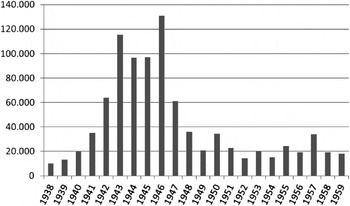
Figure 3 shows the evolution of manufactured exports during the post-war period. After reaching a new record in 1946, the downward trend became more pronounced. By 1948 industrial exports represented 2.2 per cent of the total value of Argentine exports, a similar percentage to the pre-war level. At the beginning of the 1950s the Korean War brought about a recovery with the sale of some textile products, but exports fell shortly afterwards and remained low until the end of the 1960s.
Manufactured Exports, 1938–59 (US$ Million)

The fall in exports of manufactures was the result of a number of causes that carried different weight in the two periods separated by the crisis of 1949. In the immediate post-war years, sales dropped due to the renewal of competition from industrialised countries and, locally, to the application of an anti-inflationary policy aimed at satisfying domestic demand by establishing maximum prices, compulsory permits, quotas and prohibitions. The export control policy had been introduced by Castillo in 1942, but it became more forceful during Perón's government. The fixing of quotas had negative effects given that, as the Cámara de Exportadores (Chamber of Exporters) stated, their reduced number and the official practice of allocating them among several companies made it impossible to comply with foreign orders.Footnote 73 When, towards the end of 1946, it was observed that industrial exports would reach a new record, the Central Bank repealed the preferential exchange rate for several products: textiles, leather shoes and industrial machinery, among others. Their price consequently increased by 18 per cent, affecting competitiveness.Footnote 74 Some of the reasons for these measures were the rise in prices, the black market and the failure of the policy that fixed maximum prices in agreement with business leaders.
Other reasons, of a structural nature, played a more important role in the decline of exports after 1949: the trend towards exchange rate appreciation, the technological obsolescence of Argentine industry and an increase in production costs.
The exchange rate lag was one of the most important features of the Peronist economy. A fixed exchange rate together with rising domestic inflation resulted in a tendency towards overvaluation. According to Díaz Alejandro, between 1947 and 1955 the real export exchange rate appreciated by 36 per cent, while the import exchange rate rose 43 per cent.Footnote 75 The lag in the exchange rate meant a loss of competitiveness for Argentine products by about the same percentage.
Currency appreciation was the other side of industrialisation policy, which was based on income redistribution from the primary export sector to industry and the urban economy.Footnote 76 On the one hand, the exchange rate lag and the state monopoly on exports delinked the domestic prices of primary products, which were also wage goods, from the world market. During the years in which world prices of grain and meat increased, this policy allowed the state to capture part of the extraordinary income and, at the same time, to improve real wages by keeping the price of wage goods low. On the other hand, industry benefited from a low exchange rate which made the import of machinery and inputs cheaper. Producers in the pampa were the worst hit, as their income fell at a time in which they had to invest in machinery and plant. Exporting industries also suffered the effects of the lag and although incentives were offered, they were not enough.
After 1955, a trend towards the depreciation of the real exchange rate started. The strong devaluation of 1955 was unable to increase production from the pampa. Even though it was claimed that industry would have greater possibilities to export, it did not respond to the exchange rate stimulus.Footnote 77 What really happened was that the devaluation increased inflation and the wage–price spiral. Over the following years the trend continued due to the elimination of export taxes and the maintenance of the free market. In December 1958, faced with a new balance of payments crisis, Frondizi devalued the peso and liberalised the foreign exchange market in the framework of a stabilisation policy agreed with the International Monetary Fund in order to attract foreign investment. And although the depreciation of the exchange rate got worse, exports did not increase. The sharp swings of the real exchange rate started to become an inconvenience which, as they became riskier, could hamper rather than encourage industrial exports.
A second problem industry faced was the renewal of production equipment which had suffered excessive wear and tear during the war. The issue became one of the key demands of business leaders, and the government gave it considerable attention. Estimates of the investments necessary agreed that the replacement and expansion of machinery would call for extraordinary imports, given that during the 1930s investments had been of little significance.Footnote 78 It was understood that the foreign currency accumulated during the war, which amounted to about US$ 1.7 billion in 1946, should be used preferentially to this effect. For business leaders these purchases were indispensable to ensure the competitiveness of industry at a time when imports were resuming, but were ‘also a chance for the young national industry to export’.Footnote 79 Perón's administration stimulated the purchases by granting favourable exchange rates and fixing compulsory permits to avoid the entry of second-hand machinery. Machinery imports were strong, especially from the United States, and they represented 16 per cent of total imports between 1948 and 1950.Footnote 80
After 1950, however, due to the contraction of the capacity to import, the foreign currency available had to be used to purchase fuel and supplies essential to economic activity, and the purchase of industrial machinery slowed down.Footnote 81 The Argentine capital goods industry could offer some machinery, especially for the textiles sector, but at a higher price.Footnote 82 Business leaders demanded a solution to this problem, but the external imbalance imposed strict limits. The Central Bank authorised purchases by deferred payment from countries with trade agreements, which amounted to a total debt of US$ 295 million in 1955. In 1953 the government passed the Ley de Inversiones Extranjeras (Law on Foreign Investment), which allowed companies based in the country, whether Argentine or foreign, to invest in machinery only if they could prove the non-Argentine origin of the capital. However, the inclusion of limits to profit remittances and other regulations encouraged an inflow of only US$ 12 million. In brief, the rate of industrial capitalisation, although higher than in other sectors, was not what manufacturing industry needed to renew its equipment.
A third problem was the high cost of production. Wages and other labour costs increased considerably and at the same time became independent of the evolution of productivity. Labour-intensive industries such as the textile, clothing and leather industries, which showed a slower increase in labour productivity, were negatively affected.Footnote 83 The problem was tackled by the Peronist government, the Confederación General Económica (General Business Confederation, CGE) and the Confederación General del Trabajo (General Confederation of Labour, CGT) at the Congreso de la Productividad (Productivity Congress) in March 1955. Even though the corporaciones reached an agreement to eliminate some of the obstacles that existed in labour agreements, the measures were not applied in the last months of Perón's government.Footnote 84
Business leaders thus found themselves at a dead end. Due to the shortage of foreign currency, they could not import new equipment, while the power wielded by the workers in the factories and workshops, through the comisiones internas, established limits on the reorganisation of production, rationalisation and the application of productivity incentives.
At the same time, the lack of competition from imported products due to the shortage of foreign currency allowed many companies to continue operating in spite of their high costs, but it also discouraged businessmen from reducing costs and improving their products. The possibilities of increasing productivity by making better use of existing machinery and improvements to the design of factories were well known in the 1950s, but apparently they did not arouse businessmen's attention.Footnote 85
Last but not least, promotion policies for manufactured exports were limited mostly to the use of special exchange rates. Other aspects of the export business were not taken into account. Thus, for example, until 1963 the state banks did not grant loans specifically aimed at financing industrial exports.Footnote 86 Companies had to assume the financial cost of sales; coverage against export risks and foreign currency risks, to avoid the effects of exchange rate fluctuations, was not implemented either. These deficiencies reveal that ultimately the government had little faith in the possibilities of industrial exports.
All these factors together provide an insight into the difficulties that industrial exports faced and help to explain their stagnation during the 1950s.
The Argentine experience in Latin America
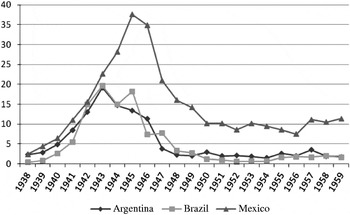
The contraction of industrial exports during the post-war period was not limited to Argentina. Figure 4 shows that industrial exports in Argentina, Brazil and Mexico behaved similarly during the post-war era, in particular in Argentina and Brazil, which traded actively with other South American countries. The experience in Mexico seems to have been more important, but the fall in traditional exports must be noted. In any case, the decline during the post-war period was much the same.
Argentine, Brazilian and Mexican Industrial Exports, 1938–59 (% of Total Exports)

The principal Brazilian and Mexican exports were cotton textiles. In Brazil, the renewal of British competition and the implementation of some import controls affected sales to the Argentine market, which was the principal destination for its textile exports; Brazil would soon lose that market.Footnote 87 At the beginning of the 1950s the textile industry in Brazil was working at lower levels than during the war. In 1951 it exported only 10 per cent of the volume that it had in 1947, which was the year of greatest sales. In Mexico the sale of yarn and fabric reached a record of 15,000 tons in 1945, which represented 20 per cent of national production and of the total value of exports.Footnote 88 In those days it was thought that due to its high costs the industry would face strong foreign competition in its own market as well as in foreign ones.Footnote 89 During the post-war period, the Mexican textile industry lost its foreign markets in the United States and Central America; in 1950, it operated at under half its installed capacity. This loss was a very negative factor, since official policies did not stimulate the growth of domestic demand.Footnote 90
In comparison with these cases, the Argentine textile industry's performance was positive because, at the onset of the post-war period, the degree of import substitution was lower, and especially because of the stimulus arising from domestic demand. Between 1937–9 and 1948–50, the industry continued growing at an average yearly rate of 9 per cent.Footnote 91 At the beginning of the 1950s, however, an acute textile crisis broke out. Although a cycle of recovery started around 1953, the boost provided by the domestic market seemed to be over. It was time to move towards foreign markets, but the world situation was complex – the Latin American markets were protected, and competition was arising from South-East Asian countries, which had the advantage of cheap labour.
During the 1950s Argentine industrial exports continued to be stagnant, representing a very low percentage of the export trade. Somewhat similar were the cases of Brazil and Mexico, where industrial exports were discouraged due to high costs and currency overvaluation, but the process was more dramatic in Argentina, as industrialisation stumbled into the limitations imposed by a supply of currency that was derived exclusively from the primary sector and did not exceed US$ 1 billion a year.Footnote 92 This shortage of foreign currency restricted the import of equipment and supplies, hindering industrial expansion. Official policies were unable to bring down these barriers and encourage a structural change. On the other hand, in the 1950s Brazil and Mexico speeded up growth in the sector, with annual rates of 9 per cent and 6 per cent respectively, and advanced in developing basic industries. Besides, even though these economies also suffered balance of payments crises, the boosting of their import capacity, through the increase in and diversification of primary exports or, as in the case of Mexico, with capital stemming from tourism, allowed them to have a more regular supply of imported equipment and inputs.
Conclusions
Argentine industry was born under the shelter of protectionism and grew, with the exception of the meat industry and a few other activities, on the basis of the domestic market. After the 1929 crisis, ISI speeded up and the industrial sector became the driving force of the economy, but the initial features of this sector – its low level of competitiveness and orientation towards the domestic market – became more pronounced.
The Second World War and the economic upheavals that resulted from it encouraged an export movement which acquired great intensity until the end of the 1940s. This expansion was possible because of very special circumstances which could not last: the displacement of trade flows and the industrialised countries' withdrawal of the supply of manufactures. Argentine industry took good advantage of these conditions, to a great extent due to the advances in industrial development of the previous decades. The process was extremely intense and framed within the emergence of some agencies aimed at promoting exports, such as the CPI, and a few specific measures of industrial policy.
As this essay has argued, contemporaries observed the future of Argentine industrial exports with a certain degree of pessimism. The reports released by the ARF disclosed the problems that Argentine products faced in the external market and which were not limited to the cost of production. They included a lack of stable supplies, poor standardisation and uniformity, an absence of minimum quality standards and a technical lag in industrial production, even in those industries which had the advantage of cheap and plentiful raw materials, such as leather goods, dairy products and some chemicals. In his recommendations on the profile of industry for the post-war period, Hopkins held that few industries would be able to face the renewal of external competition.
This outlook, which was shared by business leaders and public policy-makers, questions the hypothesis that in the mid-1940s Argentine industry faced two alternative paths: one linked to a greater export specialisation and the other aimed at the domestic market. Moreover, the characteristics of the growth in exports led to the conclusion that the problems of Argentine–US trade would continue to be influential. It is clear that the most natural destination seemed to be neighbouring countries and not, as the historiography has stressed, the United States. The alternative of strengthening a commercial alliance between Argentina and the United States to replace the weakened link with the United Kingdom was hardly viable. Even when referring to manufactured goods, evidence here shows that the English and South African markets were as important a destination for Argentine exports as the US market during the war.
The low level of industrial competitiveness and the growing obsolescence of equipment reinforced the role of state aid to the sector. A new generation of economists and engineers, especially the followers of Alejandro Bunge, favoured industrialisation as a path of development. Industrialisation would promote primary production, create employment, strengthen the domestic market and limit the vulnerability of the economy vis-à-vis external crises. Nonetheless, the industrialists believed that, before beginning a new stage of developing the iron and steel and basic chemical industries, Argentine industry should consolidate the positions attained during the war. These concepts were taken up again by Peronism, which implemented some explicit measures to help the sector. Peronist policies of the immediate post-war years did not include autarky as a model; in fact, domestic industry had to compete with imported products. Only after 1950 were imports cut back as a consequence of the external crisis. On the other hand, the Five-Year Plan included a few export industries in its objectives – curiously, the same ones that the CPI reports had identified.
Income redistribution and Peronist economic policies increased domestic demand and spurred the growth of the industrial sector, but the industrial boom of the post-war period was based on weak foundations: stagnant agricultural production in the pampa and exceptionally high world prices for primary products, which could not last for long. After 1949 the fall in export production and the decline of world prices, a trend that would extend for more than ten years, imposed strict limits on economic policies and forced Perón to review his position. The balance of payments crises that would characterise many Latin American economies were suffered earlier and more severely by the Argentine economy. It was these factors, rather than the early exhaustion of the domestic market, which placed barriers on industrial growth and development.
The Peronist government tried to resolve these serious problems. Together with the revision of policies on agricultural prices, Perón encouraged industrial exports through exchange rate incentives and bilateral agreements, but these instruments were not effective in solving the external problem and diversifying exports. Not even the devaluation of 1955 could improve the prospects for exports; indeed, an array of structural factors – technological lag, low productivity and high production costs – limited competitiveness and became a considerable obstacle. These problems were hard to solve at a time of foreign currency shortages that made importing of equipment and inputs difficult and created a condition of indiscriminate protection. Moreover, trade policies were limited to offering exchange rate incentives and did not deal with other key issues in order to foster a stable exporting situation, such as credit, transport facilities and the risk of currency variations. It is not surprising, then, that export pessimism should have coloured all discussions regarding the country's economic development and industrialisation. Given the fact that industrial growth and the economy remained dependent on the supply of foreign currency produced by farming in the pampa, very soon the proposal that integrated industrialisation should be stimulated, now supported by ECLA, gained strength in Argentina.