Implications
Weaning, that is, separation of the piglets from the sow after the lactation period, often results in poor piglet performance. This study suggests that the housing conditions of piglets before weaning can affect their intestinal function after weaning. Piglets were raised either in a conventional system with an individually housed sow or in a more complex multi-suckling (MS) system, in which a group of five sows and their piglets could interact in a more physically enriched and spacious environment. As such, an MS system may contribute to improved welfare of piglets around weaning.
Introduction
At weaning in conventional pig farming, piglets are removed from the sow at 3 to 4 weeks of age, and consequently have to switch from ingesting mainly sow milk, with fat and lactose as major energy sources (Hurley, Reference Hurley2015), to eating solid feed which contains more complex carbohydrates. This abrupt dietary switch, in combination with other stressors such as changes in the piglets’ social and physical environment, generally results in a low post-weaning feed intake (Vente-Spreeuwenberg and Beynen, Reference Vente-Spreeuwenberg and Beynen2003), with fasting periods up to 4 days in some piglets (Bruininx et al., Reference Bruininx, Van Der Peet-Schwering, Schrama, Vereijken, Vesseur, Everts, Den Hartog and Beynen2001). The lack of nutrients in the intestinal lumen leads to changes in intestinal morphology, such as a reduced villus height, an increased crypt depth and an increased paracellular permeability (Hampson, Reference Hampson1986; van Beers-Schreurs et al., Reference van Beers-Schreurs, Nabuurs, Vellenga, Kalsbeek-van der Valk, Wensing and Breukink1998; Spreeuwenberg et al., Reference Spreeuwenberg, Verdonk, Gaskins and Verstegen2001; Hu et al., Reference Hu, Xiao, Luan and Song2013). The latter can contribute to an impaired intestinal barrier function after weaning, facilitating bacteria and toxins to cross the epithelial barrier (Vente-Spreeuwenberg and Beynen, Reference Vente-Spreeuwenberg and Beynen2003; Heo et al., Reference Heo, Opapeju, Pluske, Kim, Hampson and Nyachoti2013). Taken together, the post-weaning intestinal capacity to digest and absorb nutrients is suboptimal and the protective barrier function of the gut is compromised in conventionally weaned piglets (Wijtten et al., Reference Wijtten, van der Meulen and Verstegen2011; Heo et al., Reference Heo, Opapeju, Pluske, Kim, Hampson and Nyachoti2013). This contributes to their poor post-weaning performance, which is characterised by, for example, a growth check and the occurrence of diarrhoea (Pluske et al., Reference Pluske, Hampson and Williams1997).
To ease the transition from the milk-based diet in the suckling phase to the post-weaning diet, it is important to stimulate pre-weaning feed intake (Bruininx et al., Reference Bruininx, Binnendijk, Van Der Peet-Schwering, Schrama, Den Hartog, Everts and Beynen2002; Berkeveld et al., Reference Berkeveld, Langendijk, van Beers-Schreurs, Koets, Taverne and Verheijden2007). Piglets offered creep feed during lactation (Meyer, Reference Meyer2008) and/or characterised as pre-weaning ‘eaters’ (Sulabo et al., Reference Sulabo, Jacela, Tokach, Dritz, Goodband, Derouchey and Nelssen2010) showed a better post-weaning performance. Moreover, creep feeding during lactation increased net absorption in the small intestine after weaning (Kuller et al., Reference Kuller, van Beers-Schreurs, Soede, Langendijk, Taverne, Kemp and Verheijden2007), suggesting that early experience with solid feed increases piglets’ capacity to cope with the dietary switch after weaning. In a previous experiment (van Nieuwamerongen et al., Reference van Nieuwamerongen, Soede, van der Peet-Schwering, Kemp and Bolhuis2015), we found that piglets raised in a multi-litter system showed an improved early post-weaning performance compared with conventionally kept piglets, which was reflected in a higher feed intake, higher weight gain and indicators of a lower diarrhoea occurrence. The pre-weaning environment in the multi-litter system was likely an important contributing factor, as there were ample opportunities for social facilitation and social learning of eating (Nicol and Pope, Reference Nicol and Pope1994; Morgan et al., Reference Morgan, Lawrence, Chirnside and Deans2001; Oostindjer et al., Reference Oostindjer, Bolhuis, Mendl, Held, van den Brand and Kemp2011) in the communal feeding area, and the presence of enrichment materials may have stimulated the development of chewing and eating behaviour (Oostindjer et al., Reference Oostindjer, Bolhuis, Mendl, Held, van den Brand and Kemp2014). Post-weaning housing, however, also differed between both treatment groups in our previous work, hence the relative contribution of pre-weaning and post-weaning conditions regarding post-weaning performance could not be distinguished. Moreover, it was not known to what extent a difference in intestinal function may have contributed to the observed differences. Therefore, the aim of the current study was to clarify the impact of these pre-weaning housing conditions (i.e. a multi-suckling system v. individual pens with crated sows) on peri-weaning performance and measures of intestinal function, that is, absorption capacity of two different sugars (mannitol and galactose) under equal post-weaning housing conditions. This was studied in relatively light and relatively heavy piglets, as these may differ in their response to pre-weaning conditions (Meyer, Reference Meyer2008). We hypothesised that piglets from an MS system would show improved post-weaning performance and a higher carbohydrate absorption capacity.
Material and methods
Animals and experimental design
The experiment was approved by the Animal Care and Use Committee of Wageningen University (AVD10400201551, registration code 2015024.c). In total, 64 piglets (Tempo×Topigs 20) from 16 litters were studied in two successive batches. Before weaning, piglets were housed at the animal facilities of Swine Innovation Centre Sterksel, the Netherlands, either in an MS system consisting of five sows and their litters or with a sow in a conventional farrowing crate (FC). All sows were multiparous and allocation of the sows to the pre-weaning housing treatments was balanced for parity. Per batch and per housing system, four healthy litter-mates from four litters were selected to participate in this study. Per litter, these selected piglets consisted of one light and one heavy piglet from both sexes. Selection took place based on BW 6 days before weaning (day −6). In principle, the lightest and heaviest piglet from both sexes was selected, with the exception of outliers considering the lightest piglets. In addition, when comparing the selected animals with the intact group, a similar relative weight difference was strived for per pre-weaning housing treatment. Before selection, mean litter weights at day −6 were 6.39±0.30 kg in the MS system and 6.16±0.34 kg in the FC system. Mean BW of the selected piglets was 7.53±0.23 kg for the ‘heavy’ MS piglets, 5.57±0.23 kg for the ‘light’ MS piglets, 7.34±0.23 kg for the ‘heavy’ FC piglets and 5.44±0.20 kg for the ‘light’ FC piglets. After weaning at 27.1±0.4 days of age, the piglets were transported to the research facility ‘Carus’ of Wageningen University & Research, the Netherlands. Post-weaning housing conditions were the same for all piglets.
General pre-weaning management
Piglets were ear tagged and weighed within 24 h postpartum (p.p.). Litter sizes were standardised between 24 and 48 h p.p. according to the number of functional teats available per sow. Piglets were tail docked and received an iron injection (1 ml Uniferon; Pharmacosmos, Holbaek, Denmark) within 4 days after birth. Male piglets were not castrated. Pre-starter creep feed (11.6 MJ of net energy (NE), 17.5% CP and 1.17% ileal digestible lysine) was provided to the piglets in round feeders (diameter 28 cm) twice daily from 12 days after the expected date of birth. On days 21 and 22 pre-starter was gradually mixed with weaner feed (9.9 MJ of NE, 16.0% CP and 0.99% ileal digestible lysine), after which only weaner feed was provided. Water was available ad libitum and animal health was checked twice daily. Litter size at weaning was 10.5±0.5 in the MS system and 12.6±0.5 in the FC system (P=0.14). Litter sizes at weaning were (numerically) lower due to higher mortality in the MS system, despite peri-natal litter equalisation due to cross-fostering.
Pre-weaning housing
Multi-suckling system
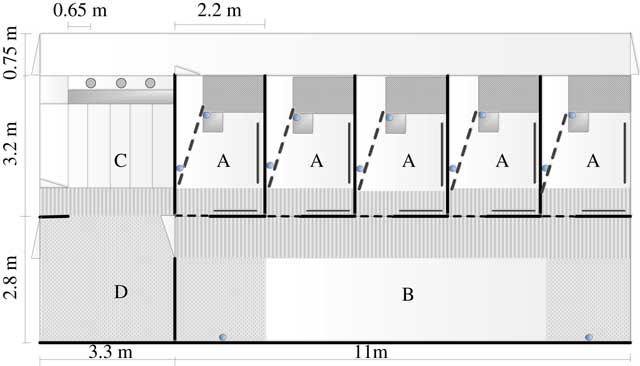
Multi-suckling housing consisted of five farrowing pens connected to a communal area (Figure 1). Sows could access all areas from the moment of entry in the system. The farrowing pens were 3.2×2.2 m each and contained a feed trough for the sow, a water nipple for the piglets and a covered piglet nest of 0.7×1.6 m with heated solid flooring. The floor in the rest of the pen consisted of solid concrete and concrete slats. Per farrowing pen, five hessian sacks were provided as nesting material. From day 2 p.p., two handfuls of long-stemmed straw were provided daily per pen. The adjacent communal area was divided in an area for feeding (solid concrete and metal slats), defecating/urinating (metal slats) and lying (solid concrete and metal slats). Five hessian sacks and five ropes were attached to the partitions surrounding the resting area and were replaced if needed. The communal feeding area contained five feeding places for the sows separated by horizontal metal bars, and a surrounding area with piglet feeders accessible to only the piglets. Each individual sow was locked in her own farrowing pen daily between 1630 and 0730 h until farrowing of that particular sow had ended. From that moment onwards, each sow could freely access all farrowing pens and communal areas again. Piglets were given access to the whole system at a mean age of 7.9±0.3 days. This was achieved by removing a 31-cm high piglet barrier at the entrance from each farrowing pen. In addition, a ‘piglet door’ (0.4×0.3 m) was removed from the front wall of each farrowing pen, to provide piglets more space to move in and out of the farrowing pens. The sows were floor fed twice daily in the communal area and piglets could eat together with the sows from the sow feed and from creep feed provided in the piglet feeders. Sows were fed in their own farrowing pen only in the afternoons before farrowing and in the first days after farrowing in case the sows did not leave their pen to eat in the communal area. Otherwise, they were fed in the communal area.
Layout of the multi-suckling system. The system has five farrowing pens (A. with a piglet nest, sow feeder, drinkers and anti-crushing devices) connected to a communal area with a lying area (B. with two drinkers), feeding area (C. with five sow feeding places surrounded by a piglet area with piglet feeders) and a dunging area D.

Conventional system
Each FC litter was kept in a pen of 2.4×1.8 m, which contained a farrowing crate of 2.0×0.7 m for the sow. The pens were situated in farrowing units containing 12 pens each. The floor consisted of metal slats within the crate, a solid floor of 1.2×0.3 m with a heat lamp for the piglets and plastic slats in the remaining area. The sow had a feed trough and a drinking nipple available. The piglets had access to a separate drinking nipple and creep feed was provided in a round feeder located in the corner at the posterior side of the sow. One day before expected farrowing, sows received a hessian sack as nesting material. During the whole pre-weaning period, a plastic roll was available for both sow and piglets and a chain with a wooden block was available as enrichment for the sow.
Post-weaning housing
After weaning, 32 piglets per batch were transported (for about 1.5 h) to their new housing facilities. During transport, the 16 MS piglets were penned in one group, whereas the 16 FC piglets were penned in groups of four litter-mates. After arrival, MS and FC litters were equally divided over two adjacent rooms, where the four pens in one room were filled alternatingly with piglets from MS and FC litters. Each pen (2.7×3.6 m) housed four litter-mates and was bedded with 550 l of sawdust, 10 kg of straw and 90 l of peat on a solid floor. A physically enriched post-weaning environment was provided, as experiencing a reduction in the level of environmental enrichment may be detrimental (see e.g. Bolhuis et al., Reference Bolhuis, Schouten, Schrama and Wiegant2006; Munsterhjelm et al., Reference Munsterhjelm, Peltoniemi, Heinonen, Hälli, Karhapää and Valros2009), which would occur if the MS piglets would be housed under more conventional conditions. On a daily basis, soiled bedding was removed from the pens and 70 l of fresh sawdust and 1 kg of straw was added. Fresh peat was added on a weekly basis (45 l). A hessian sack, a rope and a chain with bolts were available as further enrichment. The same weaner feed that was provided in the late pre-weaning phase was offered ad libitum in a feeder with four eating places. Water was continuously available from a drinking nipple. Animal health was checked twice daily.
Measurements
Piglets were weighed on days −6, −1, 2, 5 and 13 post-weaning. Post-weaning feed intake at pen level was determined for days 0 to 2, 2 to 5 and 5 to 13. A faecal consistency score was given to all piglets on days −1, 2, 5, 7 and 9 post-weaning by means of visual inspection of the anal area of each piglet. Scoring was done either in the pen or during routine handling such as weighing. Lifting piglets was avoided if not needed. A score of 0 was given if no faeces was present, score 1 if pasty faeces was present and score 2 if watery faeces was present. Furthermore, piglets were subjected to a sugar absorption test using a protocol based on Turpin et al. (Reference Turpin, Langendijk, Chen and Pluske2016) on day 5 before weaning and day 5 after weaning. Piglets were fasted for 3 h, during which they had access to drinking water but not to solid feed or milk. Before weaning, piglets were fasted by relocating the four litter-mates to an empty pen in a different unit. After weaning, piglets were fasted by removing the feeders from the pens. After the fasting period, each piglet was fixated in a vertical position with the nose pointing upward. Then, a nasogastric tube lubricated with paraffin oil was inserted in the stomach via the nose, after which physiological saline was administered. Thereafter, a sugar solution was administered. On day 5 before weaning, all piglets received 5 ml/kg BW of 10% mannitol. On day 5 after weaning, half of the piglets (balanced for pre-weaning housing system, weight class and sex) received 5 ml/kg BW of 10% galactose and the other half received 5 ml/kg BW of 10% mannitol. Galactose was administered only after weaning because of the presence of galactose in milk. Thereafter, the piglet was placed back with its litter-mates. Twenty min after administration of the sugar solution, the piglet was fixated in a supine position by two persons and a 4-ml blood sample was collected in a heparin tube by puncture of the jugular vein. The sample was stored on ice (maximum 1 h) until further processing. When the four piglets of one litter had been blood sampled, they were placed back in their home pen (before weaning) or the feeder was placed back in their pen (after weaning). Samples were centrifuged for 10 min at 1300×g at 4°C and plasma was stored at −20°C until analysis. Mannitol concentrations were determined using a commercial colorimetric assay kit (Abcam, ab155890, Cambridge, England, UK). d-mannitol was converted to d-fructose by mannitol dehydrogenase in the presence of NAD to form NADH, which reduces a colourless probe to a chromogen with strong absorbance at 450 nm. Galactose concentrations were determined using a commercial assay kit (Abcam, ab83382) in which galactose is specifically oxidised generating a product that produces colour (OD 570 nm). For both sugars, concentrations were calculated using their corresponding standard curve, in accordance with the manufacturer’s instructions.
Statistical analysis
Data were analysed with SAS 9.2 (SAS Institute Inc., Cary, NC, USA). Residuals were checked for normality; post-weaning mannitol concentrations were log-transformed and feed intake between days 2 and 5 was square root transformed. Body weight gain, sugar concentrations and the number of days piglets had pasty or watery faeces were analysed with mixed models including pre-weaning housing system, weight class, housing×weight class interaction, and batch. Pen within housing treatment was included as a random effect, as measures on pigs from the same litter and pen may not be independent.
Feed intake and feed conversion ratio were determined at pen level and were analysed with mixed models including pre-weaning housing system and batch. One FC pen in the second batch was excluded from analysis of feed intake and feed conversion ratio because piglets in this pen had a poor start after weaning with severe diarrhoea and therefore received liquid feed supplementation. BW was analysed with a mixed model including pre-weaning housing system, day post-weaning, weight class, their two-way and three-way interactions, and batch. Pen (within housing treatment and batch) was included as a random effect. Repeated observations on the same animals were taken into account by including a repeated effect of piglet (within pen, housing treatment and weight class). The proportion of piglets with pasty or watery faeces was analysed with generalised linear mixed models (proc glimmix) models using a binary distribution and logit link function, including pre-weaning housing system, weight class, housing×weight class interaction and batch. Pen within housing treatment was included as a random effect. Average faecal consistency scores were analysed with mixed models including pre-weaning housing system, day post-weaning, weight class, their two-way and three-way interactions, and batch. Pen (within housing treatment and batch) was included as a random effect. Repeated observations on the same animals were taken into account by including a repeated effect of piglet (within pen, housing treatment, and weight class). Sex did not affect any of the variables tested and was therefore removed from the final models. In case of significant housing×weight class interaction effects, post hoc comparisons were made using the least square differences. Results are presented as (untransformed) lsmeans±SEM. P-values <0.05 were considered statistically significant.
Results
BW, feed intake and faecal consistency scores
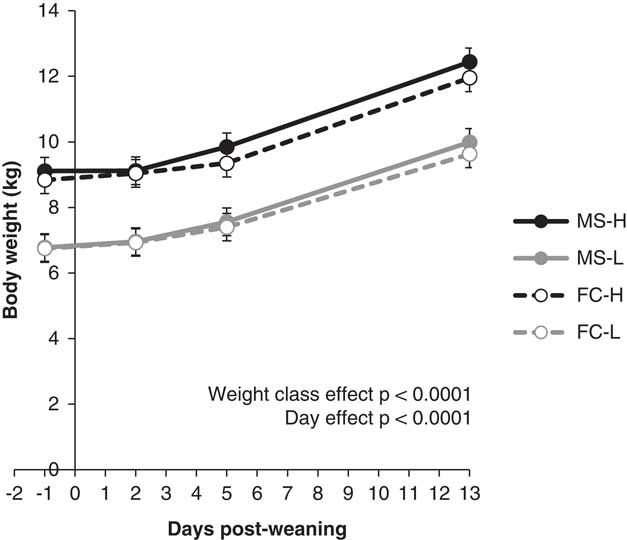
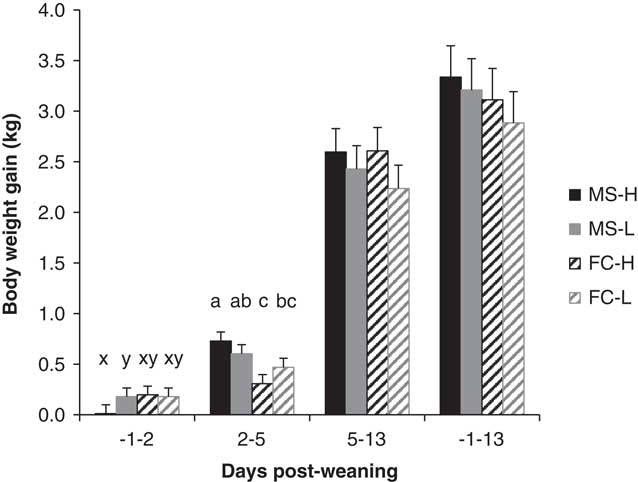
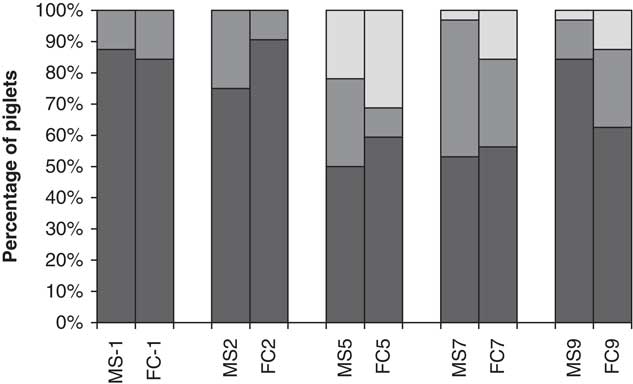
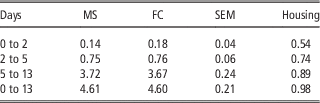
Pre-weaning housing (P=0.66), housing×weight class interaction (P=0.35), housing×day interaction (P=0.55), weight class×day interaction (P=0.77) and housing×weight class×day interaction (P=0.96) did not affect post-weaning BW (Figure 2). ‘Heavy’ piglets, however, had a higher BW than ‘light’ piglets on all days measured and BW increased over time (Figure 2). Between days −1 and 2, ‘heavy’ MS piglets tended to have a lower weight gain than ‘light’ MS piglets (P=0.09 for the interaction between pre-weaning housing and weight class, see Figure 3). Between days 2 and 5, weight gain was higher for MS piglets compared with FC piglets (0.67 v. 0.39 kg, SEM=0.07, P=0.02). This difference, however, seemed to hold mainly for piglets in the ‘heavy’ weight class; ‘heavy’ MS piglets gained more weight than both ‘heavy’ and ‘light’ FC piglets, and ‘heavy’ FC piglets gained less than both ‘heavy’ and ‘light’ MS piglets (P=0.04 for the interaction between pre-weaning housing and weight class, see Figure 3). When weight class was excluded from the statistical model, the housing effect remained significant (P=0.02). Pre-weaning housing, weight class and their interaction did not affect weight gain between days 5 and 13 and days −1 and 13 (Figure 3). Mean overall weight gain between days −1 and 13 was 3.27 kgperMS piglet and 3.00 kgperFC piglet, SEM=0.27. Feed intake between days 0 to 2, 2 to 5, 5 to 13 and 0 to 13 did not differ between pre-weaning housing treatments (Table 1) and neither did feed conversion between days 0 and 13 (MS: 1.43, FC: 1.46, SEM=0.10, P=0.86). Between days 2 and 5 post-weaning, feed conversion was lower in MS piglets than in FC piglets (1.34 v. 1.83, SEM=0.14, P=0.02). Lastly, pre-weaning housing, weight class and their interaction did not affect faecal consistency scores on any of the days measured (Figure 4), number of days with pasty or watery faeces (MS heavy piglets: 1.56; MS light: 1.44; FC heavy: 1.56; FC light: 1.38, SEM=0.31) or number of days with watery faeces (MS heavy piglets: 0.25; MS light: 0.31; FC heavy: 0.69; FC light: 0.50, SEM=0.19).
Body weight (kg) relative to the day of weaning (=day 0) of piglets raised in a multi-suckling (MS) system and piglets raised with a sow in a farrowing crate (FC) per weight class determined on day −6. H=heavy; L=light.

Body weight gain relative to the day of weaning (=day 0) of piglets raised in a multi-suckling (MS) system and piglets raised with a sow in a farrowing crate (FC) per weight class determined on day −6. H=heavy; L=light. a,b,cValues without a common letter differ at a significance level of P<0.05.x,yValues without a common letter differ at a significance level of P<0.10.

Faecal consistency scores on days −1, 2, 5, 7 and 9 post-weaning for piglets raised in a multi-suckling (MS) system and piglets raised with a sow in a farrowing crate (FC). A faecal consistency score was given by means of visual inspection of the anal area of each piglet. A score of 0 was given if no faeces was present ( ), score 1 if pasty faeces was present (
 ) and score 2 if watery faeces was present (
 ).

Feed intake per piglet (kg) relative to the day of weaning (=day 0) of piglets raised in a multi-suckling (MS) system and piglets raised with a sow in a farrowing crate (FC)

P-values are given for effects of pre-weaning housing.
Sugar absorption test
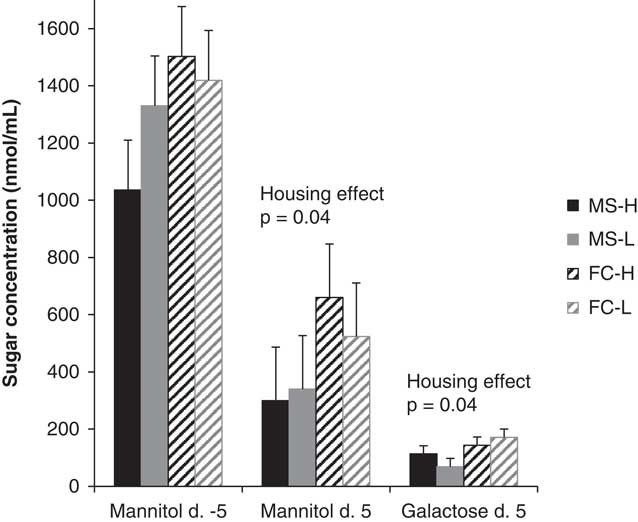
Pre-weaning mannitol concentrations 20 min after oral administration on day −5 were not affected by pre-weaning housing, weight class or their interaction (Figure 5). On day 5 post-weaning MS piglets had a lower plasma concentration of mannitol (320 v. 592 nmol/ml, SEM=132, P=0.04) and galactose (91 v. 157 nmol/ml, SEM=20, P=0.04) than FC piglets. When the FC pen that had a poor start after weaning was excluded from analysis, the housing effect on galactose remained significant, but that on mannitol became a tendency (320 v. 496 nmol/ml, SEM=117, P=0.07). Post-weaning sugar concentrations were unaffected by weight class and housing×weight class interaction (Figure 5).
Plasma sugar concentrations 20 min after oral administration, relative to the day of weaning (=day 0), of piglets raised in a multi-suckling (MS) system and piglets raised with a sow in a farrowing crate (FC) per weight class determined on day −6. H=heavy; L=light.

Discussion
Our study aimed to gain more insight in the impact of pre-weaning housing conditions on peri-weaning performance, including measures of intestinal function. Pre-weaning housing consisted of either an MS system or individual pens with crated sows, and post-weaning conditions consisted of an enriched environment that was equal for all piglets. Over the whole 2-week period after weaning studied, faecal consistency scores, feed intake, BW and weight gain were similar in piglets from both pre-weaning housing treatments. Between days 2 and 5 post-weaning, however, the MS piglets had a 72% higher weight gain than the FC piglets. This is consistent with a previous study (van Nieuwamerongen et al., Reference van Nieuwamerongen, Soede, van der Peet-Schwering, Kemp and Bolhuis2015). The difference in weight gain between MS and FC piglets, whilst having a similar feed intake, suggests a different efficiency of digestion and absorption of nutrients. Between days 2 and 5 post-weaning, feed conversion was lower in MS piglets than in FC piglets. Possibly, the use of the communal feeding area in the MS system played a role, where piglets were stimulated to start eating at an early age. Abrupt weaning at a relatively young age of 4 weeks, compared with the gradual weaning process seen in nature, forces the gastrointestinal tract into an accelerated maturation (Miller and Slade, Reference Miller and Slade2003). In a previous study we observed that MS piglets showed an almost threefold higher frequency of feed directed behaviour at 2 weeks of age than FC piglets (van Nieuwamerongen et al., Reference van Nieuwamerongen, Soede, van der Peet-Schwering, Kemp and Bolhuis2015). Possibly, the MS piglets in the current experiment also experienced earlier contact with solid feed before weaning due to social learning and facilitation, more gradually preparing the intestinal tract for digestion and absorption of solid feed.
Other post-weaning differences that were found in an earlier study (van Nieuwamerongen et al., Reference van Nieuwamerongen, Soede, van der Peet-Schwering, Kemp and Bolhuis2015) were not confirmed in the current study. In the previous study, piglets raised in an MS system showed a higher feed intake between days 0 and 2 post-weaning, a higher post-weaning weight gain, and more solid faecal consistency scores over the first 2 weeks after weaning. This discrepancy likely results from differences between both studies in post-weaning housing conditions, which made the transition from pre-weaning to post-weaning housing in the current study less favourable for the MS piglets than for the FC piglets. For the MS piglets, the large changes in group size, group composition and total available space at weaning may have contributed to their relatively poorer performance compared with the previous study. In this previous study, MS piglets were housed in groups of 40 after weaning, unlike the present study in which the MS group was split into small litter-mate groups after transport. For the FC piglets, on the other hand, the post-weaning pen was substantially more enriched and larger than their farrowing pen, making the transition more favourable than in the previous study (where FC piglets were housed groups of 10 litter-mates in a barren pen). Pigs’ performance in a particular housing environment depends on their previous experiences, with negative effects if the current environment is less enriched than the previous one (Bolhuis et al., Reference Bolhuis, Schouten, Schrama and Wiegant2006; Munsterhjelm et al., Reference Munsterhjelm, Peltoniemi, Heinonen, Hälli, Karhapää and Valros2009). The enriched post-weaning conditions in the current study, which are notably different from weaning under commercial conditions, may therefore have reduced both post-weaning problems and the contrast between MS and FC animals.
The relationship between coping with weaning and piglet weight is equivocal. On the one hand, it is suggested that heavy piglets are more mature and tend to have higher pre-weaning creep feed intake and higher pre- and post-weaning weight gain. On the other hand, light piglets may show more compensatory eating before weaning, making the transition to the post-weaning diet easier (Pajor et al., Reference Pajor, Fraser and Kramer1991). In our study, however, heavy FC piglets tended to lag behind in weight gain between days 2 and 5 compared with light and heavy MS piglets, suggesting that this putative effect of weight class may depend on pre-weaning experiences.
We used the absorption of mannitol and galactose as an indicator of gastrointestinal function. Considering the results of the sugar absorption test, mannitol absorption was lower after weaning as compared with pre-weaning levels. This is consistent with other studies (Berkeveld et al., Reference Berkeveld, Langendijk, Verheijden, Taverne, Van Nes, Van Haard and Koets2008; Turpin et al., Reference Turpin, Langendijk, Chen and Pluske2016). As such a decrease in mannitol absorption is absent in unweaned pigs, it has been attributed to the marked changes in gastrointestinal function due to weaning (Berkeveld et al., Reference Berkeveld, Langendijk, Verheijden, Taverne, Van Nes, Van Haard and Koets2008). Although decreased gut permeability has been suggested to be a natural maturation process enhanced by weaning (Wijtten et al., Reference Wijtten, van der Meulen and Verstegen2011), Berkeveld et al. (Reference Berkeveld, Langendijk, Verheijden, Taverne, Van Nes, Van Haard and Koets2008) reported a correlation between mannitol absorption and early post-weaning growth, suggesting a link between the post-weaning growth check and carbohydrate malabsorption. However, this does not provide a satisfactory explanation for the lower plasma concentrations of mannitol (−46%) on day 5 after weaning in MS piglets compared with FC piglets, as MS piglets seemed to perform better between days 2 and 5 in terms of feed utilisation. Mannitol both passes through the epithelial layer by paracellular transport (Krugliak et al., Reference Krugliak, Hollander, Schlaepfer, Nguyen and Ma1994), and is also absorbed via the transcellular route in vivo (Menard et al., Reference Menard, Cerf-Bensussan and Heyman2010). Where in vivo studies report a decrease in mannitol absorption after weaning, several in vitro studies have demonstrated an increased flux of mannitol via the paracellular route following weaning (Spreeuwenberg et al., Reference Spreeuwenberg, Verdonk, Gaskins and Verstegen2001; Boudry et al., Reference Boudry, Péron, Luron, Lallès and Sève2004), possibly as a result of short-term fasting (Carey et al., Reference Carey, Hayden and Tucker1994). Moeser et al. (Reference Moeser, Klok, Ryan, Wooten, Little, Cook and Blikslager2007) suggested that the increase in intestinal (paracellular) permeability of mannitol compared with unweaned controls may reflect intestinal barrier breakdown due to the weaning process. It can be speculated that the higher mannitol concentrations in FC piglets indicate higher intestinal permeability by paracellular transport, thus possibly reflecting a compromised intestinal barrier function (Vente-Spreeuwenberg and Beynen, Reference Vente-Spreeuwenberg and Beynen2003; Wijtten et al., Reference Wijtten, van der Meulen and Verstegen2011). Stress may play a role in impairing the barrier function, mediated by receptors for corticotrophin-releasing factor in the intestine (Moeser et al., Reference Moeser, Klok, Ryan, Wooten, Little, Cook and Blikslager2007). Nevertheless, we found no other indications of an impaired intestinal barrier function in the FC piglets (e.g. reflected in the faecal consistency scores).
Besides a difference in post-weaning mannitol concentrations, we also found, unexpectedly, lower levels of galactose after weaning in MS piglets compared with FC piglets (−42%). Galactose absorption occurs through active transport via the transcellular pathway using a Na+/galactose co-transporter. Active absorption may increase in response to weaning, possibly due to a fasting state, as a low availability of nutrients seems to upregulate active absorption in the proximal jejunum (Carey et al., Reference Carey, Hayden and Tucker1994; Boudry et al., Reference Boudry, Péron, Luron, Lallès and Sève2004). It should be noted, though, that active absorption may also increase due to the switch from a milk-based diet to a cereal-based diet (Boudry et al., Reference Boudry, Lallès, Malbert, Bobillier and Sève2002). As post-weaning feed intake did not differ between MS and FC piglets, it can be speculated that the suggested difference in onset of pre-weaning experience with solid feed (as found in our earlier work) may have affected post-weaning active nutrient absorption.
Overall, the interpretation of the results from the sugar absorption test is not straightforward as several mechanisms may play a role. Moreover, the relative contribution of each mechanism may differ before and after weaning. In addition, it should be noted that, in general, the found differences in this study may partly be explained by the numerically different litter size at weaning for MS and FC piglets. Piglet development can be affected by the level of competition at the udder, and relatively light piglets may for instance perform better in a small litter than in a large litter (English and Bilkei, Reference English and Bilkei2004). Nevertheless, there was no difference between the MS and FC piglets weaning weight before and after selection of piglets.
In conclusion, MS and FC piglets differed in aspects of gastrointestinal carbohydrate absorption, suggesting differences in gastrointestinal function, but pre-weaning housing did not affect overall feed intake, weight gain and measures of faecal consistency over the first 2 weeks after weaning. Between days 2 and 5, however, MS piglets showed a better feed utilisation, as they gained more weight whilst having a similar feed intake in this period, compared with FC piglets. Overall, this study suggests that pre-weaning housing conditions can affect measures of intestinal function after weaning, even with similar levels of post-weaning feed intake.
Acknowledgements
The authors gratefully acknowledge the staff of Swine Innovation Centre Sterksel and Research Facility Carus for their assistance and care for the animals. Furthermore, the authors want to thank Bjorge Laurenssen, Fleur Bartels, Rudie Koopmanschap, Monique Ooms, Caroline Clouard, Nick Timmermans, Sanne Benjamins, Jasmijn Strous and Hilde de Kok for their assistance during various parts of this experiment.