Introduction
Throughout the lifespan, women are more likely than men to report psychological distress: the lifetime prevalence of major depressive disorder and any anxiety disorder in women is 1.5 times that of men (Kessler et al., Reference Kessler, McGonagle, Swartz, Blazer and Nelson1993). This is true whether depression is indexed either as a diagnosed mental disorder or as subclinical symptoms (Nolen-Hoeksema, Reference Nolen-Hoeksema2001). This literature is well supported in young and middle-aged populations (Leach et al., Reference Leach, Christensen, Mackinnon, Windsor and Butterworth2008; Seedat et al., Reference Seedat2009), but among older adults some measure of uncertainty about the robustness of this finding emerges, particularly at more advanced ages. For example, while a number of researchers have reported that gender differences in depressive symptoms diminish with increasing age (Takkinen et al., Reference Takkinen, Gold, Pedersen, Malmberg, Nilsson and Rovine2004; van't Veer-Tazelaar et al., Reference van't Veer-Tazelaar2008), others have reported that such differences remain (Osborn et al., Reference Osborn2002; Zunzunegui et al., Reference Zunzunegui2007). For example, Barefoot et al. (Reference Barefoot, Mortensen, Helms, Avlund and Schroll2001), in a study of an advanced aged cohort (80+ years), found that gender differences in the report of depressive symptoms decreased as the cohort aged. In contrast, gender differences in anxiety symptoms have been reported as increasing with age (Fuentes and Cox, Reference Fuentes and Cox2000). Studies of gender differences in anxiety and depression in later life are important due to the high comorbidity of these conditions (Beattie and Pachana, Reference Beattie and Pachana2010).
Studies involving older cohorts may yield varying results for several reasons. The measures used, particularly for those aged over 70, may not have been designed specifically for use with older adults. A variety of authors have commented on the utility of using such age-appropriate measures (e.g. Kazniak, Reference Kazniak, Birren and Schaie1990); this is important in depression, where both symptom expression as well as reactions to assessment of said symptoms may differ in later life (Gonçalves et al., Reference Gonçalves, Albuquerque, Byrne and Pachana2009). In addition, the older cohorts included in many research studies span a variety of age ranges, and may encompass those younger than 65 years, or may not include many individuals over the age of 80; this limits what can be said about individuals at more advanced ages. Finally, studies may or may not control for potentially important intra-individual variables such as present cognitive status and poor general health, which has been associated with mental disorders (Costa et al., Reference Costa, Barreto, Uchoa, Firmo, Lima-Costa and Prince2007).
We report data comparing men and women on three separate measures of self-reported mental health functioning: the mental health subscale of the SF-36 (Ware, Reference Ware and Maruish1999), the Geriatric Anxiety Inventory (GAI) (Pachana et al., Reference Pachana, Byrne, Siddle, Koloski, Harley and Arnold2007), and the Patient Health Questionnaire (PHQ9) (Spitzer et al., Reference Spitzer, Kroenke and Williams1999). Our interest was in the degree of gender difference in the self-reporting of psychiatric distress in a relatively older (age 80+) sample of relatively narrow age range. Of particular interest were gender differences on individual items.
Methods
Participants
This project is a nested substudy of the Men, Women and Ageing project which incorporates data from two population-based longitudinal studies that began in 1996: the 1921–26 birth cohort of the Australian Longitudinal Study on Women's Health (ALSWH) and the Health in Men Study (HIMS).
The ALSWH is a national survey of the health and well-being of three cohorts of women who were aged 18–23 years (1973–1978 birth cohort), 45–50 years (1946–1951 birth cohort) and 70–75 years (1921–1926 birth cohort) when recruited in 1996. The project uses mailed questionnaires to collect self-report data on health and related variables every three years. Women were selected from the Australian national health insurance database (Medicare), which includes all citizens and permanent residents. Stratified random sampling was used with intentional over-sampling of women from rural and remote areas. Details of the cohorts and recruitment methods have been described elsewhere (Lee et al., 2005) and details of the study can be found at www.alswh.org.au. The ethics committees of the University of Newcastle and the University of Queensland approved the research protocol.
The HIMS cohort comprised men who were screened for abdominal aortic aneurysm in a randomized controlled trial conducted in Perth, Western Australia in 1996. In this trial, eligible men were aged 65–79 years, resident in Perth (the capital of Western Australia), and not in long-stay institutional accommodation. Details of enrolment of participants have been described elsewhere (Norman et al., Reference Norman, Flicker, Almeida, Hankey, Hyde and Jamrozik2009). The HIMS research protocol was approved by the ethics committee of the University of Western Australia.
Participation in the substudy was confined to men and ALSWH women living in Perth, Western Australia, who had consented to a telephone interview that provided data on cognition and mood. Additional data on these participants were drawn from the fifth ALSWH survey, conducted in 2008 and the third HIMS survey, also conducted in 2008. The final sample consisted of 78 men and 111 women aged 82–87 years.
Measures
The GAI (Pachana et al., Reference Pachana, Byrne, Siddle, Koloski, Harley and Arnold2007) is a 20-item self report or interviewer-administered scale that measures dimensional anxiety in older people, with higher scores reflecting increased anxiety symptoms. This instrument was designed to be relatively brief to minimize fatigue. It has a dichotomous response format for ease of use in the context of poor education or mild cognitive impairment, and minimal somatic symptoms to limit overlap with the symptoms of general medical conditions. The instrument has good sensitivity and specificity in clinical and community samples.
The PHQ9 (Spitzer et al., Reference Spitzer, Kroenke and Williams1999) contains nine items derived from the DSM-IV classification system that measure: (1) anhedonia, (2) depressed mood, (3) trouble sleeping, (4) feeling tired, (5) change in appetite, (6) guilt or worthlessness, (7) trouble concentrating, (8) feeling slowed down or restless, (9) suicidal thoughts. Responses are 0 = not at all, 1 = several days, 2 = a week or more, 3 = nearly every day. Scores range from 9 to 36, with a higher score indicative of more severe depression. Owing to low endorsement of responses 1 to 3, positive responses were combined and categories used in the data analysis were 0 = not at all and 1 = yes.
The Modified Telephone Interview for Cognitive Status (TICS-m) (Gallo and Breitner, Reference Gallo and Breitner1995) consists of 21 items with a maximum score of 50 points, with lower scores reflecting higher cognitive impairment. The interview includes questions regarding long- and short-term memory, orientation to time and place, attention, language and abstraction. Praxis is examined by asking the participant to tap five times on the telephone. The TICS-m version used in the present study included the following modifications for Australian usage: (1) Item 15 was changed from “first and last name of president” to “What is the name of the monarch (of the Commonwealth)?”; and (2) Item 16 was changed from “first name and last name of vice-president’ to “What is the name of the current Prime Minister?”
The Australian version of the SF-36 Health Profile, which assesses general physical and psychological health and well-being over the past four weeks (Ware, Reference Ware and Maruish1999), was also administered. There is a “General Health” item that asks participants to rate their health, with possible responses ranging from “excellent” to “poor”. This response is used as a global measure of self-rated health. In this analysis, men and women who responded “poor” and “fair” were combined into group 1 (GH1), and those who responded “good”, “very good” or “excellent” were combined into group 2 (GH2).
The mental health (MH) score from SF-36 is based on a weighted sum of five items, which include one or more items from each of the four major MH dimensions (anxiety, depression, loss of behavioral/emotional control, and psychological well-being).
Demographic variables
Demographic variables included marital status, which was classified as married/partnered, single/separated/divorced or widowed; country of birth: Australia, other English-speaking or other. Education was categorized into three groups: lower (no school or some primary school), middle (some high school), and higher (trade or tertiary qualification).
Statistical analyses
We used cross-tabulation and χ2 tests to examine gender differences between demographic characteristics. The summative GAI score and the summative PHQ9 score were both strongly skewed to the right, with a large proportion of people with a score of 0 (GAI = 44.6%, PHQ9 = 37.9%). Furthermore, the standard deviation was large (GAI M = 2.22, SD = 3.55, PHQ9 M = 2.70, SD = 3.85). To investigate gender differences in the GAI and PHQ9, we examined the responses (reference = disagree or no) in each individual item with the items as a repeated measure. We used the generalized estimating equation function to test the effect of gender (reference = women), and the effect of gender by item interaction. A binomial distribution model was fitted. All analyses that examined the relationship between mental health and gender controlled for cognitive status (TICS), education, and self-rated health.
Results
Demographic characteristics
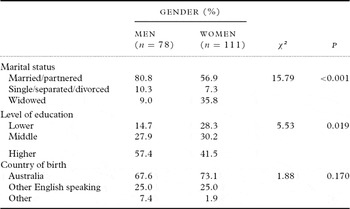
There were no age differences between men (M = 83.95, SD = 1.64) and women (M = 84.34, SD = 1.49), t = 1.17, p = 0.089. Table 1 shows the demographic characteristics of the current sample by gender. Men were generally more highly educated; more men were married or partnered than were the women. More women were widowed than men. Most of the participants were born in Australia, although more women than men were Australian-born.
Demographic characteristics of the sample by gender

Self-rated health did not differ by gender, χ2(4) = 3.58, p = 0.466. Men (M = 29.26, SD = 5.25) had slightly lower scores on the TICS than women (M = 31.83, SD = 6.56), t = 2.98, p = 0.003.
MH by gender
A linear regression showed that after controlling for TICS, education, and self-rated health, there were no differences in MH scores between men (M = 81.92, SD = 14.66) and women (M = 81.40, SD = 14.02), t = 0.82, p = 0.416.
GAI by gender
The 20 GAI items were treated as a repeated measure and a binomial distribution was assumed in fitting GAI responses as the outcome, where 0 = disagree (reference) and 1 = agree. The predictor variables were gender (reference = women) and the interaction between gender and item, controlling for TICS, education and GH1. The test of model effect showed that there was no gender effect on GAI responses, χ2(1) = 0.29, p = 0.593, and no gender by item effect on GAI responses, χ2(19) = 0.44, p = 0.436.
PHQ by gender
The 9 PHQ9 items were repeated variables and the outcome was 0 = not at all (reference) and 1 = yes. Predictors were gender and the interaction between item and gender (reference = women), and control variables were education, TICS, and GH1. Test of model effect showed no significant gender effect, χ 2(1) = 0.08, p = 0.773, and no significant gender by item effect, χ2(8) = 13.39, p = 0.099.
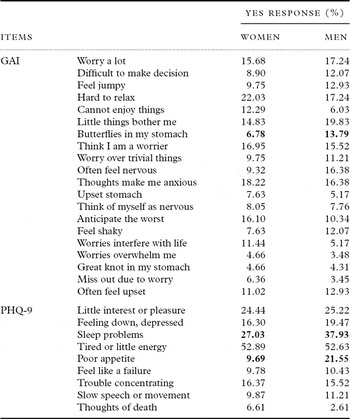
Table 2 illustrates the percentage of items in each psychiatric measure endorsed by both genders.
Item endorsement of GAI and PHQ-9 by gender

Note. Gender differences using χ 2 tests, p < 0.05 are shown in boldface
GAI = Geriatric Anxiety Inventory; PHQ = Patient Health Questionnaire
Discussion
The results of this study show no significant gender differences in anxiety, depression and general psychological distress among a cohort of men and women in their eighties, after controlling for cognitive status, general health and education. These results provide support for the proposition that the female predominance in psychological distress diminishes with increasing age.
The skew that was apparent in both the GAI and PHQ9 concurs with previous findings regarding anxiety and depression in older adults (e.g. Osborn et al., Reference Osborn2002). It suggests that the more severe end of the anxiety and depression spectrum is relatively rare in this age group, particularly when analyses are conducted with a group of community-dwelling older adults. The prevalence of both anxiety and depression is widely acknowledged to be greater in residents of residential aged care facilities (Smallbrugge et al., Reference Smalbrugge, Jongenelis, Pot, Beekman and Eefsting2005). The association between gender and anxiety and depression in very old adults is controversial. Although many studies have found that gender differences remain consistent across the lifespan (e.g. Zunzunegui et al., Reference Zunzunegui2007), studies which restrict analyses to very advanced old age suggest that these gender differences are no longer apparent (Barefoot et al., Reference Barefoot, Mortensen, Helms, Avlund and Schroll2001).
Our results are consistent with the gender similarities hypothesis of Hyde (Reference Hyde2005), which suggests that gender differences in psychological function are strongly influenced by context – in our case, the context of advanced old age, which removes the influence of gender roles. Increasing age may be associated with a decreasing obligation to conform to social norms such as gender roles.
Several limitations warrant mention. As this was a cross-sectional analysis of a relatively small number of older men and women no causality can be inferred; a larger sample followed over time would yield additional data and allow for exploration of causality. While two of our measures were not specifically designed for application in an older population, the GAI has been developed and normed solely within older adults (Pachana et al., Reference Pachana, Byrne, Siddle, Koloski, Harley and Arnold2007). The consistency of our results across all measures suggests that the lack of gender difference in psychological distress is not merely an artifact of measurement error. All measures used self-reported anxiety and depression rather than clinical diagnoses of anxiety and depression disorders; use of clinical interview data might help explicate gender differences in specific symptom presentation and duration. However, a strength of the study was our control for cognitive function, albeit with a broad screening measure. Age-related declines in cognition, as well interactions between depressive and anxiety symptoms and cognitive functioning in later life (Bierman et al., Reference Bierman, Comijs, Jonker and Bekman2005), warrant such control.
In conclusion, our study of men and women aged in their mid to late eighties found no gender differences in anxiety, depression or general psychological distress. Future research should be directed at the experience of psychological distress among the oldest old.
Conflict of interest
None.
Description of authors' roles
All authors contributed to the conception, design, statistical analyses, and drafting of the paper. JL performed the majority of the statistical analyses, and JL and AD had full access to all of the data in the study and were responsible for the integrity of the data and the accuracy of the data analysis. DM, NP and GB drafted the majority of the paper. All authors approved the final version.
Acknowledgments
The Men, Women and Ageing project is funded by Strategic Award no. 409953 of the National Health and Medical Research Council of Australia / Australian Research Council Ageing Well, Ageing Productively. The Australian Longitudinal Study on Women's Health is funded by the Australian Government Department of Health and Ageing. The Health in Men Study is supported by grants from the National Health and Medical Research Council of Australia (project grant numbers 279408, 379600, 403963). The funding sources had no influence on the design and conduct of the study; the collection, management, analysis, and interpretation of the data; nor preparation, review, or approval of the paper.