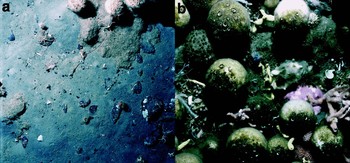
Thatje et al. (Reference Thatje, Hillenbrand and Larter2005) concluded that “only a few species with adaptive early life cycles, mainly through pelagic larvae or drifting stages” have been able to survive Antarctica's harsh conditions by “migrating from one shelf shelter to another” since the onset of glaciation (∼34 m.y.a.). Today, these extant species make up Antarctica's biodiversity. In addition, iceberg scouring is considered a destructive mechanism especially in species rich suspension feeder assemblages (Gutt & Piepenburg Reference Gutt and Piepenburg2003, Gutt Reference Gutt2007, Barnes & Conlan Reference Barnes and Conlan2007). However, a novel form of dispersal is proposed based on seabed photographs taken during expedition ANT XXI/2 (PS 65) of the German RV Polarstern in 2003–2004 to the eastern Weddell Sea. An unusually high ratio of obviously dead/living sponges (27/7) was recorded at stations (42, 43, 44) (Arntz & Brey Reference Arntz and Brey2005) representing a total area of 62 m2. Spanning a distance of about 4 km at a depth of ∼450 m these were situated between two hotspots of suspension feeder communities (Fig. 1). The place in question is an inner shelf depression which was ice shelf covered until c. 25 years before the investigation (Grosfeld et al. Reference Grosfeld, Hinze, Ritter, Schenke, Sievers and Thyssen1989).
Seabed photographs, eastern Weddell Sea, Antarctica; area: 1 m2 each. a. three demosponges (Cinachyra barbata) on dead sponge substrate (upper margin); typical other megabenthic organisms i.e. ophiuroids and regular echinoids (stn 43), b. hot spot of sponge dominated suspension feeder community with >15 individuals m-2, mainly Cinachyra barbata (stn 247) [for metadata and additional photographs see http://www.pangaea.de].

There are two hypotheses which could explain the high proportion of dead sponges:
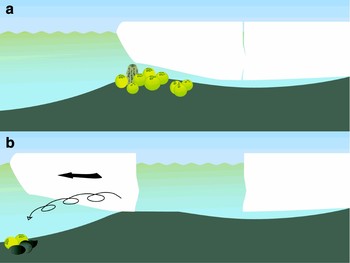
Hypothesis 1. The calving ice shelf served as a dispersal vector that allowed for the transfer of adult sponges to areas where successful recruitment was formerly prohibited by larval dispersal barriers and/or fatal conditions for juveniles (Fig. 2). The absence of juveniles draws attention to little known (Pearse et al. Reference Pearse, McClintock and Bosch1991) and neglected aspect of life cycles which could possibly explain biodiversity patterns. Conditions are generally adequate for adult sponges to prosper. After the calving event some survive while others succumb to the damage.
Fig. 2.Depiction of a sponge community a. before major calving event underneath the ice shelf, b. after calving event where the iceberg scraped off the community but also served as a vector transferring adult sponges to the deeper continental shelf.

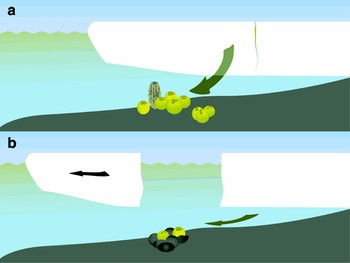
Hypothesis 2 (not mutually exclusive of the first hypothesis). When the ice shelf was still present seafloor topography, in combination with the coastal current, caused an increase in current velocity (“jet effect”). Thus, sufficient advective, particulate food was provided, especially for a sponge dominated community, which would not have existed otherwise. The calving event changed this current regime so that food particles were fewer and transported more slowly. Consequently there is direct competition for food and only a few sponges survive (Fig. 3).

It is possible that both hypotheses apply to other essential community members such as ascidians, bryozoans, and cnidarians but only sponges persist to raise these questions about the past. However, shallow-water observations of the soft bottom colonial tunicate Distaplia cylindrica show that it frequently floats to the sea surface, most likely dislodged by iceberg scouring or anchor ice, giving an example of a possible dispersion strategy for living Antarctic marine macroinvertebrates (McClintock et al. Reference McClintock, Amsler, Amsler, Southworth, Petrie and Baker2004). Anchor ice, as a disruptive mechanism, is adding to the already highly variable dynamics of sponges and their associated fauna (Dayton Reference Dayton1989).
We conclude that advances of ice in Antarctica contributed in the above ways for c. 25–30 m.y. (Hambrey et al. Reference Hambrey, Ehrmann and Larsen1991) to the well known eurybathy and to intermediate-scale heterogeneity and large-scale homogeneity (Clarke & Johnston Reference Clarke and Johnston2003) of biodiversity patterns.
Depiction of a sponge community a. before major calving event underneath the ice shelf, currents are channelled by the ice shelf thereby increasing the velocity and hence the planktonic food supply b. after calving event where changed current regimes drastically reduced food availability leading to starvation due to competition for this resource.