Introduction
Transition metal borides (TMBs) have received great interest due to the high hardness, high strength, excellent thermal stability, and high melting point, etc. [Reference Pan and Lin1, Reference Tao, Chen, Lian, Xu, Li, Feng, Wang, Cui, Zheng and Zhu2, Reference Pan and Lin3, Reference Kvashnin, Zakaryan, Zhao, Duan, Kvashnina, Xie, Dong and Oganov4, Reference Pan and Zhou5, Reference Robinson, Liu, Ciborowski, Martinez, Chamorro, Zhang, Mcqueen, Bowen and Alexandroca6, Reference Pan and Wang7, Reference Pan, Mao, Jiang, Wan and Guan8, Reference Cheng, Li and Fu9, Reference Pan, Lin, Xue, Ren and Wang10]. The previous works have shown that the measured or calculated Vickers hardness of ReB2, CrB4, and WB4 is up to 50.3 GPa [Reference Šimůnek11], 43–49 GPa [Reference Knappschneider, Litterscheid, Dzivenko, Kurzman and Sechadri12], and 41.1 GPa [Reference Wang, Li, Cui, Ma and Zou13], respectively, which are regarded as the potential new-generation superhard materials. In addition to the high hardness, compared to the diamond, those TMBs superhard materials not only show excellent electronic properties but also exhibit good thermodynamic properties under high temperature [Reference Pan and Wen14, Reference Euchner and Mayrhofer15, Reference Geest and Kolmogorov16, Reference Pan and Guan17, Reference Zhou, Wang, Cui and Li18]. The first-principles calculations have shown that the high hardness of TMBs is attributed to the formation of B–B covalent bond and TM–B bond [Reference Wang, Wang and Wang19, Reference Ivanovskii20, Reference Pan, Lin and Tong21]. In particular, the boron concentration plays a crucial role in the mechanical properties of TMBs superhard materials. Therefore, the boron-rich region borides have attracted growing interest in recent years [Reference Ma, Li, Zheng, Wang, Wang, Zhao, Han, Liu, Zhang, Zzhu, Long, Cheng, Ma and Zhao22, Reference Akopov, Yin, Roh, Pangilinan and Kaner23].
Among those TMBs, transition metal dodecaborides (TMB12) show prominent mechanical properties due to the high concentration of boron and the 3D network B–B covalent bonds. As the potential superhard materials, ZrB12 and HfB12 have been widely investigated over the last years [Reference Tsindlekht, Leviev, Asulin, Sharoni, Millo, Felner, Paderno, Filippov and Belogolovskii24, Reference Xie, Zhang, Zakaryan, Wan, Liu, Kvashnin and Oganov25, Reference Akopov, Roh, Sobell, Yeung and Kaner26, Reference Werheit, Paderno, Filippov, Paderno, Pietraszko, Armbruster and Schwarz27]. Korozlu et al. have investigated the structure, and elastic and mechanical properties of ZrB12 and HfB12 as a function of pressure. They have found that the calculated theoretical Vickers hardness of ZrB12 and HfB12 is up to 40 GPa and 39 GPa [Reference Korozlu, Colakoglu, Deligoz and Aydin28], respectively, which are potential superhard materials. The calculated bulk modulus, shear modulus, and Young’s modulus of ZrB12 are up to 243.5 GPa, 204.4 GPa, and 479.1 GPa, respectively. The calculated bulk modulus, shear modulus, and Young’s modulus of HfB12 are up to 249.5 GPa, 198.6 GPa, and 470.8 GPa, respectively. In addition, Ai et al.’s work has shown that the calculated bulk modulus and shear modulus of ZrB12 are up to 231.7 GPa and 193.0 GPa [Reference Ai, Luo, Yu, Miao and Hu29], respectively. In other words, the first-principles calculations have shown that the high Vickers hardness of ZrB12 and HfB12 is attributed to the 3D boron network. As a result, the network B–B can form the strong B–B covalent bonds, which improve the mechanical properties of TMBs. Unfortunately, the structure and mechanical properties of other dodecaborides (TMB12) are scarce. On the other hand, although the thermal stability plays an important role in superhard material, the thermodynamic properties of the other dodecaborides are also lacking.
In the present paper, we apply the first-principles approach with density functional theory (DFT) to study the structural stability, Vickers hardness, elastic properties, and thermodynamic properties of TMB12 (TM = W and Ti). To search for novel superhard material, we consider two TMB12, WB12 and TiB12, in our work. In particular, we study the influence of high pressure on the Vickers hardness, elastic properties, and thermodynamic properties of WB12 and TiB12 (0–100 GPa). The nature of Vickers hardness and elastic properties of WB12 and TiB12 is revealed by the electronic structure. Our work indicates that the predicted Vickers hardness of TiB12 is up to 43.2 GPa, which is a potential superhard material. In particular, those dodecaborides show better thermodynamic properties.
Results and discussions
In our work, we assume that WB12 and TiB12 are in a ZrB12-type cubic structure (space group:  $Fm\bar{3}m$, No. 225) [Reference Rybina, Nemkovski, Alekseev, Mignot, Clementyev, Johnson, Capogna, Dukhnenko, Lyashenko and Filippov30]. In this structure, TM atom and B atom occupy the Wyckoff (0, 0, 0) and (0.50, 0.171, 0.171) sites, respectively. It is obvious that the 24 B atoms will form the 3D network B–B covalent bond, which can improve the Vickers hardness and elastic properties of TMB12 in comparison with the boron-poor region borides.
To study the Vickers hardness and thermodynamic properties, we should be firstly studied the structural stability of TMB12 (TM = W and Ti). It is well known that the structural stability of a solid is related to the chemical potential between atom and the near atom, which is estimated by the thermodynamic stability [Reference Pan and Shi31, Reference Liu, Hu, Lu, Zhan, Cui, Zhan and Yu32, Reference Pan33]. In this work, the structural stability of WB12 and TiB12 is calculated by the formation enthalpy (ΔH) [Reference Pan, Li and Zheng34, Reference Wang and Pan35, Reference Pan and Guan36], which is given by:
 $$\Delta H = {E_{{\rm{TM}}{{\rm{B}}_{12}}}} - {E_{{\rm{TM}}}} - 12{E_{\rm{B}}}\quad ,$$
where  ${E_{{\rm{TM}}{{\rm{B}}_{12}}}}$, E TM, and E B are the total energy of TMB12 (TM = W and Ti), TM, and B at the ground state, respectively.
It is well known that the mechanical properties of TMBs are estimated by the Vickers hardness and elastic properties [Reference Wang, Pan, Lin and Tong37, Reference Pan, Guan and Li38, Reference Zhang, Chen, Wang, Chen, Ma, Li, Liu and Guo39, Reference Pan and Jin40]. Here, the Vickers hardness of WB12 and TiB12 is used by the Miao et al.’s method [Reference Miao, Sa, Zhou and Sun41], which is given by:
 $${H_{\rm{v}}} = {{\left( {1 - 2\delta } \right)Y} / {\left[ {6\left( {1 + \delta } \right)} \right]}}\quad ,$$
where Y and δ are the Young’s modulus and Poisson’s ratio, respectively.
Theoretically, the elastic properties of WB12 and TiB12 are calculated by the elastic modulus: bulk modulus (K), shear modulus (G), Young’s modulus (Y), and Poisson’s ratio (δ), etc. [Reference Pan, Jing and Wu42, Reference Zhang, Leng, Yang, Shi and Lu43, Reference Pan, Wang and Zhang44], which are calculated by the elastic constants (C ij). Here, the elastic constants of WB12 and TiB12 are calculated by the stress versus strain method [Reference Li, Zhou, Zheng, Ma and Chen45, Reference Pan and Wen46]. For the TMB, a set of strain, ɛ = (ɛ1, ɛ2, ɛ3, ɛ4, ɛ5, ɛ6), both stress and strain have three normal strains (ɛ1, ɛ2, and ɛ3) and three shear strains (ɛ4, ɛ5, and ɛ6). The corresponding stress is represented as σi = C ijɛi. Therefore, the linear elastic constants form 6 × 6 symmetric matrix. According to the Hooke’s law, the elastic constants of WB12 and TiB12 are calculated by [Reference Wu, Zhao, Xiang and Hao47]:
 $$C = {\varepsilon ^{ - 1}}\sigma = \left\{ {\matrix{ {{C_{11}}} & {{C_{12}}} & {{C_{13}}} & 0 & 0 & 0 \cr {{C_{21}}} & {{C_{22}}} & {{C_{23}}} & 0 & 0 & 0 \cr {{C_{31}}} & {{C_{32}}} & {{C_{33}}} & 0 & 0 & 0 \cr 0 & 0 & 0 & {{C_{44}}} & 0 & 0 \cr 0 & 0 & 0 & 0 & {{C_{55}}} & 0 \cr 0 & 0 & 0 & 0 & 0 & {{C_{66}}} \cr} } \right\}\quad .$$
Therefore, the elastic constants of a solid are calculated by using the first-principles approach. The elastic constants are calculated by using variations of the equilibrium energy with respect to applied strain, which is defined as:
 $${C_{ijkl}} = {{{\partial ^2}E} \over {\partial {\delta _{ij}}\partial {\delta _{kl}}}}\quad ,$$
where δij and δkl are the stress and strain tensor, respectively. The total energy of deformed crystal, E(V) under a strain can be expanded as the Taylor expansion. The energy of a strained system can be calculated as:
 $$E\left( V \right) = E\left( {{V_0},0} \right) + {V_0}\sum\limits_{ij} {{\delta _{ij}}{\delta _{ij}}} + {{{V_0}} \over 2}\sum\limits_{i,j,k,l} {{V_{ijkl}}{\delta _{ij}}{\delta _{kl}} + \cdots } \quad ,$$
where V 0 is the volume of unstrained crystal and E(V 0, 0) is the corresponding ground state energy. The strain tensor subscripts (ij, kl) represent the Voigt notation scheme.
Before studying the mechanical properties, we should be considered the mechanically stable of WB12 and TiB12, respectively. It is well known that the mechanically stable of a solid is determined by the elastic constants [Reference Pan, Lin, Wang and Zhang48, Reference Liu, Fu, Li, Xing, Li and Zheng49]. As mentioned above, WB12 and TiB12 belong to the cubic structure (similar to the ZrB12). For a cubic structure, therefore, there are three independent elastic constants: C 11, C 12, and C 44, respectively. The requirement of mechanical stability in a cubic structure is given by [Reference Pan50]:
 $${C_{11}} > 0,\;{C_{44}} > 0,\;{C_{11}} - {C_{12}} > 0,\;{C_{11}} + 2{C_{12}} > 0\quad .$$
Based on the structural symmetry, the bulk modulus and shear modulus of WB12 and TiB12 are calculated by the Voigth–Reuss–Hill (VRH) approximation [Reference Hill51, Reference Pan and Guan52]. On the other hand, the Young’s modulus of a solid is related to the bulk modulus and shear modulus. Therefore, the Young’s modulus of WB12 and TiB12 is given by:
 $$Y = {{9KG} \over {3K + G}}\quad .$$
As we know, the thermodynamic properties play an important role in superhard material because of the cutting and wear. Therefore, we will further investigate the thermodynamic properties of those TMBs. In this paper, the thermodynamic properties of TMB12 are estimated by the Debye temperature (θD). Here, the Debye temperature of WB12 and TiB12 is calculated by the Debye model [Reference Pan and Wen53].
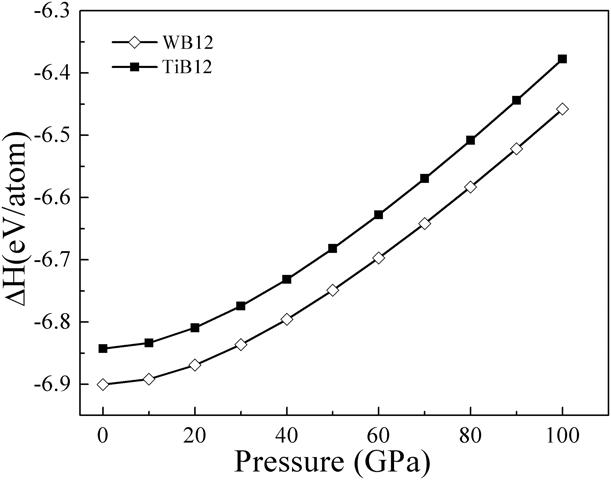
Firstly, we study the structural stability of WB12 and TiB12. In particular, we further consider the influence of high pressure on the structural stability of WB12 and TiB12, respectively. Figure 1 displays the calculated formation enthalpy (ΔH) of WB12 and TiB12 as a function of pressure (0–100 GPa). It can be seen that WB12 and TiB12 are thermodynamically stable at the ground state because the calculated formation enthalpy of WB12 and TiB12 under pressure is smaller than zero. As shown in Fig. 1, it is worth noticing that the calculated formation enthalpy of WB12 at 0 GPa is 6.900 eV/atom, which is smaller than that of TiB12 (−6.843 eV/atom). Although the calculated formation enthalpy of WB12 and TiB12 increases with increasing pressure, the calculated formation enthalpy of WB12 under high pressure (0–100 GPa) is also smaller than that of TiB12. As mentioned above, it is concluded that WB12 is more thermodynamically stable than TiB12.
Calculated formation enthalpy of WB12 and TiB12 as a function of pressure.

To reveal the nature of the structural stability, we further study the structural feature and electronic structure of WB12 and TiB12. For the cubic TMB12, the calculated lattice parameter of WB12 and TiB12 is a = 7.311 Å and a = 7.333 Å, respectively. In addition, the calculated unit-cell density of WB12 and TiB12 is ρ = 5.33 g/cm3, and ρ = 2.99 g/cm3, respectively. The calculated unit cell volume of WB12 and TiB12 is 390.7 Å3 and 394.3 Å3, respectively. As mentioned above, it can be seen that the calculated density of WB12 is much larger than that of TiB12. On the contrary, the calculated volume of WB12 is smaller than that of TiB12. According to the first-principles calculation, we suggest that this discrepancy is determined by the valence electronic density of transition metal and the localized hybridization between TM atom and B atom. It is obvious that the valence electronic density of W atom is much larger than that of Ti atom. That is to say, the heavy transition metal may form the strong covalent bond because of the charge interaction between the transition metal and B atom. This result is demonstrated by the electronic structure and chemical bonding. Based on the structural feature, we suggest that the structural stability of TMB12 is related to the symmetrical TM–B bond and B–B covalent bond. Therefore, we will further investigate the electronic structure and bonding state of WB12 and TiB12, respectively.
To the best our knowledge, the structural stability and mechanical properties of a solid are revealed by the electronic structure and chemical bonding [Reference Pan54, Reference Li and Du55]. There is no doubt that the nature of chemical bonding is well reflected by the density of state (DOS) and charge density distribution [Reference Pan and Wen56, Reference Li, Han, Hou, Yan, Hu and Zhang57]. To gain insight into the nature of the structural stability and mechanical properties, Fig. 2 shows the calculated DOS of WB12 and TiB12, respectively. It can be seen that many bands across the Fermi level, indicating that WB12 and TiB12 show a degree of metallic behavior at the ground state. Secondly, it is observed that the profile of DOS of TMB12 is contributed by the B-2s state, B-2p state, and TM-d state (W-5d state and Ti-3d state), respectively.
Calculated DOS: (a) WB12 and (b) TiB12, respectively.

Based on the electronic DOS, it is clear that the formation of B–B covalent bond is attributed to the localized hybridization between B-2s state and the B-2p state. However, the formation of TM–B bond derives from the localized hybridization between the TM-d state and B-2p state. As a result, those bonding state will improve the structural stability and mechanical properties of WB12 and TiB12, which are demonstrated by the charge density difference. However, it is worth noticing that the DOS profile of TiB12 is different from WB12. Compared to WB12 [Fig. 2(a)], there are many deep valleys for TiB12. That is to say, there is a strong localized hybridization in TiB12, which can improve the bond strength of Ti–B bond and B–B covalent bond. There it is well explained why the Vickers hardness of TiB12 is larger than that of WB12.
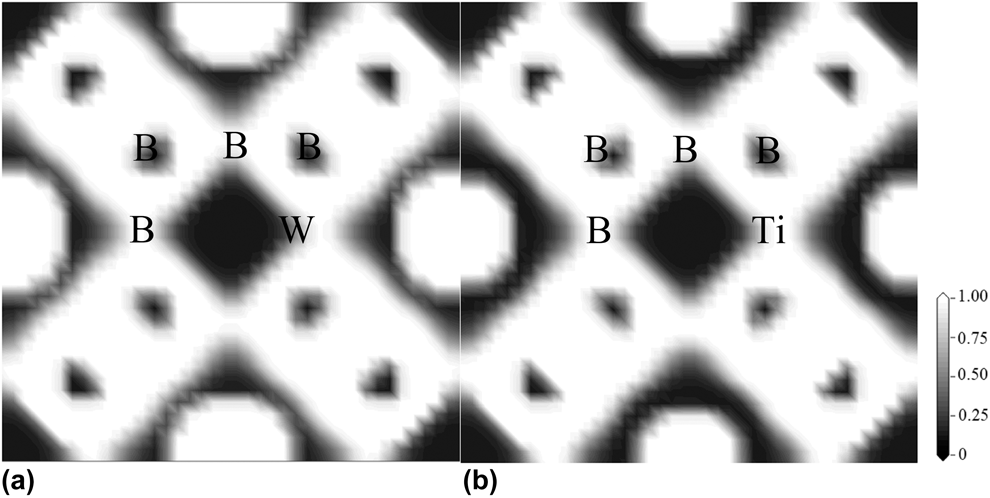
To further explore the chemical bonding, Fig. 3 shows the calculated contours of the charge density difference of WB12 and TiB12 along the (100) plane, where the critical feature is labeled. For charge density distribution, the red color implies the maximum localization of electrons and the blue color indicates the maximum delocalization of electrons. As shown in Fig. 3, it is found that there is a strong localized hybridization of TM–B atoms and B–B atoms, which can form the directional B–B covalent bond and TM–B bonds (W–B bond for WB12 and Ti–B bond for TiB12). In particular, we can see that there are two different B–B covalent bonds and one TM–B bond. Interestingly, two different B–B covalent bonds will form the 3D network B–B bond. As a result, the bonding state can improve the structural stability and mechanical properties of WB12 and TiB12.
Charge density difference along the (100) plane: (a) WB12 and (b) TiB12, respectively.

In our previous work, we suggest that the cohesive force in a layer is stronger than the cohesive force of the layered structure [Reference Pan, Wang, Zhang and Jia58, Reference Pan, Wang and Zhang59]. The structural stability of TMBs is influenced by the cohesive force of the layered structure. Therefore, the structural stability of WB12 and TiB12 is also influenced by the layered structure. Here, the calculated bond length of B–B covalent bond in layered structure is 1.649 Å for WB12 and 1.666 Å for TiB12, which are in good agreement with the other theoretical results [Reference Li, Tao and Peng60, Reference Liang, Fu, Yuan, Wang, Zhong and Zhang61]. The calculated bond length of B–B covalent bond (layered structure) for WB12 is shorter than that of TiB12. On the other hand, the cohesive force (at layered structure) of WB12 is stronger than that of TiB12. This is why WB12 is more thermodynamically stable than TiB12.
When we estimate their structural stability, we study the mechanical properties of WB12 and TiB12. Here, the mechanical properties of those TMBs are estimated by the Vickers hardness and elastic properties, respectively. In addition, we further study the influence of high pressure on the Vickers hardness and elastic properties of WB12 and TiB12.
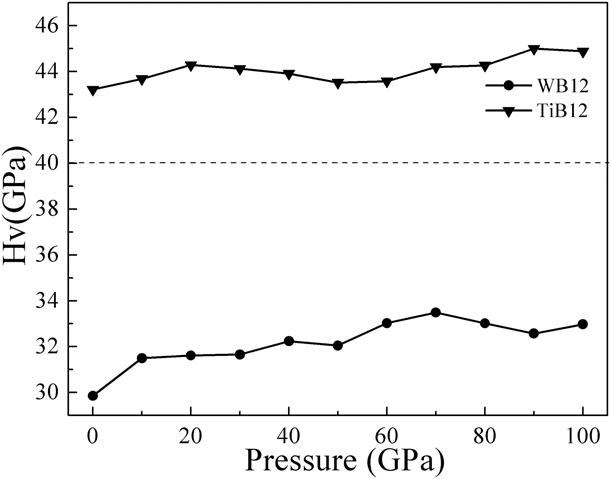
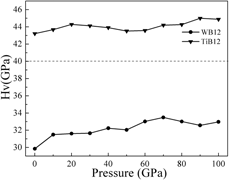
Figure 4 shows the calculated Vickers hardness of WB12 and TiB12 as a function of pressure (0–100 GPa). It can be seen that the calculated Vickers hardness of WB12 and TiB12 at the ground state is 29.9 GPa and 43.2 GPa, respectively. With increasing pressure, the calculated Vickers hardness of WB12 increases slightly. However, the calculated Vickers hardness of TiB12 is close under high pressure. In particular, it is observed that the calculated Vickers hardness of TiB12 under high pressure is much larger than that of WB12 under high pressure. It is obvious that the calculated Vickers hardness of TiB12 under high pressure (0–100 GPa) meets the requirement of superhard material (H v ≥ 40 GPa), indicating that TiB12 is a potential novel superhard material. However, we suggest that WB12 is not a superhard material. Based on the analysis of charge difference density, we suggest that the nature of Vickers hardness of WB12 and TiB12 is attributed to the 3D network B–B covalent bonds. We suggest that this discrepancy is also attributed to the bond strength of chemical bonding.
Calculated Vickers hardness of WB12 and TiB12 as a function of pressure.

To explore their mechanical properties, we study the elastic constants and elastic properties of WB12 and TiB12 under high pressure. In our work, the calculated elastic constants C 11, C 12, and C 44 of WB12 at 0 GPa are 356.3 GPa, 180.7 GPa, and 212.1 GPa, respectively. The calculated elastic constants C 11, C 12, and C 44 of TiB12 at 0 GPa are 381.0 GPa, 144.7 GPa, and 243.5 GPa, respectively. Firstly, it is concluded that WB12 and TiB12 are mechanically stable at the ground state because the calculated elastic constants of those TMBs meet the Born stability criteria. Secondly, it is found that the calculated elastic constants C 11 and C 44 of TiB12 are larger than those of WB12. Those results indicate that TiB12 shows the strong shear deformation resistance and high deformation resistance (along the a-axis) in comparison with WB12. There it is well explained why the Vickers hardness of TiB12 is larger than that of WB12.
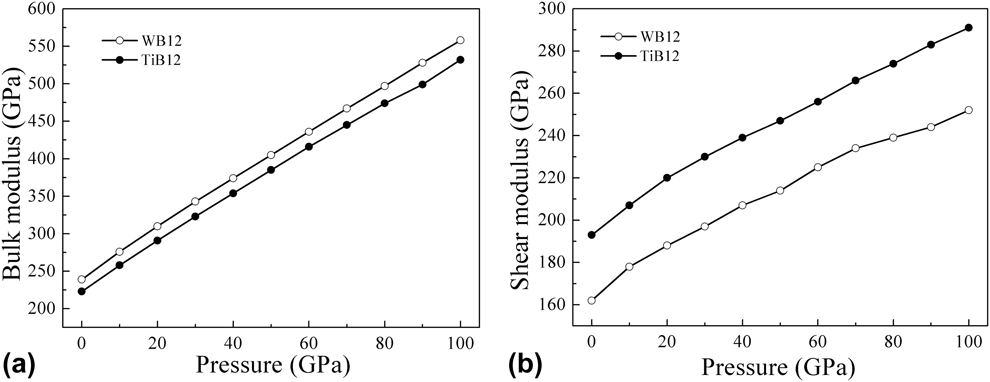
To reveal the mechanical properties, we further study the elastic properties of WB12 and TiB12. Figure 5 shows the calculated bulk modulus and shear modulus of WB12 and TiB12 as a function of pressure (0–100 GPa). The calculated bulk modulus and shear modulus of WB12 at the ground state are 239 GPa, and 162 GPa, respectively. The calculated bulk modulus and shear modulus of TiB12 at the ground state are 223 GPa and 193 GPa, respectively. Although the calculated bulk modulus of WB12 is larger than that of TiB12, the calculated shear modulus of TiB12 is larger than that of WB12. Those results indicate that TiB12 shows the strong shear deformation resistance in comparison with WB12. In particular, we further note that the elastic modulus of WB12 and TiB12 increases gradually with increasing pressure. Under high pressure, the calculated shear modulus of TiB12 is also larger than that of WB12, indicating that TiB12 shows strong deformation resistance. According to the first-principles calculations, the increase in elastic modulus is that the high pressure enhances the localized hybridization between TM (TM = W and Ti) and B, and then improves the bond strength of TM–B bond and B–B covalent bonds in a system.
Calculated elastic modulus of WB12 and TiB12 as a function of pressure: (a) bulk modulus (K) and (b) shear modulus (G), respectively.

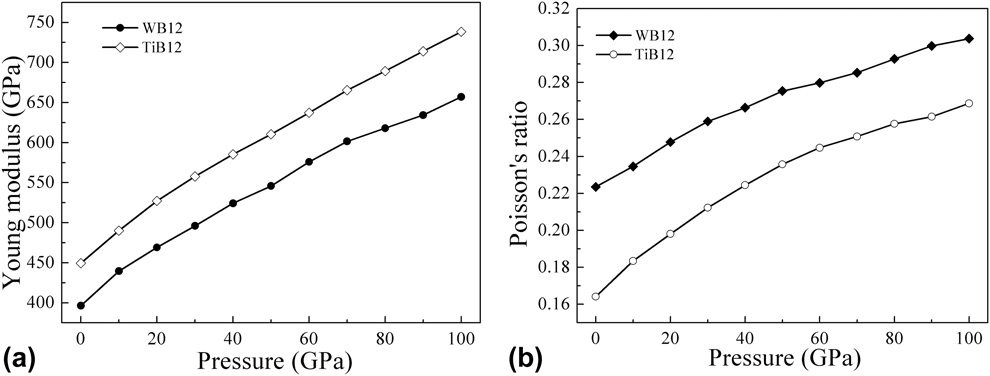
Figure 6 shows the calculated Young’s modulus and Poisson’s ratio of WB12 and TiB12 as a function of pressure (0–100 GPa). It can be seen that the calculated Young’s modulus of WB12 and TiB12 under 0 GPa is 396 GPa and 449 GPa, respectively. With increasing pressure, the calculated Young’s modulus of WB12 and TiB12 increases. Either high pressure or zero pressure, it is obvious that the calculated Young’s modulus of TiB12 is larger than that of WB12, indicating that TiB12 shows strong elastic stiffness in comparison with WB12. On the other hand, the calculated Poisson’s ratio of WB12 and TiB12 at 0 GPa is 0.164 and 0.223, respectively. In particular, the calculated Poisson’s ratio of WB12 and TiB12 increases with increasing pressure. Under high pressure, we find that the calculated Poisson’s ratio of TiB12 is smaller than that of WB12, indicating that TiB12 has strong covalent characteristic. This result indirectly demonstrates that the Vickers hardness of TiB12 is larger than that of WB12, which is consistent with the variation of Vickers hardness.
Calculated elastic modulus of WB12 and TiB12 as a function of pressure: (a) Young’s modulus (Y) and (b) Poisson’s ratio (δ), respectively.

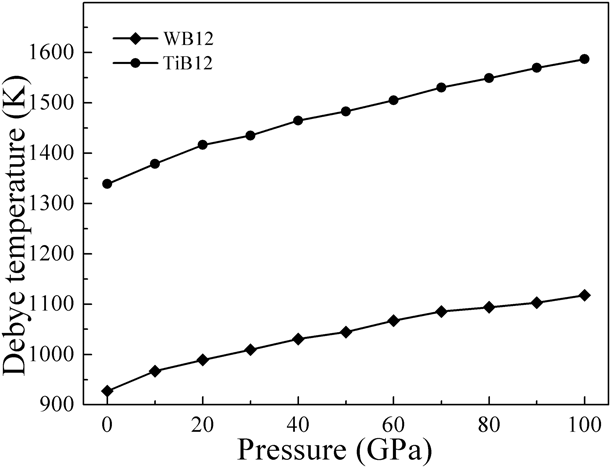
To the best of our knowledge, the thermodynamic stability plays an important role in superhard material. To study the thermodynamic properties, Fig. 7 shows the calculated Debye temperature of WB12 and TiB12 as a function of pressure (0–100 GPa). It can be seen that the calculated Debye temperature at the ground state is 927 K for WB12 and 1339 K for TiB12, respectively. Although the calculated Debye temperature of WB12 and TiB12 increases gradually with increasing pressure, the calculated Debye temperature of TiB12 under high pressure is also larger than that of WB12. Therefore, it is concluded that TiB12 shows excellent thermodynamic stability in comparison with TiB12.
Calculated Debye temperature of WB12 and TiB12 as a function of pressure.

Conclusions
In conclusion, we apply the first-principles calculations to study the structural stability, Vickers hardness, elastic properties, and thermodynamic properties of WB12 and TiB12. In particular, we further investigate the influence of high pressure (0–100 GPa) on the structural stability, Vickers hardness, elastic modulus, and Debye temperature of WB12 and TiB12. Here, we consider four elastic properties: bulk modulus, shear modulus, Young’s modulus, and Poisson’s ratio, respectively. The results show that the calculated formation enthalpy of WB12 and TiB12 under high pressure is smaller than 0, indicating that WB12 and TiB12 are thermodynamically stable. In addition, we find that WB12 is more thermodynamically stable than TiB12 because the calculated formation enthalpy of WB12 under high pressure is smaller than that of TiB12. The calculated lattice parameter of WB12 and TiB12 is a = 7.311 Å and a = 7.333 Å, respectively. The calculated unit cell volume of WB12 and TiB12 is 390.7 Å3 and 394.3 Å3, respectively.
In particular, the calculated Vickers hardness of WB12 and TiB12 at the ground state is 29.9 GPa and 43.2 GPa, respectively. Those TMBs are mechanically stable under high pressure. The calculated elastic modulus of WB12 and TiB12 increases with increasing pressure. Importantly, the calculated bulk modulus and Poisson’s ratio of WB12 under high pressure is larger than those of TiB12. However, the calculated shear modulus and Young’s modulus of TiB12 are larger than those of WB12. TiB12 shows the strong shear deformation resistance and high elastic stiffness in comparison with WB12. The calculated charge density difference shows that the high Vickers hardness and elastic modulus of WB12 and TiB12 are attributed to the formation of 3D network B–B covalent bonds. Although the calculated Debye temperature of WB12 and TiB12 also increase with increasing pressure, the calculated Debye temperature of TiB12 under high pressure is larger than that of WB12. As mentioned above, our work predicts that TiB12 is a potential superhard material.
Methodology section
In this paper, the total energy, elastic properties, and electronic structure of WB12 and TiB12 were carried out by the first-principles with DFT, as implemented in the CASTEP code [Reference Segall, Lindan, Probert, Pickard, Hasnip, Clark and Payne62, Reference Pan, Li, Zheng and Xu63]. The generalized gradient correction (GGA) within Perdew–Burke–Ernzerhof (PBE) functional was used in exchange correlation function of WB12 and TiB12 [Reference Perdew, Burke and Ernzerhof64, Reference Pan65]. The interactions between the electrons and ions were adopted by using the ultrasoft pseudopotential [Reference Vanderbilt66, Reference Pan67]. The electronic energy tolerance of the self-consistent filed (SCF) was treated by the 1 × 10⁻⁶ eV/atom. A plane-wave basis set for electron wave function with cutoff energy of 400 eV was used for WB12 and TiB12, and the integrations in the Brillouin zone was performed by using the special k-point generated with 12 × 12 × 12 mesh grids for WB12 and TiB12, respectively. The Broyden Fletcher Golddarb Shanno (BFGS) scheme was applied in all system [Reference Sun, Fu, Lin, Guo, Lei and Wang68, Reference Pan and Guan69]. The electronic configurations of W, Ti, and B were 5p 65d 46s 2, 3p 63d 24s 2, and 2s 22p 1, respectively. During the geometry optimization, all atomic positions, lattice parameters, and internal coordinates in a system were fully relaxed [Reference Zhang and Jiang70, Reference Pan and Guan71, Reference Diyou, Li, Xuemei and Tao72].
Acknowledgments
This work is supported by the State Key Laboratory of Advanced Technology for Comprehensive Utilization of Platinum Metals (Grant No. SKL-SPM-201816). We also thank Lady Yun Zheng and Runxi Pan for help.