


Introduction
At-risk mental states and cognitive behavioural therapy
During the last two decades, researchers and clinicians have been increasingly interested in the early identification of and intervention with young individuals experiencing the first stages of psychosis (McHugh et al., Reference McHugh, McGorry, Yuen, Hickie, Thompson, de Haan and Schloegelhofer2018; Schultze-Lutter et al., Reference Schultze-Lutter, Michel, Schmidt, Schimmelmann, Maric, Salokangas and Meneghelli2015; Yung et al., Reference Yung, Yuen, McGorry, Phillips, Kelly and Buckby2005). Accumulating evidence from prospective studies has shown that a sub-group of young patients who report first-episode psychosis seek psychiatric care before the onset of the full disorder because they experience a prodromal state (Häfner et al., Reference Häfner, Maurer and an der Heiden2013). This clinical picture, characterized by attenuated and/or intermittent psychotic symptoms associated with significant impairment in psychosocial functioning, was defined as at-risk mental states (ARMS; Yung et al., Reference Yung, Yuen, McGorry, Phillips, Kelly and Buckby2005). Ultra-high-risk criteria (UHR) identified three sub-groups of young individuals with ARMS: (a) attenuated psychotic symptoms (APS); (b) brief limited intermittent psychotic episodes (BLIPs) below duration criteria for brief psychotic episode; and (c) genetic vulnerability (familiarity with a first-degree relative having psychosis or schizotypal personality disorder combined with functioning decline during last year) (Yung et al., Reference Yung, Yuen, McGorry, Phillips, Kelly and Buckby2005). Yung and colleagues (Reference Yung, Yuen, McGorry, Phillips, Kelly and Buckby2005) described sub-clinical positive symptoms, defining ARMS as unusual content of thoughts, non-bizarre ideas, perceptual disturbance, and disorganized speech. An important point related to ARMS research is that about two-thirds of young individuals classified as UHR do not experience the transition to a first episode psychosis within 3 years, as transition risk was 18% at 6-month, 22% at 12-month, 29% at 24-month, and 36% at 36-month follow-up in a meta-analysis of prospective studies (Fusar-Poli et al., Reference Fusar-Poli, Bonoldi, Yung, Borgwardt, Kempton, Valmaggia and McGuire2012a, b). However, these non-converters may continue to have functional impairment, sub-clinical psychotic symptoms, anxiety and depressive symptoms (Fusar-Poli et al., Reference Fusar-Poli, Bonoldi, Yung, Borgwardt, Kempton, Valmaggia and McGuire2012a, b; Lin et al., Reference Lin, Wood, Nelson, Beavan, McGorry and Yung2015).
The cognitive behavioural therapy (CBT) model assumes that the pathway from ARMS to psychosis is reinforced by catastrophic misinterpretations of psychotic-like symptoms, exacerbated by high emotional arousal (van der Gaag et al., Reference van der Gaag, Nieman and Van den Berg2013a). The main goal of CBT for ARMS is to provide the young individual with effective skills to reduce distress triggered by sub-clinical psychotic experiences. By analysing CBT trials for ARMS, Thompson and colleagues (Reference Thompson, Millman, Okuzawa, Mittal, DeVylder, Skadberg and Schiffman2015) identified the following demonstrably effective key components in reducing transition risk: Assessment, Engagement, Case formulation, Psychoeducation, CBT strategies, Treatment of depression-anxiety, and Social skills. In a meta-analysis of five randomized trials, van der Gaag and colleagues (Reference van der Gaag, Smit, Bechdolf, French, Linszen, Yung and Cuijpers2013b) concluded that CBT is promising and pointed out that a limitation of current literature was the focus on psychosis prevention. The authors highlighted that additional outcomes should be evaluated. Okuzawa and colleagues (Reference Okuzawa, Kline, Fuertes, Negi, Reeves, Himelhoch and Schiffman2014) conducted a systematic review of six studies assessing CBT as a core element for ARMS. Three trials showed a significant effect. The researchers concluded that CBT may be beneficial in delaying or preventing psychosis, but effect sizes appeared small and further trials were needed (Okuzawa et al., Reference Okuzawa, Kline, Fuertes, Negi, Reeves, Himelhoch and Schiffman2014). Later, Schmidt and colleagues (Reference Schmidt, Schultze-Lutter, Schimmelmann, Maric, Salokangas, Riecher-Rössler and Morrison2015) produced a guidance paper through meta-analysis of five CBT trials (mean treatment duration = 6.87 months, mean follow-up = 16.67), stating that CBT should be considered as a first-line psychological strategy for psychosis prevention in ARMS populations.
Worry in ARMS
Worry is a long-studied construct defined as a process involving a chain of thoughts and mental images negatively affect-laden and relatively uncontrollable (Borkovec et al., Reference Borkovec, Robinson, Pruzinsky and DePree1983). It has been hypothesized that it represents an attempt to engage in mental problem-solving on an issue whose outcome is uncertain but which may have one or more negative outcomes (Borkovec and Inz, Reference Borkovec and Inz1990). While worry has long been investigated as a maintenance factor of anxiety disorders (e.g. Pozza et al., Reference Pozza, Coradeschi and Dèttore2013; Wells, Reference Wells1995), research has recently yielded empirical support for its association with fully psychotic symptoms, particularly paranoid thinking, in people diagnosed with schizophrenia (Startup et al., Reference Startup, Pugh, Dunn, Cordwell, Mander, Černis and Freeman2016). Worry was found to be a potential maintenance factor of psychotic symptoms, including delusional thinking and hallucinations (Hartley et al., Reference Hartley, Haddock, Vasconcelos, Sa, Emsley and Barrowclough2014).
The role of worry in ARMS is a research area increasingly drawing the attention of investigators and clinicians. Young individuals with ARMS are often worried about their psychotic-like experiences. Worry may be engaged in as a mental coping strategy to manage the distress associated with such experiences (Fresán et al., Reference Fresán, León-Ortiz, Robles-García, Azcárraga, Guizar, Reyes-Madrigal and de la Fuente-Sandoval2015). Young individuals with ARMS may fear going crazy and losing control of their minds (Meneghelli et al., Reference Meneghelli, Meliante, Amato, Pozza and Dèttore2016). Recent investigations have shown that young individuals with ARMS reported higher levels of anticipatory worry than healthy controls and to a similar extent as patients with schizophrenia (Fresán et al., Reference Fresán, León-Ortiz, Robles-García, Azcárraga, Guizar, Reyes-Madrigal and de la Fuente-Sandoval2015). Worry was the strongest predictor of sub-clinical paranoid thinking in epidemiological research conducted in community samples (Freeman et al., Reference Freeman, Stahl, McManus, Meltzer, Brugha, Wiles and Bebbington2012). Indeed, in a recent systematic review and meta-analysis (Cotter et al., Reference Cotter, Yung, Carney and Drake2017), some metacognitive beliefs (negative beliefs about uncontrollability, cognitive confidence, and negative beliefs about thoughts in general), maintenance factors of worry, have been found to be higher among individuals with ARMS than among healthy controls and as high as among patients with schizophrenia.
In light of these considerations, worry as a target of psychological intervention for ARMS, as it is in CBT for schizophrenia, might be hypothesized (e.g. Freeman et al., Reference Freeman, Dunn, Startup, Pugh, Cordwell, Mander and Kingdon2015). CBT is useful in providing the patient with a clear, tailored case formulation describing cognitive and behavioural mechanisms reinforcing ARMS. Receiving such an explanatory model of distressing psychotic-like experiences and learning that there is adequate treatment is a comforting message that may attenuate the repetitive thinking engaged in to cope with such distress (van der Gaag et al., Reference van der Gaag, Nieman and Van den Berg2013a). In addition, CBT can provide effective psychoeducation on the nature of worry and useful skills and techniques to manage it, such as metacognitive restructuring and behavioural experiments.
Rationale and objectives
While CBT has been demonstrated to be an effective strategy for reducing or delaying the risk of transition to psychosis in young individuals suffering from ARMS, there is little knowledge of its effects on other outcomes associated with ARMS. According to three systematic reviews (Okuzawa et al., Reference Okuzawa, Kline, Fuertes, Negi, Reeves, Himelhoch and Schiffman2014; Schmidt et al., Reference Schmidt, Schultze-Lutter, Schimmelmann, Maric, Salokangas, Riecher-Rössler and Morrison2015; van der Gaag et al., Reference van der Gaag, Smit, Bechdolf, French, Linszen, Yung and Cuijpers2013b), CBT should be assessed on further outcomes associated with ARMS, not only on prevention of a first psychosis episode. No study has assessed the impact of CBT specifically on worry, in an ARMS group. The current study aimed to investigate changes in worry intensity at immediate post-treatment and 14-month follow-up after CBT in a group of young individuals with ARMS seeking psychiatric care in mental health services.
Method
Eligibility criteria
Participants were young individuals seeking psychiatric care in mental health services, who were included if they were 16–35 years old and met ARMS criteria using the Comprehensive Assessment of At Risk Mental States (CAARMS; Yung et al., Reference Yung, Yuen, McGorry, Phillips, Kelly and Buckby2005). Participants were excluded if diagnosed with (a) intellectual disability, (b) neurological disorders, (c) developmental disorders, (d) current/past psychotic/bipolar disorder, (e) suicidal intent, or (f) they had undergone prior CBT, or (g) were concurrently in psychotherapy or on anti-psychotics. Concomitant anti-depressants were allowed if stable during the study. Exit/discontinuation criteria were: (a) voluntary discontinuation by the participant, or (b) for safety reasons in the investigator’s judgement (i.e. the participant met psychosis criteria or developed suicidality). Participants who developed a first episode of psychosis entered into routine psychiatric care.
Recruitment was through leaflets/emails to private and public mental health professionals and workshops providing information on ARMS and encouraging referrals. Help-seeking individuals suspected of having ARMS and referred by mental health service professionals were assessed through the CAARMS.
Baseline measures
Baseline Axis I disorders were assessed through the Structured Clinical Interview for DSM-IV-TR Axis I Disorders (SCID-I; First et al., Reference First, Spitzer, Gibbon and Williams1997a; SCID-I Italian; Mazzi et al., Reference Mazzi, Morosini, De Girolamo, Lussetti and Guaraldi2000). The psychosis module was administered at post-treatment and follow-up. Personality disorders were investigated through the Structured Clinical Interview for DSM-IV-TR Personality Disorders (SCID-II; First et al., Reference First, Gibbon, Spitzer, Williams and Benjamin1997b; SCID-II Italian; Maffei et al., Reference Maffei, Fossati, Agostoni, Barraco, Bagnato, Donati, Namia, Novella and Petrachi1997).
Onset of first psychotic episode
The diagnosis of a first psychotic episode at post-treatment or follow-up, also including any psychotic/bipolar disorders according to DSM-IV-TR (American Psychiatric Association, 2000), was assessed through the SCID-I. Development of a first psychotic episode was assessed at 6-month post-treatment and 14-month follow-up or at the moment the psychologist conducting treatment informed the researchers that transition had (probably) occurred. The Positive And Negative Syndrome Scales (PANSS; Kay et al., Reference Kay, Opler and Lindenmayer1989) were used to further support the diagnosis of psychosis at post-treatment or follow-up.
Primary outcome
The Penn State Worry Questionnaire (PSWQ; Meyer et al., Reference Meyer, Miller, Metzger and Borkovec1990) was used as a measure of trait worry and its characteristics of intensity, frequency, persistence and uncontrollability. The PSWQ is a self-report tool consisting of 16 items on a 5-point Likert scale (1 = ‘not at all typical of me’, 5 = ‘very typical of me’). High scores indicate severe worry. The Italian version (Morani et al., Reference Morani, Pricci and Sanavio1999) showed good internal consistency. In the current study, internal consistency was good (Cronbach’s alpha = 0.84).
Diagnostic reliability
The CAARMS, the SCID-I and the SCID-II were administered by two independent assessors trained through internships in the administration of the instruments. All diagnoses were reached by inter-rater consensus through staff meetings during participant enrolment.
Treatment fidelity
CBT was delivered by psychologists with 4 years of training in CBT for ARMS. Training included reading CBT for ARMS manuals, attending workshops with international experts, and role-playing. Psychologists delivering CBT were supervised by an expert with 30 years experience in CBT. Treatment fidelity was assessed by randomly selecting audiotaped sessions and subsequently having them rated by two psychologists trained in CBT not involved in the study. Cohen’s kappa estimates of fidelity were all equal to or higher than 0.70, suggesting satisfactory inter-rater agreement (Cohen, Reference Cohen1968).
Procedure
Participation was voluntary and uncompensated. All participants were offered anti-depressants/anxiolytics according to needs. Prescription and management of medication was the responsibility of medical staff in contact with, but not involved in, the study. All the participants included were asked to provide written informed consent to participate after receiving a description of the aims and were allowed to withdraw consent at any time without consequence for their treatment. Individuals under 18 years of age required informed consent from both parents. Participants’ identities remained anonymous. Materials containing personal information about participants were kept on electronic records protected by passwords. The research was approved by the Institutional Ethics Committee pursuant to the Helsinki Declaration.
CBT protocol
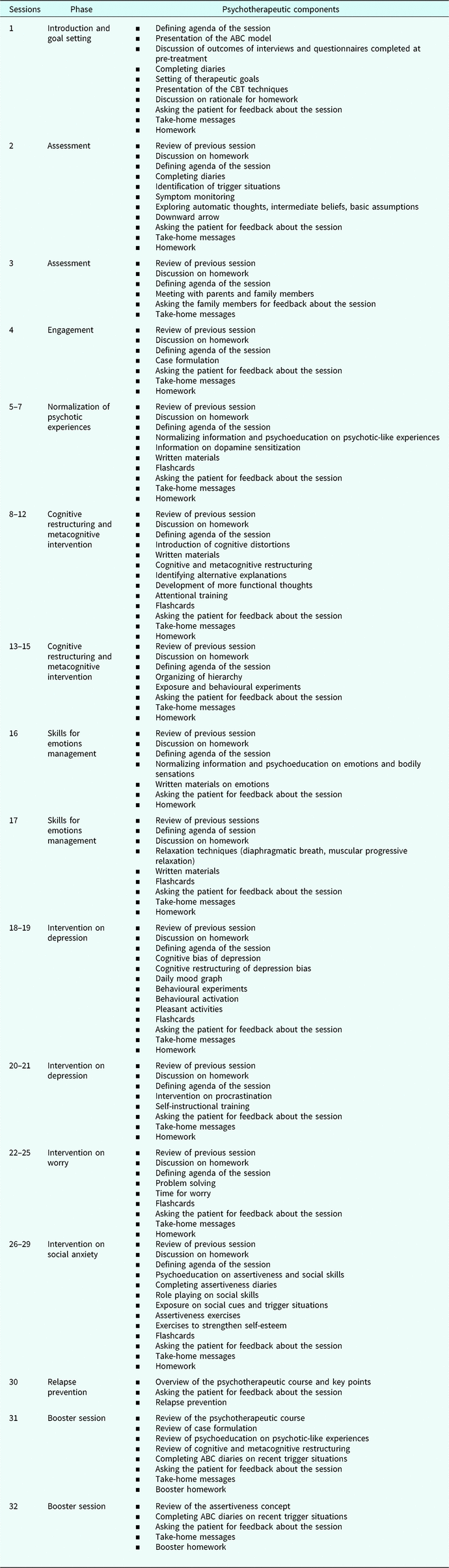
The CBT protocol consisted of 30 weekly individual 1-hour sessions for a duration of 6 months overall. The protocol was based on a textbook of CBT for young individuals at UHR for psychosis (van der Gaag et al., Reference van der Gaag, Nieman and Van den Berg2013a), which has been demonstrated to be effective (Ising et al., Reference Ising, Kraan, Rietdijk, Dragt, Klaassen, Boonstra and Wunderink2016; Rietdijk et al., Reference Rietdijk, Dragt, Klaassen, Ising, Nieman, Wunderink and van der Gaag2010). The goal of the intervention was to reduce distress provoked by psychotic-like experiences (van der Gaag et al., Reference van der Gaag, Nieman and Van den Berg2013a). In the present study, the therapeutic components of van der Gaag et al. (Reference van der Gaag, Nieman and Van den Berg2013a) were adapted to follow the recent recommendations provided by Thompson and colleagues (2015) who identified the following core components in randomized controlled trials of CBT for ARMS: Assessment, Engagement, Individualized case formulation, Psychoeducation, Cognitive behavioural strategies, Treatment of comorbid conditions (depression, anxiety), and Improvement of social skills. The intervention developed by van der Gaag and colleagues (Reference van der Gaag, Nieman and Van den Berg2013a) was further enriched with additional components based on Wells (Reference Wells2011) targeting worry [(meta)cognitive restructuring of metacognitive distortions of the advantages of worry and its dangerous effects and behavioural experiments challenging worry]. The protocol was divided into various phases including specific therapeutic components: (1) introduction, (2) assessment, (3) engagement and goal setting, (4) normalization of psychotic-like experiences, (5) cognitive restructuring and metacognitive intervention, (6) emotion management, (7) intervention on depression, (8) intervention on worry, (9) intervention on social anxiety and social skills, (10) relapse prevention, and (11) booster sessions. A detailed description of the protocol is provided in Table 1. During the Introduction phase, the therapeutic path was presented including session agendas and techniques used. During the Assessment phase, there was collaborative functional analysis aimed at identifying trigger situations; Activating events–Beliefs–Consequences (ABC) diaries were completed by the participant and the therapist during the session; symptom monitoring was facilitated; automatic thoughts, intermediate and basic assumptions were analysed. Subsequently in the Engagement phase, the therapist and the participant worked together to develop a shared hierarchy of goals for the therapeutic intervention. The therapeutic model is based on the hypothesis that the final common pathway from ARMS to psychosis is largely caused by catastrophic misinterpretations of psychotic-like symptoms which are then exacerbated by a high level of emotional arousal (Rietdijk et al., Reference Rietdijk, Dragt, Klaassen, Ising, Nieman, Wunderink and van der Gaag2010).
CBT protocol: psychotherapeutic components according to session and phase

During the fifth phase, psychoeducation on psychotic-like experiences was offered. During the subsequent phase, cognitive restructuring and metacognitive intervention were introduced. The subsequent three modules, Intervention on depression, Intervention on worry, and Intervention on social anxiety and social skills were conceived to target comorbid conditions which are often present in UHR individuals. Different from the protocol of van der Gaag and colleagues (Reference van der Gaag, Nieman and Van den Berg2013a), a module on worry was added, introducing psychoeducation on worry, exploring and correcting metacognitive maladaptive assumptions about worry (positive and negative cognitions about worry) and CBT strategies to manage worry (exposure, problem solving, behavioural experiments). Following the recommendations of Wells (Reference Wells2011), the patient’s metacognitive beliefs were challenged through metacognitive restructuring and behavioural experiments. In particular, the intervention focused on the identification and the modification of negative beliefs about worry, specifically its uncontrollability and its mental/physical dangerousness (‘Worry drives me crazy’). In addition, positive beliefs about worry were targeted (‘Worry is a useful coping strategy that makes me more capable to anticipate risks’). The goal was the reduction of negative metacognitive beliefs and the introduction of an alternative set of strategies so that the patient is better able to regulate worry and step back from triggering thoughts. The rationale given to patients is that worrying can be controlled by disengaging from trigger thoughts and postponing further conceptual processing: mental events do not matter, only responses to them do; worrying is harmless and there are no advantages to worrying. At the end of the therapeutic course, a relapse prevention module was dedicated to the identification of early warning signs of relapse. Between-session homework tasks were planned during the whole course of treatment. At the end of each session, the therapist asked the participant for feedback (e.g. how he/she felt during the session, potential difficulties encountered, usefulness of the session content). Together, they developed key take-home messages.
Data analysis
Statistical analyses were conducted using SPSS 21.00. The proportion was calculated for participants reporting a baseline PSWQ score higher than the cut-off based on the normative sample in the validation study of the instrument (Morani et al., Reference Morani, Pricci and Sanavio1999). Participants lost to post-treatment or 14-month follow-up were coded conservatively as non-converters. Data at post-treatment and 14-month follow-up on PSWQ scores were analysed using intention to treat analysis with last observation carry-forward. Analyses on this outcome were conducted on the non-converters by performing a repeated measures ANOVA, inserting time-point (baseline, post-treatment, 14-month follow-up) as the within-subject factor. Mean differences were calculated and post-hoc pairwise comparisons were made by conducting Bonferroni tests. Statistical significance was at a p-value of 0.05.
Results
Socio-demographics and clinical characteristics
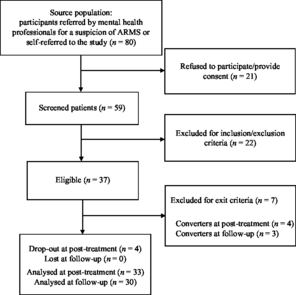
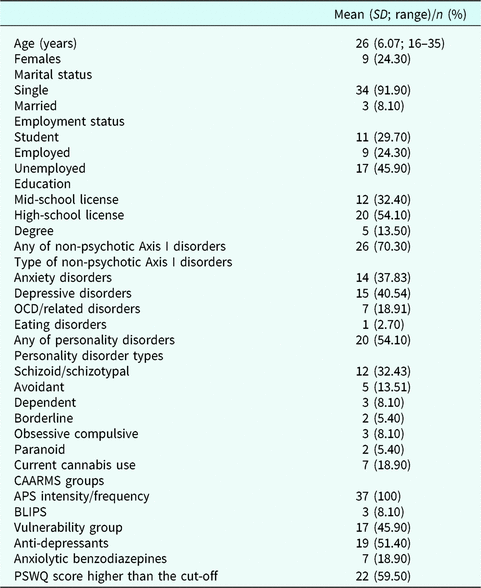
Figure 1 provides a flowchart according to the Strengthening in Reporting Observational Studies in Epidemiology statement (STROBE; von Elm et al., Reference von Elm, Altman, Egger, Pocock, Gøtzsche and Vandenbroucke2007). Thirty-seven participants were included (Table 2). Mean age was 26 years of age; eight (22.20%) were females. All the participants showed APS for intensity/frequency, three (8.10%) had BLIPs and 17 (45.90%) had a first-degree relative with psychosis or schizotypal personality disorder. Twenty-two (59.50%) reported a baseline PSWQ score higher than the cut-off based on the normative sample (Morani et al., Reference Morani, Pricci and Sanavio1999). Four participants (10.80%) dropped out from treatment before post-treatment assessment but none was lost at 14-month follow-up.
Flowchart according to STROBE guidelines (von Elm et al., Reference von Elm, Altman, Egger, Pocock, Gøtzsche and Vandenbroucke2007).

Demographic and clinical characteristics of the group (n = 37)

APS, Attenuated Psychotic Symptoms; BLIPS, Brief Limited Intermittent Psychotic Symptoms; CAARMS, Comprehensive Assessment of At-Risk Mental States; OCD, Obsessive Compulsive Disorder; PSWQ, Penn State Worry Questionnaire.
Transition to psychosis
Four participants (10.81%) at post-treatment and seven (18.91%) at 14-month follow-up had cumulatively made transition to psychosis. All patients who had transitioned at post-treatment or 14-month follow-up met psychosis criteria on the PANSS. Three participants (8.10%) reported a first episode of psychosis, three (8.10%) schizoaffective disorder, and one (2.70%) bipolar disorder with psychotic features.
Changes in worry at post-treatment and follow-up
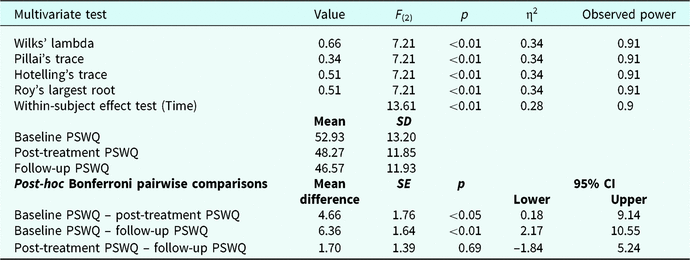
The results of repeated measures ANOVA conducted on non-converters showed a significant multivariate test (Table 3). Bonferroni post-hoc pairwise comparisons showed significant mean differences between baseline PSWQ and post-treatment PSWQ scores and between baseline PSWQ and 14-month follow-up PSWQ scores. The mean difference between post-treatment PSWQ and 14-month follow-up PSWQ scores was not significant. These results suggest that there were significant changes in PSWQ scores from baseline to post-treatment and from baseline to 14-month follow-up; PSWQ scores remained stable from post-treatment to 14-month follow-up.
Repeated measures ANOVA of PSWQ scores based on time-point in the non-converter group (n = 30)

PSWQ, Penn State Worry Questionnaire; SD, standard deviation; SE, standard error.
Discussion
CBT was found to be an effective treatment in reducing or delaying the risk of transition to psychosis in young individuals with ARMS (Schmidt et al., Reference Schmidt, Schultze-Lutter, Schimmelmann, Maric, Salokangas, Riecher-Rössler and Morrison2015). However, some researchers have highlighted the importance of investigating CBT benefits also on outcomes other than transition, particularly in the population of non-converters as they can report significant distress and symptomatic impairment despite not fulfilling the criteria for psychosis (van der Gaag et al., Reference van der Gaag, Smit, Bechdolf, French, Linszen, Yung and Cuijpers2013b). Worry was found to be a significant process associated with ARMS (Fresán et al., Reference Fresán, León-Ortiz, Robles-García, Azcárraga, Guizar, Reyes-Madrigal and de la Fuente-Sandoval2015): young individuals reporting ARMS may fear going crazy and losing control of their minds due to unexplained psychotic-like experiences. The present study is the first in the international literature to investigate changes in worry after CBT for ARMS in a group of non-converters seeking psychiatric care at mental health services. Thirty-seven young participants self-referred or referred by mental health professionals to psychiatric services were classified as ARMS and were included. All of them reported APS and a small sub-group, about 8%, also reported BLIPs; almost half of the total group, about 45%, were also classified as a genetic vulnerability sub-group. Overall, these findings seem to be in line with the percentages found in previous studies on CBT for ARMS (e.g. Stain et al., Reference Stain, Bucci, Baker, Carr, Emsley, Halpin and Startup2016), further supporting evidence that APS represents the majority of cases in the ARMS population and that a genetic vulnerability picture is present in about one-third of them.
The cumulative rate of transition to psychosis at follow-up after 14 months was about 19%, consistent with the evidence of some previous studies on CBT for ARMS where transition rates ranged from 8 to 16% (Addington et al., Reference Addington, Epstein, Liu, French, Boydell and Zipursky2011; Bechdolf et al., Reference Bechdolf, Wagner, Ruhrmann, Harrigan, Putzfeld, Pukrop and Bottlender2012; McGorry et al., Reference McGorry, Nelson, Phillips, Yuen, Francey, Thampi and Thompson2013; van der Gaag et al., Reference van der Gaag, Nieman, Rietdijk, Dragt, Ising, Klaassen and Linszen2012). The present transition rate seems slightly lower than that reported in the meta-analysis by Fusar-Poli and colleagues (Reference Fusar-Poli, Bonoldi, Yung, Borgwardt, Kempton, Valmaggia and McGuire2012a, b) on longitudinal studies, where it was 22% at 12-month follow-up.
A large sub-group, about 60%, reported significant baseline worry levels as shown by a PSWQ score higher than the cut-off reported in the validation study of the instrument (Morani et al., Reference Morani, Pricci and Sanavio1999). This evidence supports the notion that worry may be an important strategy used by young individuals with ARMS and expands previous research reporting that worry was significantly associated with ARMS (Fresán et al., Reference Fresán, León-Ortiz, Robles-García, Azcárraga, Guizar, Reyes-Madrigal and de la Fuente-Sandoval2015; Meneghelli et al., Reference Meneghelli, Meliante, Amato, Pozza and Dèttore2016). The proportion of ARMS participants reporting PSWQ scores higher than the cut-off was over twofold higher than that found among university students (Ruscio, Reference Ruscio2002).
The main result of the study was that there were significant reductions in worry levels after CBT from baseline to post-treatment and from baseline to 14-month follow-up. This suggests that CBT may be able to significantly reduce worry tendencies. An explanation of this result may be related to the fact that the protocol contained a module specifically targeting worry based on Wells (Reference Wells2011), which included some key components such as psychoeducation on worry, cognitive and metacognitive restructuring, and behavioural experiments. It may be hypothesized that reductions in worry were enhanced by reductions in cognitive biases specific to young individuals experiencing psychotic-like symptoms, such as attention to threat bias and jumping to conclusions, which are maintenance factors of worry (Pozza and Dèttore, Reference Pozza and Dèttore2017). However, as such biases were not measured in the present investigation, this explanation cannot be verified and warrants future research. Dismantling designs might disclose which CBT components aid in reducing worry in ARMS. Alternatively, in a broader sense, it may be that the protocol as a whole worked and that all the CBT skills provided helped the individuals to renounce worry as a coping strategy for managing distress and replace it with more functional strategies such as relaxation techniques. Another interesting result was that changes in worry achieved at 6-month post-treatment seemed to remain stable at 14-month follow-up; this provides evidence that the therapeutic gains achieved during a CBT course may be reliable over time and also endure after the end of treatment.
Some limitations should be considered. The lack of a control group means that the changes in worry may be attributable to factors other than CBT, including maturation or extra-therapeutic events (finding a job or a partner, or social support). Future research should compare the effects of CBT for ARMS on worry with the usual treatment by using a randomized controlled trial in order to control for these potential biases. In addition, a larger sample size is required to permit an investigation of potential moderators of changes in worry such as gender or comorbid anxiety/depressive disorders. Future research should also examine whether changes in worry moderate transition to psychosis: higher changes in worry may be associated with reduced transition risk. An interesting point might be to investigate whether changes in worry are associated with changes in some sub-clinical psychotic symptoms, particularly paranoid thinking. This may further support evidence of the role of worry in ARMS as a mechanism of change, in the same manner that worry is for full psychosis in CBT (Freeman et al., Reference Freeman, Dunn, Startup, Pugh, Cordwell, Mander and Kingdon2015). Finally, future studies may investigate socio-demographic and baseline clinical predictors of best treatment response (Brandizzi et al., Reference Brandizzi, Valmaggia, Byrne, Jones, Iwegbu, Badger and Fusar-Poli2015; Coluccia et al., Reference Coluccia, Ferretti, Fagiolini and Pozza2015; Fusar-Poli et al., Reference Fusar-Poli, Bonoldi, Yung, Borgwardt, Kempton, Valmaggia and McGuire2012a, b).
Conclusions
The present preliminary study is the first contribution to the literature investigating changes in worry after CBT for a young cohort with ARMS at immediate post-treatment and long-term follow-up. The current results indicate that CBT for ARMS may be promising in reducing worry and that treatment gains may be stable over time up to 14 months. Future research with a larger sample size and a control group randomly assigned to treatment as usual may also help in understanding whether changes in worry are associated with a reduced risk of transition to psychosis.
Acknowledgements
The authors have no acknowledgements to declare.
Conflicts of interest
A.P., S.D. and D.D. have no conflicts of interest with respect to this publication.
Ethical statement
The authors have abided by the Ethical Principles of Psychologists and Code of Conduct as set out by the American Psychological Association. Institutional Ethical Approval was obtained from the Ethics Committee.
Author contributions
A.P. designed the study, collected the data, conducted the literature searches, conducted the statistical analysis, and co-wrote the first draft of the paper. S.D. designed the study, collected the data, and co-wrote the first draft of the paper. D.D. designed the study, supervised the clinicians, reviewed the first draft of the paper, and checked the editing of the final version of the paper. All authors have approved the final manuscript.
Financial support
No grants were received for this research from any funding agency in the commercial or not-for-profit sectors.
Key practice points
(1) Psychological assessment and treatment of individuals with ARMS should focus also on worry.
(2) Worry may be used by this group of patients as a coping strategy to manage the distress associated with psychotic experiences.
(3) Young individuals with ARMS may fear going crazy or losing control of their minds due to worry.
(4) CBT therapists should provide psychoeducation on the nature of worry to normalize catastrophic interpretations about its negative effects.
(5) CBT therapists should use metacognitive restructuring and behavioural experiments to target metacognitive beliefs about worry.



Comments
No Comments have been published for this article.