Despite many recent successful cases of democratization, democracy arguably suffers from serious problems of disaffection.1
See, for example, Pharr and Putnam 2000.
The widespread perception that parties are procedurally necessary for the effective functioning of democracy does not translate into their being widely supported or respected. This syndrome is clearly evident, with parties today often being seen as both the institution most susceptible to corruption,2
Van Biezen and Kopecký 2007.
American National Election Studies show, for example, that in the late 1950s approximately 70 per cent of the American public felt they could trust government to do the right thing, or that politicians cared what people think; see Dalton 2004. By 2004, these figures had dropped to 46.5 per cent trusting the federal government to do the right thing always or most of the time, and only 34.3 agreeing that politicians cared what people think (2004 ANES).
A recent Eurobarometer study (2003, 59.1), for example, revealed that parties were the least trusted of all institutions on which opinions were sought, with an overall balance of trust of −59 per cent (i.e. only 16 per cent of respondents trusting them and 75 per cent distrusting them). The next least trusted institution were big companies (−28 per cent); trade unions recorded a balance of trust of −13 percent, the EU +6, the UN +12, the police +39, and the army +42 per cent; Eurobarometer 2003, 59.1.
On the public images of parties, see Dalton and Weldon 2005.
From this perspective, it is particularly important to reflect on the functions traditionally assigned to parties in the processes of democracy, and to ask how the apparently declining capacity of parties to perform their representative functions can be reversed, or alternatively how both parties and democratic systems more generally can adapt to the shift of those functions to other arenas. Do parties need to be reinvented? If so, what design tools are available, and how could they best be used?
Political science should be able to provide resources to understand and perhaps to help to address these corrosive tendencies and pressing concerns. But there is a strong case for arguing that it has deprived itself of a capacity to do so, due to a curious, persistent, and ultimately indefensible divide between two distinct sub-disciplinary domains: democratic theory (DT) and the study of political parties (PP). Any meaningful discussion of concerns with democracy and democratic legitimacy requires that empirical developments are assessed with reference to theories of democracy and that normative postulates can be evaluated in relation to empirical realities. The contemporary challenges to political parties, as part of a broader crisis of representation, heighten the degree to which the empirical and the normative need each other as we seek new ways to trace and express links between democracy as an existing practice and democracy as an unfulfilled ideal.
In this light, it is regrettable that, despite their importance to one another, the current literatures on political parties and normative democratic theory continue to develop to an extraordinary degree in mutual isolation. While assuming that political parties are inevitable for modern democracy, empirical studies of contemporary parties, party organization, and party systems tend to have little to say about the varied meanings and possibilities of democracy, and therefore of the varied potential roles of political parties within it. Conversely, modern democratic theory is noticeably silent on the question whether political parties have a legitimate place and function in a democracy. In this article we will back up these claims—noting that where there are exceptions they tend to prove the rule—and argue that this mutual neglect is a serious problem which threatens to prevent us taking advantage of promising areas for potential mutual engagement. We explore the key underlying reasons why democratic theorists and scholars of political parties should so rarely take on each others' core topics and concerns, and sketch just how this mutual disengagement is mutually impoverishing. The article will, however, suggest ways forward by pinpointing potentially productive areas of engagement which, if pursued, might just serve to deepen our understanding of democracy's present and its possible futures. Finally, by way of illustration we indicate how building on theory insights into deliberative democracy and party scholars' insights into party configuration and organization could be productive—and, in the light of the pressures that parties (and representation) are under, politically highly relevant.
Political Theory versus Political Science
The divide between democratic theory and the study of political parties can be seen as one part of the broader disconnection between the sub-discipline of political theory (or political philosophy—the terms are taken as interchangeable for present purposes) and political science more generally. Recently, Shapiro has argued that an ongoing process of professionalization and specialization has dissociated political philosophy from the rest of political science, and has separated normative from empirical theory, “with political philosophers declaring a monopoly over the former while abandoning the enterprise of ‘positive’ political theory to other political scientists.” As a consequence, “normative theory … is no longer informed, in the ways that the great theorists of the tradition took it for granted that political theory should be informed, by the state of empirical knowledge of politics.” This separation has not only resulted in an increasing tendency of normative political theory to downgrade concerns over practical feasibility but “has also fed the tendency for empirical political theory to become banal and method driven—detached from the great questions of the day and focused instead on what seems methodologically most tractable.”6
Shapiro 2002, 597.
Arguably, modern political philosophers have always been more aware of the nature of their activity and the way in which their sub-discipline connects to the rest of political science than their colleagues in other branches of the discipline.7
Kelly 2006, 47.
Gunnell 1986.
Ball 1995, 60.
Dryzek 2000, 26.
Kelly suggests that, if political theory is to continue to command interest and respect within the discipline, “it does more to re-engage with political science,” which it can do “by challenging the terms of much that goes on in political science.” In so doing, political theory could provide a support structure for what political scientists do by conceptual clarification and theory construction, and would act to clarify and challenge the normative dimensions of the theories and questions that political scientists work with.11
Kelly 2006, 52.
These overviews may seem exaggerated, but we would agree that they are largely accurate. There are many pressures which drive sub-disciplines away from mutual engagement, from the internal organization of academic departments to increasing journal specialization to certain research accounting and funding procedures. Whatever the causes, the diagnosis is clear enough; to move towards tentative prescriptions, we need to address a range of problems that arise from this large-scale disjunction. The specific case of the linking of democratic theory and research into political parties is just one such problem, though (as we hope to show) one of real significance.
Among the various modes of non-communication between political philosophers and political scientists, our concern here centers on the meaning and interpretation of “democracy.” We do not argue that theory and empirical work on a range of democratic institutions have not been mutually engaged—they have, in various ways. But this work, it is fair to say, focuses much more on the “hardware” of democracy rather than the “software” of mediating institutions like political parties. For example, Lijphart's consensus and majoritarian models, Dahl's account of the constitutive features of polyarchy, Guinier's discussion of electoral rules, and Mansbridge's rethinking of representation engage with characteristics and trajectories of a range of background institutions—electoral systems, electoral and other rights, executive accountability, the accountability of individual members of Congress, and so on.13
Such authors clearly engage with democratic institutions to help to generate theoretical insights. Notwithstanding such efforts, engagement between work on democratic theory and political parties specifically has remained exceptional.From that perspective, and with specific reference to work in democratic theory and on political parties, a key challenge for political theorists lies in fostering more critical conceptual engagement among scholars of political parties and the elucidation of the implicit normative assumptions underlying many of their approaches. Democratic theorists, at their best, problematise democracy, drawing out shifting and competing meanings. Some of this work may involve uncomfortable implications for the place of parties in democratic politics, today and in the future. However, when addressing empirical reality and advancing practical solutions for the improvement of the quality of democracy, democratic theorists should be less reluctant to acknowledge the reality (and indeed the potential) of the political party and to incorporate the empirical findings of party scholars.
Party scholars, on the other hand, when addressing normative and empirical issues of democracy, could benefit from developing a greater sensitivity to the broader significance of the place and role of political parties in modern democracy, and a greater awareness of the conceptual and theoretical dimensions underlying democracy. We will pick up a range of such issues in what follows.
Back to the Future?
Both democratic theorists and party scholars could find inspiration in the great thinkers of the past, as the two particular ‘schools’ have not always been disconnected. Indeed, until the mid-twentieth century it was often precisely through the concept of democracy that normative political theory and empirical political science were closely linked. In the eighteenth century, Hume was the first among the major political philosophers to take up the subject of parties.14
Sartori 1976, ch. 1.
Hume, quoted in Scarrow 2002, 35.
Mansfield, quoted in Scarrow 2002, 37.
Over the course of the eighteenth and nineteenth centuries, political philosophy gradually came to terms with the continued institutionalization of political parties and their de facto inevitability as permanent elements of the political system (though strong anti-party sentiments continued to permeate many theories of government and democracy). The reality of the political party received a final and decisive push with the advent of mass democracy and the introduction of universal suffrage. As the size of the democratic polity increased with the consolidation of large-scale nation-states, direct links between the state and the individual became increasingly unrealistic, a fact which further legitimized the status of parties as intermediary institutions between individual citizens and the state. More or less contemporaneous with this development was the shift in the dominant meaning of democracy; in the late 1700s Madison dismissed democracy, understood as Athenian-style direct democracy, in favour of republican government. In just over 100 years, Madison's republicanism was well on the path to becoming itself the dominant meaning of democracy.
Until at least the early twentieth century, as the works of major scholars of political parties such as Ostrogorski, Michels, and Weber demonstrate, the empirical study of political parties remained intimately related to democratic theory.17
To be sure, Ostrogorski and Michels in particular were primarily concerned with democracy within parties, and the undemocratic and oligarchic tendencies of bureaucratic mass parties in particular, and not with democracy as a political system based upon competition between parties. However, their theoretical and empirical analyses of the functioning of political parties are clearly related to the theory of democracy. Ostrogorski's solution to what he saw as the suffocating internal discipline of mass parties, i.e., to create a polity without permanent parties, underlines how he sought to reconcile liberalism with the idea of popular sovereignty, thus addressing a fundamental concern that pervaded much of the nineteenth century. Michels implied that parties should be seen as obstacles to, or the very antithesis of, democracy, at least to the extent that the “iron law of oligarchy” should be seen also to apply to the organization of the state itself. Weberian analysis, on the other hand, suggests that strong and responsible political leadership may be necessary for the healthy functioning of democracy, principally because it serves to prevent the politicization of an unaccountable bureaucracy. On this view, a lack of democracy within parties is not necessarily consequential for democracy at the system level because, as Sartori would later put it, “democracy on a large scale is not the sum of many little democracies.”18Sartori 1965, 124.
The Mysterious Absence: Contemporary Democratic Theory and Parties
So, the deep linkage of party (and partisan) interests with philosophical and theoretical reflection on democracy was strong and varied in a range of classic sources. It was in the twentieth century—and arguably in the 1960s and 1970s in particular, as the behavioural revolution in political science advanced while normative political theorizing suffered something of a crisis of identity and relevance—that the study of democratic theory and of political parties separated and diverged. Empirical and institutional work on democracy was still sometimes combined with theory construction and conjecture, as we have seen. But parties specifically tended to be bypassed by democratic theorists, and those scholars specializing in political parties tended to do so quite separately from the concerns of democratic theorists. In this section we briefly offer support for our view that this separation is real. In the next section, we explore the more significant question about why this separation has occurred and been sustained.
Arguably it was Schumpeter in the 1940s who most influentially reconciled parties with democracy, by defending a minimal conception of democracy in which the circulation of party elites in power through elections became both its essence and justification. In recent years, however, the theory of democracy has by and large become detached from analysis of the character and roles of political parties, despite a few notable exceptions such as Robert Dahl or Giovanni Sartori, both of whom have published normative studies of democracy as well as empirical studies of democratic institutions and political parties. As Sartori observes, however, as scholars of political parties we are “travelling more and more through the ever-growing jungle of party polities without really knowing where we started, let alone where we are heading.”19
Sartori 1976, 24.
See the argument in Saward 2001.
Schattschneider's observation that “the political parties created democracy and that modern democracy is unthinkable save in terms of the parties”21
Schattschneider 1942, 1.
This seeming incompatibility between the perceived necessity of parties, on the one hand, and their representative inadequacy, on the other, is indicative of a changing conception of political parties and democracy. More particularly, it reflects an ideational transformation of political parties away from the voluntary private associations which perform public roles and occupy government positions, to the party as a special type of public utility or public good for democracy; Van Biezen 2004.
Underlying the debates about the contemporary performance of existing parties and party systems, there are fundamental disagreements about the meaning of democracy and the role of political parties within it. What that conception of democracy is, however, remains unclear. Complaints about the decline of party, the growing disengagement from partisan politics, increasing dissatisfaction with and distrust in parties and politicians, the weakening of their representational and governmental roles, and the problems of accountability, responsiveness, and legitimacy, all rest upon, usually implicit, normative assumptions concerning what is valuable about democracy and about how democracy should work.23
Daalder 2002, 54.
A noticeable exception is Katz 1997, who links the questions and issues raised by normative democratic theory to the empirical analysis of elections and electoral systems. Other significant exceptions include Katz and Mair 1995, who analyze various models of party organization in relation to the underlying conceptions of democracy. See also Pomper 1992.
Katz 2006, for example, shows how various strands of popular sovereignty and liberal theories of democracy and competitive party systems contain widely divergent assumptions with regard to a range of issues, including the ideal number of parties, the cohesiveness of parties, their goal orientation, the internal constraints on the party leadership, or the relationship between parties and social cleavages.
Just as scholars of political parties tend to disregard the variety in conceptions of democracy, contemporary democratic theorists generally fail to acknowledge the variety in functions and types of party. If not ignored altogether, parties are often at best understood one-dimensionally, as monolithic entities or mysterious black boxes. In particular in varieties of democratic theory belonging to the strands of participatory democracy and civic republicanism (including recently prominent strands of deliberative democracy), political parties are conspicuous by their marginality or absence. Even in theories of democracy that are less averse in principle to the notion of interest representation and the existence of intermediary structures, the status accorded to political parties is quite trivial. Theories of associative democracy, for example, which argue for voluntary citizen associations as the central institutions of governance, have little to say about the role of political parties in democratizing civil society or the state, or the extent to which self-governing voluntary associations should replace or complement the activities of political parties.26
See for example Hirst 1994. A compelling account of a highly decentralized democracy based on service-delivery through voluntary associations, Hirst's approach leaves major gaps in terms of where persisting national parliamentary and party politics may fit. His schema clearly allows for them in a federated structure, but they are left largely undiscussed.
Johnson 2006, 48.
The absence of political parties from these domains of democratic theorizing is quite stark, and is evident in a range of contemporary democratic theory topics and debates. Key parts of the literature on “participatory democracy” in the late 1960s to the early 1980s bypassed parties to look instead at functional and radically decentralized modes of participation.28
See for example Pateman 1970, Bachrach 1967, and Barber 1984. MacPherson's advocacy of a Soviet-style pyramidal party structure was an exception of sorts, but was based largely on a rejection of empirical realities of existing political parties; MacPherson 1977.
Shapiro and Hacker-Cordon 1999.
Gutmann and Thompson 1996.
Parties play a marginal, and to a degree a suspect, role in Young's otherwise extensive examination of the politics of inclusion and democracy,32
Young 2000.
Fishkin and Laslett 2003.
Christiano 1996.
Of course this is a selective sample. Nevertheless readers can judge for themselves our basic claim: contemporary democratic theorists rarely consider the necessity, roles, promise, or democratic character of political parties, and often simply neglect them. Rather, they focus on an array of principles, moral dilemmas, institutional hardware and design, individuals as actors and citizens, “the people,” and new forums and other institutions which may embody democratic ideals. There are exceptions—Christiano to some degree, Phillips and Budge for example40
—but they are isolated ones. It is something of an irony that in one of the earliest and most influential articles in the dominant deliberative democracy strand, Joshua Cohen noted that “the question is how we can best approximate the deliberative conception. And it is difficult to see how that is possible in the absence of strong parties, supported with public resources.”41Cohen 1989, 32.
Manin 1987, 357.
Why Democratic Theorists and Party Scholars Don't Talk to Each Other
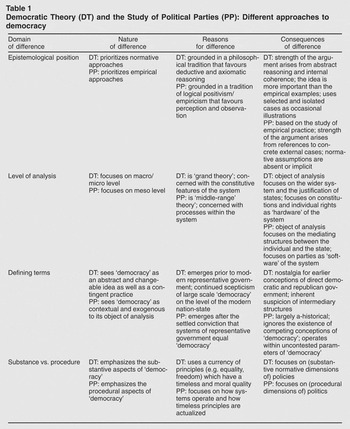
With so many topics and concerns in common—not least the fundamental health of democracy—why is there such a divide between democratic theory and the study of political parties? We have hinted at some reasons; in this section we approach the issue explicitly and more systematically. We think that there are at least four key, and interrelated, characteristics of the different literatures' approaches to democracy within which the core reasons can be located; these are referred to as “domains of difference.” These domains are: (1) dominant epistemology approach, addressing fundamental issues of how we know what we know; (2) the level of analysis, dealing with different tendencies to prioritize the focus on certain evident features of polities; (3) definitions of key terms, above all democracy, and (4) positioning of analyses on issues of substance and procedure. No doubt there are different ways of carving up fundamental differences dividing the two literatures concerned. But we hope to show that these four domains are fundamental. Further, there are clear relationships between the four domains. For example, an epistemological approach that prizes normative thinking is more likely to emphasize substance over procedure (or at least to see procedures in terms of principled points of substance). Likewise, scholars of political parties will in part emphasize procedures since their epistemological preferences for empirical approaches induce scepticism about positing essential substance. These different approaches have deep roots and extensive influence on the focus and style of the different literatures. These characteristics, as well as the broader nature of the different approaches, the reasons for them, and their consequences, are schematically represented in table 1.
Democratic Theory (DT) and the Study of Political Parties (PP): Different approaches to democracy

The first domain of difference concerns the different dominant epistemological approaches of democratic theory and the study of political parties. Although perhaps less directly related to the treatment of democracy per se, these positions have an immediate bearing on it, as well as being related to the other characteristics. Broadly speaking, democratic theory tends to prioritize normative approaches, concentrating on the ideals and fundamental principles of democracy, while the study of political parties tends to prioritize empirical approaches, focusing primarily on the workings of democratic institutions in actual practice. The main reason for this methodological difference is that democratic theory largely emerged out of, and remains grounded in, a philosophical tradition that favours deductive reasoning from abstract axiomatic principles, while the study of political parties is rooted in a later tradition of logical positivism that favours empirical exploration and the verification and falsification of empirically observable evidence.
This means that for the democratic theorist clarifying and debating the democratic ideal remains more important than (and the necessary precondition for) exploring actual empirical examples. The primary force of the argument derives from abstract reasoning and internal coherence rather than a correspondence between theoretical claims and empirical reality (the latter is often more than just a negligible concern, but not often with specific reference to political parties). Empirical examples serve a purpose primarily as selective and isolated illustrations of the argument. To scholars of political parties, on the other hand, empirical observations are vital to theory building, whether inductively or deductively conceived, and contentions and claims only hold true to the extent that they can be supported by empirical evidence. Normative ideas are often taken to be largely irrelevant—it remains implicit that we already know what democracy is, and why it is valuable. From that perspective, arguments about ideal models of democratic deliberation arising from speculative contract theories (as Cohen's does, through Rawls, for example),43
See Saward 2000.
For the study of democracy in particular, this means that the concern of the democratic theorist lies primarily with the foundations that constitute the democratic polity, while for the student of political parties it lies with the actual functioning of the institutions within it. This brings us to the second, and related, domain: the level of analysis. Democratic theory and the study of political parties see themselves as operating at different levels of generality. Democratic theory is often grand theory, while the study of political parties operates largely at the middle-range level. While democratic theory focuses primarily on the macro (or system) level and its links to the autonomous individual at the micro level, the study of political parties concentrates mainly on the meso level of the political system. Because democratic theory is essentially concerned with the constitutive features of the democratic state and their moral justification, it tends to focus its attention on the broader system. Moreover, modern democratic theory arises largely from liberal traditions of philosophy. As contractarian sub-traditions of liberal philosophy have been extremely influential in democratic theory, these have biased the latter towards the constitution of states rather than the processes operating within states.44
Some theorists have expressed frustration at how general normative prescriptions are discussed in isolation from their institutional implications or embodiment (e.g. Smith 2000).
Democratic theory, therefore, often concentrates on questions of constitutionalism and individual rights, which it sees as the important hardware of democracy. Parties are seen as software and as less basic to democracy in temporal, organizational, deliberative, or normative terms. Democratic theorists, indeed, convey real doubt as to whether democracy does “need” parties; partisanship generally is often seem as something to be overcome, an obstacle to democratic reasoning,45
Muirhead 2006.
Debate about the often blurred distinction between theory and ideology raises a further issue. One can argue that normative political theories are not as different from party ideologies as their progenitors often imply. Such theories can be seen as particularly sophisticated versions of partisan ideological arguments, expressed in a different idiom but belonging ultimately to the same genus.
Each of these concerns, in turn, has an impact on how the fundamental concept at hand, democracy, is defined and understood in the two literatures. With regard to the defining terms, therefore, to study democracy means something altogether different for the democratic theorist than it does for the scholar of political parties. This observation brings into focus the third domain of difference. For the democratic theorist, democracy is an abstract and changeable idea as well as a contingent practice. For the scholar of political parties, on the other hand, democracy is largely contextual and exogenous to its object of analysis. In order to understand why this should be the case it is important to underline the sequence in which democratic theory and the study of political parties developed in relation to the establishment of representative government. Democratic theory developed prior to the emergence of modern representative government. Until surprising recently democracy meant direct, face-to-face democracy, a meaning stretching back to its Greek origins over 2,500 years ago. The idea of unmediated, face-to-face politics still hovers in the background as an implicit—and sometimes foregrounded as an explicit—baseline against which to measure degrees of democracy in different contexts.47
Barber 1984.
Dahl 1989, 30.
Fishkin 1991, 119 n.31, attributes this term to Bruce Ackerman.
There are varied suggestions in contemporary democratic theory that proximate or face-to-face politics is superior to mediated or distant connections. Although the language of “authenticity” is often treated with scepticism in their writings, Fishkin and Luskin's (2000) account of the deliberative poll, Dryzek's (2000) account of localism and ecology, and Phillips's (1995) work on the ‘politics of presence’ all display something of this tendency.
In addition, as we have hinted above, democratic theory largely emerges out of traditions of thinking about politics which stress individualism, on the one hand, and the collective (including the collective interest), on the other. There is little scope for what lies in between that dyad, for mediating institutions and organizations such as political parties. In fact, the existence of political parties was fundamentally incompatible with both the liberal democratic tradition rooted in the resolute individualism of Locke and the radically communitarian and anti-representative democratic tradition inspired by Rousseau, both of which in their different ways are difficult to marry with partisan institutions, which by their very nature both transcend individual interests and refute the existence of some sort of “general will.”51
Or, as Daalder argues, the source of the rejection of party can be found in two bodies of thought. On the one hand, there were the defenders of the traditional political order “who saw in the rise of party an unwanted invasion of the terrain of the state, which as the guardian of long-term transcendental interests threatened to fall victim to private interests of a short-term nature.” On the other hand, there were the defenders of the sovereign and free individual, “who opposed what they regarded as they tyranny of party, which would do away with freedom of individual action and thought for the sake of collectivist organizations led by irresponsible elites”; Daalder 2002, 41.
The analysis of political parties, by contrast, emerged only after the notion that systems of representative government are democracy had more or less settled. Studies of political parties, therefore, tend to be rather a-historical. They ignore the variety in both historical and contemporary conceptions of democracy and tend to accept elections, and the narrow interpretation of representation associated with them, as benchmark democratic practice. Relatedly, they also tend largely to operate within the uncontested parameters of existing democratic systems without any systematic questioning of their democratic quality. While many empirical studies of political parties and democracy will accept the notion that democracy belongs to the category of “essentially contested concepts,” the literature is not very good at “making democracy strange,” to use the old anthropological way of formulating the first necessary step in analysis. Such approaches can sometimes be seen as committing the “definitional fallacy”52
Holden 1974.
See the discussion of this and related issues in Skinner 1973.
The fourth domain of difference is that of substance versus procedure. Whereas democratic theory tends to emphasize the substantive aspects of democracy, the study of political parties emphasizes the procedural aspects of democracy. To do political philosophy is to write about morality, about issues pertaining to rightness and wrongness, which lends itself to theorizing about substance, not procedures.54
For a good example of the tensions between substance and procedure in recent democratic theory building—and the perceived need to defend oneself against charges of “proceduralism”—see Gutmann and Thompson 2003.
Why Democratic Theorists and Party Scholars Should Talk to Each Other, and How They Could
There are many good reasons for rectifying the contemporary lack of communication between democratic theorists and scholars of political parties. Political parties occupy an ambiguous position in modern democracies, which is in part a product of the tension between their de facto inevitability as key institutions of modern democracy and their increasing inability to perform the representative functions that legitimized their emergence and that are widely seen as essential to the quality of democracy. The centrality of political parties can be demonstrated empirically by the fact that they are firmly rooted in the established western democracies, and have rapidly acquired relevance in the more recently established democracies which have emerged out of what Huntington has called the “third wave,”55
Huntington 1991.
Modern democracy, as Hardin puts it either “cannot entail massive citizen participation or it is irrelevant to actual practice in modern politics.”56
Hardin 1999, 169.
Both theories of liberal democracy and deliberative democracy offer some potential to extend and to reconnect in this respect, as neither is in principle averse to the notions of representation and mediation. However, further progress would require a deeper appreciation and analysis of the place and functions of parties as the principal mediators in the democratic system. Even arguments for new mediating or representative institutions that might afford a deeper realization of democratic norms in practice need to deal with the issue of whether they can or should supplement or replace party-based processes.
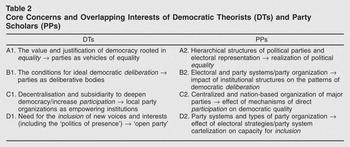
What are some of the key areas in which this renewed engagement should occur? Consider a snapshot of selected core concerns of democratic theorists and party scholars respectively:
Each of the items in the left column of table 2 can be seen as democratic theory demands on democracy, and a set of areas in which democracy might be extended or deepened. They reflect the widespread conviction in democratic theory that the process of democratization is always unfinished, and that democracy is always an imperfectly realized ideal. Each of the items in the right column, deriving largely from the study of parties and party systems, can be seen as either constraints on the supply of democracy or vehicles through which the demands might in part be met. Both columns also include suggestions how both fields might take on board and engage more directly with each others' concerns.
Core Concerns and Overlapping Interests of Democratic Theorists (DTs) and Party Scholars (PPs)

With regard to A, equality, democratic theorists could gain by considering how, and to what extent, parties, in present or transformed configurations, can act as vehicles for the democratic ideal of equality. Discussions of equality lie at the heart of justifications of democracy,57
Equality above all other values is invoked in philosophical discussions of democracy's value. See Dahl 1989, Saward 1998, and Beetham 1999.
Downs 1956.
We return to B, deliberation, shortly, for reasons we shall make clear.
With regard to C, participation, decentralizing tendencies within democratic theory—oriented towards getting power closer to the people—might engage much more fully the local-national nexus in party systems and structures, and ask, for example, to what extent decentralized parties might act as a surprisingly subversive vehicle for disrupting the resolutely national (and therefore highly indirect and often distant) focus of democratic politics. Democratic theorists might also reflect on the role of parties in linking the local with the national, or on empowering the people through the agency of party in the democratization of decision-making structures and governing processes at the level of the nation-state. And indeed, since cosmopolitans and greens within democratic theory have been concerned to explore democratization in the international arena, links between parties in different countries, as well as the organization of international parties, ought to be explored. Party scholars might take less for granted the national basis of democracy and ask, for example, to what extent the dominance of national party organizations underpins the persistence of a minimal democratic politics and undermines a more diverse, local and even direct or participatory democratic politics. They might also further explore how the increased use of mechanisms of direct democracy, both inside and outside party channels, for decision-making and candidate selection impact on democratic ideals for deepening democracy.
For D, inclusion, democratic theorists' concerns about facilitating the representation of new and marginalized interests in democracies could focus less on general institutional fixes (such as quotas for women) or exotic imports and creations (citizens juries, for example), and more on the democratic potential of provocative ideas like the “open party”—a party in which its grassroots members, and perhaps also supporters more broadly, are responsible for setting political and policy goals. In other words, they could engage more fully in a discussion on how a deeper realization of democratic inclusiveness might be achieved through a modification or transformation of the existing representative institutions rather than ignoring the party-based process or tacitly assuming that it is best replaced by other structures. Students of parties, on the other hand, could fruitfully consider the extent to which parties fail to prioritize the inclusion of concerns of the marginalized in their search for electoral pre-eminence and government office, and how in turn they may unwittingly act as brakes on the deepening of democracy. Do parties lack a democracy-supporting incentive to build long-term capacity as opposed to maximizing short-term gain? On the level of the party system, they could examine the extent to which the formation of “cartel parties” has encouraged the exclusion or effective marginalization of certain interests and thus undermined a more inclusive democratic politics, and explore possibilities to counteract current trends towards less inclusiveness.59
Inter-party relations in the era of the cartel party, according to Katz and Mair 1995, are characterized by a pattern of inter-party collusion rather than competition, whereby the main parties work together and take advantage of the resources of the state to ensure their collective survival, making it difficult for newcomers to enter the system and challenge the status quo.
In all of these areas, and others, each camp has much to learn—or perhaps more to the point, much to be provoked by—in the different orientation of the other one. So, democratic theorists need to engage more, for example, with the constraints and opportunities which the realities of parties and party systems embody with respect to the realization of core democratic ideals. And party scholars need to engage more with the demandingness, restlessness, and changeability of those ideals, as well as with difficult issues of how far empirical realities offer a sufficient realization of democratic ideals.
Clearly the four areas are closely related. Participation is not the same as inclusion but the demand for one can often be a demand for the other. Inclusion might involve issues about citizenship, raising questions about the boundaries of the political community and who is to be included in the equality concern. Deliberation is not necessarily a basis of, or a producer of, equality, but issues of equal access to deliberative forums are crucial to the claims of deliberative theorists. We lay the issues out here as we do for clarity's sake.
Of course, it is one thing to call for more engagement, and point towards how it might be done. It is tougher actually to do the work. So let us try to put this partly right by spelling out for illustrative purposes what it might mean to follow our own injunction for our second democratic demand B, deliberation. We do not have space to be much more than indicative in so doing.
Scholars of political parties have largely ignored the “deliberative turn” in democratic theory. And theorists of deliberative democracy have largely ignored political parties. Even when they recognize the limited contribution deliberation can make to democratic politics and governance, democratic theorists still do not discuss parties.60
This may be because theorists see parties as part of the problem of political disaffection and voter ignorance, and not part of a potential solution. Or because the deliberative ideal has roots in thinking oriented to the general interest, roots which influence their preference for certain alternative devices—citizens' juries and deliberative polls for example—and steer them away from suspect partisan institutions like parties (and thus, according to Budge's critique, taking “the politics out of politics.”)61Budge 2000.
But what if both party scholars and democratic theorists took up Cohen's early challenge to explore parties as vehicles for deliberative democracy? Deliberation, theorists argue, can produce more informed preferences and enhance legitimacy, although the ultimate purpose of deliberation—the education and development of citizens, the forging of a broad consensus, etc.—has a real impact on the sites and mechanisms of deliberative democracy. Consider first parties themselves as sites of deliberation. We need to accept, of course, that parties are partisan, but that need not mean narrowly partisan. Parties have to sell a general interest vision to voters. And, especially in an era where relatively fixed class roots of party ideologies are loosening, there is arguably more scope for deliberation over alternative party visions, programmes, and policies. Parties could be umbrellas for positive deliberation over alternative proposals, all still within the broad ideological “frame” of the party. There may be scope to increase party memberships (in steep decline in many countries) if genuine opportunities to deliberate over policy are seen to be available.62
See, for example, Mair and van Biezen 2001.
Hendriks, Dryzek, and Hunold 2007.
Analysts could also look at decentralist and consultative mechanisms already present in party organization, exploring and perhaps deepening democratic deliberation on the back of them (with potential benefits in terms of identification, legitimation, and even strategic advantage). Such mechanisms could include bottom-up policy-making, degrees of local party autonomy, party primary elections and other participative modes of candidate selection, and party conferences. Further, there is little reason why more-favoured deliberative mechanisms, such as deliberative polls, could not be deployed within party debates.
Next, consider parties as potential promoters of societal deliberation. Party competition clearly fosters societal deliberation, through the media and otherwise—observers might analyze the quality and extent of this deliberation, and how parties do (and might) contribute to both. Could parties take part in policy and candidate debates more often and more prominently—perhaps even to their strategic advantage? Could they, in this light, sponsor citizen's juries or consensus conferences, rather than the more narrow focus groups that are often more favoured by parties? Even more broadly, what of the different incentive structures inherent in different electoral systems for promoting inter-party and diffuse societal deliberation? Perhaps the shift to cartel parties, ironically enough, could foster deliberation, since the latter is sometimes easier to engender in more elite contexts.64
On elitist tendencies in a focus on deliberation, see Offe 1997.
Observers might pay closer attention to deliberation between parties in legislatures. To what extent are parties vehicles for deliberation as well as representation in that context? And how can the potential complementary nature of these two roles be enhanced? Further, at a time when environmental and other issues are leading us to question the very idea of domestic policy, deliberation's capacity to work across borders and contexts may be enhanced by parties engaging for example with sister parties in other countries through policy deliberation. More generally, the value of party-fostered diffuse and episodic societal deliberation, not confined to one specific mechanism or device, has been under explored.
In these brief comments there is a range of hypotheses, born of looking past the mutual disregard that is the core topic of this article. Refining and exploring these hypotheses would require new orientations for both democratic theorists and party scholars. The former would need, for example, to engage with parties as unavoidable, if flawed, vehicles of policy aggregation and political representation; to recognize deliberation's limits; to work with institutional constraints; and to recognize the grey zone between particular and general interests. The latter would need, for example, to accept that democracy is inevitably a normative notion and take on board the power of the deliberative ideal; to recognize the potential of deliberative devices as supplementing and potentially improving party legitimacy and procedures; and to recognize the importance of critical questioning of party contributions to the quality of democracy, and deliberation. By such routes, new ways for scholars to address the widespread disaffection with politics in general, and parties and politicians in particular, may be opened up. And that would be significant for the relevance and utility of political science.
Conclusion
If it is true, as Bryce argued at the beginning of the twentieth century, that modern representative democracy cannot function without political parties, current developments indicating that parties are losing their capacity to act as agents of representation have far-reaching implications for the nature of democracy.65
Bryce 1921, 119.