I. Introduction
VIOLENCE commonly follows the handover of power from military dictators to democrats: over 40 percent of governments undergoing this transition became embroiled in internal violence within five years.Footnote 1 What explains the coincidence of democratization and violence? One explanation relates to how military leaders use violence to retain control. In this article, we examine the role of the military and the strategies it pursues to protect rents during a democratic transition. We argue that military elites face a perverse incentive to stir up conflict in economically valuable areas to prevent new civilian leaders from asserting control.
During regime transitions, civilian leaders must decide what to do with the old guard. Although a new civilian government may want to curtail the role of generals, it both relies on security forces to maintain order and risks a coup if it attempts to strip soldiers of authority and status. The military’s cache of arms and ongoing role in national defense thus provide it with bargaining power during a transition to democracy.Footnote 2 As Juan Linz and Alfred Stepan observe, military leaders do not eagerly cede political control but instead “negotiate their withdrawal,” attempting to maximize their “non-democratic prerogatives.”Footnote 3 These prerogatives can take the form of rents, political influence, or formal roles within the new administration. To further amplify its bargaining power and expand these prerogatives, the military has an incentive to convey—even to exaggerate—its role in protecting the nascent civilian government from internal and external threats.
To assess whether this prediction matches reality, we focus attention on a recent transition (since 2010) from military rule to democracy: Myanmar.Footnote 4 We find evidence that Myanmar’s military (known as the Tatmadaw) selectively stokes conflict to retain nondemocratic prerogatives, specifically its stake in the country’s jade-mining sector.Footnote 5 By some estimates, Myanmar’s jade sector was valued at about US $31 billion in 2014, equivalent to roughly half of the country’s gdp.Footnote 6 We argue that the Tatmadaw’s leadership, which has well-documented ties to jade production and smuggling, initiated violence in mining areas during and after the transition to deter the civilian government from directly administering these regions.
Using geocoded data on conflict and the locations of jade mines, we find support for this argument. Just as Myanmar embarked on its political transition—inaugurating a new civilian government in 2011— we observe a sharp increase in conflicts involving government security forces in jade-mining areas. We find no corresponding spike in townships without jade mines. Primary and secondary sources indicate that this violence represents a Tatmadaw offensive in the jade-mining areas designed to protect rents flowing to military commanders. In an exemplary report on Myanmar’s jade sector, the international ngo Global Witness observes, “As with war economies the world over, genuine peace and outright war are the main enemies of the military entrepreneur in [the jade-mining areas of] Kachin State. Far preferable are the grey areas in between that justify the deployment of the troops needed to intimidate and extort but do not demand much actual fighting.”Footnote 7
We bolster this conclusion by ruling out alternative explanations for the violence. The increase in conflict does not represent a broader confrontation between the military and rebel groups, for example, due to a change in the perceived strength of the Tatmadaw. Of the fifty-seven townships covered by ceasefire arrangements between the government and insurgent groups (negotiated starting in 1989), violence flared up only in townships with jade mines. Furthermore, we do not observe increased conflict among ethnic armies or communal groups in jade-mining areas (or violence between military units). This suggests that the military was not reacting to instability but was instead initiating the violence. We also rule out commodity price changes, the controversial Myitsone Dam project, and trends specific to Kachin State as alternative rationales.
Research on democratization highlights the challenge of compensating incumbent elites who stand to lose from a transition to popular civilian control.Footnote 8 These incumbents recognize that their position is perilous: once solidly in power, the ascendant democratic administration will strip them of their prior office-holding benefits.Footnote 9 We contribute to this literature by illustrating a strategy that military leaders deploy to forestall this loss of power and rents. We argue that rather than quietly returning to the barracks, the military strategically uses violence to deter the new government from directly administering valuable territory, which leaves control of it in the military’s hands.
Previous, almost exclusively qualitative studies suggest that the dynamics we uncover in Myanmar generalize to other transitions.Footnote 10 Juntas the world over resist the loss of rents implied by democratization. Under certain conditions, stoking violence can provide a means of maintaining the existing system of protection and profit.Footnote 11 We expect this strategic dynamic to be present in contexts in which a plausible challenge to state authority, for example, an insurgent group like the Kachin Independence Army in Myanmar, can be used as a pretense for military intervention in or administration of valuable territory. These scope conditions are satisfied in a number of autocracies. We identify over two dozen autocratic regimes that encompass valuable but contested districts—operationalized here as subprovincial administrative units in which both mineral deposits and civil conflict coincide—such as Cameroon, Laos, Syria, and Uzbekistan.Footnote 12
Mining is not the only determinant of a territory’s value. In Yemen, for example, separatist conflicts could provide grounds for military intervention in and continued oversight of oil and gas fields.Footnote 13 In another case, were a transition to occur, the Eritrean border conflict with Ethiopia could be used to justify military engagement along the lucrative coffee-trade corridor.Footnote 14
Although we cannot speak to the durability of democratization since Myanmar remains a coup risk, the military’s efforts to retain reserved domains hampers reform efforts. Larry Diamond, remarking on the limits of liberalization in many third-wave democracies, observes, “In a majority of countries the traditionally dominant sectors of society— political elites, the wealthy, armies, police—continue to enrich themselves at public expense…. Voters can choose presidents and legislators through the ballot box in most countries, but government remains a racket dominated by the powerful and the well-connected.”Footnote 15 Examining how juntas use violence to maintain a grip on power clarifies the limits to reform and the trade-off between democracy and stability.
II. Background
Military Responses to Democratic Transitions
During their reign, military leaders often assume wide-ranging control, “conquer[ing],” to use Guillermo O’Donnell’s language, “a broad range of issues and institutions.”Footnote 16 For example, the military junta in Brazil (1964–1985) established a set of state-owned enterprises, including the Embraer aircraft manufacturer and the Engesa engineering firm. In modern-day Vietnam, the military owns and operates Viettel, which is the largest telecommunications firm in the country. In the case of Myanmar, jade mining constitutes a valuable part of the military’s portfolio.
This control entitles military leaders to a steady stream of rents, which they are understandably reticent to relinquish. Barbara Geddes, Erica Frantz, and Joseph Wright observe that military regimes more often avoid violent overthrows (relative to other autocracies) and instead carry out “managed transitions” that are intended to maintain cohesiveness and to protect their privileges.Footnote 17 In quietly “negotiating their withdrawal,” to use Linz and Stepan’s terminology, these military elite attempt to maximize their “non-democratic prerogatives.”Footnote 18 The terms of these extrication pacts include promises of ongoing political and economic influence, including roles within the new administration.Footnote 19 For example, in Turkey, after the 1980 coup by the Turkish military, the junta successfully drafted a constitution that protected its privileges and kept military personnel in positions of authority within the next civilian administration.Footnote 20 In Brazil in the 1980s, outgoing military officials were allowed to maintain control of state-owned industries in exchange for withdrawing from politics.Footnote 21
In the course of negotiating the terms of a political transition, military leaders and their civilian successors jockey to maximize their bargaining positions.Footnote 22 The military’s destructive capacity and ongoing role in national security provide obvious sources of leverage. As Samuel Finer notes, “The political advantages of the military vis-à-vis other and civilian groupings are overwhelming. The military possess vastly superior organization. And they possess arms.”Footnote 23
This bargaining power is amplified by threats of internal or external conflicts. Recognizing the advantages of violence, incumbents “sustain war” to bolster their legitimacy or to gain economic advantage.Footnote 24 To illustrate, the military junta of Argentina used the 1982 Falkland Islands dispute to rally public support, and Greek military officials deployed a coup d’état in Cyprus in 1974 to overcome unpopularity at home. Violence can also be used in a targeted way to deter the new government from controlling valuable regions. Previewing our argument, we claim that Myanmar’s military stoked violence in resource-rich regions to retain its control over the country’s lucrative jade-mining sector.
Myanmar’s military did not pioneer this strategy. India and Angola provide instances of rebel violence being used as a pretense for resisting central government attempts to assert control over mining regions.Footnote 25 Describing the tactics of Angola’s “wildcat miner generals,” William Reno notes how they “take advantage of chaos in mining areas to make their own deals with unita [rebel] miners or conquer turf for themselves…. In fact, enterprising generals may see rebel attacks as a chance for them to take direct control over diamonds for personal gain, which can also be done in collusion with rebels.”Footnote 26 Rather than representing collapse of political order, violence during a transition can be a way for the military to maintain its system of profit in the face of reform.Footnote 27 Cross-national data on regime transitionsFootnote 28 and intrastate conflictFootnote 29 indicate that internal violence commonly follows transitions from military rule to democracy. We find that 41 percent of states (twenty of forty-nine) that made this transition from 1946–2010 experienced internal violence involving the government within five years of the transition. Of those violent transitions, 75 percent occurred in countries that depend heavily on natural resources (greater than 10 percent of gdp in 2015).
This literature suggests two challenges associated with wresting political power from the military. First, the military is unlikely to fully relinquish control and return to the barracks. Consistent with a common finding in the literature on democratization, transitions are likely to be halting and incomplete. Second, political liberalization can provoke violence, generating a trade-off between democracy and stability.Footnote 30
The Military’s Past and Current Role in Burmese Politics
Since its inception, the Burmese state has had to contend with numerous ethnic minority and communist insurgencies in the borderlands. In the decade after independence in 1948, ethnic, political, and territorial tensions escalated,Footnote 31 destabilizing the nascent Rangoon-based government.Footnote 32 During this time, the Tatmadaw emerged as the sole institution capable of establishing order and consolidating widespread authority.Footnote 33 The civilian government relied on the army to fight insurgents and to maintain some semblance of stability throughout the country. As such, the Tatmadaw undertook a significant structural transformation and built up its violent capacity resulting in “military aggrandizement of resources, responsibilities, and power in traditionally nonmilitary realms.”Footnote 34 The development of military powers expanded into state building and governing, eventually culminating in a 1962 coup and military rule. During this period, the Tatmadaw began to establish itself as the institution we know today. As Dan Slater notes, “It is the relative intensity and intractability of separatist insurgencies that Burma confronted between 1948 and 1962 that best explain why the Tatmadaw has exhibited so much more unity and so much greater will to power than its counterparts in South East Asia and beyond.”Footnote 35
The military might of the Tatmadaw was solidified in 1988 when a second coup brought to power the State Law and Order Restoration Council (slorc). Military rule under slorc (and later, the State Peace and Development Council) was characterized by military expansion, the creation of military-owned economic enterprises, elevation of the role of regional commanders, and ceasefire diplomacy. The new junta undertook a massive expansion of the armed forces, doubling the number of soldiers from 186,000 in 1988 to 370,000 in 1996.Footnote 36 Additionally, over US$1 billion was spent on new equipment (including combat aircraft, naval vessels, and tanks).
The Tatmadaw’s most economically lucrative sector has long been the jade trade, which is estimated to represent half the country’s gdp. In addition to its major holdings in the gemstone sector, the Tatmadaw also earns revenues from banking, hotels and tourism, transportation, telecommunications and electronic equipment, construction, real estate, and automobiles.Footnote 37 Much of the revenue has been funneled through two military-owned corporations, the Union of Myanmar Economic Holding, Ltd. (umehl) and the Myanmar Economic Corporation (mec), which after transition have remained under the control of the military hierarchy. Military leaders also charged a “whitening tax” on foreign exchange brought in by the opium and methamphetamine trades.Footnote 38
In the service of its economic operations, the military regime often sought to alleviate conflict through ceasefire diplomacy. Between 1989 and 1997, for example, at least seventeen ceasefires were negotiated with armed ethnic groups, including the United Wa State Party (uwsp), Shan State Army, and the Kachin Independence Organization (kio).Footnote 39 Although these ceasefires rarely addressed the underlying political grievances of ethnic minority communities, they frequently established an economic partnership between the Tatmadaw and armed groups. As Mary Callahan notes, these ceasefire agreements were “nothing more than temporary, ad hoc answers to complex, centuries-old structural problems of state building in the regions beyond central Burma where most of these insurgent groups operated and where many of Burma’s most exportable resources lie.”Footnote 40 Several militias funded their campaigns through black-market trades in drugs and natural resources; leaders in the Tatmadaw showed a willingness to suspend operations against these groups in return for a cut of these trades. The ceasefire with the uwsp, for example, was based on the Tatmadaw receiving a share of the group’s drug-trafficking revenues.Footnote 41
Given the Tatmadaw’s grip on political and economic power, many were surprised when democratic reforms were initiated in 2011. There is extensive debate on why the Tatmadaw agreed to transition; the arguments range from desire to reengage the West, to Chinese pressure, to worries of future uprisings.Footnote 42 Regardless of the precise, substantive reasoning, the military regime initiated reforms from a position of strength.Footnote 43 In 2008, a new constitution was adopted that ensured the military’s continued control under the new “democratic” system. The constitution allows the Tatmadaw to retain 25 percent of seats in both houses of the legislature (effectively, a constitutional veto); have exclusive appointment of one of the two vice presidents; operate military affairs without civilian oversight; and appoint the powerful defense, home affairs, and border affairs ministers.Footnote 44 The constitution also created the National Defense and Security Council (ndsc). Composed of eleven members, six of whom are appointed by the army commander, the ndsc is Myanmar’s supreme arbitrating body.Footnote 45 It has the capacity to declare a state of emergency, under which it may then dissolve the Hluttaw and take over all legislative, executive, and judicial powers. As is clear, the Tatmadaw was able to negotiate a withdrawal in which it retained significant political power.
That said, the military’s hold on some of its most valuable economic rents has been challenged in the posttransition period. New tax policies enacted after 2011 subjected military-owned enterprises to taxation for the first time in Myanmar’s history, and the umehl and mec have lost their lucrative monopolies on cars, cooking oil, cigarettes, and beer.Footnote 46 As recently as 2014, the military-owned mobile operator mpt had an uncontested 100 percent market share, which fell to 46 percent as of 2016 in the face of competition from two international providers. Recent investigative reporting by national media has increasingly put military-owned enterprises under the microscope for tax evasion and questionable business practices.Footnote 47 With earnings from the formal economy under increasing pressure and public scrutiny, illicit revenues from the jade sector have taken on even greater importance to the Tatmadaw in the posttransition period.
The Jade Trade in Myanmar
As the ceasefire agreement with the uwsp suggests, the Tatmadaw has deep ties to Myanmar’s illicit exports, especially jade. Kachin State, in north-central Myanmar, has the highest-quality jade in the world, with the largest mines located between the Uru and Chindwin Rivers.Footnote 48 Major jade-mining areas include Tawmaw, Hweka, and Mamon, with Hpakant being the center of the jade-mining district.Footnote 49 Large-scale excavation in this region dates to the second half of the eighteenth century.Footnote 50
After the coup in 1962, the Revolutionary Council nationalized the Burmese economy and made all private transactions of gemstones and natural resources illegal.Footnote 51 Consequently, the 1960s and 1970s marked the rise of illicit exports. “The consumption demands of Burmese society were met by the black market linked to the underground border trade. Natural resources and raw materials, such as rice, teak, cattle, antiques, hides, ivory, opium and jade stones, were smuggled out to neighboring countries from areas controlled by rebel groups, and in return daily consumer items and weaponry were smuggled into Burma.”Footnote 52
In 1995, slorc passed the Myanmar Gemstone Law, allowing citizens to trade jade.Footnote 53 This law imposes strict regulations on jade production. The Ministry of Mines gemstone division allocates jade concessions; legal sales must occur at the annual, government-organized emporium; and stones are taxed 20 percent at the mine site and another 10 percent when sold.Footnote 54
In practice, these regulations are selectively enforced or simply flouted to the benefit of the country’s military elite. Jade holdings have been, and continue to be, concentrated among companies with military connections. “The licensing process is weighted heavily in favour of a powerful elite connected or allied to the [then] ruling Union Solidarity and Development Party (usdp) [the political party formed by the junta] and the military.”Footnote 55 Prior to transition, when the US imposed sanctions on Myanmar, for example, it was estimated that the military earned “in excess of $300 million” in 2006 from the gem trade.Footnote 56 We reviewed the set of entities sanctioned by the US Treasury Department following the 2008 Junta’s Anti-Democratic Efforts Act (jade Act) and found that more than 90 percent could be linked to military commanders.Footnote 57 Little has changed since 2011. Global Witness estimates that military families (commanders’ wives often serve as owners of record) and their companies made over $1 billion from their official jade sales in 2013 and 2014. This figure represents a lower bound, as most jade is smuggled out of the country thus avoiding the heavily taxed emporiums. Global Witness reports estimate that more than 50 to 80 percent of jade is smuggled from Myanmar into China.Footnote 58 David Dapice and Xuan Nguyen estimate that less than 10 percent of total jade sales in 2011 was taxed by the central government.Footnote 59
The military elites not only have large stakes in major mining operations, they also run a lucrative racket in Kachin State. Global Witness reports that military officers demand 20 percent of the value of any stone found by small-scale, artisanal miners.Footnote 60 Moreover, the Tatmadaw receives payments from concessionaires, who both pay for soldiers to guard their compounds and distribute bribes to clear any roadblocks along their smuggling routes.
Proceeds from illegal jade exports not only benefit military elites and their cronies, but also provide an important source of income for the Kachin Independence Army (kia). The kia, the armed wing of the kio, consistently has been one of the largest and most active insurgent groups in Myanmar since its formation in 1961. According to the Myanmar Peace Monitor, the group boasts membership of close to ten thousand troops and occupies territory in Kachin State as well as in northern Shan State. Funding for the kia also comes from a variety of other sources: because it has lost control of jade-mining areas, it has relied more heavily on illegal logging and timber sales.
III. Conflict as a Strategy for Retaining Control
Jade mining provides the Tatmadaw with an enormous stream of rents, which they do not want to see diverted to a civilian government. Global Witness concluded, “Because the big companies are, in many cases, owned or aligned with entrenched military and ruling [usdp] party figures, they have everything to lose if the rules of the game change following the November 2015 elections or in the event of an equitable peace agreement between [the government in] Nay Pyi Taw and the kia/kio.”Footnote 61
Given what is at stake, how can the military stymie reforms that threaten its rents? Drawing on past work regarding the military’s response to political transitions, we argue that the military strategically uses violence to deter any civilian government from directly administering valuable territory, leaving control in the military’s hands.Footnote 62
First, consider the period prior to democratization, when there is no civilian government to challenge the military. In this setting, the first best outcome is for the military and any local rebel group to split the proceeds from economic activity (in this case, jade mining and smuggling).Footnote 63
Such was the situation in Kachin State between the mid-1990s and 2010. During this period, the Tatmadaw and kia/kio forged a ceasefire that did not resolve political grievances but did establish a mutually beneficial bargain. Reports from this period suggest that the military and kia/kio—while ostensibly foes—colluded to sustain their mutual interest in the jade trade. Observers note, “The Tatmadaw and kia maintain close contact in Hpakant to agree on how much tax each will receive from significant jade finds.”Footnote 64 Global Witness reports, “The Tatmadaw Tactical Commander and kia Battalion 6 use the same jade brokers both to levy payments from small-scale miners and to maintain communications, thereby reducing the scope for misunderstandings that might lead to armed confrontation.” The military and local rebels endeavor to prevent informational asymmetries that could derail their lucrative and largely peaceful bargain.
Second, political reforms permit the possibility of greater civilian control. A civilian administration might develop an interest in administering lucrative sectors of the economy, but civilians cannot effectively collect revenues in an active war zone. So, the military has an incentive to initiate violence in valuable territories to hamper the development of a competing authority.Footnote 65
We argue that this is the case for Myanmar in the aftermath of its political transition.Footnote 66 The resumption of conflict in jade-mining areas is a strategy used by the Tatmadaw to deter civilian control. “The notion of Kachin State being ungovernable,” Global Witness argues, “allows this [military and usdp] elite to perpetuate the idea that applying transparency reforms such as eiti [Extractive Industries Transparency Initiative] to the jade business is not possible. This sustains the secretive, abusive and highly lucrative status quo.”Footnote 67 Although we might naively assume that the military has an interest in peace and order, in this case it retains its lucrative nondemocratic prerogatives in the jade trade by ensuring that jade-mining areas are too dangerous to be managed by civilians. Zoltan Barany observes that the Tatmadaw employed a variant of this strategy to sustain its fifty years of rule: “Owing to military elites’ economic stakes—involvement in the illegal trade in drugs, gems, lumber, etc.—they had a vested interest in the continuation of hostilities. Furthermore, the generals could use the on-going conflict to further justify their claim to their rule.”Footnote 68
This argument assumes that the civilian government is a real threat to the Tatmadaw’s control of jade-mining areas. Without denying the Tatmadaw’s continued authority in Myanmar, its control is no longer absolute. The Tatmadaw high command no longer has the same powers over policy that it did before transition: “With the 2011 government having created a legal space for politics, the [Tatmadaw] no longer claims an unchallengeable monopoly of all public authority.”Footnote 69 This extends to the jade sector. Shortly after 2011, the Thein Sein government announced its intention to tax the previously sheltered umehl and mec, which have substantial interests in the jade sector.Footnote 70 At the same time, in its platform the then-ascendant, now-ruling National League of Democracy (nld, led by Daw Aung San Suu Kyi, de facto prime minister) included strong language about increasing government revenues from the jade sector and cracking down on smuggling.Footnote 71 A more recent announcement by the nld government that it plans to overhaul the jademining sector represents a public warning shot. “Freezing licenses,” according to the secretary general of the Kachin Development Networking Group, “is a critical first step towards wresting control from the elites who have plundered the country’s jade riches for so many years.”Footnote 72
These actions are not simply political theater. The assertiveness of the civilian government is felt in mining areas. Interviews with jade miners indicate that the scramble for resources has intensified, as noted by an industry representative: “They try to mine as much as possible as fast as possible. Mom [Daw Aung San Suu Kyi] is coming to check up, so the kids grab as many cookies as they can from the cookie jar while they can.”Footnote 73
And the military has allegedly hampered increased civilian oversight by timing attacks to disrupt visits by ministers or international observers, using conflict as an excuse to defer reforms.Footnote 74 As of 2017, the military’s strategy appeared to be working.
Our argument has two observable implications. First, we expect conflict to increase dramatically after political transition. Second, this increase in conflict should occur primarily in jade-mining areas, where returns for deterring civilian control are high.
In other settings, the civilian government might see through this charade and disregard violence as a bargaining tactic cynically deployed by the military.Footnote 75 Yet, in an area still occupied by a historically rebellious ethnic army, the civilian government cannot easily discern whether violence reflects renewed separatist activity or military provocation. As such, the military can exploit unrest in this region—even of its own making—to convince an uncertain civilian government to cede authority to the generals in administering lucrative and “disputed” territory. This situation suggests a scope condition for our argument: prior contestation in a territory bolsters the military’s claim that its continued presence is necessary for legitimate defensive purposes.Footnote 76
Our theory suggests two additional scope conditions that enable the military to strategically deploy violence to retain control of a valuable reserved domain. First, valuable assets, such as natural resources, must fall within the territory under a plausible, preexisting threat.Footnote 77 This is often the case; separatists frequently seek to wrest control over resourcerich regions. Second, the outgoing autocratic regime needs to influence military decision-making, for example, by occupying or exercising influence over positions of authority.
These three scope conditions encompass many recent and contemporary cases. Assembling data on autocratic regimes, conflict, and mining, we roughly classify the set of countries that meet our scope conditions.Footnote 78 First, we map all subprovincial units—which are equivalent to counties in the United States—using the Database of Global Administrative Areas. Second, we spatially merge (1) point data on over 300,000 mineral deposits from the US Geological Survey’s Mineral Resources Data System, which is current as of 2011; and (2) data on armed conflict from the Uppsala Conflict Data Program Georeferenced Event Dataset (ucdp ged) database, which covers 1989 to the present (described below). So doing allows us to identify all autocracies containing districts with both natural resources and past conflict.Footnote 79 The resulting list consists of thirty countries, including Angola, Eritrea, and Ethiopia (all identified in our reading of the secondary literature), as well as our case, Myanmar.Footnote 80 This exercise and the secondary literature on other cases suggest that the dynamic we uncover is not unique to Myanmar.
IV. Data
We employ conflict data from the ucdp ged.Footnote 81 The data are event-based, and we retain only events that can be geocoded to townships or more specific locations within townships. A conflict event is defined as “an incident where armed force was used by an organized actor against another organized actor, or against civilians, resulting in at least 1 direct death at a specific location and a specific date.”Footnote 82 Information about conflicts is based on global newswire reporting and local news, as well as on secondary sources, such as local media and field reports from ngos. The data set codes each violent event by date, location, and groups involved.
A limitation of news-based incident reports, such as the ucdp, is that coders must rely on local reports, including those from combatants, to determine the initiators and targets of attacks and to characterize them as civilian, government, or rebel. After reviewing the stories behind the ucdp incident reports, we find that ucdp “state-based incidents” are more often reported as initiated by both sides (though predominantly by the Tatmadaw). For “one-sided” events, reportage consistently claims that the government initiated the conflict, though whether its targets are civilians or rebels is typically contested.Footnote 83 As an example, the following is a one-sided event from the ucdp data:
January 2013. Burmese military admits airstrikes against Kachin: Burma’s military acknowledged launching airstrikes against ethnic Kachin rebels in the north and said it captured a hilltop post….
… The military announcement highlights a seeming disconnect between the government and the military, which retains much power behind the scenes. An order late last year by Thein Sein to halt offensive operations against the Kachin was not honored in practice.Footnote 84
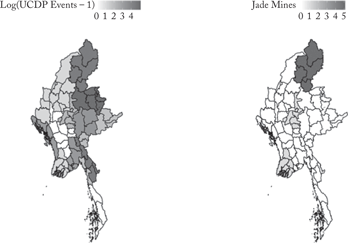
We aggregate the data to the township-year level and use the logged total number of violent incidents as the primary dependent variable.Footnote 85 Figure 1 shows a map of logged conflict events at the district level (the administrative division above townships).Footnote 86
Conflict Incidence from 2006 to 2015 and Jade Mining by Districta
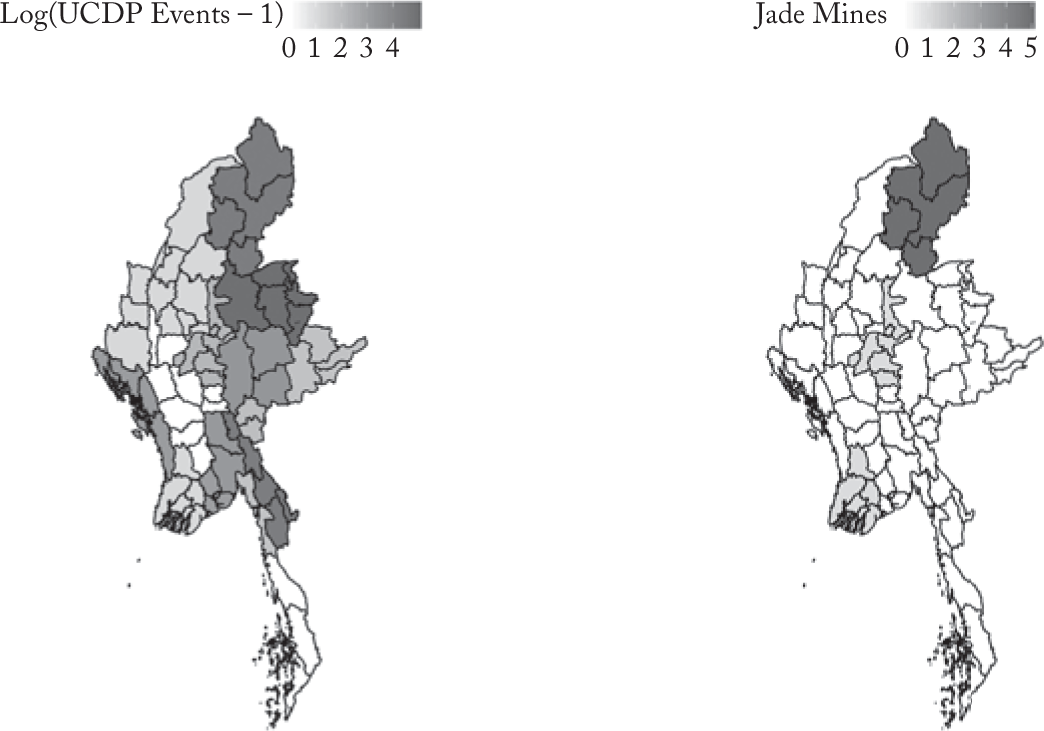
Mining data is gathered from the gemdata data set, which provides coordinates for gemstone deposits throughout the world.Footnote 87 The data set contains information on gemstone sites, including jade, in sixtyone countries.Footnote 88 Data were collected in 2004, prior to the transition and resumption of conflict, and include the longitude and latitude of gemstone sites, as well as the types of gems being produced. For our empirical analysis we record the total number of jade-producing sites within a township.Footnote 89 Figure 1 includes a map of jade mining by district.
For methodological reasons, we prefer a pretransition measure of mine locations. The gemdata from 2004 allows us to avoid concerns that mining activity changes in response to renewed conflict in Kachin, a clear instance of posttreatment bias.Footnote 90 To address concerns about measurement error, we review the available data on jade concessions since 2004 in Myanmar and find no evidence of major changes in the extent of jade mining at the township level. Classical measurement error would only serve to attenuate our estimates. We also employ a binary measure of mining activity to alleviate concerns about measurement error regarding the number of active mines.Footnote 91 Though less precise (the binary measure discards information), our results are qualitatively similar.
V. Empirical Strategy
We employ a difference-in-differences design, estimating differential changes in conflict before and after the transition for townships that do and do not host jade mines.Footnote 92 More technically, let Dit be the product of the number of mines in a township and a dummy variable for the posttransition period (Dit = Number of Minesi × 1(Year ≥ 2011)). We estimate
 $${y_{it}} = {\alpha _i} + {\beta _t} + \gamma {D_{it}} + {\varepsilon _{it}},$$
where i indexes townships; t, years. Note that the direct effects of the number of mines or the posttransition period are absorbed by the township and year fixed effects (αi and βt, respectively). In robustness checks, we include township-specific linear time-trends (τi Year) to absorb any secular (linear) trends in conflict incidence within each township. In equation 1, γ represents the posttransition increase in conflict associated with each additional jade mine after differencing out the change in conflict observed in other parts of Myanmar. This approach exploits subnational variation in conflict trends; any explanation that causes a nationwide shift in hostilities or generates time-invariant level differences in conflict cannot explain our results. We cluster our standard errors on township for all models.
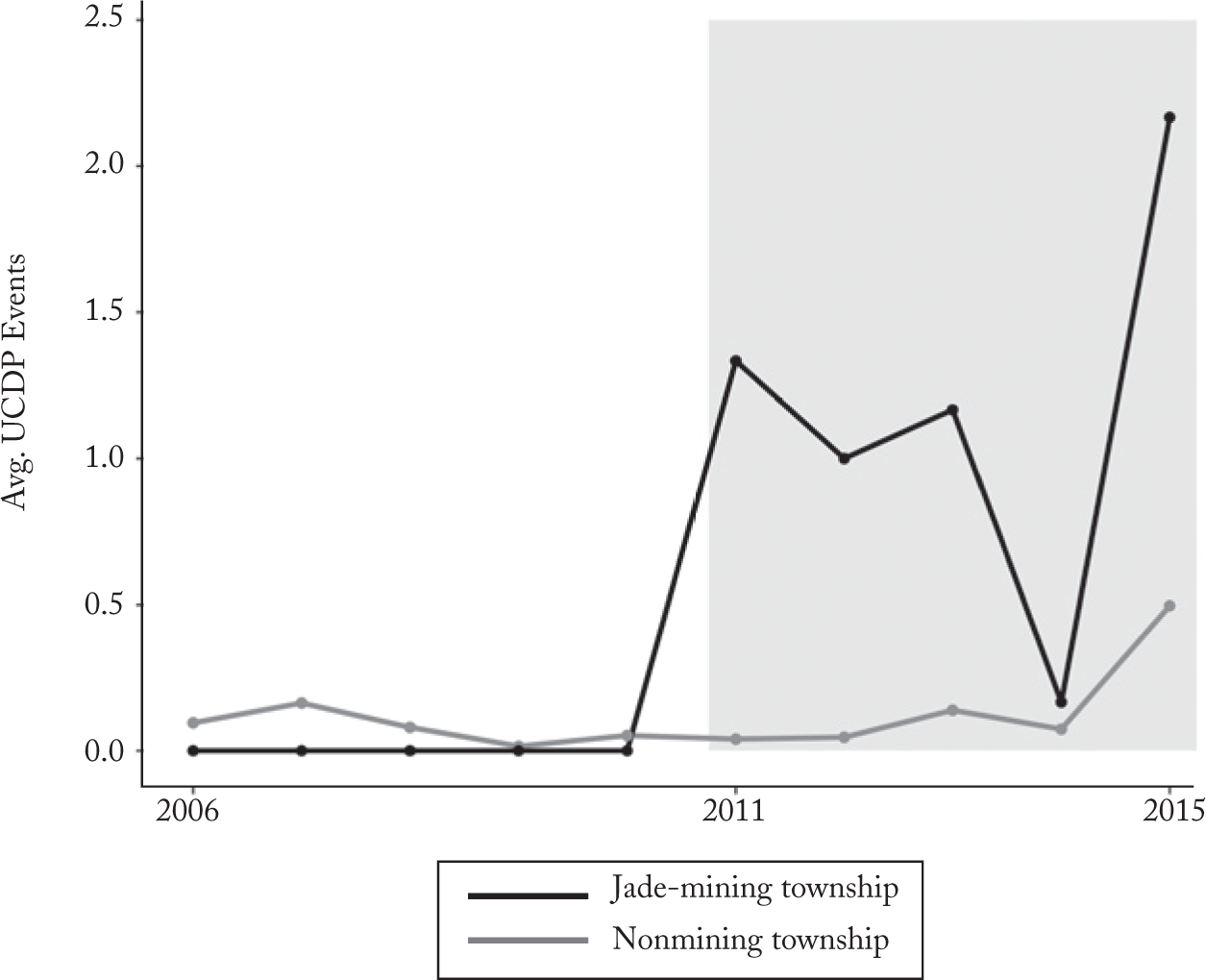
Our design hinges on the parallel trends assumption that areas with and without mines would have followed the same trend in conflict in the absence of any political reforms. Although that assumption is untestable, we take several steps to shore up its credibility. First, we show that prior to the transition, both mining and nonmining townships followed similar trends regarding conflict incidence. This is apparent in Figure 2 and verified through a series of placebo tests. We estimate equation 1 using data from the pretransition period (1995–2010) and code Dit using years prior to the actual transition.Footnote 93 The placebo transitions consistently generate null findings, indicating that mining and nonmining areas do not follow divergent trends prior to 2011.
Jade Mining and Conflict, 2006–2015a

Second, we preprocess our data, reweighting our nonmining observations to ensure balance across pretreatment measures. More specifically, we employ entropy balancing using the following pretreatment variables:Footnote 94 median altitude; average nighttime luminosity; and the sum of different conflict types during two periods, 1995 to 2000 and 2000 to 2005 (logged).Footnote 95 By weighting to generate balance on elevation and pretreatment measures of development and conflict, we aim to generate a control sample that better approximates the counterfactual trend that mining areas would have followed. To implement this routine, we dichotomize townships into mining or nonmining and dispense with information about the number of mines.
VI. Results
Our main results are apparent in the raw data. Figure 2 shows the average number of conflicts in jade mining (black) and other townships (gray). Although there is effectively no conflict between 2006 and 2010, we see a big jump in violence after 2010 (gray area) that is limited to jade-mining areas. This figure foreshadows the regression results presented below. We see a sharp and differential increase in violence in jade-mining areas after the transition.Footnote 96 Moreover, although prices increase almost monotonically over the period,Footnote 97 we do not find a positive relationship between commodity price changes and conflict after accounting for the effect of the transition.
In substantive terms, from 2006 to 2010, townships without jade mining averaged just over one battle death according to the ucdp; jademining areas saw zero battle deaths. This contrasts sharply with the period from 2011 to 2015, in which jade-mining townships averaged over forty-one battle deaths while other townships maintained a much lower average of just over three fatalities. These figures do not capture the displacement and collateral damage associated with conflicts.
The moderate increase in violence reflects the incentives of the Tatmadaw. They are not inclined to wage a full-on war; instead, we should expect the level of conflict to be only enough to dissuade civilian authorities from exerting control while allowing exploitation of resources to continue. The violence we uncover—three to four fatalities per month in jade townships—seems consistent with maintaining a low-intensity fight that supports a narrative of insecurity.
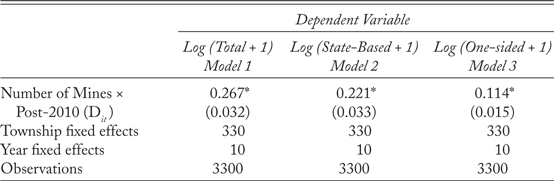
We start by estimating the difference-in-differences specified in equation 1. Whether we use all events, state-based conflicts, or onesided conflicts, we find consistent evidence that violence—specifically violence perpetrated by the Tatmadaw—increased more markedly in jade townships following the political transition in late 2010.Footnote 98 The coefficient in model 1 of Table 1 suggests that the transition led to a roughly 27 percent increase in conflict per jade mine. This result is robust to dropping any of the jade-mining townships from the sample. We use the inverse hyperbolic sine transformation of our dependent variable, recommended by John Burbidge, Lonnie Magee, and Leslie Robb, and the raw counts of conflict, respectively; our results are unchanged.Footnote 99
Effect of Political Transition on Violence in Jade Townshipsa
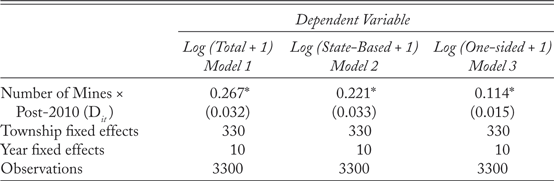
Robust standard errors clustered on township; †p < 0.1, *p < 0.05
Models 2 and 3 confirm on-the-ground assessments that a Tatmadaw offensive drove this increase in violence.Footnote 100 Nearly all conflict events involve the Tatmadaw, and we observe a meaningful increase in attacks on civilians by government forces. No reports indicate that conflicts pitted Tatmadaw regiments against each other.Footnote 101
To rule out the possibility that mining townships simply have increased conflict over the whole period, we include township-specific linear time trends. Our coefficients increase slightly in magnitude.Footnote 102
We augment our difference-in-differences with a preprocessing routine to generate balance along pretreatment measures of elevation, economic development, and conflict. This technique effectively generates balance;Footnote 103 by reweighting nonmining townships we can generate a control sample that is statistically indistinguishable from mining areas in terms of elevation or past economic development or conflict. We estimate equation 1 using our reweighted sample (taking the weights as fixed), and our findings do not change.Footnote 104 We find positive and significant effects on the incidence of all or state-based conflicts; the effect on one-sided violence remains positive but is less precisely estimated (p = 0.17).
Finally, our placebo tests reassure us that differential pretrends do not account for our findings. Using data prior to 2011, we recode Dit using years prior to the actual political transition. If jade-mining areas were experiencing an uptick in violence in advance of political reforms, these placebo estimates would be positive. Yet, we find consistent null effects that stand in sharp contrast to our actual estimate.Footnote 105
VII. Alternative Explanations for Violence
Reaction to a Deteriorating Security Situation
We argue that the increase in violence after 2010 reflects an offensive by the military in Kachin State. This claim is supported by the composition of conflict events: nearly all events involve the Tatmadaw. Moreover, government-perpetrated attacks against civilians (and not involving rebels) increase, an observation that is also consistent with contemporary accounts of the fighting. Human Rights Watch, for example, blames the Tatmadaw for the resumption of violence in June 2011: “The Burmese army first attacked a strategic kia post…. The army subsequently launched a major offensive and moved in hundreds of troops to areas formerly controlled by the kia.”Footnote 106 In fact, Bertil Lintner argues that the Tatmadaw had well-laid plans to attack the kia.Footnote 107 Summarizing military sources, he reports, “There was little doubt at the time that the [Tatmadaw] intended to break the ceasefire it had maintained with the kia since February 1994.”Footnote 108
But there could have been other changes that occurred around the transition that affected the security situation in mining areas. If that was the case, the military could have been reacting to a deteriorating security situation in mining townships rather than initiating violence.
To evaluate this possibility, we look for differential changes in nonstate conflicts (in this context, conflict between ethnic armed organizations) after the transition in mining and nonmining townships. We find no increase in conflicts among nonstate actors in mining areas before and after the transition.Footnote 109 With and without township-specific trends, our estimates are precisely estimated zeros. This result both points to our preferred mechanism—a proactive military strategy—and alleviates concerns about unobservables contributing to increased instability in mining areas.
News accounts and the data suggest that the upsurge in violence in mining areas was the result of a destabilizing military offensive rather than a defensive response by the Tatmadaw.Footnote 110 Global Witness offers a stark assessment of the Tatmadaw’s objectives in the region, claiming, “The Tatmadaw’s main priority in Hpakant is milking money from the jade business and this imperative frequently trumps its designated function of fighting the kia.”Footnote 111
Shift in Military Strategy and Relations with Armed Groups
Our primary findings cast doubt on a countrywide shift in the strategy of the military or ethnic armed organizations. If, in the wake of the transition, the military or armed groups simply became more bellicose—seizing, perhaps, on a perceived moment of strength—we would expect an uptick in violence across Myanmar’s contested areas, a classification that covers large swaths of the periphery, including parts of Chin, Mon, Kachin, Kayin, and Shan states.Footnote 112 But as is apparent in Figure 2, nonmining townships largely avoided renewed conflicts. And looking at equation 1, any such secular trend in conflict would be absorbed by our year fixed effects and so could not explain our results.
Using recently compiled data from the Asia Foundation’s Township Development Indicators, we can go further, identifying the fifty-seven townships covered by ceasefires signed by government and armed groups in or before 2011. We then look at whether violence increased more dramatically in these previously contested areas following the political transition.Footnote 113 We do not find a resurgence of violence in these townships after 2011, suggesting that the Tatmadaw battles in jademining areas were not part of a broader offensive against—or mobilization among—insurgent groups.
We also use data on the location of military headquarters—specifically, the locations of regional military commands, regional operation commands, and light infantry divisions—to ensure that these do not fall in jade-mining townships. According to data compiled by the Asia Foundation, the regional military command in Kachin State is in Myitkyina, along with the 99th Light Infantry Division; the regional operation command is headquartered in Tanai.Footnote 114 Critically, neither of these townships includes jade mines according to the gemdata, so our results cannot be attributed to increased violence near bases and the coincidental colocation of military headquarters and mines.
Commodity Price Changes
A number of studies in political economy find a positive relationship between commodity prices and armed conflict in mining areas.Footnote 115 Ernesto Dal Bó and Pedro Dal Bó offer a model to rationalize these findings, arguing that rising commodity prices inflate insurgents’ ranks with individuals keen to prey on increasingly lucrative mining operations.Footnote 116
Employing data on the price of (or international demand for) jade, we also look at whether conflict in mining areas increases with the price of jade. Information on jade prices comes from Global Witness,Footnote 117 which compiled data on sales at every official Myanmar Gems Emporium between 2005 and 2014, as well as on official revenues from minesite taxes and production data. We calculate the average jade price by dividing the total value of sales by the total volume sold. We note that sales prices at the emporiums are likely downwardly biased, because the most lucrative jade is often smuggled into China. If this downward bias is consistent over time, then it will not confound our empirical strategy, which exploits changes in price.
We start by estimating a naive model that ignores the political transition that occurred in 2011:
 $${y_{it}} = {\alpha _i} + {\beta _t} + \Psi [1{(Mine \gt 0)_i} \times \log (Pric{e_{t - 1}})] + {\varepsilon _{it}},$$
where, again, αi and βt are township and year fixed effects. The direct effects of the number of mines or price are absorbed by the unit and time fixed effects. In this equation, ѱ captures the differential effect of jade prices on violence in townships that do and do not have jade mining.Footnote 118
The identifying assumption for this naive model is that the areas that do and do not mine jade would have experienced parallel trends in conflict had prices remained flat. But our theory suggests that this is an imprudent assumption. We argue that jade-mining areas saw an abrupt increase in violence starting in 2011 due to the political transition. To demonstrate that the political transition—and not price changes— led to increased violence in jade-mining townships, we take two approaches. First, we separately estimate equation 2 using the periods before and after the transition.
Second, we nest equations 1 and 2 and estimate:
 $${y_{it}} = {\alpha _i} + {\beta _t} + \Gamma {J_{it}} + \Psi [{(Mine \gt 0)_i} \times \log (Pric{e_{t - 1}})] + \eta [{J_{it}} \times \log (Pric{e_{t - 1}}) + {\varepsilon _{it}},$$
where Jit is an indicator for jade-mining areas after the transition. In this specification, ѱ and (ѱ + η) represent the relationship between changes in price and conflict in jade-mining areas before and after the political transition, respectively. To capture the posttransition increase in conflict in jade-mining townships, we sum ᴦ + η × Avg.log(Price), where the average price is calculated using the posttransition sample. We expect a sharp increase in conflict after the political transition; yet prior to 2011, we do not expect to see any relationship between prices and conflict given the bargain between the Tatmadaw and kia/kio (that is, ѱ and (ѱ + η) should be close to zero).
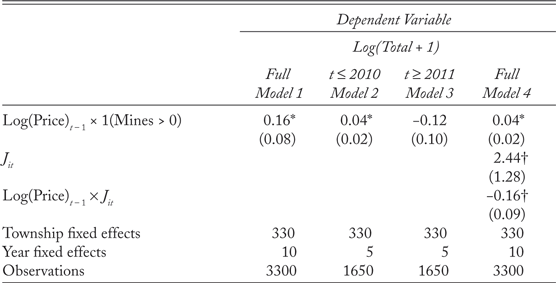
We find that a naive specification, which ignores Myanmar’s political transition, suggests that conflict increases with jade prices (see Table 2, model 1). But this is simply because jade prices increase nearly monotonically from 2006 to 2014, and violence in jade-mining areas is concentrated at the end of this period, in the wake of the transition. In models 2 and 3 we look separately at the relationship between prices and conflict in jade-mining areas before and after the transition. We find no evidence that higher prices exacerbate armed conflict in mining areas in either period.Footnote 119 Our estimates of ѱ (the coefficient on the interaction of logged prices and mining activity) from equation 2 in models 2 and 3 are substantively small and, for the period after the transition, indistinguishable from zero. Looking at the final, nested model in Table 2, even after incorporating price changes, we see a sharp increase in conflict in the posttransition period consistent with our earlier results.Footnote 120
Effect of Political Transition and Prices on Conflict in Jade-Mining Areasa
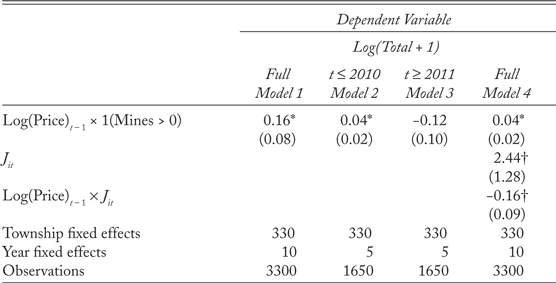
Robust standard errors clustered on township; †p < 0.1, *p < 0.05
Potential Drivers of Conflict in Kachin State
Yun Sun observes, “The fact that armed conflict broke out three months after the inauguration of the Thein Sein government lends credence to the belief that there was a causal relationship between the political change and the armed conflict.”Footnote 121 But our account is not the only explanation for why the Tatmadaw resumed hostilities in Kachin State following the political transition.Footnote 122
First, some blamed fighting on the Myitsone Dam, a massive joint venture between the China Power Investment Corporation and Myanmar’s government. The project’s environmental and social impacts inspired dissent; the government offensive was allegedly intended to secure the investment project. A conservationist interviewed by the Guardian summarizes this viewpoint: “The conflict is closely related to the dams. The government has sent in troops because it wants to gain control of a region [Kachin State] that hosts major Chinese investments in hydropower.”Footnote 123
Nothing in the data indicates that conflict near the dam is driving our results. Myitkyina Township, the site of the Myitsone Dam, does not contain any jade mines according to gemdata.Footnote 124 Thus, our estimates do not conflate the effects of the project and mining activity. Our results are robust to omitting Myitkyina Township from the sample. If anything, the three conflicts that occurred in Myitkyina between 2011 and 2013 attenuate our estimates.
Second, in 2010, the year prior to the political transition, the kia/kio refused to transform into a border-guard force, a subdivision of the Tatmadaw. At the same time, the kia/kio called for a federal state.Footnote 125 Some sources suggest that by 2009, General Than Shwe, angered by these demands for greater autonomy, had already decided to resume fighting the kia/kio.Footnote 126 A variant of this argument suggests that the Tatmadaw intended for their offensive against the kia/kio to intimidate other ethnic armed organizations outside of Kachin State.
Both claims suggest that Kachin State in general, rather than jademining areas specifically, should have seen a sharp increase in conflict. But our results are robust to the inclusion of state × year fixed effects (that is, dummies for every state and year), indicating that our estimates do not simply reflect an uptick in violence in Kachin State after the transition.Footnote 127 Put more simply, when restricting attention to only Kachin State, we still find that after the political transition conflict increases more sharply in jade-mining areas relative to townships without mines.
We recognize that this is not conclusive evidence. kia/kio personnel might have been stationed in jade-mining areas, hence, it could appear that fighting occurred near mines simply by virtue of prior troop placements. Before the political transition, there was no correlation between the number of mines and conflicts across townships in Kachin State, suggesting that past confrontations were not concentrated near jade mining. This is consistent with Tom Kramer’s pretransition map, which suggests that kia/kio control did not extend to the jade-mining townships of Kachin, including Hpakant, Mohnyin, and Waingmaw. Rather, the group’s strongholds, including its headquarters in Laiza, are located near the Chinese border.Footnote 128 Global Witness interviews with kia/kio officials also indicate that the group had agreed to pull out of jade-mining areas during the ceasefire period: “From a kia/kio perspective the government had breached the ceasefire [in 2011] and this meant that any agreement to stay out of the mining areas and not [directly] tax the companies was null and void.”Footnote 129 After fighting broke out, the group expressed a desire “to resume control and management of the jade business,” intending to reclaim authority ceded in its informal revenue-sharing agreement with the Tatmadaw. Despite this primary evidence, with no pretransition data on the location of kia brigades, we cannot pin down where these troops were stationed when the Tatmadaw launched its operations in 2011.
Finally, David Brenner argues that “ceasefire capitalism”—the period of relative peace in Kachin State that enabled the exploitation of the region’s natural resources—enriched military elites and kia/kio leaders but did little to benefit the rest of the population.Footnote 130 This generated resentment among the rank and file of the kia/kio. And after these lower-ranking officers seized power, they adopted a more confrontational stance vis-à-vis the Tatmadaw. Without disputing this account, it does not explain (1) why conflict within Kachin State conflict was concentrated in jade-mining townships; (2) why conflict ticks up so suddenly after the political transition; and (3) why the kia/kio’s internal politics would induce more one-sided attacks on civilians by the Tatmadaw.
VIII. Conclusion
We argue that when facing a democratic transition, the military can maintain its control of valuable rents by stoking violence. The logic, while perverse, is quite simple: an ascendant civilian government relies on security forces to put down domestic unrest and external threats and is reluctant to strip military elites of their authority over conflict-ridden regions.
We find evidence of this dynamic in Myanmar, a country transitioning from four decades of military rule. Prior to democratization, the military government peacefully colluded with rebel groups to split the profits from jade mining and smuggling—a sector worth roughly half of Myanmar’s gdp. But fearing that the new civilian government would assume control of jade-mining areas and the associated rents, the military ginned up unrest in mining townships to deter the development of an alternative authority.
Using geocoded data on armed conflict and jade mining, we show that (1) conflicts involving the Tatmadaw in jade-mining townships increased dramatically in the wake of the country’s political transition (relative to violence in other parts of the country during the same period), and (2) prior to democratization, jade-mining areas remained peaceful despite increases in the value of jade exports, which some theories suggest should have induced predation by greedy rebels.
Our findings point to a major challenge facing Myanmar and other countries transitioning from military to civilian rule. Like any incumbent, the military uses the strategies at its disposal to retain power during political transitions; unlike other incumbents, the strategies available to the military include inciting large-scale armed conflicts. This does not bode well for the consolidation of democracy and peace. Global Witness offers a bleak assessment: “In Myanmar’s current political landscape, money is power. Everyone wishing to see peace and genuine democracy in Myanmar should urgently consider the implications of allowing hundreds of millions of dollars a year [in resource rents] to be siphoned off by some of the most determined and ruthless opponents of reform.”Footnote 131 Unfortunately, this article and past research on democratic transitions from military rule suggest that unseating ruthless and well-armed opponents of reform may outstrip the capacity of a new civilian government.
Supplementary Material
Supplementary material for this article can be found at https://doi.org/10.1017/S0043887118000308.
Data
Replication data for this article can be found at http://doi.org/10.7910/DVN/SQ0UM2.
Acknowledgments
We are grateful to James Fearon, Tarek Ghani, Guy Grossman, Chad Hazlett, Amy Liu, Eric Min, Tom Pepinsky, Jacob Shapiro, and the audiences at Southeast Asia Research Group 2017, European Political Science Association 2017, Midwest Political Science Association 2016, American Political Science Association 2017, and New York University for comments on earlier drafts. We would also like to thank Global Witness for generously sharing its data and for feedback.
Authors
Darin Christensen is an assistant professor of public policy and political science at the University of California, Los Angeles. He studies the political economy of development, focusing on institutions and policies that promote investment and mitigate violence in developing countries in sub-Saharan Africa, Southeast Asia, and Latin America. He can be reached at darinc@luskin.ucla.edu.
Mai Nguyen earned a Ph.D. in political science from New York University in 2018. She will be a fellow at the Institute for Quantitative Theory and Methods at Emory University beginning fall 2019. She can be reached at mai.truc.nguyen@emory.edu.
Renard Sexton is an assistant professor in the Department of Political Science at Emory University. He studies conflict and development, especially related to aid, natural resources, military interventions, and democracy promotion, with a focus on Latin America, Southeast Asia, and Afghanistan. He can be reached at renard.sexton@emory.edu.