Introduction
Dementia and cognitive decline have been associated with increased disability and mortality and account for a significant proportion of care expenditure for older people (Di Carlo et al. Reference Di Carlo, Baldereschi, Amaducci, Maggi, Grigoletto, Scarlato and Inzitari2000; Pérès et al. Reference Pérès, Verret, Alioum and Barberger-Gateau2005; Langa et al. Reference Langa, Larson, Karlawish, Cutler, Kabeto, Kim and Rosen2008; Comas-Herrera et al. Reference Comas-Herrera, Northey, Wittenberg, Knapp, Bhattacharyya and Burns2011; Tinetti et al. Reference Tinetti, McAvay, Chang, Newman, Fitzpatrick, Fried and Peduzzi2011; St John et al. Reference St John, Tyas and Montgomery2015). In the UK, an earlier analysis has suggested that the continued growth of the ageing population will potentially result in 3.7 million people with cognitive impairment by 2026, which if realised would result in greater healthcare costs (Jagger et al. Reference Jagger, Matthews, Lindesay, Robinson, Croft and Brayne2009). Given the individual, family and societal burden of dementia and cognitive decline, it is important to identify potential risk factors and develop effective strategies for prevention or risk reduction. Indeed, estimates suggest 28.2% of the population-attributable risk of developing Alzheimer's disease could be related to potentially modifiable factors (Norton et al. Reference Norton, Matthews, Barnes, Yaffe and Brayne2014).
Depression and anxiety are common mood disorders, which affect approximately 10% of people aged 65 or above in Western Europe (Copeland et al. Reference Copeland, Beekman, Braam, Dewey, Delespaul, Fuhrer, Hooijer, Lawlor, Kivela, Lobo and Magnusson2004; McDougall et al. Reference McDougall, Kvaal, Matthews, Paykel, Jones, Dewey and Brayne2007). These common mood disorders, especially current experience of depression, have been associated with poorer cognitive performance and an increased risk of cognitive decline, mild cognitive impairment and dementia (Reppermund et al. Reference Reppermund, Brodaty, Crawford, Kochan, Slavin, Trollor, Draper and Sachdev2011; Diniz et al. Reference Diniz, Butters, Albert, Dew and Reynolds2013; Yates et al. Reference Yates, Clare and Woods2013; Steffens et al. Reference Steffens, McQuoid and Potter2014). A recent meta-analysis has suggested that approximately 10% of dementia cases could be prevented if depression is addressed (Norton et al. Reference Norton, Matthews, Barnes, Yaffe and Brayne2014). In addition, a comprehensive review of existing evidence combined with consensus by eight experts indicated that there is good evidence that depression is a modifiable risk factor for cognitive decline and dementia (Deckers et al. Reference Deckers, Boxtel, Schiepers, Vugt, Muñoz Sánchez, Anstey, Brayne, Dartigues, Engedal, Kivipelto, Ritchie, Starr, Yaffe, Irving, Verhey and Kӧhler2015).
The associations between lowered mood and cognitive decline or dementia may be due to a shared underlying mechanism (Leonard, Reference Leonard2007; Korczyn & Halperin, Reference Korczyn and Halperin2009; Byers & Yaffe, Reference Byers and Yaffe2011). Depression in later life and poorer cognitive performance are both associated with white matter hyperintensities, hippocampal atrophy and decreases in total brain volume (Nebes et al. Reference Nebes, Vora, Meltzer, Fukui, Williams, Kamboh, Saxton, Houck, DeKosky and Reynolds2001; Lampe et al. Reference Lampe, Hulshoff Pol, Janssen, Schnack, Kahn and Heeren2003; Ballmaier et al. Reference Ballmaier, Toga, Blanton, Sowell, Lavretsky, Peterson, Pham and Kumar2004; O'Brien et al. Reference O'Brien, Lloyd, McKeith, Gholkar and Ferrier2004; Enzinger et al. Reference Enzinger, Fazekas, Matthews, Ropele, Schmidt, Smith and Schmidt2005; Debette & Markus, Reference Debette and Markus2010; Elbejjani et al. Reference Elbejjani, Fuhrer, Abrahamowicz, Mazoyer, Crivello, Tzourio and Dufouil2015). These pathological overlaps suggest that perhaps factors that are protective against cognitive impairment and decline may also be protective against depression in older people and could be of benefit in moderating the association between mood and cognition.
One such factor could be cognitive reserve (CR). CR is built through engagement in cognitively engaging activities across the lifespan, including educational level, complex occupations and cognitively stimulating leisure activities (Stern, Reference Stern2002, Reference Stern2009, Reference Stern2011; Richards & Sacker, Reference Richards and Sacker2003; Richards & Deary, Reference Richards and Deary2005; Whalley et al. Reference Whalley, Dick and McNeill2006). Several reviews indicate that greater CR is associated with better cognitive performance in healthy older people and a reduced risk of cognitive decline and dementia (Valenzuela & Sachdev, Reference Valenzuela and Sachdev2006a , Reference Valenzuela and Sachdev b ; Fratiglioni & Wang, Reference Fratiglioni and Wang2007; Meng & D'Arcy, Reference Meng and D'Arcy2012; Harrison et al. Reference Harrison, Sajjad, Bramer, Ikram, Tiemeier and Stephan2015; Opdebeeck et al. Reference Opdebeeck, Martyr and Clare2016a ). Higher levels of CR have also been associated with reduced levels of depressive symptoms (Lorant et al. Reference Lorant, Deliège, Eaton, Robert, Philippot and Ansseau2003; Paulson et al. Reference Paulson, Bowen and Lichtenberg2014; Opdebeeck et al. Reference Opdebeeck, Quinn, Nelis and Clare2016b ).
At present, research into whether CR moderates the association between mood and cognitive function has produced conflicting results. A review of studies assessing whether CR moderates the association between mood and cognition concluded that there was a potential modifying effect of CR on the negative association between mood and cognitive function and decline, but the result was tentative (Opdebeeck et al. Reference Opdebeeck, Quinn, Nelis and Clare2015a ). The results of the individual studies included in this review were varied, ranging from a moderating effect of higher education on the negative association between clinical depression and cognitive function (Pálsson et al. Reference Pálsson, Aevarsson and Skoog1999, Reference Pálsson, Larsson, Tengelin, Waern, Samuelsson, Hallstro and Skoog2001) to reports that cognitive performance decreases as depressive symptoms increase in those with higher but not lower levels of education (Geerlings et al. Reference Geerlings, Schoevers, Beekman, Jonker, Deeg, Van Tilburg, Adér and Schmand2000; O'Shea et al. Reference O'Shea, Fieo, Hamilton, Zahodne, Manly and Stern2015; Santos et al. Reference Santos, Costa, Cunha, Portugal-Nunes, Amorim, Cotter, Cerqueira, Palha and Sousa2014).
To address the uncertainty in the literature, the aim of this study is to investigate the potential modifying effect of CR, measured using a composite indicator, on the association between cognitive function and mood disorders in a contemporary large population-based cohort of older people in England.
Method
Participants
Participants were drawn from the first wave of the Cognitive Function and Ageing Study II (CFAS II, version 3; http://www.cfas.ac.uk/). A total of 7762 people over 65 completed the study between 2008 and 2011 in three geographical areas of England – Cambridgeshire, Newcastle and Nottingham – which included both rural and urban populations. More detailed information on CFAS II has been reported previously (Matthews et al. Reference Matthews, Arthur, Barnes, Bond, Jagger, Robinson and Brayne2013; Gao et al. Reference Gao, Green, Barnes, Brayne, Matthews, Robinson and Arthur2015). To avoid the potential confounding effect of dementia at prevalence and to standardise participant living situation, this study excluded those with a diagnosis of dementia or an organicity score of 3 or higher based on AGECAT diagnostic algorithms (n = 487) and an additional 81 people living in institutional settings. This resulted in a sample of 7194 community-dwelling older people without dementia.
Measures
Cognitive reserve
A composite measure of CR, the cognitive lifestyle score (CLS), was calculated based on participants’ educational level, primary occupation and engagement in social and cognitive activities in later life. The calculation of this score was based on the CLS created in MRC CFAS, the first cohort of the CFAS studies (Valenzuela et al. Reference Valenzuela, Brayne, Sachdev and Wilcock2011) with the addition of responses to questions about cognitive activities, which included the frequency with which participants listen to the radio, read newspapers, magazines, or books, play games such as cards or chess, and do puzzles and/or crosswords. These questions were added in CFAS II, making it possible to investigate current cognitive lifestyle in more detail.
Educational level was expressed as years of education completed. Occupation was assessed in line with the procedure of Valenzuela et al. (Reference Valenzuela, Brayne, Sachdev and Wilcock2011) in that the participants’ main occupation was coded in terms of social class grouping (from I to V) and socioeconomic grouping (11–150), with lower scores indicating more complex occupations in each case. These two groupings were then exploded and ranked to create an occupational complexity score with a possible range of 1–14, that was more fine-grained than either grouping alone. For example, if a person had a social class grouping of I and a socioeconomic grouping of 11, they were given an occupation score of 1. In another example, a participant with a social class grouping of IIIN (skilled non-manual) or IIIM (skilled manual) and a socioeconomic grouping between 70 and 80 would be given an occupation score of 9 in this system. Further details regarding the combinations used to create each occupation score can be obtained from the corresponding author. An additional ranking of 15 was given to housewives as these individuals do not receive a formal code in the UK social class ranking system. The ratings were then reversed to be in the same direction as education and social and cognitive engagement, with lower scores indicating a less active cognitive lifestyle. The later life activity score comprised the three indicators of current social engagement as utilised in the CLS created in MRC CFAS (Valenzuela et al. Reference Valenzuela, Brayne, Sachdev and Wilcock2011) and the seven measures of current participation in cognitive activities added in CFAS II. Current participation in each of the cognitive activities was coded on a 5-point scale from undertaking the activity once a year or less to undertaking the activity every day. Scores for the 10 items were summed to create an overall activity score.
To enable each of the three subscores to contribute equally to determining whether a person's cognitive lifestyle reflected low, medium or high levels of activity, the scores were weighted to provide equal distribution across the subcomponents. To determine the weights of each component, the range of scores between the 25th and 75th percentiles were examined, and the weights were calculated to ensure that all three components had equal interquartile ranges, allowing each to contribute equally to the total CLS. The total CLS was then calculated using the following formula:
 $$\eqalign{{\rm CLS} &= ( {3.4 \times {\rm education}} ) \cr &+ ( {2.4 \times {\rm occupational}\;{\rm complexity}} ) \cr &+ ( {1 \times {\rm social}\;{\rm and}\;{\rm cognitive}\;{\rm engagement}}).}$$
The CLS was slightly skewed (Skewness = 0.70; Kurtosis = 3.72) suggesting that it was not normally distributed. Hence, the CLS was divided at the tertile level to allow for comparisons between those with lower, medium and higher CLSs, which can be considered a proxy measure for their levels of CR.
Mood disorders
Depression and anxiety were assessed using the Geriatric Mental State Automated Geriatric Examination Assisted Taxonomy (GMS AGECAT). The GMS is a semi-structured interview designed to assess organic and psychiatric disorders in older people. The AGECAT programme uses an algorithm to assign diagnoses to provide consistency across time and location. The AGECAT assigns scores for depression (0–5) and anxiety (0–5) based on clusters of symptoms. These scores were coded into groups of those with no mood disorder (GMS AGECAT for anxiety and depression = 0), a subthreshold mood disorder (GMS AGECAT for anxiety or depression = 1–2), or a clinically relevant mood disorder (GMS AGECAT for anxiety or depression = 3+). Absence or presence of a subthreshold or clinical level mood disorder, rather than of depression or anxiety individually, was chosen due to the strong association between depression and anxiety. Additionally, the GMS AGECAT uses a hierarchical system to determine a main diagnosis, which may give precedence to a diagnosis of depression over a diagnosis of anxiety when overlapping symptoms are reported. The GMS AGECAT has demonstrated good concordance with diagnoses by trained psychiatrists (Cohen's κ = 0.84, Copeland et al. Reference Copeland, Dewey and Griffiths-Jones1986) and eliminates the variability that has been observed with clinical diagnosis (Copeland et al. Reference Copeland, Prince, Wilson, Dewey, Payne and Gurland2002).
Cognition
Cognition was assessed using the Cambridge Cognitive Assessment (CAMCOG). The CAMCOG provides an overall score for cognitive function from eight subscales – orientation, language, memory, attention, praxis, calculation, abstract thinking and perception. Total scores range from 0 to 107; however, as in MRC CFAS, total scores on the CAMCOG in this study could range from 0 to 103 (Williams et al. Reference Williams, Huppert, Matthews and Nickson2003). The CAMCOG has good inter-rater reliability (r = 0.97) with 92% sensitivity and 96% specificity in detecting cognitive impairment, and avoids the ceiling effects seen in other brief neuropsychological assessments (Roth et al. Reference Roth, Tym, Mountjoy, Huppert, Hendrie, Verma and Goddard1986).
Data analysis
T tests and χ2 tests were used to compare age, sex and mood disorder in those with and without missing CAMCOG and CLS information. Inverse probability weighting was then used to adjust for non-response in CFAS II (Matthews et al. Reference Matthews, Arthur, Barnes, Bond, Jagger, Robinson and Brayne2013) as well as missing data, with weights calculated by age, sex, depression and anxiety levels.
Weighted linear regression modelling was used to investigate the association between cognitive function, CR and mood disorder adjusting for age and sex. To examine the potential modifying effect of CR on the association between cognition and mood, interactions between CR measures (the overall CLS, and the individual components of education, occupation and social/cognitive activity) and mood disorder were included in the regression models. All the analyses were carried out using Stata version 13.
Results
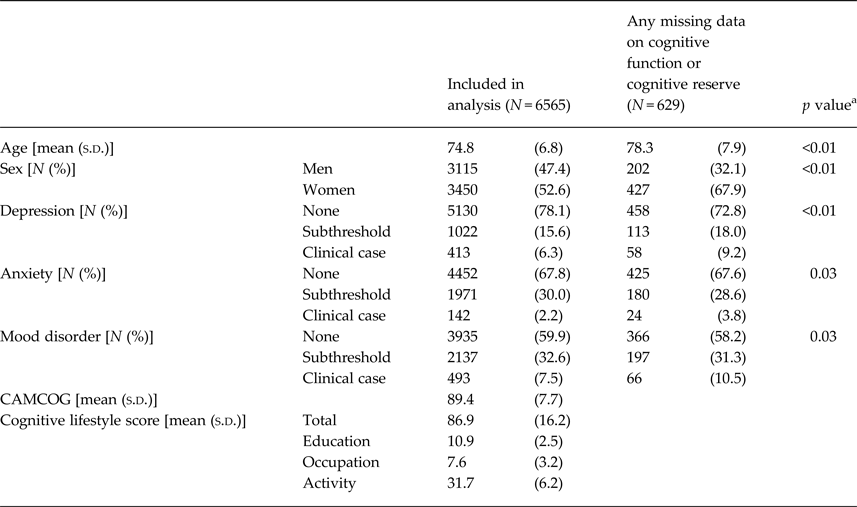
The 7194 community-dwelling individuals without dementia included 3115 men and 3450 women, but 629 people had missing CLS or CAMCOG scores. Individuals with missing data were significantly more likely to be older, female and to have a mood disorder (Table 1). Among the 6565 people with complete data, the mean CAMCOG score was 89.4 (s.d. = 7.7) with a range between 42 and 103, and the mean CLS was 86.9 (s.d. = 16.2). The CLS ranged from 26.8 to 156.4 with a median score of 84.6.
Sex, age, education and level of depressive disorder for those included in the analysis and those with missing data

a p value for t test (age) or χ2 test (other variables).
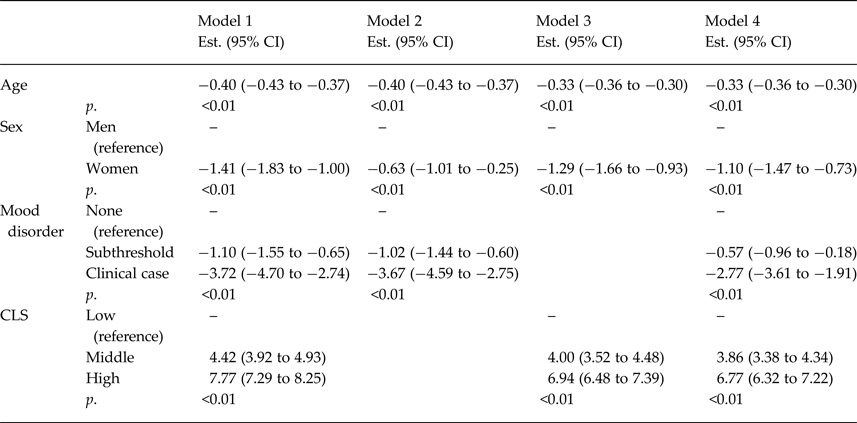
Mood disorder was associated with poorer cognitive performance (Table 2). Compared with those without mood disorder, lower CAMCOG scores were found in people with subthreshold [−1.02; 95% confidence interval (CI) −1.44 to −0.60] and clinical (−3.67; 95% CI −4.59 to −2.75) levels of mood disorder after adjusting for age, sex and missing data. A higher level of CR was associated with better cognitive performance. Compared with those with low CR, people with medium levels of CR had CAMCOG scores 4.00 points (95% CI 3.52–4.48) higher and this difference increased to 6.94 (95% CI 6.48–7.39) for those with high CR when adjusted for age, sex and missing data. The relationships between cognitive function, CR and mood disorder remained significant in the full model, including all variables, although the effect sizes slightly reduced (model 4, Table 2).
Weighted linear regression models for cognitive performance regressed on cognitive reserve (CLS) and level of mood disorder

p.: p value of test for heterogeneity.
Model 1: Univariate model.
Model 2: Multivariable model including age, sex and mood disorder.
Model 3: Multivariable model including age, sex and cognitive reserve (CLS).
Model 4: Multivariable model including age, sex, mood disorder and cognitive reserve.
All models were adjusted for missing data.
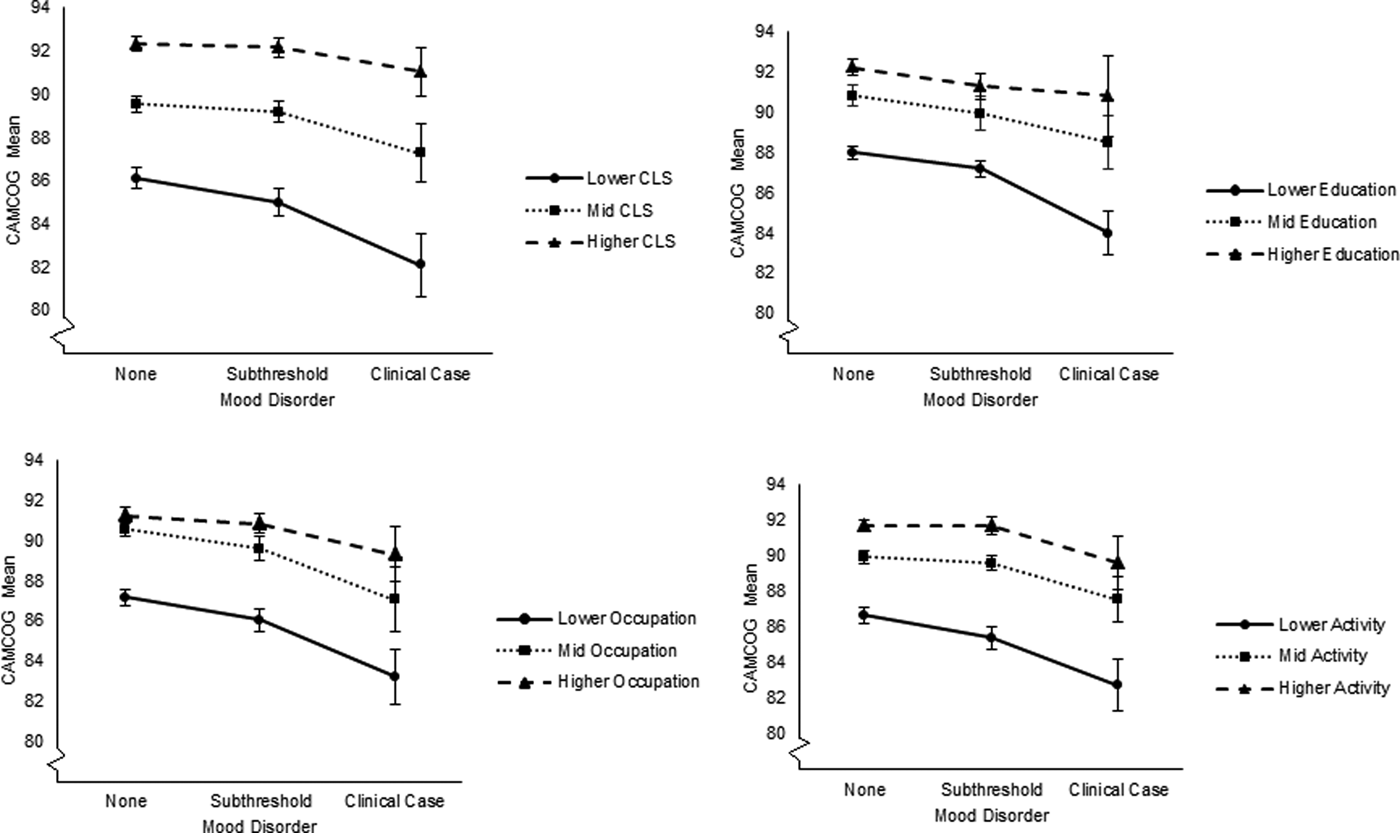
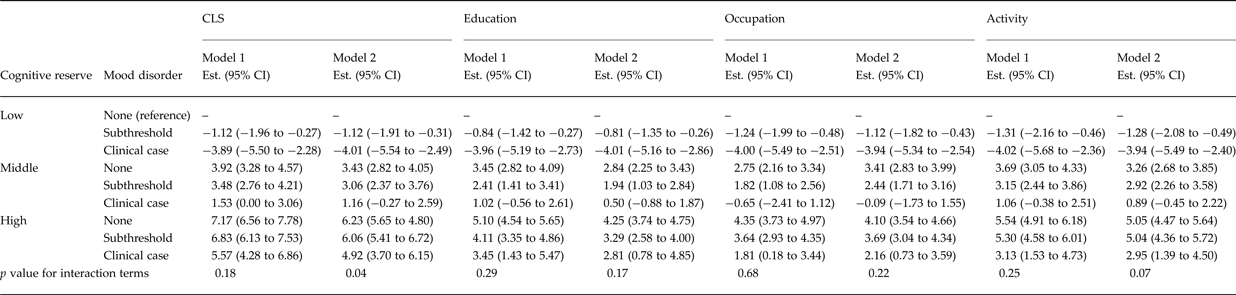
To investigate whether CR modifies the association between cognitive function and mood disorder, Table 3 shows differences in CAMCOG scores by CR and mood disorder levels. In the lower CLS group, those with subthreshold (−1.12; 95% CI −1.91 to −0.31) and clinical (−4.01; 95% CI −5.54 to −2.49) mood disorder had significantly lower cognitive function scores compared with those without mood disorder. However, the strength of the negative association in those with clinical mood disorder compared with those without mood disorder was weaker in the middle (−2.28; 95% CI −3.65 to −0.90) and higher CLS groups (−1.30; 95% CI −2.46 to −0.15), and these differential relationships achieved statistical significance (p = 0.04; Fig. 1). Although similar patterns were found for each individual indicator of CR (Fig. 1), the interaction terms between mood disorder and levels of education, occupation and social/cognitive activity did not achieve statistical significance (Table 3).
Mean cognitive performance by cognitive reserve group (CLS), educational level, occupation group, and social and cognitive activity level, and level of mood disorder. Error bars represent 95% CI.

Changes in cognitive performance by the interaction terms of cognitive reserve level and mood disorder

Model 1: Univariate model adjusted for missing data.
Model 2: Multivariable model adjusted for age, sex and missing data.
The figures also show the extensive variance seen in cognitive performance in those with a mood disorder in comparison to those without a mood disorder or with a subthreshold mood disorder, regardless of the CR level.
Discussion
This study investigated whether CR moderated the association between mood and cognitive function using a population-based study of older people in England. The presence of a subthreshold or clinical level mood disorder was associated with poorer cognitive performance, while higher levels of CR were associated with better cognitive performance. CR did moderate the negative association between mood disorders and cognitive function. The difference in cognitive performance between those with and without a clinical level mood disorder was significantly smaller for those with medium or higher levels of CR than for those with lower CR.
These results support our previous findings indicating that mild depressive symptoms and anxiety are negatively associated with cognitive function in those with lower CR but not in those with higher CR (Opdebeeck et al. Reference Opdebeeck, Nelis, Quinn and Clare2015b ). The current study expands upon these previous findings and suggests that similar moderating effects of CR on the association between mood disorders and cognition are found as when self-reported symptoms that are mild and do not reach clinical levels are considered. In contrast, the observed effect was the opposite of that reported by Geerlings et al. (Reference Geerlings, Schoevers, Beekman, Jonker, Deeg, Van Tilburg, Adér and Schmand2000) and O'Shea et al. (Reference O'Shea, Fieo, Hamilton, Zahodne, Manly and Stern2015) who reported that depression was associated with poorer cognitive performance and greater decline in those with higher education but not in those with lower education. The results also contrasted with several studies that have reported no significant interaction effect between proxy measures of CR and mood on cognition (Wilson et al. Reference Wilson, De Leon, Bennett, Bienias and Evans2004; Bhalla et al. Reference Bhalla, Butters, Zmuda, Seligman, Mulsant, Pollock and Reynolds2005).
One possible explanation could be the differences between the study cohorts. CFAS II, a contemporary study of older people in the UK, has shown through comparison with earlier findings that there have been improvements in cognitive health over the past 20 years (Matthews et al. Reference Matthews, Arthur, Barnes, Bond, Jagger, Robinson and Brayne2013; Jagger et al. Reference Jagger, Matthews, Wohland, Fouweather, Stephan, Robinson, Arthur and Brayne2015). The baseline level of CR might be higher in CFAS II compared with other cohorts, for instance due to increased levels of education, which may result in a stronger moderation effect on the association of mood disorders with poorer cognitive performance. Another explanation for these differences is that the current study used a combination of life experiences to indicate levels of CR, while the contrasting studies consider only individual proxy measures of CR, most commonly years of education. However, when we replicated the analysis with individual components, rather than lifetime CR, the interactions were similar to those found with lifetime CR, but the individual component interactions were smaller and non-significant. These smaller and non-significant interactions demonstrate that it is probable that lifetime CR has a stronger moderation effect than the individual components.
The design and contemporary nature of the CFAS II cohort allowed us to investigate whether CR, considered in terms of multiple indicators, moderates the association between mood and cognition in several beneficial ways. It enabled the consideration of the differences between those with no mood disorder, a subthreshold disorder and those with a clinical level mood disorder rather than low levels of depressive symptoms, as seen in several previous studies (Avila et al. Reference Avila, Moscoso, Ribeiz, Arrais, Jaluul and Bottino2009; Opdebeeck et al. Reference Opdebeeck, Nelis, Quinn and Clare2015b ; O'Shea et al. Reference O'Shea, Fieo, Hamilton, Zahodne, Manly and Stern2015). In addition, levels of a comprehensive, lifetime indicator of CR were represented in tertiles rather than using dichotomies of individual or combined proxy measures of CR as several previous studies have done (e.g. Bhalla et al. Reference Bhalla, Butters, Zmuda, Seligman, Mulsant, Pollock and Reynolds2005; Avila et al. Reference Avila, Moscoso, Ribeiz, Arrais, Jaluul and Bottino2009; Opdebeeck et al. Reference Opdebeeck, Nelis, Quinn and Clare2015b ). This allowed an investigation of the finer detail of the effects of different levels of CR. Nevertheless, there are several limitations to this study. As this was a cross-sectional study, it is not possible to determine the causal directions of the observed associations. Future research could consider examining whether a comprehensive proxy measure of CR, including education, occupation and current activities, moderates the longitudinal association between mood and incidence of cognitive impairment and dementia. A more comprehensive neuropsychological assessment than was employed here would allow for assessment of the effects within different domains of cognitive function and may give a better insight into the mechanisms of these associations, especially if combined with a longitudinal design. Additionally, there was greater variation in cognitive performance in those with a clinical mood disorder compared with those with no mood disorder, irrespective of level of CR. This may indicate the operation of other influences not accounted for here, which could be investigated in future research. Furthermore, depression is generally a relapsing and remitting condition with different trajectories of depression showing different relationships with the risk of developing dementia (Mirza et al. Reference Mirza, Wolters, Swanson, Koudstaal, Hofman, Tiemeier and Ikram2016), indicating that people's past history of depression may be as, if not more, important than their current levels of depression. There may also be shared risk factors for, or causes of, both depression and cognitive decline or dementia other than CR, which could help explain the association between mood disorders and cognitive function; for example, childhood nutrition has been associated with both mood and cognitive status in later life (Whalley et al. Reference Whalley, Dick and McNeill2006; Case & Paxson, Reference Case and Paxson2008; Heys et al. Reference Heys, Jiang, Schooling, Zhang, Cheng, Lam and Leung2010).
Stern (Reference Stern2002) theorised that healthy people with higher CR are better able to cope with increasing task difficulty, while for those with brain damage or disease, CR allows compensation through the recruitment of alternate neural networks or cognitive paradigms. It is possible that a mood disorder increases the challenge of cognitive tasks, for example, due to reduced attentional control (Eysenck et al. Reference Eysenck, Derakshan, Santos and Calvo2007), and that those with higher CR are better able to compensate for this increase in task demands than those with lower CR. Several studies report increased activation in frontostriatal regions during executive function tasks in people with depression compared with those without depression when both groups have similar performance levels (e.g. Matsuo et al. Reference Matsuo, Glahn, Peluso, Hatch, Monkul, Najt, Sanches, Zamarripa, Li, Lancaster and Fox2007; see Pizzagalli, Reference Pizzagalli2011 for a review), but reduced activation in people with depression when this group's task performance was poorer than that of people without depression (e.g. Harvey et al. Reference Harvey, Fossati, Pochon, Levy, LeBastard, Lehéricy, Allilaire and Dubois2005; Pizzagalli, Reference Pizzagalli2011). As far as we are aware, no study has investigated differences in activation levels in people with and without depression by their CR level, but it is possible that CR helps to compensate for the potential abnormality of frontostriatal circuit function in people with depression. Future research could investigate this possibility by examining the differing levels of activation during cognitive tasks in those with higher and lower levels of CR and with and without a mood disorder.
CR has previously been described as a fluid construct and it has been suggested that it is possible to continue to build on existing reserve throughout the lifespan (Richards & Sacker, Reference Richards and Sacker2003; Richards & Deary, Reference Richards and Deary2005; Whalley et al. Reference Whalley, Dick and McNeill2006). Interventions in mid- and later life aimed at increasing CR, such as incentives to engage in life-long learning programmes or cognitively complex activities, could moderate the negative effect of mood disorders on cognition and support the maintenance of cognitive health in later life.
Conclusion
The findings of this study suggest that CR is not only associated with better cognitive function in later life, but also moderates the negative association between mood disorders and cognitive function. There is growing emphasis being placed on strategies to reduce the risk of cognitive decline and dementia, and mood disorders have been recognised to be important risk factors for dementia. Enhancing CR over the life course, through strategies such as increasing engagement in social and cognitive activities, may mitigate the negative impact of mood disorders on cognitive health in later life.
Acknowledgements
CFAS II has been supported by the UK Medical Research Council (research grant: G06010220) and received additional support from the National Institute for Health Research (NIHR), comprehensive clinical research networks in West Anglia, Nottingham City and Nottinghamshire County NHS Primary Care trusts and the dementias and neurodegenerative disease research Network (DeNDRoN) in Newcastle. This research was done within the UK National Institute of Health Research collaboration for leadership in applied health research and care for Cambridgeshire and Peterborough (CLAHRC EoE), and the Biomedical Research Centre infrastructures at Cambridge and Newcastle upon Tyne. FEM is supported by the MRC (research grant, U105292687). The authors thank the participants, their families, the general practitioners and their staff, the primary care trusts and CCGs for their cooperation and support. The authors also thank the CFAS II fieldwork interviewers at Cambridge, Nottingham and Newcastle for their valuable contribution. The funders are represented on the CFAS management committee and the biological resource advisory committee but they had no role in the study design, data analysis, data interpretation, or writing of the report. The first author had full access to all the data in the study and the corresponding author had the final responsibility for the decision to submit for publication.
Contributors
The CFAS management committee all contributed to all aspects of the study including fund raising, design, supervision, acquiring the data, supporting and conducting the fieldwork and drafting; CO wrote the first draft and all authors edited the report; FEM and CB conceived and designed the study, acquired the funds, acquired the data, supported and conducted the fieldwork; FEM consulted on the analysis; Y-TW conducted the analysis; RTW and LC assisted in the conceptualisation of the paper; CO and Y-TW are guarantors of the analysis.
CFAS Collaboration
CFAS core team and fieldwork support: E. Green, L. Gao, R. Barnes, J. Warwick, A. Mattison. CFAS management committee membership: A. Arthur, C. Baldwin, L. E. Barnes, C. Brayne, L. Clare, A. Comas-Herera, T. Dening, G. Forster, S. Harrison, P. G. Ince, C. Jagger, A. S. McDonald, F. E. Matthews, C. F. M. McCracken, I. G. McKeith, C. Moody, B. Parry, L. Robinson, B. Stephan, S. Wharton, R. Wittenberg, B. Woods. CFAS Biological resource advisory committee – R. Weller (chair).
Declaration of Interest
None.
Ethical Standards
The authors assert that all procedures contributing to this work comply with the ethical standards of the relevant national and institutional committees on human experimentation and with the Helsinki Declaration of 1975, as revised in 2008.