




No CrossRef data available.
Article contents
WAIS-III and WMS-III performance in chronic Lyme disease
Published online by Cambridge University Press: 23 January 2006
Abstract
There is controversy regarding the nature and degree of intellectual and memory deficits in chronic Lyme disease. In this study, 81 participants with rigorously diagnosed chronic Lyme disease were administered the newest revisions of the Wechsler Adult Intelligence Scale (WAIS-III) and Wechsler Memory Scale (WMS-III), and compared to 39 nonpatients. On the WAIS-III, Lyme disease participants had poorer Full Scale and Performance IQ's. At the subtest level, differences were restricted to Information and the Processing Speed subtests. On the WMS-III, Lyme disease participants performed more poorly on Auditory Immediate, Immediate, Auditory Delayed, Auditory Recognition Delayed, and General Memory indices. Among WMS-III subtests, however, differences were restricted to Logical Memory (immediate and delayed) and Family Pictures (delayed only), a Visual Memory subtest. Discriminant analyses suggest deficits in chronic Lyme are best characterized as a combination of memory difficulty and diminished processing speed. Deficits were modest, between one-third and two-thirds of a standard deviation, consistent with earlier studies. Depression severity had a weak relationship to processing speed, but little other association to test performance. Deficits in chronic Lyme disease are consistent with a subtle neuropathological process affecting multiple performance tasks, although further work is needed to definitively rule out nonspecific illness effects. (JINS, 2006, 12, 119–129.)
Keywords
Information
- Type
- Research Article
- Information
- Journal of the International Neuropsychological Society , Volume 12 , Issue 1 , January 2006 , pp. 119 - 129
- Copyright
- © 2006 The International Neuropsychological Society
INTRODUCTION
Lyme disease is caused by infection with the tick-borne spirochete Borrelia burgdorferi. It typically starts with an erythematous rash that evolves within days to weeks into a multisystemic illness affecting one or more bodily systems, including joints, heart, eyes, peripheral and/or central nervous systems (Steere, 2001). The most common clinical profile includes arthralgias, myalgias, paresthesias, radicular pain, headaches, marked fatigue, and a subjective sense of clouded thinking. Neuropsychological testing of these patients reveals problems with attention, memory, verbal fluency, and concentration that are commonly attributed to an encephalopathy (Krupp et al., 1991). Psychiatric manifestations can occur as well, and are most often expressed as irritability, depression, and anxiety, and much less frequently as psychosis or dementia (Fallon & Nields, 1994). Patients generally do well when treated rapidly after the initial infection, but not all cases are quickly diagnosed, resulting in a more disseminated infection with variable responses to standard courses of antibiotic therapy. When Lyme disease has central neurologic manifestations, for example, up to 40% of patients will have a limited response to treatment or relapse months to years after discontinuation of antibiotic therapy (Logigian et al., 1990).
If symptoms persist after a standard course of antibiotic therapy, patients are considered to have “chronic Lyme disease” or “post-treatment Lyme disease” (Fallon et al. 1998). There is substantial controversy about this chronic phase of Lyme disease, in terms of clinical phenomenology, validity of laboratory testing, and treatment. Symptomatology is variable, both in type and severity. Persistent symptoms may reflect either persistent infection or past infection with residual immunologic reactivity or structural damage. It is rarely possible to culture the organism once disseminated beyond the rash phase, and laboratory test results with the enzyme-linked immunosorbent assay (ELISA) or Western blot are at best only an indirect marker of infection.
The most frequent finding from neuropsychological studies of chronic Lyme disease is impaired memory, especially on verbal list-learning tasks (Krupp et al., 1991; Kaplan et al., 1992; Shadick et al., 1994; Benke et al., 1995; Bujak et al., 1996; Ravdin et al., 1996; Gaudino et al., 1997; Kaplan et al., 1999; Pollina et al., 1999b;). Verbal fluency is often impaired relative to control groups (Krupp et al., 1991; Benke et al., 1995; Gaudino et al., 1997), although fluency deficits are not found in all samples (Kaplan et al., 1999; Svetina et al., 1999; Kaplan et al., 2003). Impaired “initiation speed” has been found by one group (Pollina et al., 1999a), but, again, not replicated across all studies. The largest, most recent study of patients with chronic Lyme disease (Kaplan et al., 2003) found poorest performance in the areas of processing speed (Symbol-Digit Modalities Test) and delayed memory recall (Rey Auditory Verbal Learning Tests). However, standardized group means were only approximately 0.5 SD below the level of population norms, and no nonpatient comparison group was studied.
A review of previous neuropsychological studies of chronic Lyme disease (Westervelt & McCaffrey, 2002) concluded that these deficits likely reflect some type of “frontal system dysfunction.” However, brain imaging studies of patients with chronic Lyme disease typically find nonspecific heterogeneous reductions in blood flow or metabolism spread throughout the cortex and subcortical white matter, and no consistent focal deficits in frontal lobes (Logigian et al., 1997; Newberg et al., 2002). Our own previous study of cerebral blood flow in chronic Lyme disease using an older Xenon-inhalation, external-detector technology found deficits in compartment-modeled white matter flow in temporal and parietal regions (Fallon et al., 2003). These deficits correlated with poorer verbal memory performance and relative deficits in WAIS-R Block Design and Digit Symbol test performance.
The lack of focal imaging findings and the mild nature of neuropsychological deficits found in chronic Lyme disease patients have lead some to attribute their deficits to psychiatric disturbance. Depression and other psychopathology ratings are often elevated in chronic Lyme patients. These ratings, however, typically do not correlate with neuropsychological performance (Kaplan et al., 1992; Barr et al., 1999). Fatigue severity, on the other hand, often does (Ravdin et al., 1996; Gaudino et al., 1997).
Studies of larger samples of patients with well-characterized chronic Lyme disease, using standard assessment instruments, are needed to clarify inconsistencies regarding level of impairment in these patients. The study we report here examined a large sample of participants with carefully diagnosed chronic Lyme disease using the third revisions of the Wechsler Adult Intelligence Scale (WAIS-III) and Wechsler Memory Scale (WMS-III). Its purpose was to characterize these participants' general intellectual and memory function and to determine if there is a typical profile of impairment on these extensively normed and commonly used tests.
This is the first study of chronic Lyme disease to use the newest revisions of the WAIS and WMS. In general, indices and subtests from the earlier versions of these scales did not discriminate well between chronic Lyme disease patients and other groups. Five previous studies used various subtests of the WAIS-R, and none used the entire WAIS-R. Gaudino et al. (1997) found differences between chronic Lyme disease on WAIS-R Digit Span, but were the only group to report a difference on any subtest (Krupp et al., 1991; Benke et al., 1995; Gaudino et al., 1997; Kaplan et al., 1999). Five studies used WMS-R tasks. Bujak et al. (1996) administered the entire scale, but only found differences on the Attention/Concentration index, and none of the primary memory scales. Krupp et al. (1991) found differences between chronic Lyme disease and controls on Logical Memory and Paired Associates, but other studies found no differences with nonpatient controls in either Logical Memory (Kaplan et al., 1992; Gaudino et al., 1997) or Paired Associates (Kaplan et al., 1992; Shadick et al., 1994). Kaplan et al. (1992) found differences in Visual Reproduction, but Shadick et al. (1994) did not.
This is not only the first study to report WAIS-III and WMS-III scores in chronic Lyme disease, but also the first to use all subtests necessary to compute the full complement of index scores for each test, as well as demographically adjusted T-scores for all index and subtest scores. T-score adjustments correct for the influence of demographic factors such as sex, ethnicity, and, most important, education level, over and above the usual correction for age provided by the Wechsler scales' standard scores. These adjustments are useful because many Lyme endemic areas are suburbs where educational attainment, occupational status, and premorbid ability levels are high (Orloski et al., 2000). Consequently, participants may decline a standard deviation or more from premorbid levels but still perform in an average range for the population.
METHODS
Research Participants
Participants included 81 patients with chronic Lyme disease and 39 nonpatient comparison participants. Patients met the following inclusion criteria: (a) documentation of Lyme disease using the CDC surveillance criteria (1997) for clinical features and laboratory tests, (b) a currently reactive IgG Western blot by CDC criteria (as assessed by University Hospital of Stony Brook), (c) prior treatment for Lyme disease with at least 3 weeks of either IV ceftriaxone or cefotaxime, and (d) cognitive problems that started after getting Lyme disease and that have persisted or returned despite prior treatment. Exclusion criteria included: (a) the presence of comorbid diseases that could cause significant cognitive problems (i.e., major neurological illnesses unrelated to Lyme, or psychiatric illnesses predating the onset of Lyme), (b) history of head trauma, hypoxia, or loss of consciousness, (c) history of a pre-Lyme disease cognitive disorder, such as a learning disability. Nonpatient comparison participants had no history of Lyme disease or a Lyme-like illness, had currently negative Western blot assays for Lyme disease, and had no history of neurologic or psychiatric disorders.
Instruments
Participants received a self-report symptom questionnaire (see Table 1 for symptoms surveyed), the Beck Depression Inventory (BDI), and the third revisions of the Wechsler Adult Intelligence Scale (WAIS-III) and Wechsler Memory Scale (WMS-III). The WAIS-III included all subtests necessary to compute all IQ scores and all index scores; the WMS-III included all subtests necessary to compute all index scores. Tests were administered by trained technicians under the supervision of the first author. Scaled subtest scores and standard index and IQ scores were computed for each scale and reported in tables. However, all statistical analyses were computed on demographically adjusted T-scores, obtained from algorithms developed by Robert Heaton and his colleagues at the University of California, San Diego and now incorporated into the scoring software (WAIS-III/WMS-III Scoring Assistant) available from the tests' publisher (Psychological Corporation).
Participant characteristics

Participants also received two IQ estimation instruments, the Barona demographic formula (including age, sex, ethnicity, education, occupational attainment, and region of residence; Barona et al., 1984) and the North American Adult Reading Test (NAART; Blair & Spreen, 1989). The two were also combined in a regression equation in an attempt to improve the prediction of IQs in our nonpatient participants (to improve accuracy and manage anticipated ceiling effects on these scales; highest IQ attainable on the Barona is 121, on the NAART it is 128; see Willshire et al., 1991). After deriving an equation to optimize prediction of WAIS-III IQ in our nonpatient sample:

this equation was then applied in our patient sample.
Procedures
All participants were potential participants in a treatment study of chronic Lyme disease involving 10 weeks of intravenous antibiotic or placebo (or no treatment for a group of serially assessed nonpatients), serial PET and MRI scans, medical examinations, and neuropsychological evaluations. Testing reported here was an initial screening to determine level of impairment for inclusion/exclusion in the treatment component. Participants were recruited via advertisement and physician referral. Nonpatients were recruited from areas demographically similar to patients. All participants were initially screened by telephone, then received a blood test (to determine current serological status) and a face-to-face evaluation. Documentation of past illness and treatment was gathered from past physicians by study staff. Patient participants in this study account for 5.6% (81/1458) of those who received telephone screening, and 55.5% (81/146) of those who were currently IgG Western Blot positive. Excluded participants with IgG positive serology most often did not have sufficient documentation of past illness or treatment for inclusion in the neuropsychological screening. This study was approved by the local Institutional Review Board. All participants signed informed consent for this phase of the study.
Statistical Analyses
Demographic variables and depression ratings for Lyme and nonpatient groups were compared using t tests at an alpha level of .05. Demographically-corrected T-scores for WAIS-III and WMS-III IQ's, indices, and subtests were compared via t test at an alpha level of .01, to control for number of comparisons. A more conservative adjustment for multiple comparison (e.g., Bonferroni correction) was not appropriate because WAIS-III and WMS-III scores are heavily intercorrelated.1
Based on a Monte Carlo simulation using WMS-III correlational structure (and confirmed with WMS-III normative data), family-wise error rate across index scores is approximately .02 at a nominal alpha level of .05. WAIS-III has a similar correlational structure; therefore this alpha level was halved for comparisons across both scales.
Stepwise discriminant function analysis was then run using those tests that discriminated between the two groups, in order to determine the degree of overlap among these test differences. Discriminant analyses were run two ways: first, using WAIS-III and WMS-III index scores that differed between groups, and, second, using WAIS-III and WMS-III subtest scores that differed between groups.
Finally, depression ratings and self-reported symptom/clinical history variables were compared to test scores using Spearman correlations (duration of illness and treatment variables were highly skewed) and t tests. Due to the exploratory nature of these analyses, associations/group differences at p < .05 are reported.
RESULTS
Demographics and Estimated (Premorbid) IQ
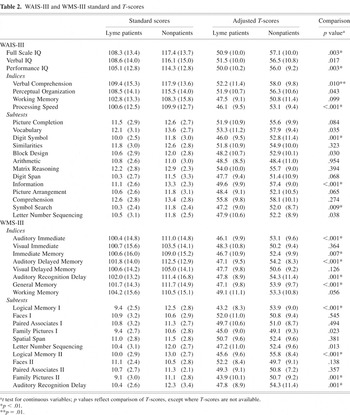
Chronic Lyme participants and nonpatients were comparable in age, sex ratio, and education level (Table 1.). Although the difference in age approached significance, age effects on neuropsychological performance were controlled in normative adjustments of test scores and are not likely to affect group differences. Chronic Lyme disease participants and nonpatients were comparable, as well, in estimated IQ, whether assessed via the Barona demographic scale, the NAART, or our regression formula combining the two measures. These samples were well above average in expected intelligence level. IQ estimates generated by the Barona and NAART fell below the level of actual IQs obtained by the nonpatient comparison group (due to anticipated ceiling effects; see actual IQs in Table 2); regression combination of the two estimates, however, accurately predicted WAIS-III IQ in nonpatients (r = .73; estimates correlated best with WAIS-III Verbal Comprehension, r = .79, and Working Memory, r = .65, indices, and with Immediate Memory, r = .54, and General Memory, r = .59, all p < .001).
WAIS-III and WMS-III standard and T-scores

Compared to nonpatients, BDI scores were significantly higher in the Lyme patient group, such that their mean score fell within the mildly depressed range.
Symptomatology, Illness History, and Treatment History
The majority of the patient participants reported a combination of rheumatologic, neurologic, and psychiatric/psychological symptoms. The most common rheumatologic symptoms were joint and muscle pain (arthralgias, myalgias). The most common neurologic symptom was headache (other than complaint of cognitive problems, which was required for study entry). Median duration of illness in this sample was 7 years, and median time before initiation of treatment was 8 months. Participants had received a median of nearly 3 months of oral antibiotics and 5 weeks of IV antibiotic treatment. Overall, this is a symptomatic sample of individuals with chronic illness who had received multiple courses of treatment, with recurrence of symptoms.
WAIS-III and WMS-III Index Scores
WAIS-III and WMS-III index scores are presented in Table 2, and index score profiles are illustrated in Figure 1. Lyme patients performed more poorly in general than nonpatients. Statistical differences at the .01 level were found in WAIS-III Full Scale and Performance IQ, but the only index score to differentiate the groups at p < .01 was Processing Speed. Verbal Comprehension differences fell at the p = .01 criterion for significance, even though estimated premorbid IQs were similar.

Demographically adjusted T-scores for WAIS-III and WMS-III IQ and index scores in chronic Lyme disease participants and nonpatient comparison participants. Abbreviations: WAIS-III–FSIQ = Full Scale IQ, VIQ = Verbal IQ, PIQ = Performance IQ, Vcomp = Verbal Comprehension, PerOrg = Perceptual Organization, WkMem = Working Memory, ProcSp = Processing Speed; WMS-III–AudImm = Auditory Immediate, VisImm = Visual Immediate, ImmMem = Immediate Memory, AudDel = Auditory Delayed, VisDel = Visual Delayed, AuRecDel = Auditory Recognition Delayed, GenMem = General Memory, WorkMem = Working Memory.
On the WMS-III, group differences were found in Auditory Immediate, Auditory Delayed, Auditory Recognition Delayed, and General Memory indices. T-scores on these measures fell an average of about 7 points below nonpatients (∼2/3 of a standard deviation), and 3 points below the external population norm of 50 (∼1/3 of a standard deviation). Chronic Lyme patients' WMS-III scores generally fell below the level of their regression estimated IQ and WAIS-III Verbal Comprehension index. However, this was also true for the nonpatient comparison group.
WAIS-III Subtest Scores
Lyme patients performed significantly more poorly on both Processing Speed subtests, Digit Symbol and Symbol Search, and on the Information subtest (Table 2 and Figure 2). Subtests are generally consistent with index score results, although they suggest that patient/nonpatient differences may have been found on the Working Memory index if nonpatients' T-score on the Arithmetic subtest was not relatively low.

Demographically adjusted T scores for WAIS-III subtest scores, grouped by index, in chronic Lyme disease participants and nonpatient comparison participants. Abbreviations: Voc = Vocabulary, Sim = Similarities, Inf = Information, Pcomp = Picture Completion, Bdes = Block Design, Matrx = Matrix Reasoning, Arith = Arithmetic, Dspan = Digit Span, Letnum = Letter Number, Dsym = Digit Symbol, Symsr = Symbol Search, Parr = Picture Arrangement, Comp = Comprehension.
WMS-III Subtest Scores
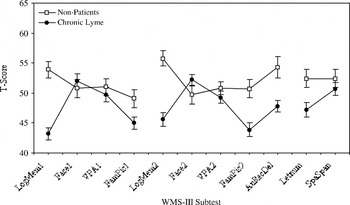
Differences between chronic Lyme and nonpatients on WMS-III subtests (Table 2 and Figure 3) reveal a pattern that was not expected on the basis of index score differences. Although patients differed most consistently on the auditory memory indices, their poorest subtest performances were on Logical Memory (an auditory memory subtest) and Family Pictures (a visual memory subtest). No differences were observed on Paired Associates or Faces subtests, immediate or delayed (n.b., the Auditory Recognition Delayed “subtest” is the only score included in the index of the same name).

Demographically adjusted T-scores for WMS-III IQ subtests in chronic Lyme disease participants and nonpatient comparison participants. Abbreviations: LogMem1 = Logical Memory Immediate, Face1 = Faces Immediate, VPA1 = Verbal Paired Associates Immediate, FamPic1 = Family Pictures Immediate; LogMem2 = Logical Memory Delayed, Face2 = Faces Delayed, VPA2 = Verbal Paired Associates Delayed, FamPic2 = Family Pictures Delayed, AuRecDel = Auditory Recognition Delayed, Letnum = Letter Number, SpaSpan = Spatial Span.
Discriminant Analyses
Discriminant analyses revealed that Lyme patients could be classified on the basis of a function including only the WMS-III Auditory Delayed index (standardized function coefficient = .671) and WAIS-III Processing Speed (standardized function coefficient = .535). This function correctly classified 68.8% of all cases (67.1% of Lyme patients, 72.2% of nonpatients).
Using subtest scores, the discriminant function included only the WMS-III Logical Memory, Immediate subtest. Using a cutoff of T = 47, 74.1% of participants could be correctly classified (73.7% of Lyme, 75.0% of nonpatients). This cutoff is relatively close to the general population mean and less than a full standard deviation (∼.7 SD) below the nonpatient comparison group mean, but fell approximately 10 T-score points (one standard deviation) below their own WAIS-III Vocabulary and Matrix Reasoning scores.
Associations with Other Clinical/Disease Measures
The Beck Depression Inventory did not correlate with any WAIS-III or WMS-III index or subtest scores in the Lyme patients. BDI correlations with WAIS-III Full Scale IQ (rho = .06, p = .66), Verbal IQ (rho = .03, p = .85), Performance IQ (rho = .06, p = .64), Verbal Comprehension (rho = .11, p = .40), Perceptual Organization (rho = .15, p = .22), Working Memory (rho = −.04, p = .73), and Processing Speed (rho = −.12, p = .36) indices were all nonsignificant. Similarly, BDI correlations with WMS-III Auditory Immediate (rho = .18, p = .15), Visual Immediate (rho = .09, p = .46), Immediate Memory (rho = .16, p = .22), Auditory Delayed (rho = .12, p = .34), Visual Delayed (rho = .07, p = .58), Auditory Recognition Delayed (rho = −.05, p = .70), General Memory (rho = .07, p = .58), and Working Memory (rho = .01, p = .94) indices were also nonsignificant.
Covarying BDI scores in group comparisons made a number of group differences marginal by our p < .01 significance criteria, although most remained significant. Covarying BDI reduced the significance level of the group comparison for the Verbal Comprehension index (F[1, 109] = 3.96, p = .049), but the difference for the Information subtest remained significant (F[1, 109] = 8.42, p = .004). Differences for the Processing Speed index (F[1, 109] = 5.30, p = .023), Digit Symbol (F[1, 108] = 2.62, p = .108), and Symbol Search (F[1, 109] = 3.68, p = .058) all did not meet the criterion for significance. On the WMS-III, differences for Auditory Immediate (F[1, 117] = 10.84, p = .001) and Immediate Memory (F[1, 117] = 7.10, p = .009), Auditory Delayed (F[1, 117] = 8.86, p = .004) and General Memory (F[1, 117] = 8.02, p = .005) remained significant. Auditory Recognition Delayed (F[1, 117] = 5.69, p = .019) did not. Differences on Logical Memory Immediate (F[1, 117] = 28.50, p < .001) and Delayed (F[1, 117] = 18.19, p < .001) and Family Pictures Delayed (F[1, 117] = 11.38, p = .001) remained significant. Overall, BDI was a nonsignificant covariate in all but one of these comparisons [Digit Symbol: F(1,108) = 4.58, p = .038]. Group differences related to processing speed appeared to be mildly affected by covarying BDI, those related to memory were generally unaffected.
Participants who recalled a tick bite had higher Full Scale IQ [t(72) = 3.45, p = .001], Verbal IQ [t(72) = 2.97, p = .004], Performance IQ [t(72) = 2.98, p = .004], Verbal Comprehension [t(72) = 2.62, p = .01], Perceptual Organization [t(72) = 3.16, p = .002], Processing Speed [t(72) = 2.42, p = .02], Auditory Immediate Memory [t(76) = 3.38, p = .001], Immediate Memory [t(76) = 2.71, p = .008], Auditory Delayed [t(76) = 3.01, p = .004], Auditory Recognition Delayed [t(76) = 2.59, p = .01], and General Memory [t(76) = 3.01, p = .004] than those who did not. Similarly, those who reported balance problems had higher Full Scale [t(72) = 2.01, p = .05] and Verbal IQ [t(72) = 2.04, p = .05], Auditory Immediate [t(77) = 2.27, p = .03], Visual Immediate [t(77) = 2.14, p = .04], Immediate Memory [t(77) = 2.47, p = .02], and General Memory [t(77) = 2.03, p = .02]. In each case, there were no differences in estimated premorbid IQ [t(75) = 1.40, p = .17 and t(76) = .42, p = .68, respectively] between groups.
Participants complaining of arthritis performed more poorly on WAIS-III Information [t(74) = 2.23, p = .03], WMS-III Auditory Recognition Delayed [t(79) = 2.20, p = .03], General Memory [t(79) = 1.97, p = .05], and Logical Memory Delayed Recall [t(79) = 2.06, p = .04]. Participants reporting shooting pains, facial palsy, headache, or sensory hyperacuity did not differ on any performance measures.
The initial lag in treatment was uncorrelated with any performance measures; duration of illness was weakly associated with poorer Digit Symbol (rho = −.26, p = .04), but was only one of 41 correlations to reach significance.
Total time receiving IV antibiotics was negatively associated with estimated IQ (rho = −.23, p = .05), and negatively associated with Verbal IQ (rho = −.27, p = .02), WAIS-III Working Memory (rho = −.40, p = .001), Digit Span (rho = −.33, p = .005), Letter Number Sequencing (rho = −.30, p = .01), WMS-R General Memory (rho = −.26, p = .03), WMS-III Working Memory (rho = −.32, p = .005), and Spatial Span (rho = −.25, p = .03). Associations remained significant after partialling estimated IQ (rank) with WAIS-III Working Memory (rho = −.34, p = .005), Digit Span (rho = −.25, p = .04), Letter Number Sequencing (rho = −.32, p = .008), and WMS-III Working Memory (rho = −.24, p = .04).
Time receiving oral antibiotics, on the other hand, was positively associated with performance on WMS-R Auditory Immediate Memory (rho = .27, p = .04), Auditory Delayed Memory (rho = .27, p = .04), and Logical Memory Immediate (rho = .25, p = .05) and Delayed (rho = .29, p = .03) subtests.
DISCUSSION
Chronic Lyme disease patients in this study had mild levels of impairment in processing speed and memory, consistent with the findings of Kaplan et al. (2003). These impairments are less severe than those found in acute Lyme encephalopathy prior to treatment (Halperin et al., 1990; Gustaw et al., 2001). These impairments were modest relative to population norms, although more obvious relative to the nonpatient comparison group. It is important to note that Lyme patients' standard scores on the WAIS-III and WMS-III are all approximately average, even though Lyme patients standard score IQ is 7 points below their estimated premorbid levels. Without demographic adjustment, these participants would appear to be performing comparably to the general population. T-scores indicate that they are, in fact, slightly below average when compared to appropriate demographic standards, and more clearly deficient relative to nonpatients of comparable intelligence.
The mild nature of the deficits found here suggests, on the one hand, that the WAIS-III and WMS-III may not be ideal for characterizing impairment in chronic Lyme disease. Their predecessors, the WAIS-R and WMS-R, have a history of being relatively insensitive, or at least inconsistently sensitive to deficits in chronic Lyme disease (Westervelt & McCaffrey, 2002). On the other hand, observed deficits in processing speed and memory recall for complex material may have resulted from a diffuse or idiosyncratic neuropathological process, rather than focal damage to well-defined cortical areas (Lezak et al., 2004). If this is the case, it is unlikely that any one test will consistently differentiate Lyme cases across samples. When averaged together, these patients may be distinguished best by their substandard performance across a variety of tasks. Individual participants may show more pronounced impairment in circumscribed cognitive functions, dependent on the unique effects of Lyme disease on individual brains. Our own prior imaging work suggests that chronic Lyme disease affects white matter (Fallon et al., 2003). Such pathology is more likely to affect global processing speed and the integration of cognitive functions rather than any single aspect of cognitive performance (Rao, 1996; Reed et al., 2004). However, language functions and recognition memory—affected in the Lyme sample here—are typically intact in white matter diseases, unless total lesion load is high (Rao, 1996).
Test scores may also reflect substandard performance due to nonspecific illness factors such as pain and fatigue. However, a supplemental analysis of tiredness and somatic concern items from the BDI, either alone or in combination, revealed no association to test scores.
An interesting discrepancy was found between results of index score analyses and subtest score analyses on the WMS-III. Index scores suggest that chronic Lyme patients were most deficient in Auditory Memory, while subtests indicate that Lyme patients were only deficient in Logical Memory from among the auditory tasks, and almost equally deficient in Family Pictures, a visual memory task. Deficits in chronic Lyme disease, then, reflect common elements in these two tasks, such as the inclusion of context and the need to organize material to be recalled. These tasks may place greater demands on processing speed to initially encode material, although, in another supplemental analysis, we found that covarying WAIS-III Processing Speed Index did not eliminate group differences on these WMS-III subtests. Discriminant analyses, similarly, suggest that processing speed deficits and memory deficits are distinct, in that each contributes to classification of Lyme cases.
Level of depression was significantly higher in Lyme patients than nonpatients, with the average BDI score falling in a “mildly depressed” range. However, as in most other studies of Lyme encephalopathy, depression severity did not correlate with test performance. Covariance analyses suggest that depression may account for some degree of processing speed deficit in Lyme patients, but, overall, BDI score was a very weak covariate of test performance.
Deficits in processing speed and memory found in Lyme patients are nonetheless similar to those typically found in participants with major depression (Veiel, 1997; Zakzanis et al., 1998), and depression effects cannot be ruled out completely by correlation and covariance analyses. Although these deficits presumably have a different etiology in the two disorders, they may be difficult to distinguish on the WAIS-III and WMS-III. Deficits on Verbal Comprehension subtests such as Information and the severity of memory deficit in Lyme disease are, however, less typical of depression and suggest a more significant impairment of memory encoding and retrieval in Lyme disease. Direct comparison of these groups on the WAIS-III and WMS-III is needed.
The low Information score in Lyme patients could be interpreted as an indicator of poor premorbid ability, but this subtest score is low relative to other typical premorbid ability indicators such as Vocabulary. If the discrepancy between Information and Vocabulary (difference score) is entered in the discriminant analysis, it is retained as a significant discriminating variable along with Logical Memory (standardized coefficient .48; for Logical Memory .98; correct classification: 80.4%). Lyme disease commonly affects verbal skills such as fluency (Benke et al., 1995; Gaudino et al., 1997; Krupp et al., 1991) in addition to memory, and some measures that are typically used as indicators of premorbid ability may be not as reliable in Lyme patients.
Supplemental analyses of symptom data are difficult to interpret due to the extensive overlap of symptoms across participants. Patients who did not observe a tick bite or have balance problems performed more poorly than those who did, possibly because the absence of these symptoms may have obscured recognition of the infection and delayed diagnosis and treatment. Participants with arthritis, on the other hand, performed less well on tests that distinguished patients with chronic Lyme disease from nonpatients. Lag between initial symptoms and initial treatment, and duration of illness had surprisingly little relationship to test performance. These participants have received varying courses of treatment, though, which may have obscured these relationships. Also surprising was the correlation between longer treatment with IV antibiotics and poorer working memory performance. While this correlation could reflect a long-term adverse effect of IV treatment, it may also mean that more impaired participants were more likely to receive longer courses of IV treatment. Length of treatment with oral antibiotics was, however, positively associated with test performance on key memory measures. More systematic research on long-term treatment effects is needed before any firm conclusions can be drawn about these relationships.
There are limitations to this study that may have resulted in our understating the level of impairment in Lyme disease participants. As in the study by Kaplan et al. (2003), patients were recruited based on their interest in participating in a placebo-controlled treatment trial. These patients may have milder illness, because physicians would likely recommend against participation in such a study for patients with marked encephalopathy and a currently positive IgG Western blot. In addition, greater than half of the patients in our sample had more than the standard 3–4 week course of IV antibiotic therapy during earlier treatments. This sample is biased toward patients who already may have experienced partial improvement in cognitive symptoms. Another limitation is that patients had to meet CDC surveillance criteria for Lyme disease. Because the surveillance criteria do not include encephalopathy as a criterion, our sample (as well as the sample of Kaplan et al., 2003) may have systematically excluded those with Lyme encephalopathy who did not recall an erythema migrans rash, or develop swollen joints, cranial neuropathy, or meningitis/encephalitis. As noted in Table 1, all patient participants reported cognitive difficulties, but fully 77.8% also reported arthritis, making this a multi-symptom sample.
In general, patients with chronic Lyme disease performed more poorly than nonpatients on the WAIS-III and WMS-III, but there does not appear to be any reasonable set of cut-off scores or any distinctive profile that can be used to identify them on an individual basis. The Logical Memory score determined by discriminant analysis was an efficient single cut-off score in this sample, but it is too close to the population norm to be meaningful in general clinical use. Other specialized tasks (e.g., measures of reaction time, attention, components of memory encoding/retrieval) may be needed to characterize these participants more effectively. Recent studies suggest that cognitive performance is relatively unchanged in chronic Lyme disease after additional courses of standard antibiotic treatment. However, given the mild, diffuse nature of their impairments, treatment effects may be most clearly evident as modest improvement across a battery of tests rather than a dramatic change in any single task. Future studies that combine cognitive measures with structural or functional imaging will enable us to determine if there are relationships between specific structural/functional brain abnormalities and specific types of cognitive impairment. Participants in this study who met inclusion criteria for its treatment component received both MRI and PET scans before and after treatment, these imaging tools will be used to address some of these questions.
ACKNOWLEDGMENTS
This study was supported by NINDS Grant # NS 38636 and by grants from the Lyme Disease Association, Time for Lyme, Inc., and the National Research Fund for Lyme and Tick-borne Diseases.
References
REFERENCES
Barona, A.,
Reynolds, C., &
Chastain, R.
(1984).
A demographically based index of premorbid intelligence for the
WAIS-R.
Journal of Consulting and Clinical Psychology,
52,
885–887.Google Scholar
Barr, W.B.,
Rastogi, R.,
Ravdin, L., &
Hilton, E.
(1999).
Relations among indexes of memory disturbance and depression in
patients with Lyme borreliosis.
Applied Neuropsychology,
6,
12–18.Google Scholar
Benke, T.,
Gasse, T.,
Hittmair-Delazer, M., &
Schmutzhard, E.
(1995).
Lyme encephalopathy: Long-term neuropsychological deficits years
after acute neuroborreliosis.
Acta Neurologica Scandinavica,
91,
353–357.Google Scholar
Blair, J.R. &
Spreen, O.
(1989).
Predicting premorbid IQ: A revision of the National Adult Reading
Test.
The Clinical Neuropsychologist,
3,
129–136.Google Scholar
Bujak, D.I.,
Weinstein, A., &
Dornbush, R.L.
(1996).
Clinical and neurocognitive features of the post Lyme
syndrome.
Journal of Rheumatology,
23,
1392–1397.Google Scholar
Center for Disease Control.
(1997).
Case definitions for infectious conditions under public health
surveillance.
Morbidity and Mortality Weekly,
Rep. 46 (No. RR-10),
20–21.Google Scholar
Fallon, B.A.,
Keilp, J.,
Prohovnik, I.,
Heertum, R.V., &
Mann, J.J.
(2003).
Regional cerebral blood flow and cognitive deficits in chronic lyme
disease.
Journal of Neuropsychiatry and Clinical Neurosciences,
15,
326–332.Google Scholar
Fallon, B.A.,
Kochevar, J., &
Nields, J.A.
(1998).
The underdiagnosis of neuropsychiatric Lyme disease in children and
adults.
Psychiatric Clinics of North America,
21,
693–703.Google Scholar
Fallon, B.A. &
Nields, J.A.
(1994).
Lyme disease: A neuropsychiatric illness.
American Journal of Psychiatry,
151,
1571–1583.Google Scholar
Gaudino, E.A.,
Coyle, P.K., &
Krupp, L.B.
(1997).
Post-Lyme syndrome and chronic fatigue syndrome. Neuropsychiatric
similarities and differences.
Archives of Neurology,
54,
1372–1376.Google Scholar
Gustaw, K.,
Beltowska, K., &
Studzinska, M.M.
(2001).
Neurological and psychological symptoms after the severe acute
neuroborreliosis.
Annals of Agricultural and Environmental Medicine,
8,
91–94.Google Scholar
Halperin, J.J.,
Krupp, L.B.,
Golightly, M.G., &
Volkman, D.J.
(1990).
Lyme borreliosis-associated encephalopathy.
Neurology,
40,
1340–1343.Google Scholar
Kaplan, R.F.,
Jones-Woodward, L.,
Workman, K.,
Steere, A.C.,
Logigian, E.L., &
Meadows, M.E.
(1999).
Neuropsychological deficits in Lyme disease patients with and
without other evidence of central nervous system pathology.
Applied Neuropsychology,
6,
3–11.Google Scholar
Kaplan, R.F.,
Meadows, M.E.,
Vincent, L.C.,
Logigian, E.L., &
Steere, A.C.
(1992).
Memory impairment and depression in patients with Lyme
encephalopathy: Comparison with fibromyalgia and nonpsychotically
depressed patients.
Neurology,
42,
1263–1267.Google Scholar
Kaplan, R.F.,
Trevino, R.P.,
Johnson, G.M.,
Levy, L.,
Dornbush, R.,
Hu, L.T.,
Evans, J.,
Weinstein, A.,
Schmid, C.H., &
Klempner, M.S.
(2003).
Cognitive function in post-treatment Lyme disease: Do additional
antibiotics help?
Neurology,
60,
1916–1922.Google Scholar
Krupp, L.B.,
Masur, D.,
Schwartz, J.,
Coyle, P.K.,
Langenbach, L.J.,
Fernquist, S.K.,
Jandorf, L., &
Halperin, J.J.
(1991).
Cognitive functioning in late Lyme borreliosis.
Archives of Neurology,
48,
1125–1129.Google Scholar
Lezak, M.D.,
Howieson, D.B., &
Loring, D.W.
(2004).
Neuropsychological assessment
(4th ed.).
New York:
Oxford University Press.
Logigian, E.L.,
Johnson, K.A.,
Kijewski, M.F.,
Kaplan, R.F.,
Becker, J.A.,
Jones, K.J.,
Garada, B.M.,
Holman, B.L., &
Steere, A.C.
(1997).
Reversible cerebral hypoperfusion in Lyme encephalopathy.
Neurology,
49,
1661–1670.Google Scholar
Logigian, E.L.,
Kaplan, R.F., &
Steere, A.C.
(1990).
Chronic neurologic manifestations of Lyme disease.
New England Journal of Medicine,
323,
1438–1444.Google Scholar
Newberg, A.,
Hassan, A., &
Alavi, A.
(2002).
Cerebral metabolic changes associated with Lyme disease.
Nuclear Medicine Communications,
23,
773–777.Google Scholar
Orloski, K.A.,
Hayes, E.B.,
Campbell, G.L., &
Dennis, D.T.
(2000).
Surveillance for Lyme disease: United States,
1992–1998.
Morbidity and Mortality Weekly,
Rep. 49 (SS-3),
1–11.Google Scholar
Pollina, D.A.,
Elkins, L.E.,
Squires, N.K.,
Scheffer, S.R., &
Krupp, L.B.
(1999a).
Does process-specific slowing account for cognitive deficits in Lyme
disease?
Applied Neuropsychology,
6,
27–32.Google Scholar
Pollina, D.A.,
Sliwinski, M.,
Squires, N.K., &
Krupp, L.B.
(1999b).
Cognitive processing speed in Lyme disease.
Neuropsychiatry, Neuropsychology and Behavioral Neurology,
12,
72–78.Google Scholar
Ravdin, L.D.,
Hilton, E.,
Primeau, M.,
Clements, C., &
Barr, W.B.
(1996).
Memory functioning in Lyme borreliosis.
Journal of Clinical Psychiatry,
57,
282–286.Google Scholar
Reed, B.R.,
Eberling, J.L.,
Mungas, D.,
Weiner, M.,
Kramer, J.H., &
Jagust, W.J.
(2004).
Effects of white matter lesions and lacunes on cortical
function.
Archives of Neurology,
61,
1545–1550.Google Scholar
Shadick, N.A.,
Phillips, C.B.,
Logigian, E.L.,
Steere, A.C.,
Kaplan, R.F.,
Berardi, V.P.,
Duray, P.H.,
Larson, M.G.,
Wright, E.A.,
Ginsburg, K.S.,
Katz, J.N., &
Liang, M.H.
(1994).
The long-term clinical outcomes of Lyme disease: A population-based
retrospective cohort study.
Annals of Internal Medicine,
121,
560–567.Google Scholar
Svetina, C.,
Barr, W.B.,
Rastogi, R., &
Hilton, E.
(1999).
The neuropsychological examination of naming in Lyme
borreliosis.
Applied Neuropsychology,
6,
33–38.Google Scholar
Veiel, H.O.F.
(1997).
A preliminary profile of neuropsychological deficits associated with
major depression.
Journal of Clinical and Experimental Neuropsychology,
19,
587–603.Google Scholar
Westervelt, H.J. &
McCaffrey, R.J.
(2002).
Neuropsychological functioning in chronic Lyme disease.
Neuropsychology Review,
12,
153–177.Google Scholar
Willshire, D.,
Kinsella, G., &
Prior, M.
(1991).
Estimating WAIS-R IQ from the National Adult Reading Test: A
cross-validation.
Journal of Clinical and Experimental Neuropsychology,
13,
204–216.Google Scholar
Zakzanis, K.K.,
Leach, L., &
Kaplan, E.
(1998).
On the nature and pattern of neurocognitive function in major
depressive disorder.
Neuropsychiatry, Neuropsychology and Behavioral Neurology,
11,
111–119.Google Scholar

Participant characteristics
WAIS-III and WMS-III standard and T-scores

Demographically adjusted T-scores for WAIS-III and WMS-III IQ and index scores in chronic Lyme disease participants and nonpatient comparison participants. Abbreviations: WAIS-III–FSIQ = Full Scale IQ, VIQ = Verbal IQ, PIQ = Performance IQ, Vcomp = Verbal Comprehension, PerOrg = Perceptual Organization, WkMem = Working Memory, ProcSp = Processing Speed; WMS-III–AudImm = Auditory Immediate, VisImm = Visual Immediate, ImmMem = Immediate Memory, AudDel = Auditory Delayed, VisDel = Visual Delayed, AuRecDel = Auditory Recognition Delayed, GenMem = General Memory, WorkMem = Working Memory.

Demographically adjusted T scores for WAIS-III subtest scores, grouped by index, in chronic Lyme disease participants and nonpatient comparison participants. Abbreviations: Voc = Vocabulary, Sim = Similarities, Inf = Information, Pcomp = Picture Completion, Bdes = Block Design, Matrx = Matrix Reasoning, Arith = Arithmetic, Dspan = Digit Span, Letnum = Letter Number, Dsym = Digit Symbol, Symsr = Symbol Search, Parr = Picture Arrangement, Comp = Comprehension.
Demographically adjusted T-scores for WMS-III IQ subtests in chronic Lyme disease participants and nonpatient comparison participants. Abbreviations: LogMem1 = Logical Memory Immediate, Face1 = Faces Immediate, VPA1 = Verbal Paired Associates Immediate, FamPic1 = Family Pictures Immediate; LogMem2 = Logical Memory Delayed, Face2 = Faces Delayed, VPA2 = Verbal Paired Associates Delayed, FamPic2 = Family Pictures Delayed, AuRecDel = Auditory Recognition Delayed, Letnum = Letter Number, SpaSpan = Spatial Span.
 You have
Access
- 32
- Cited by