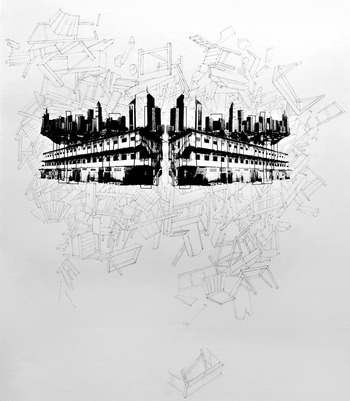
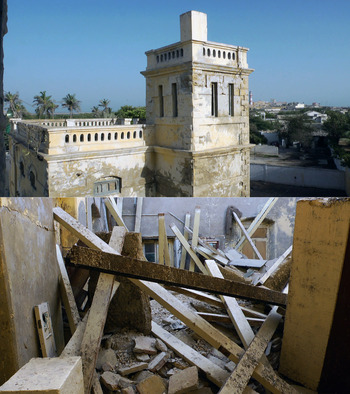
Naiza Khan's Membrane (Reference Khan2010, see figure 1), a silkscreen print overlaid with a pencil drawing, juxtaposes three images related to the island of Manora, which sits in the harbor of the Pakistani city of Karachi. The print combines a photographic image of abandoned workers' housing on Manora with the skyline of Dubai, the city held up as a model by real estate developers who wish to transform Karachi's coast. On top of that relatively straightforward comparison, Khan (b. 1968) drew hundreds of pieces of broken furniture: images of the debris that she used in a Reference Khan2010 video work, Homage. This drawing—more beautiful, delicate, and ambiguous than the print below it—renders what she describes as a “membrane that feeds our unconscious. . .” (Fekri Reference Fekri2010). Each of the three images in Membrane corresponds to different experiences of urban space: the material present of the built environment; the social and political significance of spatial imaginaries; and the bodily experience of things. Khan's sophisticated work of art isolates these layers of meaning by exploiting the specificities of artistic media. The screen print depends upon the mechanically reproduced medium of photography, which carries the assumption of an indexical connection to its referent, and the drawing is the product of the artist's imagination and skill. Overall, the work makes an astute and suggestive observation about urban development and the destruction that often lies in its wake.
Naiza Khan, Membrane, Reference Khan2010, silkscreen and graphite, 100 x 70 cm, coll. Walsall New Art Gallery. Courtesy the artist and Rossi & Rossi, London | HK. Photo by Mahmood Ali.

Though dominated by a naval base and changing quickly because of a port rejuvenation project, Manora is a weekend refuge for tourists. Most are Karachi residents, fleeing the bustling and overcrowded city to visit the seaside, its mangrove forest, and a small village. In 2006, all but 3,000 of Manora's civilian population were bought out of their property by a developer, who planned a luxury resort. The following year, the global financial crisis caused the project to collapse. As a result, Manora is uncannily empty, with many of its buildings lying vacant, slowly falling into ruins. Khan began to work on the island after the collapse of the building deal, taking photographs and collecting historical material, some of which she transforms in her studio into works like Membrane. She also engages with urban activists eager to imagine other futures for the island, alternatives to capital-driven development projects that disproportionately serve the needs of the rich.
Khan is hardly alone among Pakistani contemporary artists in her focus on urban space. Her work follows in the wake of the 1990s movement of Karachi Pop, in which artists criticized aesthetic hierarchies by incorporating popular visual culture into their work. Although their artistic practice diverged sharply from hers in approach, many of the Karachi Pop artists were close friends of Khan's, serving with her on the faculty of the Indus Valley School of Art and Architecture. As Hammad Nasar (Reference Nasar2013) argues, Karachi Pop “treated art as a mode of inquiry and the city itself as a kind of museum.” It anticipated more contemporary efforts to address the city, including the work of two of Pakistan's most successful artists, Bani Abidi and Rashid Rana, who have each used documentary methods to address the lived culture of Pakistan's cities (Hashmi Reference Hashmi2009).Footnote 1 Like Abidi, who has completed two series on Karachi, and Rana, whose works often refer to Lahore, Khan's Manora/Karachi work originates in photographic practice. All three artists build upon the strong “archival impulse” that has pervaded global contemporary art for the past two decades, in which artists explore the potential meanings of documents, as well as practices of collecting and preservation (Foster Reference Foster2004; cf. Cotter Reference Cotter and Sloman2009; Enwezor Reference Enwezor2008).
Abidi, Rana, and Khan are products of Pakistan's extraordinarily vibrant contemporary art scene, which has exploded into global prominence in the past decade. If seen in terms of art market indicators or international curatorial agendas, this kind of efflorescence can seem sudden. But in Pakistan, as in other booming Asian art worlds, such vitality depends on decades of institutional development. The most obvious example of Pakistani institutional strength is the “modern miniature” movement associated with Lahore's National College of Art (Whiles Reference Whiles2010). But Pakistani art institutions have supported other approaches as well, and the richness and variety of the country's practice is as much a consequence of the intricacy of local debates as it is dependent upon the ability of individual artists to understand and interpret global trends in contemporary art (cf. Taylor Reference Taylor2011). This article attends to this very basic condition—what is perhaps the most important factor shaping the form taken by art from places like Pakistan—by elucidating the connections of Khan's practice to critical discourse from outside Pakistan while explicating in more detail the manner in which her work is embedded in local intellectual debates and social conditions.
Khan's practice is distinguishable from the work of Abidi and Rana, as well as the earlier wave of Karachi Pop, in two ways. First, Khan deliberately integrates prevailing debates in urban studies in Pakistan into her work, sometimes even literally including their findings in her images. Influenced by urban activist scholars concerned about the relationship between development and violence (Anwar Reference Anwar2012; Hasan Reference Hasan2000, Reference Hasan2010b; Hasan and Raza Reference Hasan and Raza2012), Khan exploits the rich association of art with the life of the imagination in order to draw visual and metonymic connections between “the emerging construction sites in the city and the structure of violence on which this city is built” (Naiza Khan Reference Khan2012). While she has so far stopped short of direct political advocacy, her work provides an alternative form of engagement with the city, one that emphasizes complexity and takes as its primary object the production of critique.
Second, Khan is unusually interested in exploiting the tension between the documentary mode and more traditional artistic media. Khan's British training, with its strong commitments to the figure and immersion in the history of Western art, has set her apart from the majority of artists in Pakistan.Footnote 2 She has been an important figure in the Karachi art world, for years serving as the administrator of the Vasl Collective, a residency program affiliated with the Triangle Arts Network that is known for its formal inventiveness (Dadi Reference Dadi2012). But while many of her contemporaries in Karachi have fully rejected traditional media, Khan has combined her work in new media with a lasting commitment to existing artistic disciplines. She questions how, taken to their logical limits, practices of drawing, painting, and sculpture can produce new possibilities. The art historical term for this investigation is medium specificity, which comprises a medium's conventions and its material properties (Krauss Reference Krauss1999). While exploring several media simultaneously, Khan allows a thematic engagement with the figure of the ruin to organize her work. She takes advantage of the long history of artistic representations of ruins, through which artists have explored the capacity of ruined spaces to elicit a phenomenological address. That has allowed her to extend her long-standing commitment to the work of art as a site of embodied knowledge.
Although certainly worthy of sustained attention in itself, my contention is that, through its development of artistic language, Naiza Khan's work on Manora supplements the analytical or empirical knowledge produced by the academics and activists with whom she works. The body of scholarship focusing on urban space, planning, and development in Karachi has itself only recently emerged as a compelling counterpoint to studies of the city focused on ethnic violence. Karachi has been notoriously violent since the 1980s, when a so-called “Kalashnikov culture” of “political assassination, nepotism, blackmail, burglary, and car theft” emerged during and after the Afghan War (Verkaaik Reference Verkaaik2004, 1). The academic emphasis on the politicization of ethnicity follows the grain of formal politics, which is dominated by conflicts between the party that claims to represent the interests of the originally North Indian muhajir community, the Muttahida Qaumi Movement (MQM), and the Pakistan People's Party, which draws local support from the Sindhi community (Gayer Reference Gayer2007; Verkaaik Reference Verkaaik2004, Reference Verkaaik, Rieker and Ali2008). An alternative set of analyses focuses on how ethnic conflict is managed in everyday life, particularly by women (Asdar Ali Reference Asdar Ali, Rieker and Ali2008; Ring Reference Ring2006; see also Breman Reference Breman2012). Avoiding explicit reference to ethnicity, Khan's work on Manora prioritizes contests over land as an explanation for violence in Karachi, one that provides insight into the bodily experience of the city. Her work parallels that of scholars developing an alternative discourse about how to understand Karachi that privileges questions of space (Anwar Reference Anwar2012; Anwar and Viqar Reference Anwar2014; Asdar Ali and Rieker Reference Asdar Ali and Rieker2009; Dadi Reference Dadi2007, Reference Dadi, Ali and Rieker2009a, Reference Dadi and Abraham2009b, Reference Dadi and Khan2010c; Jaffri and Verkaaik Reference Jaffri, Verkaaik, Anjaria and McFarlane2011; Kaker Reference Kaker2014; Naiza Khan Reference Khan2010; Rieker and Asdar Ali Reference Rieker and Ali2008; Verkaaik Reference Verkaaik, Rieker and Ali2008; Yusuf Reference Yusuf, Anjaria and McFarlane2011).
The Critical Potential of Art in Karachi
For The Rising Tide, an exhibition she curated that tracked the development of Pakistani art since 1990, Naiza Khan observed that urban space has emerged as an important mode for conceptualizing art across Pakistan's art centers. Those include the larger and more established hubs of Karachi and Lahore, but also the smaller and more embattled cities of Quetta and Peshawar. She notes that urban spaces have been the stage for the most dramatic transformations in Pakistan's recent history, and writes that “artists have a special ability to sense these changes, recasting them in ways that offer scope for critical reflection” (Naiza Khan Reference Khan2010). While in her curatorial text she identifies this tendency in the work of other Pakistani artists, it is clearly also how she understands her own recent work, as she began to turn toward the city.
Engagement with urban life is a significant trend in global contemporary art, with the city often providing artists a springboard for reimagining politics. In her essay “subTERRAIN,” Indian art critic Geeta Kapur (Reference Kapur2007) argues that in the “post-national” contemporary moment the most significant artistic works engage directly with what are called “global cities.” Kapur finds that Indian artists address the city in various ways, two of which resonate with Naiza Khan's work: one, through the establishment of metonymic links between the body and the city and, two, in the mimicry of the documentary practices of the state (Kapur Reference Kapur2007, 279, 284). It is important to note, especially with regard to the document, that Kapur diverges here from influential critic Hal Foster's (Reference Foster2004, 4) critique of similar artistic movements in the West. Foster describes “the archival impulse” as exemplary of the collapse of both political commitment and traditional artistic disciplines, in an emergent “‘whatever’ artistic culture in keeping with a ‘whatever’ political culture.” The engagements with the city that Kapur describes are markedly similar in form to the works from the United States and Western Europe that Foster described as apolitical. Yet in the Indian context, she argues, they provide a “residual politics” by which the “artist as citizen dreams of a more democratic and just society” (Kapur Reference Kapur2007, 279). Similarly, Kapur affirmatively tracks artists' formal shift away from traditional artistic disciplines, especially painting, and toward documentary forms, new media practices, and installation. Even with its dependence upon the document, Khan's work sits less easily here, with its continued investment in drawing and painting.
Kapur published an initial version of “subTERRAIN” in 2003, just as Naiza Khan began her first foray into the city with a series of wall paintings called Henna Hands (2002–6). Before this point, Khan was better known for intimate, studio-based works. In drawings and prints, and later sculptures in latex, organza, or steel, she engaged with the image of the female body, as well as the relationship between desire, freedom, and constraint. Although born in Pakistan and a resident of Karachi since 1991, she spent much of her childhood in England and was trained in printmaking and drawing at the Ruskin School of Drawing and Fine Art at the University of Oxford. In the 1990s, as her friends engaged directly with Karachi's visual culture, Khan limited herself to more personal subjects. Her Henna Hands series was therefore a significant break in her artistic development. She used the project to establish the sort of metonymic link between the body and the city that Kapur describes (Naiza Khan Reference Khan2006).
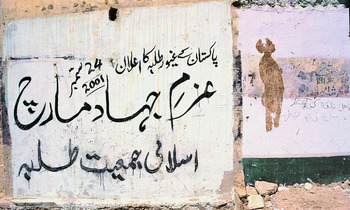
For Henna Hands, Khan created templates of female nudes, realistic and imperfect bodies, from stencils used to apply henna to the hands and arms on special occasions. Rubbing vegetable dye paste directly on roadside walls, she created paintings in two neighborhoods of the city that were undergoing demolition and reconstruction. In situ her images were provocative, both as female nudes in a society in which the public visibility of women's bodies is fiercely debated and in the secondary meanings made by the immediate juxtapositions with advertisements and graffiti. In one example (see figure 2), Khan placed her work next to an invitation to march in support of jihad sponsored by an Islamic students' organization. Some of her paintings were defaced almost immediately, while others were ignored and left to fade.
Naiza Khan, Henna Hands, 2002, henna pigment on the wall, dimensions variable. Site-specific project near the Cantonment Railway Station, Karachi. Courtesy the artist and Rossi & Rossi, London | HK. Photo by Mahmood Ali.

Writing of these works in the context of the visual experience of the city, Iftikhar Dadi (Reference Dadi, Ali and Rieker2009a) notes that their effect depends upon the manner in which the city's public space is gendered and politicized (discussed more fully in Dadi Reference Dadi2010b). He suggests that Khan's work signals the artist's attempt “to address an expanded public sphere” beyond the very limited audience for art (Dadi Reference Dadi, Ali and Rieker2009a, 188). Henna Hands is similar, in that sense, to a collaborative and transnational project undertaken around the same time by Karachi-based artist Huma Mulji and Mumbai-based artist Shilpa Gupta. Called Aar-Paar (2000–2, tr. Across the Divide), the project addressed the cultural ties and continuing conflict between Pakistan and India. In 2000, Mulji and Gupta asked artists to design single objects suitable for exhibition in public in the other city. In 2002, Mulji and Gupta organized artists to send by e-mail designs suitable for posters, which were then printed and posted on the walls of the other place. Khan sent work both times; the second piece was related to her Henna Hands series. But she was also deeply involved as the administrator of Vasl, which organized the Pakistani side of the project. As Chaitanya Sambrani (Reference Sambrani2004) writes, by operating on a small scale, projects like Aar-Paar avoid “pretending to make grandiose statements that have overarching implications for the world at large,” while “nevertheless manag[ing] to speak to a wider audience.” Further, Sambrani argues, “they harness the un-regulated sector of a common economy, slipping beneath the radar of state surveillance, or market control” (n.p.). Sambrani's formulation of the modesty of the artists' goals is very apt. But especially in light of Khan's later work, in which state and market failures loom large, Sambrani's characterization of the informal sector of the economy as independent of those spheres seems naive.
Khan's work on Manora highlights how acts of state negligence and market failure have shaped the seemingly abandoned landscape of ruins. This more critically engaged stance is a product of the connections Khan built to a group of architects and urban planners associated with the Urban Research and Design Cell (URDC) at the NED University of Engineering and Technology, Karachi. The URDC, along with two older organizations, the Orangi Pilot Project (est. 1981) and the Urban Resource Center (est. 1989), works to develop a more equitable and dialogic approach to urban development and to address vital problems of infrastructure and urban growth. They engage the global debates about inequality that are paradigmatic of the new urbanist approach to city development. All three of these organizations have been closely associated with architect Arif Hasan (see Hasan and Raza Reference Hasan and Raza2012), who is among the most prominent of Karachi's urban activists (Hasan Reference Hasan2000, Reference Hasan2010b). Khan has consulted with Hasan and URDC colleagues in her research on Manora. Hasan also contributed to the catalog for the The Rising Tide exhibition, for which two members of the URDC directed walking tours and provided other public programming.
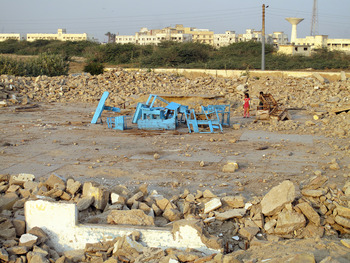
Khan's most eloquent illustration of the effects of state negligence and market retreat on the island is her video Homage (Reference Khan2010, see figure 3), which is also her work closest in spirit and method to Henna Hands. The video opens with a title screen and the voices of children, who, we see after a half a minute, are playing in the rubble that surrounds a large pile of scrap wood painted a brilliant blue. The video then flashes back to the artist painting a pile of what is eventually recognizable as the same broken and discarded furniture that appears in Membrane. As Khan explains quickly for the camera, her act is intended as a memorial to four children who were crushed to death two years before when a concrete wall on the playground of the F. G. Public School collapsed on them as they sat outside eating a snack. The color is copied from their gravestones. For a few minutes of video Khan paints alone, but then she is joined by a young working-class man from the area. We watch them paint while she asks the man about his brother, whom she knows from her work on the island, and finds that he has recently emigrated to Canada. They also discuss politics with weary resignation. Later, we overhear a couple of men who came to watch, as they talk about the difficulty of making ends meet. The scene is quiet and casual, as the daylong process of painting the wood is condensed into a number of minutes.
Naiza Khan, still from Homage, Reference Khan2010, single-channel video, 13.10 min. Courtesy the artist and Rossi & Rossi, London | HK. Photo by Maria Benjamin.

The video very carefully places her intervention—what is essentially a ritual of resignification—inside a thin tissue of everyday life on Manora, refusing to privilege either art or the lives of island residents (cf. Dadi Reference Dadi2010a). Homage also declines to make explicit connections between the footage and larger narratives; like the Aar-Paar project, the video avoids grandiosity. But Homage does carefully reveal a series of facts about life on the island, including details of economic conditions for the adult men who appear in the video and who stand in for a struggling non-elite class, as well as the artist's social distance from that life. These facts are teased out slowly and carefully, and are cut across by the purposeless act the artist performs. The resulting video is poetic and ambiguous, but also ethnographically rich, dexterous in its illustration of life on the island.
While Khan's Homage, like her Henna Hands series, was made in public and traces out the contours of social life, it is not exactly public art. Occurring in the same informal sector as Aar-Paar, it lacks the official sanction or long-term collaboration with the community that defines public art, in which the structure of the public is crucial to a work's undertaking, if not always its eventual form (Kwon Reference Kwon2004).Footnote 3 Her intervention in the space was deliberately brief, primarily offering to Khan the opportunity to explore the manner in which the material remains of the school—the furniture—could become significant. She noted in a private communication that she later saw a piece of blue-painted wood being used elsewhere on the island, highlighting the impermanence of her work and the distinctly utilitarian character of scrap wood for the community. And so, in spite of the broadening of her address outside the studio in works like Homage and Henna Hands, Khan has few illusions about the potential of her work to reach a popular public. The primary significance of both projects lies instead in their development of her artistic language and her growing capacity to articulate a critical position.
Khan's critical capability depends principally upon her exploration of the limits and potentials of different artistic media. As Foster (Reference Foster2004) remarks in his critical look at the “archival impulse,” it is now common for contemporary artists to work across disciplines, by which he means that many artists no longer describe themselves as painters or sculptors or prize the extensive training that those labels imply (cf. Krauss Reference Krauss1999, Reference Krauss, Arppe, Kaitaro and Mikkonen2009). His complaint about the “de-skilling” of the artist does not apply to Khan, or to many other Pakistani artists, who tend not only to be trained in traditional disciplines but also to teach those subjects in art schools. Her facility in representational drawing is clear, and, moreover, in Pakistan she is unique in the rigorous, classically Western training she obtained at the Ruskin. Khan's engagement with the city continues to privilege mark making, and her work is most disciplined in those media. But her project on Manora has also led her to develop her skills in photography and video, as well as to collaborate with experts in those media. This kind of highlighting of skill, however distributed between herself and others, is evidence of Khan's understanding of the critical purchase of artistic method. Her engagement with the city has offered her a wealth of material with which to develop new artistic strategies, with the strategies themselves forming a unique type of embodied knowledge, generated through practice.
The Multiple Temporalities of Manora's Ruins
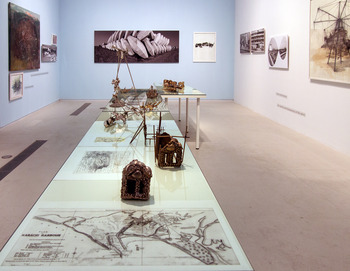
Khan's work finds its richest site in the ruin. The Manora Project (2007– ), which was most recently presented at the 2012 Shanghai Biennale (see figure 4), contains a collection of photographs taken by the artist and historical documents found on the island. It also includes oil paintings, watercolors, and prints based on her research; small sculptures cast in brass; and new media work, including videos and a sound piece. As Khan transfers her photographic source material to different media, the repetition and recombination of images gives to the archive one of its most potent effects. Khan photographed structures, including an early twentieth-century Hindu temple and Anglican church, the 1960s apartment blocks that appeared in Membrane, and masses of tethered ships continually impounded from Indian fishermen if they stray over the invisible international border dividing the Indian Ocean. Whether presented relatively simply, in digital photocollage, or transformed into prints, drawings, or paintings, the images of ruined structures capture the passage of time and the destruction of human communities. Yet, as in Homage, the forms of life associated with these ruins are neither totally vanished nor particularly ancient. They instead reflect the rapid pace of historical erasure in Karachi under colonial and postcolonial regimes (Dadi and Khan Reference Dadi, Khan and Masters2013).
Installation of Naiza Khan, The Manora Archive at Shanghai Biennale, 2012. Courtesy the artist and Rossi & Rossi, London | HK. Photo courtesy of Naiza Khan.

Ann Stoler's (Reference Stoler2008) “Imperial Debris” provides important suggestions for thinking through the analytical possibilities of the ruin in postcolonial contexts. She builds upon Walter Benjamin's (Reference Benjamin1999) analysis of the decidedly unromantic, abandoned Parisian arcades as “petrified life,” or tangible signs of the ultimate fragility of power. But Stoler's commitment to exploring the continuing effects of imperial formations causes her to refute Benjamin's treatment of ruins as “inert remains,” preferring to consider the process of ruination as ongoing. As she writes, “[I]mperial effects occupy multiple historical tenses. They are at once products of the past imperfect that selectively permeate the present as they shape both the conditional subjunctive and uncertain futures” (Stoler Reference Stoler2008, 194–95). In other words, the ruins Stoler finds in postcolonial contexts—half-demolished structures, polluted places, and forms of life—are not abandoned, empty artifacts to be looked upon with remove. They are the debris in which life is lived, having continuing—and often literally toxic—effects in the present and placing significant force upon the future. For Stoler, the question is clear and the stakes could not be higher: “How do imperial formations persist in their material debris, in ruined landscapes and through the social ruination of people's lives?” (194).
As further examination of Khan's work will show, such attention to the temporal complexity of ruins is all the more important on Manora, where effects must be traced to both colonial and postcolonial histories. Khan's most recent video work, The Observatory (2012, see figure 5), highlights the colonial origin of conditions on Manora. It overlays footage of a ruined building that served as a weather station in the late colonial period with the text of a 1939 weather report that she found sitting on a shelf inside. The voice reads out a list of weather events in cities, most lying outside the present borders of Pakistan, while the picture moves across a tangled mess of collapsed roof beams and abandoned pre-1947 files, the literal debris of imperial rule. By contrast, the neglect highlighted in Khan's video Homage must be traced to the most recent, neoliberal regime. The collapsed wall that killed four children is an intersection of physical ruins and “social ruination,” and makes it possible to follow Stoler's lead in tying the breakdown of society to what she calls “degraded personhood”: the devaluing of human potential that is less often discussed as an effect of imperial histories than in more present-oriented, social scientific terms (Stoler Reference Stoler2008, 193).
Naiza Khan, video stills from The Observatory, Reference Khan2010, video, 6.22 min. Courtesy the artist and Rossi & Rossi, London | HK. Photos by Mahmood Ali.

The artistic representation of ruins has recently reemerged as a vital aesthetic force in contemporary art through engagements with the remains of the industrial age, from Detroit to Berlin to Sarajevo to Chongqing (Dillon Reference Dillon2011; Halle and Schönle Reference Halle and Schönle2010; Roth, Lyons, and Merewether Reference Roth, Lyons and Merewether1997; Wu Reference Hung and Hung2008). Writing in the contemporary art journal Grey Room, Andreas Huyssen (Reference Huyssen2006) notes that the contemporary fascination with ruins of modernity emerges from their embodiment of past hopes for alternative futures. As with the industrial sites Huyssen discusses, some of the ruins Khan photographs point to different social possibilities. They are represented as much by the egalitarianism of the workers' housing shown in Membrane as by the list of weather stations stretching across an undivided Indian subcontinent. Khan finds this architecture all the more poignant because of the shallowness of the history represented; in a personal communication, she remarked upon how terribly old the most recent ruins appear to be.Footnote 4
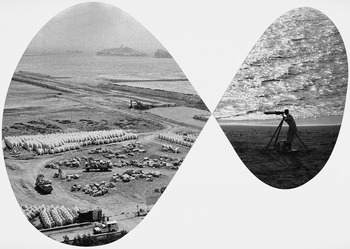
Some of Khan's most recent photographs from Manora are not of ruins, but of construction: the pylons brought in by a Chinese firm tasked with rebuilding the island's port by reclaiming land from the sea. Khan's archive now includes a series of three photocollages called Building Terrain (2013, see figure 6), which all make use of a photograph she took of concrete pylons neatly stacked beside heavy construction equipment taken from a picturesque distance. Perhaps as an effect of digital editing, the photograph is grainy, making it difficult to distinguish land from water. So far, Khan has either showed it on its own or combined it with an image of a man looking through a doorbeen (binocular telescope) placed on the beach for tourist use. The tense of this photocollage is difficult to pinpoint: the doorbeen is an oddly anachronistic sort of seaside delight, but what is on view is the island's future. So far the tone of the image has been carefully neutral, withholding critique of the development it depicts.
Naiza Khan, Building Terrain II, Reference Dadi, Khan and Masters2013, digital C-type print, 129.5 × 93 cm. Courtesy the artist and Rossi & Rossi, London | HK. Photo by Mahmood Ali.

In a piece co-written by Sarwat Viqar, Nausheen Anwar (Reference Anwar2014), an urban theorist with whom Khan has worked in Karachi, uses the somewhat different terms of critical urban planning discourse to tease out the complex relationship between the future-oriented, physical development of the city and its pasts. The authors focus on the 2011 Port Grand complex, which incorporates the structures of the Jetty and Napier Mole Bridge into a shopping and entertainment complex for the city's contemporary elite. As Anwar and Viqar write, the bridge and jetty, which connect the city to the port, were originally built through investments by both the British colonial state and Hindu and Parsi merchant communities. In the late nineteenth and early twentieth centuries, those merchant communities were empowered by the Karachi Port Trust to make use of the space for both commercial and religious purposes—the Lakshmi Narayan temple on the jetty was an important funerary and festival site. But after 1947, the jetty and bridge changed dramatically, becoming places for “people from diverse ethnic, religious and working-class backgrounds to fish, fly kites and make religious offerings by feeding birds and seeking protection against Nazr-e-badd (evil eye)” (Anwar and Viqar Reference Anwar2014, 329). The authors argue that the Port Grand project strictly curtails these customary seaside activities, creating a site for altogether different forms of consumption.
As Anwar and Viqar point out, the Port Grand project treats the colonial history of the structures as heritage, in which the colonial past is seen as elegant local color enlivening the cosmopolitan architectural form of the shopping mall. As they write, “[T]he invocation of the colonial landscape is meant to claim a link to what is seen as the most aesthetically acceptable built heritage for the city and at the same time to invoke a model for urban reconstruction” (344). They associate this vision of the colonial historical moment with a specifically muhajir historical imaginary in which the early postcolonial moment was one of proper sense of civic life (cf. Jaffri and Verkaaik Reference Jaffri, Verkaaik, Anjaria and McFarlane2011; Yusuf Reference Yusuf, Anjaria and McFarlane2011). This latter imaginary is more intimately tied to the plans to remake the city put forth by the MQM-led city government in the Musharraf era of the early 2000s, often with the assistance of the Karachi Port Trust, in which physical renewal was expected to generate a more proper political subjectivity. In their critique of urban development in Karachi, Anwar and Viqar describe the historical imaginary they call “colonial nostalgia” as politically regressive, tied to the disenfranchisement and social control of the majority of the city's population.
The authors treat nostalgia as straightforwardly false memory, arguing that such imaginations of the past must be disassembled in order to reveal their implication in the politics of the present. Khan works in an altogether different mode. In place of the classic gesture of demystification, so important to scholarship, the artist invests further in the imagination, attempting to wed critical engagement to subjective experience. In much of her work, this involves finding the place “where landscape becomes an internal, body-based concept, where it loses its direct association to the site and becomes part of something else—something more emotive and conceptual, as a metaphor or a bodily experience” (Dadi and Khan Reference Dadi, Khan and Masters2013, 137). Khan also calls her approach “diagonal mapping, trying to make connections between events far off in history and events in the present” (136). As the next section explores, this operation involves Khan's participation in a form of nostalgia invested in the production of critique.
Painting and Reflective Nostalgia
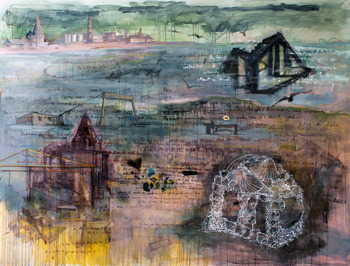
Khan's work exhibits a kind humility in the face of history that is not typically associated with nostalgia. The more common form of nostalgia, which artist and theorist Svetlana Boym calls “restorative nostalgia,” tends to have confidence in the stability of history as it seeks out return to a lost authentic origin. Khan engages instead in what Boym calls “reflective nostalgia,” which “does not attempt to rebuild the mythical place called home,” but instead “cherishes shattered fragments of memory and temporalizes space. . .” (Boym Reference Boym2001, 49–50). The artist describes how this process works in her large Manora-based oil painting, Between the Temple and the Playground (2011, see figure 7). Khan writes:
[T]his painting re-locate[s] this space and root[s] it in another time-specific place, where time is compressed and stretched simultaneously. The land and sea becomes [sic] both a single mass and interchangeable. In this way they carry equal proportions of meaning. The texts (in the painting) offer leads from within the painting; not just towards the imagery, but to a process of working across the surface. The layers of paint are essential, like excavating each page of history that has come to these shores. This is not a landscape; it is more about the moving image, and an extension of temporality. (Khan and Raza Reference Khan, Raza and Malik2014, 50)
Naiza Khan, Between the Temple and the Playground, 2011, oil on canvas, 270 × 200 cm, private collection. Courtesy the artist and Rossi & Rossi, London | HK. Photo by Mahmood Ali.

The painting is as formally complex as it is conceptually dense. Anchored at the top by a detailed drawing of the island's coastline, the dreamlike landscape is formed out of fragments of architecture presented as if submerged in water (Naiza Khan Reference Khan2012). Khan has lifted ruin images from her photographs and relocated them in the painting, where they take on new geographical relationships—a literal iteration of the “diagonal mapping” of past and present that she elsewhere describes. Khan used thin layers of paint, which she allowed to drip, creating vertical lines. Together with the handwritten notes that cover the bottom two-thirds of the canvas, the lines form a grid, drawing attention to the painting's surface. The written phrases describe the landscape and its temporality, among them: “The water around the island . . . The idea of a moat, a defence”; “Traditions are gone but we do not know it”; “the photograph seems to hold a space that does not exist”; and “this space that is at the brink of erasure.”
Khan made this painting in response to the massive floods that hit rural Sindh in 2010, which precipitated a massive refugee crisis in Karachi, among other effects (Parenti Reference Parenti2011). After she began the painting, she read a story of how receding water exposed a nineteenth-century shipwreck in the Indus River floodplain at Jhirk, a trade outpost east of Karachi. The steamboat, called the Fath-e Muhammad (Blessed Conquest), plied the river around the time of the 1843 annexation of Sindh, reported historian Mubarak Ali (Siddiqui Reference Siddiqui2011). Government officials confirmed that it had also resurfaced during the Ayub Khan period, forty years before. To her, this event confirmed her sense of the presence of the past in material form. As Huyssen (Reference Huyssen2006, 13) writes, “[T]he dimension present in any imaginary of ruins . . . is the hardly nostalgic consciousness of the transitoriness of all greatness and power, the warning of imperial hubris, and the remembrance of nature in all culture.” It is visible in the painting as half-submerged wreckage, its exposed ribs carefully articulated.
Khan reports that she began this painting by looking at two source images. The first is a series of photographs she took of burqa-clad Baloch women walking in the direction of the Shri Varun Dev temple on Manora. She found the images striking, not least because it appears that the women are going on a pilgrimage to the temple, which is highly unlikely, of course. Looking at them, she writes, “[I]t occurred to me that an image can aspire to mythical proportions” (Khan and Raza Reference Khan, Raza and Malik2014, 50). She composed the photographs so that the figures cut across the frame. This mimics the treatment of space in Giovanni Bellini's The Agony in the Garden (1465), her second source image. From Bellini, she borrows both a diagonal structure and the use of landscape to convey temporal complexity. The landscape Bellini portrays is distinctly Italian and contemporary to the painting, with two fortified towns and a church. The main subject is Jesus Christ, who prays as his disciples Peter, James, and John sleep and Judas Iscariot leads Roman soldiers across the painting's middle ground to arrest him. An angel appears before Jesus on a cloud carrying a cup and paten, symbols of the Eucharist, or his imminent sacrifice. The angel establishes the odd temporality of sacred narrative, in which one moment in the story is represented as the present, but the painting's meaning depends upon knowledge of the crucial, off-screen future events of Jesus's death and rebirth. By building on this painting, especially as an example of an authoritative history of Western art, Khan finds a model for representing a “landscape as simultaneously a mythic and real experience” (50).
The elements of that experience are decidedly non-monumental, however. The odd concrete stairways on the top right corner of the painting, we know from Khan's sound piece Manora Journal (5', 2011), are the steps attached to slides from the playground of the school where the children died. The early twentieth-century Shri Varun Dev temple, shown on the painting's left as well as in the skyline at the painting's top, is layered with images of the various structures used for loading ships at port. In the painting, all of those structures appear to be submerged in water, including a boat, whose exposed inner ribs are carefully drawn. On the bottom right corner, Khan has drawn in striking white paint a house covered in seashells, or a seepi ghar (shell house). Normally a small hand-crafted object that is sold on the island to tourists, in the painting it takes on a huge scale.
From Khan's other works and from her written texts, we know that these architectural elements—the temple, the playground—are connected to larger historical and sociological narratives of the failure of the state to live up to its promises. The tragedy on the playground was not a simple accident, but rather a sign of systematic neglect. The temple, a physical reminder of the diverse religious history of the area before the creation of Pakistan, alludes to the vulnerability of other minority communities in Karachi. The Hindu site stands in for Christian, Shi'a, and other targets of violence (see Naveeda Khan Reference Khan2010). The boat—partly revealed, partly submerged—provides a concrete connection to the past. The painting does not explicate the critical import of these images, or spell out their politics. Instead, with structures painted with deliberate realism in an otherwise ethereal pictorial space, the painting simulates the manner in which such ruins become concentrated nodes of affective memory.
In his 2013 interview with Khan, Iftikhar Dadi suggests that Karachi is beset with a “structural amnesia.” He elaborates, “I think we all grew up in a city that is evacuated, not just in terms of monuments and so on, but even in terms of public memory of everydayness” (Dadi and Khan Reference Dadi, Khan and Masters2013, 137–38). Boym writes in similar terms of the condition of memory in the former Yugoslavia. Citizens of Serbia and Croatia, she writes, quoting Croatian author Dubravka Ugrešić, “suffer from the ‘confiscation of memory,’” especially a “common corpus of emotional landmarks” (Boym Reference Boym2001, 52). Reflective nostalgia, Boym argues, is as a constructive reaction to such contexts. For, as she writes, “it reveals that longing and critical thinking are not opposed to one another, as affective memories do not absolve one from compassion, judgment or critical reflection” (49–50).
Rejecting any sense of the past as static, reflective nostalgia “opens up a multitude of potentialities, nonteleological possibilities of historical development” (Boym Reference Boym2001, 50). Khan exploits the medium specificity of oil painting—its material properties and conventions—to reveal the multiple temporalities inherent to remembrance. This comes first in Khan's allusion to Bellini's painting, and the conventional association of oil painting with the representation of sacred subjects and mythic temporalities. But when discussing this and other oil paintings, Khan mostly emphasizes the material qualities of paint: its ability, in contrast to her more commonly used media of drawing and watercolor, to produce a layered image. The thin layers of paint, each partially obscuring the one beneath, simulate the manner in which memory draws direct connections between and assigns meanings to distinct concrete images. Layering becomes, in other words, a way for Khan to assert the potential of artistic methods for representing embodied knowledge. It serves well the site of Manora, characterized so strongly by its temporal differences from Karachi.
The Materiality of Oils and the Embodied Knowledge of Karachi
Khan is drawn to Manora in part because it allows her a kind of freedom of movement, an escape from the “ghettoized type of residential enclave” in which she lives in Karachi (Dadi and Khan Reference Dadi, Khan and Masters2013, 137). As in most other South Asian cities, the enclave, or gated community, is a response to violence and the failure of the police to provide adequate security, along with other state institutions' failure to provide essential services like water and sanitation. But although both formal and informal enclaves have effectively lobbied the state for services, Kaker (Reference Kaker2014) argues that they cannot effectively counter the problem of insecurity. In fact, as she shows, the “very processes tied to ensuring protection and security perpetuates [sic] urban conflict, insecurity and violence” (Kaker Reference Kaker2014, 96). Kaker's qualitative fieldwork in Karachi allows her to comment on the subjective effects of these conditions, which include the strengthening of ethnic solidarities and exclusions and the emergence, particularly in the poorer of the two settlements in which she worked, of paranoia.
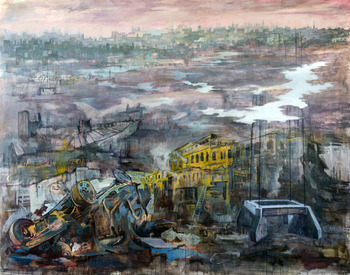
In one of two large oil paintings Khan has so far made of Karachi itself, The Streets Are Rising (2013, see figure 8), the artist directly represents the city's insecurity and its effects. The foreground of the painting is filled with debris, including the twisted body of a car blown apart by a bomb, which she photographed in a neighborhood close to her daughter's school, and the shells of burned-out buildings. The buildings are based on photographs of Bolton Market, which was burned, allegedly in a land dispute, following the bombing of the ashura processions in Karachi in 2009. Khan reported to me that when she began to work on the painting she turned to a section of a Pakistani newspaper that summarized the casualties of violence in the city. In the initial stages of the painting, she inscribed the data on the surface of the canvas. But she eventually covered over the statistics in favor of two repeated phrases: “we reap what we sow” and “the streets are rising.”Footnote 5
Naiza Khan, The Streets Are Rising, Reference Khan2012–13, oil on canvas, 200 × 256 cm. Courtesy the artist and Rossi & Rossi, London | HK. Photo by Mahmood Ali.

The latter phrase emerged from a conversation with a U.S.-based Pakistani scholar who visited her studio. While discussing the violence that is endemic to the city, he observed how rubble accumulated following each blast, and joked that the streets must be rising as a result. Khan enjoyed the double meaning of the phrase: not only does it connect the rubble of construction to that of violence, it set up a tension between “the street” as the site of the popular and the archaeological truth contained in material culture, as rubble becomes the strata of history. In the most explicit invocation of this point, on the right of the painting, lines of exposed rebar protrude from a brand-new concrete base. As in her work on Manora, the debris from ruined buildings—the past—and from development projects—the future—blend together in an image of the present.
In the middle of the canvas, it is just possible to see the bare outlines of a whale. This is a reference, which recurs in Khan's work, to a mythic story by the Sindhi poet Shah Abdul Latif Bhittai (1689–1725) about a man named Morriro who is swallowed by a whale. Morriro is determined to recover the bodies of his fisherman-brothers from the whale's belly, so he devises an iron cage covered in hooks and blades and allows himself to be swallowed in it (see Dadi Reference Dadi2010a). Morriro cuts his way out of the whale after retrieving the bones of his brothers, which he buries at Karachi, making that place his home. As Asif Farrukhi argues, descriptions of the dangerous waters off of Karachi are among the first recorded descriptions of the city. They figure allegorically in Bhittai's Sufi writings. Farrukhi (Reference Farrukhi2008, 5) writes, “[T]he ensnaring whirlpool . . . [represents] the temptations of the world and the whale, which takes on mythical dimensions, as the nafas-e-ummarah (nafs-i ammāra, tr. carnal soul) or the Beast inside who has to be captured and slain in order to reach the state of harmony by the pilgrim soul of the boat-bound hunter.” Khan's reference to this story lends to the less monumental images of debris some of its allegorical power, placing these very distinct events at once into a larger historical cycle of violence and into an individual struggle against aggression.
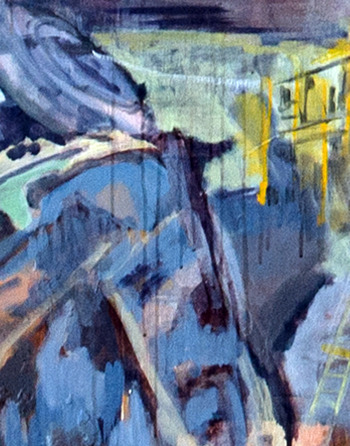
The Streets Are Rising is almost overwhelmingly complex. Its large scale (6 by 8 feet) makes it difficult to absorb in a single glance. While the diagonal line should organize viewing, drawing the eye upward as it does in Between the Temple and the Playground, it does not. The pools of water painted along the diagonal shimmer on the surface of the painting, confounding the canvas's sense of depth. There is a grid formed by thin vertical drips of paint and handwritten horizontal lines of text, but the rubble interferes with its effect. The vertical lines of rebar and scaffolding are only intermittently clear, flipping back and forth between concrete image and formal device. The images of the blown-up car and burnt-out buildings retain their links to their photographic originals, but they also assert themselves as painterly gestures. The stripes of yellow, blue, and turquoise paint threaten to disintegrate into pure color (see figure 9). In other words, Khan at once uses and undermines the realist conventions of oil painting, harnessing the medium's convention-based capacity to monumentalize space and construct mythic narratives while also calling attention to the pure materiality of paint. The painting laboriously itemizes the tasks involved in representing Karachi.
Naiza Khan, detail of The Streets Are Rising, Reference Khan2012–13, oil on canvas, 200 × 256 cm. Courtesy the artist and Rossi & Rossi, London | HK. Photo by Mahmood Ali.

The challenge the city's violence poses to representation is widely felt. In an op-ed published in the Dawn newspaper, urban activist Arif Hasan (Reference Hasan2010a) traces the 2009 burning of Bolton Market to the development of an “intricate nexus” of criminal gangs, whose speculation in real estate is facilitated by the segregation of neighborhoods by ethnicity. Attributing the gangs' dominance to the failure of the state, Hasan argues that strengthening state structures is the only way to combat ethnicization and its accompanying spiral of violence. In the same piece, Hasan also explicitly refers to the pernicious effects of violence on knowledge production, noting that “there is also a lot of information on Karachi but it is unpublished for obvious reasons.” In his book on Karachi, National Public Radio journalist Steve Inskeep reported that Arif Hasan received a death threat shortly after he went on television to discuss the Bolton Market arson (Inskeep Reference Inskeep2012, 37). Such threats are clearly credible. In 2013, as Khan was painting The Streets Are Rising, Perveen Rehman, the director of the Orangi Pilot Project and one of Karachi's most prominent urban activists, was assassinated (Khattak Reference Khattak2013).Footnote 6
The targeting of urban activists joins the cycle of ruination and development and the profusion of gated communities as one of the circumstances that conditions Khan's representation of the city. Each of these issues has a distinct effect on the bodily experience of the city, producing fear and paranoia, altering the physical environment, and changing the inhabitant's sense of space. Khan's stated intention in her works on both Karachi and Manora is to engage—by representing or reproducing—those bodily effects of the city. Among her works, The Streets Are Rising contains Khan's starkest impressions of life in the city. It represents Karachi as overwhelmed by debris, grappling with its physical and psychic burdens. It is a pessimistic painting, in which the outlet for the imagination, so present in her works on Manora, is severely constricted.
Conclusion: Manora and Metonymy
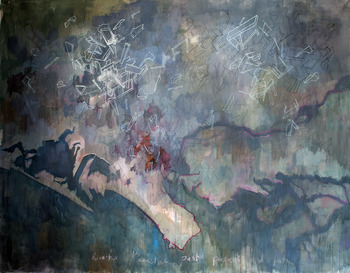
The second of Khan's two 2013 Karachi oil paintings adapts the device she used for Membrane, the first work discussed in this essay, placing a fine drawing of furniture debris over a painted rendering of a colonial-era map (see figure 10). It takes its title, Kurrachee, Past, Present and Future, from that map, which is transcribed very accurately on the canvas. The coastline is highlighted in hot pink, and the territory on either side of that line is built up from thin layers of paint in shades of blue and brown for ocean and pink and grey for land. The debris, some of which is drawn in black paint and the rest in white, appears to be in motion, either exploding up from the land or falling down upon it. In contrast to the representational chaos of The Streets Are Rising, this painting is a clear, if elegiac, statement about urban space, its temporality, and the metonymic role that materiality plays in tying the body to the city.
Naiza Khan, Kurrachee, Past, Present and Future, Reference Khan2012–13, oil on canvas, 200 × 256 cm. Courtesy the artist and Rossi & Rossi, London | HK. Photo by Mahmood Ali.

The island of Manora is visible on the southwestern part of the map, making it clear how tiny a portion it is of the massive, sprawling city. For Khan, it serves as a kind of laboratory. Compared to Karachi, Manora is a relatively controlled space, in which the historical and social processes that interest her are more easily seen. While the island is markedly different from the city—largely devoid of population, its spaces disused and its decay accelerated—the changes that Manora has experienced are intimately connected to the history of Karachi as a whole. Calling the island “a nucleus of transformation,” that, as she continued, “on many levels echoes what Karachi has gone through,” Khan allows her work to rest upon the metonymic association of the island with the city. As a whole, her Manora/Karachi body of work exploits a variety of metonymic links, including those between ruins and the body, history, and time. These figurative associations are established through the juxtaposition of images and the skillful handling of media.
I have argued that Khan's work with space and ruination simulates memory and bodily experience. Most significantly, perhaps, it provides an opening for imaginative thinking, supplementing the empiricism and demystification offered by the academics and activists upon whose work Khan builds. Khan's artist statements (Dadi and Khan Reference Dadi, Khan and Masters2013; Khan and Raza Reference Khan, Raza and Malik2014) deliberately mark her divergence from more conventional forms of research, for which Manora's marginality might make the island a less vital site for study. By contrast, she describes her approach to her work as purposely uncalculated. My analysis of Khan's oil paintings emphasizes how her work, though improvisational, proceeds along a course determined not by conceptual design but by the conventions and material possibilities of the media in which she works. The discipline of artistic practice allows her work a conceptual freedom that is broadly effective and quite different from other modes of knowledge formation.
Naiza Khan's work with the urban spaces of Karachi broadly confirms Geeta Kapur's (Reference Kapur2007) insight that the city offers to contemporary artists a crucial site for the articulation of a politics appropriate to today's globalizing moment. Khan's is a politics of engagement, one that makes most sense when taken alongside the rapid growth of the city of Karachi, which itself has spurred the discourse of urban studies. Her techniques allow for a complex understanding of the manner in which the city, its built environment, and its histories shape contemporary experience.
Acknowledgments
This article benefits from a series of phone interviews and personal correspondence with the artist spanning from October 2011 to June 2013, undertaken for an exhibition curated by the author, Naiza Khan: Karachi Elegies, at the Eli and Edythe Broad Art Museum at Michigan State University (February 22–May 26, 2013). The author is grateful for the comments of three anonymous reviewers for this article.