Introduction
Molecular phylogeny has revolutionized our understanding of the lichen family Graphidaceae (including the Thelotremataceae), which is the dominant element of tropical crustose lichen communities (Rivas Plata et al. Reference Rivas Plata, Lücking and Lumbsch2008; Lücking et al. Reference Lücking, Archer and Aptroot2009). Starting with Staiger's (Reference Staiger2002) monographic revision of the genus concept in lirellate forms, Frisch et al. (Reference Frisch, Kalb and Grube2006) in a similar manner introduced a new genus concept for the thelotremoid taxa. Molecular data (Frisch et al. Reference Frisch, Kalb and Grube2006; Staiger et al. Reference Staiger, Kalb and Grube2006; Mangold et al. Reference Mangold, Martin, Lücking and Lumbsch2008; Rivas Plata & Lumbsch Reference Rivas Plata and Lumbsch2011; Rivas Plata et al. Reference Rivas Plata, Hernández, Lücking, Staiger, Kalb and Cáceres2011) have added to this and refined the systematic classification. Thus, a family that, until recently, was considered to include just 15 genera in two separate families, now comprises over 50 genera in at least four distinct lineages. While many of these are well-characterized, large clades, such as the Ocellularia and the Phaeographis clade, they are only beginning to be studied in detail and will require further substantial changes in generic concepts once resolved. Here we describe a new genus and species in the Phaeographis clade, which is both morphologically and genetically unique. Externally it resembles species of Graphis in lirellae and thallus morphology, but in hymenium and ascospore characters agrees with Phaeographis. Genetically it is related to Phaeographis and allies, but clusters outside all currently recognized genera in that clade.
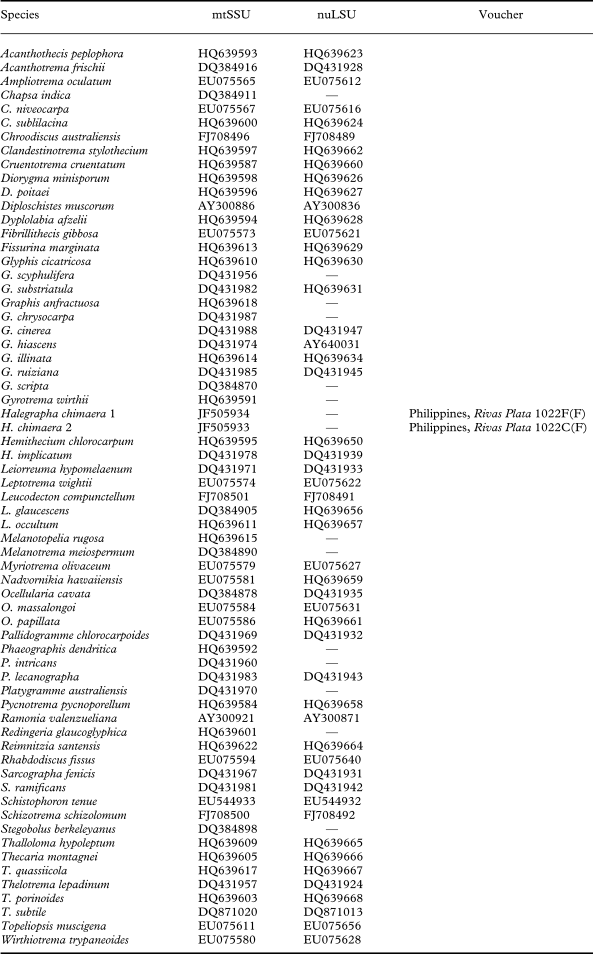
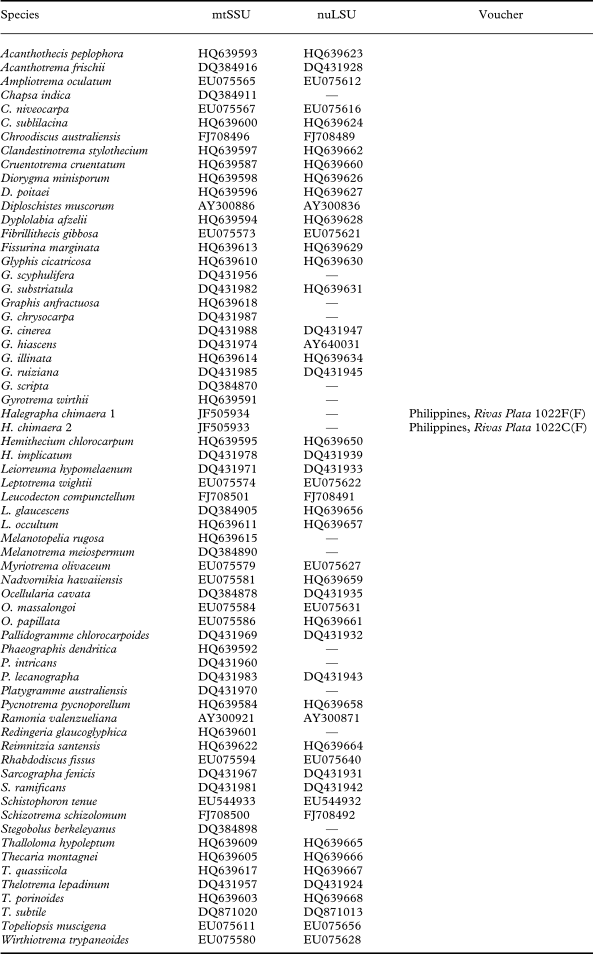
GenBank accession numbers for sequences used in this study
Material and Methods
Fresh material for this study was collected during field work in the Philippines by ERP and RL. The specimens were studied using standard techniques of light microscopy and thin-layer chromatography (Arup et al. Reference Arup, Ekman, Lindblom and Mattsson1993; Lumbsch Reference Lumbsch, Kranner, Beckett and Varma2002). DNA extraction and sequencing was performed by ERP and sequences of the mitochondrial small subunit rDNA (mtSSU) and the nuclear large subunit rDNA (nuLSU) were targeted; unfortunately, amplification of nuLSU did not work in the specimens sampled. Two new mtSSU sequences were generated for this study from two specimens of Halegrapha chimaera, and details for DNA extraction and sequencing are described in Rivas Plata et al. (Reference Rivas Plata, Hernández, Lücking, Staiger, Kalb and Cáceres2011). The sequences obtained were aligned with selected Graphidaceae from GenBank (Table 1), representing a 1751 base pair long subset of the combined mtSSU/nuLSU dataset used in Rivas Plata et al. (Reference Rivas Plata, Hernández, Lücking, Staiger, Kalb and Cáceres2011); for details of alignment and testing for conflict, see Rivas Plata et al. (Reference Rivas Plata, Hernández, Lücking, Staiger, Kalb and Cáceres2011). The subset used here contained 65 OTUs. Phylogenetic analysis was performed using maximum likelihood in RAxML 7.2.6 (Stamatakis Reference Stamatakis2006) with GTR-Gamma and bootstrapping with 500 replicates.
Taxonomy
Halegrapha Rivas Plata & Lücking gen. nov
MycoBank No.: 519821
Genus novum familiae Graphidaceae. Thallus corticicola, albo-cinereus, cortice et crystallis instructus. Lirellae immersa vel erumpentia, nigrae, labiis bene evolutis. Excipulum carbonisatum. Hymenium inspersum vel non inspersum. Ascosporae fuscae, transversaliter septatae. Sine acidi lichenum vel acidum sticticum vel norsticticum aggr. continens.
Holotypus: Halegrapha chimaera Rivas Plata & Lücking.
Thallus corticolous, continuous, white to grey; prothallus absent. Thallus in section with cartilaginous upper cortex, irregular photobiont layer, and abundant clusters of crystals above and between the photobiont layer. Photobiont Trentepohlia. Lirellae immersed to erumpent, with basal to lateral thalline margin or thalline margin absent; disc concealed or rarely exposed; labia thick, entire or rarely becoming striate, black. Excipulum apically to completely carbonized; hypothecium prosoplectenchymatous, colourless to pale yellowish; hymenium usually inspersed, inspersion of the Phaeographis type (see discussion below), clear in two species; epithecium indistinct. Paraphyses unbranched; asci clavate. Ascospores 8 per ascus, oblong-ellipsoid with rounded ends or distally tapering, transversely septate, grey-brown, I+ vine-red.
Chemistry. No substances or stictic and norstictic acids and satellite substances.
Notes. The new genus is dedicated to the late Mason Hale Jr., for his significant contributions to tropical lichenology and particularly the family Graphidaceae (inluding the Thelotremataceae). Hale also collected the first specimens of the new genus, now in Halegrapha intergrapha, and noticed its particular combination of features, but never had the time to formally describe the taxon.
At first glance, species of Halegrapha perfectly resemble typical Graphis in the white-grey thallus encrusted with abundant calcium oxalate crystals and thick, carbonized labia with the disc usually concealed or, if exposed, of the same colour as the margin. This type of morphology is not known in Phaeographis and allied genera, in which most species have a thallus of some shade of yellow-olive and lacking or with few and scattered calcium oxalate crystals usually beneath the photobiont layer, the labia are usually thin, and the disc is usually exposed (Staiger Reference Staiger2002; Lücking & Rivas Plata Reference Lücking and Rivas Plata2008; Archer Reference Archer2009). A few species in this clade do have whitish thalli, such as Leiorreuma spp. and Phaeographis dendritica, but these always have thin labia and exposed discs, and the thalli are of a different anatomy. Graphis-type lirellae with thick, carbonized labia and concealed disc are known from Platygramme spp. and Thecographa prosiliens (Staiger Reference Staiger2002; Rivas Plata & Lücking Reference Rivas Plata, Lücking and Lumbsch2008), but here the thallus is Phaeographis-like and yellow-olive, lacking crystals above the photobiont layer. Species of Graphis have hyaline ascospores which usually have at least seven, at least slightly constricted septa when mature and have both ends characteristically tapering (never rounded except in large muriform ascospores), and the septa are I+ violet-blue; if inspersion is present, it is of a type different from Phaeographis and allies (Lücking Reference Lücking2009).
All brown-spored Graphidaceae with an inspersed hymenium tested to date (R. S. Common, unpublished data) have a pale to strong I+ blue reaction, closely associated with the cell walls of the paraphyses, after pretreatment with 10% KOH. Prior to K pretreatment, in specimens with a strong reaction, a pale I+ red reaction can usually be seen in the same areas in a dilute (0·15%) iodine solution. These characteristics are consistent with the hemiamyloid (Baral Reference Baral1987) or amylomycan (Common Reference Common1991) type of iodine reaction. We could reproduce this reaction very weakly in Halegrapha chimaera. The fact that not all species here assigned to Halegrapha have an inspersion is not contradictory to their placement, since inspersion is lacking in other groups of this clade, for example the Phaeographis intricans group (Staiger Reference Staiger2002).
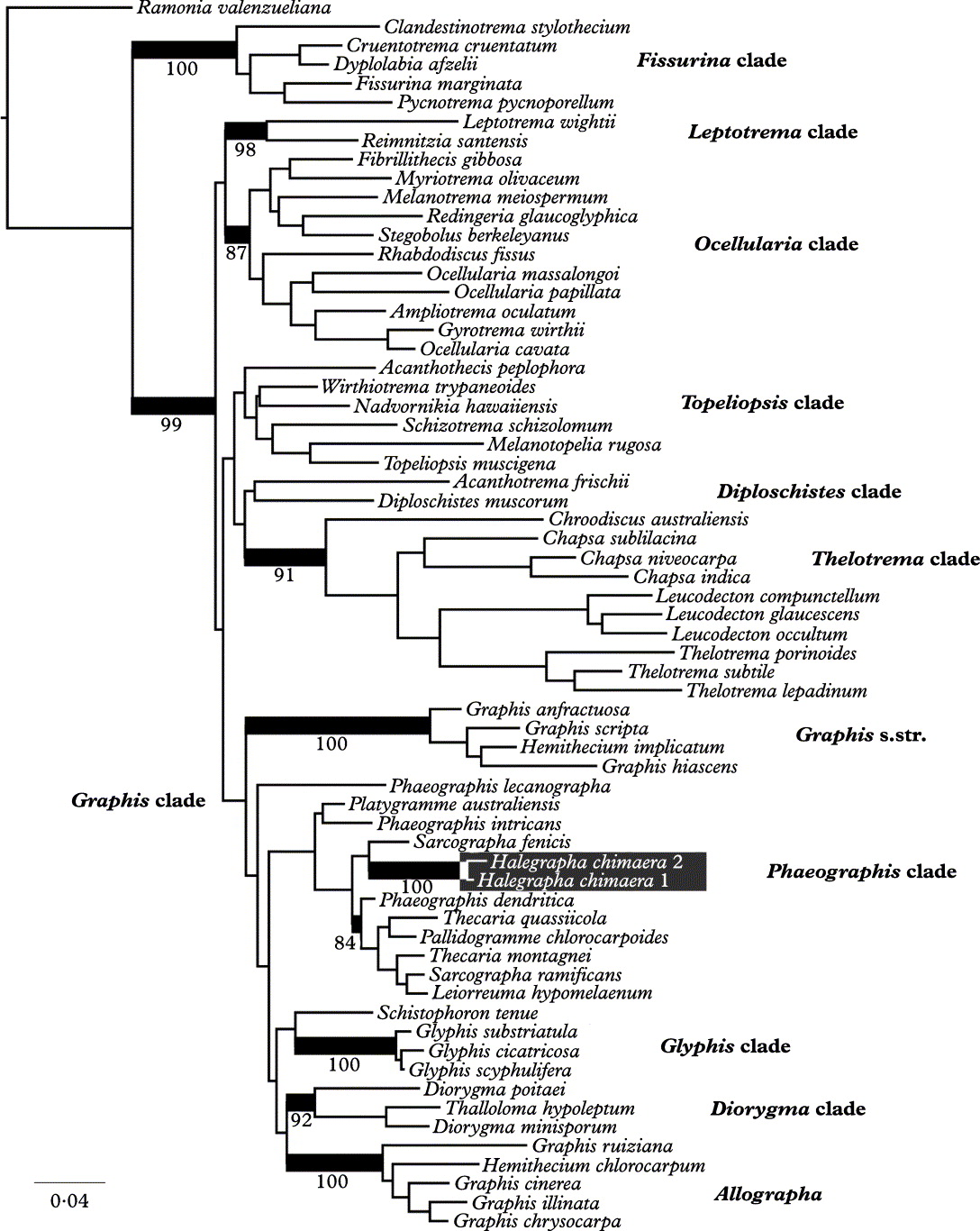
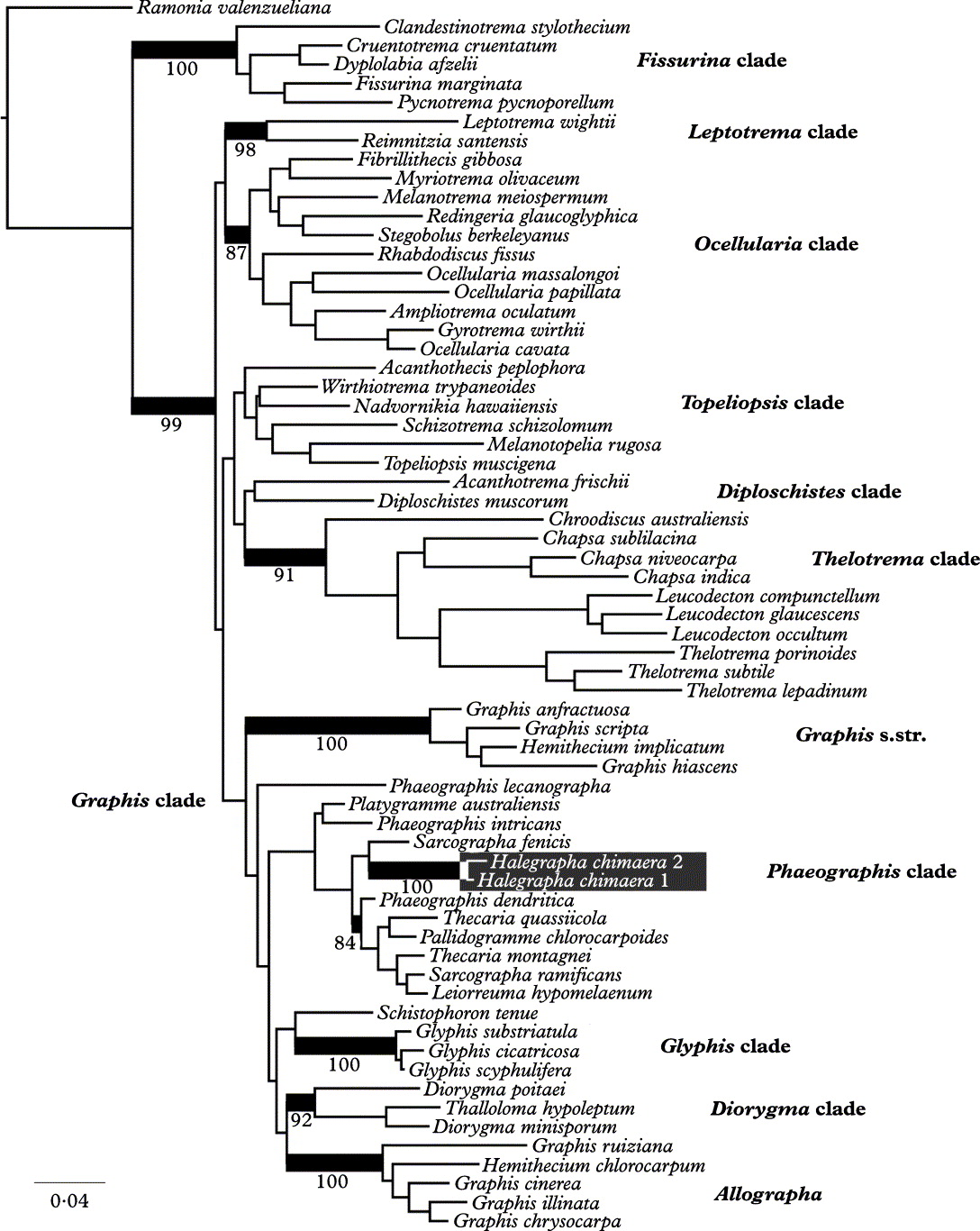
Thus far, only a few species of Graphis with (pale) grey-brown ascospores are known (Lücking Reference Lücking2009; Lücking et al. Reference Lücking, Archer and Aptroot2009), but in these the ascospore shape is characteristically Graphis-like. Thus, Halegrapha is perfectly intermediate between the two genera, as it combines a Graphis-like morphology with a Phaeographis-type hymenium and ascospores. Molecular phylogeny demonstrates that the new taxon belongs in the Phaeographis clade (Fig. 1), which supports the notion that, in the lirellate Graphidaceae, morphology is less predictive of phylogenetic relationships than hymenial and ascospore characters (Rivas Plata & Lumbsch Reference Rivas Plata and Lumbsch2011; Rivas Plata et al. Reference Rivas Plata, Hernández, Lücking, Staiger, Kalb and Cáceres2011). The Phaeographis clade is currently under revision and preliminary results suggest that the genus Phaeographis as currently circumscribed (Staiger Reference Staiger2002) is polyphyletic: the P. lecanographa and P. intricans groups do not cluster with the type species, P. dendritica (Fig. 1). The same applies to the genera Sarcographa and Thecaria sensu Staiger (Reference Staiger2002).
Maximum likelihood tree of selected Graphidaceae derived from combined mtSSU and nuLSU sequences showing position of Halegrapha. All named clades received support in 3-gene studies including RPB2 (Rivas Plata & Lumbsch Reference Rivas Plata and Lumbsch2011; Rivas Plata et al. Reference Rivas Plata, Hernández, Lücking, Staiger, Kalb and Cáceres2011).
The new genus has a pantropical distribution and so far includes five species collected in the Philippines, Malaysia, Kenya, Mexico and the United States (Florida).
Halegrapha chimaera Rivas Plata & Lücking sp. nov
MycoBank No.: 519822
Thallus albo-cinereus. Lirellae erumpentia disco abscondito labiis striatis. Excipulum in parte laterali carbonisatum. Hymenium inspersum. Ascosporae 3–5-septatae, 15–20 × 6–8 µm. Sine acidi lichenum.
Typus: Philippines, Nueva Vizcaya (Luzon), Mt. Palali, near Solano; 16°26′ N, 121°13′ E, 700 m, partially disturbed lower montane rain forest, on trunk in semi-exposed situation, March 2007, Rivas Plata & Lücking 1022F (F—holotypus).
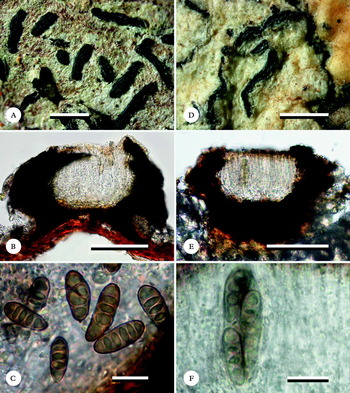
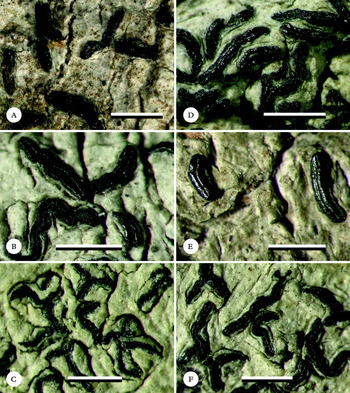
(Fig. 2A–C)
A–C, Halegrapha chimaera: A, lirellae and thallus; B, section through lirellae showing excipulum and hymenium; C, ascospores. D–F, Halegrapha floridana: D, lirellae and thallus; E, section through lirellae showing excipulum and hymenium; F, ascospores. Scales: A & D = 1 mm; B & E = 100 µm; C & F = 10 µm. This figure appears in colour online.

Thallus corticolous, 1–5 cm diam., 30–60 µm thick, continuous; surface smooth to uneven, white to grey; prothallus absent. Thallus in section with cartilaginous upper cortex, irregular photobiont layer and large clusters of crystals. Lirellae flexuose, unbranched to sparsely branched, erumpent, with basal thalline margin, 1–3 mm long, 0·15–0·25 mm wide, 0·12–0·15 mm high; disc concealed; labia at first entire but soon becoming distinctly striate, black; basal thalline margin white to pale grey. Excipulum laterally carbonized but basal part below hypothecium often dark brown (appearing thinly carbonized in thick sections), 30– 50 µm wide; basally covered by corticate algiferous thallus including clusters ofcrystals; hypothecium prosoplectenchymatous, 10–15 µm high, colourless to pale yellowish; hymenium 90–100 µm high, colourless, inspersed. Asci fusiform, 80–90 ×12–15 µm. Ascospores 8 per ascus, ellipsoid with distal end usually tapering, 3–5-septate (very rarely submuriform with one additional longitudinal septum), 15–20 × 6–8 µm, 2–3 times as long as wide, brown.
Chemistry. No substances detected by TLC.
Notes. Halegrapha chimaera resembles Graphis anfractuosa Eschw., a species with similar, albeit more prominent lirellae, and an inspersed hymenium. However, G. anfractuosa has Graphis-type ascospores, which are more elongate than Phaeographis-type ascospores and have tapering instead of rounded ends and also react I+ violet-blue. Halegrapha chimaera has been selected as the type species of the new genus, since it is the only species for which molecular data are available (Fig. 1).
Halegrapha chimaera is externally similar to H. intergrapha (see below), but differs in the more complete excipulum carbonization and the much smaller, distally tapering ascospores lacking particularly thick walls. The ascospores are similar to those found in H. floridana and H. kenyana (see below), but those two species have lirellae with eventually striate labia and lateral thalline margin and a thinner, completely carbonized excipulum.
Additional specimens examined. Philippines: Nueva Vizcaya (Luzon): Mt. Palali, near Solano; 16°26′ N, 121°13′ E, 700 m, partially disturbed lower montane rain forest, on trunk in semi-exposed situation, 2007, Rivas Plata & Lücking 1022C, 1022G (F).
Halegrapha floridana Common & Lücking sp. nov
MycoBank No.: 519823
Thallus flavescenter albus. Lirellae immersa disco abscondito labiis striatis. Excipulum in parte laterali et basali carbonisatum. Hymenium inspersum. Ascosporae 3-septatae, 11–14 × 5–6 µm. Sine acidi lichenum.
Typus: USA, Florida, Collier Co., Fakahatchee Strand Preserve State Park, Big Cypress Bend, old growth Cypress swamp, April 1997, Common 7410C (MSC—holotypus).
(Fig. 2D–F)
Thallus corticolous, 1–2 cm diam., 50–100 µm thick, continuous; surface uneven, yellowish white; prothallus absent. Thallus in section with cartilaginous upper cortex (partially disintegrating), irregular photobiont layer and large clusters of crystals. Lirellae flexuose, unbranched to sparsely branched, immersed-erumpent with the base deeply below the thallus surface, with (basal to) lateral thalline margin, 1–2 mm long, 0·1–0·15 mm wide, 0·1–0·12 mm high; disc concealed; labia striate, black, with the striae visible as thin, pale grey-brown lines; lateral thalline margin white. Excipulum bowl-shaped, completely carbonized (massively at the base), 25–50 µm wide and up to 70 µm high at the base; laterally covered by corticate algiferous thallus including clusters of crystals; hypothecium prosoplectenchymatous, 10–15 µm high, colourless to pale yellowish; hymenium 80–100 µm high, colourless, inspersed. Asci fusiform, 70–90 × 10–14 µm. Ascospores 8 per ascus, ellipsoid with distal end usually tapering, 3-septate, 11–14 × 5–6 µm, 2–2·5 times as long as wide, brown.
Chemistry. No substances detected by TLC.
Notes. Halegrapha floridana is known only from a very small collection but, due to the uniqueness of the genus and since all diagnostic characters can be observed on the specimen and have been documented here, it is formally described. It is most similar to H. kenyana (see below), but differs in the thicker excipulum being massively carbonized at the base, the inspersed hymenium, and the absence of lichen substances.
Halegrapha floridana should not be confused with species of Leiorreuma, which are also characterized by a basally thick and massively carbonized excipulum. The latter are characterized by thin, entire labia and a distinctly exposed disc, and the thallus is more or less smooth and not Graphis-like.
Halegrapha intergrapha Hale ex Lücking sp. nov
MycoBank No.: 519824
Thallus albo-cinereus. Lirellae erumpentia disco abscondito labiis indivisis. Excipulum in parte apicali carbonisatum. Hymenium inspersum. Ascosporae 7–9-septatae, 20–32 × 10–12 µm. Sine acidi lichenum.
Typus: Malaysia, Borneo, Sabah, Sungei Bating road, 24 km NW of Sandakan, 10 m, logging area in virgin dipterocarp forest, March 1965, Hale 30572 (US—holotypus).
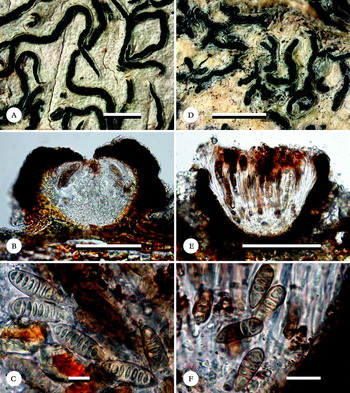
(Fig. 3A–C)
A–C, Halegrapha intergrapha: A, lirellae and thallus; B, section through lirellae showing excipulum and hymenium; C, ascospores. D–F, Halegrapha kenyana: D, lirellae and thallus; E, section through lirellae showing excipulum and hymenium; F, ascospores. Scales: A & D = 1 mm; B & E = 100 µm; C & F = 10 µm. This figure appears in colour online.

Thallus corticolous, 1–5 cm diam., 30–60 µm thick, continuous; surface smooth to uneven, white to grey; prothallus absent. Thallus in section with cartilaginous upper cortex, irregular photobiont layer and large clusters of crystals. Lirellae dense, flexuose, irregularly branched, erumpent, with basal thalline margin, 1–5 mm long, 0·15–0·25 mm wide, 0·12–0·15 mm high; disc concealed; labia entire, black; basal thalline margin white to pale grey. Excipulum carbonized in upper half (not down to the base), 25–50 µm wide; basally covered by corticate algiferous thallus including clusters of crystals; hypothecium prosoplectenchymatous, 10–15 µm high, colourless to pale yellowish; hymenium 100–120 µm high, colourless, inspersed. Asci fusiform, 80–100 × 15–20 µm. Ascospores 8 per ascus, oblong-ellipsoid, thick-walled, 7–9-septate, 20–32 × 10–12 µm, 2–3 times as long as wide, brown.
Chemistry. No substances detected by TLC.
Notes. This species was originally intended by Mason Hale to be described in Phaeographis, due to the Phaeographis-type ascospores. We have taken up Hale's original epithet as it conveys the intermediate nature of this species between Graphis and Phaeographis, a fact apparently realized by Hale, even if at that time he was unaware of a future modern classification of Graphidaceae.
Halegrapha intergrapha is externally similar to H. chimaera, although the lirellae are more densely branched. Internally, however, it is clearly set apart by the larger ascospores with thick walls and rounded ends on both sides, as well as the excipulum carbonization which usually does not reach down to the base.
Additional specimens examined. Malaysia: Selangor (Malaya): Ulu Gombak Forest Reserve, compartment 30, 24 km NE of Kuala Lumpur, 300 m, virgin dipterocarp forest, 1965, Hale 30029 (US), 31181 (US). Sabah (Borneo): Sungei Bating road, 24 km NW of Sandakan, 10 m, logging area in virgin dipterocarp forest, 1965, Hale 30562 (US), 30592 (US). Sarawak (Borneo): Rasau logging area, 32 km N of Sibu, sea level, logging area in virgin peat dipterocarp forest, 1965, Hale 29956 (US), 29968 (US).
Halegrapha kenyana Kalb & Lücking sp. nov
MycoBank No.: 519825
Thallus flavescenter albus. Lirellae immersa vel erumpentia disco abscondito labiis striatis. Excipulum in parte laterali et basali carbonisatum. Hymenium non inspersum. Ascosporae 3–5-septatae, 13–18 × 5–7 µm. Acidum sticticum aggr. continens.
Typus: Kenya, Coast Province, Kwale District, Shimba Hills, 350 m, September 1985, Kalb & Schrögl 13201 (hb. Kalb—holotypus).
(Fig. 3D–F)
Thallus corticolous, 1–3 cm diam., 50–80 µm thick, continuous; surface smooth to uneven, yellowish white; prothallus absent. Thallus in section with cartilaginous upper cortex, irregular photobiont layer and large clusters of crystals. Lirellae dense, flexuose, irregularly branched, immersed-erumpent with the base deeply below the thallus surface, with lateral thalline margin, 1–2 mm long, 0·1–0·15 mm wide, 0·1–0·12 mm high; disc concealed; labia becoming striate, black, with the striae visible as thin, pale grey-brown lines; lateral thalline margin white. Excipulum bowl-shaped, completely carbonized (dark brown in thin sections), 15–25 µm wide; laterally covered by corticate algiferous thallus including clusters of crystals; hypothecium prosoplectenchymatous, 10–15 µm high, colourless to pale yellowish; hymenium 80–100 µm high, colourless, clear. Asci fusiform, 70–90 × 11–15 µm. Ascospores 8 per ascus, ellipsoid with distal end usually tapering, 3–5-septate, 13–18 × 5–7 µm, 2–3 times as long as wide, brown.
Chemistry. Stictic acid (major), constictic acid (minor); K+ persistently yellow efflux in microscope sections.
Notes. This new species was initially labelled as Graphis / Phaeographis, documenting its intermediate nature between the two genera. It is most similar to H. floridana, but differs in the clear hymenium lacking any traces of inspersion, the bowl-shaped, basally thin excipulum, and the presence of stictic acid. The two species differ from H. chimaera and H. intergrapha morphologically in the immersed-erumpent lirellae with lateral thalline margin. The bowl-shaped excipulum of H. kenyana is more reminescent of Phaeographis and allies.
Halegrapha mexicana A. B. Peña & Lücking sp. nov
MycoBank No.: 519826
Thallus albo-cinereus. Lirellae erumpentia disco visibile labiis indivisis. Excipulum in parte laterali et basali carbonisatum. Hymenium inspersum. Ascosporae 5–7-septatae, 17–25 × 6–8 µm. Sine acidi lichenum.
Typus: Mexico, Veracruz, Catemato, Reserva Ecológica del Ejido Adolfo López Mateos, 18°26′ N, 94°58′ W, 365 m, tropical lowland rain forest, on bark of Pseudolmedia oxyphyllaria, April 2009, Barcenas Peña 785 (MEXU—holotypus).
(Fig. 4A)
A, Halegrapha mexicana, lirellae and thallus; B–F, Halegrapha mucronata, lirellae and thallus; B, lectotype of Graphis mucronata; C, lectotype of Phaeographis australiensis; D, holotype of Phaeographis cinerascens; E, holotype of Phaeographis inscripta; F, holotype of Phaeographis subcompulsa. Scales: A–F = 1 mm. This figure appears in colour online.

Thallus corticolous, 1–3 cm diam., 30–50 µm thick, continuous; surface smooth to uneven, white to grey; prothallus absent. Thallus in section with cartilaginous upper cortex, irregular photobiont layer and large clusters of crystals. Lirellae flexuose, unbranched, erumpent, lacking thalline margin, 1–3 mm long, 0·15–0·25 mm wide, 0·12–0·15 mm high; disc exposed; labia entire, black. Excipulum completely carbonized, 30–50 µm wide; hypothecium prosoplectenchymatous, 10–15 µm high, colourless to pale yellowish; hymenium 100–120 µm high, colourless, inspersed with irregular droplets. Asci fusiform, 90–115 × 15–18 µm. Ascospores 8 per ascus, ellipsoid to oblong with distal end usually tapering, 5–7-septate, 17–25 × 6–8 µm, 2·5–3·5 times as long as wide, brown.
Chemistry. No substances detected by TLC.
Notes. This new species is most similar to Halegrapha chimaera but differs in the consistently exposed disc and the excipulum being distinctly carbonized at the base, as well as the slightly larger ascospores featuring more numerous septa. The species is reminescent of Graphis handelii Zahlbr. and allies (Lücking Reference Lücking2009), but can be distinguished by the Phaeographis-type inspersion and ascospores.
Additional specimens examined. Mexico: Veracruz: Catemato, Reserva Ecológica del Ejido Adolfo López Mateos, 18°26′ N, 94°58′ W, 378 m, tropical lowland rain forest, on bark of Myriocarpa longipes, 2009, Barcenas Peña 786 (MEXU); ibid., 360 m, tropical lowland rain forest, on bark of Calophyllum brasiliense, 2009, Barcenas Peña 787 (MEXU).
Halegrapha mucronata (Stirt.) Lücking comb. nov
MycoBank No.: 519827
Graphis mucronata Stirt., Trans. Glasgow Field Naturalist 4: 95 (1876).— Phaeographis mucronata (Stirt.) Zahlbr., Cat. Lich. Univ. 2: 382 (1923).— Platygramme mucronata (Stirt.) A. W. Archer, Bibl. Lichenol. 94: 136(2006); type: Australia, New South Wales, Riverina District, 1875, Paton s.n. (BM— lectotype).
Phaeographis subcompulsa Müll. Arg., Flora 65: 503 (1882); type: Australia, New South Wales, Nepean River, 1880, Woolls s.n. (G—isotype).
?Phaeographis cinerascens Müll. Arg., Flora 65: 503 (1882); type: Australia, New South Wales, Nepean River, 1880, Woolls 81 (G—isotype).
Phaeographis australiensis Müll. Arg., Flora 65: 504 (1882); type: Australia, New South Wales, Parramatta, Woolls s.n. (G—lectotype).
?Phaeographis inscripta Müll. Arg., Flora 65: 504 (1882); type: Australia, New South Wales, Nepean River, Woolls s.n. (G—holotype).
Graphis aulacothecia C. Knight, Trans. Linn. Soc. London, Bot. 2: 41 (1882); type: Australia, New South Wales [Near Sydney], 1880, Knight 7 (WELT—lectotype).
(Fig. 4B–F)
Thallus corticolous, 1–3 cm diam., 50–80 µm thick, continuous; surface smooth to uneven, white-grey; prothallus absent. Thallus in section with cartilaginous upper cortex, irregular photobiont layer and large clusters of crystals. Lirellae dense, flexuose, sparsely branched, (immersed to) erumpent, with basal thalline margin, 1–3 mm long, 0·2–0·3 mm wide, 0·15–0·2 mm high; disc concealed to slightly exposed (type of Phaeographis australiensis); labia entire, black; basal thalline margin white. Excipulum laterally carbonized but sometimes convergent below the hymenium, 30–60 µm wide; basally covered by corticate algiferous thallus including clusters of crystals; hypothecium prosoplectenchymatous, 10–20 µm high, colourless to pale yellowish; hymenium 120–150 µm high, colourless, clear. Asci fusiform, 100–130 × 15–20 µm. Ascospores 8 per ascus, oblong with both ends appendiculate, 7–9-septate, 35–45 × 6–8 µm, 5–6 times as long as wide, brown.
Chemistry. Norstictic acid (major), connorstictic acid (minor); K+ yellow efflux forming red, needle-shaped crystals in microscope sections.
Notes. When Archer (Reference Archer2006) recombined the species in Platygramme, he already noted the odd combination of characters intermediate between Graphis and Phaeographis and stated that “… its taxonomic position is unclear” (Archer Reference Archer2006: 138). Within Halegrapha, H. mucronata is well-characterized by the clear hymenium, the rather long ascospores with terminal appendages (hence the epithet ‘mucronata’), and the presence of norstictic acid.
Archer (Reference Archer2006) listed five taxonomic synonyms under Platygramme mucronata, and two further names pertaining to this group, Phaeographis inscripta f. simplizior Szatala and Phaeographis inscripta f. subparallela Szatala (Szatala Reference Szatala1941), probably also belong here, but we have not been able to study authentic type material except for a duplicate of Phaeographis inscripta f. simplizior in BM distributed under Cryptogamae Exsiccatae Editae A Museo Hist. Natur. Vindobonensi. The material on which these names are based is heterogeneous, as also indicated by the rather broad description of the taxon by Archer (Reference Archer2006). The types of Graphis mucronata and Phaeographis subcompulsa agree perfectly (Fig. 4B & F); the type of P. australiensis also fits within the concept of Halegrapha mucronata, especially in having appendiculate ascospores, but the disc is exposed rather than concealed (Fig. 4C). The type of Phaeographis cinerascens is here accepted as a synonym of Halegrapha mucronata with a question mark; it differs in the shorter, prominent lirellae with more or less completely carbonized excipulum (Fig. 4D). The type material of Phaeographis inscripta Müll. Arg. differs substantially in the completely immersed, abundantly branched lirellae (Fig. 4E), the completely carbonized excipulum, as well as the slightly larger ascospores from Halegrapha mucronata, and might represent a separate species; it has, however, the characteristically appendiculate ascospores. More material is needed to clarify this question.
Key to the species of Halegrapha
1 Hymenium clear; norstictic or stictic acid (thallus sections with K+ yellow efflux under the microscope, persistently yellow with stictic acid and forming red crystals with norstictic acid) ... 2
Hymenium inspersed; no substances (thallus sections K−) ... 3
2(1) Norstictic acid (K+ yellow efflux under the microscope, forming red crystals); ascospores 7–9-septate, 35–45 × 6–8 µm, terminally appendiculate; excipulum thick; labia entire; Australia and New Zealand ... H. mucronata
Stictic acid (K+ yellow efflux under the microscope, persistently yellow); ascospores 3–5-septate, 13–18 × 5–7 µm; excipulum thin, bowl-shaped; labia becoming striate; Kenya ... H. kenyana
3(1) Ascospores 20–32 × 10–12 µm, 7–9-septate; excipulum carbonized in upper half (usually not down to the base); Malaysia ... H. intergrapha
Ascospores 11–20(–25) × 5–8 µm, 3–7-septate; excipulum laterally to completely carbonized ... 4
4(3) Lirellae lacking thalline margin; labia entire; disc becoming exposed; Mexico ... ... H. mexicana
Lirellae with basal to lateral thalline margin; labia becoming striate; disc concealed ... 5
5(4) Excipulum laterally carbonized with thin base below the hypothecium; lirellae with basal thalline margin; Philippines ... H. chimaera
Excipulum completely carbonized with thickened base below the hypothecium; lirellae with lateral thalline margin; Florida ... H. floridana
Mason Hale's field work, during which the material of Halegrapha intergrapha was collected, was supported under the US-Japan Cooperative Science Program. The Florida Department of Environmental Protection, Division of Recreation and Parks, is kindly acknowledged for issuing a collection permit in 1997 to Ralph Common (#04169714), and the Department of Environment and Natural Resources of the Philippines for providing a collection permit for the Mt. Palali area. The material was studied within the framework of the NSF-funded projects TICOLICHEN (DEB 0206125 to The Field Museum; PI R. Lücking), Phylogeny and Taxonomy of Ostropalean Fungi, with Emphasis on the Lichen-forming Thelotremataceae (DEB 0516116 to The Field Museum; PI H. T. Lumbsch; Co-PI R. Lücking), Neotropical Epiphytic Microlichens – An Innovative Inventory of a Highly Diverse yet Little Known Group of Symbiotic Organisms (DEB 715660 to The Field Museum; PI R. Lücking), and ATM – Assembling a taxonomic monograph: The lichen family Graphidaceae (DEB-1025861 to The Field Museum; PI T. Lumbsch, CoPI R. Lücking). A. Barcenas Peña is grateful for scholarships by CONACYT (#165048) and PAPIIT-UNAM (#IN225808) and would like to thank Dr María de los Ángeles Herrera-Campos for the logistic support of the laboratory of lichens IB-UNAM, PCB-UNAM.