Introduction
The association between passive smoking and adverse child health outcomes is well established in the epidemiological literature (Cook et al., Reference Cook, Whincup, Jarvis, Strachan, Papcosta and Bryan1994; Nafstad et al., Reference Nafstad, Kongerud, Botten, Hagen and Jaakkola1997; Wennergren et al., Reference Wennergren, Amark, Amark, Oskarsdottir and Sten1997; Mannino et al., Reference Mannino, Moorman, Kingsley, Rose and Repace2001; Steyn et al., Reference Steyn, de Wet, Saloojee, Nel and Yach2006). There is evidence that children's exposure to environmental tobacco smoke, either during pregnancy or the postnatal period, can have a detrimental impact on their respiratory and immune systems (Mannino et al., Reference Mannino, Moorman, Kingsley, Rose and Repace2001; Hofhuis et al., Reference Hofhuis, de Jongste and Merkus2003; DiFranza et al., Reference DiFranza, Aligne and Weitzman2004) and cognitive development (Polanska et al., Reference Polanska, Hanke, Ronchetti, van den Hazel, Zuurbier, Koppe and Bartonova2006), and even trigger malfunction of the lungs at later ages (Johnston et al., Reference Johnston, Strachan and Anderson1998; Martiniuk et al., Reference Martiniuk, Lee, Lam, Huxley, Suh, Jamrozik, Gu and Woodward2006). However, a large number of these studies were based on data from more developed countries (Graham, Reference Graham1990) and there is hardly any research on this issue in less developed settings where many children are highly vulnerable to developing respiratory infections because of high exposure to environmental tobacco smoke and indoor air pollution from cooking fuel (Smith et al., Reference Smith, Samet, Romieu and Bruce2000; Mishra, Reference Mishra2003; Shrestha & Shrestha, Reference Shrestha and Shrestha2005). The aim of this paper is to quantify the effect of maternal smoking on acute respiratory infection (ARI) symptoms among children aged below five years using nationally representative population-level data from Nepal.
In Nepal, about a quarter of children aged below five years suffer from symptoms of ARI, especially those who live in mountain and high-altitude regions (Ministry of Health (Nepal), New ERA & ORC Macro, 2002). Other respiratory illnesses such as asthma are also common among children, and are primarily attributed to a high level of smoke exposure from tobacco and combustion of biomass fuels such as wood, crop residues and animal dung for cooking purposes or heating (Melsom et al., Reference Melsom, Brinch, Hessen, Schei, Kolstrup, Jacobsen, Svanes and Pandey2001; Shrestha & Shrestha, Reference Shrestha and Shrestha2005). About 94% of Nepalese households use firewood, charcoal and dung for cooking and very few use biogas/LPG (Ministry of Health (Nepal), New ERA & ORC Macro, 2002). Apart from evidence from a few small-scale studies (Melsom et al., Reference Melsom, Brinch, Hessen, Schei, Kolstrup, Jacobsen, Svanes and Pandey2001; Shrestha & Shrestha, Reference Shrestha and Shrestha2005), little systematic population-level research has been done into disentangling the independent effect of maternal smoking on ARI symptoms. According to the 2001 Demographic and Health Survey (DHS), about 30% of women of reproductive age reported smoking tobacco products, and of those who smoked about 37% reported smoking six or more cigarettes in the 24 hours preceding the survey (Ministry of Health (Nepal), New ERA & ORC Macro, 2002). Unlike Western societies, tobacco smoking in Asia has been found to be more common among men than in women, despite the fact that there are few data on the prevalence of smoking in women (Martiniuk et al., Reference Martiniuk, Lee, Lam, Huxley, Suh, Jamrozik, Gu and Woodward2006). Nonetheless, gender differences in smoking could affect child health. For example, the impact of tobacco smoking on children's respiratory illnesses could be relatively higher if mothers smoke, since mothers usually spend more time with their children than other family members do.
It is hypothesized that children born to mothers who smoke more frequently are at higher risk of developing ARI symptoms. Additionally, the spatial patterns explaining the association between maternal smoking behaviour and children's ARI symptoms are explored controlling for potential clustering effects in the data and other selected individual and seasonal characteristics. Given the unique geographical location of regions within Nepal, identifying the spatial influences is critical in this study in order to target high-risk areas for developing appropriate policies and interventions suitable for reducing child morbidity in Nepal.
Methods
Data
The study used the 2001 Nepal DHS, which is a nationally representative cross-sectional survey that collected detailed demographic, socioeconomic and health information from 8726 women aged 15–49 years and 2261 men aged 15–59 years based on a two-stage stratified representative sample of 8602 households. Data on the health status of children and other related aspects of health care were collected from women for only those children born in the five years preceding the survey. The analysis reported in this study was based on the data from 6056 children born to 4099 mothers in the five years preceding the survey. It has to be noted that 359 de jure residents (children) were excluded from the analysis due to reasons of incomplete data. The DHS data were provided by Measure DHS at Macro International Inc, USA, in anonymized format for academic research use (www.measuredhs.com).
Outcome variable
The outcome variable for the analysis was ARI symptoms among children aged below five years of age. The ARI symptoms refer to children's respiratory condition for the last two weeks preceding the survey. The DHS asked mothers whether their child had any illness with a cough at any time in the last two weeks before the survey. If the child experienced a cough, then an additional question was asked about whether the child had difficulties in breathing, specifically short, fast and unusual breaths. Children who had been sick with a cough accompanied by short, rapid breathing in the two weeks preceding the survey were considered to show symptoms of ARI. The response variable was dichotomous with children who had symptoms of ARI coded as 1 and 0 for those who had not experienced any symptoms. The recall errors were assumed to be minimal since the events in question relate to a short period (two weeks) before the survey.
Exposure variables
The primary exposure variable considered in this study was the smoking status of the mother. Mothers were asked whether they had ever smoked any tobacco products (cigarette, pipe or bidi, which is local tobacco rolled in dried leaves) in their life-time. Those who responded affirmative were asked further the number of cigarette/pipe/bidi they had smoked in the last 24 hours. The frequency of smoking in the last 24 hours was used as a proxy to determine the extent of smoking effect on ARI. The variable was defined into three categories: mothers who never smoked (reference category); mothers who smoked fewer than six cigarettes/pipes/bidi in the last 24 hours; and those who smoked six or more cigarettes/pipes/bidi in the last 24 hours. It is assumed that the smoking patterns reported in the last 24 hours represent mothers' recent smoking behaviour. Other exposure variables considered at the household level were smoking status of other household members and the type of fuel used for cooking. Smoking status of other members in the household was categorized into two: (i) households where at least one other household member smoked apart from the mother and (ii) households where no other members had smoked. The type of fuel used for cooking was defined into three categories: (i) biomass fuels that have potentially damaging impacts to respiratory tract pathogens such as firewood, charcoal, dung and straw (Smith et al., Reference Smith, Samet, Romieu and Bruce2000), (ii) cleaner fuels such as LPG, biogas and natural gas and (iii) kerosene.
Control variables
The extent to which children develop ARI symptoms depends not only on smoke exposure but also on a range of individual biological, socioeconomic and spatial characteristics. The study was particularly interested in understanding the strength and independent effect of the primary exposure variable with a statistical control of other potential variables. The control variables considered in the analysis were broadly grouped into biological, socioeconomic, seasonal and spatial characteristics. The biological factors included age and sex of children, nutritional status measured in terms of stunting (Ministry of Health (Nepal), New ERA & ORC Macro, 2002), current breast-feeding status, immunization status (BCG) and preceding birth interval. The socioeconomic controls included education, occupation and ethnicity of the mother and the wealth status of the household.
The spatial characteristics were place of residence, ecological zone and developmental region and altitude recorded in metres. Nepal is a land-locked country divided into three distinct ecological zones: mountain, hill and terai (terrain) and five developmental regions (eastern, central, western, mid-western and far-western). The mountain zone is poorly developed in terms of social and human development, followed by terai and hill zones, whereas the mid- and far-western regions are poorer than the other developmental regions (UNDP, 2004). The DHS used a Global Positioning System to calculate latitude and longitudinal co-ordinates for each of the primary sampling unit selected during the household listing stage, which were then integrated along with other spatial data into the individual and household information (Ministry of Health (Nepal), New ERA & ORC Macro, 2002). Previous research has shown that children who live in a high-altitude environment are usually at high risk of developing pulmonary artery pressure and respiratory distress (de Meer et al., Reference de Meer, Heymans and Zijlstra1995). Respiratory risks are estimated to be highest at altitudes above 2500 m and high between 1400 m and 2500 m when compared with an altitude below 1400 m (Gabry et al., Reference Gabry, Ledoux, Mozziconacci and Martin2003). Additionally, the month of the interview was controlled for to capture possible seasonal effects on ARI symptoms among children, which are especially frequent during the winter season. The winter season mainly extends from December to February in Nepal.
Statistical analyses
Multilevel statistical techniques were used to examine the effect of maternal smoke exposure on children's ARI symptoms, taking into account potential confounding effects of other control variables and clustering of the data. Four-level binary logistic models were developed with children nested in households in local areas and districts. There were 6056 children (level 1) nested in 3945 households (level 2) in 211 local areas (level 3) and 69 districts (level 4). Although it would be appropriate to present the variations at the mother level, the level of clustering at the mother level was not different from that at the household level. Marginal quasi-likelihood (MQL) approximation with second-order Taylor linearization was used to calibrate the models (Rashbash et al., Reference Rashbash, Steele, Browne and Prosser2005). The parameters were estimated using the maximum likelihood approach, with the Iterative Generalized Least Squares (IGLS) algorithm. A sequential model building process was used to explain the extent to which the exposure and intermediate variables explain the variations in ARI symptoms among children. The rationale for adopting a sequential model building process was to investigate the changes in the association between maternal smoking and ARI symptoms among children when other important intermediate factors were controlled in the model. The null model controlled for only the random effects. The subsequent model-building processes added the primary exposure (maternal smoking) and other exposure variables (smoking status of household members and type of cooking fuel) controlling for the random effects (Model 1), further adding biological variables (Model 2) and then socioeconomic variables (Model 3), seasonal variables (Model 4) and spatial variables (Model 5).
At each stage of the model building the variables that were not significant at p<0.10 were discarded. To ensure robustness of the final model, only variables significant at p<0.05 were selected. The significance of variables was further tested in the final model accounting for relevant interaction effects. Multilevel analyses of the data were carried out using MLWin 2.0 (Rashbash et al., Reference Rashbash, Steele, Browne and Prosser2005).
Results
Descriptive
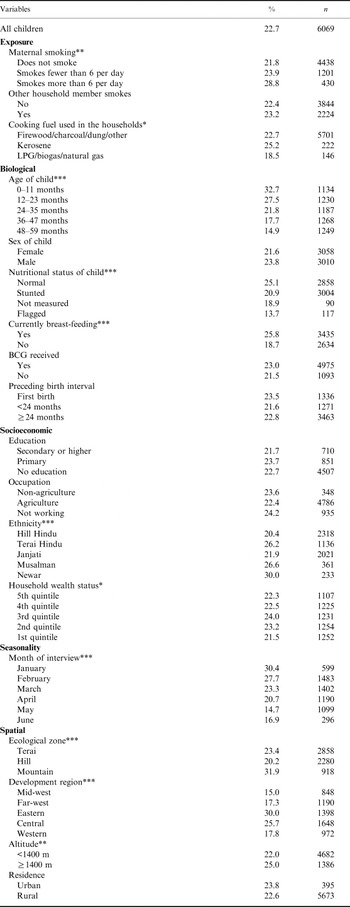
The association between ARI symptoms and explanatory variables was examined using a chi-squared test (Table 1). About 23% of children aged below five years experienced ARI symptoms during the two weeks preceding the survey. There were significant variations in ARI symptoms according to maternal smoking behaviour. Acute respiratory infection symptoms among children born to mothers who smoked six or more times in the last 24 hours were significantly different when compared with those of their counterparts whose mothers smoked fewer than six times and those who never smoked any tobacco products. Smoking status of other household members was hardly significant, but children in households that relied on biomass fuel for cooking were significantly different from those whose households used LPG/biogas/natural gas. The distribution of ARI symptoms varied significantly by most of the control variables. Acute respiratory infection symptoms were very high among younger children. There was hardly any difference in ARI symptoms by sex, birth interval and BCG immunization status of children. The BCG was considered as proxy for immunization status and excluded other immunizations for censoring reasons because there were very young children in the sample who might not have had other immunization at the time of survey.
Distribution of ARI symptoms by exposure and control variables (weighted estimates)

*** p<0.01;
** p<0.05;
* p<0.10; n refers to number of children.
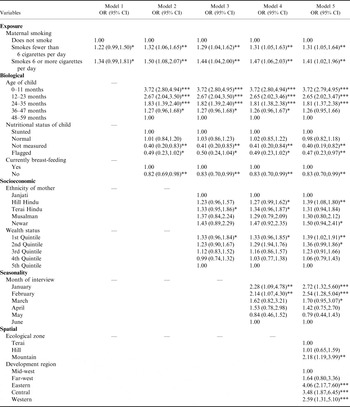
Adjusted odds ratios of ARI symptoms with 95% confidence intervals

*** p<0.01;
** p<0.05;
* p<0.10.
Contrary to expectations, the data showed that children who were stunted and those who were not measured or flagged (due to extreme measurements) were less likely to suffer from ARI symptoms when compared with well-nourished children. It is difficult to ascertain whether this result is due to random variations in the data or for the reason that the height-for-age is a stable anthropometric indicator which might not be associated with short-term respiratory symptoms. Currently breast-fed children were significantly more likely to suffer from ARI symptoms than their counterparts. Further data investigations that controlled for children's age showed that most of the currently breast-fed children were very young, and were apparently more susceptible to respiratory infections than their counterparts.
Among socioeconomic variables, mothers' education and occupation had no significant association with children's ARI symptoms, but ethnicity and wealth index turned out to be important. Children who belong to Newar ethnicity were at higher risk of ARI symptoms than those from other ethnic groups. The association between household wealth index and ARI symptoms was marginally significant; ARI symptoms were common among those in the second and third quintiles. On the other hand, the month of interview (season) was significantly associated with ARI symptoms, with children born in the winter season (January and February) being at higher risk than their counterparts.
Ecological variations in ARI symptoms showed a mixed pattern although the symptoms were generally high in the mountainous area when compared with other zones. With regard to development region, the symptoms were highly prevalent in the eastern and central regions when compared with other regions. The prevalence of symptoms was slightly higher for children who lived in high altitude (≥1400m) when compared with those who lived in areas below 1400 m; the difference was statistically significant (p<0.05). The DHS data showed that only less than 2% of the study population lived above 2500 m. Place of residence was not significantly associated with ARI symptoms.
Multilevel analysis
The results from bivariate analysis were further established in multilevel regression, which controlled for relevant variables and data structure (Table 2). The results clearly show that the effect of maternal smoking on children's ARI symptoms remained significant and robust when controlled for other exposure, biological, socioeconomic, seasonal and spatial variables. This suggests that although the control variables were important in explaining variations in ARI symptoms, maternal smoking behaviour has an independent effect on children's ARI symptoms.
The odds of ARI symptoms, after adjusting for biological variables, increased considerably from 32% for mothers who smoked fewer than six times to 50% for those who smoked six or more cigarettes/pipes/bidi (p<0.05). Although the magnitude decreased slightly, similar significant effects were retained in subsequent models that adjusted for socioeconomic, seasonal and spatial variables. The effect of other exposure variables was trivial and hence they were not considered in the regression models. For example, about 94% of Nepalese households rely on biomass fuel, which clearly indicates a high degree of homogeneity in the data. Moreover, the association between use of cooking fuel and ARI symptoms was found to be weak in the bivariate analysis. However, other control variables such as child's age, nutritional and breast-feeding status, ethnicity, wealth status, seasonality, ecological and development region and altitude were highly significant predicators of ARI symptoms.
Children whose height was not measured or flagged were found to be significantly less likely to suffer from ARI symptoms than stunted children; however, the difference between normal and stunted children was not significant. Also, younger children were more susceptible to experiencing ARI symptoms: children less than one year of age were almost four times more likely to experience symptoms of ARI than those aged 48–59 months (p<0.001). The odds of ARI symptoms were significantly higher among children of Hill Hindu and Newar ethnicity and those who belong to lower social strata measured in terms of household wealth. Acute respiratory infection symptoms were significantly higher during the winter when compared with the summer season.
Acute respiratory infection symptoms varied significantly by spatial characteristics. The results show that children from the mountain areas and those from the eastern, central and western regions had significantly higher odds of suffering from ARI when compared with their counterparts. Altitude was not significant in the final model. Potential interaction effects were considered: for example between maternal smoking status and ecological zone, children's age and breast-feeding status, and developmental region and ecological zone. However, none of the interactions was significant in the regression models.
District, local area and household variations
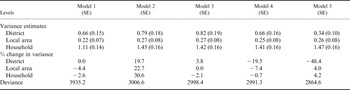
The variance estimates and their corresponding standard errors from the multilevel logistic regression models are presented in Table 3. The results show that maternal smoking and control variables do not unequivocally explain all the variations in ARI symptoms at the district, local area and household levels (p<0.01). When maternal smoking was included (Model 1), the variations across geographic areas decreased by 4% at the local area and by 3% at the household level but they remained the same at the district level. Conversely, in Model 5, which included other control variables and seasonal and spatial effects, the variations at the local and household levels increased substantially but those at the district level decreased. The household-level variations were the highest in Model 2, which accounted for maternal smoking and biological characteristics.
Variance estimates from the four-level random intercept models

Note: The variance estimates from all models were statistically significant at p<0.01; SE, standard error. The level 1 (individual) variance of the random effects is constrained to follow a multinomial distribution and hence is not reported in the table. The change in variance for Model 1 is compared with the null model controlling for the levels of clustering.
Ecological variations
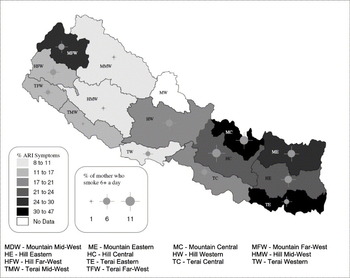
Figure 1 shows the percentage of children suffering from ARI symptoms and the percentage of mothers who smoke six or more cigarettes/pipes/bidi a day by sub-regions. The percentages of ARI symptoms among children were estimated adjusting for variables shown in Model 5 (Table 2). The percentages of mothers who smoke six or more cigarettes/pipes/bidi per day were estimated using multinomial model (non-smokers=0 coded as reference; those who smoke fewer than six per day=1 and those who smoke six or more per day=2) adjusting for mothers' age, education and spatial variables including residence (results not shown separately). A strong spatial pattern is evident in the prevalence of ARI symptoms after adjusting for maternal smoking and relevant control variables. The level of ARI symptoms was found to be much higher in the central and far-eastern areas of mountainous and hilly regions than other regions. More than 10% of mothers in these regions smoked six or more cigarettes/pipes/bidi a day: this clearly explains the observed association between maternal smoking and ARI symptoms. Similar patterns were noticed in the western part of the hilly region although ARI prevalence was relatively lower in these areas compared with those in the central and eastern regions.
Adjusted estimates of children showing ARI symptoms (%) and mothers who smoke six or more cigarettes/pipes/bidi a day (%) by sub-regions.

Discussion
This research investigated the population-level association between maternal smoking and health outcomes among children in Nepal, hitherto not systematically explored in the epidemiological literature. The foregoing analysis confirmed evidence of a statistically significant association between maternal smoking behaviour and ARI symptoms among children and further validates the hypothesis that children born to mothers who smoked frequently were at higher risk of developing ARI symptoms. The effect of maternal smoking on ARI symptoms remained higher and statistically significant even after adjusting for biological, socioeconomic, seasonal and spatial effects. The clustering effects were significant at the household, local area and district levels, which implies heterogeneity in the distribution of ARI symptoms.
The results of this study have considerable policy implications for Nepal where childhood respiratory illnesses are common, especially in the geographically disadvantaged mountain region. The vast majority of these children who suffer from respiratory symptoms had no primary care and hence were vulnerable to developing other chronic conditions such as asthma, pneumonia and bronchitis. These children were exposed to a dual burden of environmental smoke through tobacco and biomass fuel consumption. The findings of this study direct the need to promote public health awareness programmes to halt smoking within households, targeting especially women of reproductive age. Further investigations of the DHS data show that mothers who engage in frequent smoking are those who belonged to Hill Hindu, Terai Hindu and Newar ethnic groups, those without any schooling experiences and those living in poorly developed regions.
In 2006, the Supreme Court in Nepal ordered a ban on smoking in public places and imposed restrictions on tobacco sale and advertising in Nepal (Environment Law Alliance Worldwide Advocate, 2006). Moreover, the Millennium Development Goals and the health policies enunciated under the tenth five-year plan stress the need for appropriate intervention measures to tackle ARI among children in Nepal (Department of Health Services, 2003; Dhakal et al., Reference Dhakal, Drone, Risal, Ale and Khanal2004), including the need to reduce indoor air pollution (Department of Health Services, 2003). It is too early to judge the impact of these legislative measures on household strategies to reduce indoor pollution. This study underscores the importance of designing exclusive public health intervention measures to prevent tobacco smoking within households, for example through awareness campaigns highlighting the adverse effect of maternal smoking on child health. Further studies are needed to appropriately disentangle the complex and dynamic relationship between maternal smoking and respiratory symptoms, particularly focusing on different ethnic communities residing in geographically vulnerable areas.
A few data limitations are worth mentioning. It is difficult to establish any causal links between maternal smoking and ARI symptoms using the DHS data. Apart from the cross-sectional nature of the data, the information on ARI symptoms was reported by mothers and not clinically validated. In addition, it was not possible to control for any biological processes underlying the ARI symptoms in children due to lack of appropriate data in the DHS. However, the analysis reported in this paper was based on the recent morbidity experiences of children for the last two weeks preceding the survey. The authors strongly believe that mothers are capable of understanding childhood illnesses and that they are likely to provide accurate responses in the survey. On the other hand, the DHS provides the only nationally representative population-level data on childhood morbidity. Yet another limitation of the data is the lack of information on the frequency and episodes of ARI symptoms; the availability of such information could perhaps offer better insight into the association between maternal smoking and ARI. Finally, it is difficult to judge from the data whether women who reported smoking did so in the presence or absence of children. In this context, the observed relationship between maternal smoking and ARI symptoms indicates more an association than causation.