Accurately diagnosing urinary tract infections (UTIs) in hospitalized patients remains challenging, requiring correlation of frequently nonspecific symptoms and laboratory findings. Urine cultures (UCs) are often ordered indiscriminately, especially in patients with urinary catheters, despite the Infectious Diseases Society of America guidelines recommending against routine screening for asymptomatic bacteriuria (ASB).Reference Nicolle, Gupta and Bradley1,Reference Leis, Gold, Daneman, Shojania and McGeer2 Positive UCs can be difficult for providers to ignore, leading to unnecessary antibiotic treatment of ASB.Reference Leis, Gold, Daneman, Shojania and McGeer2,Reference Spivak, Burk and Zhang3 Using diagnostic stewardship to limit UCs to situations with a positive urinalysis (UA) can reduce inappropriate UCs since the absence of pyuria suggests the absence of infection.Reference Kayalp, Dogan, Ceylan, Senes and Yucel4–Reference Simerville, Maxted and Pahira6 We assessed the impact of the implementation of a UA with reflex to UC algorithm (“reflex intervention”) on UC ordering practices, diagnostic efficiency, and UTIs using a quasi-experimental design.
Methods
We retrospectively studied 3 hospitals (a 300-bed community hospital, a 500-bed academic-community tertiary-care hospital, and a 500-bed academic tertiary-care hospital) in the same healthcare network, using a single electronic medical record (EMR, PowerChart Millennium, Cerner, Kansas City, MO). For socialization prior to implementation, the reflex UC order was available alongside the routine UC order starting April 2017 as a soft rollout. On August 1, 2017, all hospitals implemented the reflex intervention, where the default inpatient UC order was replaced with an order set with 2 options: (1) a prechecked order (except for orders within obstetric, neutropenic fever, neonatal, renal transplant or pre-urology procedure order sets) for UA with microscopy which reflexes to UC only if the UA has ≥10 white blood cells per high-power field and (2) a UC without a UA (nonreflex UC). Embedded clinical-decision support suggested that nonreflex UC orders be limited to patients who were pregnant, neutropenic, aged <1 year, or those receiving renal transplant or undergoing a urologic procedure.
The primary outcomes were the change in rates of nonreflex and total UCs ordered per 1,000 patient days before the intervention (October 1, 2015–July 31, 2017) and after the intervention (August 1, 2017–July 31, 2018). The secondary outcomes assessed the change in UTIs per 1,000 patient days and diagnostic efficiency (proportion of UCs with bacterial growth). UTIs were determined by pooling catheter-associated UTIs (CAUTIs) as defined by the National Healthcare Safety Network (NHSN) and admissions with an ICD-10 code adapted from the Agency for Healthcare Research and Quality (AHRQ) Prevention Quality Indicator (PQI) 12 for UTI or UTI in pregnancy (Supplemental Table 1 online). We compared median monthly rates and interquartile ranges (IQRs) with Wilcoxon rank-sum tests and proportions using χ2 tests. An interrupted time series (ITS) analysis using an autoregressive segmented linear regression model was performed to estimate the change in monthly UC and UTI rates associated with the intervention while controlling for unmeasured trends in time. The potential monthly decrease in UCs and UTIs attributable to the intervention was calculated by multiplying the adjusted rate difference by the median number of patient days (32,892.5).
Results
UC order rates
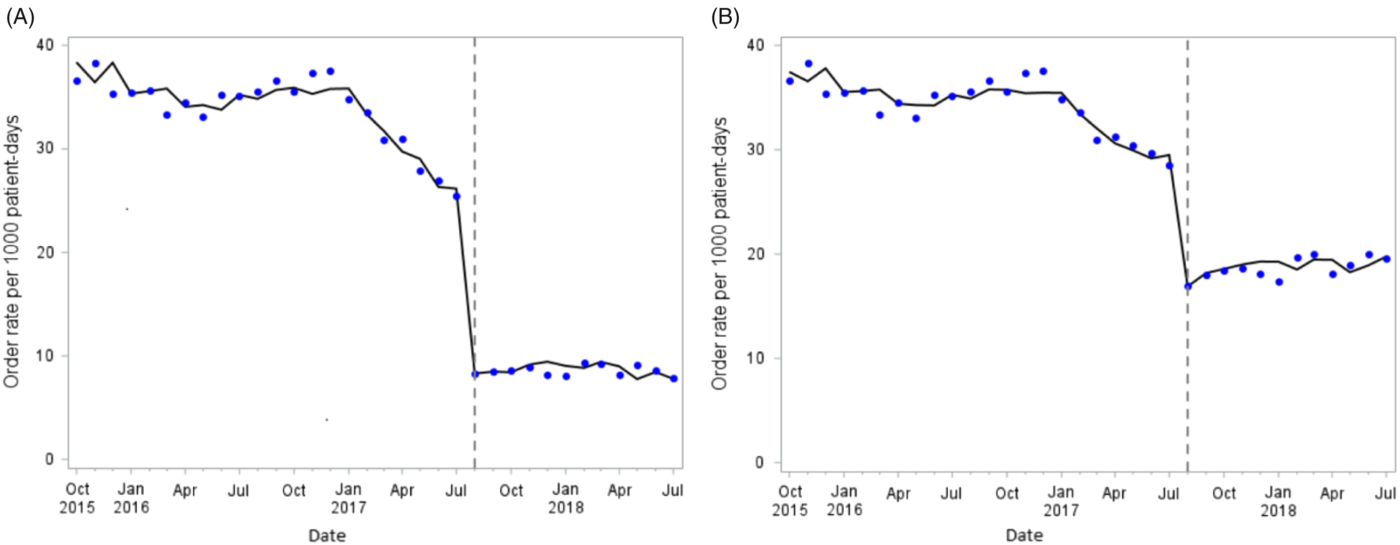
The median monthly rate of nonreflex UC orders per 1,000 patient days decreased by 75.6% after implementing the reflex initiative: 35.2 (IQR, 33.1–35.7) preintervention versus 8.6 (IQR, 8.2–9.0) postintervention (P < .001) (Supplemental Table 1 online). Total UC orders per 1,000 patient days also decreased from 35.2 (IQR, 33.1–35.7) to 18.6 (IQR, 18.1–19.6; P < .001), a decrease of 47.2%. In an ITS analysis, the intervention decreased the monthly nonreflex UC rate by 16.8 cultures per 1,000 patient days (P < .001) and decreased the total UC rate by 12.4 cultures per 1,000 patient days (P < .001), corresponding to a potential monthly decrease of 408 UCs (Fig. 1).
Monthly rates of nonreflex urine cultures (A) and total urine cultures (B) ordered per 1,000 patient days before and after the intervention (dashed line). The data points represent the observed monthly rates, and the solid line represents the autoregressive model.

Diagnostic efficiency
After the intervention, the proportion of UCs performed with bacterial growth increased (22.2% vs 30.5%; P < .001) and reflex UCs were more likely to yield bacterial growth than nonreflex UCs (41.0% vs 18.2%; P < .001).
UTI rates
The median monthly rate of UTIs per 1,000 patient days decreased after the intervention: 16.1 (IQR, 15.4–17.4) preintervention versus 14.7 (IQR, 14.5–15.3) postintervention (P < .001). In the ITS analysis, the intervention decreased monthly UTIs per 1,000 patient days by 1.5 (P = .04), for a potential monthly decrease of 49 UTIs.
Discussion
Implementing a reflex UC intervention significantly decreased potentially inappropriate UCs ordered without a UA and total UCs ordered per month by almost 50%. With an estimated decrease of 408 UCs per month at a cost of $15 per culture,Reference Munigala, Rojek and Wood7 our healthcare system saved $6,120 per month in laboratory costs and increased diagnostic efficiency.
Our results are consistent with prior studies demonstrating that diagnostic stewardship can decrease UC ordersReference Munigala, Rojek and Wood7,Reference Munigala, Jackups and Poirier8 and CAUTIs in intensive care units.Reference Epstein, Edwards and Halpin9 To our knowledge, our study is the first to demonstrate that UTIs in hospitalized patients may decrease following a reflex UC intervention. This decrease in UTIs may reflect more accurate diagnoses because asymptomatic patients without pyuria could no longer be incorrectly diagnosed with a UTI. Alternatively, the intervention may have increased awareness of inappropriate UTI diagnoses and led to changes in coding behavior. Similar interventions may reduce the number of patients at risk for adverse events from receiving antibiotics for ASB.Reference Spivak, Burk and Zhang3,Reference Zalmanovici Trestioreanu, Lador, Sauerbrun-Cutler and Leibovici10 However, pyuria alone should not be used as a surrogate for ordering a UC or antibiotic treatment. This study has several limitations: (1) We could not assess appropriateness of nonreflex UC orders. (2) UTI rates were determined primarily from administrative and not clinical data. (3) Due to the soft rollout of the reflex order prior to the full implementation, we may have underestimated the effect of the intervention.
In conclusion, a reflex UC intervention can be an effective diagnostic stewardship tool to reduce unnecessary UCs, improve diagnostic efficiency, and limit inappropriately diagnosed UTIs. Improved clinical decision support to determine when to order a UC using readily available clinical data may help to further reduce potentially inappropriate UC orders.
Acknowledgments
We gratefully acknowledge information technology services, nursing staff, infection preventionists, and leadership at both the hospital and system levels at Emory Healthcare for their invaluable support in developing, implementing and supporting this initiative.
Financial support
J.H.A. was partly supported by the National Center for Advancing Translational Sciences of the National Institutes of Health (grant nos. UL1TR002378 and TL1TR002382). J.T.J. was partly supported by the Centers for Disease Control and Prevention Epicenters (grant no. U01CK00054). The content is solely the responsibility of the authors and does not necessarily represent the official views of the National Institutes of Health or the Centers for Disease Control and Prevention.
Conflicts of interest
All authors report no conflicts of interest relevant to this article.
Supplementary material
To view supplementary material for this article, please visit https://doi.org/10.1017/ice.2020.5