1. DID ORGANIZED INDUSTRY FAVOR MEDICARE'S PASSAGE? HOW CAN WE KNOW?
On July 29, 1965, the day before President Lyndon Johnson signed Medicare and Medicaid into law, the president's congressional aide Larry O'Brien circulated the guest list for the bill's signing ceremony around the White House. Most scholars would not be surprised at the individuals and organizations the administration invited to celebrate the passage of one of the Great Society's most renowned legacies: numerous liberal members of Congress, union officials, and senior citizen advocacy group representatives were all expected to attend. Nor, in contrast, would most scholars be surprised that the White House did not invite a single representative of industry, commerce, or any other business group to the ceremony.Footnote 1
Nonetheless, considerable empirical evidence seemingly suggests that industry groups and their allies played a crucial role in supporting Medicare's passage: business-friendly Republicans overwhelmingly voted for the measure, which included a major provision, now known as Medicare Part B, that was conceived by Republicans, inserted into the bill by the unimpeachably pro-business Rep. Wilbur Mills (D-AR), and that a representative of the National Association of Manufacturers said could be “strongly supported by industry.”Footnote 2 Prior to the bill's passage, the Council of State Chambers of Commerce likewise endorsed the view that “full and complete medical care should be provided those aged members of our society who cannot reasonably pay for such care themselves.”Footnote 3
Consistent with what these facts seem to imply, a number of scholars have argued that changes in businesses’ preferences are the crucial driving force behind welfare state expansions, and thus that, contrary to conventional wisdom, business is far from the near-universal roadblock to the welfare state's growth that conventional wisdom would posit. For example, Peter Swenson argues that changes in industry and employer interests have principally accounted for welfare state growth, and Isabela Mares chastises scholars for “often assum[ing], rather than document[ing]” business opposition to welfare programs.Footnote 4 In support of such arguments, scholars regularly find that, as occurred with Medicare, business groups and their allies have often granted their support to welfare state expansions just before they have occurred.
As I will review below, such claims that business support drives welfare-state growth have been vigorously contested, as has the broader claim that businesses reliably exert outsized political influence.Footnote 5 Yet in recent years the debate over businesses' influence on the welfare state has reached an impasse over a fundamental methodological challenge: identifying these political actors’ true policy preferences when they might have reason to misrepresent them. Specifically, some scholars posit that businesses’ support for welfare-state expansions simply reflects strategic acquiescence from weak political positions just prior to probable losses, though others point out that businesses might also have reasons to understate their support for these programs.
The methodological impasse this particular literature has reached reflects a broader lacuna in scholarly knowledge with even greater implications: from literatures on ideal point estimation to interest-group influence, identifying political actors’ policy preferences is a foundational starting point for numerous scholarly analyses of politics, yet this basic task can be surprisingly difficult to overcome because political actors may have reason to strategically misrepresent their views in a number of subtle ways.
In this article I use Medicare's passage as a case study to illustrate how inattention to the possibility that political actors are misrepresenting their preferences can easily lead to biased inferences and mistaken attributions of causality. I show, for example, that the seemingly clear evidence I presented above about the National Association of Manufacturers’ support for Medicare is in fact deeply misleading, and that none of the actors I referenced truly supported the program's passage. The possibility that seemingly unambiguous evidence about political actors’ preferences can in fact merely reflect strategic misrepresentations thus poses a fundamental challenge to the ‘internal validity’ of political research (that is, whether valid causal conclusions are drawn from the empirical evidence).Footnote 6
This article explores these issues as follows. I first review the debate over business influence on the welfare state and the impasse scholars have reached over how to identify business actors’ preferences. I then discuss reasons why political actors might misrepresent their preferences and the challenges that this poses for researchers more generally. To illustrate these issues, I next turn to considering Medicare's historical case and situate this case within the broader literature on how business interests influence welfare-state development. I then document business groups’ and pro-business politicians’ unequivocal opposition to some of the Great Society's signature social programs, events on which existing accounts of the program's political history are largely silent.Footnote 7 In doing so, I draw much evidence from materials that were made available only recently, including President Johnson's telephone conversations, Minutes of executive sessions of the House Ways and Means Committee, oral histories, the papers of the U.S. Chamber of Commerce and the National Association of Manufacturers, and the papers of Congressmen Wilbur Mills and John Byrnes.
This evidence demonstrates how various interest group and legislative actors strategically misrepresented their preferences about Medicare and how such misrepresentations could be remarkably easy to miss, a problem I follow Hacker and Pierson in calling “the problem of preferences.”Footnote 8 In contrast to extant approaches to this issue, however, I argue that overcoming this problem of preferences is crucial and in many cases achievable. Specifically, I show that considering how actors’ expressed preferences vary across strategic contexts—such as across time and audiences—is vital to establishing whether they are strategically misrepresenting them. Without such evidence, however, reliably reconstructing the policy preferences of political actors, even in the presence of ostensibly compelling archival evidence, is exceedingly difficult to accomplish. I therefore conclude by arguing that it should be the obligation of researchers working with both qualitative and quantitative methods to explicitly defend inferences about political actors’ true preferences from the possibility that these actors are misrepresenting them.
2. BUSINESS INTERESTS AND WELFARE-STATE DEVELOPMENT: DOES THE WELFARE STATE EXPAND BECAUSE BUSINESSES WANT IT TO?
Most understandings of the development of the modern welfare state continue to follow from Walter Korpi's premise that “the probability of changes in the economic organization of society depends basically on changes in the distribution of power resources between the contending classes.”Footnote 9 Or, as Korpi later wrote, that “in the capitalist democracies, it is fruitful to view politics as an expression of a democratic class struggle . . . in which class, socio-economic cleavages and the distribution of power resources play central roles.”Footnote 10
The power-resource school's assertion that businesses thus reliably oppose welfare-state growth has come under increasing attack in recent decades. Most notably, Peter Swenson's Capitalists Against Markets marshals extensive historical evidence to argue not only that capitalist interests are often served by welfare-state growth, but that business interests are in fact chiefly responsible for welfare-state expansions. In particular, Swenson argues that large firms have the incentive to turn over the financial burden for work-benefit and pension programs to the state in order to better compete with smaller firms without these obligations. Swenson thus argues that the Great Depression heralded the Social Security Act's (SSA) passage principally due to the resulting economic changes, not the political ones usually identified. Faced with a remade labor marketplace after the crash, he argues, it became in large firms’ economic interest to effectively hand over their retiree and pension programs to the state, thus leading to the SSA.Footnote 11
Other scholars have found similar support for related theses. For example, Gordon argues that the SSA was largely a product of business's “effort to ‘even out’ the competitive disparities resulting from two decades of private and state-level experimentation with work benefits;”Footnote 12 and Mares likewise contends that business drives welfare-state expansion in order to solve market failures in skill formation by reducing workers’ reluctance to invest in industry- or firm-specific skills.Footnote 13
Though Swenson, Mares, Gordon, and others explicate different causal mechanisms, scholars in this school of welfare-state scholarship all make a similar ultimate claim: far from retarding welfare-state development, employer interests in fact generally dictate the size of the welfare state. In this view, variation in the welfare state is principally explained by variation in employer interests; hence Swenson doubts that “a shifting balance of class power will ever explain much” about the welfare state.Footnote 14 Supporting this argument, these scholars frequently document that businesses have granted support to significant welfare-state expansions, and—perhaps indicative of a crucial causal role—have often done so just before such expansions occurred.
The Empirical (and Methodological) Debate
The claims advanced by this “business-interest school” have been vigorously contested by other welfare-state theorists. Most prominently, Jacob Hacker and Paul Pierson argue that these conclusions result from a fundamental misinterpretation of the empirical evidence. It is often difficult, Hacker and Pierson reason, “to determine whether a particular policy stance reflects a genuine preference or reluctant acquiescence in light of a weak political position,” a challenge they term the “problem of preferences.” If businesses choose to support their most favored alternative within the space of politically feasible options, evidence that they supported particular welfare-state programs does not necessarily imply that they truly preferred these alternatives relative to the status quo: they might have been attempting to limit the welfare state's growth as much as possible within the constraints set by hostile political environments.Footnote 15
Swenson rejects this explanation, however, noting businesses’ clear statements of support for various welfare-state expansions both in the United States and abroad, including in private communications and meetings.Footnote 16 Swenson, Korpi, Hacker and Pierson, and others have continued to debate the issue of how to interpret business's stated support for welfare-state expansions in Studies and elsewhere. Yet this debate has remained at an impasse due to the challenge Hacker and Pierson outlined: identifying political actors’ preferences when they might have reason to misrepresent them. And though some have tried, no scholar has yet offered a compelling solution to this problem.
Far from being limited to this particular question, identifying political actors’ preferences is an issue that is fundamental to numerous literatures and research programs. Yet scholars rarely grant much attention to the possibility that the actors we study might misrepresent their preferences: from such topics as the estimation of legislators’ ideology to the influence of interest-group money in politics, it is frequently assumed that political actors reveal their preferences relative to the status quo truthfully. However, though little work has directly confronted the challenge of how to account for this possibility, there is good reason to think that such misrepresentations are pervasive and pose difficult challenges for the study of politics.
3. THE “PROBLEM OF PREFERENCES”
When and Why Would Political Actors Misrepresent Their Preferences?
Few political observers would readily assume that a present-day politician or interest group's statements about their beliefs represent their genuine viewpoints. However, scholars frequently risk doing this very thing in both qualitative and quantitative approaches to positions taken by political actors in the past without paying careful attention to the reasons these actors might have misrepresented them. The crux of the problem is succinctly stated by Frieden: “the position of a government representative, politician, manager, lobbyist, or union leader typically embeds in it calculations of what the impact of [taking] this position might be.”Footnote 17
What such “impacts” might political actors hope to achieve by misrepresenting their preferences? Though no unified treatment of these issues exists to my knowledge, existing scholarship provides several reasons why actors might leave behind empirical evidence suggesting that they support a policy alternative that (greatly) differs from their true preference.
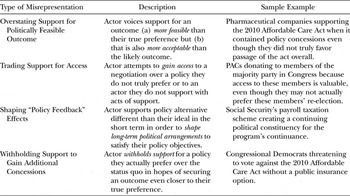
Overstating Support for Politically Feasible Outcomes. One way political actors can be expected to misrepresent their preferences is by overstating support for a politically feasible outcome when they judge their true preferences to be politically unfeasible. Specifically, actors may advance (and indeed hope to actually achieve) a policy alternative that they do not truly prefer relative to the status quo but is (a) more politically feasible than their true preference, yet (b) still closer to their true preference than the likely policy outcome absent their actions.
For example, many pharmaceutical companies supported the Affordable Care Act of 2010 in exchange for particular policy concessions even though many such companies appear not to have truly favored passage of the Act relative to the status quo, even once it contained these provisions. In other words, these actors appear to have expected the “impact” of taking the compromise position to be preferable to the “impact” of opposing the legislation, even though the latter strategy would ostensibly have been more consistent with their true preferences.Footnote 18
Similarly, as I will argue, businesses and their political allies who were completely opposed to Medicare in any form nevertheless advanced a number of proposals for subsidizing health care for the aged in order to limit the scope of what they deemed to be the inevitable passage of an even more expansive policy. Whereas in each case these actors might have squandered their efforts were they to advance their true preference, their efforts to advance a politically feasible alternative could plausibly yield substantial payoffs relative to the likely outcome. In sum, actors sometimes advance policies they do not truly prefer relative to the status quo in order to secure an outcome closer to their true preference than would prevail otherwise.Footnote 19
Trading Support for Access. Second, political actors sometimes overstate their support for a policy or another political actor in order to gain access to negotiations or to gain the audience of another actor. For example, PACs generally contribute a great deal more money to members of the majority party in Congress. The best explanation for their doing so is that they perceive higher value in gaining access to Congresspeople who are members of the majority, not that PACs’ preferences for which members are re-elected regularly changes en masse at the same time party control of Congress does.Footnote 20
Shaping “Policy Feedback” Effects. Third, political actors routinely structure policy in such a way as to shape the subsequent political environment that these policies create. As a prominent example, Social Security taxes were famously designed so as to cement a broad-based constituency for the program; the Social Security tax deduction from every person's paycheck was viewed as a key political strength of the proposal, even though some of its proponents did not appear to favor this idea in the narrowest policy terms. Similarly, as will be discussed in the case of Medicare, conservative Democrat Wilbur Mills appears to have essentially tripled Medicare in scope so as to best forestall the demand for universal national health insurance. Though Mills’ expansion of the program appears to have placed policy much further from his preference in the short term, in creating a fairly expansive program Mills succeeded in securing an enduring barrier to a more broad-based government-sponsored health insurance program in the United States. In sum, political actors often anticipate the downstream political consequences of proposed policies, what scholars term “policy feedback” effects,Footnote 21 and thus shape policies in ways that they hope will secure more preferable outcomes in the long-term.
Withholding Support to Gain Additional Concessions. Finally, political actors might also overstate their opposition to a likely outcome in order to bring policy even closer to their ideal, even when they truly support the alternative under consideration. Though in most ideal point estimation frameworks, for example, legislators always vote for the option that is closer to their bliss point, actors might expect to be able to extract concessions by withholding their support. As Swenson notes, if an interest group believes that “there is the chance that the legislators [they are influencing] might tidy up a few details to suit [them] before passage—like a car salesman who might, for example, reduce the price or lengthen the warranty—why show enthusiasm instead of resistance?”Footnote 22 Liberal congressional Democrats’ threat to vote against the 2010 Affordable Care Act if it did not contain a public insurance option was (an attempt to pursue) such a strategy.
Table 1 summarizes these broad reasons to expect that actors might misrepresent their preferences.Footnote 23 Though the examples of preference misrepresentation provided are particularly stark, similar dynamics regularly occur in ways that can prove much more difficult for researchers to spot and can severely bias historical inferences. In the following pages I illustrate such dynamics at play in such subtler forms as I revisit debates about businesses’ role in welfare-state development with evidence from the passage of Medicare. I begin by reviewing crucial aspects of Medicare's political history.
Common Reasons Actors Misrepresent Preferences

4. A BRIEF HISTORY OF MEDICARE
Before LBJ
Medicare began its political life as a much more ambitious idea: government-sponsored health insurance for all Americans. After decades of failed attempts to build support for such proposals, which had been first seriously advanced in the earliest years of the twentieth century, reformers in the early 1950s settled on advancing a new, narrower proposal: government-sponsored health care for the aged alone. No other political system had targeted a health program in this way, yet the proposal promised to be more politically feasible for a number of reasons: there was a strong substantive case to be made that the aged bore the greatest need for government assistance; the elderly could be expected to support the proposal in massive numbers; many younger citizens also hoped to socialize the risk they bore for their elderly relatives’ health care; and the proposal would be much less costly than covering all Americans.Footnote 24
Yet the idea did not meet much support at first: President Truman's proposal for state-sponsored health insurance for the aged received little backing, and President Eisenhower successfully ran against the measure during his presidential campaign, branding it “socialized medicine.” Even after regaining control of Congress in 1954, northern Democrats who supported the proposal did not have nearly enough votes to advance it: in fact, they held no hearings on the subject until 1958, when they deemed that the possibility for its passage first became “slight.”Footnote 25
By 1960, however, it had become clear to Medicare's foes that growing liberal power in Congress would eventually lead some version of the proposal to pass. Assenting to the “tactical need for federal action,” the American Medical Association (AMA) and businesses thus helped lead the charge for a modest, state-based medical aid program for the indigent, hoping that this program would “head off the demand for Medicare.”Footnote 26 For the first (and not the last) time during Medicare's political life, actors opposed to it thus granted support to a limited version of the proposal in hopes of frustrating efforts to enact the full plan.
This program, called Kerr-Mills, was enacted in 1960. But Kerr-Mills did not successfully forestall demand for Medicare as the AMA and its allies had hoped: the AFL-CIO and other liberal interest groups continued to successfully build public support for a broader plan.Footnote 27 John Kennedy followed suit as he ran for president, stressing his support for Medicare throughout the 1960 campaign as he noticed it reliably receiving the “biggest applause lines” at his rallies.Footnote 28 (For his part, rival candidate Richard Nixon told voters that “the American people . . . do not want, they must not have, a compulsory insurance plan forced down their throats, and we will not allow it.”Footnote 29)
Even before his inauguration, however, Kennedy learned that a Medicare bill was unlikely to pass during his presidency: Congressional leaders friendly to the administration's agenda explained that the conservative-dominated Senate Finance and House Ways and Means Committees would not support many of his legislative priorities, including Medicare, short of dramatic concessions. (Kennedy reportedly remarked in response, “When I was a Congressman I never realized how important Congress was. But now I do.”)Footnote 30
The White House nonetheless attempted to break the conservative coalition's opposition by mobilizing the public's support. As the administration prepared for this push, the AMA and business groups readied their resistance, creating a group called AMPAC with assistance from the U.S. Chamber of Commerce and the National Association of Manufacturers. The AFL-CIO led interest-group support for the bill with assistance from traditional liberal groups such as Americans for Democratic Action (ADA) and seniors groups.Footnote 31
Behind the public fight between Kennedy, liberal interest groups, and the AMA that was ultimately waged during the Kennedy years, however, the administration was aware that the AMA was largely a political “scapegoat”: Administration officials diagnosed their fundamental problem as the paucity of liberal Democrats in Congress. Nevertheless, Kennedy believed that Medicare made a winning campaign issue and kept the measure high on his agenda even as only slow progress was made into 1963.Footnote 32
LBJ Comes to Power
Medicare's most important history of consideration began under President Lyndon Baines Johnson. After his inauguration, the new president made Medicare one of his first major legislative priorities, capitalizing on the martyred Kennedy's support for the program and ever cognizant of the public's broad and ever-growing support for it.
Privately, however, LBJ also knew that the proposal would never pass without the blessing of the powerful Chairman of the Ways and Means Committee, Representative Wilbur Mills. In typical fashion, Johnson thus started courting Mills's support for Medicare early, telling Mills that he would dub Medicare the “Mills bill,” assuring Mills he could claim credit for the legislation, and calling it the “single most important, popular thing.”Footnote 33 Three days after calling Mills to stroke his ego, LBJ forced Mills to sit through his lengthy recitation of the results of a public opinion poll from Vermont that stressed LBJ's popularity while arguing that the his only weakness going into the 1964 election was that he had “done nothing for the old folks.”Footnote 34
Yet for all of Johnson's infamous cajoling tactics, Mills did not budge in 1964. Most importantly, Mills knew that there were not enough liberal Democrats to pass a Medicare bill in the House, even though he could have mustered the votes in the Ways and Means Committee to get it to the floor. As he had done throughout his career, however, Mills resisted reporting any legislation from the committee that was not assured to pass.Footnote 35 Therefore, even though a Medicare rider provision passed the Senate on September 3, Mills's skepticism about its prospects in the House led him to kill the rider in the October 1964 Conference Committee.Footnote 36
The Decisive 1964 Election
The election of 1964 shattered this impasse. As James Sundquist would record, “the 1964 Democratic landslide settled the question” of whether Medicare would pass.Footnote 37 Theodore Marmor likewise famously characterized the period as reflecting “the politics of legislative certainty.”Footnote 38
Most importantly, the historic landslide had ushered in a congressional environment significantly friendlier to liberal Democrats: in sixty-nine—or nearly 1 in 6—seats in the U.S. House of Representatives there now sat freshmen Democrats who believed they owed their victories to LBJ.Footnote 39 The Johnson administration shared this view of the 1964 election's decisive role: in a December 1964 memo, Mike Manatos, the special assistant to the president, noted that, through electoral replacement alone, the administration had moved from not quite having the votes to have a Medicare bill pass the Senate to a situation where they would win by a comfortable margin.Footnote 40 The election also defeated three of Medicare's most dependable opponents on Ways and Means, while a change in the House rules precipitated by the election changed the ratio of Democrats to Republicans on Ways and Means from 15–10 to 17–8.Footnote 41
Rank-and-file members of Congress of both parties shared the view that the 1964 election had removed nearly all obstacles to Medicare's passage: one Republican congressman reflected, for example, “there's not much we can do to stop this program”;Footnote 42 Medicare's approval was routinely characterized around Washington as “easy”; and members of Congress perceived its popularity among the public to be unmistakable.Footnote 43
In light of his newly strengthened political hand, Johnson redoubled his efforts to pass a Medicare law at the start of the 89th Congress, making it clear that the program was his first priority by arranging for the Medicare bills in the House and Senate to be labeled H.R. 1 and S. 1, respectively, and informing his legislative allies that Medicare would be first on the agenda.Footnote 44
Mills changed his position after the 1964 election, too, recalling the following in an oral-history interview in answer to a question about why he supported Medicare in 1965 after representing such a notoriously obstreperous roadblock in the years prior:
Well, time had developed, I think, more support for it [Medicare] among the people. But then the election of the President [Johnson] in 1964 had the major impact, made the major difference. He had espoused it in his campaign, you know, and here he was elected by a 2 to 1 vote, which was a pretty strong endorsement of it, I thought. I thought the time had come to pass it. I don't think we could have passed it in 1961.Footnote 45
Regardless of whether Mills was then or previously personally opposed to Medicare, it had at least become clear that Medicare would pass in some form, leaving Mills no choice except to take advantage of the measure's popularity and “turn it to his own purpose.”Footnote 46 Not only did Mills do so, but, in a coup-de-grace that would surprise everyone, he set into motion what would ultimately become some of the largest welfare-state programs in the world.
Wilbur Mills's “Three-Layer Cake”
What Congress ultimately passed in 1965 was more far reaching than anyone in 1964 had imagined—and numerous political actors’ gross misrepresentations of their true preferences made it possible. The Kennedy and Johnson administrations’ Medicare proposal, H.R. 1 in 1965, had consisted mainly of what is now known as Medicare Part A, hospital insurance for Americans over 65 financed by a payroll tax on current workers. Regular medical care, such as routine doctors’ visits, was almost entirely outside the scope of the proposed program.
In response to the overwhelming likelihood that this proposal would pass, however, the staunchly opposed AMA and congressional Republicans thus thought their best hope for opposition was to split the broad coalition supporting the administration's hospital insurance bill by claiming that it didn't go far enough, didn't cover the most important people or procedures, or simply didn't take the correct approach.Footnote 47 The AMA thus drafted an alternative proposal known as Eldercare, which would have built off the Kerr-Mills program and provided state-based medical aid to the poor, and poured nearly $1 million into advertising the plan ($7 million in 2012 terms).Footnote 48
Ranking Republican Ways and Means Committee Member John Byrnes similarly recognized that “the discussion stage” was “over” after the election, recalling that: “the 1964 election . . . created the situation where it was clear that apparently there were votes enough to pass it. . . . All you had to do was read the election results in a sense to recognize that the big increase in Administration-elected members of the House meant that they would have the votes to pretty much put through something.”Footnote 49 In response to this new political reality, Byrnes thus crafted a Republican alternative largely resembling what is now known as Medicare Part B. The plan allowed seniors to voluntarily sign up for a federally administered insurance plan that would cover not only hospitalization but also routine doctor visits and other similar noncatastrophic services that the poorest would be unable to afford.Footnote 50
Less than two months into the 89th Congress, on March 2, 1965, the Ways and Means Committee held a closed session to consider these alternatives. Though few thought any proposal but H.R. 1 would emerge from the session, the committee still had the three seemingly mutually exclusive proposals on the table before it: the administration's King-Anderson hospital insurance plan, the AMA-backed state-based means-tested Eldercare proposal, and the Byrnes proposal for voluntary insurance for the elderly.Footnote 51
Yet after the coalitions supporting each approach formally presented their arguments, Mills “surprised everyone” with the unthinkable—instead of tabling the AMA and Byrnes proposals as was expected, Mills instead suggested combining all three plans into one omnibus bill (in what he called a “three-layer cake”) that would provide a mandatory hospital insurance program (now Medicare Part A), a voluntary program for physician services (the Byrnes plan, now Part B), and aid for the poor administered by the states with help from the federal government (the AMA plan, now known as Medicaid).Footnote 52 Underscoring the ostensibly compromising nature of this combined proposal, Mills dubbed it the “medi-elder-Byrnes” bill when he floated it to the committee.Footnote 53
This omnibus bill was approved by a party-line vote in the committee and sent to the House floor. On the floor, Republicans raised a motion to recommit that would have substituted the three-part Mills bill with only the Byrnes provisions. The motion failed by forty-five votes, less than the number of freshman Democrats elected that year: Mills's judgment about the necessity of the 1964 election had been correct. Medicare then passed the House and, after minor modifications, the more liberal Senate on July 9. It finally became law with the president's signature on July 30, 1965.
With these basic historical facts established, I more extensively explore businesses’, Byrnes's, and Mills's activities in the following sections.
5. BUSINESSES’ PREFERENCES AND STRATEGIES
Did businesses play any role in Medicare's passage? Existing literature provides little hint that they did. Vogel argues that Medicare “was not opposed by the executives of large companies,”Footnote 54 and few scholarly works on Medicare make much reference to businesses’ role in opposing the program. By contrast, I show that the U.S. Chamber of Commerce and the National Association of Manufacturers (NAM), the two largest and most prominent organizations representing business, industry, and employers’ interests in Washington at the time, in fact actively opposed Medicare.
First, I show that the Chamber, the NAM, and their affiliates were consistent in opposing medical care for the aged in any form throughout the first half of the 1960s. As Medicare became steadily more popular, these groups increased their oppositional activities in turn, attempting to mobilize their members, friendly politicians, and public opinion against the proposal. Crucially, however, these groups dramatically changed these strategies directly following the 1964 election. Records of meetings held following the Democrats’ landslide explicitly record their judgment that the passage of some Medicare program would be inevitable in the coming Congress and that they thus judged the best strategy to be supporting the most limited Medicare program that might pass. Public and private records of these groups’ positions after November 1964 reflect this strategy; illustrating the problem of preferences, I show that much seemingly incontrovertible evidence that these groups supported Medicare just prior to its passage was thus in fact merely the result of their strategic misrepresentations.
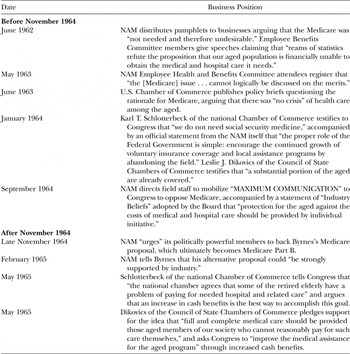
Before 1964: The NAM's and the Chamber's Complete Opposition
The National Association of Manufacturers and the U.S. Chamber of Commerce were both strong and unequivocal in opposing Medicare before the 1964 election, and their reasons for doing so are clear. Nearly any Medicare proposal would have raised taxes, with an inevitably large impact on business profits. In historian Julian Zelizer's words, Medicare represented “one of the largest tax increases in postwar history,”Footnote 55 and businesses correctly anticipated this. Unsurprisingly, the NAM consequently filed feedback from their members on the Medicare issue in their “Taxation” file.Footnote 56
Both the Chamber and the NAM devoted significant resources to making two key arguments to Congress and the public: that Medicare was not needed and that it was too expensive. An information kit the NAM Employee Health and Benefits Committee sent to association members in January 1960 was typical of this approach: the kit described the details of Medicare plans being considered in Congress, warned that they constituted “an initial step toward a compulsory national health insurance scheme,” and denied that the elderly were in need of insurance, writing that “the [NAM Employee Health and Benefits] committee is convinced that the voluntary health insurance business will eventually provide insurance against the cost of medical care to every individual who wants and needs such coverage.”Footnote 57 Likewise, in flyers distributed to association members on the early Forand Medicare proposal, the NAM noted its complete opposition and argued that “a large percentage of our aged population already have health insurance,” going on to predict that “in a relatively few short years, most of the aged population who want and need health insurance will have it” without any government action.Footnote 58
As the environment in Washington became more favorable to Medicare in the early 1960s, the NAM increased the volume of its oppositional activities. In 1961 and 1962, the association began releasing a steady stream of publications continuing the attack on Medicare's main rationale: the NAM distributed pamphlets to businesses in November 1961 arguing that the program was too expensive and not “really needed”;Footnote 59 in May 1962, the association produced materials explaining why the approach was “not needed and therefore undesirable”;Footnote 60 in June 1962, NAM leaders began to give speeches across the country asserting that “reams of statistics” would “refute the proposition that our aged population is financially unable to obtain the medical and hospital care it needs”;Footnote 61 and, finally, in 1963, the NAM Health and Benefits Committee sent a report to NAM members reiterating its position that “the proper role of the federal government is a simple one: encourage the continued expansion of voluntary health insurance by abandoning the field to private effort.”Footnote 62
As the Kennedy administration drew increasingly more public attention to Medicare into 1963, the NAM began its own nationwide campaign to mobilize business owners against the program. The NAM sent weekly legislative bulletins to its members, keeping businesses up to date on the association's oppositional activities and asking members to join in: one NAM bulletin noted, for example, that “the NAM is working closely with the Health Insurance Association in an attempt, locally, to counteract the flood of favorable publicity to start the bandwagon rolling” on Medicare, and asked members in to write letters to the editors of their local newspapers in opposition to Medicare.Footnote 63 The NAM continued to pursue this “local” strategy well throughout 1964, mobilizing its members at key political moments: as the House was considering a Medicare rider in September 1964, for example, the NAM told members that “Business action on Medicare is needed now,” exhorting them to “contact [their] congressman today, urging that he stand firm in opposition to any” Medicare proposal.Footnote 64
Alongside their pleas to member businesses through such centralized communications, the NAM also directed the efforts of numerous “field staff” stationed across the country to mobilize local business opposition. As late as September 1964, the NAM's directives to these staff instructed them to help the association mobilize “MAXIMUM COMMUNICATION” from individual businesses to their members of Congress to oppose Medicare, exhorting:
INDUSTRY SHOULD CONTACT ALL MEMBERS OF THE HOUSE IMMEDIATELY URGING THEM TO STAND FIRM IN OPPOSITION TO ANY AMENDMENT TO HR 11865 PROVIDING FOR ANY SORT OF HOSPITAL OR MEDICAL CARE UNDER THE SOCIAL SECURITY SYSTEM.Footnote 65
Though the U.S. Chamber of Commerce's archives do not record as extensive a grassroots effort, it similarly deployed its resources to building the public case against Medicare through publications distributed to its members. In 1963, for example, the Chamber published a series of policy briefs questioning the rationale for Medicare, warning that Medicare's costs would spiral out of control in the future and arguing that there was “no crisis” of health care for the aged.Footnote 66
Alongside their member mobilization strategies, national, state, and local leaders in the NAM and the Chamber took their case against Medicare directly to Congress as well, fully opposing the entire concept of state support for the aged's medical care in their congressional testimony in 1964. Specifically, the NAM and Chamber argued that the crisis of insurance coverage for the elderly was simply a product of a “transitional situation” that would pass without any government action; that over 90 percent of the elderly had some health protection and thus “we do not need social security medicine”;Footnote 67 that a “substantial portion of the aged are already covered”;Footnote 68 that the entire Medicare approach was “not needed,” and that while “some [of the elderly] are needy, most are not”;Footnote 69 and that “the proper role of the Federal Government is simple: encourage the continued growth of voluntary insurance coverage and local assistance programs by abandoning the field.”Footnote 70 (Despite these groups’ claims, Kerr-Mills had actually failed to provide medical care for the aged and indigent in all but a few states;Footnote 71 only 38 percent of the aged nationwide had health insurance coverage of any kind.Footnote 72)
In short, organized industry's premier interest groups were totally and unmistakably opposed to Medicare before the 1964 election, as is made clear from their forceful oppositional mobilization. These groups’ publications and statements to Congress also show that organized industry opposed not only the Medicare proposals being considered by Congress in 1964 but also Medicare in any form. The minutes of the NAM Employee Health and Benefits Committee's meeting in May 1963 sum up this view of Medicare when they note that attendees felt “the [Medicare] issue . . . cannot logically be discussed on the merits”; Footnote 73 so too does the NAM 1964 official “Industry Beliefs” statement adopted by the association's board of directors: “protection for the aged against the costs of medical and hospital care should be provided by individual initiative.”Footnote 74 Likewise, the Chamber's position is summed up well in a harsh statement from their Board of Directors in June 1964, in which they resolved to staunchly oppose “any proposal in which the social security trust fund would pay directly, or through any other agency, for hospital or any other health care services rendered.”Footnote 75
Although one might wonder whether these actions by the leaders of organized industry reflected the will of rank-and-file businesses, the evidence among the NAM and Chamber members suggests that it did: even as the NAM and Chamber were softening their own institutional opposition to Medicare in January 1965, an opinion poll taken by the NAM showed that its members were nearly unanimously opposed to Medicare in any form.Footnote 76
The business-interest school's claim that welfare-state expansions occur when businesses support them thus receives no support and much contradiction from the evidence of positions expressed just months before the program ultimately passed: there is no evidence that any significant industry groups saw it as beneficial for the government to play any role in supporting medical care for the aged, and their activities made it abundantly clear that they opposed government involvement. Yet the NAM and Chamber's public tune dramatically changed in the wake of their weakened political position after the 1964 election.
A Changing Political Environment: 1964 and 1965
Despite their strident opposition to Medicare before the 1964 election, the NAM and Chamber of Commerce began to overstate their support for the likely outcome—that is, Medicare—as the political environment grew hostile to their true preferences. Read at face value, many of these groups’ statements and strategies thus ostensibly provide strong support for the business-interest school's thesis with the same kind of evidence as its proponents regularly discover: statements businesses made in favor of welfare state expansions just prior to these expansions’ occurrence. And indeed, a leading proponent of the business interest school has concluded just this from such evidence in Medicare's case.
The NAM after the Election. In late November 1964, the NAM gathered with the leaders of several large American corporations to discuss next steps in light of the Democrats’ landslide. The NAM was under no illusions about what the election foretold: “It appears only two members [of the U.S. House Ways and Means Committee] can be depended upon to oppose Medicare,” the NAM informed attendees, asking them for suggestions about what to do in this newly “unfavorable” political environment.Footnote 77
The NAM and its allies came to pursue two strategies to account for the new political reality. On the one hand, the NAM recognized that its rank-and-file members were staunchly opposed to Medicare, and continued to urge its members not to take “an attitude of surrender towards Medicare.”Footnote 78 It also continued to produce wholly critical publications, including pamphlets warning that Medicare was unnecessary and arguing that it would lead to a compulsory system of care like Britain's.Footnote 79 The NAM likewise persisted in mobilizing its member businesses against Medicare: in February 1965, the NAM warned members: “Members of the House should be hearing industry's views on the subject. If the volume of communication is heavy enough, House Members might begin lobbying their colleagues on the Ways and Means Committee with good effect” to stop Medicare's progress.Footnote 80
Yet even as they continued to urge their members to oppose Medicare's progress, the NAM also recognized that opposition alone was insufficient. The NAM thus decided to support a compromise proposal fielded by their longtime ally Congressman John Byrnes, the ranking Republican on the House Ways and Means Committee. Byrnes's proposal, what is now known as Medicare Part B, would have created a voluntary government-sponsored insurance program for the elderly. The NAM “urge[d]” its politically powerful members to back the proposal, so they could “at least” argue “for separate financing of Medicare if [Medicare's passage] be inevitable.”Footnote 81 The NAM also revised its official policy platform in the wake of this new position, replacing the sentence “the federal government has no place in an old age assurance program” with language assenting to a “basic” role.Footnote 82
Though it is clear from this evidence that the NAM's support for Byrnes's plan was purely tactical (as was Byrnes's plan itself, as I will describe in the next section), the NAM's strategy of support for a more palatable alternative to the administration's plan could be easily mistaken for sincere support without attention to the strategic context for this proposal. In fact, a theorist in the business-interest school has argued just this. In an initial argument about the role of business in Medicare's passage, Peter Swenson points to a letter from M. E. Feary, supervisor of employee benefits at the NAM, who wrote to Byrnes in February 1965 that “There are five basic factors in your medical program for the elderly that deserve serious consideration by the House Ways and Means Committee and that I personally believe can be strongly supported by industry. None of these appear in the King-Anderson bill.” These five factors were that Byrnes's alternative would:
1 be administered by corporate agencies instead of the government;
2 limit a “drain of the public funds” because of free choice of participation;
3 keep financing of the program separate from Social Security;
4 be contributory, “restraining abuse,” and;
5 not be able to grow to excess and provide a force for political uses.Footnote 83
Swenson interprets this letter as granting support to the theory that Medicare's passage was “hardly a victory of labor and liberals over big business,” and concludes that “there is no evidence for anything like a shift in a ‘balance of power’ against capital.” He deduces that there is instead “suggestive evidence of an interest shift” being responsible for Medicare's passage, consistent with the business-interest school's expectations.Footnote 84
Yet the broader context of the letter makes abundantly clear that the NAM's true preferences actually changed very little if at all: the NAM noted their opposition to Medicare in any form throughout this period, both to their members and in private; the letter merely shows that the NAM supported Byrnes's efforts to pass a version of the program that was less offensive to their interests given that something was likely to pass. Consistent with this, all five of the points Feary listed in his letter are comparisons to the administration's plan (that is, the likely outcome) rather than to the status quo at the time. This reflects the fact that, as discussed, Byrnes's proposal was explicitly pitched as the least expansive credible alternative that might pass given the overwhelmingly pro-Medicare political environment.
Fuller strategic context thus gives Feary's letter significantly different meaning than an ostensibly straightforward reading would extract: it indicates only the NAM's support for Byrnes's alternative relative to the likely outcome (the administration plan), and not relative to the status quo. Simply because M. E. Feary's letter does not explicitly mention this context as it professes support for Byrnes's efforts says nothing about whether Feary or the NAM would have supported Byrnes's legislation relative to the status quo.
Swenson's misinterpretation of the NAM's letter illustrates how the problem of preferences renders even ostensibly unambiguous private communications difficult to straightforwardly interpret. Actors do not always provide the relevant strategic context in their communications, though such context is essential to accurately identifying their preferences from such evidence.Footnote 85
Chambers of Commerce after the Election. Representatives of the U.S. Chamber of Commerce and various subnational Chamber chapters also took a newly softened stance to Congress that might be mistaken for sincere support. Whereas in testimony before the 1964 election industry representatives remained monolithically opposed to providing additional assistance to the elderly in any form and argued that the aged would receive adequate health coverage under the status quo (see the previous subsection), after the election the national Chamber publicly accepted the premise that a program was needed and began to argue with Congress over the details of what should pass.
Largely acceding to the premise that Congress would pass some sort of health insurance coverage for the aged, most Chamber chapters argued that the best solution would be a simple increase in cash benefits for the elderly instead of the creation of a government medical program. The New York Chamber of Commerce, for example, stressed that they “support[ed] and urge[d] approval by Congress” a “general increase in cash benefits” because it was “the preferable answer to the problem of health and medical costs” among the aged.Footnote 86 Likewise, the Council of State Chambers of Commerce went on record before Congress in a statement endorsed by more than half of the state chambers of commerce as “opposed in principle to providing, as a matter of right, services as distinguished from cash benefits under the Social Security Act,” and thus pledging its support for a cash-transfers-based approach to the problem.Footnote 87 The national Chamber similarly registered its opposition to government administration of health care services, calling the idea “unsound,”Footnote 88 while a representative from the Greater Philadelphia Commerce and Industry Council similarly told Congress that “the bill should encourage the retention of plans presently sponsored by employers or carried by individuals,” instead of erecting a new government program.Footnote 89
Yet in none of their statements did these Chamber representatives contest the basic new political premise that state assistance to the elderly should be provided in some fashion, while many even professed support for government action—even though bitterly opposing these claims had been their central strategy just months before. This change again shows how the “problem of preferences” might confound historical inference if a scholar considered only statements made in 1965.
For example, Leslie J. Dikovics of the Council of State Chambers of Commerce had argued in 1964 that a “substantial portion of the aged are already covered;” that the “American system of voluntary health insurance has done and is doing much to reduce the health care cost problem for millions of our aged citizens;” and therefore that any government federal government action would be unnecessary.Footnote 90 Yet only a few months later, after the 1964 election, Dikovics pledged support for the idea that “full and complete medical care should be provided those aged members of our society who cannot reasonably pay for such care themselves,” and he indeed asked Congress to “improve the medical assistance for the aged program” through increased cash benefits.Footnote 91
Similarly, Karl T. Schlotterbeck of the U.S. Chamber of Commerce had argued in 1964 that support for the elderly's medical costs was “not needed” as more than “90 percent” of the elderly already had adequate medical care and nearly all of the rest would have access to this care soon; the problem was “transitional” and “of decreasing proportions,” according to Schlotterbeck in 1964, and therefore could be expected to go away on its own.Footnote 92 Yet, in 1965, Schlotterbeck noted that “the national chamber agrees that some of the retired elderly have a problem of paying for needed hospital and related care” and argued that cash benefits were the best way for the federal government to accomplish this goal.Footnote 93
Table 2 presents a representative selection of statements by business interests before and after the decisive November 1964 election to help illustrate this shift in their expressed preferences. Examining business's statements and strategies from after the election alone underscores how easily the problem of preferences can be overlooked. How much more unambiguous can one be, a scholar could argue, than when the Council of State Chambers of Commerce explicitly asked Congress to “improve the medical assistance for the aged program”? Yet fuller historical context shows that industry's stated support was a reflection of its understanding that some program would pass. The historical record documents these groups’ appraisal of the environment after the election as markedly more “unfavorable” to their interests as well as their judgment that the passage of some sort of medical assistance program would prove “inevitable,” making the reasons behind their rapid shift in position following the election abundantly clear.Footnote 94 Yet taking evidence from this latter period at face value, even when it is drawn from private sources (as Swenson did with Feary's letter), would lead one to substantially misinterpret organized industry's true preferences, and hence to misidentify their degree of influence and power as well.
Selected National Association of Manufacturers and U.S. Chamber of Commerce Statements Before and After November 1964

Of course, this evidence regarding the Chamber's and the NAM's behavior does not necessarily speak to all businesses’ interests or preferences at the time; as recent work has cautioned us, scholars often too readily elide the distinction between certain prominent businesses’ interests and “business interests,” and those who chose to join these business associations may not be representative of all businesses.Footnote 95 However, the Chamber and the NAM were widely recognized as the banner interest groups representing businesses’ preferences at the time.Footnote 96 The archives do not record any other business groups as being nearly as active on the issue, and, as discussed, these groups’ rank-and-file members appeared to support their actions. There is also no evidence that these groups were more hostile to Medicare than other, less-prominent business actors were at the time. Nonetheless, it should be kept in mind that these groups were not necessarily representative of all businesses’ views.
6. BYRNES, BUSINESSES, AND PART B: “OPPOSITION TO MEDICARE IS NOT ENOUGH”
Though it may seem obvious to remark that politicians often misrepresent their preferences in public, in this section I explore how politicians’ seemingly clear private actions and statements can still be quite easily misinterpreted without careful attention to their strategic context.
As the chairman and ranking member of the House Ways and Means Committee, respectively, few people in Washington were in a better position to shape Medicare's final passage than were Wilbur Mills and John Byrnes, and indeed both deserve great credit for crafting significant aspects of the sizeable social welfare program that Medicare still is today (albeit inadvertently on Byrnes's part). Yet both men were also among businesses’ most dependable allies in Congress, raising the question of whether these unimpeachably pro-business politicians might have anticipated businesses would develop support for Medicare after its passage despite their clear opposition at the time. Indeed, Swenson argues that businesses have provided such retroactive support in numerous historical instances, and that the anticipation of such retroactive support is often responsible for a pattern in which pro-business politicians frequently voice support for welfare-state expansions in cases when businesses have actively opposed them.Footnote 97 Thus, even if one accepts that the NAM and the Chamber of Commerce were truly opposed to Medicare in 1965, the business-interest school might counter that business interests were still responsible for the program's passage because Byrnes or Mills expected that Medicare would be good for business and “ultimately accepted [by business] as such.”Footnote 98
In this section I show that this argument receives no support from the historical record, but that again much historical evidence could be easily misread in favor of it. Instead, the historical evolution of Byrnes's position on Medicare makes clear that he and the Republicans did not truly favor his Part B proposal over the status quo, though they stridently claimed to support it as a part of their political strategy. Indeed, the historical record chronicles Byrnes's explicit view that Part B was borne out of political strategy alone, verifying what an analysis based on the historical evolution of his views and tactics implies.
There are a number of compelling reasons to expect that Byrnes would act in accordance with businesses’ dominant interests on the Medicare issue. The NAM had long provided substantial support to the campaigns of Republican members of Congress through both financial contributions and in the form of grassroots efforts by association members to re-elect Republicans.Footnote 99 In the context of Medicare, as reviewed in the last section, Byrnes had also closely coordinated with the NAM throughout the program's consideration by Congress.
What then of the possibility that Part B was not Byrnes's best attempt to limit Medicare's size but in fact a program that he genuinely supported because he believed that businesses would too? Byrnes's private memoranda constitute the firmest demonstration that his 1965 proposal should be read as nothing but reluctant acquiescence. The evolution of the positions Byrnes took as the political climate changed illustrates how strategic circumstances are crucial to how political actors choose to represent their preferences.
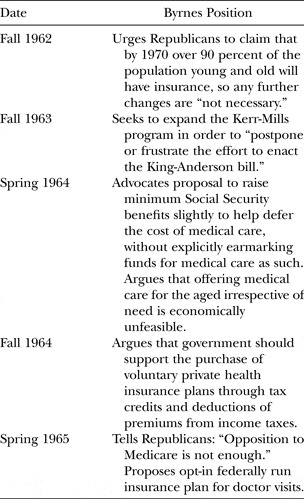
Echoing the U.S. Chamber of Commerce's and the NAM's strategies before the 1962 election, Byrnes advised his Republican colleagues that it would be “of use” in their “campaign for re-election” to spread the message that Kennedy's Medicare program was “not necessary” since “at the present over 75 percent of the entire civilian population—young and old—have some type of health insurance. By 1970, it will be 90 percent.”Footnote 100 (Of course, this was false.) In November 1963, Republicans’ strategy remained largely the same: the assistant council to Republicans on the Ways and Means Committee, David West, wrote to Byrnes that even as Medicare was becoming more popular among the public, he felt it would be best for Republicans to continue their strategy of proposing small changes to the state-based Kerr-Mills framework to limit demand for a larger program, which is exactly what Byrnes did.Footnote 101
Yet, as political pressure to pass Medicare mounted following Kennedy's assassination and Johnson's ascendancy, some rank-and-file Republicans began to file bills that went beyond the Kerr-Mills framework. The response from Byrnes's office was clear disapproval. West reprimanded Republican members of the committee in a February 1964 memo, tersely writing: “The introduction of such bills constitutes at least an implied admission that existing laws are inadequate. If the trend toward the introduction of such bills continues, it may be impossible for the Ways and Means Committee not to take some action in this area.”Footnote 102 Reflecting this strategy, Byrnes also continued to argue that the Kerr-Mills approach was sufficient and that medical care for “all the aged, irrespective of need” would be economically infeasible.Footnote 103
After the 1964 election, however, Byrnes's strategy changed dramatically. Only then did Byrnes draft the Republican alternative largely resembling what is now known as Medicare Part B. The plan allowed seniors to voluntarily sign up for a federally run government insurance plan that would cover not only hospitalization but also routine doctor visits and other similar noncatastrophic services that the poorest would be unable to afford.Footnote 104
Table 3 summarizes this evidence, drawn entirely from Byrnes's own records and statements. Though this evolution of Byrnes's strategies before and after the election merely strongly suggests that his Part B proposal was not his true preference, Byrnes's papers and oral history interviews explicitly indicate that this was the case. In fact, Byrnes fully admitted that although the measure was not warranted on policy grounds, he thought it “incumbent upon Republicans to offer a sound alternative” plan so that Republicans could attack politically “vulnerable” aspects of the administration's proposal. Byrnes also hoped that once his plan was inevitably rejected, the Republicans would at least have a “we-told-you-so advantage” in the event that any aspect of Medicare's implementation went poorly. “Opposition to Medicare is not enough,” Byrnes thus wrote in a memo to Republicans in January 1965, “It is incumbent upon the Republicans to offer a sound alternative.”Footnote 105 William Quealy, the Republican staff counsel on the Ways and Means Committee (and thus Byrnes's employee) similarly urged the move, as he told the Republican committee members that they needed to “face political realities.”Footnote 106
The Evolution of Byrnes's Strategies, 1962–1965

As Byrnes later reflected, he had realized that “the discussion stage” was “over” after the election, recalling that: “the 1964 election . . . created the situation where it was clear that apparently there were votes enough to pass it. . . . All you had to do was read the election results in a sense to recognize that the big increase in Administration-elected members of the House meant that they would have the votes to pretty much put through something. . . . It was perfectly apparent that the truck was on the road and it was all gassed up and going. . . . The politics of the thing dictated that there was going to be passage of a federal program.”Footnote 107
Byrnes's statements at the time and later recollections thus verify that his Part B proposal was exactly what the historical evolution of his actions implies: merely an effort to offer a less-expansive political “substitute” for the administration's proposal given unfriendly political circumstances. A journalist at the time thus recorded that Byrnes's plan was:
generally dismissed as a political grandstand play, and Byrnes himself privately conceded that the bill had no chance. . . . Although the Republicans might have no hope of getting the measure through Congress, they could be counted on to use it later as an example of how they had been trying to take care of old people when the Democrats betrayed them with a halfway piece of legislation.Footnote 108
Moreover, Mills's surprise move of including the Byrnes provisions in the “three-layer cake” took Byrnes himself completely off guard and cannot be read as a Byrnes coup. The move left Byrnes “stunned” according to those present: one observer noted that Byrnes “just sat there with his mouth open” after Mills's move, and Byrnes himself later told a journalist that Mills's move was “quite a surprise” to him.Footnote 109 Indeed, as Mills had hoped, the minutes of the closed session, released only recently, show that Byrnes attempted but had difficulty forming a coherent argument against the combination bill since it contained the very ideas he had been strategically championing.Footnote 110 Once the meeting ended and news leaked to the press, the AMA was “horrified;”Footnote 111 after spending more than $900,000 to advertise the administration bill's inadequacy, their own advocacy had been turned against them to create a plan more far-reaching than any had realized was possible.Footnote 112
Mills thus harnessed Republicans’ claims that the administration-backed hospital insurance proposal was inadequate to fashion a bill that was “unassailable politically from any serious Republican attack” in the administration's estimation.Footnote 113 Department of Health, Education, and Welfare Secretary Wilbur Cohen likewise called Mills's move “one of the most skillful political maneuvers [he'd] seen in thirty years,”Footnote 114 since, as he gloated to the press a year later, “The doctors couldn't complain, because they had been carping about Medicare's shortcomings and about its being compulsory. And the Republicans couldn't complain, because it was their own idea. In effect, Mills had taken the AMA's ammunition, put it in the Republicans’ gun, and blown both of them off the map.”Footnote 115 LBJ's legislative aide Larry O'Brien similarly remembered that “[Mills’ move] didn't eliminate opposition, but suddenly you're looking at a piece of legislation that effectively rebutted these claims made over the years of ineffectiveness.”Footnote 116 Other administration officials commented that with the move the opposition was “outfoxed,”Footnote 117 that “the wind was taken out of [their] sails,”Footnote 118 and that it had left Democrats completely “off the hook” politically.Footnote 119 Mills himself recalled that Byrnes had thus “painted himself into a corner,”Footnote 120 while LBJ referred to Mills as having “stole[n]” the provision from Byrnes.Footnote 121 As Johnson would later crassly observe, Mills thus left the AMA and Byrnes “knee-deep in their own shit.”Footnote 122
Within the context of Byrnes's previous actions and the changing political climate, there is thus strong evidence Byrnes's 1965 proposal was only intended to limit Medicare's scope as much as possible, even though this was not its ultimate effect. In light of Byrnes's prior public statements before the 1964 election and his private admissions at the time, there is little reason to believe that Byrnes's 1965 actions and statements came from a position of sincerity.
Note, however, that one would completely mistake Republicans’ true preferences by considering only Byrnes's actions just prior to Medicare's passage: Byrnes directed his efforts toward advocating several alternative proposals to Medicare with business support for his efforts; and, Republicans nevertheless overwhelmingly voted for the final bill. Indeed, Swenson claims that Mills “jumped” on Byrnes's idea lest the administration's proposal be rejected and Byrnes's proposal be substituted in its place on the House floor. The inclusion, Swenson thus argues, illustrates a “cross-class alliance” without which the bill would not have passed.Footnote 123 Yet the facts Swenson identifies provide no evidence for his assertions when these actors’ strategic contexts are fully taken into account, an interpretation that Byrnes's explicit statements confirm.Footnote 124
Byrnes's memoranda thus further illustrate how even private materials can be subject to the problem of preferences and the resulting difficulty in interpretation. Just as industry groups expressed more support in any form for Medicare after political circumstances forced their hand, Byrnes only supported Medicare after November 1964. This evolution is not surprising given what transpired in American politics during these years; however, it does illustrate how misleading each of these private statements might be in isolation, no matter how clear they might appear (such as Byrnes's full-throated endorsement of his Part B proposal in a closed session of the Ways and Means Committee, just prior to his horror that Mills superficially accepted it). In concluding, to paraphrase Byrnes himself, political actors often find that it is not the best strategy to simply oppose that which one opposes.
7. WILBUR MILLS'S TWO CONSTITUENCIES
Despite businesses’ and the Republicans’ own clear opposition to Medicare, Wilbur Mills's impeccable pro-business credentials ostensibly lend circumstantial evidence to the claim that organized industry's allies in Congress thought they might ultimately come to support Medicare: after all, Mills was as reliably friendly with businesses as any member of Congress and appears essentially solely responsible for the Medicare bill's dramatic expansion in scope in March 1965. Yet Mills's papers paint a much more complicated picture about his relationship with businesses on this issue.
Before 1965, Mills's reputation in general and with organized industry was primarily based on his stance on taxes, a natural role for the chairman of the Ways and Means Committee. In this regard, Mills defined himself as a tax cutter and reformer: Time magazine featured Mills on its cover in January 1963 for a story about his proposal to overhaul the tax code and reduce federal taxes, after which numerous businessmen wrote him to congratulate him on the publicity and laud his continuing efforts.Footnote 125 Mills also routinely gave interviews to business publications to promote his tax-cutting proposals, such as for an article in National Business Magazine in August 1964, “Wilbur Mills Talks on Taxes.”Footnote 126
Yet despite his close relationship with organized industry, Mills's papers imply that he did not view businesses as an ally for Medicare's passage. Specifically, the content of remarks he made to meetings of numerous business groups in Arkansas sheds light on his own understanding of these groups’ priorities and opinions.
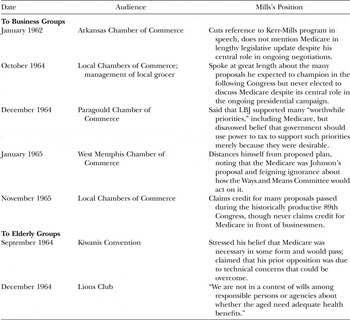
Mills's preparations for a speech he gave in January 1962 to the Arkansas Chamber of Commerce typify the congressman's approach. One of Mills's aides wrote a first draft of the speech touting the limited Kerr-Mills program and claiming that it had already made “remarkable” progress. Yet Mills himself decided to cut the reference in the final version of the speech, and did not mention health benefits at all in his lengthy remarks about various proposals pending before Congress.Footnote 127 Likewise, in numerous speeches before the 1964 election to local chambers of commerce and to the management of local corporations, Mills spoke at great length about the many proposals he expected to champion in the following Congress but never once raised the issue of Medicare with these audiences.Footnote 128 Indeed, in all of Mills's many speeches to business groups in 1964, the one speech that appears to reference Medicare even indirectly occurred after the election, in December, when Mills spoke to the Paragould Chamber of Commerce. Yet even then, Mills only generally commented that while there were many “worthwhile priorities” that the following year's Congress would consider, among which Medicare was one of many, he did not believe that government should use the power to tax to support priorities merely because they were desirable.Footnote 129
Perhaps even more indicatively, even after Medicare passed, Mills's apparent assessment of businesses’ support for the combined three-part policy he crafted appeared to remain similar. In speeches in November 1965, Mills traveled across Arkansas to visit local Chambers of Commerce and claim credit for the many proposals he had shepherded through the Ways and Means Committee during the historically productive 89th Congress. Yet despite these speeches’ great length and scope, Mills consistently declined to claim credit for Medicare's passage in front of businessmen,Footnote 130 despite the fact that most would single out the program as the signature achievement of his legislative career.
In fact, in Mills's papers I only found one exception to his tendency to avoid discussing his position on Medicare with businesses, an example which further reinforces this argument. In January 1965, right after Johnson had announced that Medicare was his top legislative priority in the coming Congress, Mills devoted only one paragraph to Medicare in a speech to the Chamber of Commerce of West Memphis, Arkansas. In it, Mills distanced himself from the proposed plan, being careful to note that the proposal came from Johnson, and feigning ignorance about how the Ways and Means Committee would receive the administration's proposals.Footnote 131
Yet even as Mills eschewed discussing Medicare with businesspeople in his district, he spoke of it quite readily and frequently when among another group of his constituents—the elderly. When speaking to a Kiwanis convention in Arkansas in September 1964, for example, Mills sought to deflect criticism that he had opposed Medicare's passage in 1964, referring to his “deep concern … over using the [OASDI] system for financing a medical or hospital care program” but stressing that he believed the program was necessary and would pass.Footnote 132 Similarly, he told a Lions Club on December 2, 1964, that “we are not in a contest of wills among responsible persons or agencies about whether the aged need adequate health benefits.”Footnote 133
Such patterns, summarized in Table 4, have clear implications for inferences about Mills's own perceptions of the political economy of Medicare. Mills did defend his reputation on Medicare in front of the elderly, but among businessmen never elected to discuss the issue, much less emphasize his support.
Mills's Position on Medicare, 1962–1965, Across Audiences

Though this evidence alone does not necessarily indicate that Mills thought all businesses were opposed, it does suggest that most businesses were at best indifferent in Mills's estimation. In concert with the evidence from the previous sections and what we know about Mills's very close relationship with business groups,Footnote 134 however, Mills's reticence on the Medicare issue in front of businesses in Arkansas paints the picture of a politician trapped between one of his most powerful and core constituencies and a political tidal wave in the U.S. House and among the public. It is no surprise that the NAM chose to ask its members to reach out to, of all figures, Mills in particular during key moments in the Medicare fight—he had always proven to be their dependable ally. Yet businesses’ opinion could not wholly determine his actions.
Mills's actions stand in striking contrast to what the business-interest school would assert; Mills did and said little that would suggest that he saw organized industry as a potentially supportive constituency for Medicare, while the evidence implies much the opposite. There is no evidence that Mills expected to be able to cultivate business support for Medicare, either. Were Mills asked to provide his view on the business-interest school, his behavior implies that he would almost certainly be a strong skeptic.
More broadly, Mills's actions also illustrate another way that researchers can identify how political actors’ strategic context shapes their expressed preferences: by tracing how their actions change across strategic contexts within time (in addition to over time). Exploring how strategic context within time mediates the policy preferences actors claim to have can thus yield crucial insight into their perceived strategic environment.
8. CONCLUSION: BUSINESS AND THE WELFARE STATE
In this article I have presented evidence that Medicare's passage cannot be well explained by changes in businesses’ interests. While a traditional power-resources account well explains the observed pattern—a considerable decline in the political power held by organized industry's main allies brought about by the election of 1964—there is no evidence for a shift in businesses’ interests or these interests’ importance, empirically or theoretically, between the early 1960s and when Medicare passed in 1965. The nation's banner organized business groups behaved as many scholars would predictFootnote 135 on an issue of such high salience to which they were so clearly opposed: by enlisting local businesspeople to lobby their members of Congress and endeavoring to turn public opinion against the measure.
They were not successful. Indeed, in stark contrast to what the business-interest school's theoretical premises would predict, what is perhaps most remarkable about politicians’ behavior on the Medicare issue is how indifferent key actors appeared to organized industries’ preferences and clout. Consider, for example, Wilbur Mills's words when speaking privately with LBJ about his three-pronged proposal. Mills said the following with regard to the insurance industry, one of the most powerful lobbies in Washington:
Don't you worry one minute about these doctors and insurance companies organizing against this bill. We have written the insurance people, we must admit, completely out of the bill for people over 65. . . . the insurance people are going to oppose it, there's no doubt about that. They were going to oppose HR 1. They were going to oppose anything we did. Footnote 136
Of course, this quote from Mills does not refute the claim that he most frequently acted in capitalists’ interests quite often—as we have seen, Mills regularly courted business support through a variety of means. Yet it does illustrate how brazenly Mills was willing to abrogate the clear preferences of this powerful interest group, seemingly in favor of what he perceived as the public's demands.
Johnson's strategy for coping with organized interests who were opposed to Medicare was even more aggressive: Johnson largely reacted to interest-group opposition by asking that the proposal be rushed through the House before opponents had time to mobilize opposition, and did not focus on how to address their concerns, much less how to achieve their ideal.Footnote 137 In fact, when LBJ asked his legislative aide Cohen how insurance companies had reacted to Mills's three-pronged proposal, and Cohen told him they would “raise hell,” LBJ only replied with a general “I think that's wonderful” before changing the subject.Footnote 138 LBJ was somewhat less blasé about industry and the medical profession's opposition, simply telling Mills: “for God's sake . . . when you get [the bill] out of that committee, you call that son of a bitch up before they can get their letters written,” then asking Mills to give the phone to Democratic Majority Leader Carl Albert so that the president could also exhort him to schedule a vote on the bill as soon as possible “before they can generate opposition to us.”Footnote 139
Even more remarkably, Johnson's telephone calls also record him schooling the vice president on congressional relations, and thus give Johnson's own perspective on how he approached shepherding these proposals through Congress. In his advice to Humphrey, Johnson discussed the importance of bringing a record of accomplishment to the voters and taking advantage of labor union support, though Johnson never referenced currying, harnessing, or featuring business support for any Great Society programs or other administration priorities. In fact, Johnson even used the very example of the NAM and U.S. Chamber of Commerce opposition to his social programs as an example of when to be tough in response to interest groups’ demands, telling Humphrey that he had threatened the NAM and the Chamber by telling them that if they tried to “cut the guts out of my program . . . I'll cut the guts out of yours.”Footnote 140 In light of this evidence it becomes quite difficult to assume that politicians will reliably avoid “legislation that antagonizes large numbers of capitalists able to fund a massive counteroffensive.”Footnote 141 In their own judgment, LBJ and Mills consciously chose to do just this.
Of course, despite Medicare's substantive importance, in this article I have examined only one particular program in one particular context, so the usual caveats about the potential generalizability of my arguments of course apply. However, as the U.S. political system has typically been considered to be among the most favorable towards business interests, my results suggest that the business-interest thesis may meet even greater difficulty in other contexts.
What can we learn about the American welfare state from Medicare's case? Though it is beyond the scope of this article to sustain a counternarrative of Medicare's passage, the new evidence presented here does suggest that future research on Medicare should further consider the role of public opinion. As noted, interviews with Mills years later indicate that he recalls public opinion being the decisive factor in his ultimate support for Medicare, and that he frequently sought to associate himself with the program in public after its passage. Likewise, Johnson seemed to share the view that public opinion could ultimately move Mills at the time: recall that Johnson thought he would be persuasive in telling Mills that Medicare would be the “single most important, popular thing” that Mills would do in Congress that year,Footnote 142 and perhaps during his entire career. Similarly, Johnson read Mills the results of opinion polls that indicated Medicare was popular and Democrats had “done nothing for the old folks.”Footnote 143 Though this evidence is not definitive, it suggests that the roots of the public's support for the program (or at least politicians’ perceptions of this support) deserve serious attention.Footnote 144
The role of the decisive 1964 election itself also ought not to be neglected. Whatever factors kept Medicare high on the Democratic Party's agenda for nearly a full decade before its passage, only the decisive election of 1964 allowed these factors to manifest. In this sense, Medicare's fortunes before and after the election of 1964 starkly demonstrate how, as Huber and Stephens have argued, the presence of a friendly political party can play a “crucial mediating role” in welfare-state development.Footnote 145
Medicare's passage may also provide fruitful ground for research on state autonomy.Footnote 146 Though Johnson claimed to many members of Congress that voters had given him a mandate to pursue Medicare, a confluence of factors that were at least as important as Medicare decided the 1964 election. These included Goldwater's extremist platform, the Vietnam War, civil rights, poverty, and the memory of Kennedy's assassination. Explaining how and why Johnson translated his popularity into passing his Medicare program is another interesting question that future scholars should closely consider.
Last, but perhaps most important, Mills's own role in expanding the Medicare program threefold is particularly remarkable and worthy of further investigation: there is no evidence that the administration's original bill would have failed without Mills's action; to our best understanding, Mills dramatically expanded the scope of the bill even though his political circumstances did not necessitate it.Footnote 147
9. ADDRESSING THE PROBLEM OF PREFERENCES: TRACING PREFERENCES ACROSS STRATEGIC CONTEXTS
More broadly, this article has illustrated the vital importance of considering political actors’ strategic circumstances when seeking to identify their policy preferences. Identifying political actors’ preferences is foundational to the study of politics, especially when seeking to ascertain to what degree various actors wield political power (such as that of businesses on the welfare state). Yet, though actors’ preferences must be estimated from their positions, an actors’ decision to take a position, as Frieden notes, also “typically embeds in it calculations of what the impact of [taking] this position” will be.Footnote 148 As discussed previously and summarized in Table 1, there are a number of “impacts” political actors might hope to achieve by misrepresenting their preferences, including advancing a less unsatisfactory outcome from a position of political weakness; overstating opposition to extract further concessions; gaining access to actors and policymaking processes; and shaping policy feedback effects.
Such tendencies pose a thorny methodological problem, the “problem of preferences,” that researchers cannot benignly ignore. Throughout this article, I have shown how actors’ true preferences can be (and have been) easy for scholars to miss by neglecting these issues, even when using private primary sources like personal letters and internal memoranda.Footnote 149 This evidence illustrates how reliably reconstructing the policy preferences of a political actor through their statements is exceedingly difficult, and that both public and private statements should be viewed through a strategic lens.
Nevertheless, despite the importance and pervasiveness of this problem, scholars have few reliable guidelines as to how to identify actors’ true preferences when there is reason to be concerned that they might be acting strategically. Though other scholars have proposed solutions to this problem, these suggestions have crucial weaknesses. Hacker and Pierson argue that researchers should specify actors’ interests ex ante to avoid this problem, ascertaining actors’ preferences from an a priori theoretical analysis.Footnote 150 Frieden, in the tradition of international relations, similarly supports such “deduction” about actors’ preferences “on the basis of preexisting theory” given the problem of preferences.Footnote 151 However, as the debate between Hacker and Pierson and Swenson indicates, in practice it is nearly impossible to definitively establish ex ante what is in actors’ interests (or, worse, what actors perceive to be in their interests). Korpi, by contrast, argues that a better approach to overcoming the problem of preferences is to consider “the time order in which different actors enter the policy-making process,” arguing that those who “initiate” advocacy for a particular policy “can be assumed to” favor it “as their first-order preference.”Footnote 152 Yet Medicare's case shows the weakness of Korpi's proposed approach as well, as a number of policies, including the Kerr-Mills program, Part B, and Medicaid, were all initiated by actors who clearly did not truly favor these programs’ enactments.
In this article I have also illustrated how scholars can seek to overcome the problem of preferences by tracing actors’ expressed preferences across different strategic contexts. Scholars can expect to better understand the impact of strategic context by seeking variation in it because strategic context is responsible for inducing the problem of preferences in the first place. In this way, just as scholars seeking to understand the impact of any variable investigate what coincides with changes in it, scholars attempting to account for the role of strategic context in actors’ expressed preferences can learn much from variation in it. Conversely, however, the same logic also implies that, without showing how actors expressed preference change across strategic conditions, even the most ostensibly trustworthy sources and methodologies may yield deeply inaccurate interpretations.
This article has illustrated two ways scholars can trace how actors’ preferences change with strategic context: specifically, researchers can trace how actors’ preferences change over time as strategic settings change and across strategic settings within time. I illustrated this methodological approach by tracing how the NAM, the U.S. Chamber of Commerce, and Byrnes changed their expressed preferences before and after the 1964 election and how Wilbur Mills changed his appeals across audiences.
In many of these cases I also documented these actors’ explicit statements about their understandings of their strategic environments. Statements like these are rare in the historical record but can crucially add to such analyses. Using these strategies, this article was able to shed new light on the business-interest debate's impasse: all these theories would make the same predictions about business's expressed preferences after the November 1964 election, but they crucially differed in what they would expect just before this event (and across actors’ strategic contexts within time).
Tracing how actors’ expressed preferences change with variation in their strategic contexts can thus help scholars appraise the incentives historical actors face and the preferences they hold. As Gerring notes, process tracing is generally “akin to detective work” in that multiple pieces of evidence are “employed for the verification of a single inference.”Footnote 153 In the case of ascertaining actors’ true preferences, Gerring's formulation is especially apt: it is unlikely that any one piece of evidence can convincingly establish what actors truly prefer because variation in actors’ strategic context is analytically crucial to identifying their preferences.
While this problem of preferences may appear of greatest interest to historical researchers engaged in the close study of particular cases, its importance is by no means limited to them. For example, as discussed, one example of how political actors might support a political outcome they do not truly prefer is when PACs donate money to members of the majority in Congress simply because these members are in the majority. Imputing a massive preference shift among PACs when control of Congress changes would be erroneous, though PAC donation patterns still contain a wealth of useful information about politics we would like to use. In pioneering work estimating the ideological position of PACs, therefore, Bonica includes controls for politicians’ majority party status (i.e., a key variation in strategic environment PACs face) in order to account for this manifestation of the problem of preferences.Footnote 154 Economists likewise have long wrestled with how to infer consumers’ preferences from choices made in particular incentive environments.Footnote 155 Political scientists also, however, regularly use procedures such as content analyses to ascertain various actors’ preferences in ways that do not confront the problem of preferences and are thus vulnerable to substantially misinterpreting various actors’ preferences, interests, and power.
Scholars advancing claims about actors’ genuine preferences—and the role that these preferences play in determining important shifts in political power and institutional development—should thus view careful consideration of the problem of preferences as a central methodological obligation. Not only should scholars, as Frieden argues, “be explicit about how they determine the preferences of relevant actors,” but, as we do so, also pay careful attention to the strategic circumstances political actors faced and the “impacts” they might have hoped to achieve with the positions being analyzed.Footnote 156