


1. Introduction
Across the fractured geopolitical landscape of the twenty-first century, the Global South faces a world marked by deepening economic asymmetries and rival power blocs. In this renewed age of contestation, struggles over sovereignty and development have resurfaced, as competing visions of global order redraw the lines of inclusion and exclusion.
The long-heralded promise of multipolarity – what Thomas Friedman has called our ‘Polycene’, marked by China and India’s ascent – has opened only limited room for manoeuvre for Global South countries.Footnote 1 Despite the expanded influence of BRICS states, the structural inequalities embedded in the global economy remain largely intact. As Andrew Fischer has noted, the much-announced ‘end of peripheries’ has not materialized.Footnote 2 Data from the Global Inequality Project confirm this persistence: average income disparities between the Global North and South have widened almost fourfold since 1960, rising from about $14,000 to nearly $52,000 in 2023.Footnote 3
Parallel to this widening gap, the international order is fragmenting along lines that recall the Cold War era. Trade disputes between the United States and China, the war in Ukraine, Palestine’s continued denial of full statehood amid US opposition, battles over oil and critical minerals, and escalating conflicts over digital infrastructure and energy transitions now define global politics. Climate negotiations remain paralyzed by race-to-the-bottom dynamics, and even a renewed space race – involving public and private actors – has re-emerged. Commentators increasingly describe these dynamics as a ‘new’ or even multiple ‘new’ Cold Wars, marked by geopolitical rivalry and accelerating legal and economic fragmentation.Footnote 4 Crucially, these fractures are reshaping international law, trade, and development in ways that continue to constrain Global South sovereignty. In contrast to dominant accounts that frame the ‘new Cold War’ as a novel geopolitical rupture driven by renewed great-power rivalry, this article argues that contemporary conflicts are better understood as transformations within a longer juridical and institutional order consolidated during the mid-twentieth century.
To grasp what is at stake in this moment, I return to the original Cold War as the historical crucible in which today’s global economic order was consolidated. I approach the Cold War as a decisive phase of consolidation, in which international law, development, and governance frameworks converged to produce the institutional and epistemic foundations of contemporary world capitalism. The global economy we inhabit was not a natural formation but the outcome of projects that translated older imperial hierarchies into new economic norms and institutional arrangements. From the vantage point of the Global South, this process reveals uneven experiences of Cold War governance and its enduring consequences for global inequality. As Leoni observes, the Cold War may appear ‘structured and simple’ from afar, but viewed from within it reveals a much more differentiated terrain.Footnote 5
Recent scholarship has illuminated the Cold War’s formative role in shaping international law and its institutions.Footnote 6 This work has shown how technocratic expertise, state-making, and market rule reproduced Global South subordination under the guise of sovereign equality and development.Footnote 7 I extend these insights here by arguing that the Cold War consolidated a global economic order rooted in earlier imperial practices that separated economic governance from social and political life. This structural logic continues to delimit the possibilities of Global South sovereignty.
Understanding the Cold War in this way, I trace how international law and the emerging discourse of development functioned as interlocking techniques of world-making.Footnote 8 Together, they articulated a new promise of global prosperity while abstracting economic relations from the social and environmental worlds they reshaped. The Cold War, in this sense, was not an exception to the longer history of imperialism but an intensified phase in the longue durée of global disembedding – a process set in motion with Europe’s expansion into the ‘New World’, when extraction was legally dislodged from social and ecological obligations. For the purposes of this article, the ‘economy’ is then not a pre-existing domain but a historically produced object of governance. Across the periods examined here, it emerges through specific legal, financial, and epistemic practices – from colonial surveys and fiscal regimes to GDP accounting, development indicators and lending criteria – that render social and ecological relations legible in economic terms. I use disembedding, in this sense, to name the practical and juridical work through which ‘the economy’ is constituted and sustained as an apparently autonomous sphere.
While Global South nations used international law for counter-hegemonic ends, the period also saw the Global North entrench its own project through regressive economic logics and a restrictive international order. Debates over the relationship between national and international development became defining battlegrounds. Global South states pressed for an international developmental framework capable of supporting national transformation, even as the Global North retooled law and development to advance its interests.Footnote 9 Global South actors were not passive recipients of this order but active – if constrained – agents in its remaking.
Despite the significance of Global South resistance, Cold War internationalism ultimately reinforced a structural logic rooted in earlier imperial hierarchies, increasingly severing economic governance from social and political claims. In Karl Polanyi’s terms, it deepened a process of disembedding – the detachment of economic life from its social and political context.Footnote 10 International development became a central site where this juridical disembedding was advanced. Contestation persisted, but the development project was institutionalized as a legal–managerial framework that recast economic governance as a domain of technical expertise, echoing colonial systems and foreclosing possibilities for transformative politics in the Global South.
The conceptual framework of this article draws on Polanyi, as well as on the work of Timothy Mitchell in this area. Where Polanyi diagnosed the effects of disembedding, Mitchell elucidates its mechanics: an autonomous economic sphere is never created, but only made to appear through legal, political, epistemic, and technological interventions. These ‘metrological regimes’, understood as the assemblage of practices through which economic relations are measured, rendered legible, and governed, stabilize the impression of an economy detached from society, and it is this impression that performs the disciplining.Footnote 11 Through these socio-technical arrangements, particular forms of measurement and representation come to define what counts as ‘the economy’ from within the milieu of social relations. Disembedding occurs, therefore, when such practices narrow the field of politics, allowing economic management to present itself as neutral and technical – a trajectory that, if left unchecked, leads, in Polanyi’s words, to the ‘demolition of society’ from within.Footnote 12 During the Cold War, this abstraction was not incidental but programmatic. National income accounting, GDP metrics, lending criteria, conditionalities, and the dollarization of national economies recast economic activity as a technical domain governed by expertise rather than redistribution or justice. In postcolonial contexts, these metrological regimes built directly on colonial predecessors – from fiscal and cadastral surveys that rendered land and labour legible to commodity-export statistics and extraction-based balance sheets that once rationalized empire’s ‘civilising’ mission, now reframed as developmental problems requiring specialized knowledge and tools. Polanyi and Mitchell are brought together here because they allow us to move from diagnosing the effects of disembedding, to analysing the concrete practices through which such process is performed and regularized over time.
Against this backdrop, I make three contributions to existing scholarship. First, I reconceptualize disembedding as a juridically mediated process, showing how economic governance is actively constituted and sustained through legal and institutional arrangements rather than simply detached from social life. Second, I foreground metrological regimes – from national income accounting to development indicators and conditionalities – as central techniques through which this disembedding is operationalized across historical contexts. Third, I trace a continuous line from imperial formations through the Cold War to contemporary struggles over trade, data, and resource governance, situating current debates on a ‘new Cold War’ within a longer history of the juridical construction of the global economy.
Revisiting this long and, in many ways, well-trodden history – which I do here with the ambition of bringing its disparate strands into a new constellationFootnote 13 – helps illuminate international law’s dual character as both a vector of inequality and a site of resistance. This ambivalence remains relevant today, as Global South demands for structural transformation re-emerge in initiatives such as the Program of Action on the Construction of a New International Economic OrderFootnote 14 and the Draft International Covenant on the Right to Development.Footnote 15 Their persistence signals both the endurance of global asymmetries and the continuing – if fragile – faith in international law’s transformative potential. The images included throughout the article are not illustrative but operate as sites through which these processes can be apprehended materially. In this sense, echoing Parfitt’s use of images as a form of critical legal constellation reconstruction, and drawing on my own work tracing the everyday operation of international law, they draw attention to the concrete spaces and objects through which global ordering is assembled, stabilized, and contested.Footnote 16
A final point of clarification. I use in this article the term ‘Global South’ not as a geographical marker but as a relational and political category that captures shared yet differentiated experiences of marginalization and resistance.Footnote 17 This conceptual shift, crystallized in the 1980 Brandt Report,Footnote 18 underscores that global inequality is not a colonial residue but a constitutive feature of the postwar order.
My discussion below proceeds in three movements. Section 2 reconstructs how development emerged in the colonial and interwar periods as a juridical and administrative project that organized empire through doctrines of tutelage and technocratic management. Section 3 shows how the Cold War consolidated these logics by embedding development within a global governance architecture that framed economic management as neutral expertise. Section 4 traces the late Cold War and its aftermath, examining how Global South efforts to reshape the global economy were curtailed or absorbed by neoliberal legalism and conditionality-driven governance. The conclusion returns to the present, showing how the tensions identified here continue to structure contemporary struggles over global economic life and how new Global South initiatives seek to reopen questions that earlier decades left unresolved.
2. Empire and the first making of the global economy
When the Spanish Crown promulgated the New Laws of 1542, it inaugurated a juridical form of ‘civilisation’ that fused humanitarian idealism with economic domination and territorial appropriation.Footnote 19 Under the banner of salvation and improvement, empire bound moral duty to material extraction, turning formal law into a key technology for converting human and more-than-human life into governable resources. These ordinances – and the Recopilación de Leyes de las Indias (1680) that later systematized them – embedded care and conquest into a single legal grammar. Though presented as uniting economic and social aims, this project inaugurated a deeper structural dynamic that continues to shape global governance: the gradual disembedding of economic management, organized from metropolitan centres, from social, ecological, and political life in the peripheries.Footnote 20
From the outset, this reorganization was framed as a civilizational mission. Drawing on Christian theology and emerging doctrines of natural law, imperial authorities claimed to protect Indigenous populations even as they institutionalized tribute, forced labour, and expropriation. Thinkers such as Francisco de Vitoria gave legal and theological form to these contradictions – what Anghie terms a ‘dynamic of difference’Footnote 21 – by portraying colonized peoples as inferior yet redeemable, capable of uplift through European tutelage.Footnote 22 Law thus redefined the terms of existence by recasting land, labour, and resources as governable objects.
By the sixteenth and seventeenth centuries, institutions like the repartimiento and, most enduringly, the encomienda, embedded these logics into administrative practice. As both a legal grant and a social relation, the encomienda allowed settlers to extract labour and tribute from Indigenous communities in exchange for nominal protection.Footnote 23 Reform efforts such as the New Laws exposed the inseparability of uplift and extraction, as violent settler resistance revealed the limits of imperial regulation.
As Alvarez-Nakagawa has shown, the encomienda operated within a broader performative legal structure designed to consolidate sovereignty through ritual and repetition.Footnote 24 Conquest was enacted through acts of possession, town founding, and symbolic displays of state power. Law, in this sense, was not a constraint on empire but its method: it rendered land and life appropriable and translated authority into juridical form.Footnote 25 Development thus emerged as jurisdictional transformation – a legal act of world-making under colonial terms.
These practices extended far beyond the Americas. As European empires expanded into Asia, Africa, and the Pacific, they exported legal, economic, and cultural templates grounded in moral and fiscal tutelage – notably embodied in plantation systems.Footnote 26 Across these sites, the claim that Indigenous and Black populations required civilizing guidance became a trans-imperial grammar.Footnote 27 Improvement legitimized regimes of dispossession, labour coercion, and resource extraction, binding care and control within the same juridical frame.
The Enlightenment secularized this logic.Footnote 28 Theological imperatives gave way to ideals of progress, commerce, and technological innovation. Figures like Nicolas de Condorcet linked development to moral duty, calling on Europe to uplift those awaiting incorporation into the rationality of markets, law, and administration.Footnote 29 Colonized territories were recast as temporally deficient spaces moving along a universal trajectory of civilization.
As Stoler and Cooper argue, this ‘new’ colonialism built on earlier practices of differentiation, now mediated by bourgeois modernity.Footnote 30 Religious justifications gave way to economic utility, racial hierarchy, and technocratic governance. Colonies became laboratories for modern rule.Footnote 31
By the late nineteenth century, evolutionary theory and racial science further consolidated these hierarchies. Social Darwinism and statistical regimes rearticulated development as a linear, racialized ladder of civilization. As Allan notes, this marked a cosmological shift from divine providence to scientific management.Footnote 32 Colonial rule became both moral imperative and technocratic exercise.
British and French administrations translated these logics into increasingly formalized – and financially sophisticated – governance. In Britain, the doctrine of indirect rule, first tested in India and later generalized across the empire, devolved limited authority to local rulers while maintaining metropolitan control over fiscal and strategic matters. Framing colonies as ‘undeveloped estates’ requiring imperial assistance, Joseph Chamberlain cast Britain as both guardian and beneficiary of colonial progress.Footnote 33 The 1899 Colonial Loans Act embedded development as a shared yet asymmetrical obligation whose financial burden ultimately rested on the colonies. Indirect rule emerged as a quiet principle of international law, shaping governance into the present.Footnote 34
Infrastructure, health, and education were not social goods but instruments of discipline. Roads facilitated extraction; schools cultivated obedience; disease control targeted labour productivity. Colonial health campaigns presented sanitary measures as civilizational imperatives,Footnote 35 while practices such as sanitary cordons, segregated hospitals, mobility regulations, and nutrition regimes became techniques of racialized governance.Footnote 36 The colonial body was medicalized for empire’s reproduction.
These techniques – rationalized through statistics and expert discourse – cemented a technocratic colonial regime in which intervention was imperative rather than optional. Development appeared as a matter of technological superiority and administrative expertise,Footnote 37 not structural inequality. Inequality was reframed as a stage within a linear transition to modernity, normalizing hierarchy while promising eventual convergence. In this setting, the international development project took shape as a scientific mission grounded in empire’s metrics and managerial logics.
By the early twentieth century, colonial states had become developmental machines. As Mamdani and Cooper show, they operated through a bifurcated legal order: civil law for settlers, customary law for the colonized; citizenship for some, permanent tutelage for others.Footnote 38 The late colonial state governed through social and economic interventions crystalized in legal form, entrenching racialized hierarchy in institutions that would persist and disembed economic from social life into post-colonial statehood.
After the First World War, Frederick Lugard’s The Dual Mandate in British Tropical Africa distilled this ethos (Figure 1). For Lugard, colonial rule was both a moral duty and a technical enterprise designed to uplift native populations while ensuring imperial profitability.Footnote 39 Indirect rule was framed as a scientifically validated method for managing different ‘stages’ of development while preserving metropolitan control. This approach resonated with a post-war world in which the principle of self-government – soon recast as self-determination – had been endorsed by both the Soviet Union and the United States.Footnote 40
F.D. Lugard, The Dual Mandate in British Tropical Africa (William Blackwood and Sons, Edinburgh and London, 1922), Cover, quoting King Georges V, the Covenant of the League of Nations, Art. 22, and Joseph Chamberlain.

Britain’s 1929 Colonial Development Act formalized this shift, establishing development aid as a technical instrument for financing social reform while sustaining empire.Footnote 41 Hobson’s critique of ‘new imperialism’ had already exposed the underlying calculus: development absorbed metropolitan surplus while reinforcing imperial rule.Footnote 42
This fusion of law, humanitarianism, and capital was also codified internationally. The 1884–85 Berlin Conference partitioned Africa under a shared civilizational mandate,Footnote 43 declaring development a collective responsibility that justified conquest. Liberal internationalist thought enabled this continuity, blending universalist aspiration with racial exclusion.Footnote 44
The League of Nations Mandate System institutionalized this pattern (Figure 2). Development was explicitly named in Article 22 of the League Covenant, which specified that the territories detached from Germany and the Ottoman Empire after the First World War were not to be annexed outright – the conventional legal solution under international law. Instead, they were placed under the authority of mandatory powers, which were to govern them according to the principle that ‘the well-being and development of such peoples form a sacred trust of civilisation’. Sovereignty under the Mandate System was therefore conditional: not a right but a reward for meeting standards set by the imperial powers. Development meant, in this context, cultivating the capacity of colonial subjects ‘to stand by themselves under the strenuous conditions of the modern world’.
Syrian Delegation Mandate, League of Nations, Second Assembly (1921). Courtesy, United Nations Archives at Geneva. Reference Code: P045_01_072.
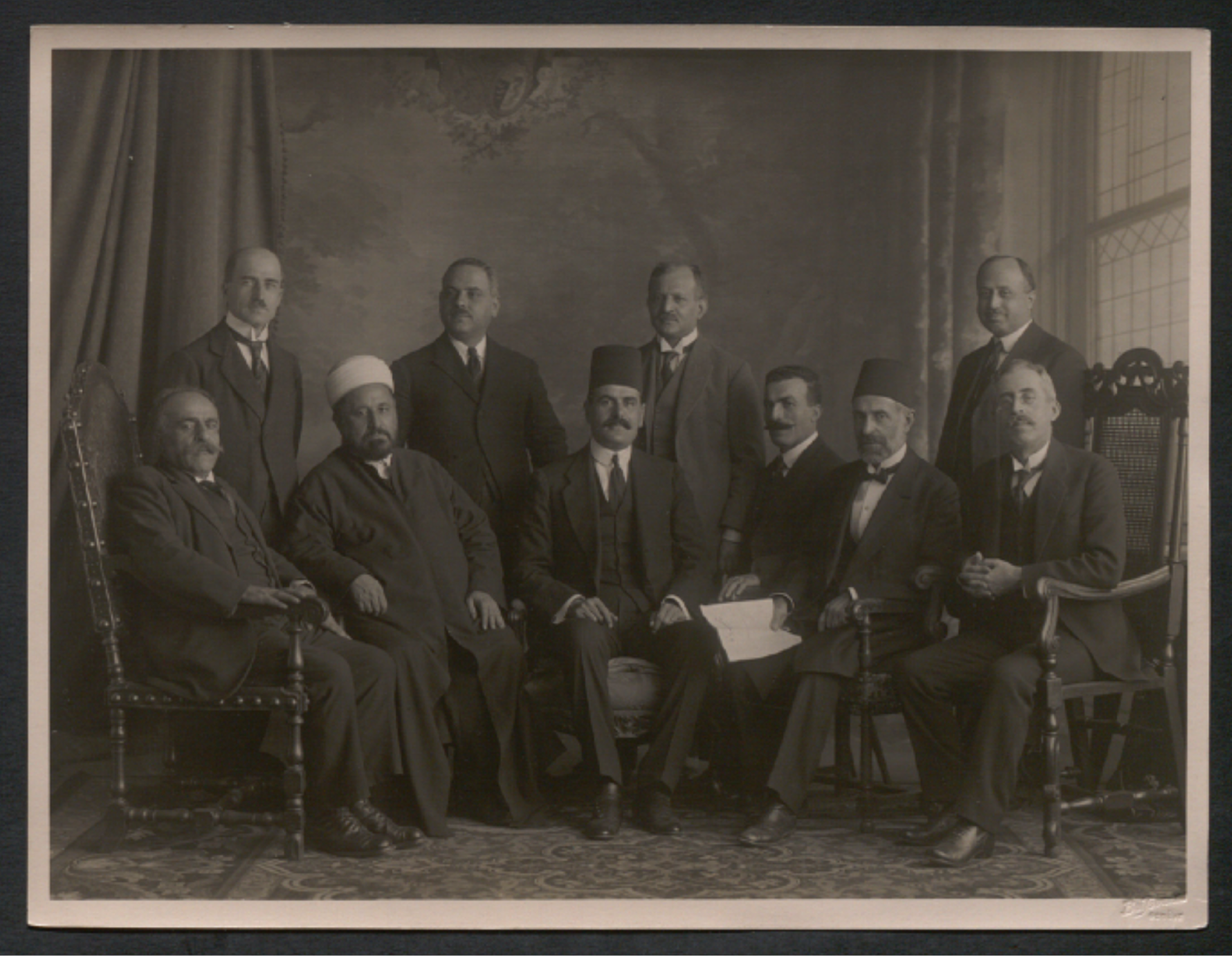
As Storr has shown, this legal stewardship masked ongoing economic extraction and political domination.Footnote 45 The case of Nauru is emblematic.Footnote 46 Administered by Britain, Australia, and New Zealand, the island’s phosphate deposits were mined to exhaustion in the name of development – both to finance Nauru’s purported advancement and for the ‘benefit of humankind’. The result was ecological devastation and long-term precarity. The legal frameworks of the Mandate System shielded administrators and facilitated dispossession, even as they proclaimed the uplift of colonized peoples.
The reporting mechanisms of the League’s Permanent Mandates Commission, later echoed in the British 1929 Colonial Development Act, codified a system through which local governments could request grants and loans under the guise of mutual benefit.Footnote 47 Yet the function of these mechanisms was clear: to standardize colonial development while securing international goals – territorial stability, the protection of property rights and foreign investments, and the maintenance of free trade.Footnote 48 These were legal systems designed to govern disembedded transformation, masking coercion behind an administrative rationality that appeared technical and objective.
Importantly, these dynamics were not confined to capitalist empires. The Soviet Union developed its own developmental imaginary rooted in central planning and ideological transformation.Footnote 49 From the 1920s GOELRO electrification plan to successive Five-Year Plans, the Soviet state cast material and social transformation as revolutionary imperatives. Yet Soviet internationalism – whether in Egypt, India or Central Asia – relied on similar techniques of development: technical expertise, bureaucratic control, and geopolitical strategy.Footnote 50 Though framed as anti-imperial, this developmentalism increasingly reproduced paternalistic logics and lost its transformative edge as Stalinist consolidation reconfigured the Soviet project.
Across these centuries, imperial law translated moral hierarchies into economic standing. The New Laws of the Indies, the Colonial Loans Act, the Berlin General Act, and the League’s Mandate System all advanced a structural separation: the management of colonial wealth and life as matters of administrative imperial expertise. Through these instruments, empire fashioned an ‘economy’ – a domain in which extraction could be justified as civilization, codified as duty, and measured as progress. This was, in many ways, the first great disembedding: the conversion of social reproduction into economic objectivity, of reciprocity into debt, and of stewardship into surveillance. As colonial rule matured into global administration, the economy itself emerged as a legal construct – presented as universal yet produced through processes of estrangement, codification and quantification.
It is from this terrain that the Cold War would inherit its economic foundations and developmental rationality. The doctrines of indirect rule, fiscal discipline and civilizational trusteeship reappeared in the managerial languages of international development and financial governance. The League’s mandates and reporting obligations supplied templates for post-war development planning, while colonial loans and infrastructure acts foreshadowed the conditionalities of Bretton Woods. The next section traces how these imperial grammars were rearticulated within a new global governance architecture: how the moral economy of civilization was further recast through the idea of development, and how international law became the medium through which that reconfiguration was secured.
3. The Cold War and the consolidation of the global economy
The Cold War marked the moment when development shifted from an imperial technique to a central mechanism of global governance. Rather than a rupture, it intensified administrative logics inherited from the interwar and colonial eras, refashioning practices of indirect rule and economic tutelage into a universal programme of modernization and growth. Economic management was further detached from social and political life and recast as a domain of expertise and international oversight. Extending critical histories of international law and development, this section shows how the Cold War consolidated a global economy that preserved imperial hierarchies under new developmental and juridical guises, illustrating how juridical, financial, and metrological practices – from loan covenants and voting structures to statistical regimes – materialized the disembedding processes identified by Polanyi and further analysed by Mitchell. These practices did not merely regulate economic life but actively constituted it as a distinct domain of governance, delimiting what could be seen, measured, and governed as ‘the economy’.
By the time of the interwar period, projects such as infrastructure and agricultural extension schemes, including late-colonial educational cinema programmes, deployed ethnographic and pedagogical techniques to promote economic self-sufficiency and political order among African subjects.Footnote 51 These experiments translated coercion into expertise, presenting colonial administration as technical assistance. Repackaged after 1945 through the language of planning, participation, and institution-building, this logic would underpin the post-war development project.
Recent scholarship has shown how the League of Nations laid institutional and epistemic foundations later inherited by the United Nations (UN) and Bretton Woods institutions.Footnote 52 Through its Economic and Financial Organization (EFO), the League pioneered early forms of multilateral surveillance and coordination that framed financial governance as an ostensibly apolitical domain.Footnote 53 Its support for indirect rule and its treatment of economic instability as an international concern transformed domestic economic activity into a matter of global oversight.
These precedents carried forward almost intact. Institutional blueprints, archives, and personnel migrated from the League into post-war organizations. Muschik’s microhistory of Kenneth Sargent – a colonial forester turned UN development official – illustrates this continuity.Footnote 54 Many British colonial officers transitioned into the FAO, World Bank, and other agencies, transporting administrative assumptions forged in empire. The early UN system thus absorbed and rebranded late-colonial expertise as universal development knowledge, reinforcing a disembedded vision of economic governance abstracted from postcolonial social aspirations while legitimated through international legal form.Footnote 55
By the time delegates met at Bretton Woods in 1944 and San Francisco in 1945, a distinctive vision of the post-war order was taking shape. Actors from the peripheries – Latin American officials, alongside representatives from China, India, Eastern Europe, and beyond – had long pressed for an international response to global economic disparity.Footnote 56 Sun Yat-sen’s 1922 call for an ‘international development organization’ and the Soviet Union’s articulation of the ‘red man’s burden’Footnote 57 had already placed questions of redistribution and development on the wartime agenda.
At Bretton Woods – supported by a United States eager to assert leadership and by a Soviet Union keen to advance its ‘affirmative-action’ imperialismFootnote 58 – these southern demands were channelled into the creation of post-war financial institutions. They helped shape the mandate of the International Bank for Reconstruction and Development (IBRD) and informed debates surrounding the IMF. Yet the victorious Allies engineered a bifurcated order: political deliberation would occur through the UN, while economic governance would be insulated within the IMF and World Bank.Footnote 59 This insulation was not only institutional but also epistemic, relying on emerging techniques of measurement and standardization that rendered national economies comparable, governable, and subject to external evaluation. Though framed in the language of sovereign equality, these arrangements vested effective control of finance and development in capital-exporting states.
The close alignment between British and US delegations at Bretton Woods further narrowed the influence of developing countries.Footnote 60 India’s participation exemplified this dynamic: formally included but represented by a British official, its delegation was celebrated publicly while privately regarded as peripheral.Footnote 61 British and American negotiators often dismissed Global South representatives: Keynes described the conference as a ‘monkey-house’, while Harry Dexter White mocked the Cuban delegation as mere suppliers of cigars (Figures 3 and 4).Footnote 62
Jeremy Raisman (third from right), finance member of the Governor General’s Executive Council of India, chairman of the Indian Delegation, and head of the Conference’s Committee on the proposed Bank for Reconstruction and Development at Bretton Woods, New Hampshire, USA (6 July 1944). Creator: US Office of War – Information in the National Archives. Courtesy, World Bank (30229050-0033-c.tif). License: CC BY-NC-SA 4.0.

Left to right: M.S. Stepanov, Chairman of the delegation from the USSR; John Maynard Keynes, Chairman of the United Kingdom delegation; and Vladimir Rybar, Chairman of the Yugoslavia delegation. Bretton Woods Conference, New Hampshire, USA (July 1944). Creator: US Office of War – Information in the National Archives. Courtesy, World Bank (1806806_001_P.tif). License: CC BY-NC-SA 4.0.

Even within this exclusionary environment, Global South actors left an imprint. Latin American and Chinese officials played critical roles in ensuring that the IBRD’s mandate extended beyond European reconstruction,Footnote 63 laying institutional pathways that predated US President Truman’s 1949 embrace of development as a cornerstone of US foreign policy.Footnote 64 Although the substantive direction of these institutions would soon be shaped by Northern geopolitics, southern advocacy embedded development within the architecture of the post-war order.
A comparable dynamic unfolded at the 1945 San Francisco Conference. Delegates from the South expanded development’s political standing within the UN, even as their ‘special economic needs’ received limited recognition. As decolonization expanded the General Assembly, southern states used its procedural openings to frame development as a political and social concern, though core economic governance remained insulated in the Bretton Woods institutions.
Within this setting, specialized agencies such as the FAO, UNESCO, WHO, and, later, the UNDP became the principal multilateral instruments for development assistance. They promoted literacy, health, and institutional reform in newly decolonized states.Footnote 65 Their participatory ethos aligned more closely with southern aspirations, but chronic underfunding and institutional marginalization limited their influence vis-à-vis the IMF and World Bank, whose weighted voting systems preserved Northern dominance.
From 1947 onward, the emerging Cold War hardened these divisions. Truman’s 1947 ‘Doctrine’ and his 1949 inaugural address folded development into a broader containment strategy. Development became both counter-insurgency and managerial technique: a means of managing decolonization while extending Western influence.Footnote 66 This dual character – disciplinary and juridical – would define the evolving world economy and shape international development governance.
Both the United States and the Soviet Union came to view development as essential to managing postcolonial transitions. India’s independence in 1947, the 1952 Egyptian Revolution and Ghana’s 1957 independence raised urgent questions about integrating new states into the world order. Competing answers converged on similar premises: both blocs sought to reshape societies through law, planning, and expertise.
On the capitalist side, the modernization theory of development offered a programmatic vision. Emerging from US military strategy and Cold War social science, it aimed to rationalize institutions and depoliticise societies, producing subjects compatible with market governance.Footnote 67 Walt Rostow’s The Stages of Economic Growth: A Non-Communist Manifesto mapped a teleological path from ‘traditional society’ to ‘high mass consumption’, providing a juridical and institutional blueprint for capitalist modernity and US regional and global reach (Figure 5).Footnote 68 In this model, disembedding was not an accident – it was the design.
W.W. Rostow, The Stages of Economic Growth: A Non-Communist Manifesto, Original Cover (1st ed. Cambridge University Press, 1960).

The intellectual roots of this approach lay in mid-century US sociology, particularly Talcott Parsons’s reading of Max Weber, which equated development with the legal–cultural transformation required to sustain capitalist rationality.Footnote 69 In the heated context of the Cold War – when the United States doubled down on its use of development to protect its interests against the expansion of Soviet influence, most dramatically through President John F. Kennedy’s Alliance for Progress in Latin America – law became the key mechanism for producing investor-friendly institutions and political allies across the Global South. The Alliance mobilized legal reform, technocratic planning, and integrated rural development as instruments for securing hemispheric loyalty, embedding the idea that development required juridical and institutional restructuring aligned with US geopolitical priorities (Figure 6).
US President John F. Kennedy and Colombia’s President Alberto Lleras Camargo unveiling a plaque at the Techo Housing Project in Bogotá, built as part of the Alliance for Progress (17 December 1961). Courtesy, Cecil Stoughton; White House Photographs; John F. Kennedy Presidential Library and Museum, ST-C290-1-61.

Figure 6: Long description
A group of people gathered outdoors under a clear blue sky. In the center, US President John F. Kennedy and Colombia’s President Alberto Lleras Camargo are unveiling a plaque on a brick structure. Kennedy is holding a trowel and a bucket, while Lleras Camargo assists. Behind them, a large map of the Techo Housing Project is displayed on a board. The crowd includes men in suits and military uniforms, and a woman in a red coat and hat. The event is taking place in an open area with mountains visible in the background.
The Soviet Union advanced its own project of socialist modernization across Central Asia, Afghanistan, and parts of Africa. Literacy campaigns, irrigation schemes, and technocratic planning were deployed in the name of solidarity, yet often reproduced paternalistic and coercive structures.Footnote 70 In Uzbekistan, canal-building and cotton monoculture – intended to transform the arid steppe into a socialist landscape – subordinated local knowledge and environmental limits to production quotas. Water became a disciplinary instrument; resistance was met with repression. These experiments later travelled beyond the USSR. As Kalinovsky details, Soviet advisers exported techniques first tested in Central Asia to post-war Afghanistan, framing them as assistance to an allied state.Footnote 71 From Uzbek canals to Kabul’s hydroelectric dams, socialist modernization bound postcolonial states into circuits of expertise, finance, and law that mirrored Western regimes even as they aspired to overcome them. Despite divergent political horizons, both blocs shared a structural ambition: to remake economies through legal-bureaucratic control and to reconfigure sovereignty along technocratic lines.Footnote 72
These initiatives were institutionalized through overlapping regimes. The UN and Bretton Woods institutions were joined by regional banks and, within the Socialist bloc, the Council for Mutual Economic Assistance (COMECON).Footnote 73 While these institutions provided funding and expertise, they also entrenched asymmetries. Governance structures privileged donors; programmes reflected Northern priorities; and legal instruments imposed compliance mechanisms that curtailed domestic autonomy. Western states reinforced this order through the Coordinating Committee for Multilateral Export Controls (CoCom) and the OECD’s Development Assistance Committee (DAC), embedding trade embargoes and policy conditionalities into the legal fabric of development.Footnote 74
Across ideological divides, development converged on a single metric: economic growth. What Pahuja calls the ‘sacred beating heart’ of development,Footnote 75 GDP became the universal yardstick of progress, reducing social complexity to numerical abstraction. Although Simon Kuznets – its architect – warned against such misuse, GDP quickly became both policy target and justification.Footnote 76 It codified a narrow conception of value that privileged market expansion and export orientation over redistribution.Footnote 77
By the late 1960s, international development had become a central pillar of the Cold War order,Footnote 78 but it was under Robert McNamara’s presidency of the World Bank (1968–81) that its Western variant was decisively consolidated. Bringing a managerial ethos forged at Ford and refined during the Vietnam War, McNamara expanded the Bank’s scope dramatically, entrenching it far more deeply in the economic and social conditions of its borrowers (World Bank, n.d.). His vision centred on a global ‘war on poverty’, organized through an unsatisfied basic needs (UBN) framework that framed deprivation as a technical and measurable problem.Footnote 79 What appeared as a humane intervention laid the bureaucratic foundations for a more disciplinarian turn: the UBN agenda required states to reorganize and target their spending, rationalize administration, and demonstrate performance through an increasing narrow set of quantifiable indicators. These indicators did not simply record development outcomes but structured the terms through which development itself was defined and pursued.
The crises of the 1970s – especially the oil shocks, discussed in the next section – accelerated this shift. Seeking to stabilize global markets, McNamara increasingly urged developing countries to adjust domestic policies: rationalize subsidies, devalue currencies and dismantle regulations. Emerging structural adjustment initiatives reoriented the earlier UBN framework toward macroeconomic discipline.
This trajectory set the stage for the Bank’s later embrace of structural adjustment in the 1980s, marking the consolidation of disembedded governance. Development became a contractual relationship enforced through legal instruments – loan covenants, investment laws, fiscal reforms – that redefined sovereignty as conditionality, justice as creditworthiness and development as compliance. By the late 1980s, the Bank had become a global governance actor reshaping law and policy worldwide,Footnote 80 prefiguring the disciplinary architecture of the post-Cold War order.
Resistance persisted throughout the Cold War. In trade, developing countries were excluded from the negotiations that produced the General Agreement on Tariffs and Trade (GATT), which industrialized powers initially treated as a temporary framework.Footnote 81 At the 1947–48 Havana Conference, Global South delegates pressed for a more equitable multilateral regime through the proposed International Trade Organization (ITO), which would have addressed commodity dependence, labour standards and development financing. Although the ITO was endorsed in Havana, the United States’ refusal to ratify it ensured that GATT became the de facto order – one that offer limited space for manoeuvre for Global South states while entrenching asymmetric market structures over the long term.
The Trinidadian economist Arthur Lewis, later advisor to Kwame Nkrumah, sought to advance a more expansive developmental vision through the influential 1951 Measures for the Economic Development of Under-developed Countries.Footnote 82 Yet the report remained constrained by the intellectual horizon of the day: it framed development as internal adjustment rather than global redistribution, leaving systemic inequities intact.Footnote 83
Seen in this light, the Cold War was not an aberration but the decisive phase in consolidating a disembedded global economy. International development – celebrated as humanitarian uplift – took shape as a legal-managerial regime that normalized conditionality, external surveillance and the segmentation of economic governance from political contestation. Postcolonial governments mobilized development and international law as tools of emancipation, yet did so within institutional architectures that translated their aspirations into technocratic mandates and compliance metrics. The lasting contribution of the Cold War to the making of the global economy was therefore not ideological polarity, but the juridical consolidation of a mode of governance in which economic relations were severed from democratic authority and rendered intelligible only through the managerial languages of expertise, metrics, and conditionality.
4. Counter-hegemonic internationalism, and the rise of the new developmental state
If the Cold War consolidated a global economic order in which development was increasingly insulated from political contestation and governed through technocratic, financial, and juridical instruments, it also witnessed sustained efforts by the Global South to re-embed economic life in projects of sovereignty, redistribution, and historical repair. These efforts were not external to the Cold War order but emerged from within it, mobilizing the very forums, techniques, and languages of international law that had helped entrench disembedded governance. As self-determination congealed into a legal right, international law became a distinctly double-edged sword – at once a medium of subordination and a vehicle for counter-hegemonic imagination. Corinna Unger’s work is instructive here: international development, which consolidated in parallel with this juridification of self-determination and the end of formal colonialism, should not be read as a singular, linear project but as a contested field shaped by imperial legacies, social-scientific paradigms, and transnational negotiations.Footnote 84
By the mid-1960s, it was evident that political independence had not translated into substantive economic sovereignty for most postcolonial states. Trade remained unequal, technology and capital were monopolized by the North, and development assistance was increasingly tied to geopolitical alignment and macroeconomic discipline. This was so despite the commitment of newly independent states to the developmental project, which had transformed them into ‘developmental states’ with centralized planning and administration, a high tolerance for state intervention in the economy, and significant autonomy in monetary policy.Footnote 85 Frustration with navigating a global economy organized around the interests of powerful states increasingly pushed postcolonial governments toward more assertive forms of developmental sovereignty, drawing on longstanding radical traditions within the Global South – Mexico being a key example.Footnote 86
Building on solidarities forged at the 1955 Bandung Conference – the so-called ‘Spirit of Bandung’ – these states turned to the UN General Assembly’s one-country-one-vote system to link decolonization to development.Footnote 87 The 1960 Declaration on the Granting of Independence to Colonial Countries and Peoples made this linkage explicit, declaring that colonialism ‘prevents the development of international economic cooperation’ and ‘impedes the social, cultural and economic development of dependent peoples’, while affirming peoples’ right ‘freely to pursue their economic, social and cultural development’ (UNGA Res. 1514 (XV), 14 December 1960). Decolonization without economic re-embedding would, in other words, remain incomplete.
This mobilization reached its most ambitious expression in the call for a New International Economic Order (NIEO). Through UNGA Resolutions 3201 (S-VI) and 3202 (S-VI) of 1974, Third World states demanded legal reforms to global trade, investment, and finance; permanent sovereignty over natural resources; technology transfer; and forms of debt relief. As Mohammed Bedjaoui and other Global South diplomats argued, these were not discretionary preferences but legal claims grounded in international justice and in the juridical consequences of colonial exploitation (Figure 7).Footnote 88
Houari Boumédiène addressing the UN General Assembly at the Sixth Special Session, New York, USA (4 October 1974). Courtesy, UN Photo (UN7661405_914).

The NIEO emerged from a thick intellectual and institutional soil: Latin American structuralism, African socialism, Asian self-reliance, and strands of Eastern European socialist thinking confronting similar constraints in a bifurcated world.Footnote 89 The creation of the Non-Aligned Movement in 1961, and especially the establishment of the United Nations Conference on Trade and Development (UNCTAD) in 1964 under Raúl Prebisch – who had already advanced ISI strategies through the Economic Commission for Latin America – enabled these perspectives to be institutionalized.Footnote 90 UNCTAD reframed colonial trade patterns, commodity dependence, and technological exclusion as structural legal problems. What the NIEO envisioned, drawing on this foundation, was not hierarchical globalization but interdependence organized on solidaristic, state-led, and democratically planned terms (Figure 8).Footnote 91
Raúl Prebisch signing the Final Act as adopted by the UN Conference on Trade and Development, Geneva, Switzerland (16 June 1964). Courtesy, UN Photo (UN7652617_211).

Progressive governments – from Salvador Allende’s Chile to Houari Boumédiène’s Algeria – pushed this vision further by centring historical injustice and reparative redistribution.Footnote 92 Their efforts sought to decolonize not only the material distribution of power but the very architecture of international economic law. The NIEO thus elevated to new prominence a set of legal claims about the structural conditions of the world economy: principles relating to natural resources, commodity stabilization and asymmetric obligations that should be treated as normative rather than aspirational – claims that already had precedent in the 1962 UNGA Resolution 1803 (XVII) on Permanent Sovereignty over Natural Resources. These demands circulated through the UN General Assembly, ECOSOC, UNCTAD and the G-77, aiming to embed development within frameworks of redistribution and historical accountability (Figure 9).
President Salvador Allende addressing the inaugural meeting of the Third Session of UNCTAD, Santiago, Chile (13 April 1972). Courtesy, UN Photo (UN7472969_430).

Crucially, the NIEO also recognized that disembedding occurred not only through states and international financial institutions but through corporations. Hence the push for a UN Code of Conduct on Transnational Corporations, intended to make multinationals accountable to host states and to prevent further abstraction of national economies from local priorities.Footnote 93 In this sense, the NIEO anticipated contemporary struggles over corporate accountability, investor–state dispute settlement and global supply chains, revealing that the project of re-embedding economic relations required confronting corporate as well as interstate asymmetries.
Yet, as Julia Dehm has shown, this re-embedding project ran up against the structural power of the Bretton Woods institutions and donor states, which used procedural tactics, financial leverage, and institutional autonomy to blunt Southern initiatives.Footnote 94 A defining moment was the 1990 UN Special Session on International Economic Cooperation which, just after the fall of the Berlin Wall, acknowledged Southern grievances while reinscribing the autonomy of the IFIs and reaffirming market-led development. What had appeared in 1974 as an opening to restructure the global economy had, by 1990, been reabsorbed into a narrow and powerful vision of macroeconomic adjustment.Footnote 95 This political containment was reinforced by a long wave of coups that removed progressive and Third Worldist governments, including the overthrow of Allende in 1973 and the authoritarian consolidation that followed.
This diplomatic closure formed part of a broader geopolitical and financial turn. From the late 1970s, the IMF and World Bank moved to the centre of economic restructuring in the South through Structural Adjustment Programmes (SAPs), building on a long history of global economic governance via international institutions.Footnote 96 Formally presented as neutral responses to balance-of-payments and debt crises, SAPs directly undermined the developmental state imagined by the NIEO: fiscal austerity, trade liberalization, privatization, and deregulation substituted for redistribution, social investment, and industrial policy.Footnote 97 These programmes were not simply technocratic corrections but constitutive moments in the making of the contemporary global economy, embedding a legal–financial architecture that further insulated economic governance from political contestation.
The immediate triggers were the oil crises of the 1970s and the recycling of the dollar surpluses, or ‘petrodollars’, generated by OPEC.Footnote 98 Founded in 1960 by Iran, Iraq, Kuwait, Saudi Arabia, and Venezuela, OPEC had emerged in response to the dominance of Western oil companies, whose control over production and pricing deprived producing states of substantive sovereignty. The OPEC coordinated price rises of the early 1970s attempted to overturn this hierarchy. Yet the deeper shock lay in the monetary architecture governing oil. After the United States unilaterally ended the dollar–gold convertibility in 1971 – responding to mounting balance-of-payments pressures and the steady outflow of US gold reserves – it secured an agreement with Saudi Arabia to maintain oil pricing exclusively in dollars. A new dollarized global economy thus took shape, in which the medium of global exchange was decoupled from domestic productive relations. Dollarization thus came to function as a powerful metrological–legal technology: it isolated the economic domain from social relations, rendering liquidity, credit, and value calculable and governable through a single currency largely beyond the control of most states.Footnote 99 The NIEO’s challenge to hierarchical economic structures was therefore met with a monetary transformation that entrenched disembedding at a planetary scale.
As oil prices quadrupled between 1973 and 1974, developed economies faced soaring import costs, stagflation, and slowing industrial output. Central banks responded by tightening monetary policy, deepening domestic recessions, and forcing governments to draw down dollar reserves to pay for energy imports and stabilize currencies. The result was a contraction of global demand precisely when many Third World states were attempting to industrialize. Already constrained by chronic trade deficits, developing nations saw their ability to import oil, machinery, fertilisers, medicine, and food collapse as their reserves evaporated.Footnote 100 Meanwhile, the ‘petrodollar’ surpluses generated by OPEC countries were deposited in US and UK banks and reinvested in global financial markets, which in turn lent to developing countries to cover local needs. When the United States rejected European and Japanese proposals to recycle these dollars through the IMF and instead liberalized its own financial markets, the management of global liquidity shifted decisively to private financial centres, consolidating US power. States that maintained capital controls were effectively excluded from syndicated loans; those that dismantled them became vulnerable to volatile flows and to the fluctuations of US monetary policy.Footnote 101
The debt crisis that followed devastated many Global South nations. Aggressive Western lending during the petrodollar boom, combined with rising interest rates and collapsing export prices, created unsustainable burdens. Mexico’s 1982 default crystallized these pressures across Latin America, Africa, and parts of Asia, revealing a stark asymmetry: while developing countries were overwhelmed by repayment costs to keep afloat their economies and development plans, the United States emerged strengthened, having converted oil and financial flows into pillars of its structural power (Figure 10).Footnote 102 Even OPEC states faced destabilizing inflation and political volatility; Iran’s income boom contributed to the upheavals culminating in the 1979 Revolution. As Helleiner notes, the United States shifted from direct political control to a market-based or ‘structural’ form of hegemony at this point (Figure 11).Footnote 103
Umbrella manufacturing plant established as part of a World Bank’s slum upgrading project programme in Manila (1982). Courtesy: Eddie Manuel, World Bank. Filename: 1817737_001.tif. License: CC BY-NC-SA 4.0.

Figure 10: Long description
A black and white photo of an umbrella manufacturing plant in Manila, established as part of a World Bank’s slum upgrading project programme in 1982. The photo shows a group of workers seated at sewing machines, engaged in the production of umbrellas. The room is filled with various materials and tools related to umbrella manufacturing. On the walls, there are several signs providing information about different processes and the volume of trade, including local and export sales figures. The workers are focused on their tasks, and the environment appears to be a busy and organized workspace.
Ronald Reagan addressing the UN General Assembly Thirty-Eighth Session, New York, USA (26 September 1983). Courtesy, Milton Grant, UN Photo (UN7685626_e89).

Structural Adjustment Programmes realigned state authority along technocratic and disciplinary lines. They were not merely policy instruments but comprehensive metrological packages. SAPs operationalized restructuring through dense arrays of quantitative targets – fiscal ratios, inflation bands, trade-liberalisation schedules, and revenue benchmarks – that allowed external institutions to audit, discipline, and steer domestic priorities.Footnote 104 Development came to be defined not by redistribution or historical repair but by financial credibility, creditworthiness, and alignment with global market norms. By the Cold War’s end, sovereignty was increasingly redefined as compliance with macroeconomic conditionality, and legal reform had become the primary instrument through which this new global discipline was enforced.Footnote 105
This unravelling was not confined to the Western bloc. The socialist world faced parallel pressures in the last quarter of the twentieth century. The Soviet Union initially benefited from the soaring oil prices of the 1970s, but the subsequent ‘oil glut’ of 1981 – driven by over-extraction in response to OPEC actions – and Saudi Arabia’s 1985 price war against the USSR halved global prices, sharply reducing Soviet revenues and deepening what Gorbachev later described as a prolonged ‘era of stagnation’.Footnote 106 Eastern European states, heavily indebted through Western loans accumulated during the détente period, could no longer service their obligations once interest rates spiked. Across much of the developing world, both East and West, similar dynamics produced what Latin America termed a ‘lost decade’.Footnote 107
By the mid-1980s, both socialist and postcolonial development imaginaries appeared exhausted. The space for structural reform opened in the 1960s and 1970s narrowed sharply as coups, authoritarian restorations and externally driven transitions foreclosed alternative development paths. By the decade’s end, the fall of the Berlin Wall and the collapse of the Soviet project, the exhaustion of postcolonial industrialization, and the consolidation of dollar-centred financial discipline closed the window for the NIEO and reaffirmed a global order structured around disembedding rather than emancipation.Footnote 108
Yet even as the political horizon for the NIEO contracted and structural adjustment entrenched a new global discipline, Global South jurists advanced one final attempt to preserve an embedded vision of development in juridical form: the Right to Development. Emerging just as the NIEO’s structural project was crushed, this initiative marked a turning point in the consolidation of the contemporary global economy, signalling the triumph of market-centred governance over redistributive multilateralism. First articulated by Kéba M’bayeFootnote 109 and adopted as UNGA Resolution 41/128 in 1986, the Right to Development distilled the NIEO’s core claims – sovereignty over natural resources, equitable integration, international solidarity, and structural reform – into a new legal idiom: the language of human rights rather than political economy.Footnote 110 It was not an appendix to the NIEO but its juridical afterlife, carrying both the ambition and the limits that international law had borne throughout the Cold War.
The Right to Development therefore occupied a revealing position within the Cold War’s legal architecture. Its preamble reiterated the NIEO’s insight that development is not a technocratic undertaking but a ‘comprehensive economic, social, cultural and political process’, grounded in popular sovereignty and attentive to global structures. It recognized how unequal trade, technological dependence, volatile financial markets, and concentrated economic power impede human dignity and allocated corresponding duties to the international community. Yet, by translating these claims into a human rights register, it absorbed the structural constraints that had long shaped international law and development. Rights language offered moral authority and institutional visibility, but it channelled transformative demands into a normative terrain largely detached from the levers of global economic governance.Footnote 111 In doing so, the Right to Development crystallized the contradictory dynamics shaping the fate – and possible unfating – of the Global South: it encoded a vision of an embedded, justice-oriented global order while being constrained by a legal system structured to reproduce disembedded economic governance.
This duality explains both the endurance and the limits of the Right to Development. It preserved a juridical space for structural claims precisely as structural adjustment hollowed out the material foundations for transformative development, extending a long tradition of Global South advocacy within human rights arenas and the radical retooling of rights language.Footnote 112 Yet its reach was structurally circumscribed: it could not bind the international financial institutions, nor transnational corporations, and creditor states treated it as aspirational. In this sense, the Right to Development became the conceptual and institutional hinge between the emancipatory ambitions of the 1960s–70s and the post–Cold War emergence of a reconfigured, or ‘new’, developmental state – one increasingly decentralized, privatized, and experimental.Footnote 113 It stood as a reminder of an earlier vision of global justice even as the developmental state was being remodelled to operate within the narrowed parameters of a disembedded global economy.
The World Bank’s annual World Development Reports from 1978, the first year these reports were published, to the early 1990s document this shift with particular clarity. In the wake of the oil crisis, the 1980 WDR still spoke of ‘adjustment with growth’, presenting reform as necessary to stabilize developing countries while ensuring recovery and social well-being: ‘direct attack on poverty … must be combined with measures to ensure that the economies of the developing countries continue to expand’.Footnote 114 By 1981 and 1983, state intervention was reframed as an obstacle and market liberalisation as the remedy.Footnote 115 Although ‘very painful’, structural adjustment had become the Bank’s primary instrument by 1985.Footnote 116 In 1987 the Bank made the legal dimension explicit, tying development to tax reform, investment codes, and central-bank independence.Footnote 117 The 1988–91 reports reinforced this trajectory, promoting cost-recovery in social services, prioritizing property rights and financial liberalization, and reframing poverty policy in narrowly targeted, market-compatible terms.Footnote 118 These reports refined the metrological architecture through which national economies and the global economy would be governed: aggregating data, modelling growth paths, recalibrating poverty lines, benchmarking institutional performance, and ranking policy environments. They did not merely describe the economy – they produced it as an identifiable, legible, and governable object.
In the post-Cold War period, this template was consolidated. The 1991 WDR’s jigsaw-puzzle cover captured its governing imaginary: a world fragmented into ever smaller modular jurisdictions, each subject to economic disciplines through standardized metrics (Figure 12).Footnote 119 As Mamdani noted in his analysis of indirect rule during the colonial period, such division into self-contained units rendered resistance ‘fractured, fragmented, localized, and decentralized’ – a formation easily managed within a technocratic order.Footnote 120
World Bank. 1991. World Development Report 1991: The Challenge of Development. © World Bank. https://hdl.handle.net/10986/5974 License: CC BY 3.0 IGO.

As the twenty-first century began, Poverty Reduction Strategy Papers – which extended the logic of Structural Adjustment Programmes – together with rule-of-law initiatives and new forms of governance diagnostics, translated the contractual logic of adjustment into a softer language of participation and partnership.Footnote 121 What had begun as the emergency architecture of the debt crisis hardened into the grammar of a neoliberalized development apparatus.
The ‘new developmental’ state that emerged in this period was not a diminished state but a re-coded one: its authority calibrated through alignment with the standards of a disembedded global economy. Central to this reconfiguration was a dense metrological infrastructure – governance diagnostics, credit ratings, ‘Doing Business’ indicators at national and local levels, poverty headcounts, environmental audits, participatory scorecards.Footnote 122 These tools operationalized global norms within domestic institutions and extended metric-driven governance into the most intimate spaces of everyday life in Global South communities, households, and individuals.Footnote 123
The new developmental state thus became a crucial vessel through which the global economy was remade after the Cold War and a primary determinant of the institutional fate of postcolonial states within it. This state remains in place in the twenty-first century, even as international aid comes under renewed pressure from its own architects, particularly the United States, France, Germany, and the United Kingdom,Footnote 124 and as ‘new Cold Wars’ proliferate. It continues to promise development while anchoring a world economy that remains profoundly disembedded.
5. Conclusions
At the UN General Assembly’s 77th high-level debate in September 2022, Ghana’s President Nana Akufo-Addo denounced the global financial architecture as a system ‘skewed against developing countries’. His warning – echoed by leaders in Sri Lanka, Pakistan, and Zambia – reflected a broader recognition that contemporary sovereign debt crises are not anomalies but the foreseeable outcomes of a juridical economic order that has hollowed out fiscal autonomy and subordinated domestic policy to external discipline.Footnote 125 As I have discussed in this article, since the 1980s – and in crucial respects long before – Global South states have been required to internalize disciplinary norms while remaining structurally excluded from shaping the rules of the global economy. Generations of critical scholars – from Walter Rodney’s How Europe Underdeveloped Africa (1972) to more recent analyses – have underscored that these crises are symptoms of an entrenched legal and institutional order that systematically limits postcolonial agency.Footnote 126
Writing during another moment of upheaval, Karl Polanyi argued that the idea of a self-regulating market emerged by severing an economy from social life, converting land, labour, and money into ‘fictitious commodities’.Footnote 127 Timothy Mitchell extended this insight to the postcolonial world, showing how development discourse and bureaucratic practice produced the idea of an economy as a technical object insulated from democratic contestationFootnote 128. Building on these insights, this article has argued that the Cold War was a pivotal juridical moment in a much longer history of disembedding. What distinguished this period was not ideological polarity but the consolidation of a global economic order in which development, framed as a legal and managerial project, translated postcolonial aspirations into frameworks of conditionality and institutional reform.
Yet this process was never uncontested. Global South jurists, diplomats, and activists mobilized counter-hegemonic internationalisms – through Bandung, UNCTAD, the New International Economic Order (NIEO), and the Right to Development – to re-embed economic life in projects of sovereignty, redistribution, and historical justice. Their efforts exposed international law’s dual character: a medium through which hierarchy was stabilized, but also a vehicle for imagining alternative global orders. As structural adjustment gained ground in the 1970s and 1980s, the global economy became increasingly governed through metrics, indicators, and institutional templates; contestation persisted but within a tightening architecture of quantified governance.
Since the late 1990s, the World Development Reports have continued to deepen this metrological order. Read together, they articulate a governing logic that further treats the economic sphere as an autonomous domain sustained by refined legal, statistical, and increasingly digitalized techniques. The 1995, 1996, and 1997 WDRs laid the groundwork for liberalized national economies, insulating ‘the economy’ from distributive concerns.Footnote 129 The 1998/99 report reframed inequality as informational scarcity; the 2000/01 WDR translated structural dispossession into targeted delivery; and the 2002 and 2005 WDRs advanced a legal blueprint centred on contract enforcement, property rights, and regulatory predictability.Footnote 130 Later reports normalized spatial inequality as agglomeration, cast conflict as an obstacle to investment climate stability, and reframed distributive questions as behavioural frictions.Footnote 131 Across these iterations, national economies and development appear not as sites of political struggle but as objects of calibration: the alignment of institutions, economic spaces, and social conduct with the operating requirements of a legally insulated global economy.
Recent WDRs make this logic explicit. The reports on Governance and the Law (2017), Global Value Chains (2020) and Data for Better Lives (2021) present legal form, standards, and data infrastructures as the hidden architecture sustaining integrated markets – an architecture to which states must adapt.Footnote 132 The Middle-Income Trap (2024) reasserts a Rostowian imaginary in green-growth idioms, while the WDR 2025 concept note on Standards for Development casts technical standards as development’s central problem and primary instrument.Footnote 133 Together, these reports consolidate a post-Cold War settlement in which international law safeguards the autonomy of a disembedded, standardized, global economy, even as that economy buckles under ecological crisis and geopolitical fracture.
At the same time, new Global South initiatives show that the struggle over the global economy’s purpose remains open. The 2024 Program of Action on the Construction of a New International Economic Order proposes Southern-led payment systems, commodity buffer stocks, public digital infrastructures, coordinated labour regimes, resource governance mechanisms, and climate reparations.Footnote 134 These proposals do not reject legalization or measurement; they retool them – challenging dollar-centred hierarchies, reorienting tax and credit-rating regimes, and reorganizing technological and ecological governance around solidarity and sovereign equality. In doing so, the Programme reclaims the structural ambitions of the NIEO for an era defined by financialization, digital extraction, and ecological breakdown.
Parallel developments within the UN system point in a similar direction. The 2023 Draft International Covenant on the Right to Development crystallizes decades of Global South advocacy into legally binding obligations on cooperation, differential treatment, equitable participation, and structural reform.Footnote 135 Crucially, the Draft Covenant recognizes that inequality is reproduced not only through legal rules but through metrological regimes – pricing structures, indicators, credit ratings, tax formulae, and trade classifications that appear neutral yet entrench hierarchy. It therefore seeks to reorient these infrastructures toward substantive equity and distributive justice. In doing so, the Covenant mobilizes again the dual character of international law traced throughout this article: a system long implicated in disembedding, yet simultaneously one of the only terrains where alternative orders can be articulated.
Current calls for a ‘new Cold War’, framed around U.S.–China rivalry and struggles over digital, ecological and financial sovereignty, signal mutation rather than rupture. Export controls, debt diplomacy, carbon markets, data regimes, and technical standards operate through the same juridical architectures forged in the twentieth century. Economic governance remains disembedded, administered through treaties, ratings, algorithms, and conditional lending that privilege predictability over redistribution. The Cold War’s legal order endures not as memory but as method.Footnote 136
One of the most consequential features of that method is the deep fossil-fuel dependency built into the Cold War’s global economic architecture. As Kulamadayil shows, the post-war economy’s structural reliance on petroleum gave petro-states bargaining power while fragmenting the broader solidarities that Bandung, UNCTAD, and the NIEO had sought to consolidate.Footnote 137 The 1973–74 price shocks revealed how petroleum politics could pit Global South states against one another, enabling external powers to exploit these divisions while entrenching an extractivist model of development. This fossil-fuel order persists today, entangled with ecological breakdown, digital extraction, authoritarian retrenchment, and new forms of debt-mediated dependency. Far from receding, the oil-based infrastructures of the Cold War – together with the dollarization that accompanied them – continue to distort international legal authority, destabilize Global South alliances, and constrain equitable post-carbon futures.
Yet its legacy is also enabling. The counter-projects revisited here remain vital archives of alternative world-making. Contemporary movements for debt cancellation, climate reparations, food sovereignty, and technology justice draw on these precedents to reopen the question of global re-embedding. Even within mainstream institutions, episodic returns to ‘inclusive growth’, ‘structural reform’, or ‘global public goods’ demonstrate the persistence – however muted – of that aspiration.
The Cold War ended with the NIEO dismantled and the Right to Development unimplemented, but today’s overlapping crises – ecological collapse, sovereign debt distress, digital extractivism, and geopolitical fragmentation – demand juridical transformation. Confronting the conditions that render disembedded governance natural requires interrogating and unmaking the legal and metrological infrastructures through which the global economy is constituted. These infrastructures have long constrained postcolonial agency, yet they have never extinguished counter-hegemonic legal imagination.
The challenge posed by both the old and the new Cold Wars is therefore not to restore a past model of development but to consolidate contemporary efforts – from the Program of Action to the Draft Covenant on the Right to Development – that refuse the inevitability of the current order and seek to embed global economic life within the social and ecological realities of the majority world. In this ongoing work of juridical reconstruction lies the horizon of a re-embedded global economy.
Use of AI
ChatGPT (OpenAI, GPT-5.3) was used for language editing. No AI tools were used to generate substantive content.


 Open access

