INTRODUCTION
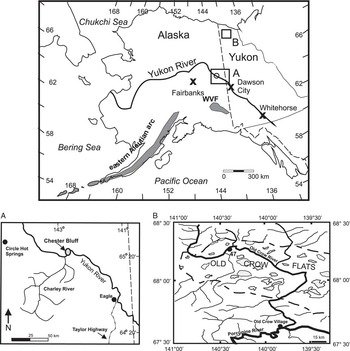
Thick sedimentary sequences, rich in fossils and tephra beds, are well preserved in unglaciated eastern Beringia (Fig. 1) and offer exciting possibilities for detailed paleoenvironmental reconstructions with tight chronological control (Preece et al., Reference Preece, Westgate, Froese, Pearce and Perkins2011). A study along these lines in the northern Old Crow basin, Yukon Territory, was recently completed (Westgate et al., Reference Westgate, Pearce, Preece, Schweger, Morlan, Pearce and Perkins2013) but suffered from poor temporal controls. The single tephra bed (Surprise Creek tephra [SZt]) found at site CRH47 (Fig. 1B) in the lower part of a 12-m-thick alluvial sequence is thin, fine-grained, and very discontinuous so that only a small sample of glass shards was available for fission-track dating, resulting in an imprecise age estimate of 170±70 ka. Therefore, the host alluvial sediments, including the basal interglacial sediments, could not be assigned with confidence to a particular Marine Oxygen Isotope Stage (MIS). Similarly, the prolific in situ mammalian faunal remains recovered from these alluvial sediments at and below SZt could only be assigned by Richard Morlan to some portion of the interval between the beginning of the Bruhnes Chron and the Irvingtonian-Rancholabrean boundary (Westgate et al., Reference Westgate, Pearce, Preece, Schweger, Morlan, Pearce and Perkins2013). This faunal assemblage includes shrew, pika, hare, ground squirrel, beaver, vole, muskrat, lemming, weasel, and rabbit remains, as well as teeth of steppe mammoth (Mammuthus trogontherii), fox, wolf, horse, and caribou.
Location of the two sites of interest to this study: Chester Bluff on the Yukon River, Alaska (inset A), and locality CRH47 on the Old Crow River, Yukon (inset B). WVF is the Wrangell volcanic field. Modified after Westgate et al. (Reference Westgate, Pearce, Preece, Schweger, Morlan, Pearce and Perkins2013) and Jensen et al. (Reference Jensen, Froese, Preece, Westgate and Stachel2008).

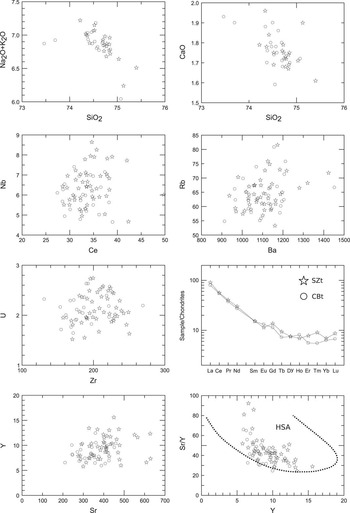
During the course of writing the Westgate et al. (Reference Westgate, Pearce, Preece, Schweger, Morlan, Pearce and Perkins2013) article, we recognized that SZt is a correlative of the Chester Bluff tephra (CBt) (Jensen et al., Reference Jensen, Froese, Preece, Westgate and Stachel2008), which occurs in the upper part of thick loess deposits exposed in bluffs just upstream from the junction of Charley River with the Yukon River in east-central Alaska (Fig. 1A). Being more proximal to the source volcano in the Wrangell volcanic field or the easternmost part of the Aleutian arc, as indicated by its adakitic affinity (Preece et al., Reference Preece, Westgate, Froese, Pearce and Perkins2011) (Figs. 1 and 2), CBt is coarser-grained than SZt, meaning that a more precise glass-ft age may be obtained using this tephra bed, which is the main objective of the current study.
Major- and trace-element concentrations in single glass shards from the Chester Bluff tephra (CBt) and Surprise Creek tephra (SZt) beds demonstrating their compositional equivalence. Major-element concentrations are in wt%; trace-element concentrations are in ppm. Average rare-earth elements (REE) concentrations are plotted, normalized to chondrite values from Sun and McDonough (Reference Sun and McDonough1989). Sr/Y-Y data show the adakitic affinity of these tephra beds, and the HSA field outlines the compositions of “high silica adakites.”

METHODS
Bulk tephra samples were sieved to recover the coarsest glass shards and then cleaned in an ultrasonic bath for 10 minutes. This action also removed fragile pumiceous glass, thereby concentrating glass shards of low vesicularity, which are more amenable to compositional analysis by microbeam methods. Samples were then resieved. The coarsest size fraction obtained for SZt was in the range of 0.125–0.105 mm, and for CBt it was 0.25–0.125 mm. Splits of the glass shards from the two samples were then mounted in epoxy blocks, polished, and carbon coated for major-element analysis. Analyses were done at the University of Toronto using a Cameca SX-50 electron probe microanalyzer (EPMA). Glasses were analyzed at 15 kV accelerating voltage, 6 nA beam current, and a 10 µm defocused beam. Standardization was achieved through mineral and glass standards. The rhyolitic Lipari obsidian (UA5831) and the Old Crow tephra glass (Preece et al., Reference Preece, Westgate, Froese, Pearce and Perkins2011) were used to monitor the calibration in all analytical runs to evaluate day-to-day differences in the calibration. All EPMA glass analyses were normalized to 100 wt% anhydrous with the difference from 100 wt% being considered as H2Od, although we recognize that very small concentrations of elements such as P, F, and S are likely present.
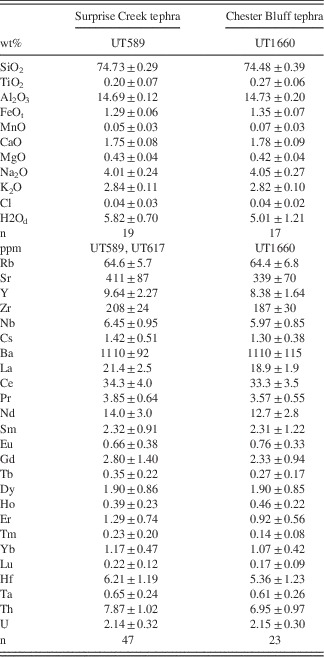
Trace-element analyses were performed on individual glass shards using laser ablation inductively coupled plasma mass spectrometry at Aberystwyth University. The system comprises a Coherent GeoLas 193 nm Excimer laser with a Thermo Finnigan Element 2 high-resolution sector field mass spectrometer (Pearce et al., Reference Pearce, Denton, Perkins, Westgate and Alloway2007, Reference Pearce, Perkins, Westgate and Wade2011). A 20-µm-diameter beam was used to ablate most of the shards, but the smaller or more vesicular glass shards were analyzed using a 10 µm beam. The data from both beam diameters are comparable and therefore have been integrated together (Pearce et al., Reference Pearce, Perkins, Westgate and Wade2011). Laser energy was 10 J/cm2 pulsed at 5 Hz with an acquisition time of 24 s. Trace-element concentrations were calculated using the method of Perkins and Pearce (Reference Perkins and Pearce1995) and Pearce et al. (Reference Pearce, Denton, Perkins, Westgate and Alloway2007). National Institute of Standards and Technology SRM 612 silicate glass was used as the calibration standard relative to concentrations from Pearce et al. (Reference Pearce, Perkins, Westgate, Gorton, Jackson, Neal and Chernery1997), and 29Si was used as the internal standard, determined from the same glass shards using EPMA and normalized to an anhydrous basis. ATHO-G, a synthetic glass with certified values for major and trace elements (Jochum et al., Reference Jochum, Stoll, Herwig, Willbold, Hofmann, Amini and Aarburg2006), was used as a secondary standard and was measured during the course of each analytical session. Accuracy and precision are on the order of ±5%. Element fractionation, related to laser interaction with the sample, was applied to all analyses based on methods established by Pearce et al. (Reference Pearce, Perkins, Westgate and Wade2011). Major- and trace-element data are presented in Table 1.
Average major- and trace-element composition of glass shards in Chester Bluff and Surprise Creek tephra beds, eastern Beringia.

Notes: Analyses on single glass shards; one standard deviation is given. See text for details on methods.
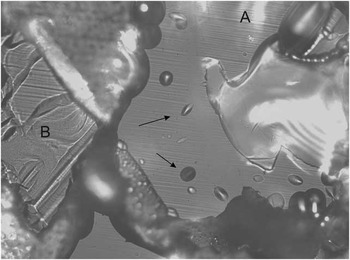
The coarsest and least vesicular fraction of glass shards belonging to CBt was separated from the initial cleaned and sieved sample for glass-ft dating. Only samples with a single, homogeneous glass population, as determined by EPMA, can be dated by this method. CBt satisfies this requirement (Fig. 2). It is not necessary to have a pure glass separate; mineral contaminants, if present, can be recognized readily and ignored during the counting operation. In fact, the CBt sample prepared for ft dating contained many mineral grains (Fig. 3). The glass separate was split into two aliquots, one of which was irradiated at the McMaster Nuclear Reactor at Hamilton, Ontario. Glass shards from both aliquots were then mounted on glass slides with epoxy, polished to expose internal surfaces within the shards, and etched together in HF to reveal the fission tracks (Fig. 3). The areal fission track density of each aliquot was determined using a microscope at 500× magnification; track sizes were measured at 1000× magnification using image analysis software. Area was estimated using the point-counting technique (Naeser et al., Reference Naeser, Westgate, Hughes and Péwé1982). All hydrated glass shards suffer from partial track fading (PTF) (Fig. 4), which can occur even at ambient surface temperatures, so that it is necessary to apply a correction for this fading effect before a meaningful age can be obtained. The correction method used involved measuring the long axis of fission tracks in the natural sample and comparing these measurements to those in the irradiated glass shards, giving a diameter correction (diameter-corrected fission track [DCFT]) age (Sandhu and Westgate, Reference Sandhu and Westgate1995). Additional details are given in Westgate et al. (Reference Westgate, Naeser and Alloway2007) and Westgate (Reference Westgate2015).
Fission tracks in a glass shard (A) of Chester Bluff tephra (UT1875). The long axis of the larger tracks is in the range of 6–8 µm, and the linear striations were produced when the sample was polished. Mineral grains (B) are common in this sample but can be recognized readily and ignored during the counting operation. Arrows point to fission tracks.

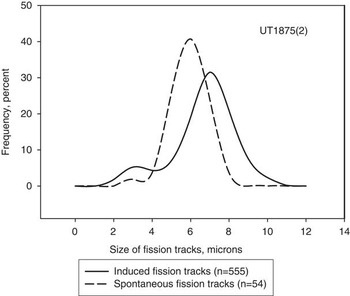
Size frequency plot of induced and spontaneous fission tracks of sample UT1875(2) showing that partial track fading has occurred because the spontaneous tracks are smaller than the induced tracks. The mean diameter values are given in Table 2. The unimodal curves demonstrate a simple thermal history; no postdepositional heating has affected this sample.

DETAILS ON THE STRATIGRAPHIC AND PALEOENVIRONMENTAL SETTING OF THE TEPHRA BEDS
Prior to placing SZt and CBt in their stratigraphic and paleoenvironmental context, and given the critical importance of firmly establishing whether these two tephra beds are equivalent, additional trace-element analyses on glass shards of SZt were run, more than doubling the number of analyses presented in Westgate et al. (Reference Westgate, Pearce, Preece, Schweger, Morlan, Pearce and Perkins2013). Table 1 and the comprehensive array of bivariate plots (Fig. 2) clearly show that SZt and CBt are the same tephra bed.
SZt at site CRH47 in the northern Old Crow basin (Fig. 1B) is located 4 m above the base of the fossiliferous alluvial sediments, which consist mostly of silt and clayey silt with minor sand, peaty beds, and wood fragments. Pollen studies by Lichti-Federovich (Reference Lichti-Federovich1973) and Schweger et al. (Reference Schweger, Froese, White and Westgate2011) securely place SZt in its paleoenvironmental setting. The basal organic-rich alluvium, in places preserved in small channels scoured into the underlying lacustrine clayey silt, yielded Picea frequencies from 36% to 26%, Alnus from 13% to 2%, and Betula from 40% to 28%, indicating an open spruce forest vegetation and pointing to full interglacial conditions. Pollen records through SZt are dominated by Betula (13%–9%), Alnus (26%–3%), and Picea (18%–1%), but Cyperaceae, Gramineae, and Artemesia are all important contributors, indicating an open boreal woodland or shrub-tundra vegetation. A few meters above SZt, in the middle of the alluvial sequence, a landscape is envisaged with spruce on the alluvial sites, shrub-herb tundra on the interfluves, willow and alder stands along the watercourses, and local heath and dwarf birch tundra on the more stable substrates (Lichti-Federovich, Reference Lichti-Federovich1973). It follows, therefore, that SZt was deposited during a cooling trend when open boreal woodland/shrub-tundra conditions replaced the interglacial open spruce forest.
At Chester Bluff in east-central Alaska (Fig. 1A), CBt is directly above and locally reworked into an organic bed (Jensen et al., Reference Jensen, Froese, Preece, Westgate and Stachel2008) thought to be of interglacial character based on plant macrofossils (Bigelow, Reference Bigelow2003). Picea is abundant, macrofossils are similar to those of the modern plant community in the area, and the presence of white heather (Cassiope mertensiana) leaves indicates a much more northerly distribution for this plant than that of today, indicating warmer conditions. Tephrostratigraphic considerations demonstrate that this interglacial bed must be older than MIS 5 because Coal Creek tephra is older than Old Crow tephra (which occurs in sediments of late MIS 6 age) and younger than CBt (Jensen et al., Reference Jensen, Froese, Preece, Westgate and Stachel2008; Preece et al., Reference Preece, Westgate, Froese, Pearce and Perkins2011). Jensen et al. (Reference Jensen, Froese, Preece, Westgate and Stachel2008) list MIS 7, 11, and 13 as possible ages for this interglacial deposit.
These observations can be reconciled with those made at site CRH47 in the northern Yukon Territory. CBt and its correlative SZt were deposited soon after the demise of an interglacial environment—but which one?
AGE OF CBt
CBt has all the essential attributes needed for a meaningful glass-ft age determination. Most of the shards are made up of solid glass with few vesicles and microlites (Fig. 3). The latter two features are undesirable because on etching they can resemble fission tracks. The U content of ~2 ppm is sufficient to give enough fission tracks for a statistically significant age determination, and there is only one compositional population of glass shards (Fig. 2, Table 1).
PTF has affected CBt, as can be seen in Figure 4. The spontaneous fission tracks are smaller than the induced tracks, both samples being etched at the same time under identical conditions. The spontaneous fission events formed following deposition of the tephra bed under field conditions, whereas the induced fission events occurred during irradiation at the nuclear reactor. The size of the induced tracks, revealed by etching, is taken to indicate the size of the spontaneous tracks prior to PTF. Correction for this effect was done by using the diameter-correction procedure, giving a DCFT age (Sandhu and Westgate, Reference Sandhu and Westgate1995; Westgate, Reference Westgate2015). The unimodal curves in the fission track size-frequency plot (Fig. 4) demonstrate a simple thermal history for CBt; no postdepositional heating has affected the sample, a condition anticipated given its occurrence in loess deposits of east-central Alaska. Another correction procedure for PTF, which involves heat pretreatment (Westgate, Reference Westgate1989), could not be used because the glass shards were too small.
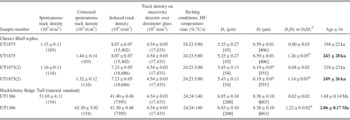
Two independent glass-ft age determinations were carried out on CBt, the first (UT1875) in 2012 and the second (UT1875(2)) in 2015, when the sample was repolished and etched. At this time, no reference was made to the earlier result to obviate the possibility of bias in counting the fission tracks. An age of 243±28 ka was obtained for UT1875 (Westgate, Reference Westgate2013) and 249±26 ka for UT1875(2) (Table 2). The weighted mean age and error is 246±19 ka. Close agreement between the 40Ar/39Ar and glass-ft age of the internal standard (Huckleberry Ridge tephra)—2.003±0.014 (2σ) Ma versus 2.06±0.17 (1σ) Ma—lends confidence to the view that this age estimate for CBt is accurate (Table 2).
Glass fission-track age of Chester Bluff tephra, Yukon River, eastern Alaska.

Notes: The population-subtraction method was used (Westgate, Reference Westgate2015). Ages calculated using the zeta approach and λ D =1.551×10⁻¹⁰/yr. Zeta value is 301±3 based on six irradiations at the McMaster Nuclear Reactor, Hamilton, Ontario, using the National Institute of Standards and Technology SRM 612 glass dosimeter and the Moldavite tektite glass (Lhenice locality) with an 40Ar/39Ar age of 14.34±0.08 Ma (Laurenzi et al., Reference Laurenzi, Bigazzi, Balestrieri and Bouska2003, Reference Laurenzi, Balestrieri, Bigazzi, Hadler Neto, Iunes, Norelli, Oddone, Osorio Araya and Viramonte2007). Area estimated using the point-counting method for UT1875 and an eyepiece graticule for UT1366. Number of tracks counted is given in parentheses; number of tracks measured is given in square brackets. Age determinations are corrected for partial track fading (PTF) using the diameter-corrected fission-track method (Sandhu and Westgate, Reference Sandhu and Westgate1995). D i , mean induced track diameter; D s , mean spontaneous track diameter. Ages in bold font are those corrected for PTF; other ages are uncorrected for PTF. The 40Ar/39Ar age of Huckleberry Ridge Tuff is 2.003±0.014 Ma (2σ error) (Gansecki et al., Reference Gansecki, Mahood and McWilliams1998). All samples irradiated at same time on June 27, 2012. UT1875 was counted on August 25, 2012, and UT1875(2)—after repolishing and etching—on December 1, 2015. Weighted mean age of UT1875 and UT1875(2) is 246±19 ka. # indicates application of Di/Ds value for age correction.
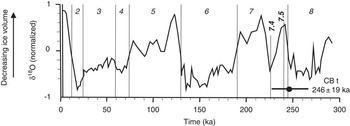
Therefore, CBt, the proximal correlative of SZt, was deposited during the early part of MIS 7. In light of the paleoenvironmental context of CBt (=SZt), the mean glass-ft age is probably a little too old, but within the 1σ limit—that is, between MIS 7.5 and 7.4, on the upper shoulder of the first thermal peak of MIS 7 (Pisias et al., Reference Pisias, Martinson, Moore, Shackleton, Prell, Hays and Boden1984) (Fig. 5). An older age for CBt (=SZt) is unlikely because this would place this tephra bed in the cold phase of MIS 8, which lasted 30,000 yr (Fig. 5).
Age of Chester Bluff tephra (CBt) in relation to the stacked benthic oxygen-isotope record for the last 300,000 yr (Pisias et al., Reference Pisias, Martinson, Moore, Shackleton, Prell, Hays and Boden1984). Numbers in italics are the Marine Oxygen Isotope Stages.

CONCLUDING REMARKS
CBt (=SZt) was deposited during the early part of MIS 7, soon after the demise of the MIS 7.5 interglaciation. Consequently, the interglacial bed just below SZt at site CRH47 in the Old Crow basin, Yukon Territory, and that below CBt at Chester Bluff in east-central Alaska belong to this interglaciation. This age assignment is in agreement with Bigelow’s (Reference Bigelow2003) views based on stratigraphic position and plant macrofossils at Chester Bluff, provides a more precise age than previously available for the mammalian faunal remains at site CRH47, and supports the claim of Kuzmina et al. (Reference Kuzmina, Froese, Jensen, Hall and Zazula2014) that MIS 7 sediments are also preserved farther downstream along the bluffs of the Old Crow River.
ACKNOWLEDGMENTS
This research was supported by funds from the Natural Sciences and Engineering Research Council of Canada to J.A. Westgate. Work on site CRH47 along the Old Crow River was carried out on the Vunut Gwitchin First Nation settlement lands. We thank Duane Froese (University of Alberta), David Lowe (Waikato University, New Zealand), Derek Booth (senior editor), and Jim O’Connor (associate editor) for their comments, which resulted in an improved manuscript.