Introduction
Cancer is the most common cause of death in England, accounting for 25·6% of all deaths in females and 30·3% of all deaths in males in 2016. 1 The overall incidence of cancer in the United Kingdom is projected to rise in the foreseeable future. Despite public health education initiatives, the combination of increasing cancer incidence with a growing ageing population presents challenges for healthcare planners. Reference Smittenaar, Peterson, Stewart and Moitt2 At the same time, there is evidence of slight but consistent improvement in survivorship with further reductions in cancer death rates being reported. 3 Taken together, the evidence suggests that as the number of people living with cancer rises, there will be increasing strain on cancer services in the future.
Radiotherapy is an important modality in the management of cancer, with approximately 50% of all patients receiving radiotherapy as part of their treatment. 4 For patients with distressing symptoms of advanced and incurable cancers, rapid access to treatment is important to achieve swift palliation. Palliative radiotherapy involves the use of targeted high-energy X-rays to treat advanced cancers, providing a safe, efficient and cost-effective means of managing these patients for whom symptom control and quality of life are key concerns. Reference Spencer, Parrish, Barton and Henry5 With more cancer patients living longer, there is forecast to be increasing demand for radiotherapy services which play an important role in the management of cancers. 6
Any projected increase in the demand for radiotherapy services must be viewed in the context of an emerging picture of key shortages across the clinical oncology workforce. Clinical oncologists are the medical leaders of radiotherapy services in the United Kingdom. It has been reported that National Health Service (NHS) vacancies for consultant clinical oncologists have doubled in the last five years with existing staff working excessive hours, leading to stress and burnout. In addition, there are insufficient clinical oncology training centres to close the gap between supply and demand, which has resulted in a forecast shortfall of 272 whole-time equivalent consultant clinical oncologists by 2023. 7 With increasing demands and limited resources, there is a need to make more efficient use of the radiotherapy workforce to increase capacity across the service if lengthening NHS waiting lists are to be avoided. 8
Skill mix initiatives have been developed to enhance service quality and patient outcomes by enabling therapeutic radiographers to perform roles previously exclusively within the domain of the clinical oncologist. These role extensions can provide cost-effective utilisation of the radiotherapy workforce. Reference Duffton, Devlin, Tsang, Mast and Leech9 Although skill mix initiatives are widespread and can enhance the job satisfaction of staff involved, Reference Field and Snaith10 there is limited evidence of impact upon service quality and patient outcomes. Reference Hardy, Johnson, Sharples, Boynes and Irving11
Against a backdrop of increasing demand and sustained shortages within the consultant clinical oncologist workforce, the Department of Clinical Oncology at Northampton General Hospital (NGH) NHS Trust developed a skill mix initiative under the leadership of their clinical radiotherapy lead. A team of therapeutic radiographers was trained to plan and prescribe palliative radiotherapy treatment to patients within a defined scope of practice in accordance with professional guidance. 12-16 The intention was to ease pressure on the clinical oncology workforce and to facilitate rapid access to treatment for patients needing palliative radiotherapy. This service has been operating since July 2016. Two years’ worth of radiotherapy data was analysed to ascertain whether a radiographer-led palliative service facilitated fast access to treatment for patients. A clinical oncologist-led service was used as the standard against which access time was measured.
Methods
Data for all patients treated with palliative radiotherapy at NGH between July 2016 and June 2018 was reviewed retrospectively. Patient data was collected from the HIVE™ hospital information data system. Quality assurance was performed by cross-checking appointment data and site treated with the Aria™ radiotherapy management system. Histology was cross-checked against pathology reports on the Sunquest ICE™ information system.
Data was analysed to include patient demographics such as gender, age, inpatient/outpatient status and referring clinic location as well as diagnosis, site treated, dose/fractionation, appointment dates for clinic consultation, planning CT scan and first treatment.
A total of 952 courses of palliative radiotherapy were delivered during this time. Data analysis focused on patients treated with single-field or parallel opposed-field plans as these fell within the scope of practice of the prescribing radiographers. Diagnoses of skeletal metastases, malignant spinal cord compression (MSCC), whole-brain radiotherapy for brain metastases and prophylactic cranial irradiation (PCI) plus lung radiotherapy for primary or metastatic disease were included. A total of 726 courses of radiotherapy met these criteria.
MSCC is an oncological emergency for which guidelines require definitive treatment to commence within 24 hours of diagnosis. 17 All MSCC patients treated at NGH during the study period were treated within 24 hours. These patients were managed on a separate pathway than other patients and so excluded from the study. Patients treated with whole-brain radiotherapy for small-cell lung cancer at NGH are managed on a complex pathway involving chemotherapy and lung radiotherapy. The sequencing of PCI within the patient pathway is carefully managed (potentially introducing delays between planning and treatment) to facilitate the management of acute morbidity associated with other treatment modalities. Reference Jett, Schild, Kesler and Kalemkerian18 These patients were managed on a separate pathway than other patients and so excluded from the study. A further rationale for exclusion of whole-brain radiotherapy patients was the presence within the dataset of patients being retreated for brain disease. This treatment falls outside the scope of practice of the prescribing radiographers. Authorisation for radiographers to prescribe lung treatments occurred late in the study period with only one lung patient being radiographer-led. These patients were excluded from the study because of the imbalance in sample weights. Three courses of treatment for skeletal metastases were excluded from the data because the treatment plans did not conform to the radiographer-led scope of practice.
This left a total of 425 courses of radiotherapy delivered for the treatment of skeletal metastases. All were treated with either single-field or parallel opposed-field plans. As patients with known confounding factors were excluded from the study, this enabled like-for-like comparison of radiographer- and clinical oncologist-led cohorts.
An initial data analysis was performed using descriptive statistics to quantify demographics and differences in referral to treatment time between radiographers and clinical oncologists. Graphical presentation of data demonstrated a positive skew, indicating there was not normal distribution. Mann–Whitney U tests were used to compare referral to treatment times for radiographer- and clinical oncologist-led patient cohorts. Referral time was calculated from decision to treat at outpatient consultation to start of radiotherapy treatment. Chi-squared tests were used to evaluate the statistical significance of demographic variables. Only p-values <0·05 were considered statistically significant.
This study did not require the use of patient-identifiable data or intervention in clinical care. Authorisation that the study did not require ethical approval was provided by the Research Department at NGH NHS Trust in accordance with national guidance. 19,20
Results
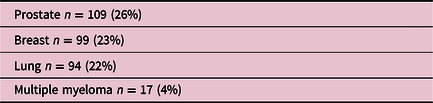
Patient age ranged from 27 to 93 years with a mean age of 67·9 years. There were 232 males aged 33–91 years with a mean age of 70·5 years, and 193 females aged 27–93 years with a mean age of 64·9 years. There were 32 separate primary clinical diagnoses within the study group of 425. The most commonly treated primary diagnoses were prostate, breast, lung and multiple myeloma (n = 319) accounting for 75% of all cases treated for skeletal metastases (Table 1).
Most common primary diagnosis

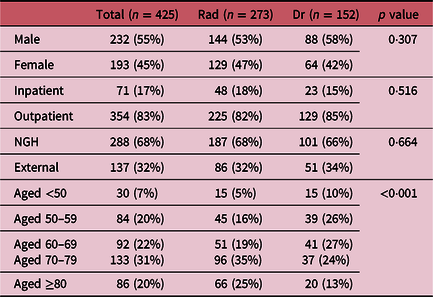
Radiographer-led procedures (n = 273, 64%) were more commonly performed than clinical oncologist-led procedures (n = 152, 36%). A comparison of demographic variables was performed using chi-squared tests (Table 2). There was no statistical significance in the distribution of radiographer- and clinical oncologist-led procedures on the basis of gender, inpatient/outpatient status and referring clinic location. Age was a factor in the distribution of procedures with patients aged ≥70 years more likely to be planned by radiographers than by clinical oncologists (p < 0·001). Patients within this age group constituted a higher proportion of the radiographer-led workload (n = 162, 59·3%) than the clinical oncologist-led workload (n = 57, 37·5%).
Demographics of skeletal metastases study group

Abbreviations: Rad, radiographer-led pathway; Dr, clinical oncologist-led pathway
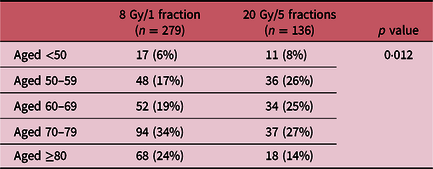
Patients receiving radiotherapy for skeletal metastases (Table 3) were more likely to be treated with a single fraction of radiotherapy (p = 0·012). A dose fractionation regime of 8 Gy in single fraction (n = 279, 65·6%) was most commonly used, with 20 Gy in five fractions (n = 136, 32·0%) being the preferred alternative. Together, these two regimes (n = 415/425) accounted for 97·6% of all radiotherapy prescriptions. Patients aged ≥70 years (n = 162) accounted for 58% of all single-fraction treatments. Patients aged <70 years (n = 81) accounted for 59% of all those receiving 20 Gy in five fractions.
Frequently used dose fractionation regime

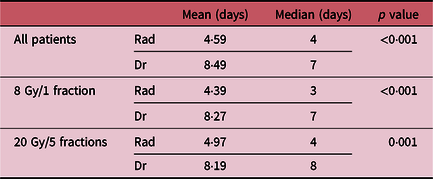
The Mann–Whitney U test was performed to analyse the statistical significance of differences in access times between radiographer- and clinical oncologist-led procedures (Table 4). The median referral to treatment time for all patients was 4 days for radiographer-led and 7 days for clinical oncologist-led. This difference was reflected in 8 Gy in single-fraction prescriptions (3 versus 7 days) and 20 Gy in five-fraction prescriptions (4 versus 8 days), respectively. A comparison of all prescriptions (p < 0·001), 8 Gy in single-fraction prescriptions (p < 0·001) and 20 Gy in five-fraction prescriptions (p = 0·001) showed a statistically significant distribution with radiographer-led procedures enabling faster access to treatment in each category.
Time from referral to commencing treatment

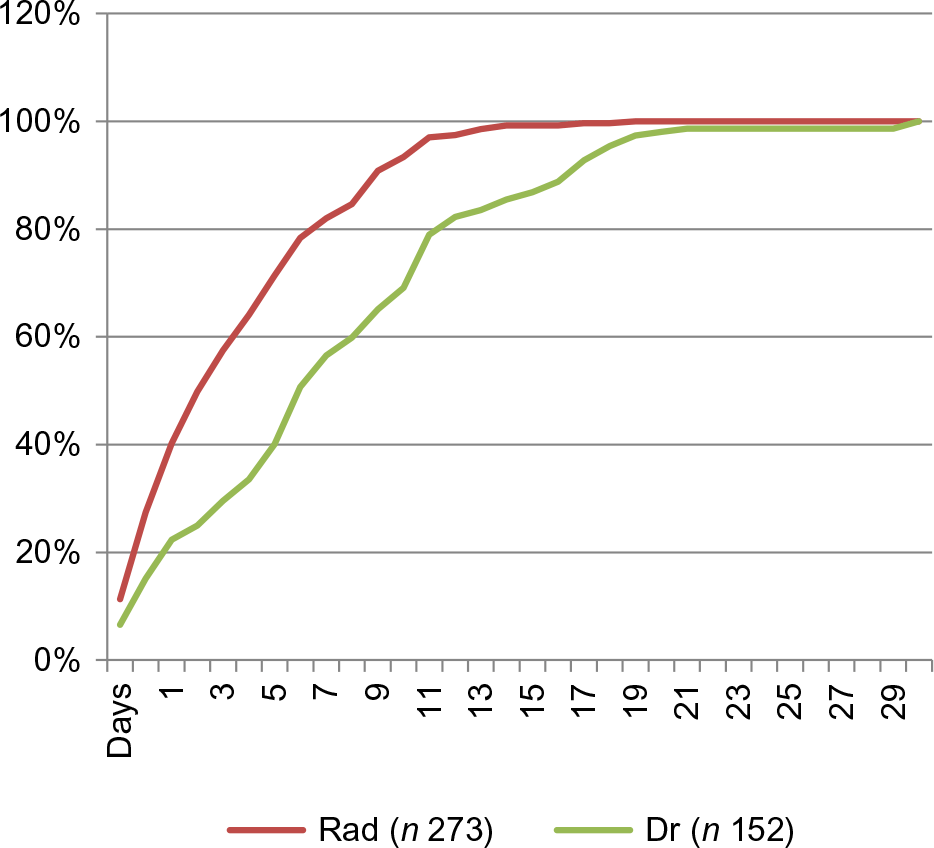
A graph of cumulative frequency to treatment (Figure 1) shows faster access to treatment for radiographer-led procedures (n = 269), with 99% of patients commencing treatment within 2 weeks. Clinical oncologist-led procedures (n = 127) showed 84% of patients commencing treatment within 2 weeks.
Cumulative frequency to treatment.

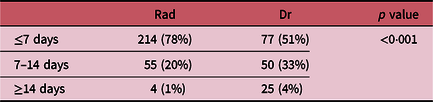
A further analysis of the data (Table 5) examined access time for those patients being treated within 2 weeks of referral. 21 Patients treated within 2 weeks (n = 396, 93·2%) accounted for the majority. An analysis using chi-squared tests confirmed radiographer-led patients are more likely to be treated within 2 weeks of referral (p = 0·001).
Data for commencing treatment within 2 weeks (n = 396)

Discussion
Our data shows that patients aged ≥70 years are more likely to be treated with a single 8 Gy fraction, and that these patients are more likely to be planned by radiographers. The choice of single-fraction radiotherapy may be multifactorial and include frailty, comorbid conditions, lack of transport and avoidance of acute toxicities. Professional guidance on radiotherapy dose fractionation and scheduling recommends that patients with uncomplicated bone pain show good response to 8-Gy single-fraction radiotherapy. 22 In England, a single-fraction radiotherapy prescription is recommended for symptomatic bone metastases in order to minimise discomfort and inconvenience for patients without compromising clinical effectiveness. 23 This is reflected in the American Society of Therapeutic Radiation Oncology (ASTRO) guideline, which concludes that there is no significant difference in clinical response between single-fraction and multiple-fraction treatments. It recommends that, on balance, single-fraction prescriptions may be particularly useful for patients with limited life expectancy. Reference Lutz, Balboni and Jones24
Evidence supporting single-fraction treatments for uncomplicated bone metastases for patients with limited life expectancy is consistent with the findings of this study. These patients require quick access to treatment with minimal inconvenience. The study demonstrated that these patients are more likely to be planned by radiographers and that they would have faster access to treatment through a radiographer-led pathway.
The choice of single-fraction versus multiple-fraction treatments is influenced by multiple factors, including normal tissue toxicity and prognosis. Although pain control outcomes are comparable in both management approaches, the risk of radiation-induced toxicity is a major determinant in the choice of longer dose fractionation prescriptions. Reference Lutz, Balboni and Jones24 The likelihood of patients requiring retreatment is another important consideration, and there is strong evidence that retreatment rates are linked to the choice of dose fractionation. A meta-analysis showed retreatment rates of 20% for single-fraction versus 8% for multiple-fraction treatments. Reference Rich, Chow and Raman25
Data collection did not permit an analysis of retreatments. However, it has been a standard practice for retreatments to be led by clinical oncologists. This is due to the complexity of cases and the relative inexperience of radiographers prescribing palliative treatments.
Literature on advanced radiographic practice in radiotherapy has principally focused on the justification of advanced roles. In a palliative setting, two publications have explored the variability in decision-making between clinical oncologists and radiographers. In studies involving 150 and 23 patients, respectively, there was a high correlation between both groups in radiation field placement, consistent with literature. From this, it may be suggested that radiographer-led roles have the potential to improve access to palliative radiotherapy through reduced waiting times. Reference Job, Holt and Bernard26,Reference Lacey, Ockwell, Locke, Thomas, Hendry and McNair27 Statistical analyses in both studies show a high correlation between radiographer’s and clinical oncologist’s plans, supporting the authors’ claim of equivalence in work quality. Their conclusion that radiographer-led pathways can reduce waiting times is, however, a supposition. The study design investigated the consistency of decision-making between the two groups and did not facilitate an assessment of impact upon waiting times.
Another publication reported an audit on the impact of a radiographer-led pathway on time from referral to treatment. In a before and after study involving 97 and 87 patients, respectively, the authors reported an increase from 73% to 85% in terms of the number of patients treated within 14 days. They concluded that a radiographer-led pathway would enable quicker times from referral to treatment. Reference Goldfinch, Allerton, Khanduri and Pettit28 This finding is supported by data from an NGH study showing that 98% and 84% patients were given treatment within 14 days on the radiographer- versus clinical oncologist-led pathway, respectively. 21 Factors contributing to the different access rates include increased complexity of retreatment planning by a clinical oncologist and scheduling delays built into the clinical oncologist pathway. The benefit of a radiographer-led pathway is therefore exaggerated by the inability to filter retreatments from the dataset. The NGH data did show that the flexibility provided by a radiographer-led pathway would facilitate faster access for an appropriately selected patient caseload.
Several papers have evaluated the impact of rapid-access palliative radiotherapy clinics. In a study involving 129 patients, 98% were seen within 2 weeks of referral, with 87% seen within 1 week. The median time from referral to consultation was 4 days, with 35% of patients commencing treatment on the day of consultation. Reference Morris, O’Donovan, Ofi and Flavin29 This study group had a similar age range to the NGH study, but the distribution of single-fraction to multiple-fraction prescriptions varied, with 46·7% in our analysis receiving single fraction versus 65·6% in the NGH study. This variation could be explained by the rapid-access clinic being a general palliative service rather than bone pain-specific. Regarding the measure of waiting times, the NGH data shows 99% of radiographer led-patients being seen within 2 weeks and 82% within 1 week, which is comparable with the 98% and 87% reported from the rapid-access clinic.
An established rapid-access clinic in Ontario detailed the findings of a review involving 1,890 patients within a general palliative service rather than bone pain-specific. The median time from referral to consultation was 3 days, with 60% of patients being treated on the same day. In total, 93% of patients were treated within 6 days, and 53% were treated for bone metastases. Reference Thavarajah, Wong and Zhang30 By comparison, the radiographer-led service at NGH seemed to be not as efficient, with 25% of patients treated on the same day and 88% treated within 6 days. The difference could be explained by the different models of service delivery. The Ontario Clinic is an established clinical model in operation for 8 years prior to the data being reported. Reference Thavarajah, Wong and Zhang30 The NGH service is a skill mix initiative designed to alleviate service pressures arising from shortages of clinical oncologists rather than a dedicated rapid-access model. The NGH service has been experiencing significant capacity pressures with managers balancing the rising demand with limited linear accelerator capacity. In this context, the data from NGH illustrates the potential to develop alternative service delivery models to facilitate faster access.
In a study of 58 lung cancer patients in Vancouver, 72% received treatment on the same day as their consultation. Of these, 42% were treated for bone pain. Reference Lefresne, Berthelet and Cashman31 Another study of a rapid-access programme reported on a cohort of 33 patients with brain metastases. The median referral to treatment time was 6 days, with 76% of patients seen within 1 week. Ninety-four per cent of patients commenced treatment on the same day as being seen. Reference Danielson and Fairchild32 Both papers reported small patient cohorts utilising differing service delivery models. Their performance relative to the NGH radiographer-led model illustrates the importance of a clinical model to access times. The NGH data shows that fewer patients were being treated on the same day (25%) than the Vancouver Clinic, but with faster median access (3 days for single fraction and 4 days for multiple fractions) than the brain metastases clinic. Comparisons of access times are generalised because of the different clinical models but can serve as an indicator for service development initiatives.
A general review of rapid-access care models reported on a number of services based across Canada, the United States, Australia and New Zealand. Data showed that the frequency of single-fraction radiotherapy ranged from 69% to 75% and that median reported waiting times ranged from 3 to 7 days. Reference Dennis, Linden, Balboni and Chow33 These findings are broadly consistent with the NGH study in which 65·6% of patients were being treated with a single fraction and median waiting times for radiographer-led procedures were 3 and 4 days for single and multiple fractions, respectively. The lack of detailed data available for review limited its usefulness for an in-depth comparison. But broadly speaking, the NGH radiographer-led service seems to facilitate fast access with waiting times comparable to internationally reported care models.
This study is a retrospective analysis of data collected using an observational study design. It provides useful initial data on the new service model, but the observational model might have been prone to unintended bias. Reference Berger, Dreyer, Anderson, Towse, Sedrakyan and Normand34 Attempts were made to reduce the unintended bias by the strict application of inclusion and exclusion criteria. This study did not address qualitative measures of patient satisfaction. There have been no published studies assessing patient satisfaction of radiographer-led palliative radiotherapy services. This is a gap in literature that could usefully be addressed to evidence quality improvement outcomes with skill mix initiatives.
The study provides evidence of scope to improve access times for patients with appropriately designed radiographer-led pathways. With increasing pressures on the clinical oncologist workforce, 7 it adds to the body of evidence that service providers can access when considering alternative service models. Locally in Northampton, it has supported the business case for a second palliative consultant radiographer who has recently come into post.
Conclusion
Skill mix has been championed as a means of improving NHS’ efficiency without compromising care quality. Evidence shows that cancer care and radiotherapy services, in particular, are at risk from a critical shortage within the clinical oncologist workforce. 7 The development of alternative models of care is, therefore, necessary to plug gaps in the system.
Much of the literature on radiographer skill mix presents the philosophical case for skill mix. Some of it provides assurance on care quality, demonstrating that radiographers working in advanced roles can facilitate delivery of services without compromising the quality of care compared to traditional models of care delivery. There is, however, little published work investigating service efficiency in the context of radiographer skill mix initiatives.
The NGH experience of radiographer-led palliative radiotherapy demonstrates statistically significant improvement in access times for patients receiving radiotherapy for symptom control. It shows faster access by the radiographer pathway than via the clinical oncologist-led route. The data also shows that the NGH radiographer-led pathway is comparable with internationally published data on rapid-access clinics, demonstrating an efficient clinical pathway for patients.
The NGH study is limited to patients being treated for symptomatic skeletal metastases. It is a retrospective data analysis, and not an audit of change in care model. The data demonstrates that the NGH radiographer-led pathway facilitates faster access to care for an appropriately selected patient caseload. The NGH study adds to the evidence demonstrating improved service efficiency from radiographer skill mix initiatives.
Acknowledgements
The authors wish to thank Professor Roshan Agarwal for his advice and support in statistical analysis.
Conflict of Interest
The authors have no conflicts of interest to declare.