Introduction
Start-up capital is essential to new ventures to start their businesses. However, new ventures often experience difficulty securing external financing owing to uncertainty and information asymmetry between entrepreneurs and potential investors (Colombo, Reference Colombo2021). Thus, using personal funding or turning to their family to raise start-up capital is natural and common for entrepreneurs. More than 50% of new venture financing comes from the founder's personal contribution (Gartner, Frid, & Alexander, Reference Gartner, Frid and Alexander2012), with reliance on personal capital for start-up funding potentially being even more extensive among nascent entrepreneurs with little entrepreneurial experience. Owing to a lack of signal of the entrepreneurs' prior experience, external investors may not be able to assess nascent entrepreneurs' capability based on factual evidence (Nagy, Pollack, Rutherford, & Lohrke, Reference Nagy, Pollack, Rutherford and Lohrke2012) and might rely on entrepreneurs' personal characteristics as an indirect clue to their ventures' potential. Thus, in addition to direct evidence, such as start-up experience, research has examined a series of personal characteristics, such as gender, human capital, social capital, and financial capital, as signals for attracting external financing and hence shaping start-up capital structure (Carter, Brush, Greene, Gatewood, & Hart, Reference Carter, Brush, Greene, Gatewood and Hart2003; Clough, Fang, Vissa, & Wu, Reference Clough, Fang, Vissa and Wu2019). Moreover, an emerging trend is to emphasize the role of family characteristics as start-up considerations (Aldrich & Cliff, Reference Aldrich and Cliff2003), especially in China, where familism is highlighted as a result of Confucian culture (Au & Kwan, Reference Au and Kwan2009).
Current literature focuses on the net effects of either entrepreneurs' personal capital endowments or their family's capital endowments in isolation, holding the assumption that capital endowments across capital dimensions or generations are congruent, and their effects are mutually independent (Colombo, Reference Colombo2021). However, economic development and institutional reform over the past century drastically altered the population structure and intergenerational mobility in countries such as China (Zhou & Xie, Reference Zhou and Xie2019). It is quite common to observe incongruency between capital endowments across either capital dimensions (i.e., human, social, and financial capital) or generations (i.e., parent and child) (Chen, Reference Chen2013). Capital endowments across generations thus lead to a set of configurations of intergenerational capital endowments in an entrepreneur's family, which may send multiple or inconsistent signals to external investors. Family dynamics in terms of intergenerational mobility suggest asking the following question: Will different configurations of intergenerational capital endowments in entrepreneurs' families impact the level of external funding in new ventures in China?
To explore the role of various configurations of intergenerational capital endowments, we apply qualitative comparative analysis (QCA) as the main method in our study. Going beyond traditional approaches in which only single factors can be examined in isolation, QCA takes advantage of addressing causal complexity by assuming the interdependence of antecedent conditions (Chen & Tian, Reference Chen and Tian2022). QCA can generate multiple sufficient configurations of the antecedent conditions (i.e., the composition of capital endowments across capital dimensions or generations) related to a common outcome (i.e., external funding in new ventures), which can help us understand the pathways of new venture financing. From a nationwide survey of Chinese privately owned enterprises, we screened 592 new ventures established by nascent entrepreneurs. By multiplying capital endowments of human, social, or financial capital across two generations, we identify four typical family prototypes that feature intergenerational capital endowments for low external funding. Our findings highlight the role of intergenerational capital configurations in shaping new venture financing.
Our study contributes to the entrepreneurship and signaling literature in three important ways. First and foremost, we contribute to the signaling perspective in the new venture financing literature. Although multiple signals have been identified as valid for external investors, how the conjoint effects of multiple signals exert different influences on new venture financing remains unknown. We extend this stream of literature by exploring the configurations of multiple signals across family generations and their effects on new venture financing. Moreover, we answer the call to examine the inconsistency among multiple signals in new venture financing (Gao, Darroch, Mather, & MacGregor, Reference Gao, Darroch, Mather and MacGregor2008). We posit that signal inconsistency exists across not only different capital dimensions but also generations and will send delicate signals to external investors.
Second, we highlight intergenerational capital endowments as prevention-based signals in attracting external funding for new ventures. As coarse signals, the entrepreneur and the parent's capital endowments might not be sufficient for external investors to decide to invest. However, these family signals are sufficient for them to decide not to invest by simply escaping from potential risks, as a result of a prevention-based focus (Crowe & Higgins, Reference Crowe and Higgins1997; Wang & Dong, Reference Wang and Dong2024). We thus join an emerging research stream by identifying an entrepreneur's family endowment portfolio as an important factor that affects investors' regulatory focus in investment decisions (Colombo, Reference Colombo2021; Kanze, Huang, Conley, & Higgins, Reference Kanze, Huang, Conley and Higgins2018).
Third, we contribute to the intersection of the family and entrepreneurship literatures by introducing the family portfolio perspective in the external evaluation of new ventures and highlighting family dynamics. The family represents a critical resource for new ventures and is widely examined as an internal factor that can affect their governance (Chrisman, Chua, & Steier, Reference Chrisman, Chua and Steier2003). However, on the external side of new ventures, family factors, especially intergenerational factors, have received little attention. We introduce the family portfolio perspective by investigating the conjoint effects of intergenerational capital endowments in the family as a valid signal in the eyes of potential investors. The family portfolio perspective can perfectly capture the family dynamics in a country with drastic social changes and portray the role of the family in new ventures in interacting with external stakeholders.
Literature Review
Signals in New Venture Financing
Securing financial resources for new ventures is one of the most critical tasks of nascent entrepreneurs, which is important to the survival and development of new ventures in the start-up phase (Ko & McKelvie, Reference Ko and McKelvie2018). However, owing to the high uncertainty associated with new ventures and information asymmetry between nascent entrepreneurs and potential investors, nascent entrepreneurs often find it difficult to obtain external financing. With the unavailability of factual information on entrepreneurs' and their new ventures' potential quality, such as prior entrepreneurial experience and venture performance (Murray & Marriott, Reference Murray and Marriott1998), potential investors will likely turn to the entrepreneurs' visible and accessible signals to predict their quality as well as that of their new ventures, albeit such signals may generate only subjective evaluations (Colombo, Reference Colombo2021).
The literature on new venture financing explores various personal characteristics of nascent entrepreneurs as signals for potential investors. As the most visible signals, gender and ethnicity are identified as important entrepreneurial signals to attract external financing (Alsos & Ljunggren, Reference Alsos and Ljunggren2017; Kanze et al., Reference Kanze, Huang, Conley and Higgins2018). However, such obvious demographic factors can draw only a general picture and classify entrepreneurs into a limited number of categories. To obtain additional information, external investors view the capital endowments of entrepreneurs as critical signals to evaluate them (Colombo, Reference Colombo2021).
The literature widely discusses the human, social, and financial capital of entrepreneurs as useful signals to attract and obtain external financing. For human capital, entrepreneurs' educational attainment is believed to be a popular signal of their abilities (Carter et al., Reference Carter, Brush, Greene, Gatewood and Hart2003; Pinelli, Cappa, Franco, Peruffo, & Oriani, Reference Pinelli, Cappa, Franco, Peruffo and Oriani2020). Entrepreneurs' perceived competence, cooperativeness, passion, self-efficacy, and reputation are also argued to be reliable signals (Cassar & Friedman, Reference Cassar and Friedman2009; Mitteness, Sudek, & Cardon, Reference Mitteness, Sudek and Cardon2012; Shane & Cable, Reference Shane and Cable2002; Svetek, Reference Svetek2023). For social capital, scholars pay attention to network factors such as network diversity and network tie strength (Kotha & George, Reference Kotha and George2012; Plummer, Allison, & Connelly, Reference Plummer, Allison and Connelly2016; Shane & Cable, Reference Shane and Cable2002), which can imply the social relationships of the focal entrepreneur. For financial capital, net worth and income are considered to be trustworthy signals (Gartner et al., Reference Gartner, Frid and Alexander2012) to verify entrepreneurs' financial strength.
In addition to entrepreneurs' personal capital endowments, the emerging trend is to investigate family-related factors, including parental capital endowments, as valid signals. For instance, Chua, Chrisman, Kellermanns, and Wu (Reference Chua, Chrisman, Kellermanns and Wu2011) examined the role of family involvement and family social capital in securing external debt financing. Birtch, Au, Chiang, and Hofman (Reference Birtch, Au, Chiang and Hofman2018) explored how familism influences investors' likelihood of providing capital. Meanwhile, Barnir and McLaughlin (Reference Barnir and McLaughlin2011) investigated the effect of parental self-employment on informal external funding.
In short, the literature makes an extensive effort to investigate the net effects of entrepreneurs' or their family's personal capital endowments but ignores the conjoint effects of capital endowments across capital dimensions (i.e., human, social, and financial capital) or generations (i.e., parent and child). However, incongruency between capital endowments across capital dimensions or generations will likely occur, especially in societies undergoing drastic changes, as discussed below.
Family Dynamics in China
Social changes and economic development over the past century have drastically altered the population structure and social stratification in China (Zhou & Xie, Reference Zhou and Xie2019). At the founding of the People's Republic of China (PRC), the proportion of rural residents was 90%, and the illiteracy rate was around 80%. China's gross domestic capital per capita was only USD 15, thereby ranking below the 100th position in the world. After the founding of the PRC, the political ideology of socialism suppressed the development of private businesses and private farming (Strauss, Reference Strauss2006). Moreover, the education system was undermined, and education became a liability for individuals during the cultural revolution (Zhou, Tuma, & Moen, Reference Zhou, Tuma and Moen1996). Meanwhile, social stratification was relatively stable, with little chance of intergenerational mobility. However, the economic reforms in the late 1970s stimulated economic development and thus changed the possibility of intergenerational mobility (Chen, Reference Chen2013). The government gradually allowed and encouraged the establishment of private businesses and reemphasized the importance of education (Yun, Li, & Hu, Reference Yun, Li and Hu2024).
With the drastic social changes, changes in social stratification and intergenerational mobility also occurred. With the reinstatement of the college entrance examination, a substantial number of ‘farmers' children’ enrolled in college and subsequently joined the tizhi system as state functionaries (Zhou et al., Reference Zhou, Tuma and Moen1996). At the same time, the trend since the mid-1980s has been for state functionaries to leave the system and start their own business, which is known as xiahai (i.e., ‘leaping into the sea’; Li, Reference Li1998). Moreover, the net income of Chinese residents was generally increasing at a high rate (Djundeva, Dykstra, & Emery, Reference Djundeva, Dykstra and Emery2019). China's gross domestic capital per capita at the end of 2022 was RMB 85,698 (equivalent to USD 12,814), thereby ranking 63 worldwide. Thus, the drastic changes resulted in considerable incongruence in intergenerational capital endowments in terms of human, social, and financial capital in Chinese society (Chen, Reference Chen2013).
China is a society founded on Confucianism, which highlights the importance of family and treats the family as the central operating unit of society (Fang, Singh, Kim, Marler, & Chrisman, Reference Fang, Singh, Kim, Marler and Chrisman2022). As a result, compared to investors in Western countries, investors in China are more likely to investigate and consider the entrepreneur's family background before making an investment decision (Au & Kwan, Reference Au and Kwan2009). Investors in China will give more weight to the entrepreneur's family members when they evaluate the venture's investment potential than those in Western countries (Ding, Sun, & Au, Reference Ding, Sun and Au2014). The drastic change in Chinese society just offers us a good opportunity to observe how intergenerational mobility in the family system is evaluated by potential investors.
Configurational Framework
New venture financing literature acknowledges the important role of personal capital endowments as valid signals for external investors but pays little attention to combining such endowments and intergenerational compositions. Thus, how different compositions of intergenerational capital endowments will impact new venture financing by sending disparate signals to external investors and altering the weight of external financing versus personal funding remains unknown. To address the research gap, we take a holistic view in investigating the signaling mechanism of new venture financing, as multiple signals do not exist in isolation and should be considered in a complex way (Colombo, Reference Colombo2021). Going beyond traditional methods in which only single factors can be examined, we introduce a configurational approach to identify the complex combinations and multiple pathways through which new ventures can send signals to external investors to leverage start-up capital (Fiss, Reference Fiss2011). Specifically, we unravel capital endowments into three dimensions, namely, human, social, and financial capital, and take the family portfolio perspective to introduce capital endowments across generations to reveal the multiple pathways that shape external funding in new ventures (Honig, Reference Honig1998; Linder, Lechner, & Pelzel, Reference Linder, Lechner and Pelzel2020). Albeit better economic status of the family might exert a direct impact and make it less necessary for the entrepreneur to seek external funding, there is a trend that the younger generation in China is more willing to seek external funding to escape from family interference (Ahlstrom, Young, Chan, & Bruton, Reference Ahlstrom, Young, Chan and Bruton2004; Au & Kwan, Reference Au and Kwan2009), making financial capital effective in sending signals externally in addition to its direct effect.
Methods
Sample and Data
We obtained the sample firms from the Chinese Private Enterprise Survey (CPES) conducted in 2016. Conducted every two years, the survey was designed and administered by a joint research team from the State Administration for Market Regulation (formerly the State Administration for Industry and Commerce of China) and the All-China Federation of Industry and Commerce (a semi-official institute that helps connect private entrepreneurs with government bureaus; Zhou, Reference Zhou2017). The project team selected a nationwide sample of 8114 private firms using stratified sampling: 0.04% of all private firms were selected from 31 provinces in different industries based on the number of firms in each region (Liu, Qian, & Au, Reference Liu, Qian and Au2023). The survey contains basic information on entrepreneurs' personal background, firm capital structure and operations, family succession, and business environment. The CPES data are widely used to understand family business and entrepreneurship in the Chinese context (Liu & Wang, Reference Liu and Wang2023; Liu et al., Reference Liu, Qian and Au2023; Zhou, Reference Zhou2017). The 2016 survey is the only survey in the past two decades that contains information on the education and occupational status of entrepreneurs' parental generation, which allowed us to obtain information on intergenerational capital endowments in an entrepreneur's family system.
We aimed to examine new ventures founded by young nascent entrepreneurs; thus, we screened out firms with an age of no more than 8 years (Luo, Yang, & He, Reference Luo, Yang and He2020) and entrepreneurs under the age of 35. According to the Chinese National Bureau of Statistics, individuals under the age of 35 are generally considered as youths. Our classification of young entrepreneurs is consistent with that of prior research in other countries (Brixiová, Ncube, & Bicaba, Reference Brixiová, Ncube and Bicaba2015). By removing observations with missing ownership structure, 759 qualified firms remained in the sample after the screening. In addition, we omit observations with missing information on our key variables. Finally, we obtained a sample of 592 firms. In order to evaluate the nonresponse bias, we compared the means of key characteristics at the entrepreneur level (i.e., gender, income, education), firm level (total assets, number of employees, revenue, profit), and institutional level (i.e., province) between responses with key variables and responses with missing key variables. The t-tests indicate no significant differences between these two groups at the 5% level, eliminating the concern about the nonresponse bias.
Fuzzy-Set QCA (FsQCA)
FsQCA is a method based on configurational thinking and adopts concepts from set theory and Boolean algebra (Ragin, Reference Ragin2008, Reference Ragin2014). Different from the traditional regression-based method that seeks to obtain the net effects of particular variables, fsQCA aims to examine how a particular combination of variables is related to the outcome (Fiss, Reference Fiss2011; Pappas & Woodside, Reference Pappas and Woodside2021). This method has been used increasingly in strategy and entrepreneurship research (for a review, see Nikou, Mezei, Liguori, & El Tarabishy, Reference Nikou, Mezei, Liguori and El Tarabishy2024).
FsQCA, as a configurational approach, can enrich theory development from two aspects. On the one hand, fsQCA adopts holistic thinking and can help identify how combinations of causal conditions interact to affect the outcome of interest (Nikou et al., Reference Nikou, Mezei, Liguori and El Tarabishy2024). The method can also explain how certain conditions can be complementary or substitutable to produce the outcome (Chen & Tian, Reference Chen and Tian2022). In traditional variance-based regressions, the interdependencies of causal conditions are usually modeled through interaction terms. However, interaction effects are likely to result in multicollinearity and are hard to interpret when the number of variables exceeds two (Fainshmidt, Witt, Aguilera, & Verbeke, Reference Fainshmidt, Witt, Aguilera and Verbeke2020). On the other hand, fsQCA relies on the concept of equifinality and can show how multiple distinctive configurations can yield similar outcomes, which can provide practical implications (Fiss, Reference Fiss2011; Ong & Johnson, Reference Ong and Johnson2023).
Empirically, fsQCA is feasible for small (<50) and large samples (thousands; Greckhamer, Furnari, Fiss, & Aguilera, Reference Greckhamer, Furnari, Fiss and Aguilera2018). In large samples, the method can be used to identify patterns across many cases without detailed case exploration (Greckhamer, Misangyi, & Fiss, Reference Greckhamer, Misangyi and Fiss2013). In addition, in fsQCA, each solution will represent only part of the sample, and any outliers will affect only some possible configurations. Thus, fsQCA is in a way more robust than variance-based methods (Pappas & Woodside, Reference Pappas and Woodside2021).
Except for the above-mentioned advantages, fsQCA has two other features that make us choose it over Latent Profile Analysis (LPA), another method for identifying configurations (Ong & Johnson, Reference Ong and Johnson2023). First, fsQCA allows asymmetric solutions for the absence and presence of a given outcome (Fainshmidt et al., Reference Fainshmidt, Witt, Aguilera and Verbeke2020). Configurations leading to the presence of an outcome differ from the configurations that lead to its absence (Fiss, Reference Fiss2011). In contrast, LPA does not incorporate causal asymmetry effects. Any configurations identified will have symmetric relationships with the outcome (Gabriel, Campbell, Djurdjevic, Johnson, & Rosen, Reference Gabriel, Campbell, Djurdjevic, Johnson and Rosen2018). Second, in fsQCA, consistent configurations do not stand alone without an outcome, and sometimes meaningful configurations of causal conditions do not always emerge for a specific outcome. However, in LPA and cluster analysis, the identification of latent profiles is independent of any outcome variable (Gabriel et al., Reference Gabriel, Campbell, Djurdjevic, Johnson and Rosen2018; Ong & Johnson, Reference Ong and Johnson2023), which is not beneficial to establish causal relationships between conditions and outcomes.
New venture capital investment is a complex phenomenon that can be explained by numerous factors, such as an entrepreneur's intergenerational human, social, and financial capital; thus, considering fsQCA's conjunction, equifinality, and causal asymmetry nature, it is an ideal method to unpack the complexity of such a phenomenon and provide multiple equifinal configurations (Chen & Tian, Reference Chen and Tian2022).
Measurement
Outcome variable
Our primary interest in this study is the extent to which entrepreneurs attract external funding for their new ventures. The capital structure of the new venture is evolving and dynamic. In the survey, the entrepreneurs were asked to report the latest capital structure of their ventures. They provided information on the proportion of funds from personal and family sources, and external sources such as state investors, foreign investors, and other investors in the total capital raised for their venture. Consistent with prior research on new venture capital (Chandler & Hanks, Reference Chandler and Hanks1998; Kotha & George, Reference Kotha and George2012), we use the proportion of external investment in the total capital as the primary indicator of our outcome variable.
Causal conditions
Based on the framework of ‘human-social-financial capitals’ as the baseline framework to comprehensively describe personal capital endowments (Honig, Reference Honig1998; Linder et al., Reference Linder, Lechner and Pelzel2020), specific factors are selected based on three major criteria: visibility, representativeness, and conciseness.
First, to be a valid signal, the information should be visible to the information receiver (Colombo, Reference Colombo2021). As a result, we tend to select accessible demographic factors such as education and tizhi experience, since coarse information is more likely to be discussed between the investor and the investee or their acquaintance, especially when they are not quite familiar with each other. Economic status might also be discussed through personal conversation but could also be observed and speculated by the investor directly through the entrepreneur's accessories and traveling vehicles.
Second, as we are capturing family dynamics in China, it is also important to ensure those indicators represent the structural changes of Chinese society and are applicable to the general public. In recent decades, China's drastic reforms in college entrance exams, state-owned enterprises, and economic reforms have caused prevalent changes in individual's education, job nature, and income for specific cohorts. These changes have given birth to family dynamics at large and could ideally represent the incongruency of human, social, and financial capital across generations.
Third, to better employ the benefits of QCA, we need to keep the conditions as concise as possible because QCA has no omitted variable bias in the same way regression analysis does since QCA draws on Boolean algebra rather than on correlations (Fainshmidt et al., Reference Fainshmidt, Witt, Aguilera and Verbeke2020). As a result, we have selected education, tizhi experience, and economic status as proxies of human, social, and financial capital, respectively.
Education
Education is a critically representative factor that could capture the family dynamics in human capital in China. The reinstatement of the college entrance examination in 1978 resulted in quite a few ‘farmer's children’ attending college while the Higher Education Expansion policy since the late 1990s substantially increased educational attainment nationwide (Che & Zhang, Reference Che and Zhang2018; Zhou et al., Reference Zhou, Tuma and Moen1996). The policy changes thus lead to educational gaps and human capital discrepancies across generations within a family.
Following prior research, we use the educational background of an entrepreneur and that of their parental generation to indicate intergenerational human capital. In the 2016 survey of CPES, respondents were asked to report their educational background as well as that of their parental generation before they started their current business. Educational background is measured by an ordinal variable ranging from 1 to 6 (1 = ‘elementary school or below', 2 = ‘middle or high school', 3 = ‘junior college (dazhuan)', 4 = ‘university, with a bachelor's degree (benke)', 5 = ‘university, with a master's degree', 6 = ‘university, with a doctoral degree’).
Tizhi experience
Tizhi experience is a representative indicator in China to capture intergenerational differences in securing social capital. The first several batches of college graduates since 1978 were mostly assigned to government agencies or state-owned enterprises. Since the mid-1980s, in response to the call of the government, many state functionaries left the bureaucratic system and started their own businesses, which is known as xiahai (Li, Reference Li1998). The second generation might choose to remain outside the system or return to the system (Huang, Reference Huang2022). As a result, the social capital gaps within Chinese families emerge.
We thus use an entrepreneur's and their parental generation's prior work experience in the tizhi system to represent their social capital (Xu, Duan, & Lin, Reference Xu, Duan and Lin2022). The tizhi system is a pervasive organizational form that originated from the planned economy (Bjorklund, Reference Bjorklund1986) and typically includes government agencies, state-owned public institutions, and state-owned enterprises (SOEs; Wang, Liu, Delios, & Qian, Reference Wang, Liu, Delios and Qian2023). Employees who work in the tizhi system are close to committees of the Communist Party of China at various levels and generally familiar with government documents and sensitive to policy changes (Bjorklund, Reference Bjorklund1986; Xu et al., Reference Xu, Duan and Lin2022). Individuals who work in the tizhi system are typically provided with a guaranteed employment contract, a competitive salary and retirement pension, and other benefits, such as free housing and health care (Dai, Liu, Liao, & Lin, Reference Dai, Liu, Liao and Lin2018). Employees who work in a government institution are often considered as insiders in China's political system (Yun et al., Reference Yun, Li and Hu2024). On the one hand, the tizhi experience is conducive to the formation and strengthening of ties with political actors based on ideological common ground (Hu, Li, & Yun, Reference Hu, Li and Yun2023). Entrepreneurs usually maintain informal relationships with former colleagues/associates as close political contacts (Zhou, Reference Zhou2014). Ties and guanxi with government and political institutions are especially important for resource acquisition in emerging economies such as China (Li, Wei, Cao, & Chen, Reference Li, Wei, Cao and Chen2022; Wang, Liu, & Niu, Reference Wang, Liu and Niu2023). On the other hand, people with tizhi experience generally enjoy high social status and power owing to their affiliation with a prestigious institution (Dai et al., Reference Dai, Liu, Liao and Lin2018) and belongingness to cadres (Nee, Reference Nee1991). Thus, private entrepreneurs can signal a high social status when they have relevant work experience. In the CPES, entrepreneurs were asked to report their work experience as well as that of their parental generation before they started their new venture. We code tizhi experience as 1 if the respondent or parent had prior work experience in a government agency, state-owned public institution, or SOE, and 0 otherwise (Xu et al., Reference Xu, Duan and Lin2022).
Economic status
The economic reform since 1978 and economic liberalization since the 1990s have increased the economic level of Chinese residents to a considerable degree, changing the social hierarchy in China substantially (Bian, Reference Bian2002; Park, Li, & Tse, Reference Park, Li and Tse2006).
In the CPES, entrepreneurs were asked to evaluate their perceived economic position relative to the people around them. They were asked to make an assessment based on a visual ladder ranging from 1 (very high) to 10 (very low). Following prior research, we use this question to evaluate an entrepreneur's economic status (Li, Wei, Cao, & Chen, Reference Li, Wei, Cao and Chen2022; Liu, Dai, Liao, & Wei, Reference Liu, Dai, Liao and Wei2021). As no items related to the economic status of the parent generation exist in CPES, we use an entrepreneur's perceived economic status to indicate the financial capital of the entrepreneur's family, as a whole. We deem this treatment valid for two reasons. First, a person's economic class can be largely based on the sum of assets and capital that one can control (Sørensen, Reference Sørensen2000). Thus, entrepreneurs' economic status can largely represent the financial capital that they can control or leverage. Since young entrepreneurs may not find it easy to accumulate personal wealth in their early careers (Edelman, Manolova, Shirokova, & Tsukanova, Reference Edelman, Manolova, Shirokova and Tsukanova2016), their perceived economic status can be largely attributed to their family's financial capital (Lui, Chung, Wallace, & Aneshensel, Reference Lui, Chung, Wallace and Aneshensel2014) or attained through wealth transfer from the parent generation (Hansen & Wiborg, Reference Hansen and Wiborg2019). Second, given the differences in firm scope and firm size, the same level of income might mean something different to different entrepreneurs. For example, a relatively rich entrepreneur might find their wealth insufficient to support a large venture while a relatively poor entrepreneur might find their wealth sufficient enough to support a small venture. Thus, the subjective perception of one's economic status may be more proper in capturing financial capital for entrepreneurs.
Although personal income can also represent an entrepreneur's financial capital, it is highly sensitive information. The entrepreneur might not report it accurately due to their concerns about government expropriation. In addition, due to the low ability to accumulate wealth in their early careers, entrepreneur's income level might not fully capture their financial capital. In robustness checks, we also employ an entrepreneur's annual income as a proxy for financial capital. Table 1 shows the descriptive analysis of the five causal conditions and the outcome variable.
Descriptive statistics

To summarize, our study starts with the premise that the five causal conditions will play a role in the exhibition of different levels of external funding among the identified set of Chinese new ventures. What remains to be determined is whether any of these five causal conditions are necessary or sufficient for high or low personal external funding levels to occur. To satisfy the necessary criterion, all new ventures for which high or low levels of personal external funding occur must exhibit the specified condition. To satisfy the sufficient criterion, the presence of the specified condition must always result in the exhibition of high or low levels of personal external funding for the new venture. The matters of causal condition necessity and sufficiency are empirically explored below.
Calibration
Before performing the formal QCA, we need to transform the variables into sets of membership (Ragin, Reference Ragin2008). We calibrate the raw data into set membership scores ranging from 0 (full non-membership) to 1 (full membership; Ragin, Reference Ragin2008; Schneider & Wagemann, Reference Schneider and Wagemann2012). The calibration should be based on theoretical knowledge and empirical evidence (Pappas & Woodside, Reference Pappas and Woodside2021). Researchers recommended using external benchmarks, rather than sample variance, in setting anchoring points (Greckhamer et al., Reference Greckhamer, Furnari, Fiss and Aguilera2018).
Prior research suggested that the calibration can use the sample maximum, mean (median), and minimum values as the anchoring points when only partial knowledge is available (Fiss, Reference Fiss2011). We follow this approach to calibrate our outcome variable. The maximum and minimum values of external funding are 1 and 0. Thus, 1 represents ‘fully in’ in external funding, whereas 0 indicates ‘fully out’ in external funding. For the crossover point, instead of using the sample mean, we consulted prior studies that contain information on external funding, which resulted in an average sample mean of 0.499 (Au & Kwan, Reference Au and Kwan2009; Carter & Van Auken, Reference Carter and Van Auken1991; Cassar, Reference Cassar2004; Chandler & Hanks, Reference Chandler and Hanks1998; Kotha & George, Reference Kotha and George2012). Fainshmidt et al. (Reference Fainshmidt, Witt, Aguilera and Verbeke2020) suggested that for ownership or equity-based measures, the crossover point may indicate not only the degree of control but also the type of control (majority vs. minority control). Thus, we set the crossover point to 0.50. To avoid analytical difficulties in the point of maximum ambiguity (0.5), we added a small constant of 0.001 to 0.5 in accordance with the current practice (Pappas & Woodside, Reference Pappas and Woodside2021; Ragin, Reference Ragin2008). In the robustness checks, we also used the sample mean as the crossover point to conduct additional analyses.
Education is an ordinal variable; thus, it may be inaccurate to use the direct method to calibrate this variable, like a Likert scale (Ragin, Reference Ragin2014). Thus, based on the sample distribution and conceptual anchors, we calibrated this variable into crisp sets (Misangyi, Greckhamer, Furnari, Fiss, Crilly, & Aguilera, Reference Misangyi, Greckhamer, Furnari, Fiss, Crilly and Aguilera2017). Our sample consists of nascent entrepreneurs under the age of 35 years. The entrepreneurs were generally born after 1980, whereas their parental generation was generally born after 1950. In 1977, the college entrance examination was reinstated, which brought opportunities for people to pursue higher education (Chu & Wen, Reference Chu and Wen2019). Hence, higher education became an important criterion for determining people's human capital in Chinese society (Che & Zhang, Reference Che and Zhang2018). In 1999, China's central government implemented the Higher Education Expansion policy, which further increased the enrollment rate to 60%, doubling the rate from 1978 to 1998. The 1980 birth cohort was the first batch affected by this policy (Chu & Wen, Reference Chu and Wen2019). Thus, the junior college education level may not fully represent an entrepreneur's high human capital level for the generation born in the 1980s. In our sample, around 75% of the entrepreneurs have a junior college degree or higher, whereas only 34.8% have a bachelor's degree or higher. Thus, we consider the entrepreneurs with a bachelor's degree or higher as having received higher education and calibrated them into 1 (‘fully in’). Meanwhile, we calibrated those with a lower education level into 0 (‘fully out’). For the parental generation, the junior college level was quite difficult to attain. In our sample, only 21.45% of the entrepreneurs' parental generation has a junior college degree or higher. For the entrepreneurs' parental generation, we calibrated a college degree or higher into 1 (‘fully in’) and a lower education level into 0 (‘fully out’).
We also calibrated the other variables (tizhi experience and entrepreneur economic status) into crisp sets to ensure consistency. As a binary variable, we calibrated the entrepreneurs with prior work experience in the government, a public institution, or an SOE into 1 and those without such experience into 0. The original operationalization of economic status was a subjective evaluation through a comparison of economic status between the focal entrepreneurs and their social peers. Social comparison theory states that actors tend to assess their performance by comparing themselves with similar others instead of using absolute values (Festinger, Reference Festinger1954), and social comparison should be distinguished as upward comparison or downward comparison, with the average level as the cutoff point (Lee & Griffith, Reference Lee and Griffith2019). Therefore, we follow the logic of social comparison theory and calibrate the entrepreneurs' economic status as high (equal to 1) if they perceived their economic status as being above the average level of their social peers, and low (equal to 0) otherwise.
Analytical Procedures
The asymmetry principle in fsQCA suggests that configurations leading to high external funding may not negate the configurations leading to low external funding. Thus, we analyze configurations resulting in high external funding and low external funding separately.
Necessary condition analysis
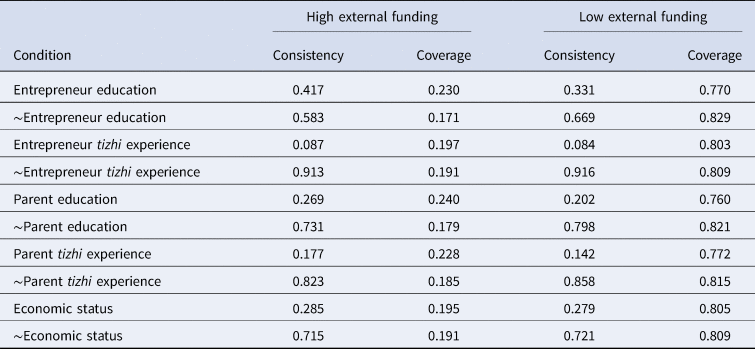
Necessary condition analysis must be conducted to determine whether any single causal condition is necessary to generate the outcome (Ragin, Reference Ragin2008). If the consistency value of a particular condition exceeds the threshold of 0.90, then the condition is a necessary condition to produce the outcome (Pappas & Woodside, Reference Pappas and Woodside2021; Wu, An, Zheng, & Zhang, Reference Wu, An, Zheng and Zhang2021). We conducted a necessary condition analysis on the five causal conditions to determine the necessary conditions. As shown in Table 2, except for the absence of entrepreneur tizhi experience, the consistency values of all the other conditions were well below 0.90 in both high and low external funding outcomes. Thus, the absence of entrepreneur tizhi experience is a necessary condition for both high and low external funding in a new venture.
Necessary condition analysis of each single condition for external investment proportion

Truth table construction and sufficient condition analysis
We perform the main analysis using the truth table algorithm in fsQCA 3.0 (Ragin, Reference Ragin2014). We construct a truth table by using the five causal conditions after the calibration. The truth table contains 32 (25) possible logical combinations of the five conditions, which take a value of either 1 (‘fully in’) or 0 (‘fully out’).
We conducted sufficient condition analysis by reducing the initial truth table through three steps. First, we employed a frequency threshold to choose the minimum number of cases for each solution to be considered as a configuration (Ong & Johnson, Reference Ong and Johnson2023). The common threshold of two cases will generally fit the situation of small-sample analysis (Fainshmidt et al., Reference Fainshmidt, Witt, Aguilera and Verbeke2020; Fiss, Reference Fiss2011). Our sample size can be considered as large for fsQCA (Fainshmidt et al., Reference Fainshmidt, Witt, Aguilera and Verbeke2020); therefore, we aim to obtain an optimal number of solutions and retain around 90% of the cases. Thus, we set the threshold to nine cases for each configuration (equivalent to 90% of the cases) in both high and low external funding scenarios. We also ensure the robustness of this choice by increasing and decreasing the threshold in the supplementary analyses.
Second, we selected the threshold for two consistency indicators to further simplify the truth table. Consistency represents the degree to which the cases in each configuration that share the same causal conditions can yield a consistent outcome (Pappas & Woodside, Reference Pappas and Woodside2021). A high consistency score indicates that a certain configuration will produce the outcome (Ong & Johnson, Reference Ong and Johnson2023). We employed proportional reduction in (PRI) consistency to avoid any potential simultaneous configuration subsets appearing in the presence or absence of the outcome (Pappas & Woodside, Reference Pappas and Woodside2021). A large PRI consistency score indicates sufficient consistency and few conflicting configurations. Configurations with a PRI consistency value below 0.5 are unacceptable (Greckhamer et al., Reference Greckhamer, Furnari, Fiss and Aguilera2018). Following prior leads, we set the raw consistency threshold to 0.80 and PRI consistency to 0.75 (Dwivedi, Joshi, & Misangyi, Reference Dwivedi, Joshi and Misangyi2018; Ragin, Reference Ragin2008).
Third, the final configurational results are based on a standard counterfactual analysis, opting for the presence or absence of a causal condition. We assume that high and low external funding would occur with the absence of entrepreneur tizhi experience based on the necessary condition analysis. For the other conditions, we chose either presence or absence due to the lack of a relevant theory about such a choice (Ong & Johnson, Reference Ong and Johnson2023). The sufficiency analysis results in a complex solution, a parsimonious solution, and an intermediate solution (Ragin, Reference Ragin2014). Following previous studies (Chen & Tian, Reference Chen and Tian2022; Ong & Johnson, Reference Ong and Johnson2023), we used intermediate and parsimonious solutions to report our final configurations. Parsimonious solutions are primarily used to detect core conditions.
Results
Using the above procedures, we analyzed the data with the fsQCA 3.0 software. Interestingly, no configurations for high external funding emerge while five configurations for low external funding are identified during the process. The results further validate the asymmetrical principle of fsQCA. Table 3 shows the five configurational paths leading to low external funding. To be consistent with prior research (Chen & Tian, Reference Chen and Tian2022; Ong & Johnson, Reference Ong and Johnson2023), we use black circles to indicate the presence of a condition and circled crosses to represent its absence. The large circles indicate the core conditions, whereas the small ones indicate the peripheral conditions. The blank spaces represent the ‘do not care’ condition, which can be either the presence or absence of a condition. The overall consistency of the solutions is 0.837, with the consistency of each solution being well above 0.80. Thus, all the configurations reach a satisfactory level of agreement in producing the outcome (Pappas & Woodside, Reference Pappas and Woodside2021). The overall coverage is 0.680, which indicates that the five configurations cover 68% of the membership in the set of firms with a low level of external funding. This result is relatively high for a large-sample QCA study (Greckhamer et al., Reference Greckhamer, Misangyi and Fiss2013).
Configurations for low external investment proportion

Notes: ‘ ' indicates the presence of a core condition; ‘
 ' indicates the absence of a core condition; ‘
 ' indicates the presence of a peripheral condition; ‘
 ' indicates the absence of a peripheral condition; blank spaces represent the ‘do not care' condition, which can be either present or absent.
Overall, the five configurations are equifinal sufficient combinations of the conditions that will yield low external funding for the new ventures founded by young nascent entrepreneurs. Configuration 1 (~EE*~ETE*~PE*~ES) suggests that entrepreneurs who belong to the low-economic-status group, have a low level of intergenerational education, and lack of prior tizhi experience will result in a low level of external funding. Specifically, the lack of a high education level in both generations is the core condition. With a coverage of 43%, this configuration is the most common among the five configurations.
Configuration 2 (~ETE*~PE*~PTE*ES) and Configuration 3 (~EE*~ETE*~PTE*ES) show that when the entrepreneurs have a high economic status, the lack of prior tizhi work experience in both generations will be sufficient for low external funding, with either the entrepreneur or their parental generation having a low education level. Meanwhile, education and economic status are the core conditions in the two configurations.
Configuration 4 (EE*ETE*~PE*~PTE*~ES) depicts a situation in which the entrepreneurs belong to the low-economic-status group, and a high education level and tizhi experience are absent in their parental generation. This situation will lead to a low level of external funding even though the entrepreneurs have a high level of education and tizhi experience. We notice that the presence of the entrepreneurs' tizhi experience is a core condition, whereas the absence of the condition is a necessary condition in the previous section. One possible explanation for this finding may be the high frequency of no tizhi experience in the data (Mattke, Maier, Weitzel, Gerow, & Thatcher, Reference Mattke, Maier, Weitzel, Gerow and Thatcher2022). In addition, in a large-sample QCA, some niche configurations may go against some dominant and common ones in the data. Thus, following the practice of prior research (Mattke et al., Reference Mattke, Maier, Weitzel, Gerow and Thatcher2022), we do not consider the absence of entrepreneurs' tizhi experience as a necessary condition.
Configuration 5 (EE*~ETE*PE*PTE*~ES) describes the core conditions in which entrepreneurs' parental generation has a high level of education and tizhi experience, but the entrepreneurs belong to the low-economic-status group. In the above situation, the condition of the entrepreneurs not having any prior tizhi experience would be sufficient for low external funding even though the entrepreneurs have a high level of education.
Robustness Tests and Supplementary Analyses
In order to verify the robustness of our findings, we have explored alternative model specifications, alternative measures, and supplementary analyses such as traditional regressions and latent class analysis.
Alternative QCA specifications
Following commonly recommended practices by prior research (Greckhamer et al., Reference Greckhamer, Furnari, Fiss and Aguilera2018; Zhang & Du, Reference Zhang and Du2019), we conducted robustness checks by changing the consistency threshold, adjusting the frequency threshold, and altering the calibration points and sample size. We refer to the set relation and fit difference of the configurations as the evaluation standards. The results are summarized in Table 4.
Summary of robustness tests

First, we focused on the consistency threshold. We increased the raw consistency threshold from 0.8 to 0.82 and the results remain unchanged. When we increased the raw consistency threshold to 0.83, Configurations 3 and 5 are eliminated, whereas the other configurations remain unchanged. However, coverage decreases slightly. When we increased the consistency threshold to 0.85, Configurations 3 and 5 are reduced, whereas the other solutions remain unchanged or become a subset of the baseline solutions. However, coverage decreases to 9.8%, which is common in large-sample QCA (Greckhamer et al., Reference Greckhamer, Misangyi and Fiss2013). We further reduced the PRI consistency threshold to 0.7, which is a common practice in prior research. Our results remain the same, but coverage decreases.
Second, we changed the frequency threshold. We initially reduced the frequency to 5, which is often used in large-sample QCA, and our results remained robust. We further increased the frequency threshold to 12 (around 80% of the total cases; Greckhamer et al., Reference Greckhamer, Misangyi and Fiss2013). Configuration 4 is eliminated, whereas the other solutions remain stable or similar.
Third, we recalibrated the outcome variable. Although we justified our use of 0.5 as the crossover point in the main analysis, we tried to recalibrate our outcome variable by using the sample mean (0.163) as the crossover point. Similar to those above, Configurations 3 and 5 are eliminated, whereas the other solutions remained logically consistent.
Following prior research on QCA (McKnight & Zietsma, Reference McKnight and Zietsma2018), we used a subsample (n = 249) by reducing the threshold of the entrepreneurs' age to below 30 years. Configurations 4 and 5 are dropped, whereas the other solutions remained the same or became a logical superset of the baseline solutions. Overall, the robustness tests logically show that the findings are not significantly qualitatively different from the baseline results (Greckhamer et al., Reference Greckhamer, Furnari, Fiss and Aguilera2018; Schneider & Wagemann, Reference Schneider and Wagemann2012). Thus, the main results are robust.
Alternative measures
In order to verify the robustness of the specific factors we have employed in the main analysis, we explored several alternative measures of the outcome variable, social and financial capital. For the outcome variable, we also considered using the external-to-personal funding ratio to reflect the venture's relative ability to attract external funding. Our results remained logically consistent when we replaced the external funding proportion with the external-to-personal funding ratio. For the entrepreneur's social capital, we employed the entrepreneur's political ties and the entrepreneur's business membership as alternative measures. The results remained logically consistent when we replaced the entrepreneur's tizhi experience with either the entrepreneur's political ties or the entrepreneur's business membership, or when we merged the above two types of capital to the original condition.
In the main analysis, the entrepreneur's perceived economic status is utilized to reflect family financial capital. The entrepreneur's annual income is also considered as an alternative measure of financial capital. The results are logically consistent except for the drop of Configuration 4. In addition, parental prestigious working experience is added to the original five conditions with the assumption that such working experience would help the parent to accumulate wealth. The results remain logically similar. A detailed summary of the results with alternative measures, together with their operationalizations, can be found in Table A1 in the Appendix. With robust findings from alternative measures, we aim to provide a more general view of how configurations of intergenerational capital endowments shape external funding in new ventures.
Traditional regressions
To further eliminate alternative mechanisms, we introduced traditional regressions to examine how configuration membership would relate to the venture's external funding when controlling for relevant covariates. We followed the recommendations of prior leads to categorize each firm into different configurations based on their membership scores in each causal condition (Meuer & Rupietta, Reference Meuer and Rupietta2017; Ong & Johnson, Reference Ong and Johnson2023). Due to conceptual similarity and the high correlation of membership score in Configurations 2 and 3, we combined cases from these two configurations into one category. Several factors at the regional, firm, and entrepreneur levels are controlled to rule out alternative mechanisms. The fractional logit model is utilized considering the nature of the outcome variable. The results show that after controlling for potential covariates, all four configurations have a negative relationship with the venture's external funding, supporting the main findings in fsQCA (Table A2 in the Appendix). We also obtained similar results when the Tobit model is applied.
In addition, to explore whether similar conclusions would be reached through traditional variable-centered approaches, we conducted an additional regression predicting the venture's external funding by introducing the two-way interactions of the entrepreneur and parent human and social capital (Ong & Johnson, Reference Ong and Johnson2023). We do not include higher-order interactions considering the difficulties in the interpretation of results and the large number of possible interactions. The results show that only the interaction term of intergenerational tizhi experience was marginally significant (b = −0.354, p < 0.1) (Table A3 in the Appendix). Thus, the configuration of two generations with tizhi experience would lead to low external funding. However, if we use the traditional variable-centered approach, we will miss the configurations that both entrepreneur and parent without tizhi experience can also have low external funding. Thus, fsQCA can generate more insights when multiple causal conditions exist and have complex interactions with each other (Fainshmidt et al., Reference Fainshmidt, Witt, Aguilera and Verbeke2020).
Latent class analysis
Latent class analysis (LCA), as an alternative approach for configurational analysis, is also evaluated. We explored whether any intergenerational capital endowment classes exist in our data and whether the generated classes are associated with different levels of external funding. Following the lead of prior research, we identified the latent classes without a priori assumption on those classes (Gabriel et al., Reference Gabriel, Campbell, Djurdjevic, Johnson and Rosen2018). Based on multiple enumeration fit statistics for each model (Tables A4 and A5 in the Appendix), the three-class model is the best solution considering its low AIC, BIC, aBIC value, the statistical significance of pLMR and pBLRT value (p < 0.05), large entropy value (>0.8), and smallest class size (>5%) among all models. The results (Table A6 and Figure A1 in the Appendix) show that the three classes are qualitatively similar to Configuration 5, Configuration 4, and Configuration 1 respectively in the fsQCA analysis. For example, class 1 has families with a high probability of high entrepreneur education, low probability of entrepreneur tizhi experience, high probability of high parent education, high probability of parent tizhi experience, and low probability of high economic status. Thus, the configuration in class 1 is highly similar to what we find in Configuration 5 in fsQCA.
In the LCA analysis, we also included external funding as a distant outcome variable via the Bolck, Croon, and Hagenaars (Reference Bolck, Croon and Hagenaars2004) auxiliary method (Gish, Guedes, Silva, & Patel, Reference Gish, Guedes, Silva and Patel2022). The results (Table A6 in the Appendix) show that all three classes have a relatively low level of external funding while class 3 (with a low probability of high capital endowment in all dimensions) has the lowest level of external funding. These results complement fsQCA by identifying different levels of external funding associated with different intergenerational endowment configurations.
Discussion
Using a sample of 592 new ventures founded by young nascent entrepreneurs, we discover different combinations of entrepreneurs' familial intergenerational human, social, and financial capital that are sufficient for a low level of external funding for a new venture. The reason for the outcome is primarily entrepreneurs' lack of ability to convey a combination of credible signals to attract external capital. We highlight the importance of treating an entrepreneur's family portfolio as a unit of analysis in new venture financing research.
Intergenerational Capital Endowments as Prevention-Based Signals for External Financing
The causal asymmetry feature of fsQCA provides the opportunity to detect distinctive configurations leading to high and low external funding. Interestingly, no consistent configurations concerning high external funding emerge in our analysis. Instead, five configurations are identified to result in low external funding. On the one hand, the asymmetrical results in high and low external funding further prove the value of using fsQCA as our analytical approach. On the other hand, it provides us the opportunity to explore the nature of intergenerational capital endowments as signals for external financing.
When making financing decisions, external investors may utilize either promotion or prevention-based considerations to evaluate the venture's potential (Kanze et al., Reference Kanze, Huang, Conley and Higgins2018; Malmström, Voitkane, Johansson, & Wincent, Reference Malmström, Voitkane, Johansson and Wincent2020). With a promotion focus, external investors tend to focus on the achievement and growth of a venture. They are more sensitive to the presence of positive outcomes (Crowe & Higgins, Reference Crowe and Higgins1997). With a prevention focus, external investors concentrate more on safety and security, and ensure making correct rejections and against any omission errors (Crowe & Higgins, Reference Crowe and Higgins1997). They are more sensitive to escaping from negative outcomes.
The five configurations on low external funding suggest that intergenerational capital endowments are more likely to be utilized by external investors as prevention-based signals to evaluate a venture's investment potential. The intergenerational capital endowments help external investors identify which new venture would have a high risk of failure and low investment potential, and thus make correct rejections. In addition, we do not detect any intergenerational capital endowment configurations to attract a high level of external funding. The findings suggest that intergenerational capital endowments might not function as promotion-based signals to attract high external funding. Thus, although intergenerational capital endowments might not be sufficient for external investors to make a pitch, they are fair enough for external investors to make a rejection decision.
Intergenerational Capital Endowments as Compound Signals
An entrepreneur's human capital, social capital, and financial capital are highlighted as important signals of the quality or investment potential of their business venture (Gartner et al., Reference Gartner, Frid and Alexander2012; Pinelli et al., Reference Pinelli, Cappa, Franco, Peruffo and Oriani2020; Plummer et al., Reference Plummer, Allison and Connelly2016; Shane & Cable, Reference Shane and Cable2002). Our findings show that the presence or absence of any single factor is not sufficient to explain why ventures have different levels of external funding. Thus, though entrepreneurs' different capital endowments send important signals to potential investors, an isolated perspective is insufficient for understanding the role of each signal, because different signals may have a complementary or substitutable effect (Edelman, Manolova, Brush, & Chow, Reference Edelman, Manolova, Brush and Chow2021).
Specifically, our findings suggest that the endowments of the entrepreneur and their parental generation are both pertinent to affect external funding. By taking an intergenerational view of entrepreneurs' family's capital endowments, we not only examine an entrepreneur's family capital endowments as an entire portfolio but also observe the family dynamics embedded across intergenerational capital endowments. Such dynamics will contain critical information on the entrepreneur's potential, the amount of possible support from their parental generation, and the intergenerational mobility path of their family. Intergenerational capital configurations can send a compound signal to investors to evaluate a venture's potential.
Intergenerational human capital dynamics acts as a critical signal
Our results show that from Configuration 1 to Configuration 4, either the entrepreneurs or their parents failed to attain an education higher than the college level. Education, as an important part of human capital, can bring cognitive resources to a new venture (Carter et al., Reference Carter, Brush, Greene, Gatewood and Hart2003). When both generations have a low level of education (Configuration 1 and possibly Configurations 2 and 3), it will signal that the entrepreneur's family may not be able to bring considerable cognitive resources to their venture, and the business will not likely be knowledge-driven. External investors will evaluate such ventures as with low investment potential. Intergenerational mobility may occur when only the entrepreneur or their parental generation has a high level of education (Guo, Song, & Chen, Reference Guo, Song and Chen2019). The education level inconsistency may result in a cognitive gap in an entrepreneur's family. Such a cognitive gap will impede effective communication between the two generations, which may result in potential conflicts (Kubíček & Machek, Reference Kubíček and Machek2020). The inconsistency in educational attainment may indicate that either the parent lacks the ability to transfer or sustain his family's human capital, or the entrepreneur cannot gain a sufficient understanding from their undereducated parents. In both scenarios, the venture will lack the ability to convey credible signals of solid human capital to investors owing to the low signal consistency, which will result in a low level of external funding. Notably, Configuration 5 is the only one in which the entrepreneurs and their parents have a high level of education. However, owing to the entrepreneurs' lack of social and financial capital, high intergenerational education alone is not a sufficient signal to indicate high quality.
Intergenerational social capital dynamics as a fundamental signal
Prior research highlighted the importance of social capital in new venture financing (Chua et al., Reference Chua, Chrisman, Kellermanns and Wu2011; Kotha & George, Reference Kotha and George2012). Social capital is particularly important in emerging economies where informal institutions play a critical role in market transactions (Li et al., Reference Li, Wei, Cao and Chen2022). Among several types of social capital, our findings suggest the fundamental role of tizhi experience, which is a particular form of social capital in the Chinese context (Xu et al., Reference Xu, Duan and Lin2022). From the perspective of family dynamics, the results indicate that the absence of social capital in the two generations (Configurations 2 and 3), loss of social capital in the young generation (Configurations 1 and 5), or acquisition of social capital in a family with low capital endowments (Configuration 4) may serve as a compound signal that can discount a venture's investment potential in the eyes of external investors, which will result in low external funding.
Family financial capital as a double-edged-sword signal
External investors will evaluate a venture's growth potential based on its financial conditions. The economic status of an entrepreneur can signal the initial financial condition of their new venture (Zhou, Ge, Li, & Chandrashekar, Reference Zhou, Ge, Li and Chandrashekar2020). A low economic status can signal the poor initial financial condition of a new venture, which can decrease its investment potential. In addition, the amount of financial capital needed for further growth may exceed an entrepreneur's family's initial financial conditions (Gilbert, McDougall, & Audretsch, Reference Gilbert, McDougall and Audretsch2006; Linder et al., Reference Linder, Lechner and Pelzel2020). Thus, the effect of financial capital will also depend on an entrepreneur's other capital endowments. Specifically, our findings highlight the importance of entrepreneurs' intergenerational human and social capital.
Our findings also identify three configurations related to the poor economic status of an entrepreneur. The low economic status of an entrepreneur will result in low external funding for their venture, especially when they lack other credible signals for their venture. Configuration 1 describes a situation in which no other type of capital can substitute for the lack of financial capital (Chandler & Hanks, Reference Chandler and Hanks1998), resulting in a resource scarcity scenario. Configuration 4 focuses on cases in which inconsistent signals across the two generations may indicate the lack of resource contribution of the entrepreneurs' parental generation and poor cognitive fit within the family. It can further exacerbate the poor financial conditions. Configuration 5 shows a scenario in which strong parental generation capital is coupled with entrepreneurs' poor financial capital and low social capital. It may reveal the poor ability of the entrepreneurs' parents to mobilize resources for the family's endowment growth and signal the poor support potential of the entrepreneurs' family for future business growth.
Interestingly, we also discover two configurations in which the entrepreneurs belong to the high-economic-status group. Configuration 2 and Configuration 3 are conditions in which high financial capital is coupled with poor intergenerational human and social capital. The results indicate that financial capital cannot compensate for the resource endowment constraints in the other dimensions (Linder et al., Reference Linder, Lechner and Pelzel2020). Thus, financial capital can create only the initial resource conditions for new venture funding but not for venture growth potential in the long run.
Four Family Prototypes for Low External Funding
The five configurations for low external funding can be explained by four family prototypes in Chinese society, based on the family capital endowment pattern.
The first prototype is the ‘grassroots family’, and Configuration 1 is a typical case. Although a high level of human, social, and financial capital is conducive to entrepreneurial activities, some ventures were created by entrepreneurs with low financial capital (Bruton, Ahlstrom, & Si, Reference Bruton, Ahlstrom and Si2015). Such entrepreneurs and their parental generation will typically have a low level of income and education (Bruton et al., Reference Bruton, Ahlstrom and Si2015). As grassroots, this type of family will often be isolated from the center of the market, approach strangers on the street, and constantly face resource scarcity. Some entrepreneurs from this type of family will be opportunity driven to address the needs of the low-income people in the market, whereas others will be necessity motivated for subsistence rather than growth (Si, Ahlstrom, Wei, & Cullen, Reference Si, Ahlstrom, Wei and Cullen2020). Ventures founded by subsistence entrepreneurs are typically small household businesses that rarely hire people outside the family (Si et al., Reference Si, Ahlstrom, Wei and Cullen2020). Such ventures generally have little potential to improve the life situation of the entrepreneur and their family (Bruton et al., Reference Bruton, Ahlstrom and Si2015). Without human and social capital to mobilize financial resources, most ventures from this type of family will have limited potential for future growth and scalability. Entrepreneurs born in such resource-scarce environments will likely have weak network positions (Clough et al., Reference Clough, Fang, Vissa and Wu2019). Thus, external investors will not likely invest in ventures founded by grassroots families, with the absence of all types of credible signals. The representative entrepreneur for the first prototype is Mr. Xiangjian He, the CEO of Midea Group. Born in a rural household, Mr. He received a primary school education and used to be a farmer and laborer, which made it difficult for his new venture to attract external funding.Footnote 1
Proposition 1: When the entrepreneur and their parents are short of human, social, and financial capital, new ventures are less likely to attract external funding.
The second prototype is the ‘economic upstarts family’. As a rising class in society, this type of family can be considered as bourgeoisie, with a strong profit-seeking orientation (Chen, Reference Chen2002). The economic transition opened up new possibilities for ordinary people in Chinese society to accumulate wealth. Many people start small- or medium-sized household businesses or private enterprises to accumulate personal and family wealth (Zhang, Zhang, Rozelle, & Boucher, Reference Zhang, Zhang, Rozelle and Boucher2006). Some individuals open household stores, with few employees, in the local market (Chen, Reference Chen2002), whereas others are gray entrepreneurs who take advantage of the institutional void and loopholes to gain economic benefits (Niu & Wang, Reference Niu and Wang2024; Peng, Reference Peng2001). For example, such entrepreneurs can trade foreign exchange through the black market or gain business licenses by bribing bureaucratic officials. In this type of family, the parental generation climbed the ranks from the bottom of Chinese society through self-employment, did not have prior tizhi work experience, and typically did not attain a high level of education (Chen, Reference Chen2002). Meanwhile, the second generation is typically born with a satisfactory wealth endowment because of their parents (Benton & Keister, Reference Benton and Keister2017). Through family education and imprinting, the young, rich second generation will often occupy an important position in the family business or start their own business. They may not show a strong interest in working in the tizhi system or have a primary interest in pursuing advanced studies. Configurations 2 and 3 can be categorized into this type of family. Although a strong initial financial condition is preferable for starting a new business, the sustainability of such a condition will depend on the family's social and human capital (Benton & Keister, Reference Benton and Keister2017). The incongruent signal between the financial condition and the family's social and human endowments may discount the investment potential of a new venture from the perspective of an external investor. The founder of Ding Ding Bike, Mr. Wei Ding, could be a typical example of the second prototype. Although his father is a rich businessman locally, Mr. Ding and his parents' shortage of human and social capital made it challenging for Mr. Ding's venture to attract external financing, compared to its competitors OFO and Mobike.Footnote 2
Proposition 2: Even if the family is in an advantaged economic status, when the entrepreneur and their parents are short of human and social capital, new ventures are less likely to attract external funding.
The third prototype is the ‘upward mobility family’. Configuration 4 can be classified under this type of family. In this family type, the parental generation will generally have a poor background, such as a low education level, no prior tizhi experience, and low economic status. This combination of low human, social, and financial capital is generally associated with a low socioeconomic status and class in society (Zhou et al., Reference Zhou, Ge, Li and Chandrashekar2020). This type of family typically consists of unskilled and semiskilled manual laborers or belongs to the agricultural working class (Chen, Reference Chen2013). Although intergenerational upward mobility is relatively difficult, the association between social class and education has weakened in the modern era (Breen & Jonsson, Reference Breen and Jonsson2005). The young generation can move up to a high social class by attaining a high level of education and seeking a prestigious occupation (Nee, Reference Nee1991). The entrepreneurs in our cases altered their family conditions by acquiring a bachelor's degree or higher and work opportunities in the tizhi system (Tsang, Reference Tsang2013). Such intergenerational family dynamics can unlock young entrepreneurs' potential for upward mobility. With a strong prospect for upward mobility, the second generation will likely engage in entrepreneurship to move up to a high social class (Wang, Liu, & Dai, Reference Wang, Liu and Dai2021). However, success in the business field will take time, especially when the entrepreneurs have financial constraints and family burdens. As nascent entrepreneurs, the outcomes of their entrepreneurial initiatives will involve considerable uncertainty. The mismatch in endowments between the entrepreneur and their parental generation may send incongruent signals of high investment potential. Thus, for ventures initiated by entrepreneurs from an intergenerational upward mobility family, the entrepreneurs will fail to acquire external funding owing to the poor origins of their parental generation. The representative entrepreneur for the third prototype is Mr. Chuanfu Wang, the chairman of the board of BYD Company. He has excellent human and social capital after graduating from Central South University in 1987, obtaining a master's degree in 1990, and entering into China Grinm Group Corporation, a central government-owned enterprise. However, his parents were both farmers who received little education. As a result, Mr. Wang found it arduous to secure external funding at the beginning of his entrepreneurship.Footnote 3
Proposition 3: Even if the entrepreneur is in an advantaged position of human and social capital, if the parental generation is short of human, social, and financial capital, new ventures are less likely to attract external funding.
The fourth prototype is the ‘post-political family (tizhi lonely bird family)’. Configuration 5 can best describe this type of family, in which the parental generation will often belong to the cadre group and have a position in the tizhi system as well as an education level higher than that of the general public (Peng, Reference Peng2001). Typically, this type of family will have an advantageous position in society through its prestigious occupational background in the tizhi system (Peng, Reference Peng2001). This type of family can either transfer its power or network, accumulate into assets for doing business, or maintain its position in the tizhi system (Nee, Reference Nee1991). Clearly, the parental generation in Configuration 5 did not accumulate high family wealth, which may indicate its poor ability to either do business or utilize its power to gain family wealth. Although a parent's successful political experience can help advance his children's political career (Laband & Lentz, Reference Laband and Lentz1985), the entrepreneurs in Configuration 5 are highly educated but have no tizhi experience, which may signal the parental generation's weak ability to use its power or position for the second generation's career advancement. Thus, in such cases, the parental generations are less likely to be successful entrepreneurs or powerful cadres (Zhao, Reference Zhao2002). This type of family can be considered to be highly intelligent, with lofty aspirations. Moreover, the parental generation will be less likely to utilize its power to gain private benefits, which may affect the entrepreneur's mindset through their family legacy. External investors may discount the potential of a venture of an entrepreneur from this type of family owing to the incongruent signals between the parental generation's high personal endowment and low financial capital. Representing the fourth prototype, Mr. Mingming Xiang, CEO of Hunan Chenguang Real Estate Company found it quite difficult to utilize his father's tie for his business funding although he has a good level of education. Mr. Xiang's father was the former county magistrate in Hunan province in China. He was a well-educated leader who never accepted bribes and had never engaged in corruption during his tenure. He genuinely detests those officials who take the people's money for their own personal gain. Mr. Xiang's father always asks him to concentrate on his studies and refuses to leverage his power for business gain.Footnote 4
Proposition 4: Even if the entrepreneur is in an advantaged position of human capital and their parents are in an advantaged position of human and social capital, if the entrepreneur is short of social capital and the family is short of financial capital, new ventures are less likely to attract external funding.
In summary, the above four types of families will receive a low level of external funding owing to their lack of ability to convey credible signals of their venture's growth potential. Either the absence of all capital signals or incongruence among multiple signals will discount a venture's potential for external investors, which will result in low external funding.
Theoretical Contributions
First and foremost, we extend the signaling perspective in the new venture financing literature. Owing to the uncertainty and information asymmetry between entrepreneurs and potential investors, the quality of new ventures cannot be observed easily (Bafera & Kleinert, Reference Bafera and Kleinert2023), especially for those founded by nascent young entrepreneurs without a valid track record in the business field (Nagy et al., Reference Nagy, Pollack, Rutherford and Lohrke2012). Gaining financing from external investors would be difficult for new ventures. Prior research highlighted the use of signals to convey a venture's qualities and reduce information asymmetry (for a review, see Colombo, Reference Colombo2021). Entrepreneurs' characteristics as well as those of their family can be used as signals to communicate the quality of their new venture. However, such characteristics are often examined in isolation. We extend this stream of literature by emphasizing the signaling role of intergenerational capital configurations in an entrepreneur's family system. On the one hand, we emphasize the crucial role of an entrepreneur's endowment as well as that of their parental generation as signaling portfolios (Bafera & Kleinert, Reference Bafera and Kleinert2023). On the other hand, we join the emerging research that highlights the importance of signal configurations to new venture financing (Edelman et al., Reference Edelman, Manolova, Brush and Chow2021). Our research suggests that the presence or absence of a single capital type is not sufficient to determine external funding. Multiple configurations of intergenerational capital can collectively signal a venture's quality and investment potential.
In addition, we also answer the call to examine the signal consistency of multiple signals in new venture financing (Colombo, Reference Colombo2021). Our findings suggest that intergenerational mobility can affect family dynamics and result in signal inconsistency. When different signals present conflicting information, it may create barriers to effective communication (Bafera & Kleinert, Reference Bafera and Kleinert2023; Colombo, Reference Colombo2021). Such conflicting signals can occur across not only different capital dimensions (i.e., human, social, and financial capital) but also different generations (i.e., parent and child) within the family system. In this article, three typical incongruent signal scenarios regarding intergenerational capital endowments are identified. The ‘economic upstart family’ sends incongruent signals across dimensions (i.e., high financial capital vs. low non-financial capital). The ‘upward mobility family’ delivers incongruent signals across generations (i.e., high endowment of the entrepreneur vs. low endowment of the parent). The ‘post-political family’ conveys incongruent signals across both dimensions and generations (i.e., high personal endowment of the parent vs. low family financial capital; high personal endowment of the parent vs. low social capital of the entrepreneur). The presence of incongruent signals may discount the investment potential of the focal venture, which will result in low external funding.
Second and relatedly, we highlight intergenerational capital endowments as prevention-based signals in new venturing financing. For investors, it is usually easier for them to make a prevention-based decision not to invest due to the high level of uncertainties and risks of new ventures. In contrast, making a promotion-based decision to invest in new ventures is generally challenging, which requires careful investigation besides easily obtained signals. Although it might be difficult for new ventures to convince potential investors to inject external funding through presenting intergenerational capital endowment, displaying certain intergenerational capital configurations is fair enough for external investors to give an unfavorable evaluation of the venture, thereby declining investment opportunities. Prior research suggests that an entrepreneur's gender identity can trigger external investors' different regulatory focus in making investment decisions (Kanze et al., Reference Kanze, Huang, Conley and Higgins2018; Malmström et al., Reference Malmström, Voitkane, Johansson and Wincent2020). In this study, we join the emerging research to identify the entrepreneur's family endowment portfolio as another important but underexplored factor that affects investors' regulatory focus in investment decisions. We also extend prior research by examining the negative message content of signals (Colombo, Reference Colombo2021).
Third, our study contributes to the literature on the intersection of family and entrepreneurship by highlighting family dynamics in a fast-changing society. We contribute to the literature by introducing the intergenerational capital endowment as a critical manifestation of family dynamics. In addition to explicit structural change in the family system and altered relationships among family members, we highlight the social class mobility across two generations in China as an implicit form of family transitions, evidenced by a fast-changing society over the past decades. The introduction of this implicit form of family dynamics offers us the opportunity to investigate the externality of family dynamics in entrepreneurship in China.
Researchers have long promoted the integration of the family into entrepreneurship research (Aldrich & Cliff, Reference Aldrich and Cliff2003; Molina, Reference Molina2020). However, prior research mostly adopted an internal perspective by exploring intergenerational factors that could affect strategy and decision making within a new venture (Carr, Chrisman, Chua, & Steier, Reference Carr, Chrisman, Chua and Steier2016; Fang, Kotlar, Memili, Chrisman, & De Massis, Reference Fang, Kotlar, Memili, Chrisman and De Massis2018). Instead of taking an internal view, we examine how intergenerational capital endowments can affect the judgment of a venture's quality of potential investors outside the firm. We highlight the role of intergenerational capital endowments as a valid signal to evaluate entrepreneurs from the eyes of Chinese investors, since family is the central operating unit of the Chinese society (Au & Kwan, Reference Au and Kwan2009; Fang et al., Reference Fang, Singh, Kim, Marler and Chrisman2022). By introducing the intergenerational capital portfolio view to the family system, we answer the call to incorporate family considerations into new venture creation and resource mobilization (Clough et al., Reference Clough, Fang, Vissa and Wu2019).
Limitations and Future Research
Our study has certain limitations that may serve as the basis for future research. First, we examined only two generations within an entrepreneur's nuclear family, as nearly all the earnings advantages or disadvantages of their ancestors would have been irrelevant after three generations (Becker & Tomes, Reference Becker and Tomes1986). Future research can consider other generations or the capital endowments of extended family members. Second, we considered only education, tizhi experience, and economic status as the primary indicators of the human, social, and financial capital of an entrepreneur's family. Although such factors may be salient as signals, future research can consider other indicators to represent capital endowments. Third, we differentiated only between personal and external investors. Different investors may have different logics; hence, future research should consider how signal configurations may differ among different types of investors (Fisher, Kuratko, Bloodgood, & Hornsby, Reference Fisher, Kuratko, Bloodgood and Hornsby2017). Fourth, we considered new ventures created by young entrepreneurs in which the parental generation will likely play a critical role. Thus, future research can examine the intergenerational effect across firm life cycles. Fifth, the ventures in the sample were founded during a specific period. Broad social changes may alter family dynamics and patterns over time (Aldrich & Cliff, Reference Aldrich and Cliff2003). Future research can examine intergenerational capital configurations in different periods to capture the temporal dynamics of social changes. Finally, some of our configurations have a relatively low coverage. Although it is quite common for some sufficient configurations to be rare in empirical settings (Wu et al., Reference Wu, An, Zheng and Zhang2021), future research can investigate other relevant factors that can improve coverage.
Data Availability Statement
The data that support the findings of this study are available from Privately Owned Enterprises Research Project Team. Data are available at https://cpes.zkey.cc/ with the permission of Privately Owned Enterprises Research Project Team.
Acknowledgments
The authors are grateful to the guest editor, Hanqing (Chevy) Fang and the anonymous review team for their guidance, support, and constructive comments. We also thank the participants in the MOR Special Issue workshop at Xiamen University for their valuable feedback. The research was partially supported by the National Natural Science Foundation of China (72302022), Guangdong Basic and Applied Basic Research Foundation (2023A1515110919; 2022A1515110847), Guangdong Philosophy and Social Science Foundation 14th Five-Year Plan Project (GD22YGL13), Guangdong University Innovation and Enhancement Project (2022WTSCX120; 2023WTSCX105), and UIC Research Grant (UICR0300028; UICR04202410-21; UICR04202411-21) at BNU-HKBU United International College.
Appendix
Intergenerational endowment classes probabilities (Casual condition = 1)

Summary of fsQCA results using alternative measures

Regressions of venture external funding on configuration membership

Regressions of venture external funding on intergenerational endowment interactions

Fit Indices for four models using latent class analysis (N = 592)

Group size distribution for latent class analysis

Intergenerational endowment classes

Chenguang Hu (chenguanghu@uic.edu.cn) is Assistant Professor at the Faculty of Business and Management, BNU-HKBU United International College in China. His research interests include international business, innovation and entrepreneurship, digital strategy, corporate governance, and strategic leadership with a focus on firms in emerging economies. His scholarly publications have been featured in prominent international journals, including Journal of World Business, Asia Pacific Journal of Management, and International Journal of Technology Management.
Peng Wang (pengwang@uic.edu.cn) is Associate Professor at the Faculty of Business and Management, BNU-HKBU United International College. His research focuses on inter-firm relationship (i.e., strategic alliances, international joint ventures, marketing channels) and entrepreneurship in emerging markets. His scholarly publications appear in several leading strategic management and marketing journals such as Journal of International Business Studies, International Journal of Research in Marketing, and Strategic Organization.
Jeffrey G. Covin (jcovin@uwyo.edu) is Professor of Management and Wyoming Excellence Chair in the College of Business, the University of Wyoming. His research interests include corporate entrepreneurship, strategic management, and innovation/technology management. His scholarly publications appear in several leading entrepreneurship and strategic management journals including, for example, Journal of Business Venturing, Strategic Management Journal, and Journal of Management Studies.