In his influential study of persistently democratic societies Lijphart (Reference Lijphart1999) argues for the general superiority of “consensus” over “majoritarian” institutions. Consensus institutions disperse power among distinct elements of a broad majority, while majoritarian institutions concentrate power in centralized institutions based on bare electoral majorities or pluralities. Lijphart finds that consensus institutions achieve levels of macroeconomic management and violence control similar to those of their majoritarian counterparts and perform considerably better representing various segments of society. In reflecting on his study, Lijphart offers the thought that highly effective consensus institutions would likely interact symbiotically with a “consensual political culture” (Reference Lijphart1999, 306). That is, Lijphart proposes that a consensual political culture, coupled with consensus institutions, would produce better government performance than consensus institutions. Yet he leaves the nature of such a culture unclear.
The nature of such a consensual political culture is an increasingly urgent question. Even among societies with consensus institutions (e.g., the Netherlands), the faltering pace of economic growth and the burgeoning diversity of populations have led to growing societal strains. Learning what cultural features nurture the mutual compromise that consensus institutions depend on and further facilitate would be helpful. In this article I investigate what a culture that interacts supportively with consensus institutions would be like for the 12 societies for which data are available: Belgium, Denmark, France, Germany, Iceland, Ireland, Italy, the Netherlands, Norway, Spain, Sweden, and the United Kingdom. Two good candidates for characterizing a consensual political culture are the “postmaterialism” found in Inglehart's comparative studies (e.g., Inglehart Reference Inglehart1997) and various mixtures of the four rival cultures of the “cultural theory” developed by Douglas, Wildavsky, and others (e.g., Thompson, Ellis, and Wildavsky Reference Thompson, Ellis and Wildavsky1990). I explore how societal postmaterialism and various societal mixtures of cultural theory's rival cultures, coupled with consensus institutions, influence governmental performance. I find that cultural theory's conception of culture contributes more to government performance and—less clearly—interacts more positively with consensual institutions than does postmaterialism's conception of culture, and I discuss why this may occur.
RELEVANT THEORY ON INSTITUTIONS AND CULTURES
Consensual and Majoritarian Institutions
Lijphart (Reference Lijphart1999) identifies 10 consensual democratic institutions and their majoritarian rivals. The first five of these polar pairs, forming what he calls the executives-parties dimension, are: (1) proportional representation election practices rather than the single-member district, plurality scheme; (2) a multiparty in place of a two-party system; (3) a multiparty coalition in contrast to a single party executive cabinet; (4) relative equality between the executive and the legislature as opposed to executive dominance; and (5) corporatist rather than pluralist interest representation. Collectively, these five institutions provide the majority of the benefits that Lijphart finds consensus democracies offer in contrast to their majoritarian counterparts.Footnote 1
Postmaterialism and Cultural Theory
Among comparativists, Inglehart's work on postmaterialism (Reference Inglehart1997) has had a high profile. Briefly, he argues that, as economic circumstances change, so, too, do cultures, leading to new political institutions. As economic development occurs, he posits the progressive replacement of traditional with modern and then modern with postmaterialist cultures. This last culture, currently growing in influence among the most affluent societies, significantly supplants a drive for greater material acquisition with a concern for better quality of life, fostering Green political parties and greater gender equality among other changes.
Cultural theory (CT) was conceived in sociology (Durkheim Reference Durkheim, Spaulding and Simpson1951), refined in anthropology (Douglas Reference Douglas1978; Evans-Pritchard Reference Evans-Pritchard1940) and advanced in political science (Thompson, Ellis, and Wildavsky Reference Thompson, Ellis and Wildavsky1990). CT explains how persons derive a limited range of answers to basic social questions such as: How does the world work, what are humans really like, and who is accountable to whom (Wildavsky Reference Wildavsky1994). Cultural theorists argue that peoples' answers to these questions produce orientations toward two basic social dimensions: the legitimacy of external prescription (grid) and the strength of affiliation with others (group). The theory thus addresses a void in the social sciences by helping to explain how distinctive preferences for social relations are formed as a consequence of various grid and group positions. The theory asserts that the range of actual social practice is constrained because only four general ways of answering these questions are socially viable: low-grid, low-group individualism; low-grid, high-group egalitarianism; high-grid, high-group hierarchy; and high-grid, low-group, nonsocially interactive fatalism. These patterns of social relations prompt functionally related beliefs and values or cultural biases. Together, the social relations and the cultural biases create distinctive ways of life or cultures.
CT's conception of culture is distinctive in several respects, two of which are relevant here. First, in contrast to thinking of cultures as roughly coincident with societies (e.g., Chinese culture), cultural theorists argue that all four of their theory's global ways of life are present in varying proportions in all large-scale, long-lived social entities. Similar to the interaction of different amino acids in biological systems, each way of life provides services for the others that they cannot create for themselves. Societies are thus “multicultural” in this sense.
Second, while these cultures contradict each other, producing some incompatible institutional preferences, they also exhibit areas of overlap, particularly among the three socially interactive forms. These overlaps create common ground that facilitates mutual compromise and sustains familiar trans-cultural coalitions that in certain configurations can be expected to interact positively with consensual institutions in enhancing governmental performance.
Lijphart (Reference Lijphart1999) finds consensus institutions to be most developed among the smaller democracies of northern Europe. Several of these societies also exhibit prominent postmaterialism. So, Inglehart's postmaterialism might be a strong bet for fulfilling the role of Lijphart's consensual political culture. It is also arguable that societies in which the adherents of CT's egalitarian culture are influential, likely in coalitions with either hierarchists or individualists, might also provide support for consensus institutions. Egalitarians prompt concerns for increasing equality of welfare and inclusion. These concerns are consistent with the foci of Lijphart's conception of consensus democracy. So, it is reasonable to hypothesize that each of these conceptions perceives culture in a manner that will complement Lijphart's consensus institutions. But a priori it is not clear which conception of culture might interact more constructively and why.
RESEARCH DESIGN AND DATA
Lijphart (Reference Lijphart1999) argues that consensus institutions provide government performance comparable to that offered by majoritarian institutions on economic management and control of political violence and superior performance on representing various segments of the citizenry. So, the dependent variable here is government performance. The World Bank Worldwide Governance Indicators (2010) data for 2000 on which I draw for the dependent variable have indices for “Government Effectiveness,” “Regulatory Quality,” “Rule of Law,” “Political Stability, No Violence” and “Voice and Accountability.” Collectively, these five indices operationalize Lijphart's criteria very well.Footnote 2 I calculate societies' government performance scores by adding their z-scores for these five indices. Cronbach's alpha for this index is .95.
The research question of this study is how two different conceptions of culture compare in their interaction with societal institutions in contributing positive effects to government performance (the dependent variable). In the following comparison of two regression models, both societies' government performance and their institutional character remain constant. Societies' institutional character is measured with Lijphart's executives-parties dimension (hereafter, executives-parties), based on the data appearing in Lijphart (Reference Lijphart1999, 312). This index is formed from the added average societal z-scores of the five elements of this dimension (electoral proportionality; number of effective political parties; percentage of nonminimal, winning one-party cabinets; degree of executive-legislative equality; and extent of interest group corporatism) across the period 1971–96. What differs between the two regression models is how culture is assessed. In one model, I use postmaterialism, drawing on data from Inglehart's 1990–91 World Values Study surveys (1997, 359—hereafter, postmaterial values). This variable solely represents the proportion of members of a society who express postmaterial values. In the other model I use my cultural theory index. My data come from Grendstad (Reference Grendstad1999, 473) which rests, in turn, on Inglehart's 1990 World Values Study surveys.Footnote 3 I create the index of societies' scores for various cultural mixtures by adapting a procedure I previously applied (Lockhart & Giles-Sims Reference Lockhart and Giles-Sims2010). This index is derived from the relative frequency of all four rival cultures in a society.Footnote 4
RESULTS
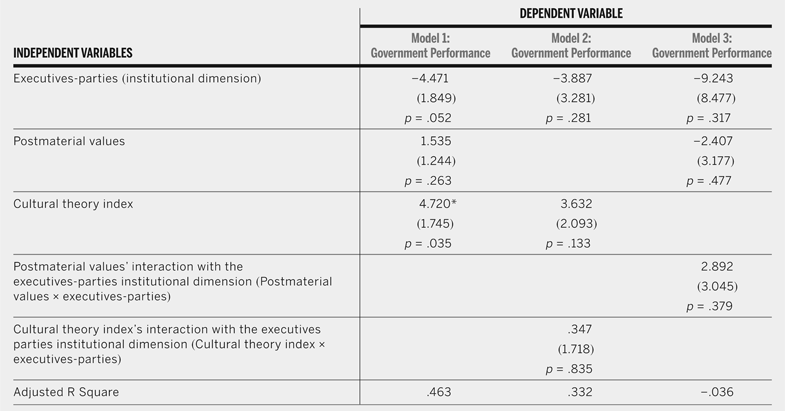
Table 1 presents three regression models rather than two. Model 1 represents a “baseline” which provides a direct comparison of the effects of executives-parties, postmaterial values, and the cultural theory index (and the two indicated control variables) on government performance. The executive-parties effect is negative. The two cultural effects are positive, but the cultural theory index effect is much stronger and statistically significant. This essential background information suggests that, for this sample of 12 societies, when the effects of culture are controlled, the effect of consensus institutions on government performance may be negative, rather than positive. When the effects of consensus institutions and one of the cultural measures are controlled, however, the other cultural measure exerts a positive effect on government performance. The executives-parties result may arise from sample peculiarities or close association between some independent variables, but it is also possible that Lijphart (Reference Lijphart1999) attributes effects to institutions that may actually arise from culture.

The table displayed above does not show two control variables, GDP/capita and societal population, which are included in the analysis. Neither of these controls produces statistically significant effects. The full analysis also includes Lijphart's (Reference Lijphart1999) federal-unitary institutional dimension and is available online at: http://www.pol.tcu.edu/faculty_staff/lockhart.htm.
N = 12 for all variables. Significant at < .05 = *. Standard errors are in parentheses.
Models 2 and 3, designed to test Lijphart's (Reference Lijphart1999) hypothesis about cultural and institutional interaction, are less informative than I had hoped. The low N (12) in combination with several correlations above .50 (potential multicollinearity) among the independent and control variables indicates that my data lack the capacity for producing clear results with respect to interaction. The only reasonably clear aspect is that Model 2, using the cultural theory index, explains (statistically) considerably more cross-societal variation in government performance than Model 3, which uses postmaterial values. Essentially, this effort to examine a rigorous, mathematical sense of interaction is indeterminate.
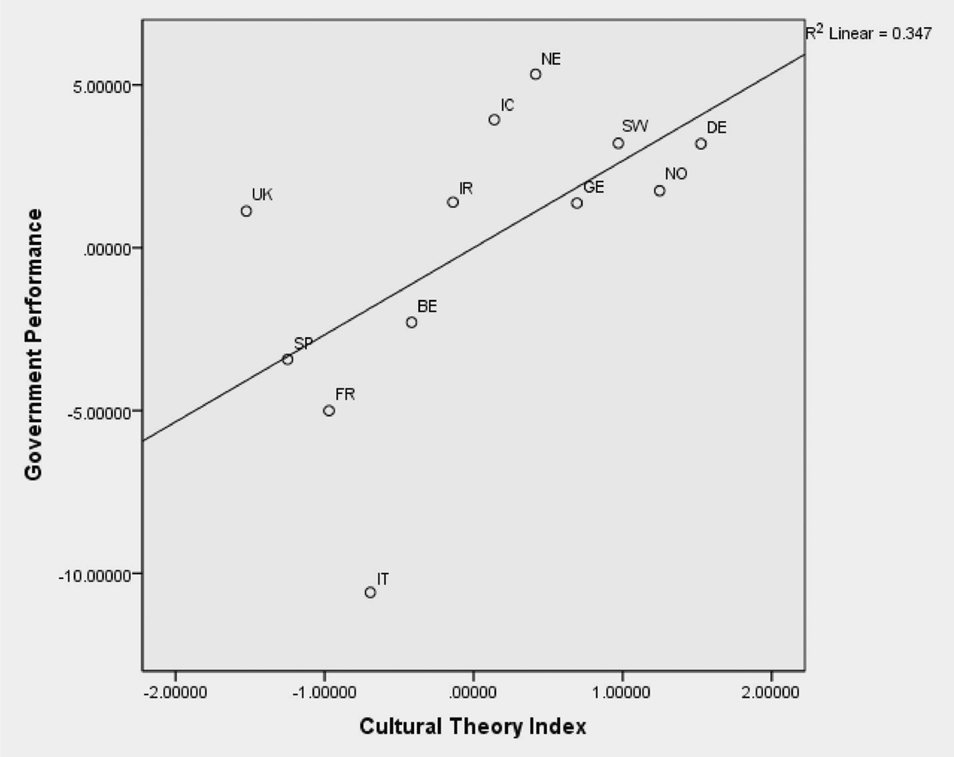
So, I turn instead to a form of analysis that demands less of its data via a pair of scatter plots. Although this analysis is useful for teasing out the basis for what appears from the regression to be the superior effect of the cultural theory index on government performance, it takes up a less rigorous conception of interaction with respect to cultural-institutional interaction. However, this conception, synonymous with culture supporting, complementing, or reinforcing consensual institutions, is closer to Lijphart's own (Reference Lijphart1999, 306) meaning of interaction. Figure 1 portrays the correlation between the cultural theory index and government performance. The simple correlation (.59) is statistically significant at <.05. Two distinct groups and four other societies appear. One group in the upper right includes the “Scandinavian” societies (Denmark, Iceland, Norway, and Sweden) plus the Netherlands. These societies exhibit high government performance, and they display five of the six highest cultural theory index scores. Also, in their populations they all have high proportions of egalitarians, sizeable contingents of hierarchists, and quite low proportions of fatalists. The second obvious group in the lower left involves the Mediterranean societies (France, Italy, and Spain). All these societies exhibit low government performance and have three of the four lowest cultural theory index scores. They also share high proportions of fatalists, lower proportions of hierarchists than Scandinavia and quite low proportions of egalitarians. The executives-parties dimension scores of these 12 societies correlate fairly closely with the cultural theory index (.71). Thus these cultural scores likely reinforce the effects of the institutional measure in producing government performance.Footnote 5 Therefore it is reasonable to infer that a paucity of actively inclusive egalitarians and a plethora of socially avoidant fatalists make less-productive use of consensus institutions in producing better government performance than do high proportions of egalitarians and low contingents of fatalists.
Cultural Theory Index and Government Performance

Belgium, Ireland, and the United Kingdom have cultural mixtures similar to, but not as extreme as, the Mediterranean societies. This combination produces intermediate levels of government performance from generally low cultural theory index scores. Germany shares government performance and cultural theory index scores with the “Scandinavian” group. But Germany's position rests on coupling high proportions of egalitarians with high proportions of individualists. So, with respect to Lijphart's executives-parties dimension, societies with significant egalitarian influence—either in combination with hierarchists in social democratic coalitions (the five “Scandinavian” societies) or, less clearly, with individualists in more classic liberal democratic coalitions (Germany)—foster better government performance.
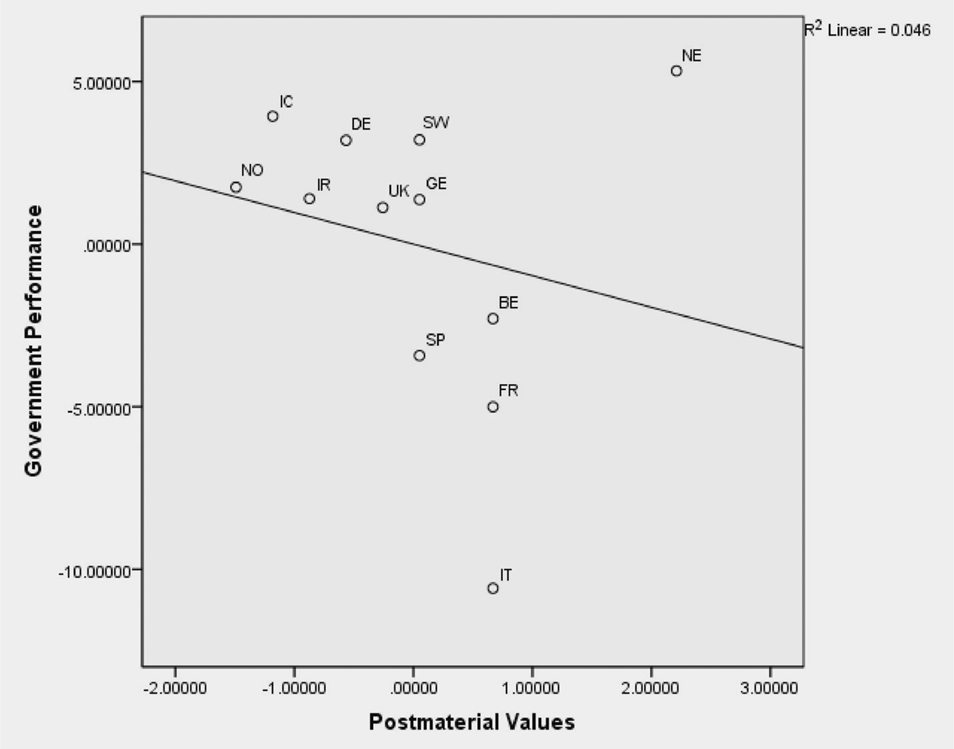
Figure 2 displays the correlation between postmaterial values and government performance. Two points of comparison with figure 1 are relevant. First, the simple correlation here is negative, but low and not statistically significant (−.21). To the degree that there is a relationship between postmaterial values and government performance for these 12 societies, it is negative rather than positive as for the cultural theory index. Second, in light of this and the correlation between postmaterial values and executives-parties (.09), it would appear quite unlikely that postmaterial values reinforces executives-parties in producing better government performance more than cultural theory index does. Further, Inglehart's conception of culture offers no clear basis—comparable to the relative proportions of and coalitional possibilities among cultural theory's rival cultures that I used with respect to figure 1—for explaining either this likely weak interaction between postmaterial values and executives parties or the clearly more limited contribution postmaterial values makes to government performance.
Postmaterial Values and Government Performance

DISCUSSION
We need to keep three points in mind about these results. First, the relationships depicted for the alternative conceptions of culture and government performance in figures 1 and 2 lack any controls for other variables. Second, it is reasonable to infer from the regression models and the scatter plots that the cultural theory index is contributing more positively to societies' governmental performance than is postmaterial values. Third, in contrast, the inference about the cultural theory index interacting more positively with executives-parties is less robust than the one on the cultural theory index's contribution toward government performance. Overall then, the relationships revealed in table 1 and figures 1 and 2 are not strong enough to identify clearly cultural theory as Lijphart's “consensual political culture.” Yet we can still learn something about the nature of such a culture by asking why variation in the cultural theory index appears to contribute more than postmaterial values toward government performance.
One key to explaining this matter is the characteristic common to Lijphart's 10 consensual institutions: the dispersal of political power across enduring institutions (e.g., rough executive-legislative power parity) or perennial societal divisions (e.g., allowing smaller political parties to cumulate votes through proportional representation) so as to regularly require mutual compromise, compromise that increases the proportions of citizens holding a stake in society. In short, consensus institutions foster, but also routinely require, compromises among societal factions.
It seems likely that all 12 societies in this study include persons with traditionalist, materialist, and postmaterialist cultural orientations. Inglehart's conception of culture, however, devotes little attention to how the members of these different cultures interact. He often focuses on summary measures (e.g., means) rather than dispersion and ensuing issues of relations among citizens with distinctive cultural orientations. Further, each culture is portrayed as likely becoming dominant in any society offering particular economic circumstances rather than having to share societal decision-making with rival cultures. Inglehart suggests that political development progressively marginalizes the traditionalist and then the materialist cultures. So, neither the nature of nor the relations among these cultures necessarily fosters compromise among them.
Although many of the substantive objectives of cultural theory's rival cultures also conflict, two features of this conception hold more encouraging possibilities for the sorts of compromises fostered and required by Lijphart's consensus institutions. First, CT explicitly recognizes and relies on the long-term mutual coexistence of its cultural types. While shifts in the relative strength of rival cultures in societies occur over time, only extraordinary efforts, such as those of hierarchists in the former Soviet Union, drive other cultures to the brink of extinction. Further, CT hypotheses that efforts by one culture to stamp out one or more its rivals will not be salutary for society. Each culture provides benefits for the others that they cannot provide for themselves. The Soviet Union imploded, in part, because its hierarchical totalitarian state so penetrated every part of the economy that it crushed the individualistic innovation necessary for the economic growth that the state needed to survive.
Second, because none of the four rival cultures is likely to be able to survive, much less rule on its own, compromises among cultures are required and routine. Further, the three socially interactive cultures are conceived in a way that the fault lines among them facilitate familiar trans-cultural coalitions. These coalitions are more clearly recognizable in political experience than any coalitions involving traditionalists, materialists and postmaterialists. For instance, of particular relevance to the societies involved in this study, the high-group cultures, egalitarianism and hierarchy, provide distinctive supports for socioeconomic rights. Their E-H (egalitarian-hierarchical) coalitions around these rights have provided the foundations for social democracy throughout much of Western Europe since World War II. Additionally, hierarchists and individualists accept different bases for social stratification, and their “establishment” coalitions share support of property rights (Thompson, Ellis, and Wildavsky Reference Thompson, Ellis and Wildavsky1990). This combination engendered H-I (hierarchical-individualistic) “blood and iron” coalitions in Europe during the nineteenth century. These coalitions now appear in East Asia where they are sometimes called “liberal autocracies.” The low-grid cultures, individualism and egalitarianism, share a dedication to civil and political rights, fostering a classically liberal (i.e., Locke-Smith) democratic I-E (individualistic-egalitarian) coalition in the current United States. Consequently, I suggest that a conception of culture that interacted highly constructively with Lijphart's consensus institutions would share the features of persistent rivalry, coexistence, and interdependence mitigated by convenient practical opportunities for coalition formation.
In conclusion, this study's findings suggest that specific combinations of cultural theory's rival cultures do a better job of producing superior government performance and likely interact more positively with consensus institutions than Inglehart's postmaterialism. In addition, the lines along which cultural theory distinguishes one culture from another coincide with patterns of cross-cultural coalitions in actual political life. This gives cultural theory a capacity for explaining—in terms of specific societal cultural coalitions—its superior performance that postmaterialism currently lacks.