Introduction
Like other Latin American countries, Chile is experiencing a rapid demographic and epidemiological transition. These transitions will be achieved with lower levels and progress in services, policies and development compared to European countries (Palloni and McEniry, Reference Palloni and McEniry2007; Provoste, Reference Provoste and Calderón2013). With increasing life expectancy and a high prevalence of non-communicable diseases, caring for dependent older people will become a relevant public issue. In Latin America, the family continues to be the primary institution in charge of providing older people's care (Martínez, Reference Martínez2007; Batthyány, Reference Batthyány and Aguirre2013) and care for dependent older people is largely informal, family-based and gender-imbalanced (Servicio Nacional del Adulto Mayor (SENAMA), 2009). In contrast, many European countries provide support to family care-givers to ease their role as carers and also institutionalised care is more common (García, Reference García2010).
Caring for dependent older people has commonly been approached from the perspective of the burden of care (Kahana and Young, Reference Kahana, Young, Biegel and Blum1990). From this perspective, intensity of care refers to the weight or the load associated with caring for someone else and centres on the negative consequences that caring for a dependent person has for the care-giver (Bover, Reference Bover2004). However, this approach has led to a limited understanding of the costs and benefits of informal family care-giving (García, Reference García2010).
From a public policy perspective, care-giving in Chile has drawn mostly on burden of care, despite the pitfalls identified. We explore whether this perspective is sufficient to understand care-givers’ experience, offering insight on the elements that may be missing to capture the experience of care in the country, and Latin America in general. We thus offer a more nuanced understanding of the experience of care and expand the understanding of this experience beyond the North American and European contexts.
Approaches to understanding the care experience
Drawing on the concept of burden of care, the medical literature measures the intensity of care through the negative physical and psychological effects on those who provide care. Similarly, the economic literature has commonly determined the intensity of care by counting the number of hours of direct care provided and the negative effects it brings to female wages, labour force participation and gender inequality (Carmichael and Charles, Reference Carmichael and Charles1998). Objective burden of care approaches usually draw on quantitative scales of time use, while subjective burden of care approaches use scales of depression, anxiety, apathy, fatigue or health (Choi and Seo, Reference Choi and Seo2019). Dwyer et al. (Reference Dwyer, Lee and Jankowski1994) define burden of care similarly, as a disruption in daily routines, social relationships and other activities, as a result of care. The interruption or disruption posed by caring in everyday life lies at the centre of both objective and subjective burden.
However, the burden of care perspective fails to account correctly for the experience of care through quantitative studies, leading to a limited understanding of the costs and benefits of informal family care-giving (García, Reference García2010). Care-givers performing the same tasks experience care differently (Werner et al., Reference Werner, Goldstein and Buchbinder2010) or some tasks relevant for care-givers are not considered in burden of care approaches (Campéon et al., Reference Campéon, Le Bihan and Martin2012). López et al. (Reference López, López-Arrieta and Crespo2005) found that a higher objective burden for the care-giver (e.g. longer period of time as the care-giver, caring longer hours per day, having less external support, etc.) does not correlate with the care-giver's satisfaction with their role as carer. Campéon et al. (Reference Campéon, Le Bihan and Martin2012) note how certain care activities, such as surveillance and providing emotional support, are not measured adequately in a burden of care perspective even though they are carried out at all times. Also, care-givers experience both negative and positive feelings simultaneously (Kramer, Reference Kramer1997); the same care-giver can draw satisfaction from helping their family members (Marks et al., Reference Marks, Lambert and Choi2002) while feeling exhaustion from this same activity (Pinquart and Sörensen, Reference Pinquart and Sörensen2003). Lin et al. (Reference Lin, Fee and Wu2012) found that the experience of care was positive or negative depending on certain factors like the care-givers’ hours worked per week, self-reported health, involvement in care, the availability of other care-givers and family conflict. These factors’ effects differed depending on care-givers’ gender and their relationship to the care recipient (e.g. wives, husbands, daughters and sons).
Studies that examine care-givers with multiple caring demands (a measure of high burden of care) found an association between higher burden, higher depression levels and lower wellbeing (Stephens et al., Reference Stephens, Franks and Atienza1997; Marks et al., Reference Marks, Lambert, Jun and Song2008). However, other studies found that holding multiple roles does not necessarily relate to negative outcomes (Dautzenberg et al., Reference Dautzenberg, Diederiks, Philipsen and Tan1999; Raveis et al., Reference Raveis, Karus and Pretter2000) as different care demands can be a source of respite (Duxbury et al., Reference Duxbury, Higgins and Schroeder2009). Along the same lines, co-residence – which could be understood as contributing to a higher burden of care (Dwyer et al., Reference Dwyer, Lee and Jankowski1994; Brody, Reference Brody2003; Bittman et al., Reference Bittman, Fast, Fisher, Thomson, Folbre and Bittman2004; Fast et al., Reference Fast, Keating, Otfinowski and Derksen2004) – has also shown mixed results (Call et al., Reference Call, Finch, Huck and Kane1999). Co-residence can allow for a more reciprocal relationship among mothers with dependency and their daughters (Dwyer et al., Reference Dwyer, Lee and Jankowski1994) and is linked to a lower prevalence of depressive emotions (Montoro, Reference Montoro1999). Similar mixed findings have appeared in relation to how paid work and vacations or leisure can reduce or increase the intensity of care (Palacios, Reference Palacios2017), underscoring how a narrow vision of care as burden paints an incomplete picture of the experience of care by ignoring other factors that influence this experience.
Burden of care perspectives, in focusing on the activities carried out, or on psychological effects, do not adequately explain how or why carers with similar care demands experience care differently. Neither objective nor subjective burden indicates how informal care-givers understand their role or where the meaning assigned to their experience comes from, two key elements for understanding the experience of care. The inability of measures of burden to explain the actual experience mean that there is an analytic gap between objective burden of care measures (tasks carried out) and subjective burden of care measures (psychological correlates of caring).
Campéon et al. (Reference Campéon, Le Bihan and Martin2012), Le Bihan and Martin (Reference Le Bihan, Martin and Widmer2008) and Martin et al. (Reference Martin, Le Bihan, Knijn, Le Bihan, Martin and Knijn2014) note that care-giving takes place in a broader social and emotional context. Care is a social relationship (Leira, Reference Leira1994; Glenn, Reference Glenn2000; England, Reference England2005; Ungerson, Reference Ungerson2005) and it has an emotional component (Hochschild, Reference Hochschild1979; Montaño and Calderón, Reference Montaño and Calderón2010). Twigg (Reference Twigg2000) emphasises the emotional element in care as it is embedded in interpersonal relations, in the feelings (often complex and conflictual) that make up family life. Understood as an inherent duality of work and emotion, care is not a heavy load or a joyful activity per se. The experience of care and how intense it is for the care-giver is thus not only a function of the tasks carried out. The experience of care crucially depends on the relationship between the carer and care receiver, the conditions under which care is given and whose choice it is (Kremer, Reference Kremer2007). Informal family care-giving develops out of socio/emotional relationships and cannot be understood independently of the relationships it involves, creates or modifies (Himmelweit, Reference Himmelweit1995; Ayres, Reference Ayres2000; Connell, Reference Connell2003; De la Cuesta, Reference De la Cuesta2009).
Most literature on the care-giving experience comes from European and North American populations, with very few reports coming from Latin American. Public and private support for the care of dependent older people in Latin America exists, but is weak in coverage and weak in the type of support it offers. For example, in Chile, day centres (centros diurnos del adulto mayor) are available only in 52 of the 345 municipalities and in the handful of municipalities where public respite is offered to carers through the Home-based Care programme (Cuidados Domiciliarios) it only covers two hours per week for a nine-month period (Palacios, Reference Palacios2017).
The distinction between the North American–European and Latin American contexts is relevant as care-giving in these regions has different institutional support. Understood from the perspective of welfare regimes (Esping-Andersen, Reference Esping-Andersen1990) and its application to Latin America (Martínez, Reference Martínez2007), when it comes to supporting older people's care, Chile has been categorised as a gendered familistic regime: care-giving for older people in Chile and Latin America is provided almost exclusively by female family care-givers through informal arrangements (Palacios, Reference Palacios2017).
Exploring the phenomenon of care-giving for older people in an institutional context in which the family holds full responsibility for care, and identifying the factors that influence how care-givers experience care, contributes to understanding better the phenomenon of care-giving in this particular context. It also helps in designing specific policies, offering a more comprehensive and nuanced approach than that of burden of care.
In this study, we analyse older people's care-givers from Chile and explore the factors that determine their experience of care. Chile is a relevant case study due to its accelerated demographic transition, the weak institutional support it offers for older people's care and the fact that, from a public policy perspective, care-giving in Chile has drawn mostly on burden of care to understand the phenomenon.
The context: care in Chile
Chile is at an advanced stage of the demographic and epidemiological transition, which it achieved at a comparatively faster speed than developed nations (SENAMA, 2009; Provoste, Reference Provoste and Calderón2013). This has brought a higher proportion of older people in the population and also an increase in dependent older people with long-term care needs. If in 1950 there were 11.7 older people for every 100 children under the age of 15 (the ageing index), this index reached 49 in 2015 and is projected to reach 200 by 2050 (CELADE, 2020). The latest National Study of Dependency, carried out in 2009, provides a snapshot of the carers for dependent older people. The study found that among people aged 60 years or older, 24 per cent have a physical or cognitive dependency, with 66 per cent being women and 34 per cent men. Among older people with some level of dependency, 51 per cent reported severe dependency, 21 per cent reported moderate dependency and 28 per cent reported low dependency. Nine out of ten of the dependent older people were cared for by a family member (86% are women, generally daughters or wives), the majority of whom devoted their daily life to care. They worked, on average, 16 hours per day on care, and 72 per cent of them provided care to the older person day and night. The study noted how two-thirds of family carers had not taken vacations in more than five years and only 8 per cent of care-givers received monetary compensation for their care work, showing how carers live burdensome lives with little recognition for their work (SENAMA, 2009).
In this context, we qualitatively describe the different ways carers experience care in a care regime that offers few (if any) options other than the family to provide care. We do not assume care is inherently burdensome and provide evidence about an understudied group. We focus on carers carrying out the same tasks in similar contexts to identify elements that are missing from the burden of care perspective to understand the experience of informal family carers for dependent older people. We thus unveil the complexity of factors underlying the actual experience of informal family carers and enrich the current quantitative burden of care approach. The results provide insights as to why similar tasks and contexts can become resources for some whilst being a constraint for others.
Methodology
We adopt an exploratory qualitative approach to study the daily experiences of main family care-givers. Qualitative methods pay attention to the meaning of phenomena rather than to their frequency (Van Manen, Reference Van Manen2002) and are directed towards understanding reality from the viewpoint of the actors themselves and the meanings people give to their own lives and experiences (Anadón and Guillemette, Reference Anadón and Guillemette2006), giving greater attention to emotional components of everyday life experiences (Lincoln et al., Reference Lincoln, Lynham, Guba, Denzin and Lincoln2011).
We analysed 42 cases of main or primary family carers of a dependent older parent or parent-in-law. We capture their experiences as narrated and emotionally expressed by the carers themselves. Whatever the care arrangement, the main or primary carer is whoever has the highest level of responsibility and/or performs the largest number of care-giving tasks. The main carer, then, is whoever provides assistance with both daily living and instrumental activities (Howe et al., Reference Howe, Schofield and Herrman1997). When part or all of the assistance is externalised, the main family carer is whoever monitors and organises care (Campéon et al., Reference Campéon, Le Bihan and Martin2012).
We guided the interviews using pre-established, general and open-ended questions that focused on care-givers’ daily routines, the reasons why they became care-givers, their socio-economic and emotional needs, the support they receive, and their history with and the relationship they have with the older person, siblings, their partner, friends and their community. Interviews also delved into care-givers’ feelings towards their situation, their expectations towards paid work, leisure and any other themes the participant was willing to share.
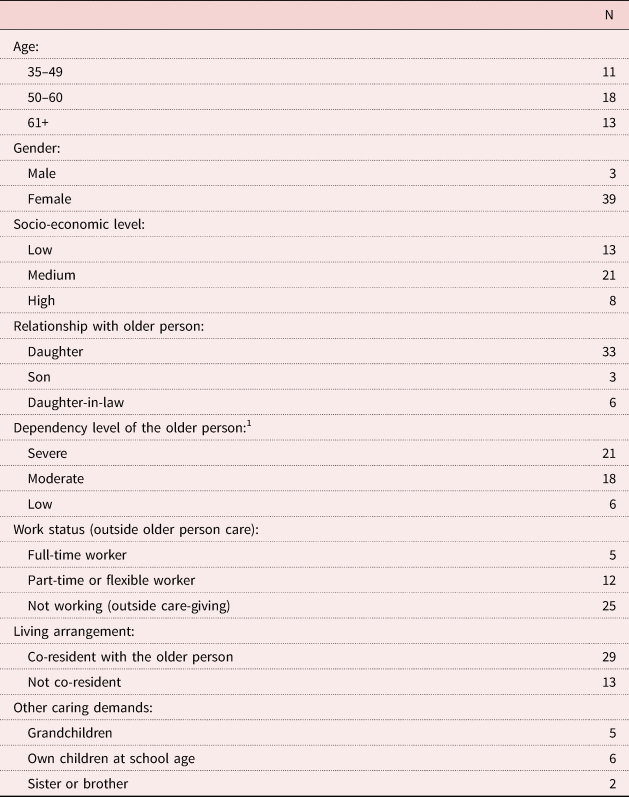
Cases come from four municipalities of the Metropolitan Region of Santiago, Chile. The four municipalities cover different geographic areas of the city and have a diverse socio-demographic population profile. Thirty-one cases were contacted through professionals from the social and health sector in the different municipalities. The remaining cases were gathered by snowball sampling among carers (the care-givers who were contacted first shared the names and contact information of people they know who were also providing care to a parent or parent-in-law). We use pseudonyms to ensure anonymity. Table 1 describes relevant characteristics of the carers interviewed for the study.
Participants details

Note: 1. The total is higher than 42 because some care-givers are responsible for caring for both parents or parents-in-law, so one care-giver has more than one older person in their care.
The sample is not intended to be statistically representative of the population of carers. It targets the variability among care experiences to understand it better. One or two interviews were conducted with each participant in November 2016, depending on the information gathered in the first interview, and the need for greater depth or clarification.
The first author carried out all interviews in Spanish and, depending on the emerging topics, prompted further questions. She conducted interviews at a time and place comfortable to the respondents (typically their home, but sometimes their workplace). Interviews lasted between 45 and 120 minutes. All participants gave their independent, informed consent for the interview and its recording, and had the option to cancel the interview at any point.
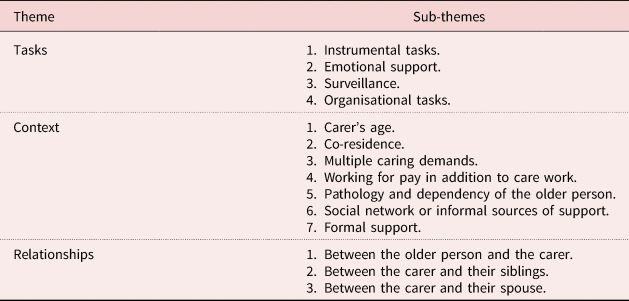
Following Braun and Clarke (Reference Braun and Clarke2006), we used an inductive thematic analysis for the full corpus of the interviews’ audios, transcripts and field notes. We identified essential themes related to each participant's situation, with particular attention to tasks, their context, relationships and intensity of the care experience. The essential themes are the aspects or qualities that make an experience how it is and without which the experience could not be what it is (Van Manen, Reference Van Manen1990). Codes were created from the collected data related to the essential themes that appeared. Codes were not extracted from previous research, as only a few studies have dealt with the phenomenon of the experience of informal care in Chile. We systematically labelled and compared all instances of particular themes throughout the transcripts. Table 2 presents the main themes that emerged. We analysed and coded the data in ATLAS.ti. The citations that exemplify these codes and the relationship between them were translated from Spanish by the main interviewer and verified by the other authors.
Main themes: determinants of the experience of care

Results
The care experience was not found to be exclusively related to the kind of tasks care-givers provided, as objective burden of care perspectives would predict. Even when analysing the different contexts in which the care tasks take place, we did not find a clear relationship between specific contexts and the ways carers experience care. Relationships – between the carer and the older person, the carer and siblings, the carer and spouse – appear as a fundamental dimension to understand how carers experience care.
This section first shows how similar tasks are experienced differently, showing how a compilation of tasks is not sufficient for understanding the experience of care. We then show how similar contexts are also experienced differently, before unveiling how relationships play a key role in explaining the caring experience.
Care-giving tasks
Care-giving tasks are diverse and vary across carers’ and older people's profiles. Tasks vary in their complexity and physical and emotional pressure. They can be categorised as instrumental tasks, emotional support, surveillance and organisational tasks (Campéon et al., Reference Campéon, Le Bihan and Martin2012). Contrary to what objective burden of care perspectives would predict, tasks are not uniformly difficult. While some tasks are in fact very difficult (e.g. bathing or moving a dependent older person), others are neutral for some carers but exhausting for others (e.g. making appointments with doctors) and still other tasks are experienced as respite by some carers but would best be avoided by others (e.g. house chores). Some tasks are continuous (e.g. surveillance) and cannot be reduced to a specific time or duration; they are typically absent from burden of care approaches yet still a potential source of intensity.
Instrumental tasks
Instrumental activities include housework such as doing the laundry and cleaning, preparing meals, shopping for groceries and clothes, managing older people's money, administrating medicine, etc. Personal assistance tasks include helping older people getting in and out of bed, feeding dependent older people, dressing them, toileting and/or bathing them (Organization for Economic Co-operation and Development, 2013). For some participants, these tasks tended to be experienced as overwhelming, especially personal care tasks (e.g. toileting and bathing):
Do you know what the most difficult part of my day is? When I'm bathing my mother, then I get hysterical. (Violeta)
When I bathe my mom or when I change her diapers I always think on the many many times in which she did the same for me when I was a little girl. Sometimes tears fall down my face, but it's not sadness, it is closer to joy, to gratitude. (Silvia)
For some carers the most difficult tasks relate to an older person's personal and intimate care because of the physical demand of lifting and moving an adult person but also, and perhaps more importantly, because of the emotional experience of seeing, very explicitly, their parent's (or parent-in-law's) dependency. Violeta goes on to say that bathing her mother is the primary expression of her mother's frailty and dependency; issues that she still has trouble accepting. Silvia thinks about herself as an infant and her mother changing her diapers when she changes her mother's. Contrasting Violeta's negative experience, Silvia sees bathing her mother as a way to return all she received from her mother when she was a child. Sylvia's physical and emotional strain are offset by the meaning of reciprocity she assigns to this activity. The past or present relationship between the older person and the carer explains the extent to which these presumably uniformly difficult tasks are, in fact, experienced with more or less pressure by carers.
House chores are also instrumental tasks. Cooking, cleaning and doing the laundry occupy an important part of care-givers’ time. They imply a high burden for Barbara, who detests them. Yet house chores were sometimes appreciated as they offered respite from the direct caring activities, as is true for Sara: ‘when I need a rest, I do housework, it is a relief for me to do these kinds of tasks, such as cleaning the house, cleaning the toilet, just doing these things helps me disconnect’. It is also true for Lucía, who disconnects and relaxes while cooking for her dependent father in her kitchen.
Emotional support
Carers also provide moral and relational support to dependent older people. This means giving the older person the sense of having someone on whom to rely, who is interested and concerned, who cares and who listens. Emotional support is provided on a daily and constant basis. This type of support, usually just spending time with the dependent parent by accompanying him or her, can be difficult. Some carers prefer to avoid it, especially when they feel that the person cared for is not in a good mood or when they do not have a good relationship with them:
When I have time, I stay with him, and I sit down close to him and I give him company and we chat while eating. I try not to leave him alone for too long, but sometimes I struggle and I can't because some days he is unbearable and everything is a matter of argument, ‘I do not like this, I do not like that, that this little girl [her daughter] is spoiled’. So instead of accompanying him to argue, I prefer to eat alone. (Lucía)
A good relationship between the care-giver and the older person for whom they provide care often offsets the strain that emotional support might imply. Maria enjoys spending her afternoons with her mother just sitting in the backyard, holding her mother's hand.
Surveillance
Along with personal tasks, surveillance is more likely to be experienced as overwhelming. It is not associated with a direct or hands-on provision of care but a constant concern for the carer. As a continuous task, it is not always considered in burden of care perspectives even if, in most cases, carers experience difficulty with it. Eugenia mentions how she is always vigilant of her severely dependent mother at home, even if she is not providing direct care and doing something else. She is concerned when she leaves the house and cannot keep an eye on her mother – even if she rarely leaves the house.
The task of watching an older person means that carers have to be able to respond immediately to any need they may have:
One must be alert all the time, alert because sometimes, while she is walking, the dog can cut her path and she can fall, when she is in bed, one must verify she has changed positions so she doesn't get bedsores, alert in case she wants to go to the toilet. It's like having a small child. (Violeta)
Surveillance can be a constant source of difficulty both for the carers who live with an older relative and for carers who visit their parents:
For me the physical tiredness isn't the hardest [task], but the tiredness of thinking about them the whole day, thinking about whether they are well. That's the worst [source of] pressure for me. (Lucy)
Organisational tasks
The organisation and management of care means bringing family members together and organising each member's involvement, organising visits to the doctor, managing external care-givers (if any), among others. It is also usually absent from objective burden of care approaches even though it is a source of difficulty, especially when the carer works or when it involves co-ordinating the care and participation of different family members or externalised care. However, not all cases experienced the organisation of the older person's care with the same intensity and difficulty.
Consuelo has paid work and is the main carer of both her parents-in-law. She lives with both of them and has an external carer on weekdays from 8:30 am to 6:00 pm. She needs to co-ordinate with her sisters-in-law who provide care on days in which the external carer does not come. Organisational and management tasks are predominant in her role as the main carer. They overwhelm her, yet she needs that external and family support so she can go to work. The pressure she feels is mainly associated with the fact that she finds it unfair for her to be the main carer, staining her relationship with her in-laws and the way she experiences her care-giver role.
For Elisa, however, organisational and management tasks are not a difficulty, suggesting that it is not the number of hours invested in organising older people's care that matters the most, but other factors such as the way carers perceive their roles or the relationships involved. Elisa expressed that she always knew she would become her mother-in-law's main carer, her husband is an only child, and that idea was never a problem for her:
For me, responsibility for my mother-in-law's care does not change my life very much. Any doctor's appointment or any other activity that concerns her care is scheduled in my agenda as one more activity within all the activities I have to carry out for my seven children. (Elisa)
The care context
The broader social and economic context where the care relationship takes place can generate constraints that make a specific set of tasks easier or harder on the carer. These potential constraints, as identified in the interviews, include: (a) a carer's own advanced age, (b) co-residence, (c) having multiple caring demands, (d) combining a paid activity with care work, (e) the older person's dependency level and the pathology, (f) the social network or informal support, and (g) formal support. Yet even these contextual factors in conjunction with tasks do not completely explain the experience of care. They are considered a constraint for some and an opportunity to alleviate the experience for others.
Carers’ own advanced age
Blanca is 78 years old and cares for her 102-year-old mother:
A normal day is extremely exhausting for me. My feet are asleep at night and my back really hurts. I no longer have the same energy as I did before because I am old myself, being my mom's carer makes me very sick, but it's a moral obligation. (Blanca)
Josefina, by contrast, notes that her old age has helped her accept her role as a carer. She is retired and, having raised all her children, is happy to be able to dedicate herself fully to her older parents’ care:
I already did my job raising my children, and I did my best and with great dedication. Now I appreciate being at another stage of my life so I can dedicate myself to my parents who need me. (Josefina)
The care-giver's age by itself does not predict whether the care experience will be experienced as intense or not.
Co-residence
Living in the same house with a dependent older relative is a practical solution for many care-givers, simplifying the care arrangement and reducing the associated commuting and rental costs. Yet it implies a re-adaptation of the carer's family dynamics and spaces, and the carer can become completely absorbed by an older person's care demands:
My mom [she exhales] absorbs me very, very much, and she wants to know everything, everything, why I did this or that. She wants me to stay with her, and even further, she wants me to go to bed at the same time she does! So then that makes me angry. (Sara)
For María's family, the co-habitation situation is complicated in terms of physical space. For three months, her 98-year-old mother has lived with them. They are four (María, her husband, her daughter and her son) plus María's mother. They live in a small house and as there is no space in the house, her mother sleeps on the living-room sofa (not a convertible sofa, just a sofa). María's children complain they are not allowed to make noise or watch television in the living room after 10:00 pm, the time their grandmother is sleeping. María prefers the physical space constraints to the time and monetary costs of commuting to her mother's house. She is not worried about her son's or her daughter's complaints. For her, as they do not help out with the older person's care they do not have the right to complain. Despite dissatisfaction with the space constraints they have a fairly good relationship.
Carers’ experience with co-residence in this research was not unequivocally a resource or a constraint. The value of co-residence depends, to a large extent, on the relationships that emerge, as will be discussed later.
Multiple caring demands
Some care-givers simultaneously cared for an older parent and grandchildren or their own young children. For some, this experience added pressure to daily life, as it involves more tasks to be carried out. For others, multiple caring demands offset the possible pressure of caring for the older person:
I like being with my grandchildren here, they are seven and eight years old and they are good children. Of course it is a sacrifice for them because they accompany me while I care for my mom and my brother. But I like to be with them, I teach them good things, I teach them values, the importance of being honest and helping other people. (Trinidad)
Combining a paid activity with care work
Whether or not a paid job adds a feeling of pressure to carers’ lives depends on the meaning paid work has for the carer. It is a resource if it provides respite or personal fulfilment. It tends to be negative if a job is primarily a source of income for the carer, but this can be moderated if carers receive support from their workplace in conciliating paid work and care.
Ofelia works full time as a teacher in a school for deaf children. She would like to stop working because she is tired of her double shifts, but she needs the money. The combined roles are a constraint in terms of higher tension and fatigue. For Catalina, the source of respite offered by her job is particularly evident when considering the difficult working conditions she faces:
I am sure that if I were not out working in the mornings, I would go crazy. Although my job is sort of crazy (laughs) [because] my boss screams at me all the time. But it is still a different situation to the one I have at home every day with my mother. I work because I need the money but mostly because I need something for me too. I am a secretary and they pay me nothing, 240,000 per month [€345], but I tell you, this is something that is mine alone and different from my mom's caring obligations. (Catalina)
The older person's dependency level and nature of the pathology
Caring for an older parent with deteriorated health was a contradictory experience for some carers who are affected by the imminent death of a loved one but also see potential relief at the same time:
On the one hand, I do not have time for anything and all I want is to rest, but on the other hand I do not want my mom to pass away (crying). (Eugenia)
Florencia, Pedro, Eugenia, Rita and Antonia, among others, care for an older parent with an advanced stage of Alzheimer's. They all find it difficult not being able to hold a conversation with their parents as they could before.
On the contrary, Adela sees her experience of caring for her mother with Alzheimer's as an opportunity to get along with her mother, who now has a totally different personality. This opportunity to be close to her mother after a long history of conflict offsets the difficulties that her care might cause.
Social network/informal support
Access to a social network is not equivalent to effective or appreciated support. Having more siblings or a partner does not necessarily mean that there are more people participating in the care arrangement or that they offer meaningful support to the primary carer.
María has eight siblings (five sisters and three brothers), and receives no support from them, yet this is not a source of constraint. María thinks that a stronger engagement from her siblings could actually cause more pressure.
By contrast, Consuelo's social network is a real constraint:
If someone asks me now if I would repeat [taking the responsibility of becoming a carer] I think I would say no because as a family it is an ungrateful experience, because people say ‘oh you are not giving the older relative the proper food, or this or that’. But in reality you do all that, and you do it the best you can. But there is always someone that complains, that criticises how you care, no matter if you do it right or wrong. (Consuelo)
We discuss family relationships in more detail further below as they determine the experience of care beyond the provision of specific support.
Formal support
The existence, availability, accessibility and acceptance of the few formal public and private support services available in Chile is not unequivocally experienced as a relief. Some public programmes for carers provide information about how to care for an older person. Carers who have cared for another person for a long time and have settled into a routine and a way of going about their tasks experience these programmes as a constraint. When the information received in these programmes does not align to their way of doing things it can lead to frustration, pressure, anxiety and guilt, as is the case for Antonia.
Family carers able to externalise some care duties through paid carers could face a constraint in doing so:
It's difficult to have strangers in the house. I have to run errands and leave my mother with a stranger. I don't like that at all, it worries me. (Estela)
Everything has a good and a bad side. Now I have less freedom to move and to do my own things because I have to be watching for carers closely every time a new one arrives because it's not that I can leave them alone right away when they arrive, but after a while I feel more confident to leave my mom with them and then I gain my freedom back. (Marita)
Relationships
This study identified relationships as an important factor behind how care-givers experience care; a dimension commonly absent from burden of care approaches. These include the relationship between the carer and the older person, but also with siblings and other members of the nuclear family. In ignoring this essential dimension of the experience of care, objective burden of care perspectives offer a limited account of the experience, and subjective burden of care perspectives cannot explain how the tasks and experiences produce those subjective manifestations.
Relationships act as a strong mediator or overriding factor in how objective measures like tasks, or the context, influence the care experience in a positive or negative way. Important relationships to consider include (a) the relationship between the carer and the older person, (b) the relationship between the carer and siblings, and (c) the relationship between the carer and spouse. All participants spoke very emotionally about their relationships, and through their emotional correlates, identified them as determinants in the experience of care.
The older person and the carer
Relationships between the older person and the main care-giver allowed very difficult caring situations (presumably burdensome tasks and contexts) to be experienced positively. Conflictive relationships made a seemingly comfortable care situation unbearable:
You know what? Care is sad when there is no affection … My childhood was very sad and restricted … I have always had zero relationship with my mom … I cannot accept my situation [of being my mother's carer]. I know I should be grateful because as compared to other people my situation is good. What happens is that I have things of the past, conflicts, memories, it is clear that she was not a perfect mother, maybe I am not either, but with my son I have a good relationship, he cares about me and I care about him, so it is a different story, we have had a very different relationship when compared to the one I had with my mom. (Violeta)
On the contrary, Silvia, who has a harder socio-economic situation and weaker social support than Violeta, appreciates the opportunity to care for her mother. Although difficult and tiring, she is grateful for how her mother was with her throughout all her life:
I honestly find that I'm not overwhelmed even though I am tired and I do nothing for myself, my priorities are my mom, my mom, my partner, my mom and then, maybe, me. Because my dear mommy will leave me someday, the moment when she will leave will arrive, then I will never see her again (in tears). (Silvia)
The onset of care and the dependency path changes relationships with both the older person and siblings. In many cases, the care relation intensifies pre-existing relational patterns; in other cases, care creates new, not necessarily easy, relationship dynamics. The emotions that emerge from an intensified or new relationship are rooted in the history of the relationship. Adela appreciates her new relationship with her cognitively dependent mother because they had a tense relationship in the past; dependency opened an opportunity to redefine it. Rita, also caring for a cognitively dependent mother, suffers with the new relationship; she would like to go back in time and bring back what they had before, a relationship of complicity and friendship where she plays the role of a daughter and her mother that of a supportive mother.
Carer and siblings
The relationship the care-giver maintains with siblings is also an important component of the care experience. The presence of brothers and sisters can be a resource for main carers but it can also be a source of pressure, depending on the relationship between the siblings. The main care-giver can maintain a good relationship with non-collaborative siblings if he or she considers no one else in the family is competent to provide care, as in Lucy's case. Fátima has a negative relationship with her sisters, increasing the intensity of her care experience. She is angry at them. She expects greater involvement in her mother's care from her sisters, but that involvement does not exist. Other carers do not share these expectations for siblings’ involvement and are content with sporadic support. This is especially the case with brothers, wherein main care-givers expect less involvement from them than from their sisters. The way carers rationalise their siblings’ support or absence of support helps explain how carers experience care. When carers believe their siblings do not have a valid or legitimate excuse for not co-operating (to meet their expectations) with the older person's care, conflicts arise, increasing the intensity of the care-giving experience. Sometimes, having a negative relationship with siblings worsens the relationship between the main carer and the older person, as in Fátima's and Ana María's case. This situation affects the entire care experience.
Carer for a parent-in-law and siblings-in-law
Having siblings-in-law when being the main carer for a parent-in-law is a vulnerable situation in terms of the relationships and the experience of care. It can increase the intensity of the care experience, by producing a strong feeling of pressure on the main carer.
Similarly, the mismatch between the main carer's expectations for sibling-in-laws’ involvement and their actual engagement causes pressure, in addition to the constant criticism and lack of recognition that the main carers receive from their siblings-in-law:
I think that for everyone it would be easier if we were all involved. We wouldn't fight and at the end the older people themselves would be happier. But when you have a sister-in-law who doesn't help and does not have money to cover some of the costs, another one who does not receive the support of her nuclear family so physically the care of the two older people alone becomes practically impossible, but she cannot, I don't know why, ask more emphatically to get some help. (Consuelo)
This mismatch of expectations and support is also true for monetary support. Paz fights with her siblings-in-law, who argue Paz cares for her older parents-in-law to keep their pensions. This makes Paz sad as she finds it unfair: the older parent-in-laws’ pensions do not even cover the medication they need.
Carer and spouse
Becoming the carer of an older parent or parent-in-law transforms the carer's relationship with a partner. If care takes place in co-residence, changes usually affect household dynamics, infrastructure and finances as well. In addition, the carer's physical and mental fatigue at the end of the day alters their sex life.
Some partners react positively and provide emotional support to their spouse; they encourage them to be patient and keep going with the older person's care, as is Sara's case. Other partners remain outside the care situation and pay little attention to the care-giver in issues related to the older person's care:
I never talk about it with my husband. He has his own problems and suddenly men get bored if one tells them about those things [care-related things], they don't understand. (Rita)
The pressure or support carers feel as a result of their relationship with their partner depends, as in the case of siblings-in-law, on the expectation the carer has for their partner's role or support. This is rarely an issue among participants, however, as the majority of participants do not expect their partners to help them provide care for the older person.
Discussion
This study shows that in a Latin American country, where most of the care is provided by informal family carers, the experience of care is complex. It is more than the sum of the tasks performed in a context of greater or lesser difficulty. Care is lived socially and emotionally so burden of care perspectives offer a limited account of how carers experience it.
Being the main carer of an older parent or parent-in-law involves constant work, attention and disposition, and usually involves sacrificing personal life and projects. Yet daily tasks presumed difficult do not necessarily mean that caring for an older parent or parent-in-law is experienced in an intensely negative or burdensome way. Difficult situations typically considered as necessarily negative in the burden of care perspective do not automatically explain the entirety or diversity of a carer's experience. The same is true for certain contextual factors (e.g. the level of dependency of the older person, age of the carer, multiple care demands, working for pay in addition to care work and co-residence) which are experienced as burdensome by some carers but constitute a source of respite for others. Tasks and contexts do not necessarily make the care experience easier or harder.
The way tasks and the context are experienced depends on the meaning carers assign to care, the opportunity a particular task may offer as respite from other more intense tasks, the type of relationship the carer has with the dependent older person and other people. These factors contribute to understanding how specific tasks and contexts produce the negative individual effects typically measured by subjective burden of care perspectives (e.g. depression, anxiety). Moreover, other tasks like surveillance and organisational tasks can contribute to feelings of pressure, yet usually go unrecorded in the burden of care perspective or time-use surveys.
Our findings are in line with those of Soullier (Reference Soullier2012) and Le Bihan et al. (Reference Le Bihan, Knijn and Martin2014) in that specific tasks, situations and contexts do not necessarily become a burden for care-givers. The findings of Le Bihan et al. (Reference Le Bihan, Knijn and Martin2014) come from a context where the responsibility of care does not fall exclusively on a single person and the public provision of care is an option. In the context of Le Bihan et al. (Reference Le Bihan, Knijn and Martin2014), family care is, to a certain degree, an option. Our findings reinforce and generalise these findings, suggesting that this type of experience of care cannot be explained as pertaining to the European context. Whether in a context of wider public support, as in European countries, or practically null public support and where the family and a particular individual is the sole care provider, as in Chile and Latin America, deeper social and personal factors determine the care experience.
That care is relational work (Leira, Reference Leira1994; Le Bihan and Mallon, Reference Le Bihan and Mallon2017) is, in part, the reason why most research analysing the relationship between the burden of care and its context and situations (such as combining care work with a paid job, caring for a severely dependent parent, co-residence between the carer and the care receiver, etc.) usually yield vague and contradictory results. The experience of care is dependent on the social relationships in which care takes place (Ayres, Reference Ayres2000; Connell, Reference Connell2003; De la Cuesta, Reference De la Cuesta2009; Martin et al., Reference Martin, Le Bihan, Knijn, Le Bihan, Martin and Knijn2014). The emotional component of these relationships is fundamental to understanding their role in shaping the experience of care (Twigg, Reference Twigg2000; Montaño and Calderón, Reference Montaño and Calderón2010). In exploring carers’ perceptions of their roles, narratives of their experience and relationships, this study identifies the complex nature of care work. Policies and initiatives that address care work, care-givers or care recipients must take this complexity, and the relationship between the carer and the older person as well as between the carer and others, into account.
Care-giving for an older relative is thus a mosaic of measurable variables (such as tasks carried out, time spent in direct activities and specific contexts) but also of the distinct and complex interpersonal experiences that the people involved go through (Gubrium, Reference Gubrium1991).
The qualitative methodology adopted in this research closely captures the complexity of the care experience. It does so by considering it value-ambivalent; it does not impose care as a negative experience (e.g. a burden). Approached negatively or reduced to specific quantifiable indicators leads to a biased or incomplete account of care-givers’ experiences, and to an underestimation of the social consequences care brings to care-givers. Rather than focusing on the frequency of hours spent and tasks rendered, the qualitative methodology views the care experience as one shaped by social relations and emotions.
Conclusions and recommendations
This paper shows that the number of hours or the tasks carried out are not enough to determine or understand the intensity of the care experience as supposed by objective burden of care approaches. Even the subjective burden of care perspective, that measures the experience of care through different psychological scales, fails to provide a complete explanation of inconsistencies in feelings towards similar tasks rendered towards providing care as it ignores the social and relational context in which care takes place.
Quantitative studies focusing on measurable tasks have been a valuable starting point for bringing the subject to the public's attention in Chile. It has raised awareness, yet the inadequacy of current public policies suggests the need to move beyond reductive approaches to understanding the experience of care. Carers can work long hours providing care and still feel comfortable and find the experience emotionally rewarding. Care-givers might also carry out only a few tasks and spend a small number of hours dedicated to care but still experience pressure. Where available, public support is usually targeted towards these dimensions that have been measured. Although tasks and time spent are an important part of the workload and experience of care-givers, they do not capture its complexity.
This paper shows that an approach to the care experience through a burden of care perspective limits our understanding of this experience. The intensity of the care experience is not only determined by the tasks and hours dedicated to providing direct care. The subjective negative effects analysed by subjective burden of care perspectives cannot capture important dimensions of the care experience such as the difficulties or potential constraints of the context in which care takes place, or the emotional and relational dimensions which can reduce or increase the intensity of specific tasks.
Approached this way, the intensity of the care experience is value-ambivalent as opposed to burden of care, which is necessarily negative. Taking a carer-centred approach to understanding care requires incorporating carers’ own appreciation of their experience and their relationship with the care receiver and others closely involved in the care arrangement (e.g. spouses, other family members, community members and institutions).
Public policies to support older people's care should consider the specific, diverse and complex needs of carers. This is an opportunity for countries beginning to develop institutional support and effectively balance older people's care away from an exclusively female family responsibility (Palacios, Reference Palacios2017) to one where the family, the community and the state play relevant roles. Given the importance of personal histories and relationships, not all care-givers need the same support. For example, for some women, combining paid work with the care of older people is a major difficulty; conciliation policies are of direct importance for them. For others, the ideal situation would be to receive monetary compensation for providing care to an older relative; a conditional cash transfer system would be best suited for these carers. Programmes should provide flexible support to care-givers who want to dedicate themselves to older people's care, but also give the option to de-familiarise older people's care by supporting access to quality residential homes or day care centres. Programmes and practitioners should also strive to understand the relationships in which care takes place, and direct efforts to improve the relational environment where care takes place. This approach would allow more adequate support to be offered to carers and older people.
Financial support
This work was supported by ANID – Millennium Science Initiative Program (code NCS17_062, grant ‘Millennium Nucleus for the Study of the Life Course and Vulnerability (MLIV)’).
Ethical standards
Ethical approval was not required. The research abides by the ethical standards of the journal.