Introduction
Epidemiological studies suggest that glucocorticoid excess in uterus may contribute to the pathophysiology of cardiovascular diseases in adulthood.Reference Seckl and Meaney1–Reference van Zaane, Reuwer and Büller4 However, the impact of maternal glucocorticoid on the cardiovascular system of the offspring has not been much explored in studies involving children.
Glucocorticoids can contribute to the development of cardiovascular diseases both indirectly by inducing metabolic changes such as insulin resistance, dyslipidaemia and hypertension, and directly by regulation of cellular pathways linked to atherogenesis, plaque instability and thrombosis.Reference van Zaane, Reuwer and Büller4–Reference Morton7
According to in vitro studies, glucocorticoid increases porcine and murine brain capillary endothelium cell stiffness.Reference Schrot, Weidenfeller, Chaffer, Robenek and Galla8 In studies, involving animals and humans, exposure to glucocorticoid in the prenatal period affected blood pressure at birth, fetal and adult vascular responses to vasoconstrictors, and the renin-angiotensin system.Reference Kari, Hallman and Eronen9–Reference Molnar, Howe, Nijland and Nathanielsz15
Even subtle glucocorticoid disturbances may alter the cardiovascular system. Studies in animals have shown that exogenously administered corticosterone, resulting in circulating maternal corticosterone levels similar to those seen as a result of mild stress, are associated with programming of hypertension in the offspring without changes in birth weight.Reference Singh, Cullen-McEwen and Kett16
As far as we know, there is no study in the literature assessing the relationship between cortisol concentrations in pregnancy and arterial elasticity in childhood, an earlier cardiovascular risk marker. Therefore, the objective of this study was to assess this association.
Materials and methods
One hundred and thirty pregnant women followed from 1997 to 2000,Reference Rondó, Ferreira and Nogueira17 and respective children 5–7 years of age followed from 2004 to 2006Reference Rondó, Lemos, Pereira, Oliveira and Innocente18 were included in this study. All participants were insured by the National Health Service (SUS) that assists low-income families. Pregnant women were selected from 15 health units and two hospitals (services with antenatal care) in Jundiai city, Southeast Brazil to participate in the first phase of the cohort studyReference Rondó, Ferreira and Nogueira17 initially involving 865 women who were followed up throughout pregnancy to the birth of their children. Only women with cortisol measurements in pregnancy whose children were included in the second phase of the cohort studyReference Rondó, Lemos, Pereira, Oliveira and Innocente18 were considered in this paper. Women were excluded from the study if they had chronic infectious diseases, metabolic diseases, cardiopathy, mental diseases, hypertension/pre-eclampsia/eclampsia and multiple deliveries. Newborns with Apgar scores ⩽3 were excluded from the study, considering the difficulty to evaluate their anthropometric measurements at birth.
Women in late pregnancy (mean gestational age = 35.97 weeks; s.d. = 4.84) were assessed at home between 0830 and 0900 hours by field workers, and instructed to rinse their mouth with water before collection of saliva samples into ‘salivette’ tubes (Sarstedt Inc., Nümbrecht, Germany) for cortisol determination. The time interval between saliva collection and delivery varied from 1.53 to 7.81 weeks. The ‘salivette’ assembly mainly consists of a small cotton swab, which fits inside a standard centrifugation tube. By gently chewing on the swab, subjects stimulate saliva flow to a rate that provides sufficient material within 30–60 s. Not only does saliva sampling with the ‘salivette’ avoid emotive biases toward the specimen, but it also facilitates pipetting of the sample since the debris is separated from the clear watery saliva supernatant.Reference Kirschbaum and Hellhammer19 Nine samples of saliva (three in each different day; 3 consecutive days) were collected in a fasting condition between 0830 and 0900 hours, to control for diurnal variations in hormonal concentrations, and stored at −20°C. Cortisol in saliva was measured, in duplicate, with the Salimetrics® cortisol enzyme immunoassay kit (Salimetrics, LLC, State College, PA, USA) at the Department of Clinical and Toxicological Analyses, Faculty of Pharmaceutical Sciences, University of São Paulo, and the results were expressed as the mean of the nine measurements. Inter and intra-assay variability were 4.5% and 5.2%, respectively.
Large artery elasticity index (LAEI) of the children was determined by the HDI/Pulse Wave™ CR-2000 Research CardioVascular Profiling System, a non-invasive system for evaluation of cardiovascular parameters (www.hdii.com/research/cvhealth.htm). The exam was performed from 0800 to 1000 hours, if the child was not tense, agitated or crying. The HDI/Pulse Wave™ CR-2000 measures and analyzes the shape of the arterial pressure wave produced by the heartbeat to evaluate LAEI, systemic vascular resistanceReference Rondó, Lemos, Pereira and Souza20 and other cardiovascular parameters. Pressure waveforms are collected from the radial artery by a blood pressure-module that uses an oscillometric method and by application of an instrument that includes a sensor. More details of the equipment are given elsewhere.Reference Cohn, Finkelstein and McVeigh21
Socio-economic and demographic factors were assessed by a questionnaire. The nutritional status of the children was determined by anthropometry in accordance to Jelliffe & JelliffeReference Jelliffe and Jelliffe22 recommendations, using a Sohnle® electronic scale, with a precision of 100 g, and a SECA® stadiometer, with a precision of 0.1 cm. Waist circumference measurements were obtained using a Stanley® tape measure of accuracy 0.1 cm. Body mass index (BMI) of the children was classified according to the Centers for Disease Control and Prevention CDC classification.23 Birth weight was obtained from the medical records.
Blood samples were collected from the children for determination of glucose and insulin concentrations, and the lipid profile. Glucose was estimated by an enzymatic method using the Bayer® ADVIA 1200 clinical chemistry system for glucose hexokinase. Fasting glycaemia concentration classification was based on the American Diabetes Association Position Statement – 2004.24 Insulin was assessed in serum by a chemiluminescence method, using the Immulite 2000 apparatus (Immulite®, DPC, Los Angeles, California, USA). Insulin resistance was determined by the homeostasis model assessment (HOMA) methodReference Matthews, Hosker and Rudenski25 using the formula: HOMA = fasting glucose (mmol/l) × fasting insulin (μU/ml)/22.5. Insulin resistance was diagnosed if HOMA ⩾2.5.Reference Valerio, Licenziati and Iannuzzi26, Reference D'Annunzio, Vanelli and Meschi27
Total cholesterol and HDL-c were estimated by a colorimetric enzymatic method, using the Bayer® ADVIA 1200 clinical chemistry system (Pittsburgh, Pennsylvania, USA). The concentrations of LDL-c were determined by the Friedewald formula.Reference Friedewald, Levy and Fredrickson28 Triglyceride concentrations were determined photometrically following an enzymatic reaction using the Bayer® ADVIA 1200 clinical chemistry system. Total cholesterol and fractions and triglyceride concentrations were classified in accordance with the recommendations of the First Guidelines for the Prevention of Atherosclerosis during Childhood and Adolescence.Reference Back Giuliano I de, Caramelli and Pellanda29
The relationship between maternal cortisol concentration and LAEI, and the variables of interest (birth weight, age, gender, BMI, waist circumference, total cholesterol, HDL-c, LDL-c, triglycerides, glucose, insulin and the HOMA index) were determined using Pearson's or Spearman's correlation. The impact of cortisol concentration and other independent variables (selected according to their importance, correlation coefficient and biological collinearity) on LAEI was determined by multiple linear regression, using the backward stepwise selection method. The outcome – LAEI – was analyzed separately for each independent variable. The variables with descriptive level of P < 0.20 (maternal cortisol, birth weight, age, BMI and HDL-c) were selected for entry into a multiple linear regression model. In the final model, the variables with a P < 0.05 were considered as being statistically significant. The software STATA version 10 (College Station, TX, USA) was used for data storage and for statistical analysis.
This study was carried out in accordance with the Declaration of Helsinki of the World Medical Association, and it was approved by the Research Ethics Committee of the School of Public Health, University of São Paulo.
Results
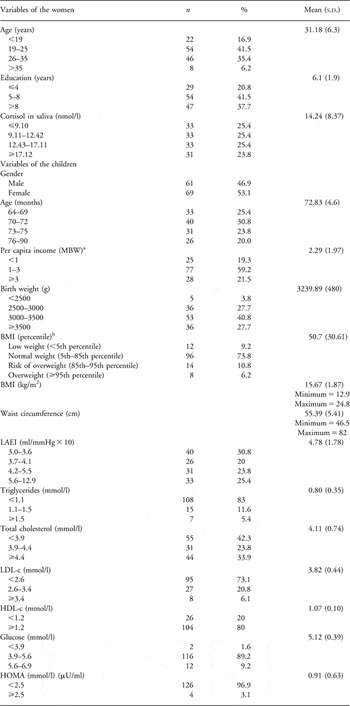
Table 1 shows the characteristics of the women and respective children. The majority of the women were from 19 to 35 years of age (76.9%), and had more than 4 years of formal education (79.2%). There is no clear cut-off point for normal concentrations of cortisol in pregnancy. Therefore, the data are presented as quartiles, mean and standard deviation. The age range of the children varied from 5 years and 4 months (64 months) to 7 years and 6 months (90 months). According to the CDC growth, charts for BMI in childhood23 the majority of the children (73.8%) showed a ‘normal weight’, 17% had overweight and obesity and a minority (9.2%) had low weight. Mean BMI percentile (s.d.) was, respectively 50.7 (30.61). Mean BMI (s.d.) in kg/m2 was 15.67 (1.87). High fasting glycaemia was detected in 9.2% of the children (5.6–6.9 mmol/l or 100–125 mg/dl), and 3.1% presented an abnormal HOMA index (⩾2.5 (mmol/l) (mU/ml)). High concentrations of triglycerides (⩾1.5 mmol/l or ⩾130 mg/dl) and total cholesterol (⩾4.4 mmol/l or ⩾170 mg/dl) were observed in 5.4% and 33.9% of the children, respectively. However, the majority (80%) of the children presented high concentrations of HDL-c (⩾1.2 mmol/l or ⩾45 mg/dl), and only 6.1% of the children presented high LDL-c (⩾3.4 mmol/l or ⩾130 mg/dl). The data for LAEI are presented as quartiles, mean and s.d. considering that there is no cut-off point for LAEI measurements in childhood.
Characteristics of the women and respective children

BMI, body mass index; LAEI, Large artery elasticity index; HOMA, homeostasis model assessment.
aMinimum Brazilian wage – MBW (R$350.00 = ∼US$77).
bCDC Growth Charts.23
According to the criteria specified in materials and methods, the variables maternal cortisol, birth weight, age, BMI, waist circumference and HDL-c were selected for entry into the multiple linear regression model. However, considering the collinearity between BMI and waist circumference (r = 0.85; P < 0.001) and the fact that the P-value for the association between LAEI and BMI (P = 0.15) was higher than for the association between LAEI and waist circumference (P = 0.10), the variable waist circumference was not included in the multivariate linear regression analysis.
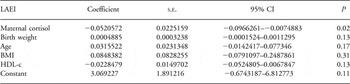
Tables 2 and 3 show negative statistically significant associations between LAEI and maternal cortisol assessed by univariate and multivariate linear regression analyses. In the multivariate linear regression model (Table 3) the association between LAEI and maternal cortisol concentrations was controlled for the variables birth weight, age, BMI and HDL-c of the children.
Univariate linear regression analysis considering LAEI as the outcome

LAEI, large artery elasticity index.
R 2 = 0.054; adjusted R 2 = 0.047.
Multivariate linear regression analysis considering LAEI as the outcome

LAEI, large artery elasticity index; BMI, body mass index.
R 2 = 0.112; adjusted R 2 = 0.079.
Discussion
Cortisol, the major human glucocorticoid, when in excess, may produce metabolic changes leading to insulin resistance, dyslipidaemia and hypertension; therefore predisposing to cardiovascular diseases.Reference van Zaane, Reuwer and Büller4–Reference Morton7 Cortisol may also have a direct effect on the vasculature through numerous mechanisms.Reference Fantidis30
The results of this study indicate an association between higher concentrations of cortisol in late pregnancy and lower arterial elasticity (assessed by LAEI) in childhood, but no associations between LAEI and birth weight, age, BMI, HOMA index and the lipid profile of the children, considering all the variables as continuous in a multiple linear regression.
Few of the children involved in the study showed alterations in their nutritional status and lipid profile. According to the CDC classification for BMI in childhood23 6.2% of the children were overweight. High concentrations of triglycerides and LDL-c were found in 5.4% and 6.1% of the children, respectively.
The association between maternal cortisol and LAEI detected in this study has probably a biological importance, considering the number of environmental, epigenetic and genetic factors that could intervene in this relationshipReference Evensen, Micklem and Blois31–Reference Muszkat, Kurnik and Sofowora33 from birth to childhood.
Huh et al. Reference Huh, Andrew and Rich-Edwards34 examined the association between venous umbilical cord blood cortisol/cortisone ratio, a potential marker for placental 11β-HSD2 enzyme activity, and blood pressure at age 3 years. The authors concluded that increased fetal exposure to active maternal glucocorticoids may program later systolic blood pressure.
Davis et al. Reference Davis, Glynn, Waffarn and Sandman35 observed that exposure to prenatal maternal cortisol exerts programming influences on the developing fetus with consequences for infant stress regulation. Larger infant cortisol response to the heel-stick procedure 24 h after birth was associated with exposure to higher concentrations of maternal cortisol during the late second and third trimesters, probably predisposing these infants to diseases in later life.
In a double-blind placebo control study the offspring of mothers who developed post-traumatic stress disorder following exposure to the World Trade Center attacks in the United States also had altered cortisol levels and temperament in the first year of life.Reference Brand, Engel, Canfield and Yehuda36, Reference Yehuda, Engel and Brand37 Boyne et al. Reference Boyne, Woollard and Phillips38 observed a relationship between cortisol concentrations in mothers and school children; children with higher cortisol concentrations also presented higher blood pressure. According to the authors, the maternal-fetal hypothalamic–pituitary–adrenal axis probably played a significant role in determining blood pressure in these children. The results of these studies can probably be based on a transgenerational ‘inheritance’ of the programming phenotype indicating the potential involvement of epigenetic processes.Reference Drake and Walker39, Reference Drake, Walker and Seckl40
Apparently, the effect of high concentrations of cortisol, even for a short period of time, permanently changes some structures of the body. Bassareo et al. Reference Bassareo, Marras, Pasqualucci and Mercuro41 have shown a loss of arterial elasticity in girls aged 11 to 18 years who had undergone surgical cure for Cushing's syndrome, underlining a significant higher cardiovascular risk, notwithstanding both the normalization of cortisol secretion and the very early age of the patients.
Overall, this study suggests that exposure to higher concentrations of glucocorticoid in the prenatal period is associated to lower arterial elasticity in childhood, an earlier cardiovascular risk marker.
The study has probably the following limitations: (1) the enzyme 11β-HSD2, which has an important role on cortisol metabolism, was not investigated; (2) diet, lifestyle and physical activity of the children were not estimated, although the diet was probably monotonous, considering that the majority of the children were from slum areas; (3) cortisol in children was not measured. Apart from the limitations cited above, it is important to point out that this type of study (cross-sectional) does not allow for causality assertions.
We advise the development of further large cohort epidemiological studies to assess the concentrations of cortisol and 11β-HSD2 in mothers and respective babies/children and their relationship to arterial elasticity in childhood and cardiovascular diseases in later life.
Acknowledgments
This study was sponsored by FAPESP – Fundação de Amparo à Pesquisa do Estado de São Paulo, Brazil (Grant no. 04/04109-8).
Statement of Interest
None.