Avoiding obstacles using the compass
In the late nineteenth century and the early twentieth a host of new modes of transport emerged and with them a new range of navigational problems. Submarines plunged out of the reach of sunlight, tanks were shrouded in enemy smoke and stranded in no-man's-land, aeroplanes ventured away from the familiarity of land to regions above thick cloud or over mile upon mile of featureless sea. The lack of visible landmarks in these situations rendered those operating the vehicles dependent on technologies of navigation, in particular the compass. Vessels on the open sea had long been in such a situation of dependence, but adapting their technologies of navigation to the new situations would be an obstacle-ridden process of negotiation.
The magnetic compass had long been considered a highly valuable but frustratingly unreliable piece of equipment. Prior to the period with which this paper is concerned, the increasing presence of metal in ships had exacerbated its unreliability, wreaking havoc on the magnetic field of the compass.Footnote 3 Before the advent of aviation the compass had received much attention from various quarters, both practically and theoretically oriented. A range of questions regarding its mode of functioning had been identified as fruitful for investigation: the difference between magnetic north and true north (magnetic variation) was itself known to vary around the globe, so navigators carried charts mapping such variations. The steel with which ships were built and furnished was known to interfere with the compass reading and so ‘compass adjusters’ attempted to compensate for this through the positioning of counteracting magnets. In short, although the performance of the compass left much to be desired, and whilst there were disputes over both the causes of its failures and the appropriate solutions, its regions of difficulty were fairly stable. When the compass moved into aeroplanes, however, many new issues became apparent. For example, the heavier-than-air craft's unprecedented speed and manoeuvrability made the needles swing wildly and settle in the wrong position. Magnetically interfering metal and engines were much closer to the compass than they had ever been on ships. The high altitudes at which the aeroplanes travelled caused the compass liquid to expand and contract, producing problematic air bubbles.
Yet the problems facing the aerocompass were not only of a technical nature. Aeroplane pilots, in particular, did not initially trust the aerocompass. In the early years of the twentieth century they viewed it as unnecessary, navigating rather by direct observation of the ground beneath them, following roads or railways, matching towns and inland water against haphazardly modified Ordnance Survey maps, and occasionally stopping at a farm for directions. In 1910 a commentator in the new Flight magazine, G. Davies, told its aviation-enthusiast readership that ‘steering by compass, except in perfectly calm weather, is almost useless’.Footnote 4 Likewise, when in 1910 one of the pioneers of aerocompass use, Captain Frank Osborne Creagh-Osborne, sent an example to C. S. Rolls of Rolls Royce, all he received in return was a report that ‘the beautiful compass turned out to spin round and round when I put it to the test, but as I had the sun to go by I did not have occasion to use it’.Footnote 5 Rolls's comments also hint at the fact that an important part of the initial reception of the aerocompass depended on its aesthetic qualities, its function seen as somewhat superfluous to flight. In a similar vein, in 1911 Captain Broke-Smith at the Army Balloon School, Farnborough, described the compass Creagh-Osborne had sent him for use in airships as ‘a beauty’.Footnote 6
One might perhaps expect the First World War's accentuated demands on accurate direction-finding to have sped acceptance of the aerocompass. But in fact negative views persisted until the Second World War. A 1922 US report on aeronautical instruments bemoaned the situation:
One of the most important and least satisfactory of all aeronautic instruments is the magnetic compass … Unfortunately, even the best types of instrument which have so far been produced are unreliable under certain conditions. This fact has led most pilots to regard the compass with suspicion, and many have come to the conclusion that a compass should not be included in the instrumental equipment of an airplane.Footnote 7
As late as 1934 a research report from the Admiralty Compass Observatory began, ‘Since the introduction of all-steel aircraft, it had been the opinion of officers using magnetic compasses … that the deviations of these instruments were subject to large and unexpected changes when in flight.’Footnote 8 In short, the aerocompass endured a long period of suspicion in the world of aerial navigation, despite the technical developments that came during that time.
Other obstacles to the success of the aerocompass were further removed from the device itself. First, pilots were not impressed by the time-consuming practices that had accompanied marine compass use, such as ‘swinging the ship’ and using ‘deviation tables’. Second, the ‘observer’ or ‘navigator’, who became a regular feature of the cockpit from the 1910s, had many other tasks to attend to besides compass-reading. He, and it was of course usually a he, had armaments to operate, aerial photographs to take and a range of other navigational equipment to handle, such as sextants and drift-meters. This paper thus explores how these obstacles were overcome.
Institutions and industry
This section introduces the institutions most directly responsible for compass design in Britain. Work on aerocompasses did not occur only in Britain: the other countries principally involved were America and Germany. But the British research community was sufficiently isolated and advanced that this restriction of the study permits the benefits of close analysis without lack of contextualization.Footnote 9 The Compass Department (CD), a branch of the Admiralty, had been at the centre of marine compass matters since its foundation in 1842.Footnote 10 But it had to work afresh if it were to establish itself as an authority in the new field of aviation. This work was largely initiated by Captain Creagh-Osborne, the CD's assistant superintendent in the early days of aviation. He made pioneering mediations between the interest groups relevant to the aerocompass. Over the years Creagh-Osborne continued his efforts towards sustaining a central position in the development and manufacture of the aerocompass, in a socially astute, prudent and occasionally subversive manner. Expanding and gaining in importance, in 1917 the CD became the Admiralty Compass Observatory (ACO), winning full government departmental status. At the same time it moved out of the Deptford Observatory to Ditton Park near Slough and acquired responsibility for the design, installation and repair of all service compasses. Yet during the First World War days of separate flying services, the ACO was more closely aligned with the Royal Naval Aircraft Service (RNAS) and hence was bound up with the tensions of partial competition and partial collaboration that the RNAS had with the Royal Flying Corps (RFC).
At the Royal Aircraft Factory, established in 1911 and renamed in 1918 as the Royal Aircraft Establishment, Farnborough (RAE F), research into general aerial navigation was carried out under the auspices first of the RFC and then of the RAF. It was therefore not inevitable that Farnborough would deem the aerocompass worthy of attention. A pioneering figure was also present in this institution. Dr Keith Lucas turned to aerocompass problems in the mid-1910s, drawing on some purely theoretical work and bringing his training in physiological problem-solving to this new issue. Whilst the CD/ACO's roles had traditionally been of a primarily practical nature, concerning the testing and installing of compasses, Lucas modernized Farnborough's approach, so that testing there became more rigorous, experimental and scientific.Footnote 11
The ACO and, to a lesser extent, Farnborough were also closely involved with a number of commercial instrument manufacturers. The ACO invited design contributions from such firms as Henry Hughes and Son; Kelvin, Bottomley and Baird; Heath and Co.; and Dent and Co. But as with Farnborough, these firms had other interests besides compasses, so had to be convinced of the value of devoting time to compass design. As early as May 1910, for example, Creagh-Osborne wrote to Francis Clark, the secretary of Kelvin & White Ltd, that there
seemed to be a general consensus of opinion among those who had got past the ‘hopping’ stage that they wanted a compass … There seems to be such a large number of machines now being tried that it appears well worth your while to be first in the field, and if you care to send me down any fittings I will be very pleased to go down to Brooklands and try them … the adjustment will not be difficult, the magnets used for Submarine Bridge Binnacles would be quite suitable.Footnote 12
Having highlighted this new commercial opportunity he outlined the kind of compass he deemed appropriate, how it should be fitted and lit and the anti-vibrational suspension required. Continuing this approach, by 1912 he was attempting to establish a standard aerocompass design, writing to a number of manufacturers with a strict set of specifications that the firms must meet (see Figure 1). A letter to Hughes and Son ended, ‘your firm will no doubt be given the opportunity of tendering for the manufacture’.Footnote 13 The phrasing implies the design power lay more on the side of the ACO. The design relationship did have a genuinely collaborative nature, however, as indicated in a 1913 letter to Creagh-Osborne from Dent and Co. and Johnson Ltd:
We are today sending to superintendent of compasses, Deptford, an Aerocompass … made in accordance with the indications given. We have also availed ourselves of the last paragraph of your letter and have forwarded a second Compass … in which we have embodied one or two alternative fittings.Footnote 14
The ACO staff were giving directions but were also encouraging independent innovation, suggesting that the design of aerocompasses was a joint effort between the military and industry.
Pattern 200 aircraft compass, by Kelvin, Bottomley and Baird – the model that resulted from Creagh-Osborne's moves to create a standard design. © National Maritime Museum, Greenwich, London.

Water in the sky
In order for the compass to be trusted as a detector of the Earth's magnetic field, that field must first have been assumed to reach it intact. Although compasses had been used on land before, the ACO was specifically promoting the transfer of ship's compasses to aeroplanes. The medium through which the plane and its compass was moving seemed to change from water to air. This change had to appear insignificant for the move to be successful.
In August 1909 Captain Creagh-Osborne made his first foray into aerocompass matters. He sent a letter to air pioneer Colonel Samuel Cody:
I was much interested to see that you were finding the necessity of a compass for aeroplane work … if you think it worth while I could easily run over from my house at Woking on a Saturday afternoon … [to] help you to steer a straight course and also at the same time to get some experience of the conditions, which would be of use in the future aerial Navy.Footnote 15
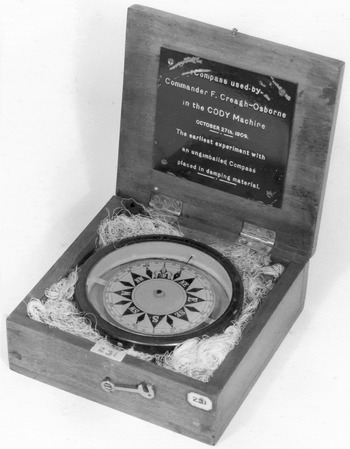
He told Cody about the introduction of liquid rather than dry compasses to the Navy, referred to the smaller compasses used by the War Office (see Figure 2), and commented that the magnetic conditions in a plane are probably ‘no worse than one finds in a Submarine Boat’. The letter conveys the mood of the time, that aviation was already viewed in terms of its potential for the military, even at this early stage in the aeroplane's history. It was only a year since Cody had made his first powered flight, itself two years after Dumont's in France and five after the Wright brothers. Importantly, Creagh-Osborne also set himself up as someone with experience and authority in marine navigation, then transferred this to the sphere of aerial navigation by equating the magnetic field in the two situations. Creagh-Osborne was to repeat this rhetorical move on a significant number of occasions.
Liquid compass packed by Creagh-Osborne into a box with cotton as damping to make it suitable for use on a flight in ‘the Cody machine’ in October 1909. National Maritime Museum, ACO0213, © National Maritime Museum, Greenwich, London.

Creagh-Osborne would often begin his articles in Flight and Aero, the new aviation journals, by drawing parallels between sea and air, currents and wind. After one such beginning, an article of his continued,
We now come to the compass, which much-abused instrument is an absolute necessity to navigators in both elements. The shipbuilder has learnt by long and bitter experience that this instrument is a broken reed … unless he himself is very careful to provide a position for it at which the directive force due to the earth's magnetism is able to reach it with its force as undiminished as possible, and with as equal an effect as possible in whichever direction the ship may be headed.Footnote 16
By referring back to the air–water equivalence as though it had by now been established, Creagh-Osborne drew his readers along with him. He was then able to exploit this sense to give authority both to seamen's practical experience with the compass and to his stated theoretical ideal of the functioning of all compasses.
Creagh-Osborne was not alone in asserting the equivalence of air and water. The phrase ‘aerial ocean’ started appearing in books and articles around 1910, as in this passage from a popular book on aerial navigation: ‘An aeroplane is subject to the air-currents just as a steamer is to a river's movement … a much closer knowledge of the aerial ocean than we at present possess is obviously necessary.’Footnote 17 Indeed, the theme recurred as late as 1945, when writers on aerial navigation made such explicit statements as: ‘There can be no question that the fundamentals of marine and air navigation are the same’, and ‘The idea that air navigation is a new and separate thing – even requiring the coinage of a new word, avigation, to name it – is not one which bears scrutiny.’Footnote 18 The emphatic nature of these writers' dismissive tones indicates the importance of maintaining the equality. The air became a source of threat to compass function. It came under question with regard to the manner in which a vehicle moved through its surrounding air, as compared to water. The solution seemed to lie in a coproduction of equality between air and water. This in turn implied that the parity extended also to the magnetic field.
Too high for comfort
By the time aeroplanes were beginning to be used, navigators and magnetic scientists had long appreciated that the variation of magnetic north from true north itself varies around the surface of the globe. In addition, mountaineering had taken land compasses to varying altitudes without any noticeable effects. Despite this background, the higher altitudes at which planes were flying were seen as posing a new potential source of variation in variation. In 1910 the ACO's superintendent, Commander Louis Chetwynd, wrote,
The use of the double compass could only be of service in fixing position by magnetic observation if the magnetic elements were correctly charted for different heights above the earth's surface. At present these elements are only charted from data obtained at the earth's surface and lines of equal horizontal force (for instance) over the land portions of the globe are so irregular that the observed values of the element would afford very little information as to latitude. … Should, however, a systematized survey ever be carried out at an altitude of say 800 to 1,000 feet an instrument on the principle of the double compass would be a very convenient means of observing the change in horizontal force.Footnote 19
It seems that compliance through uniformity was by no means taken for granted for the aerial magnetic field. Nor was the subsequent sharp rise in aeroplane use a guarantee that this suspicion of the magnetic field would be overcome. In an American symposium on aeronautics in April 1917, Louis Bauer gave a short paper on the compass. Bauer had founded in 1896 the journal Terrestrial Magnetism and Atmospheric Electricity (later the Journal of Geophysical Research) and in 1904 the Carnegie Institute Department of Terrestrial Magnetism. He thus held a fairly high profile within the field of magnetic research and was therefore likely to have been known in England. Furthermore, he quoted from S. G. Starling's work in England and the symposium was published in the Proceedings of the American Philosophical Society, so his paper in the symposium could well have been read in England. He warned that in connection
with the use of the compass in aerial navigation, an interesting scientific question comes up as to the change of the earth's magnetic field … with altitude above the surface. … The available observations to date do not pass … the requisite refinement, and it is hoped that some day a non-magnetic airship and the necessary instrumental appliances will be available for conducting a magnetic survey of the aerial regions.Footnote 20
It is clear that Bauer viewed the high skies as holding unknown magnetic properties, fit more for scientific experimentation than for safe navigation. Even in 1926, in Sir Alan Cobham's description of his flight to Australia for Flight magazine, he conveyed a sense of surprise that ‘despite the varying altitudes in going to the Antipodes, we had no trouble with the compass whatsoever’.Footnote 21
The magnetic field was not only suspected specifically of variation, but also regarded generally with wariness by designers and pilots alike. Pilots often claimed to have been in strange ‘magnetic’ clouds that caused the compass needle to rotate.Footnote 22 Even after outlining the new explanation for these strange cloud effects in 1915, Creagh-Osborne maintained a concessionary tone:
Although little is at present definitely known of the electromagnetic conditions prevailing in the atmosphere it is considered that the above remarks will account for the majority of reports of unsteady compasses when passing through fog or cloud. Causes of unsteadiness do undoubtedly, however, occur when passing through or close to highly charged clouds, and the pilot should be prepared for more or less violent oscillations of his compass when a thundery type of weather prevails.Footnote 23
The explanation itself is discussed below. Here the important point is that the explanation was widely recognized and accommodated in compass design by the early 1920s and that, despite this, doubts continued. For example, between 1932 and 1934 the ACO and Farnborough collaborated in a series of experiments whose aim was to locate the cause of changes in the deviation of compasses in all-steel aircraft. The report of the experiments, which used simultaneous photography of the ground and compass heading, stated that it was
only in 1934, when in order to ascertain the duration and frequency of these changes it was decided to take the largest possible number of photographs with the least possible intervals of time, that their real significance was discovered. It then became apparent that the errors to which the compass was subject when the aeroplane was in flight were not deviations due to magnetic causes but deflections due to mechanical causes.Footnote 24
In sum, the character of the magnetic field newly came under scrutiny when considered in the air and it was long viewed with uncertainty. This makes more significant the previously mentioned attempts to make air and water seem identical.
Swinging the ground into the air
From the magnetic field of the aerocompass-in-the-air, attention shifts inwards towards the magnetic field of the same compass when on the ground. Discipline of one required discipline of the other. Both the next two sections are concerned with the places where compasses were either adjusted or tested on the ground. While the first approaches them in terms of their effect on the magnetic field in the air, the second considers them as ground-based. The process of ‘adjusting the compass’, achieved through a practice known as ‘swinging’, was aimed at eliminating accumulated errors in compass readings by using correcting magnets. This had long been integral to compass use aboard ships, so it is necessary to consider swinging in its earlier, marine, context before looking at its restabilization in the new context of aircraft. Through this restabilization, the aerocompass-in-the-air gained a new epistemic connection to the ground.
To adjust a ship's compass the whole ship would be slowly swung though the cardinal compass points (north, south, east and west) whilst in port, and a compass reading taken at each point. Each reading would be compared to a reference compass or to observations of heavenly bodies. An experienced compass adjuster would then use magnets to correct the deviations of the ship's compass from the reference value. In fact, it was rarely possible to correct all the error, so the ship was then swung again through the full 360 degrees and the error every ten degrees recorded in a ‘deviation table’. This would be used by the ship's captain in conjunction with the compass for all subsequent readings at sea. This whole process, ‘swinging the ship’, was time-consuming, required a skilled practitioner and was repeated relatively frequently.Footnote 25
Aeroplane pilots, however, were not interested in a somewhat inscrutable procedure that ate into their airtime. As historian M. D. Wright describes, ‘Although an airplane could be turned through the series of headings much easier than a large ship, the procedure was still longer than some pilots cared for.’Footnote 26 But without the plane being swung, aerocompass readings would slip to a greater degree of unreliability, thereby even further obfuscating the point of swinging, and so on. Alignment of swinging and pilots was therefore a key factor upon which depended the success of the aerocompass.
In the early 1910s calls for the establishment of special aerocompass-swinging bases began to appear in the writings of the aviation community,Footnote 27 and requirements for the physical construction of these bases began to be outlined. By 1915 Creagh-Osborne was writing that the points of a compass should be marked on the ground of a swinging base, which markings should act as the reference compass for swinging. This statement appeared in a booklet that accompanied every purchase of a Compass Department compass, which he addressed to ‘pilots and observers, and … designers and builders’.Footnote 28 Later that year a similar idea appeared in an anonymously written article in Flight, entitled ‘The aeroplane compass’:
With the aid of another compass, lay out on the ground by means of pegs and card the cardinal points … and the quadrantal points … This second compass may now be dispensed with and the aeroplane compass corrected from the cardinal points now represented by cards on the ground.Footnote 29
By the 1918 edition of Creagh-Osborne's booklet, land compasses and ground markings seem to have entirely usurped the use of observations of the sun and other heavenly bodies. These latter ceased to feature in Creagh-Osborne's list of reference systems.Footnote 30 A few years later, in 1922, the Air Ministry's section in Flight declared, ‘Pilots should keep a constant watch on the behaviour of, and take every opportunity to test their compass whilst flying over a long stretch of road or railway, the magnetic bearing of which has been ascertained beforehand.’Footnote 31 From such statements it seems that, unlike the case of its most direct precursor the ship's compass, the credibility of the aerocompass was now firmly based on the ground.
It was not merely that the ground was being used in conjunction with the aerocompass, as in situations where the compass was seen as an optional extra to direct observation for aerial navigation. Rather, compass readings had begun to have to pass through the ground in order to stand. The step from the compass-in-the-air to the compass-on-the-ground and back again was becoming integral to the ability of the aerocompass to refer to the magnetic field. In this way, in the pilots' eyes the magnetic field was extended beyond the cockpit. This became an effective way to bolster the credibility of something viewed with much suspicion by its intended users.
Swinging set apart
In addition to the physical structure of the swinging bases, some commentators explicitly referred to the more social aspects of swinging. In 1916 the Naval Superintendent wrote to Lieutenant Towers, the American naval attaché in London: ‘A breed of aeroplane adjusters is necessary if we are to get any good results … in time, every flying station will be provided with an adjuster as well as a swinging base.’Footnote 32 In the case of ships, retired navigators had taken up posts as swinging officers, and ship-swingers had therefore been in good supply. Aeroplane navigators, however, only began to be commonplace during the First World War, so there was as yet no equivalent body of people with the appropriate background knowledge. Instead, it became necessary to create the rules for this new and evolving role. Writing in Flight in 1912, the private inventor Eric Clift gave this advice to potential adjusters: ‘It is of very great importance to observe that the various assistants (frequently energetic amateurs) on this work, do not lean over the compass adjuster, as their pockets are invariably full of iron spanners, bolts, nuts, spare parts’.Footnote 33 For swinging to be effective, so Clift emphasized, it required more persons than simply the aeroplane pilots to be disciplined.
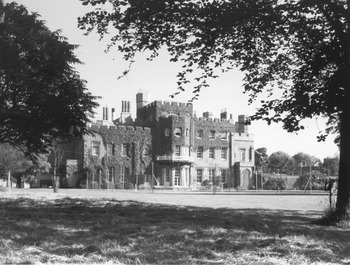
Still on the ground, compass-testing sites as well as swinging bases were sites of negotiation where shifts in perspective concerning the authority of the compass took place. Prescribing the nature of swinging bases in a 1911 issue of Aero, Creagh-Osborne wrote that a ‘fairly secluded and level spot should be chosen, far from sheds, iron drain pipes, or other magnetic materials, and of a sufficient size to allow machines to manoeuvre into position’.Footnote 34 Creagh-Osborne's apparently pragmatic tone here obscures the power of the reference to seclusion. Isolationist rhetoric recurred around the aerocompass in a range of sources that seem to indicate that it was doing important negotiating work for the aerocompass community. In particular, it was common both in contemporary and in more recent accounts of the Compass Department's move to Ditton Park in 1917 (Figures 3 and 4). The move was ostensibly due to the extra laboratory space required by the increasing numbers of staff and duties. In his history of the ACO, Fanning relates that a key reason for buying Ditton Park was its ‘magnetically “clean” environment’, and describes how ‘in order to protect the magnetic integrity of the environment the Admiralty agreed … to purchase the 250 acres of surrounding parkland’.Footnote 35 Likewise, a 1932 newspaper article on the ACO quoted its superintendent, under the subheading ‘isolated experts’:
We must be isolated for our work, of course. The nearness of electric railways was one of the things that made us move here from Deptford in 1917; they were close enough to disturb the magnetic field and disturb the compasses.Footnote 36
Seclusion: the approach to the Compass Sanctuary of the Admiralty Compass Observatory at Ditton Park, Slough. © National Maritime Museum, Greenwich, London.

The Admiralty Compass Observatory, Ditton Park, Slough. © National Maritime Museum, Greenwich, London.

This emphasis on isolation played an important role for people and compasses alike. First, it mobilized the imagery of the isolated genius that has been so central to scientists' identity. The public image of the socially detached genius denotes an absence of all the external influences seen to divert scientists from discovering ‘pure’ knowledge. In this case, authority was granted to the people working in swinging bases and at the ACO (and by extension to compass readings) through the tacit association with scientists encouraged by this language of isolation. The author of the newspaper article quoted above did more to align the ACO with typical images of science, observing that in the magnetic test rooms ‘each man [wore] the blank, abstracted face of concentration’.Footnote 37 Since the Compass Observatory was a Defence establishment, the presentation of the activities there as purely scientific would have been an important way to protect against accusations of their tainting science with ulterior motives.
Consideration of the social and physical boundaries of places of science indicates a second function of this isolationist rhetoric. Work in science studies has shown that what it means for a scientist's work to be successful is that the following potentially contradictory moves go unquestioned: first, the object of study is declared to exist in a special state only inside the scientist's place of work, often a laboratory; second, the laboratory object/phenomenon is declared to be generalizable to the object/phenomenon as it exists everywhere outside the laboratory. In this way, the laboratory is made a necessary point of passage for all knowledge relating to that object/phenomenon. Consider, for example, the following remark by S. Smith, a well-respected member of the designer group from the instrument-makers Smith and Son: ‘Although it is one thing for an instrument to work in a laboratory, conditions in an aeroplane are sometimes quite different for the same instrument to work in an aeroplane carrying out various violent manoeuvres.’Footnote 38 Here, Smith draws attention to the difference between the contexts of laboratory and plane-in-flight, so that he can later make more impressive the fact that his instruments successfully traverse the gap. But negotiating this double movement is a delicate procedure.
In order to maintain a laboratory's special status, the social and physical boundaries of the laboratory-like place must be regulated. This ensures that what happens inside it is deemed fact, not artefact. An example of the work needed to maintain this special status is a passage in which the 1932 newspaper article explicitly qualifies the authority of those working at the ACO: ‘Nearly 100 skilled workmen are employed.’Footnote 39 Policing of the boundary was also performed less obviously, by the emphasis on the magnetic field's isolation at both swinging bases and the ACO. The significance of isolation is demonstrated by its continuation in Fanning's account and by its echo at micro-levels. In the 1932 article the author felt the need to mention his finding ‘three girls in a room apart, touching the small cylindrical faces of aero compass cards with fine paint brushes tipped with radium paint’.Footnote 40
The development of swinging bases therefore enabled the emergence of a new epistemic connection of the airborne aerocompass to the ground. This granted heightened authority to the aerocompass, and so encouraged its acceptance. It also worked in tandem with the seclusionist phraseology applied to swinging bases and to the ACO as a testing site, to give greater status to the aerocompass.
Periodicity
Closer still to the compass itself was the phenomenon of ‘northerly turning error’, the discovery of which was a major theoretical advance on the magnetic field concerning the compass-in-the-air. Considering some of the design innovations that were introduced to the aerocompass to cope with northerly turning error, this section explains the challenges these brought to the world of aerocompasses.
The concern of aerocompass designers had been summarized by Creagh-Osborne in 1911 as showing that ‘the directive force due to the earth's magnetism is able to reach it [the compass] with its force as undiminished as possible’.Footnote 41 Although previously unproblematic, the continued accuracy of such a description came under question during the delineation of northerly turning error. It had previously not been necessary to specify that a navigating pilot is only interested in the component of the magnetic field horizontal to the Earth's surface. Nevertheless, the field also has a vertical component, the exact orientation of which varies across the globe: it is approximately sixty-seven degrees in England, for example. Whilst this phenomenon, known as magnetic dip or inclination, had not been of much consequence in ship navigation, the faster speed of aeroplane flight meant that planes banked when turning and this brought the matter newly to the fore.
When the aeroplanes turned, the radical deviation of the compass from horizontal caused it to respond more to the vertical component of the Earth's magnetic field, so that it no longer served as a direction indicator. The effect earned its name from being more pronounced for turns on a northerly course, where the compass would indicate that the plane had turned less than it actually had. If the pilot did not realize this was happening, as was especially the case when flying in clouds or at night, he would respond by turning more and more sharply, risking entering into a fatal spin. Conversely, for turns on a southerly course, the compass would indicate that the plane had turned further than it had, so the pilot might not turn far enough. Research into northerly turning error began with Dr Lucas at RAE Farnborough, and on Lucas's invitation Creagh-Osborne brought the ACO into the picture too.Footnote 42
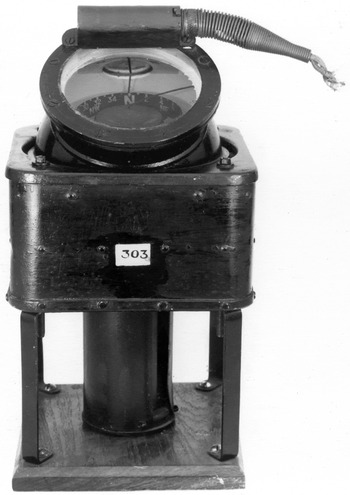
At Farnborough the solution was held to lie in slowing the period of the compass, where ‘period’ refers to the time taken for one swing of the card. In 1915 Lucas designed the RAF Mark II compass (Figure 5) to be magnetically weak, so that its relative insensitivity to changes in the field made it less prone to error during turns. This came, however, with the disadvantage of slow restabilization of the compass once the turn was complete. The ACO went to the opposite end of the range, promoting quick-period compasses such as the Pattern 255 and its successor the Type 5/17 (Figure 6), named by the ACO from the date of its completion, May 1917. This compass was not intended to be of assistance during a turn, but rapidly to return to a steady reading afterwards. These two alternatives have been widely perceived as putting the ACO/RNAS and the RAF into ‘two schools of thought’.Footnote 43 Indeed, Creagh-Osborne privately communicated that he thought the Pattern 255 ‘about as different from the RAF instrument as it is possible for two instruments designed with the same object to be’.Footnote 44
The RAF Mark II aircraft compass. © National Maritime Museum, Greenwich, London.

Type 5/17 aircraft compass designed at the Admiralty Compass Observatory. © National Maritime Museum, Greenwich, London.

This divergence of approaches made conspicuous some of the actors' fundamental viewpoints on the compass. When an instrument-maker sent some RAF Mark IIs to Lieutenant Towers in 1916, he worried that the US Navy's superintendent of compasses would ‘have a fit’ when he saw them, and remarked, ‘As you know, the slow period is to get over the Northerly banking error, and it does so at the expense of the instrument as a compass, however, the scientists forced me into it.’Footnote 45 Here the defining feature of a compass was taken to be its capacity to respond to the magnetic field in full, rather than to function as an efficient direction finder. The ACO's compass examiner Lieutenant Alexander made a similar point after the war when he opined that the Mark II was not a compass but rather a northerly turning indicator.Footnote 46 This view was given when he was called as a witness in a trial to establish the inventiveness of the firm Hughes and Son following their post-war bankruptcy claim. By contrast, a 1918 booklet on aeroplane instruments described the effect of northerly turning error thus: ‘The North end at once has a tendency to dip, and the instrument is no longer a Compass in the accepted sense of the word.’Footnote 47 This publication, from the Aircraft Production section of the Controller Technical Department, would have had the ACO as its main source of input, and defines the compass as primarily a direction finder.
Yet what was at stake during the periodicity debate was more than simply what it meant to be a compass. Following the introduction of the Mark II, the relationship between the ACO and Farnborough came under considerable strain. Dr Lucas at Farnborough had begun his research in 1914 after reading a report on various matters from the RFC in France, which contained the statement that ‘the compasses are useless’ with no explanation of why or how.Footnote 48 Creagh-Osborne, on the other hand, had only become aware of the phenomenon of northerly turning error through Lucas's report on his experiments at Farnborough, and had only been convinced of it after being invited to Farnborough to witness it in person. Viewing the Mark II as ‘simply a modernised Reynold's yacht compass with a new directive system to suit aircraft’,Footnote 49 Creagh-Osborne collaborated with Hughes and Son to create a similar compass from models they already had in stock, resulting in the Patterns 255 and 259 aircraft compasses.
Although he reported on his progress both to Lucas and to the superintendent of the Royal Aircraft Factory (SRAF), he received no response from either, except through the very formal medium of Farnborough's highly damaging public report on the Pattern 259. Incensed, Creagh-Osborne requested ‘independent’ assessments of his compass from Commander Norfolk (who later joined the ACO) and Captain Creak (an expert on ship's compasses). Neither of these two men appreciated the difference between naval and military flying, however, and based their praise of Creagh-Osborne's compass solely on naval concerns. Whilst the military were doing short flights and had to negotiate flying in clouds, which required a slow-period compass, the navy were doing either short flights in support of the military or long-distance sea patrols, which required a quick, responsive compass.Footnote 50 On the military side, writing from France in 1917 and 1918, Captain Ingham compiled a booklet on aerocompasses, in which in March 1917 he mentioned the RAF Mark II: ‘On the whole this compass is a popular one and is certainly the one most largely used in France at the time of writing.’Footnote 51
In 1917 Creagh-Osborne wrote,
The improvement of air navigation [between 1916 and 1917] has been largely due to the organisation of anti-submarine patrols in seaplanes, and it may be stated that reports received of the efficiency of their navigation shows [sic] what can be done by the intelligent use of the compasses provided and also proved that the northerly ‘turning error’ is a bogey which, while its existence should be known, need not affect the pilot in his practical work.Footnote 52
This appeared in a memorandum sent everywhere pilots were based. Such a dramatic denial of the validity of Lucas's work was not received well by the RFC. During the same year the SRAF Sir Henry Fowler wrote to the director of Military Aeronautics General Henderson that Creagh-Osborne ‘seems never to have understood the difference btwn a fast moving aeroplane and a slow moving airship’.Footnote 53 A further degree of tension was added to all of this by the fact that at this time the responsibility for all compass concerns, both RFC and RNAS, was in the process of being passed solely to the ACO.
After this transition, when the ACO became in fact the only government establishment working for two of the fighting services, inter-service rivalry over compass matters was forcibly made less obvious. This is not to say that service identity struggles would not spill over into the compass arena. Through the 1920s both the War Office and Navy, not believing in independent air power, wanted the RAF disbanded and to regain their own air arms.Footnote 54 The ACO enforced standardization of compasses across the forces in the early 1920s. The standardization centred on two pilot's compasses, P1 and P2, and the two observer's compasses, O1 and O2, in 1923. In Germany, by contrast, compasses remained under more fragmented private control, and different solutions to compass problems were used.
Beyond periodicity: systems
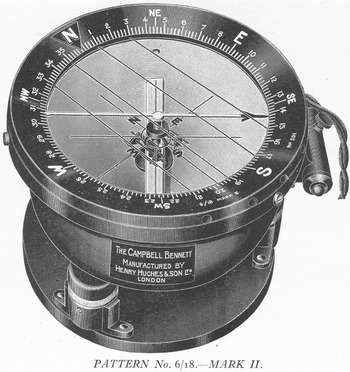
The slow/quick-period dispute was soon made irrelevant, however, by the emergence of an aperiodic compass developed at the ACO in 1918. This compass, the Type 6/18 (Figure 7), was designed by two scientists, G. R. C. Campbell of the ACO and G. T. Bennett of Cambridge University. It possessed maximal damping, minimal inertia and a maximum-possible magnetic control. It responded strongly and quickly to the magnetic field but slowed down towards the true direction without oscillating about it. This was achieved by replacing the traditional card of the compass with eight radial wires attached to the magnetic component. The perceived significance of this development in the compass is shown by the fact that, ten years after its design, Flight magazine printed this report of the British exhibits at the 1928 Berlin Aero Show: ‘Perhaps the most important instruments comprise the Aperiodic compasses for use on aircraft.’Footnote 55
The Type 6/18 aperiodic aircraft compass, from A. J. Hughes, Instruments for Aerial Navigation, London, c.1925. © National Maritime Museum, Greenwich, London.

In the standard account of events, the 6/18 simply ‘resolved’ the earlier dispute, but the transition was of course not as immediate as such a picture suggests.Footnote 56 Rather, the new compass was met with resistance. A proliferation of inverted commas among commentators was just one indicator of this:
These ‘feelers’ on moving through the liquid would set up small eddies and thus dissipate energy;
A disturbance of the liquid would seriously affect such a ‘card’ but I understand it is very good on a northerly turn.Footnote 57
For this caution to become acceptance, more than just technical factors would come into play, the first of which was to show the trustworthy pedigree of the new design. The ACO kept and displayed many compasses in an on-site museum, the notes to which were written by Lieutenant Alexander, the department's chief compass examiner from 1907 until 1930. Alexander wrote of the RAF Mark IIs, ‘Unfortunately many of these compasses were made by engineering firms without previous experience in compass making and the results were not uniformly satisfactory.’Footnote 58 The 6/18s, on the other hand, were given the accolade of being ‘partly made by messers Mappin and Webb, the well-known silversmiths, and finished in the Compass Observatory workshop’.Footnote 59 These comments reveal the importance of place and prestige to the supposedly rational succession of one compass by another.Footnote 60
Developments of the compass itself were not the only responses to the delineation of northerly turning error. As Thomas Hughes has described, technologies cannot be considered in isolation from the system in which they are embedded.Footnote 61 Wright's history of aerial navigation holds that Lucas's explanation of turning error ‘largely restored the instrument to aviators’ favour; thereafter they would know when to trust the compass and when not'.Footnote 62 But this is to get ahead of the situation. In fact, the trust of which Wright speaks owed much to the turn indicator, an instrument that came into use during 1918. If a pilot did not know whether or not he was turning, as when in cloud or at night, he could not know whether to trust the compass. The turn indicator's designers and manufacturers were careful to note that it was intended ‘as supplementary to the compass, rather than as a substitute for it’.Footnote 63 It was thus a safe way to encourage acceptance of the compass.
Even the turn indicator did not automatically guarantee success for the aperiodic compass. A 1920 Air Ministry report noted that owing to the turn indicator, the primary role of the compass was to indicate course rather than whether the machine were turning, and therefore that the primary requisite of a compass was to not oscillate wildly on a straight course. They concluded that in future the choice would likely be between aperiodic and long-period compasses.Footnote 64 In short, neither did the aperiodic compass automatically replace other types, nor did compass developments run along their own idiosyncratic rails.
The bounds of the technological system can be extended a step further. In 1919 Darwin and Mason wrote of their original 1912 ideas for a turn indicator that ‘the object in view at that time was to obtain the true vertical for bomb-dropping’.Footnote 65 Similarly, the Wimperis wind gauge or drift sight, designed by Wimperis of the RFC, ‘was developed to improve the accuracy of bombing, but it became one of the most important aids to DR [dead reckoning] in larger craft’.Footnote 66 Several types of bombsight compass were also designed at the ACO from 1917 until the end of the Second World War.Footnote 67 In other words, the military did not merely facilitate the success of aviation. In fundamental ways they influenced the directions taken in the development of aviation technologies. Consider the military language and aims in a passage from Creagh-Osborne, where he describes how the importance of pilots practising flying using compasses became relevant ‘especially at night over enemy country when all other aids to navigation are obliterated and the compass is his only guide’.Footnote 68 Covert military operation had clearly become an important working context for compass design.
Inside the cockpit
Thus far the paper has considered a number of ways in which the surroundings of the aerocompass challenged its potential for success in the air. The discussion has been gradually approaching the compass. Limits of space preclude more than a brief account of the details of the device itself. The faster speed of planes' movement compared to that of ships placed a strain on the visibility of the compass. At the same time, the compass competed for space with a range of other instruments, so it was deemed that its size and weight needed to be reduced. For a time the gradations were painted in radium, electric bulbs were used and a magnifying prism or domed glass was placed over the compass. Attempts were made to incorporate the lighter metal aluminium and around 1915 vertical card compasses began to be designed, as it was becoming difficult to find suitable positions for horizontal ones.
A second major effect of the high speeds of planes was vibration. A range of anti-vibrational suspension innovations appeared for the compass, beginning with a bed of horsehair and felt pads, and developing into springs, rubber and gimbals. Furthermore, at certain frequencies of vibration the compass card would simply spin round and round. A compass with an inverted pivot was introduced by the ACO to solve this in around 1915, with fairly smooth acceptance by Lucas's subsequent Farnborough testing.Footnote 69 As well as the position of the pivot, attention was given to the materials of its construction. Captain Ingham's 1916–18 notebook described how the ‘rough treatment to which the pivot is unavoidably subjected in aeroplane work’ meant that the ‘carefully-turned iridium point’ would become curved and mushroomed, causing friction on the cup and so making sluggish the movement of the card. He continued that the Admiralty Compass Department's Lieutenant Harrison had concluded, after ‘exhaustive research’, that the harder agate and sapphire were ‘the most suitable jewels for pivot and cup’.Footnote 70
As with the compass pivot, the problems connected with the liquid that filled the compass were the source of more than one type of innovation. Naval compasses had been filled with a mixture of one part alcohol to two parts distilled water, with a specific gravity of 0.96, but the greater power and altitude of aeroplanes caused expansion and contraction of this liquid. This had drastic effects on the compass reading. The alcoholic strength of the liquid was therefore increased from time to time, because a more alcoholic mixture would stay more constant over a greater range of temperatures and pressures, but this introduced a fresh problem. With each increase it became more difficult to obtain a paint that would not be dissolved by the more alcoholic liquid.Footnote 71 A second method of dealing with the effects of height on the liquid, introduced in the mid-1910s, was to fit compasses with expansion chambers. These trapped the air released at high altitudes. Their perfection was slow, however. In 1929 the Air Ministry Notices section of Flight magazine reported, ‘Trouble has recently been experienced through the formation of bubbles in liquid compasses installed in service and civil aircraft’, listing one of the main causes of this to be expansion chambers that were too small or stiff to cope with temperature range.Footnote 72
Conclusions
The path to acceptance of the aerocompass involved a broad range of negotiations outside the solely technical, and the paper has sought to bring some of these to light. These negotiations are clearly exposed in two statements by characters involved in aerocompass testing and design. The first is from a 1918 report on aircraft instruments by the Department of Aircraft Production:
There is too much tendency to look upon a Compass as a piece of mechanism, such as an air speed indicator or clock for instance. It is, of course, nothing of the sort, and every detail has to be carefully considered by those responsible for designing an instrument for use under special conditions.Footnote 73
Here the method of functioning of the aerocompass is presented as being more complex, less direct and less predictable than other technologies. Of course, the other named technologies also have convoluted histories and are by no means as straightforward as presented here. These contingencies are normally kept obscured, however – hence the desired force of the contrast. This has the effect of making all the more dramatic any future successes with the aerocompass, an instrument designed for the new context of flying through the air and for a new community of users who needed to be persuaded of the credibility of the novel device and its promoters.
The second passage is from a 1929 article on aircraft compass problems by T. R. Rhea, of the Marine and Aircraft Engineering Department of General Electric:
A man who contemplates the design of a compass usually has several grievances against nature. He complains that she has not cooperated; that she has not made the earth's magnetic field strong enough … the earth's field is not all one could wish for … [The magnetic card compass] is a tremendously useful device … despite the fact that the earth's field is not all one could wish for.Footnote 74
This report was among the ACO's collection of documents now held by the Royal Observatory, Greenwich. It can therefore be assumed that it was collected by the ACO to feed into its own research. Here the problems the aerocompass designer must contend with are specified and more extended than in the passage from the 1918 report above. The ‘special conditions’ under which the compass operates, the Earth's magnetic field, must be seen to have ‘cooperated’. The act of demonstrating this kind of cooperation required a range of tactics over and above the solving of purely technical problems in finding north while travelling at high speeds above the earth.