I. INTRODUCTION
The exchange reaction of oxygen between gas phase and solid is of interest from a fundamental point of view elucidating the mechanism of one of the “simplest” gas–solid reactions, as well as for its importance for electrochemical devices such as solid oxide fuel cells (SOFC), permeation membranes, and electrochemical sensors, which rely on a fast oxygen incorporation reaction.
It is not the goal of this article to analyze the rates of oxygen exchange in greatest detail. Rather, we want to extract key properties of major influence on oxygen exchange kinetics for a large range of materials. Naturally, such correlations are only sensible for comparable reaction mechanisms and most straightforward if the rate determining step (rds) remains the same (if mass action constants representing the quasiequilibrated fast reactions before and after the rds are also affected by changes of the properties governing the rds, this may lead to deviations from the idealized correlation). As discussed below, this condition is fulfilled for a large range of oxygen-deficient mixed conducting perovskites (and may even apply to perovskite-related materials such as A-site ordered double perovskites, as long as oxygen vacancies  determine oxygen transport). For materials of different structure type (and/or oxygen exchange being confined to the reaction at the surface with immediate desorption, i.e., not including oxygen incorporation into
 ), different relations are expected.
We will not deal with materials where the B site is mainly occupied by redox-inactive cations such as Ti in slightly Fe-doped SrTiO3 or the SrTi1−xFexO3−δ solid solution series with low Fe content. For those “electron-poor” materials, indeed, the limited availability of electronic charge carriers can become the main limiting factor.Reference Merkle and Maier1–Reference Jung and Tuller3 Instead, we will focus on (Ba,Sr,La)(Mn,Fe,Co)O3−δ perovskites.
As a basis for the discussion, we use oxygen exchange experiments on dense bulk samples (isotope exchange and conductivity relaxation) as well as on pore-free films deposited by pulsed laser deposition (PLD) on Y-stabilized ZrO2 (YSZ) substrates (electrochemical O exchange measured by impedance spectroscopy). Owing to the varying morphology and thus surface area (which is usually not quantified, apart from few focused ion beam scanning electron microscopy investigations, see e.g., Refs. Reference Gostovic, Smith, Kundinger, Jones and Wachsman4 and Reference Wilson, Duong, Gameiro, Chen, Thornton, Mumm and Barnett5), results from porous films (or even porous composite films) cannot be used in this discussion, which aims at comparing the intrinsic materials properties. For this reason, we will also exclude extremely thin films from the discussion, although their often accelerated oxygen exchange may be related to increased concentration and/or mobility of vacancies (see e.g., Ref. Reference la O’, Ahn, Crumlin, Orikasa, Biegalski, Christen and Shao-Horn6).
Since the oxygen incorporation surface reaction exhibits a complex network of possible reaction pathways in which the rds has to be identified, the analysis requires the measurement of effective rate constants, together with in situ surface analytical investigations as far as available (not discussed in this paper), a phenomenological kinetic description, and ab initio studies.
II. EXPERIMENTAL
Polycrystalline, dense (La,Sr)MnO3-δ (LSM), (La,Sr)(Co,Fe)O3-δ (LSCF), and (Ba,Sr)(Co,Fe)O3-δ (BSCF) films were deposited by PLD on YSZ single crystals, typically 100 nm thick. The films were patterned by lithography and ion beam etching into circular “microelectrodes” with 20–100 μm diameter, which are then individually contacted with Pt/Ir tips for electrochemical impedance measurements (see also Refs. Reference Baumann, Fleig, Cristiani, Stuhlhofer, Habermeier and Maier7 and Reference Wang, Merkle and Maier8). Details for determination of tracer diffusion coefficient D* in BSCF films are given in Ref. Reference Wang, Merkle, Maier, Acartürk and Starke9. Density functional theory (DFT) calculations for LSM and BSCF were performed with GGA-PW91 and GGA-PBE exchange–correlation functionals as implemented in the VASP code. Transition states for reaction and ion migration were located using the climbing image nudged elastic band method (see also Refs. Reference Mastrikov, Merkle, Heifets, Kotomin and Maier10 and Reference Merkle, Mastrikov, Kotomin, Kuklja and Maier11).
III. RESULTS AND DISCUSSION
A. Empirical relation involving ionic conductivity
The first step in understanding the mechanistic details of a reaction is to identify those species which are important for the rds and hence crucial for the overall rate (nevertheless, parameters of fast preceding/succeeding steps can also affect the rate). Thus, in the case of a gas–solid surface reaction, correlations with the nature and concentrations of surface species (e.g., adsorbates) and surface defects (e.g., oxygen vacancies) come to the fore. Unfortunately, in the window of relevant conditions (300–800 °C, pO2 ≈ 0.2 bar), the surface defect concentrations are experimentally accessible in the fewest cases. We are aware of the fact that defect energetics and thus absolute concentrations in the surface layer differ from the bulk. Nevertheless, as long as the same reactions determine the equilibration with the gas phase and the majority defects remain the same, the pO2 dependence of defect concentrations in bulk and surface layer will be similar (this at least holds for an electroneutral model). In addition to the different surface energetics, surface space charge zones may modify the kinetics, e.g., for slightly Fe-doped SrTiO3.Reference De Souza and Martin12 In the materials under discussion, however, such space charge zones can be assumed to be negligible (the blocking character of the grain boundaries in SrTi1−xFexO3−d vanishes with increasing Fe content, i.e., increasing carrier density and concentration of cations with variable valence, at ≥7 mol% of FeReference Jurado, Colomer and Frade13).
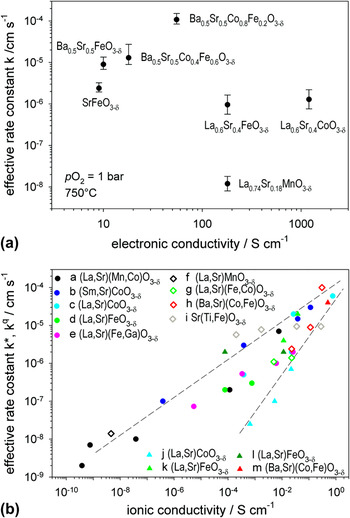
Figure 1(a) shows effective rate constants k q of the oxygen surface reaction (determined from impedance measurements of perovskite films on YSZ substrates) versus electronic conductivity. No clear trend can be recognized—for instance, Ba0.5Sr0.5Co0.8Fe0.2O3−δ with the fastest exchange rate has a lower electronic conductivity than La0.74Sr0.18MnO3−δ with the lowest rate. Although electrons must be involved in the oxygen exchange reaction, obviously, the supply of electronic carriers is not rate limiting for the perovskites considered here.
(a) Effective oxygen exchange rate constants k q of mixed conducting perovskites at 750 °C and pO2 = 1 bar plotted versus electronic conductivity. k q from Refs. Reference Baumann, Fleig, Cristiani, Stuhlhofer, Habermeier and Maier7, Reference Wang, Merkle and Maier8, and Reference Fleig, Kim, Jamnik and Maier14, σeon from Refs. Reference Mizusaki, Yonemura, Kamata, Ohyama, Mori, Takai, Tagawa, Dokiya, Naraya, Sasamoto, Inaba and Hashimoto15–Reference Kozhevnikov, Leonidov, Patrakeev, Mitberg and Poeppelmeier19. (b) Rate constants at 750 °C, pO2 = 1 bar for bulk samples [circles: k*, triangles: k* = k chem/w O from chemical relaxation experiments,  ] and dense PLD films (diamonds: k q) plotted versus ionic conductivity (in most cases calculated from diffusivity via Nernst–Einstein relation). For the interpretation of the dashed lines, see Sec. III. C. Data sources: a,Reference de Souza and Kilner20 b,Reference Fullarton, Jacobs, van Benthem, Kilner, Brongersma, Scanlon and Steele21 c,Reference Berenov, Atkinson, Kilner, Bucher and Sitte22 d,Reference Ishigaki, Yamauchi, Kishio, Mizusaki and Fueki23 e,Reference Geffroy, Bassat, Vivet, Fourcade, Chartier, Del Gallo and Richet24 f,Reference Fleig, Kim, Jamnik and Maier14 g,Reference Baumann, Fleig, Cristiani, Stuhlhofer, Habermeier and Maier7 h,Reference Wang, Merkle and Maier8 i: k q from,Reference Jung and Tuller3 σion from,Reference Rothschild, Menesklou, Tuller and Ivers-Tiffee25 jReference van der Haar, den Otter, Morskate, Bouwmeester and Verweij26 (with wO taken from Ref. Reference Mizusaki, Mima, Yamauchi, Fueki and Tagawa27) k,Reference Yoo, Verma, Wang and Jacobson28 l,Reference ten Elshof, Lankhorst and Bouwmeester29 m.Reference Chen and Shao30 If necessary, data were interpolated/extrapolated: pO2 dependences from the references were used where available. Otherwise, D* which typically has a less pronounced dependence was not adjusted, while k* was extrapolated to 1 bar with the approximate relation
 , which is reasonably close to many experimentally found exponents.

Figure 1(b) shows effective rate constants k determined by isotope exchange (k*) as well as k q (k* and k q are related by the same proportionality factor to the exchange rate of the oxygen incorporation reaction  and thus refer to the same quantityReference Maier31; in some places, we will drop the superscript for simplicity) from electrochemical measurements on pore-free thin films plotted versus bulk ionic conductivity. For a given material, the scatter in the bulk property σion is smaller compared to the surface rate constant k, which is more sensitive to sample preparation, aging, etc., thus preferably, data from the same source should be used for more detailed comparisons. One clear trend is observed; typically, the samples with a higher ionic conductivity also exhibit a faster surface reaction. The fact that a higher oxygen vacancy concentration typically leads to faster surface exchange has been observed and discussed already in Refs. Reference de Souza and Kilner20, Reference Yoo, Verma, Wang and Jacobson28, Reference ten Elshof, Lankhorst and Bouwmeester29, Reference Kilner, De Souza and Fullarton32, and Reference Mosleh, Sogaard and Hendriksen33. Based on results for BSCF perovskites,Reference Wang, Merkle and Maier8 it was further concluded that not only
 concentration but also
 mobility can significantly affect the surface reaction rate. To understand these correlations, reaction mechanisms for some perovskites will be discussed in more detail in the next section.
The importance of ionic conductivity for SOFC cathode performance is well established as a certain σion is required to allow for oxygen incorporation on the whole surface of the cathode material (“bulk path”Reference Fleig and Maier34) instead of being limited to the extremely narrow zone of the three-phase boundary. With its correlation to surface exchange kinetics as discussed here, σion must be regarded as even more important since it increases not only the electrocatalytically active part of an electrode layer but also the actual surface reaction rate.
B. Detailed mechanistic considerations for LSM, LSCF, and BSCF
For LSM (the first perovskite widely applied as SOFC cathode material), extensive ab initio calculations are available, which allow detailed atomistic insight into the reaction mechanism that could not be extracted solely from experimentsReference Mastrikov, Merkle, Heifets, Kotomin and Maier10, Reference Choi, Lynch, Lin and Liu35 (unfortunately, due to the very small supercell used, the mutual approach of adsorbed oxygen species and  is not dealt with in Ref. Reference Choi, Lynch, Lin and Liu35). As a first step, the most stable surface terminations need to be identified as they are expected to be the most exposed ones in the actual experiments with typically polycrystalline samples. For LaMnO3, under relevant SOFC conditions (high T, high pO2), the MnO2(001) termination is found most stable,Reference Mastrikov, Merkle, Heifets, Kotomin and Maier10 while for Sr-doped LSM, the (La,Sr)O(001) termination can become comparably stable or even slightly lower in energy but only at low pO2.Reference Mastrikov, Merkle, Heifets, Kotomin and Maier10, Reference Piskunov, Heifets, Jacob, Kotomin, Ellis and Spohr36, Reference Mastrikov, Heifets, Kotomin and Maier37 Nevertheless, the formation of oxygen vacancies
 as an essential ingredient for oxygen incorporation is unfavorable by about 2 eV on (La,Sr)O(001) compared to MnO2(001). At 1000 K, this corresponds to a decrease in
 concentration by more than 9 orders of magnitude, which will decelerate any mechanism accordingly (directly if the rds already contains
 ; or by making the last step requiring
 , see Fig. 2, rate limiting due to their low concentration). Thus, even if the (La,Sr)O(001) termination would cover 99% of the total exposed surface area, its contribution to the overall oxygen exchange rate will be negligible.
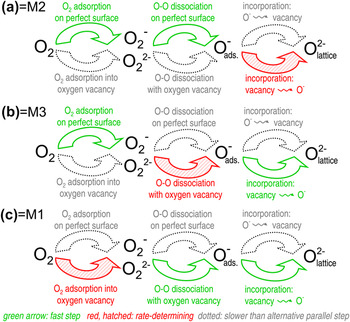
Schematic network of possible reaction steps for the oxygen incorporation into mixed conducting perovskites. (a) Predominant mechanism for perovskites with very low oxygen vacancy concentration such as LSM, =M2 in Fig. 3; (b) for perovskites with high vacancy concentration such as LSCF or BSCF, =M3 in Fig. 3; (c) hypothetical mechanism starting with adsorption into vacancy, =M1 in Fig. 3.

Therefore, the further mechanistic discussion (see Ref. Reference Mastrikov, Merkle, Heifets, Kotomin and Maier10 for more details) will focus on the MnO2(001) termination. As basis for exploring the network of possible reaction steps (Fig. 2), energies of defects and intermediate species as well as relevant reaction and migration barriers were calculated for LaMnO3. While the formation of adsorbed oxygen species is exothermic (by −1.1 eV for O2−, −0.9 eV for O22−, −2.2 eV for 2 O−ad, relative to O2,gas), the negative entropy for the adsorption process and repulsive interaction of charged adsorbates at high coverageReference Fleig, Merkle and Maier38 restrict the estimated adsorbate coverages to <0.01 for O2−, O22− and ≤0.1 for O−ad. Oxygen vacancy formation (according to  ) is easier by ≈1 eV in the MnO2(001) surface layer compared to bulk, corresponding to a much larger
 concentration in the surface layer. The
 migration barrier in the surface layer is lower by 0.3 eV. Dissociation of O22− on the perfect surface has a barrier of 0.6 eV, while after insertion of O22− into a vacancy, dissociation occurs without barrier. Overall rates for different pathways M1–M3 in the reaction network (Fig. 2) can then be estimated as a function of surface vacancy concentration (obtained from measured bulk D*Reference De Souza and Kilner39 and
 Reference Ishigaki, Yamauchi, Kishio, Mizusaki and Fueki23 values for La0.8Sr0.2MnO3 ± δ, and the decreased formation energy in the surface layer) and coverage with adsorbed O2− or O22−, as shown in Fig. 3.
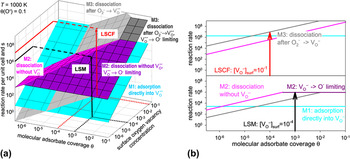
(a) Reaction rates for three alternative reaction pathways of oxygen incorporation on the MnO2(001) surface of LSM (black lines) and LSCF (red lines) estimated based on DFT results. Adapted with permission from Ref. Reference Mastrikov, Merkle, Heifets, Kotomin and Maier10, copyright (2010) American Chemical Society. (b) Two-dimensional projection for surface vacancy concentration of 10−4 (LSM) and 10−1 (LSCF).

Pathway M1 [Fig. 2(c)] starting with oxygen adsorption into a surface vacancy is unfavorable under the relevant conditions due to the low vacancy concentration on the LSM surface (cyan area in Fig. 3). Alternative paths begin with adsorption on the perfect surface. Again due to the low  concentration, the dissociation with assistance of a vacancy [M3, Fig. 2(b)] is unfavorable although the reaction barrier is negligibly small. Thus, path M2 [Fig. 2(a)] with dissociation without
 being involved provides the fastest overall rate. Within this path, either the dissociation is predicted to be rate limiting [at low adsorbate coverage, i.e., very low pO2, pink area in Fig. 3(a)], or the final incorporation step of
 into a surface
 (violet area). Interestingly, the barrier for
 migration along the surface is so high (2 eV, due to an unfavorable transition state with the migrating
 located atop an oxide ion) that it is the surface vacancy, which approaches
 (the actual incorporation then occurs without barrier). For this step being rate determining, the reaction rate is proportional to the product of
 concentration and
 mobility, the latter quantity playing the role of the rate constant (the rate for an individual
 to meet an
 is proportional to D/d 2 where d is the mean distance between
 and O−ad, and D is the diffusion coefficient of
 in the surface layer). The proportionality of the rate to the vacancy concentration [
 ] is straightforward, as long as preceding equilibria do not involve [
 ].
Under the assumption that the reaction and migration barriers do not change drastically, Fig. 3(a) can even be used to “extrapolate” reaction rates to closely related perovskites such as LSCF (the measured bulk vacancy migration barrier around 0.8 eV is similar for LSM and LSCFReference Ishigaki, Yamauchi, Kishio, Mizusaki and Fueki23, Reference De Souza and Kilner39). The vacancy concentration of LSCF is much higher than for LSM as a result of the less negative oxidation enthalpy.Reference Mizusaki, Mima, Yamauchi, Fueki and Tagawa27, Reference Mizusaki, Yoshihiro, Yamauchi and Fueki40 On the other hand, this also leads to lower adsorbate concentrations since enthalpies of adsorption and oxidation—both involving electron transfer from the transition metal to oxygen—are closely coupled (the calculated energy for molecular oxygen adsorption amounts to ≈1/4 and for two  to ≈1/2 of the O2 incorporation energyReference Choi, Lin and Liu41). This is depicted in Fig. 3 by red lines. Owing to the much higher
 concentration for LSCF, path M3 with vacancy-assisted dissociation of O2− or O22− is predicted to become the most favorable, with the encounter of molecular adsorbed oxygen and
 before the dissociation being rate limiting as shown by the light gray area in Fig. 3(a). The encounter of
 and
 for the final incorporation is faster due to the coverage of
 being higher than for molecular adsorbate species. The prediction of higher reaction rates for LSCF compared to LSM in Fig. 3 is in agreement with experiments.Reference Baumann, Fleig, Cristiani, Stuhlhofer, Habermeier and Maier7
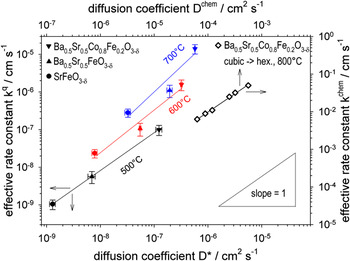
The investigation of BSCF perovskites also yields valuable insight into the oxygen exchange reaction mechanism. Ba0.5Sr0.5Co0.8Fe0.2O3−δ was initially developed for oxygen permeation membranes (i.e., high electronic and ionic conductivity) but then found to exhibit also very fast surface exchange kinetics.Reference Shao and Haile42, Reference Baumann, Fleig, Habermeier and Maier43 A plot of k q (measured by impedance spectroscopy on pore-free films on YSZ) for different cation compositions within the Ba1−xSrxCoyFe1−yO3−δ family versus  concentration yields a clear but nonlinear correlation.Reference Wang, Merkle and Maier8 In contrast to the perovskites of the (La,Sr)(Mn,Fe,Co)O3-δ family, the mobility of
 increases in BSCF with increasing content of Ba and Co. Only, when plotting k q versus
 , an approximately linear correlation is obtained (Fig. 4). For hexagonal Ba0.5Sr0.5Co0.8Fe0.2O3−δ, a lower ionic conductivity than for the cubic phase is expected (based on analogy to the closely related cubic/hexagonal SrCoO3−δReference Deng, Yang, Liu and Chen44). Interestingly, an investigation of oxygen exchange in Ba0.5Sr0.5Co0.8Fe0.2O3−δ during its slow transformation to the hexagonal perovskite phase also yields a linear correlation between k chem (= w O.k q) and D chem (= w O.D*) (open symbols in Fig. 4).Reference Yakovlev, Yoo, Fang and Bouwmeester45 Thus, increasing vacancy concentration and vacancy mobility (
 ) enhance the reaction rate. The latter makes the stronger contribution in the series SrFeO3−δ−Ba0.5Sr0.5FeO3−δ−BSCF (increasing by a factor of 18 at 600 °C from SF to BSCF) than the vacancy concentration, which is already high for SrFeO3−δ to (δ = 0.25) and increases only moderately for BSCF (δ = 0.53). Pronounced differences in oxygen migration barriers in the BSCF perovskites were found also in ab initio calculations.Reference Merkle, Mastrikov, Kotomin, Kuklja and Maier11 Geometrical constraints such as the distance of the migrating O to neighboring cations do not differ significantly. On the other hand, the decrease of the barriers with increasing Ba and Co content—e.g., from 0.72 eV for Ba0.5Sr0.5FeO3−δ to 0.47 eV for Ba0.5Sr0.5Co0.8Fe0.2O3−δ—appears related to the energetic cost for redistributing some electron density from the migrating O to the neighboring transition metal (and thus to decrease its effective size) in the transition state.
Effective rate constant for oxygen exchange on BSCF plotted versus diffusion coefficient. Solid symbols: k q,  from Ref. Reference Wang, Merkle and Maier8, pO2 = 0.2 bar (k q), 0.5 bar (D*). Open symbols: k chem (=w Ok q), D chem (=w OD*) for a Ba0.5Sr0.5Co0.8Fe0.2O3−δ sample, which slowly transforms from cubic to a hexagonal perovskite phase from Ref. Reference Yakovlev, Yoo, Fang and Bouwmeester45, pO2 = 0.33 ↔ 1 bar O2.

The pO2 dependence of k q for BSCF as measured on dense films exhibits slopes m in  in the range of 0.54 for SrFeO3−δ to 0.82 for Ba0.5Sr0.5FeO3−δ.Reference Wang, Merkle and Maier8 The overall pO2 dependence results from the reaction order of adsorbed oxygen species (1 for molecular adsorbate, 1/2 for atomic O resulting from a preceding fast dissociation reaction in quasiequilibrium) and contributions from point defects involved in the rate of the rds such as
 or electrons. Since the exponent of the pO2 dependence of electron and
 concentration is always negative (while its magnitude will depend on the actual material), the defect contributions will decrease the overall pO2 dependence to values lower than the reaction orders of adsorbed oxygen (1 for molecular species, 1/2 for atomic species); therefore, values larger than 1/2 clearly indicate molecular oxygen species such as O2−, O22− are involved in the rds.
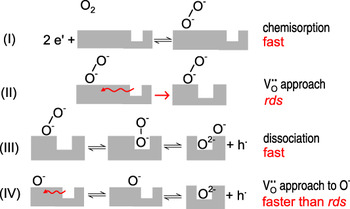
Figure 5 shows a mechanism, which is in accordance with the experimental findings, that  migration as well as molecular oxygen species appear in the rds. Chemisorption is fast on the surface while it would be slower directly into a VÖ (less vacancies available as adsorption site than transition metal ions, and more strict requirements on the orientation of O2 approaching from gas phase). After fast chemisorption (I) on the surface, the rds consists of the approach of an oxygen vacancy to the adsorbed O22− (II). In analogy to the DFT results for LSM, the following dissociation (III) is expected to occur fast with negligible barrier. The approach of another
 to the remaining
 (IV) is faster than the rds due to the larger coverage with
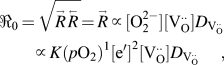
 . The equilibrium exchange rate
 (
 Reference Maier31) for this proposed mechanism is
Scheme of suggested reaction mechanism for BSCF perovskites.

where square brackets indicate concentrations, K is the mass action constant of the chemisorption, and  represents the mobility of the approaching
 . In contrast to LSM, in BSCF, the bulk
 concentration is high and the bulk migration barrier low so that the
 approach to adsorbed oxygen can occur not only by diffusion in the surface layer but also from the bulk. Thus, in contrast to LSCF, it is also plausible that rather
 migrates toward O22− before dissociation and not vice versa. The lowering of the overall pO2 dependence from the upper limit of m = 1 is mainly due to the contribution of electrons in Eq. (1) since the pO2 as well as T-dependence of [
 ] is small. This suggests that probably, the two electrons donated to the adsorbed oxygen are not transferred from (Co,Fe)3+ species (the (Co,Fe)3+ concentration has a comparably small pO2 and T-dependence like [
 ]) but from other electronic states (e.g., (Co,Fe)2+ originating from T- and pO2-dependent disproportionation of Co3+Reference Jung, Misture and Edwards46, Reference Bucher, Sitte, Caraman, Cherepanov, Aksenova and Ananyev47 and/or O deficiency when δ > 0.5). Also the activation energy of k (1.4–1.6 eV for k q of Ba0.5Sr0.5CoyFe1−yO3−δReference Wang, Merkle and Maier8; other literature values 1–1.4 eVReference Shao and Haile42, Reference Burriel, Niedrig, Menesklou, Wagner, Santiso and Ivers-Tiffee48, Reference Bouwmeester, Song, Zhu, Yi, van Sint Annaland and Boukamp49) cannot be due to
 migration (0.5 eV) and oxygen adsorption (probably with an enthalpy close to zero) alone but has a certain contribution from the T-dependent electron concentration.
C. Mechanistic interpretation of the observed k–σion correlation
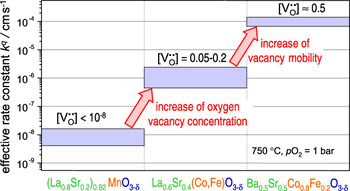
Based on this mechanistic discussion in the previous section, the differences in the exchange rates between LSM, LSCF, and BSCF can largely be interpreted as shown in Fig. 6. The increase from LSM to LSCF is essentially due to the increased vacancy concentration since  are involved in the rds. How far the
 actually migrate in the rds is less relevant as the vacancy mobility at a given temperature is in good approximation independent of cation composition for these perovskites.Reference Ishigaki, Yamauchi, Kishio, Mizusaki and Fueki23, Reference De Souza and Kilner39 The rate increase from LSCF to BSCF is mainly caused by the increased
 mobility as the relative increase in
 concentration is small.
Comparison of effective rate constants k q for oxygen exchange for LSM, LSCF, and BSCF films on YSZ. Data from Refs. Reference Baumann, Fleig, Cristiani, Stuhlhofer, Habermeier and Maier7, Reference Wang, Merkle and Maier8, and Reference Fleig, Kim, Jamnik and Maier14. The vacancy concentration [ ] is given as
 per perovskite formula unit.

Despite some scatter, in the double logarithmic plot of Fig. 1(b), the data points seem to follow a correlation with a slope close to 0.5 in the left part and gather between the dashed lines with slopes close to 1 and 0.5 in the right part. These limiting values of the slopes can be understood on the basis of the underlying mechanisms. The slope close to 0.5 in the left part corresponds to the correlation between k* and D* previously found for (Ln,Sr)(Mn,Fe,Co)O3−δ perovskites.Reference de Souza and Kilner20, Reference Merkle, Maier and Bouwmeester50 (As the DFT results for LSM indicate a higher surface  concentration and mobility than in bulk, the LSM data should appear further right in the plot, but since k* may be underestimated due to experimental limitations,Reference De Souza51 the effects on the slope may largely cancel.) For the perovskites in the left part of Fig. 1(b), the
 mobility is essentially independent of cation composition.Reference Ishigaki, Yamauchi, Kishio, Mizusaki and Fueki23, Reference De Souza and Kilner39 The increase of σion can be ascribed to the increased
 concentration and thus to the oxidation enthalpy ΔH ox (= -
 formation enthalpy) decreasing from manganate to cobaltate perovskites.Reference Merkle, Maier and Bouwmeester50 Parallel to decreasing ΔH ox, the oxygen chemisorption enthalpy decreases,Reference Choi, Lin and Liu41 and the resulting smaller adsorbate coverages will counterbalance a part of the rate increase caused by the increased
 concentration.
The mechanistic interpretation of the k*–D* correlation given in Ref. Reference Merkle, Maier and Bouwmeester50 must be updated in one point: according to the present picture, the rds is not the “dropping” of  into a neighboring
 (this was found to occur without barrier in the DFT results for LSMReference Mastrikov, Merkle, Heifets, Kotomin and Maier10) but the encounter of
 and adsorbed oxygen. What is in common is that
 are involved in the rds, and that the change in
 concentration with changing oxidation enthalpy is the origin of the correlation. The contribution bΔH ox to the activation energy of k*Reference Lee, Kleis, Rossmeisl, Shao-Horn and Morgan50 corresponds to the combined (and partly compensating) effect of ΔH ox on
 concentration and adsorbate coverage, while bΔH ≠ matches with the decreased
 migration barrier in the surface layer (0.5 ≤ b ≤ 0.7, ΔH ≠ =
 migration enthalpy). The correlation between k and the “oxygen p-band center” from DFT suggested in Ref. Reference Lee, Kleis, Rossmeisl, Shao-Horn and Morgan52 is a largely similar finding, as the O p-band center is closely related to ΔH ox. The attempt of rationalizing the trends in ΔH ox in terms of d-electron configuration in Ref. Reference Pavone, Ritzmann and Carter53 seems not really appropriate since it deals with the 2+/3+ redox couple, while the relevant couple under SOFC conditions is 3+/4+ for most materials.
A slope close to 1 as observed in the right part of Fig. 1(b) corresponds to the correlation between k* and σion found for (Ba,Sr)(Fe,Co)O3−δ.Reference Wang, Merkle and Maier8 Such a slope will arise from the general proportionality of k to σion for reaction mechanisms involving  migration in the rds, when the increase of k is mainly due to an increase of
 mobility, i.e., the enthalpy of oxidation remains approximately constant, and thus, the opposing effect of decreasing adsorbate coverage is absent.
Since electronic charge carriers appear in the chemisorption equilibria preceding the rds, the electronic structure (position of Fermi level) can also have some influence. On the other hand, it is expected that for most of the discussed materials, such effects are less significant than the differences in σion, which span a range of 9 orders of magnitude.
Based on these interpretations, the question arises to what limit the surface exchange rates could further be increased. For fast exchange, (i) a high  concentration combined with (ii) chemisorption enthalpies as negative as possible and (iii) a high
 mobility are desired. The first two points are to significant extent coupled to the oxidation enthalpy ΔH ox, a decrease of which will increase [
 ] at the expense of a lower adsorbate coverage. The (molecular) adsorbate coverage might be increased by tuning parameters such as the polarizability or basicity of the cations (although to some extent, they will also be coupled to the oxidation enthalpy). With respect to
 mobility (iii), BSCF appears to be already close to the maximum that can be achieved in perovskites, and the high mobility seems to be related to the Ba/Co size mismatch, which, on the other hand, facilitates unwanted transformation to hexagonal perovskite phases.Reference Merkle, Mastrikov, Kotomin, Kuklja and Maier11, Reference Svarcova, Wiik, Tolchard, Bouwmeester and Grande54, Reference Kuklja, Mastrikov, Jansang and Kotomin55 BSCF has further shortcomings with respect to SOFC operation (see e.g., Ref. Reference Wang, Merkle and Maier8). Another approach could be a combination of two phases being intimately mixed (with grain sizes smaller than in usual perovskite/electrolyte composite cathodes), one fostering oxygen adsorption and the other supplying a high vacancy concentration and mobility for the final incorporation.
Layered double perovskites and perovskite-related Ruddlesden–Popper phases are currently under intensive investigation. Nevertheless, in the vast majority of studies, significantly higher k values than BSCF have not been achieved so far (see e.g., Refs. Reference Tarancon, Skinner, Chater, Hernendez-Ramirez and Kilner56 and Reference Burriel, Garcia, Santiso, Kilner, Chater and Skinner57). A particular feature of the Ruddlesden–Popper phases is that in the ab planes, oxygen diffusion occurs by an interstitialcy mechanism, i.e., not requiring  .Reference Parfitt, Chroneos, Kilner and Grimes58 Interestingly, exchange rates higher than that for the single phases are reported for (La,Sr)CoO3−δ/(La,Sr)2CoO4 ± δ composites and heterostructures.Reference Sase, Yashiro, Sato, Mizusaki, Kawada, Sakai, Horita and Yokokawa59, Reference Crumlin, Mutoro, Ahn, la O’, Leonard, Borisevich, Biegalski, Christen and Shao-Horn60 As another means for improvement, moderate tensile strain (up to few percent) has the potential to accelerate the surface reaction by the effects of increased
 concentration,
 mobility, and adsorbate coverage,Reference la O’, Ahn, Crumlin, Orikasa, Biegalski, Christen and Shao-Horn6, Reference Han and Yildiz61 if the strain can actually be sustained and does not relax, e.g., by formation of higher-dimensional defects.
Finally, one may ask why the surface reaction on mixed conducting perovskites—in the majority of cases discussed here limited by the migration of a (surface) oxygen vacancy—is typically so slow that the subsequent bulk oxygen transport is faster even over a distance of 100 nm (i.e., involving thousands of bulk  jumps). One major reason is that the oxygen incorporation reaction has a strongly negative entropy (loss of translational and rotational degrees of freedom) of typically ΔS 0 ≈ −190 J/mol K per O2 at 1000 K. This value is estimated from ΔS 0 for oxide formation (SrO, BaO, Mn2O3, Fe2O3, Co3O4), and amounts to about 3/4 of the absolute entropy S 0 of gaseous O2; ΔS 0 for oxygen incorporation in La1−xSrxCoO3−δReference Mizusaki, Yoshihiro, Yamauchi and Fueki40 is also comparable. The respective contribution of −TΔS 0 ≈ 1.9 eV to the standard Gibbs enthalpy of reaction ΔG 0 corresponds to a factor of up to 10−10 appearing in the concentration of intermediate species (such as adsorbates) before the rds, which decreases the reaction rate accordingly (this aspect is discussed also in Ref. Reference Adler, Chen and Wilson62). Although chemisorption as fast preceding reaction is in quasiequilibrium, its mass action constant can affect the reaction rate by keeping the concentrations of certain intermediate species low.
IV. CONCLUSIONS
Based on the suggested reaction mechanisms, the trends in the effective rate constants for oxygen surface exchange are interpreted, which span 5 orders of magnitude in k for the mixed conducting acceptor-doped perovskites discussed here. The overall correlation with oxygen ionic conductivity can be regarded as resulting from oxygen vacancies—and in many cases,  migration—being involved in the rds. This interpretation intends to give a rough outline of the fundamental properties governing surface exchange kinetics, rather than to explain all details with high quantitative precision. One has to keep in mind that the “real surfaces” can also be affected by effects from cation segregation (related, e.g., to aging phenomena) and higher-dimensional defects, which are not considered in this interpretation. While the ionic conductivity appears to be the main factor, the electronic structure can also contribute to some extent, e.g., via chemisorption equilibria preceding the rds. For electron-rich acceptor-doped perovskites, a high σion (i.e., high
 concentration and/or mobility) can be utilized as a criterion in the search for SOFC cathode materials, which have to combine fast oxygen exchange kinetics with other requirements such as stability and compatibility (which may also depend on the electrolyte and operation temperature). The identification of materials with good intrinsic electrocatalytic activity is then a reliable starting point for the optimization of the actual cathode morphology, which undoubtedly also strongly affects overall SOFC performance.
ACKNOWLEDGMENTS
The authors thank G. Cristiani, B. Stuhlhofer, S. Schmid for PLD film preparation and microelectrode structuring, and G. Götz for XRD (MPI for Solid State Research, Stuttgart), J. Fleig (Technical University, Vienna), M.M. Kuklja (University of Maryland), and E. Heifets for fruitful discussions. L.W. thanks the Hans L. Merkle-Stiftung im Stifterverband für die Deutsche Wissenschaft for financial support and Y.A.M. was partly supported by EC FP7 NASA-OTM (Grant No. 228701).