It comes as no surprise that governments often pursue economic policies that differ from their official proclamations. Policymakers face short-term incentives to deviate from policy commitments that are otherwise optimal in the long term, including protecting property rights, maintaining free trade, and keeping prices stable. If deviations from official policy become the norm, then government proclamations may seem of little value. However, the disparate actors in any economy depend on signals of the government's economic policy intentions. The government's past behavior provides one such signal, but official proclamations—which are necessarily forward looking, addressing future policy behavior—are another, especially when they are clear and transparent to the public.
Exchange rate policy is one of the most important areas in which governments often deviate from their public declarations. Countries officially declare an exchange rate regime—whether fixed, floating, or somewhere in between—to the International Monetary Fund (IMF) and to their own citizens, and they subsequently decide how their currencies will be valued on the foreign exchange market. For many countries, the official (de jure) policy differs from the actual (de facto) policy. In an oft-cited article, Calvo and Reinhart argue that many countries demonstrate a “fear of floating,” in which policymakers use monetary policy to restrict exchange rate movements even when the currency is officially floating.Footnote 1 On the other hand, scholars have long recognized that countries with officially declared fixed exchange rates often allow their currencies to fluctuate, either in response to speculative attacks or for other politically motivated reasons. The disjunction between de jure policies and exchange rate movements has prompted several economists to develop new measures of exchange rate regimes based on actual behavior.Footnote 2 These new de facto measures have quickly become de rigueur in the literature on the political economy of monetary institutions.Footnote 3 A recent study demonstrates that the empirical literature in political science that employs de jure measures does not hold up when substituting these newly available de facto measures.Footnote 4
In this article, we argue that government proclamations should not be so easily discarded in the study of economic policymaking. The effective communication of policy intentions is essential in monetary policymaking, and a country's official exchange rate regime is one of the most important signals of a government's economic policy preferences.Footnote 5 When a government makes a de jure commitment to a fixed exchange rate, it sends a signal to domestic and international markets of its strict monetary-policy priorities.Footnote 6 In contrast, a government that proclaims a floating exchange rate signals a desire to retain discretion over monetary policy, even if it has implemented a de facto fixed rate. In short, a fixed exchange rate is most effective as a nominal anchor for monetary policy when it is the official and unambiguous policy of the government. The implication of this argument is that words—by way of government proclamations—can be just as important as actions in the forging of monetary policy.
We derive two testable hypotheses from this argument. First, governments that adopt de facto fixed exchange rates will experience lower inflation when they back up their actions with official declarations. Second, governments that abide by their commitments over time will maintain greater inflation-fighting credibility; thus a de jure fixed rate will be associated with lower inflation only when the government has demonstrated a history of following through on its policy proclamations. In countries not a part of the Organisation for Economic Co-operation and Development (OECD), we expect the inflation-fighting power of matching words and actions will be strongest in democratic countries because of their institutionalized mechanisms for accountability. We use data on 110 countries from 1974 to 2004 to test these hypotheses. Results from fixed-effects econometric models provide strong support for our hypotheses.
The article proceeds as follows. In the next section, we discuss the connection between a fixed exchange rate and inflation. We then discuss the divergence between de facto and de jure exchange rate regimes since the 1970s, and develop our argument that official proclamations are consequential for macroeconomic outcomes. After discussing the results from our empirical tests and associated robustness checks, we turn to the implications of the argument for other areas of economic policymaking.
Inflation and the Exchange Rate Regime
The money supply is a powerful policy tool that governments can change at will. A surprise increase in the money supply can lead to short-term gains in economic growth and employment. The unfortunate side-effect of increasing the money supply is inflation, which is widely understood to be detrimental to long-term economic growth and political stability. These trade-offs imply that monetary policy is “time-inconsistent”: governments with short time horizons have incentives to announce a policy of low inflation but subsequently increase the money supply to achieve short-term economic gains.Footnote 7 However, if the government's promise of low inflation is not credible, then private actors in the economy—including those who set wages for employees and prices for goods and services—will anticipate the government's opportunism and adjust their behavior accordingly, resulting in self-fulfilling inflation. Prices throughout the economy will rise, but the government will not realize any gains in economic growth or employment.
To address the time-inconsistency problem in monetary policymaking, governments must credibly commit to low inflation. In other words, private actors in the economy must be confident that the government will use monetary policy solely for the purpose of maintaining stable prices, rather than for short-term political or economic gains. One of the most effective anti-inflation strategies is to announce a quantitative target for monetary policy, such that policymakers' decisions are mechanistic rather than subject to political discretion.Footnote 8 Many governments adopt a fixed exchange rate for precisely this purpose. A fixed exchange rate provides an automatic rule for money policy, since the money supply must adjust to maintain the parity of the exchange rate. Indeed, when capital is internationally mobile, a fixed exchange rate implies a complete loss of domestic monetary policy autonomy. Countries generally fix their currency to that of a stable currency, such as the U.S. dollar or euro, and thereby import the credibility of that currency.Footnote 9 A country that fixes to the dollar, for example, essentially matches the monetary policy of the U.S. Federal Reserve.Footnote 10 Any deviations in interest rates from those of the anchor currency are immediately arbitraged away.
As a monetary commitment device, a fixed exchange rate has three main advantages. First, it is transparent: the public can monitor day-to-day fluctuations in the currency to see if the government is upholding its commitment.Footnote 11 The public can therefore hold the government directly accountable if it abandons its exchange rate target. As Broz notes, “When governments shoulder direct responsibility for a transparent exchange-rate commitment, they pay political costs when the commitment is broken.”Footnote 12 Second, a fixed exchange rate is a nominal anchor—a numeric variable that serves as a target for monetary policy. Such quantitative targets remove political discretion from the conduct of monetary policy and provide a well-defined rule for adjusting the money supply. Finally, a fixed exchange rate requires only minimal domestic financial infrastructure and human resources. A poor country with little expertise in central banking will find it administratively easier to adopt a fixed exchange rate than to conduct an autonomous monetary policy.Footnote 13
The inflation-fighting impact of a fixed exchange rate arises from its ability to anchor the public's expectations of future monetary-policy adjustments.Footnote 14 However, fixed exchange rates are not all created equal. Some countries will actively limit exchange rate movements without declaring a fixed exchange rate. For example, at various points throughout the 1980s and 1990s, countries such as Belgium, China, El Salvador, Lebanon, Hong Kong, and Mexico implemented exchange rates that were more rigid than their officially declared regimes. This phenomenon naturally raises the question, are official exchange rate regimes an important determinant of inflation outcomes, or can governments obtain the same outcomes by limiting exchange rate movements without making a public commitment? More generally, what are the consequences of a discrepancy between words and actions?
Words Versus Actions in Exchange Rate Policy
Since the beginning of the postwar period, the IMF has required member countries to make official announcements of their exchange rate regimes. Article IV, Section 2, of the IMF's Articles of Agreement grants the IMF the responsibility for exercising “firm surveillance” over the exchange rate policies of members, which it has used to publish its Annual Report on Exchange Rate Arrangements and Exchange Restrictions. Ironically, the IMF's surveillance has, until recently, entailed no evaluation of the accuracy of members' declarations.Footnote 15 This practice is most likely due to the original wording of Section 2, which states that member countries must report the regime that they intend to apply in fulfillment of their international monetary obligations.
The number of countries that officially declare fixed exchange rates has varied considerably over the years. From the founding of the IMF through the early 1970s, countries generally pegged their exchange rates to the U.S. dollar, which itself was fixed to the price of gold at $35 per ounce. After the collapse of the Bretton Woods monetary system, countries adopted a range of exchange rate strategies, including fixing unilaterally to a relatively stable currency—such as the dollar, French franc, or deutsche mark—and allowing their currencies to float, often within predetermined bounds. In 1975, only eight countries had officially declared freely floating rates; all other countries adopted more rigid regimes.Footnote 16 By 1995, the number of countries with de jure freely floating rates had increased to forty-two. As of 2004, there were thirty-four countries with de jure freely floating rates and eighty-six countries with fixed rates, with the remaining countries classifying themselves as somewhere in between.Footnote 17
Upon examining the actual behavior of exchange rates rather than government proclamations, the data look remarkably different. Based on data for de facto exchange rate regimes (discussed later), only Germany's exchange rate demonstrated enough flexibility to be classified as floating in 1975. By 1995, the number of de facto free floaters increased to seven—far shy of the forty-two countries with de jure freely floating regimes. As of 2004, there were fifteen countries with de facto freely floating regimes. The discrepancy is also evident in the opposite direction: there are many countries that declare a fixed exchange rate but allow full or partial flexibility. Figure 1 shows the number of country-year observations in our dataset from 1974 to 2004 that fall into four categories based on de jure and de facto policies. More than half of all declared floats and almost a quarter of all announced fixes conflict with actual exchange rate outcomes. Indeed, nearly all countries have, at one point or another implemented a different exchange rate regime from the officially declared regime.
Global sample classifcation (by percentage) of de facto versus de jure exchange rate regimes, 1974–2004
Notes: Solid lines refer to “supported” regimes in which the official and actual regimes are the same. Dotted lines refer to “defection” in which there is a discrepency between official and actual regimes.
Source: Reinhart and Rogoff Reference Reinhart and Rogoff2004; Eichengreen and Razo-Garcia Reference Eichengreen and Razo-Garcia2006; and IMF (multiple years).

This discrepancy between words and actions in exchange rates has emerged as an important puzzle for economists and political scientists. In a recent paper, Alesina and Wagner argue that countries with poor institutional quality—including high levels of corruption and weak protection of property rights—are more likely to allow their currencies to fluctuate under de jure fixed regimes, because they lack the ability to maintain macroeconomic stability in the absence of domestic monetary-policy adjustment.Footnote 18 In contrast, they argue that stronger institutions are associated with exchange rate rigidity under de jure floating regimes, as governments attempt to signal macroeconomic rigor and raise their credibility. Calvo and Reinhart offer a different explanation for the “fear of floating” phenomenon, namely that governments wish to reduce the risk premia on foreign borrowing associated with exchange rate instability.Footnote 19
The trade-offs involved in the choice of exchange rate regime can in part explain why countries often implement a different regime from the officially declared regime.Footnote 20 When capital is internationally mobile, a fixed exchange requires the government to forgo the use of monetary policy to respond to exogenous shocks to the domestic economy. For example, the U.S. government's decision in 1971 to remove the link between the dollar and gold is often attributed to President Richard Nixon's desire to prime the economy in advance of the 1972 election. Nixon's decision required changing the official exchange rate policy, but many countries—including Egypt, Finland, Jordan, and Norway—have granted themselves a degree of domestic monetary flexibility without changing their de jure exchange rate targets. For developing countries, any slippage between public commitments and actual exchange rate movements can be disastrous; indeed, in an environment of mobile capital, countries that officially declare a fixed exchange rate are more prone to speculative currency attacks.Footnote 21 Governments that desire the additional benefits of exchange rate stability—including stabilizing the value of debt-service payments on foreign-currency liabilities and avoiding import-related inflationary shocks due to currency depreciation—might be better served by ad hoc limiting exchange rate movements, rather than incurring the risks of declaring an official exchange rate target.
Official Declarations and Inflation
Our analysis focuses on the macroeconomic consequences of the slippage between the government's words and actions in exchange rate policy. We argue that a government's attempt to keep prices stable by implementing a fixed exchange rate is less effective if it does not declare an official exchange rate target. Our argument is similar to the existing literature in that it hinges on the difficulty that the public faces in determining the government's monetary policy preferences. As Canavan and Tommasi note, “the public is unsure of the government's true preferences, and may have a strong prior suspicion that the government is unwilling or incapable of halting inflation.”Footnote 22 However, we part company with prior scholarship by contrasting the effectiveness of de facto and de jure signals of the government's preferences and intentions.
Canavan and Tommasi and Herrendorf, among others, have argued that exchange rate targets are transparent and completely controllable by the government, and therefore serve as signals of a government's anti-inflation stance.Footnote 23 Our argument does not dispute this premise; on the contrary, it builds on the notion of government signaling. Scholars tend to compare the anti-inflationary impact of de facto pegging to more opaque targets such as the money supply and nominal interest rates, or to discretionary monetary policy within an independent central bank.Footnote 24 Compared to these alternatives, de facto pegging clearly has many advantages in helping governments overcome the time-inconsistency problem. However, it is important to consider the quality of the signal that a government sends to the public by adopting a de facto peg. The public can easily monitor fluctuations in the exchange rate, but it is uncertain as to whether the peg reflects a conscious attempt by the government to import the low-inflation credibility of another currency. The ability to monitor exchange rate outcomes is not the same as the ability to ascertain the government's intentions. Governments may limit exchange rate movements for a variety of reasons, including stabilizing the value of debt-service obligations on foreign-currency bonds, easing international trade, and minimizing the influence of currency fluctuations on domestic prices.Footnote 25 Governments that de facto peg may not even deliberately target the exchange rate; indeed, exchange rate stability may be an externality that arises when two countries adopt similar monetary policies due to high levels of economic integration, as with Switzerland and Germany throughout the 1980s.Footnote 26 In short, a de facto peg provides a relatively noisy signal to the public—albeit a cleaner signal than many of the opaque alternatives suggested in the literature.
On the other hand, a de facto peg backed by an official proclamation of the exchange rate target sends a stronger signal to the public of the government's commitment to contain inflation. The declaration itself is consequential, as the public can monitor the government's commitment and hold it accountable if it reneges. In contrast, it is not possible for a government to “renege” on a de facto outcome if its behavior is in line with de jure policy. An additional benefit of a de jure peg is also a cost: as discussed earlier, official exchange rate targets increase the likelihood of speculative currency attacks.Footnote 27 As a result, government proclamations on exchange rate policy are not “cheap talk.” The combination of a de facto and a de jure peg—what can be labeled a “supported” de jure fix—should therefore provide the strongest signal to the public of the government's commitment to maintain stable prices.
We present preliminary evidence of our argument in Figure 2, which shows a simple plot of average annual inflation rates (logged) of supported de facto fixed exchange rate regimes compared to de facto only fixed exchange rate regimes. The figure shows that even when a government maintains a de facto fixed exchange rate year after year, inflation will be higher than if the government's actions are supported by a de jure fixed exchange rate.
Comparison of annual average consumer price inflation rates (1970–2004) by type of fixed exchange rate regime
Source: Reinhart and Rogoff Reference Reinhart and Rogoff2004; Eichengreen and Razo-Garcia Reference Eichengreen and Razo-Garcia2006; IMF (multiple years); and World Bank 2007.

The preceding discussion suggests two sets of observable implications. First, a de facto fixed exchange rate regime in isolation is a noisy signal of a government's monetary policy intentions. A de jure fixed exchange rate, on the other hand, is a cleaner signal of the government's strict monetary policy priorities. Countries that implement a fixed exchange rate will therefore experience less inflation when they support their actions with a de jure exchange rate target.
Second, the effectiveness of the signal sent by announcing a de jure fixed exchange rate depends in part on a country's reputation for following through on previous commitments to a fixed exchange rate. Exchange rate policy will be most successful in anchoring the public's inflation expectations when governments consistently follow through—year after year—on their official proclamations. In light of the politically salient trade-offs inherent in exchange rate policy, the public at large will constantly monitor the government's actions and adjust their expectations accordingly.
Empirical Analyses
As signals of governments' intended and actual monetary policy, de jure and de facto exchange rate regimes should directly influence the market's expectation of future inflation rates. Matching de jure announcements to de facto policies not only provides an immediate signal to market actors concerned with the upcoming round of price setting but also offers markets a measure of a country's reputation for keeping exchange rate commitments over time. We therefore provide two sets of analyses: Analysis 1 focuses on the short-term (one-year) effects of matching a de facto fix with a de jure fix, and Analysis 2 focuses on a longer-term (three-year) horizon in which countries either maintain or lose a reputation for keeping their monetary policy commitments. We test these hypotheses on a dataset of 110 developed and developing countries from 1974 to 2004 using an estimation method that accounts for both the potential for a country-specific intercept and serial autocorrelation.
In each analysis, the annual average consumer price inflation rate serves as the primary dependent variable.Footnote 28 The use of an inflation measure creates two related theoretical and empirical concerns: how to deal with incidents of negative inflation and how to compensate for outliers. Although negative or low inflation rates have recently reemerged as a concern, our theoretical discussion of monetary policy commitments centers on preventing high levels of inflation.Footnote 29 Therefore we explicitly focus on the positive observations of inflation, which constitute over 95 percent of the sample's consumer price inflation rate observations. Excluding negative inflation rate observations simplifies the treatment of outliers. While the mean inflation over the sample period is in the single digits (8.4 percent), almost 4 percent of observations exceed three digits. As is common, we constrain the influence of such outliers by logging inflation rates.Footnote 30 As a robustness check, we implement an alternative depreciation-based mechanism suggested by Cukierman and his colleagues.Footnote 31 The results are briefly noted with other robustness checks.
The main independent variables are based on classifications of countries' de jure and de facto exchange rate regimes. Since 1974, the IMF has published a summary of countries' de jure exchange rate policies in its Annual Report on Exchange Rate Arrangements and Exchange Restrictions.Footnote 32 For our analysis, we focus on a simple distinction between fixed and floating. “Fixed” encompasses pre-announced policies that limit flexibility: no separate legal tender, pegs or currency board arrangements, crawling pegs, and narrow crawling bands (narrower than or equal to +/− 2 percent). “Floating” includes both “managed floats” in which central banks may intervene to avoid excessive volatility in exchange rates, possibly by setting wide crawling bands (wider than +/− 2 percent), and pure floats with no direct intervention. In 1999, the IMF moved from a classification system based solely on countries' stated intentions to a classification system that incorporates IMF analysts' judgment on the actual regime, noting in footnotes perceived de facto discrepancies from de jure policies. For observations from 1999 to 2004, where discrepancies were noted, we used the detailed text from the country pages to code de jure policy. As noted below, we undertake a robustness check to ensure that our post-1998 coding does not affect our results.
To code de facto exchange rate regimes, Reinhart and Rogoff use parallel market exchange rates, foreign reserve movements, and detailed country chronologies.Footnote 33 From 1974 to 2001, they classify exchange rate regime choices made by 153 countries into a fine-grained 15-point scale, which is then categorized into a coarse 5-point scale. We discard observations that are classified as “freely falling” (including episodes of currency crises and hyperinflation) and those for which parallel market data are missing. We then code the remaining observations as “fixed” (pegs and limited flexibility) or “floating” (managed float and free floating). Additionally, we expand the dataset by appending Eichengreen and Razo-Garcia's version of the datasetFootnote 34 for the years 2002 to 2004. Policy variables are lagged one period to account for the market's inability to react immediately to exchange rate signals (for example, many wage contracts are renegotiated only once per year).
We include a number of control variables in the analyses. Broz argues that central bank independence is effective at controlling inflation in transparent political systems.Footnote 35 We use a dichotomous measure of central bank independence developed from Cukierman by McNamara and Castro, and the measure of democracy to measure transparency developed by Alvarez and colleagues, and include the interaction of the two variables.Footnote 36 Given that increased inflation rates may be associated with political disturbances,Footnote 37 we also include a variable for political crises, coded 1 if a country has had one or more political crises in the past five years (based on the Political Instability Task Force database of Adverse Regime Changes).Footnote 38 Additionally, we control for economic growth, gross domestic product (GDP) per capita, and the share of trade in GDP.Footnote 39 Both GDP per capita and trade openness are logged to account for outliers. We also include a measure of capital account openness from Chinn and Ito.Footnote 40 Decade dummies account for historical, worldwide trends in inflation rates.
We report results from fixed-effects estimation models with robust standard errors clustered by country. By calculating a “unit-specific” or “idiosyncratic” error term, the fixed-effects estimator controls for unobserved unit heterogeneity but does so at a triple cost: the loss of efficiency in the calculation of standard errors, the danger of excluding time-invariant or rarely changing variables, and the artifice of out-of-sample predictions.Footnote 41 We should note that two alternative strategies were considered and rejected. First, scholars frequently prefer the more efficient random-effects model for pooled time-series cross-sectional data, but this model assumes that the regressors are uncorrelated with unit-specific effects. When this assumption is not met, bias may emerge in the estimation of coefficients. Despite similarities in the coefficients of the policy variables of interest estimated by both the fixed- and random-effects methods, a test using the artificial regression approach found evidence to reject the null hypothesis that the regressors and unit-effects were uncorrelated.Footnote 42 Second, Plümper and Troeger propose a new technique for estimating panel data models that include time-invariant or rarely changing variables in the presence of unit fixed effects.Footnote 43 While many of the variables included in our model of inflation are in fact “sluggish,” none is truly time-invariant and all have a ratio of between- and within-variances that fall below the authors' suggested threshold for preferring their vector decomposition model over the more traditional fixed-effects model. In the presentation of the fixed-effects findings, we use an “average” country for illustrative effects.
Analysis 1: Does de jure Fixing Matter for Inflation?
Table 1 presents the results of an analysis of de jure and de facto exchange rate regimes (lagged one year) on consumer prices. The two dummy variables (de jure fix and de facto fix) combined with their interaction capture all four possible policy combinations: de jure and de facto floating, de jure and de facto fixing, de facto fixing with de jure floating (so-called fear of floating), and de facto floating with de jure fixing. The interaction term allows for the estimation of the additional inflation-fighting benefits accrued by countries that both proclaim and support a fixed exchange rate regime.
Analysis of the effect of de jure and de facto regimes on annual average consumer price inflation rates (1975–2004)

Notes: Robust, clustered standard errors in parentheses.
*** p < .01;
** p < .05;
* p < .1. constant represents the average value of the fixed effects.
To address the problem of serial autocorrelation, we use a two-year lagged dependent variable. In the presence of the other one-year lagged policy variables, this modeling strategy ensures that the lagged dependent variable is itself not a manifestation of de jure and de facto policy.Footnote 44 The combination of a fixed-effects estimator with a lagged dependent variable creates a very stringent test for the significance of the policy variables.Footnote 45
The positive coefficient on the de facto fix variable indicates that a de facto fixed exchange rate by itself is not associated with lower inflation. This result suggests that de facto fixing alone does not serve as an effective signal of the government's overall commitment to low inflation. Instead, we find that only countries that support their de facto fixed exchange rate regimes with de jure pronouncements receive the benefit of inflation control. Because of the nonlinear nature of logs, the magnitude of the impact of regime choice on inflation rates depends on assumptions about the other variables. Assuming a democratic country without political crises, an independent central bank, and average wealth, GDP growth, capital account openness, and trade, the predicted inflation rate for a country with a combined de jure and de facto fix is 6.6 percent. In contrast, the predicted inflation for a country that exhibits “fear of floating” (a de facto fix with a de jure float) is 8.4 percent, or more than 27 percent higher. In other words, a proclamation of a fixed exchange rate regime is a necessary condition for the inflation-fighting effectiveness of a de facto fix. Analysis 2 further explores the credibility of de jure signals.
The results for the other variables are in line with the extant literature. As argued by Broz, independent central banks lead to lower rates of inflation but only within a democratic environment.Footnote 46 As would be expected from the increased demand on money supply, GDP growth is positively associated with inflation, although the size of the effect is small. Also as expected, wealthier countries with more open capital accounts benefit from lower inflation rates. With the exception of the central banking finding, results on these variables of interest are significant.
Analysis 2: Does Reputation Matter?
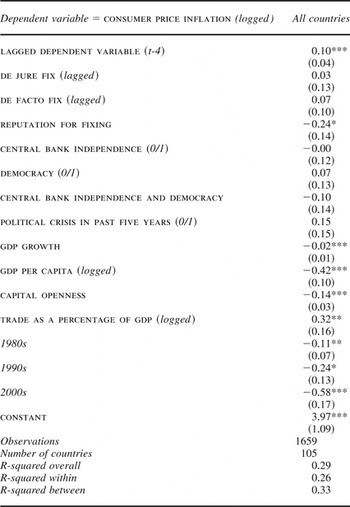
Analysis 1 demonstrates that a de jure signal is a necessary component of an inflation-fighting monetary regime; a de facto fix alone is not associated with lower inflation rates. But the question remains: does the value of a de jure signal vary across countries depending on their reputation for matching actions with words? In Analysis 2, we model a country's history for matching its public commitment to a fixed exchange rate with actual behavior. To simplify the analysis, we assume that markets take note of defections from de jure commitments, such that countries can lose their reputation for credible monetary policymaking over time. We construct a measure called reputation for fixing based on the percentage of de jure fixes not matched by de facto fixes over the prior three years.Footnote 47 For example, a country that defected on its declared fixed exchange rate in one of the previous three years would receive a score of 66 percent.Footnote 48 Countries with de jure floating exchange rates or countries that have not followed through at all on their de jure fix commitments over the prior three years receive a score of zero. As with Analysis 1, we include a lagged dependent variable to account for serial autocorrelation. However, because the key explanatory variable (reputation) has an inherent three-year lag structure, we use a four-year lagged dependent variable to ensure that it itself is not a manifestation of reputation.
Table 2 presents the results for the reputation measure. The three-year reputation period reduces the time period under analysis to 1976–2004. The coefficients for a de jure fix or de facto fix alone are not significant. Instead, the efficacy of a de jure fix appears contingent on a reputation for supporting proclamations with de facto policy: reputation for fixing has a significant and substantial negative coefficient (−.24). Again, interpretation of the logged point estimates is not straightforward, especially for interaction terms. Let us assume a democratic country without political crises and an independent central bank and with average wealth, GDP growth, capital account openness and trade openness. Such a country announcing a de jure fix with an unsullied reputation for keeping commitments to a fixed exchange rate regime (reputation for fixing = 1) benefits from a predicted 1.6 percentage point lower inflation rate compared to a country with a poor reputation for keeping de jure fix commitments (reputation for fixing = 0).
Analysis of reputation for fixing on annual average consumer price inflation rates (1976–2004)

Notes: Robust, clustered standard errors in parentheses.
*** p < .01;
** p < .05;
* p < .1. constant represents the average value of the fixed effects.
Although the prior analysis demonstrates that reputation matters when countries announce a de jure fix, the extent of this effect may be conditional on a country's institutions of accountability.Footnote 49 As we discussed, the success of de jure signals depends on the susceptibility of governments to punishment for defections from their commitments. One of the primary advantages of a fixed exchange rate is that its transparency enables the public to detect deviations from government promises. But what happens when the public becomes aware of a broken promise? Presumably a country's citizens will attempt to hold political leaders accountable for their actions. It is reasonable to assume that the mechanisms of accountability are more effective in democracies than in nondemocracies. As Fearon notes, “In democracies, foreign policy is made by an agent on behalf of principals (voters) who have the power to sanction the agent electorally or through the workings of public opinion. By contrast, in authoritarian states the principals often conduct foreign policy themselves.”Footnote 50 We should therefore expect that de jure policy is a more effective signal of government intent in democracies than in nondemocracies.
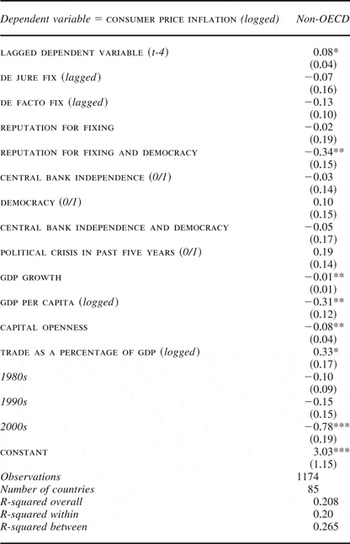
To test this hypothesis, we interact our measure of reputation with a measure of democracy from Alvarez and colleagues. To isolate the impact of democracy on the nexus between exchange rate regimes and inflation, we run the analysis on a subsample that includes only non-OECD countries. The truncated sample assures us that the results are not driven by the (highly democratic) OECD countries, which have traditionally faced less severe inflationary problems than developing countries. Table 3 presents results for non-OECD countries only (Analysis 2b). As expected, the interaction of democracy and reputation is associated with a large and significant decrease in predicted inflation rates.
Analysis of the joint effect of democracy and reputation on annual average consumer price inflation rates (1977–2004) in non-OECD countries

Notes: Robust, clustered standard errors in parentheses.
*** p < .01;
** p < .05;
* p < .1. constant represents the average value of the fixed effects.
To clarify the effect, Figure 3 depicts average inflation rates contingent on democratic institutions and reputation.Footnote 51 At reputation for fixing = 0, a country has defected from a de jure fix in all three prior periods. At reputation for fixing = 1, a country has consistently supported its commitments in the prior three years. For the intermediate reputations, we assume that at least one defection occurs in the previous year (t-1). For democracies, the difference between an unsullied and sullied reputation is an approximate 3.4 percentage point lower average annual inflation rate. Nondemocracies demonstrate only a gradual benefit from matching words and actions, with the largest impact—an approximate 1.3 percentage point decrease—occurring primarily as a result of the prior year's policies.
Comparison of predicted inflation rates for non-OECD de jure fixers
Notes: For the purpose of the comparison, we assume that both hypothetical countries are characterized by a lack of political crises; an independent central bank; average wealth, GDP growth, capital control openness and trade; and with the exception of when “Reputation for Fixing” = 1, a de facto float in t −1.
*In time period t −1 to t −3.

These results support the notion that democracies are better able than nondemocracies to signal their intentions to keep prices stable. One possible interpretation of this finding is that democracies are more subject to domestic pressure for monetary policy discretion than nondemocracies, and therefore a consistently maintained fixed exchange rate is an especially costly signal for democracies.Footnote 52 This explanation is also consistent with Tomz, who notes that investors (and by extension wage-setters and consumers) learn from “behavior in context.”Footnote 53 If democracies would normally be expected to acquiesce to political pressure and allow the exchange rate to float, then they will receive a substantial inflation-fighting benefit by going against their “type” and fixing their exchange rate.
Robustness
As noted, the empirical analyses require a number of modeling assumptions. Here we explore alternative versions of the dependent variable, possible bias in coding de jure exchange rates, the inclusion of additional variables, an extended time frame for reputation, and an alternative modeling strategy for serial correlation. Additionally, we offer a simple exploration of the direction of causality.
First, we explore an alternative to the log of the annual rate of consumer price inflation as the dependent variable. Cukierman and his colleagues argue that the rate of depreciation in the real value of money more closely approximates relative changes as perceived by consumers.Footnote 54 We therefore transform the dependent variable using the Cukierman transformation, D = F/(1 + F), where F is the average yearly rate of inflation. This transformation substantially increases the significance of the variables of interest (the lagged variable de jure fix and de facto fix and reputation for fixing, respectively) in Analysis 1 and 2a. In Analysis 2b, the variables reputation for fixing and the interaction of reputation for fixing and democracy are negative and jointly significant.
On theoretical grounds, we initially excluded country-year observations with negative annual rates of inflation. A fixed exchange rate should theoretically help lower inflation toward but not below 0 percent, therefore precluding a simple linear relationship between the independent variables and the annual inflation rate in the full sample with negative values included. Recent economic history has led Bernanke (among others) to note the symmetrical risks of too low levels of inflation, suggesting that countries should try to avoid both high and low (or negative) levels of inflation.Footnote 55 To ensure that excluding negative observations did not bias the results, we include these country years but transform negative values to positive values in line with the theory of symmetric risks.Footnote 56 In Analysis 1 and 2a, the addition of these country-year observations slightly increases the sizes of the coefficients and the significance of the key variables of interest. In Analysis 2b, the addition decreases the size of the coefficient on the interaction of reputation for fixing and democracy by one-sixth but the finding is jointly significant with reputation for fixing at the 0.05 level. In short, the exclusion of negative observations does not drive the results.
In 1999, the IMF adjusted its presentation of exchange rate regimes from de jure to de facto policy (as calculated by IMF analysts), noting deviations via annotations and textual discussion. Thus, de jure policy post-1998 was hand-coded by the authors based on the IMF country summaries. Excluding post-1998 observations does not substantially change the results presented in Analysis 1 or 2b. For Analysis 2, the coefficient on reputation for fixing falls below conventional levels of significance. In the case of de facto calculations of exchange rate policy, we appended Eichengreen and Razo-Garcia's version of the datasetFootnote 57 for the years 2002 to 2004, to the original Reinhart and Rogoff dataset. The exclusion of this data from the analysis results in no substantial change in terms of the point estimates or significance of the policy variables of interest.
We also ensure that our results are robust to the inclusion of two additional control variables. First, stabilization programs administered by the IMF might help control inflation rates. We therefore include a control variable for the presence of an IMF agreement. Second, governments with a large number of veto players might find it more difficult to pursue inflationary policies for political purposes, such as to prime the economy in advance of an election. We include the log of veto players (the checks variable from the Database of Political Institutions) to control for this possibility.Footnote 58 Our results are substantively and statistically unchanged with the inclusion of the IMF variable. In one case (Analysis 2), the inclusion of veto players—which due to data availability results in an approximate 13 percent drop in the number of observations—causes the significance to fall below the conventional threshold.
The reputation measure captured only the most recent defections from an announcement of a fixed exchange rate (t-1 to t-3). Expanding the reputation period to five years further decreases the sample's time frame to 1979 to 2004 and leads to the loss of seven countries and between 14 percent and 17 percent of the observations. However, use of this expanded reputation measure leads to substantially larger and more significant coefficients for the policy variables of interest.Footnote 59
The inclusion of a lagged dependent variable to control for serial correlation provides a high hurdle when used in conjunction with a fixed-effects estimator but offers greater flexibility in structuring the lag periods. The lesser used ARCH family models also allow for the selection of longer lag periods. Use of the ARCH model with an AR(2) process in Analysis 1 and an AR(4) process with Analysis 2 resulted in no substantial change in terms of the point estimates or significance of the policy variables of interest.
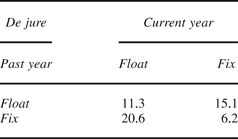
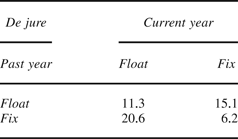
An alternative explanation for the apparent correlation between de jure fixed exchange rate regime and lower inflation is that the policy follows rather than accounts for lower inflation: governments make de jure commitments only when inflation is under control. Simple descriptive statistics fail to support such a contention. Table 4 provides the average annual consumer inflation rate according to past and present policies. Countries that choose to transition from a de jure float to a de jure fix (the shaded upper-right-hand box) do so in the face of higher average rates of inflation than those continuing with a de jure fix.Footnote 60 This selection process would make it less rather than more likely to see lower inflation rates among de jure fixers in subsequent years, a bias that works against our findings.
Annual average consumer price inflation by current and past policy
Conclusion
The behavior of individuals in any economy depends on expectations of government policy. If economic actors believe that the government is not fully committed to price stability, then they will behave as if prices will rise, and inflation will be self-fulfilling. Scholars have long recognized that countries can commit to fixing the exchange rate—which constitutes a “nominal anchor” for monetary policy—as a strategy for anchoring inflation expectations. However, the recent availability of data on de facto exchange rate regimes has called into question the value of government proclamations. Indeed, the divergence between de jure and de facto policies is often striking. Why should scholars pay any attention to the government's official policy if it often differs from actual policy? This article offers an answer. Official proclamations are indeed influential as a signal of the government's monetary-policy preferences. Our results demonstrate that countries experience the greatest inflation-fighting effect when they match their actual fixed exchange rate behavior with their official proclamations.
This article also offers a new perspective on the influence of democratic accountability on the efficacy of exchange rate policy. Among developing countries, democracies garner a greater benefit from matching words and actions than nondemocracies. This finding sits uncomfortably with the results from Broz,Footnote 61 who argues that nondemocracies benefit from the transparency of a fixed exchange rate. If supported fixed exchange rates have a negligible impact on inflation in nondemocracies, why would autocratic leaders adopt them? One possibility is that they are simply more effective than the alternatives, including central bank independence—which Broz notes is unlikely to be meaningful in “opaque” political systems.Footnote 62 Another possibility is that autocracies choose fixed exchange rates for other reasons, such as to facilitate international trade and investment and appease domestic business leaders.Footnote 63 More research is clearly needed to tease out the relationship between democracy and exchange rate politics.
A broader implication of this study is that scholars should be thoughtful about whether to use official or de facto measures in their research. It is no doubt tempting to discard official proclamations when actual state behavior can be measured and studied. Yet official proclamations are indeed policy, whereas government behavior can be considered implementation. In the case of exchange rate regimes, de facto exchange rate rigidity may not represent a deliberate strategy of the government. As Genberg and Swoboda note, a country such as Switzerland with a de jure floating regime appears to have a fixed exchange rate vis-à-vis the Euro simply because the Swiss economy is heavily integrated with the countries in the European Monetary Union.Footnote 64 Swiss monetary policy therefore resembles the policies of the European Central Bank, with the result being an inadvertent degree of fixity between the Swiss franc and the Euro. This de facto behavior should not distract researchers from the fact that official Swiss policy is to allow the currency to float. In short, the newly available datasets on de facto policy are a valuable resource that should be used with caution, lest scholars ignore the very policy decisions that they wish to explain.